
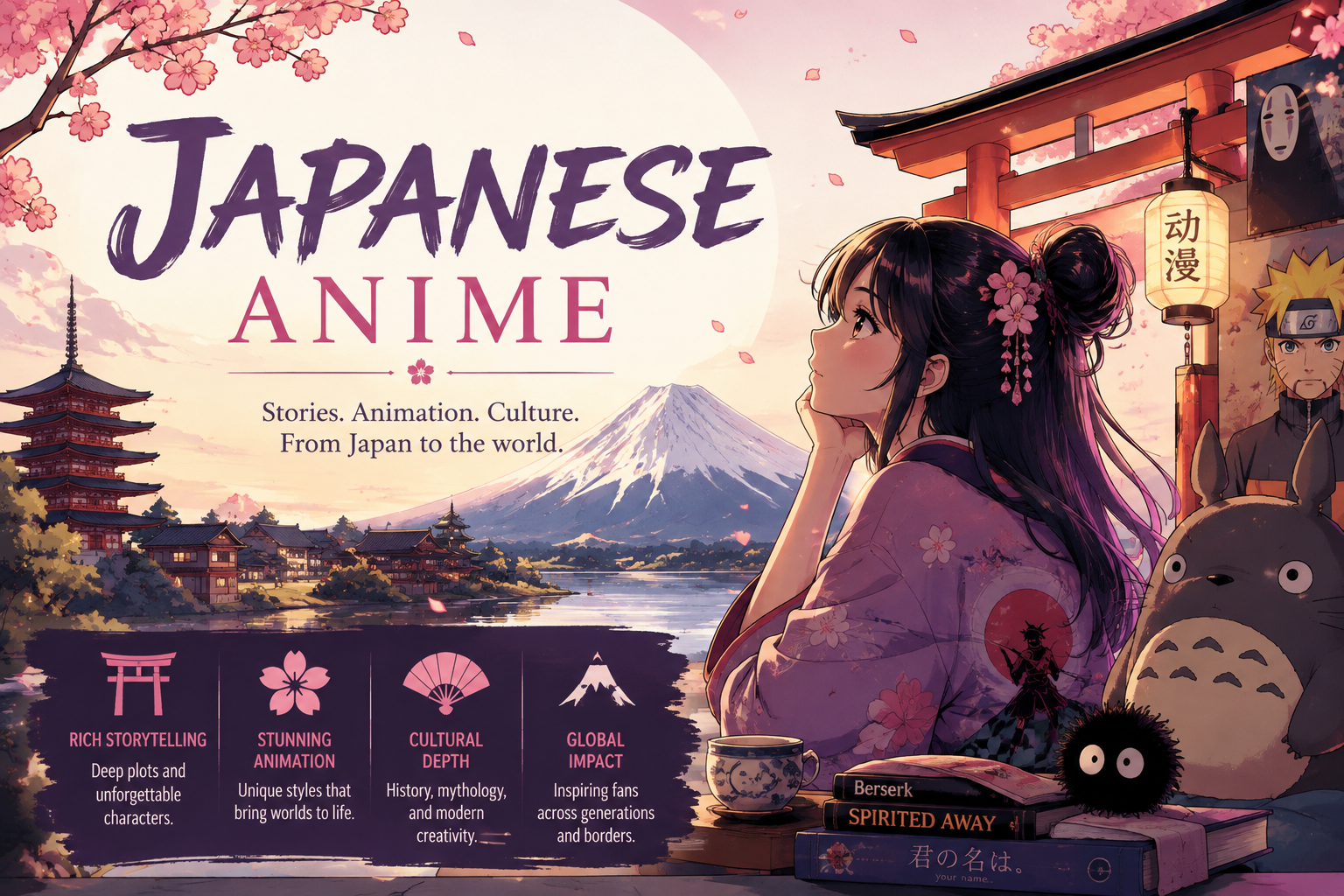
Japanese Anime
Japanese animation is much larger than one visual style, one age group, or one genre. The medium includes weekly television series, theatrical films, direct-to-video productions, internet releases, children’s programming, experimental animation, romance, horror, sports, comedy, fantasy, science fiction, historical drama, and stories that would become substantially less interesting if we tried to force them into one neat box.
This page stays focused on animation from Japan: the series and films, episode reactions and reviews, voice performers, publishing traditions, production structures, broadcast systems, release formats, and history that shaped Japanese anime into the enormous media ecosystem fans know today.
What is Japanese animation?
In English-language fandom, anime generally refers to animation produced in Japan. Inside Japan, the word comes from “animation” and can be used more broadly, which means the narrower international definition is partly something that developed as Japanese animation traveled overseas. That international usage is still useful because Japanese animation grew through a specific collection of studios, broadcasters, publishers, filmmakers, performers, distributors, technologies, and commercial systems that shaped how the medium developed.
The mistake happens when “anime” quietly becomes a genre. Battle anime gets treated like the definition because those series traveled well internationally. School romance becomes another shortcut. Then somebody discovers a slow historical drama, a devastating war movie, a children’s fantasy, an adult workplace comedy, or a strange experimental short and acts surprised that the work also counts. The surprise comes from the stereotype, not the medium. Anime is animation. The individual work still has to decide whether the story wants to be horror, romance, comedy, science fiction, sports drama, family film, political thriller, or whatever else somebody convinced a production team to make.
Japanese animation is also deeply connected to other media without being interchangeable with them. Manga and light novels provide source material for many adaptations, while games, novels, web fiction, toys, music projects, and original concepts can also become anime. Once a project crosses into animation, the story has to be rebuilt for a medium that controls movement, time, sound, editing, music, color, voice performance, and visual rhythm in ways a printed page cannot.
That larger ecosystem is why anime fandom has collected so many terms that sound suspiciously like everybody else attended orientation without us. A cour comes from television scheduling. Shōnen, shōjo, seinen, and josei come from manga publishing and readership rather than genre. A seiyuu is a Japanese voice performer whose career may extend far beyond one anime. OVAs grew from direct home-video distribution, ONAs came through internet-first release, and production committees help explain why the studio animating a series may be only one company inside a much larger project.
Japanese Anime Series
Television is one of the most visible ways Japanese animation reaches audiences, but “TV anime” still covers an absurd range of storytelling. Some series exist for one tightly planned cour. Others continue across multiple cours, return after long breaks, or grow into franchises large enough to require arc guides, filler maps, character directories, movies, OVAs, and a degree in release-order archaeology. A series can adapt a completed manga, chase an ongoing source, start from a light novel, come from a game, or exist entirely as an original production.
That structure affects how the audience experiences the story. A weekly broadcast creates rhythm. Seasonal breaks create anticipation and sometimes confusion. A manga adaptation may have to decide where one cour can stop without strangling the story. A long-running anime may eventually face the opposite problem and approach the source material faster than the source can be created. The result is that “anime series” is not just a shelf of titles. Each series carries its own production and release history behind the episode count.
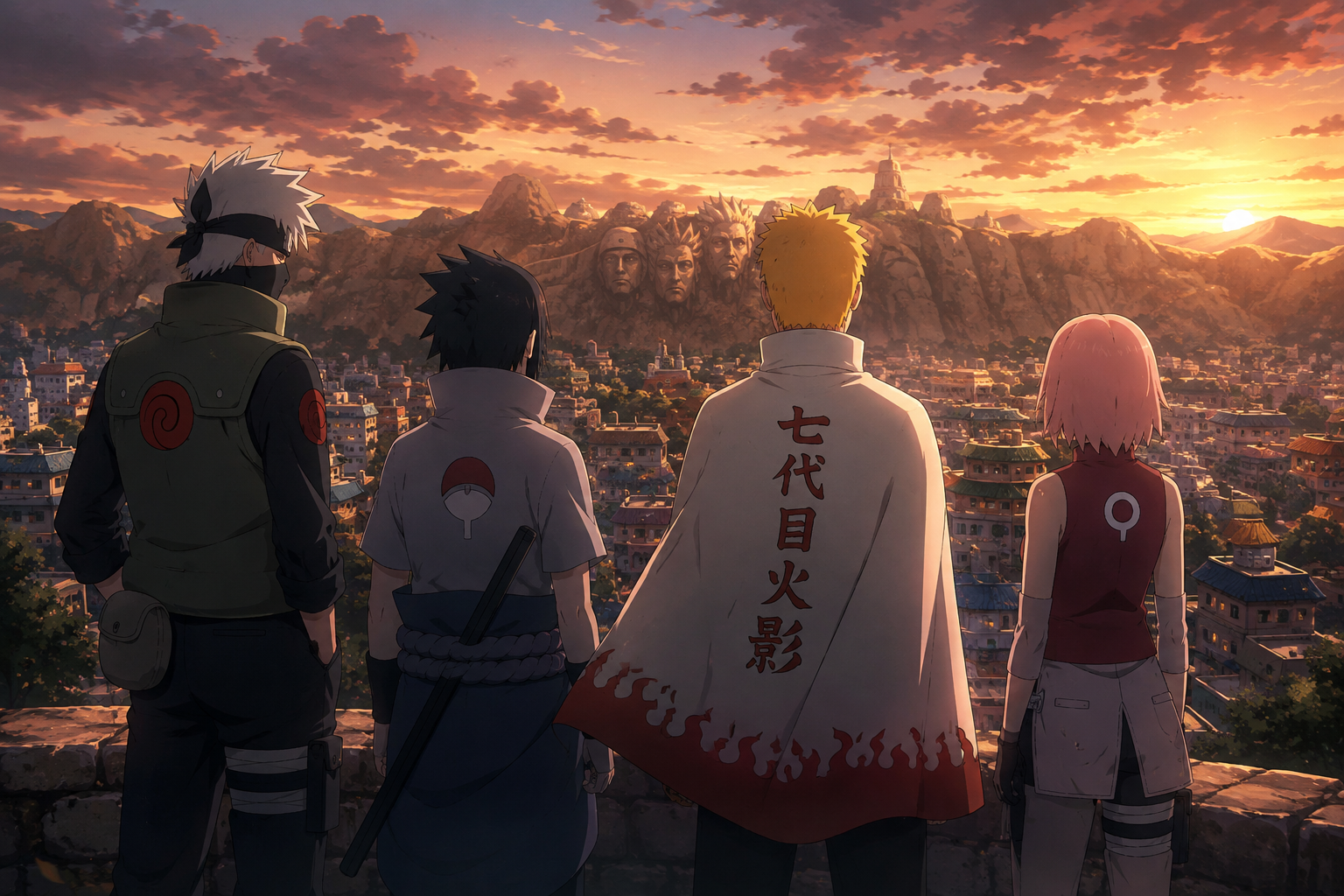
Series files, arcs, characters, voice actors, episode reactions, cultural context, filler guidance, and a truly impressive number of questionable institutional decisions made by adults around children.
Enter Naruto →
The growing guild-sized file for characters, magic, story arcs, episodes, voice performers, and the world’s most emotionally committed workplace with absolutely no recognizable HR department.
Enter Fairy Tail →Japanese Animated Movies
Japanese animated films have their own production histories, audiences, directors, pacing, financing, and release strategies. Some begin as original theatrical stories. Others adapt novels or manga, continue television franchises, retell familiar material, or take a side road through a much larger property.
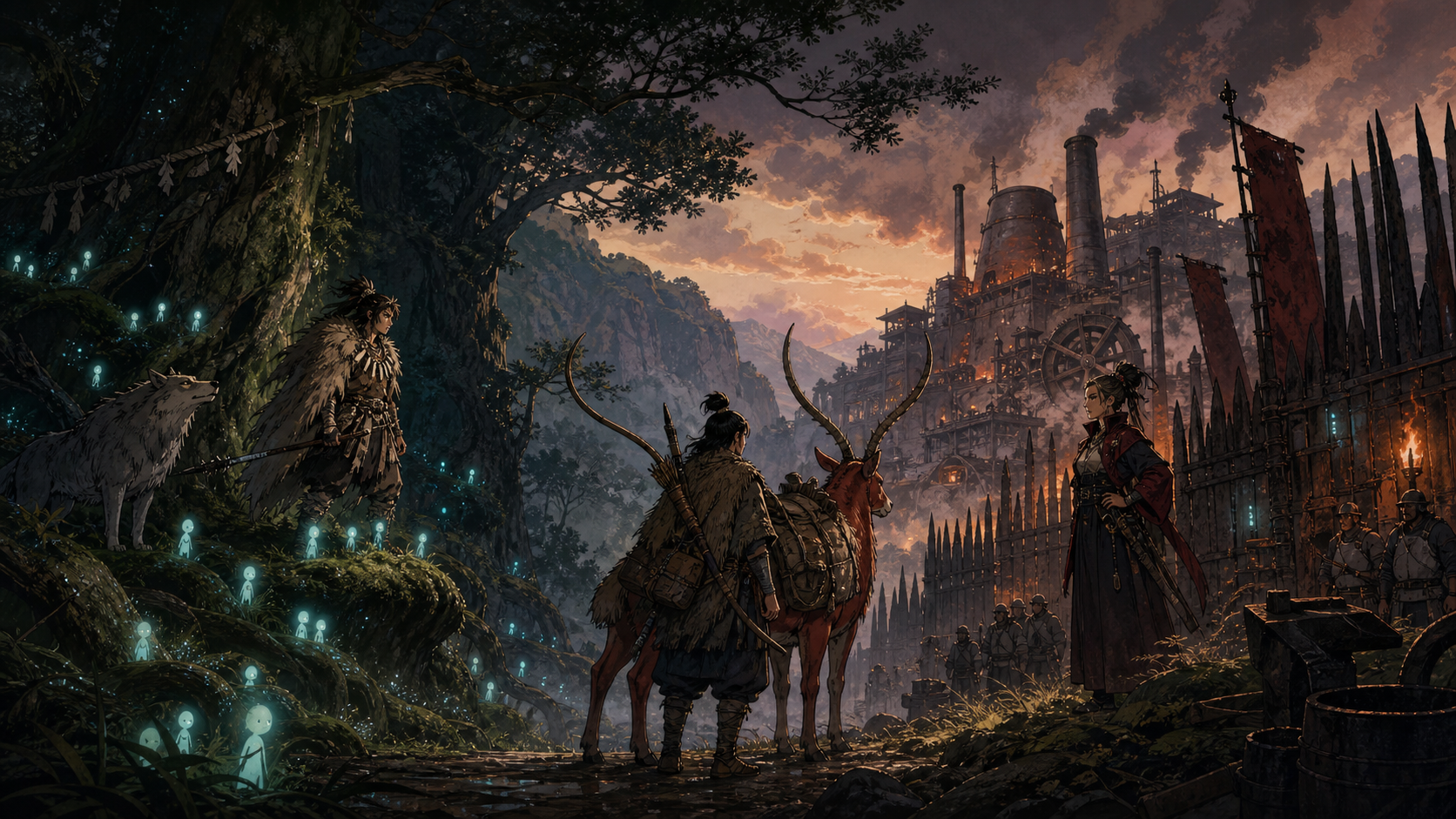
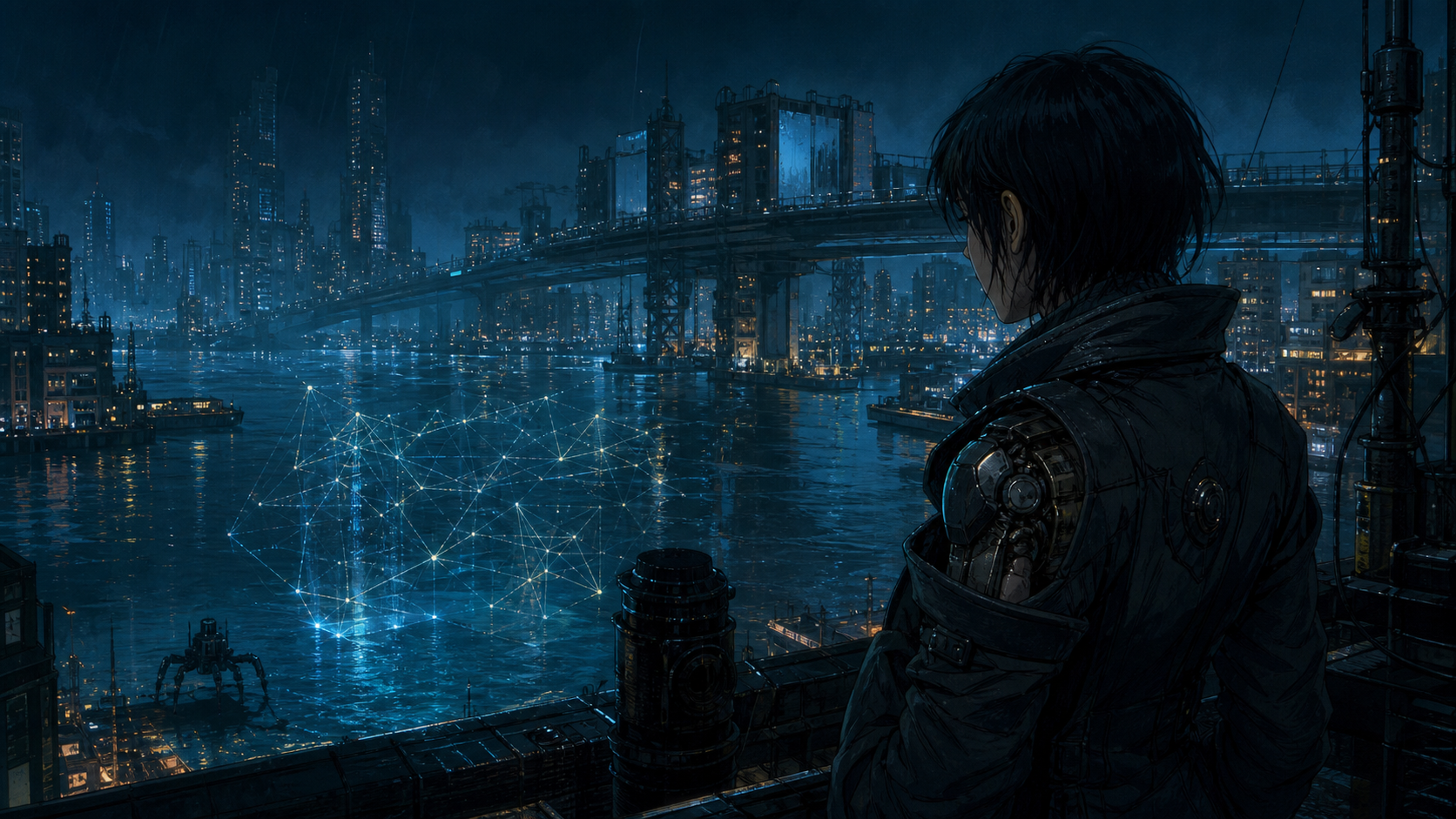
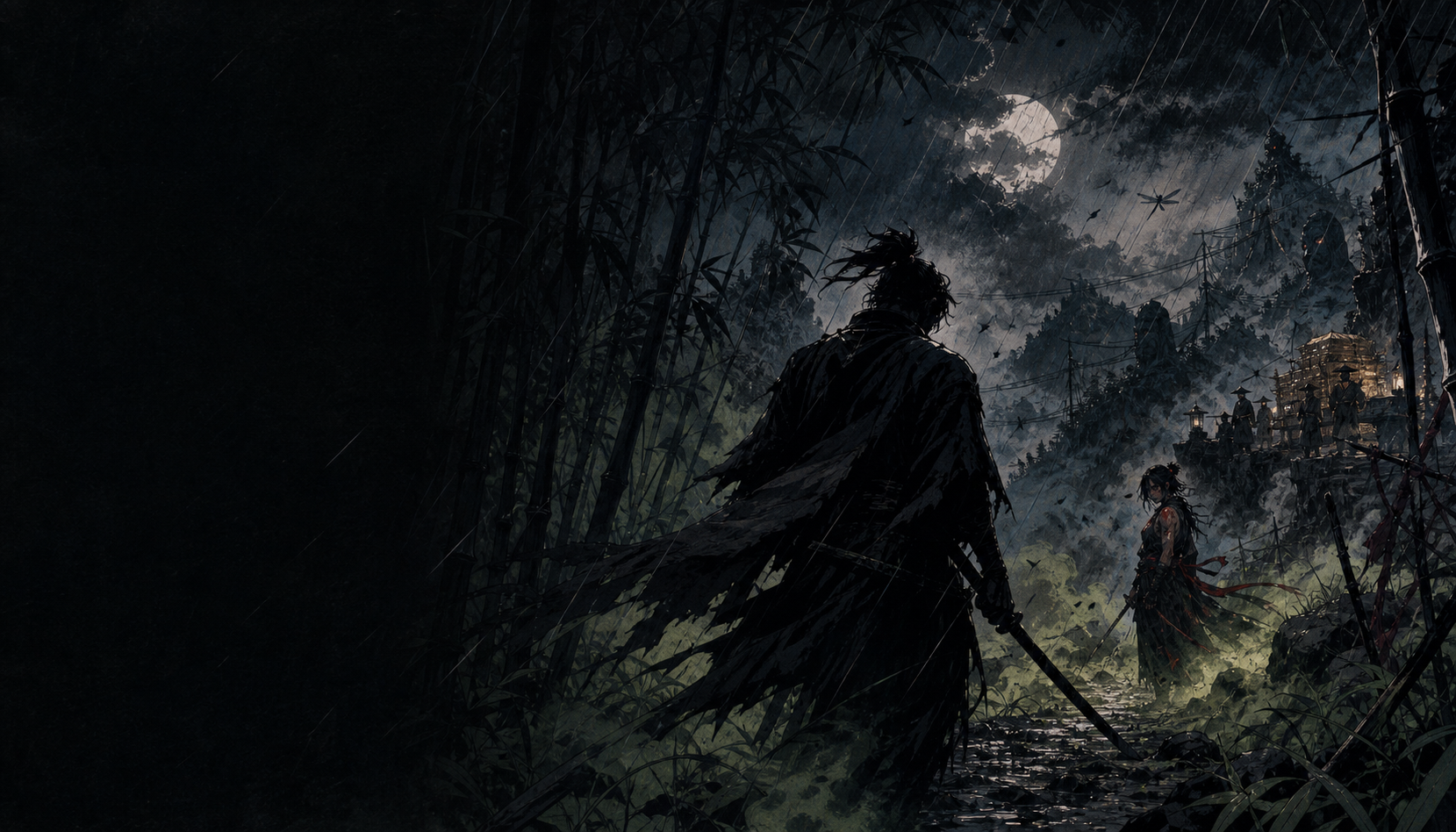
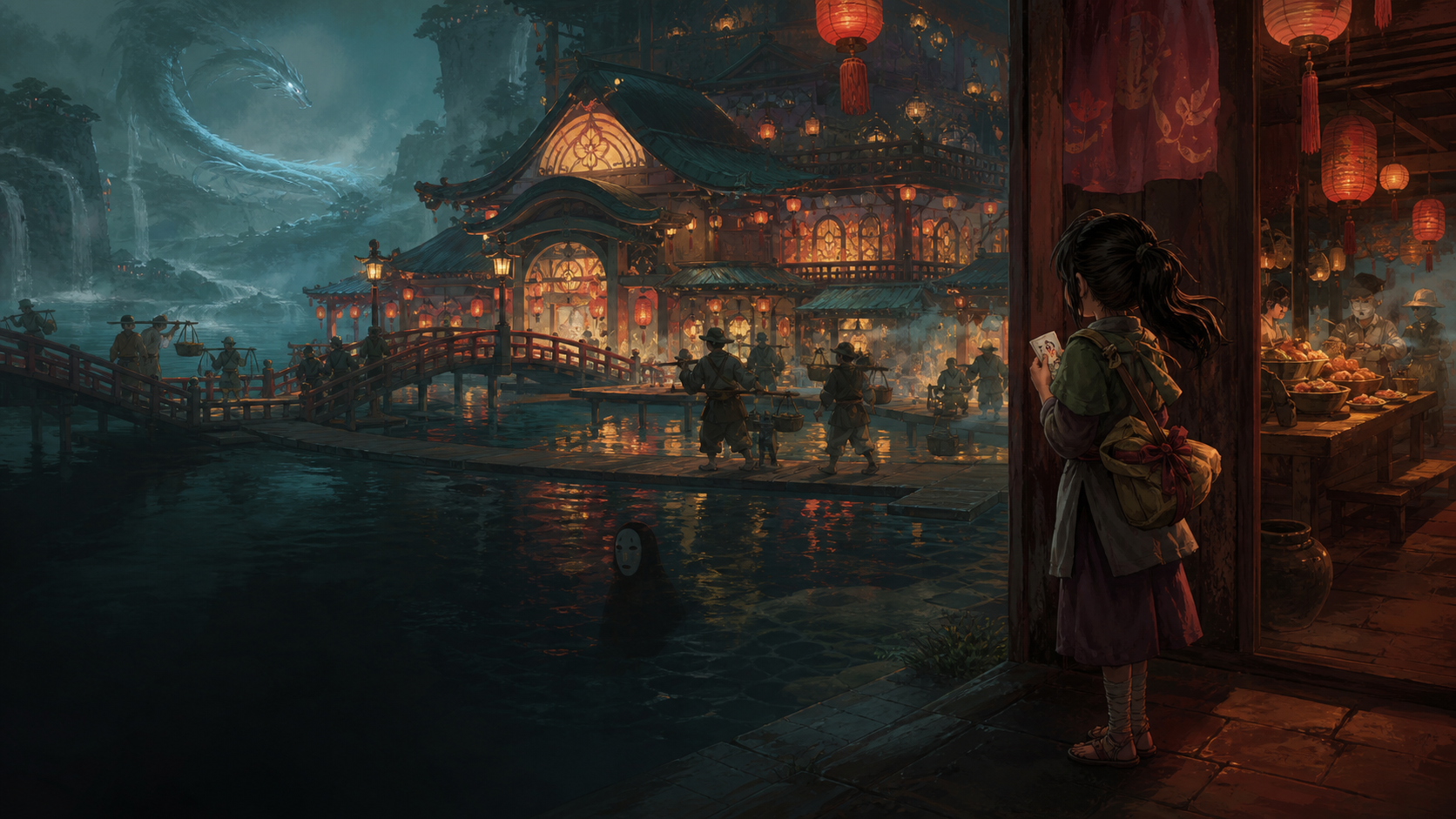
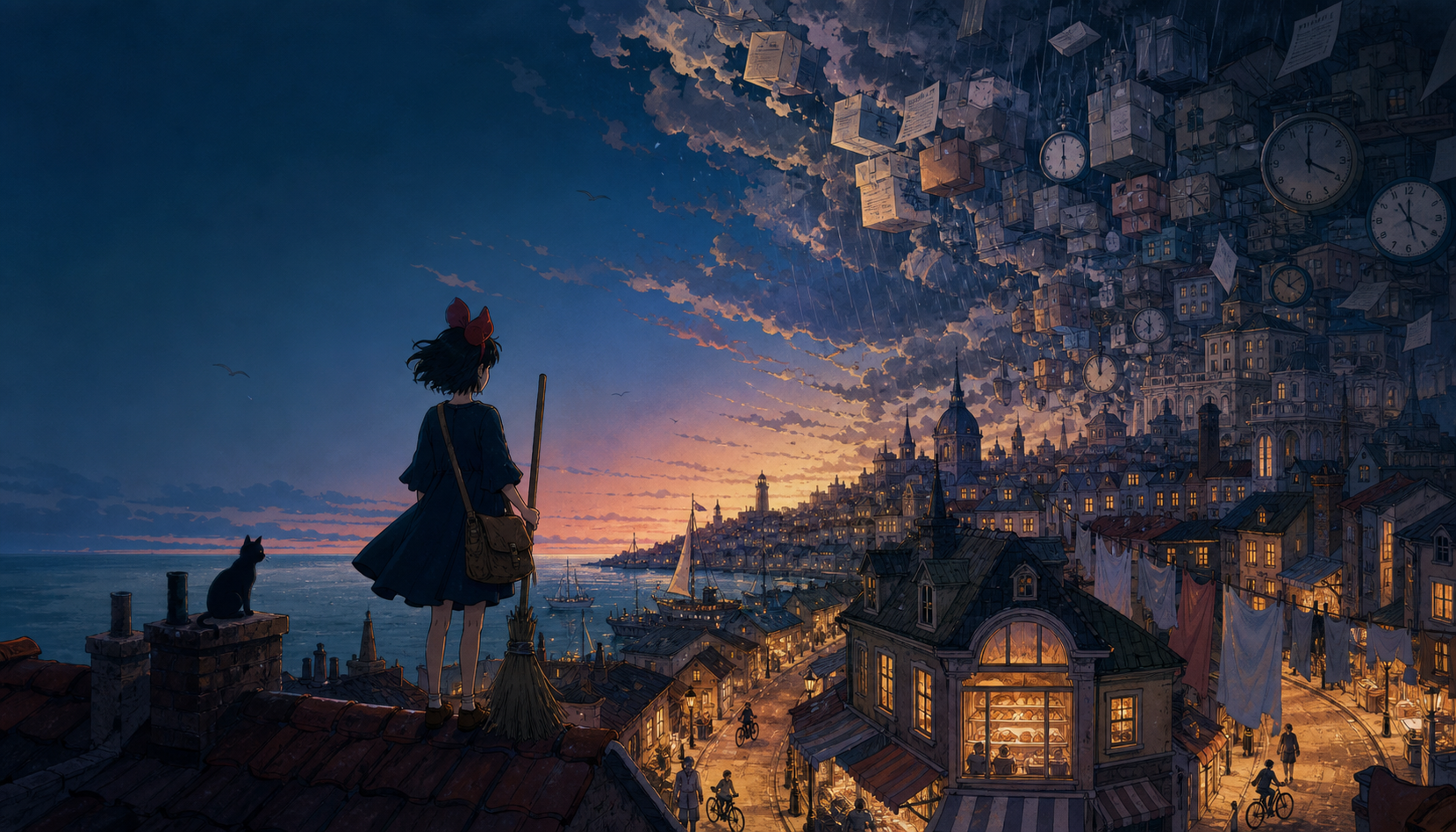
The eight reviews below are the Japanese films currently finished in the CVM Sekai library. The shelf stays honest about what has been covered while giving every completed review a real image and working destination.
Reviews, Reactions & Rants
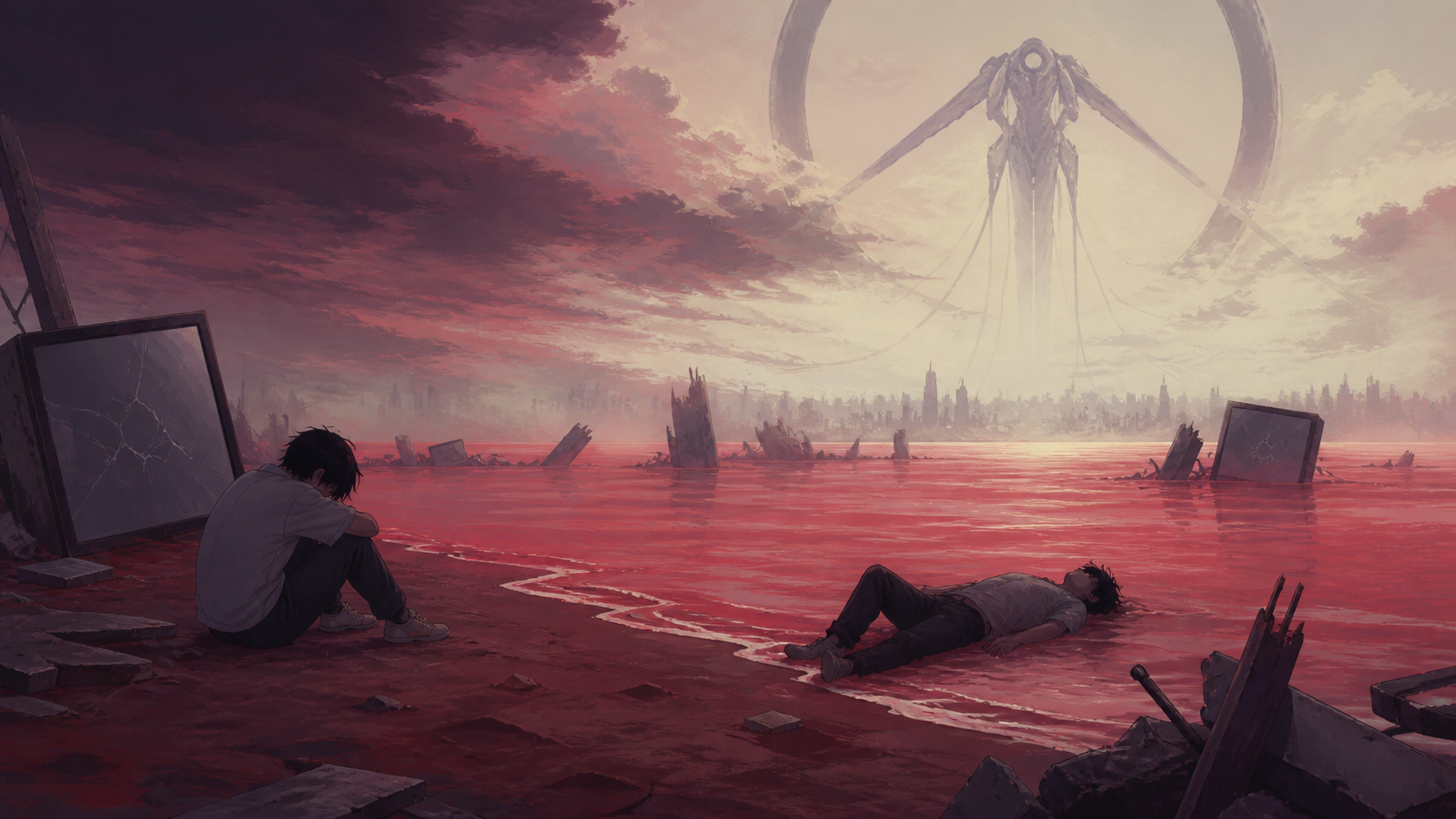
A review judges a finished movie, season, or series after the work has made its argument. A React stays close to the experience of watching one episode while the evidence is incomplete. A Rant takes the problem that keeps following RaeRae home and gives the complaint enough examples, culture, power, and consequences to stand on its own.


How Japanese anime actually gets made
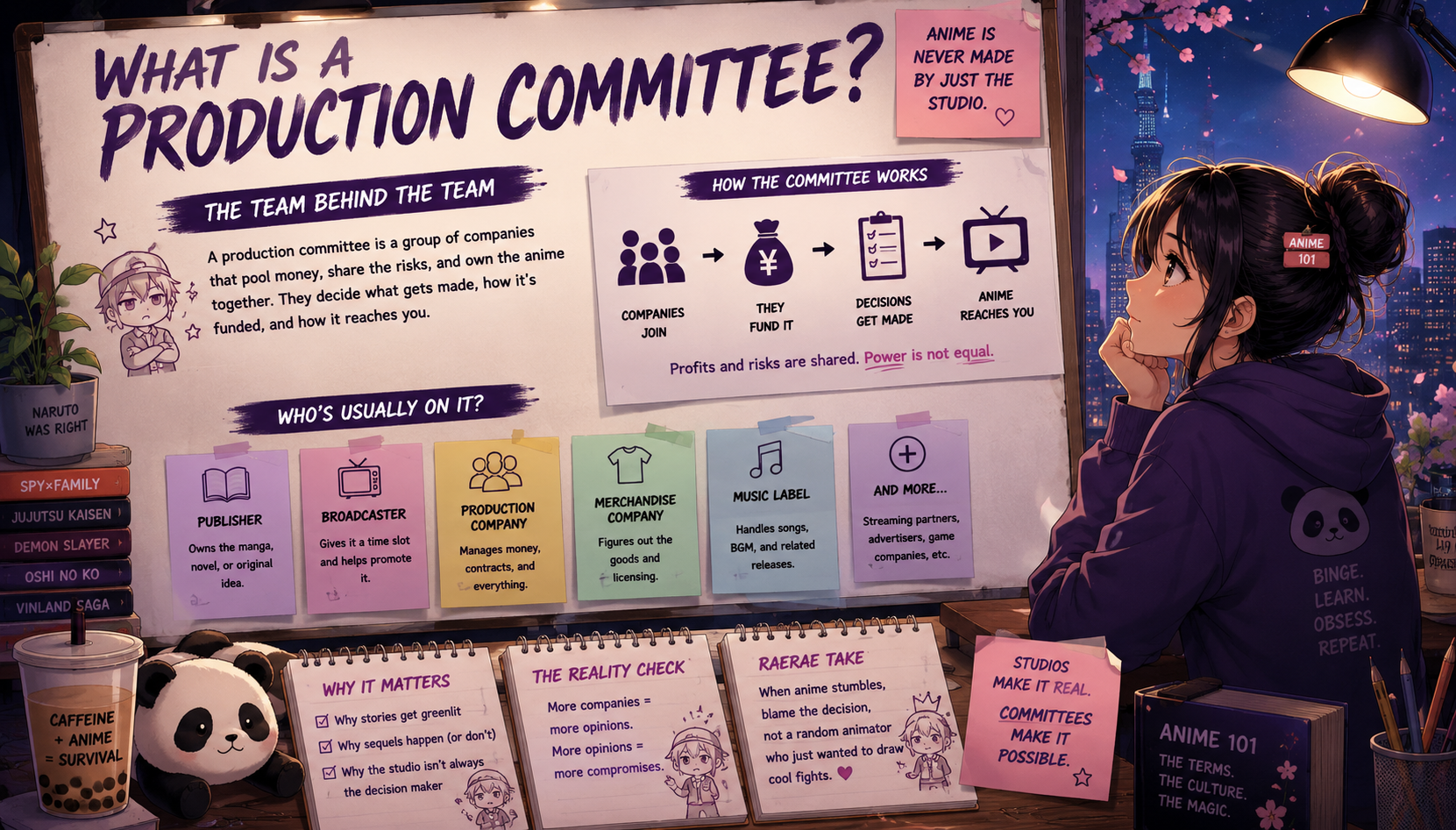
The studio name is only the most visible piece of an anime production. Before anyone animates a finished episode, the project has to exist as both a creative idea and a business proposition. Rights may need to be secured from a manga publisher or another owner. Producers organize financing and partnerships. A production committee may bring together companies with interests in publishing, broadcasting, music, home video, merchandising, games, advertising, or distribution. Original anime skips the source adaptation problem, but an original production still needs money, schedules, staff, rights, marketing, and somewhere to release the finished work.
The creative side is just as layered. Directors shape tone and audiovisual language. Series composition helps organize the larger narrative. Screenwriters turn plans or source material into episode scripts. Storyboard artists determine how those scripts become shots. Character designers create versions of the cast that can move through thousands of drawings. Key animators, animation directors, background artists, compositors, editors, sound teams, composers, seiyuu, and many other specialists contribute different pieces before the viewer ever sees the final episode.
Blaming every change on the studio can be a deeply lazy explanation. Studios matter enormously, but production decisions may involve producers, directors, writers, rights holders, committees, schedules, or circumstances that are invisible to the viewer. Even inside the studio, anime is not one artist making every frame. The credits are a reminder that the finished work is collaborative whether fandom remembers that during arguments or not.
Scheduling adds pressure to nearly every part of this process. Television deadlines do not care that Episode 9 contains the most difficult fight in the season. A spectacular sequence may depend on particular animators having enough time, while another project can be technically ambitious but badly organized. Production interviews and reliable reporting are therefore much better evidence than assigning every visible problem to whichever company logo we recognize.
The Japanese terms and systems worth actually understanding
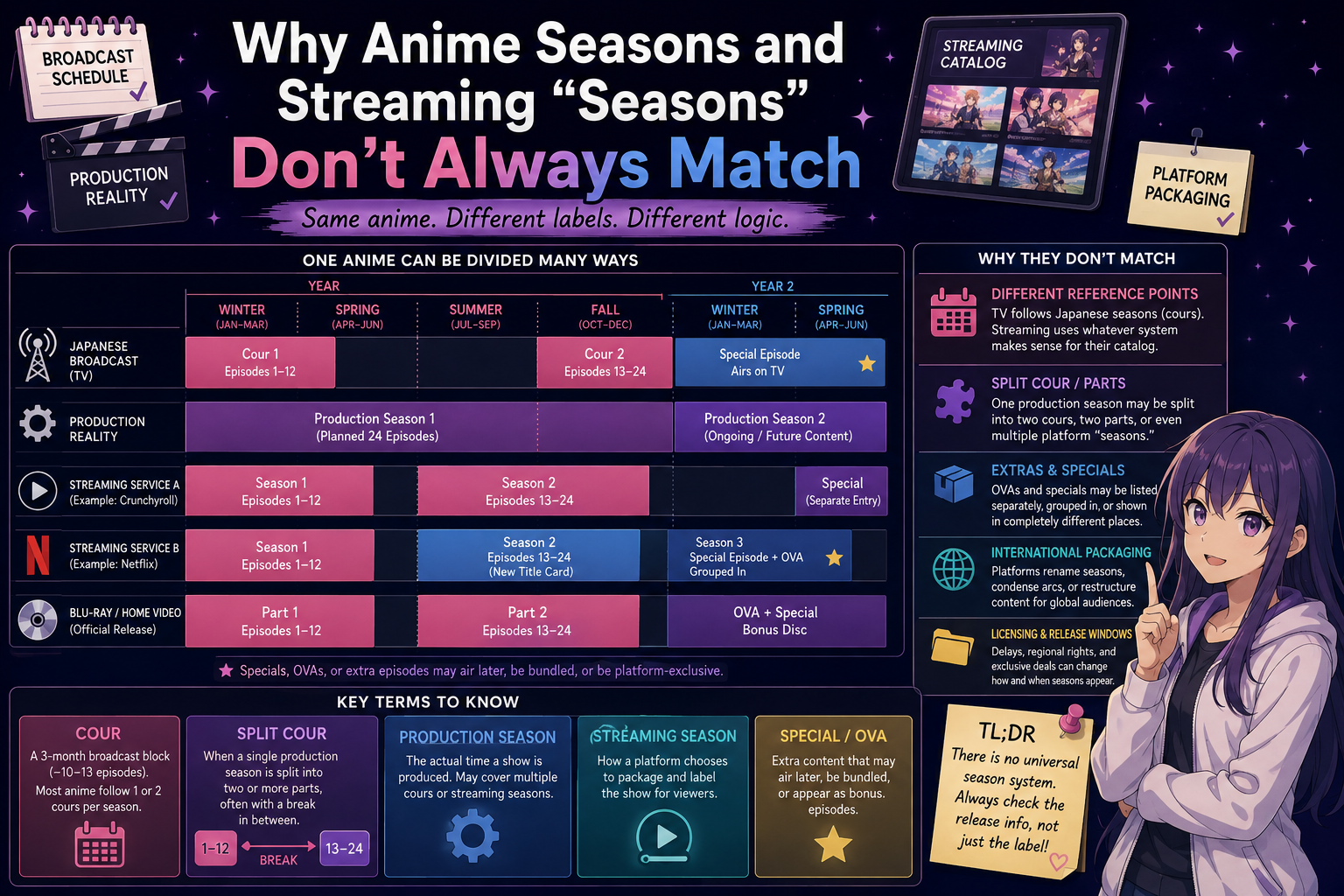
You do not need to memorize vocabulary before watching anything. These guides are here for the moment the question starts bothering you. Why are there twelve episodes? Who actually finances the anime? Why did the adaptation remove half the protagonist’s thoughts? Why does the voice actor have a concert career? Why did a streaming service call Cour 2 a new season? The cards below are the deeper explanations behind the Japanese animation ecosystem.

Manga, Light Novels & the Adaptation Pipeline
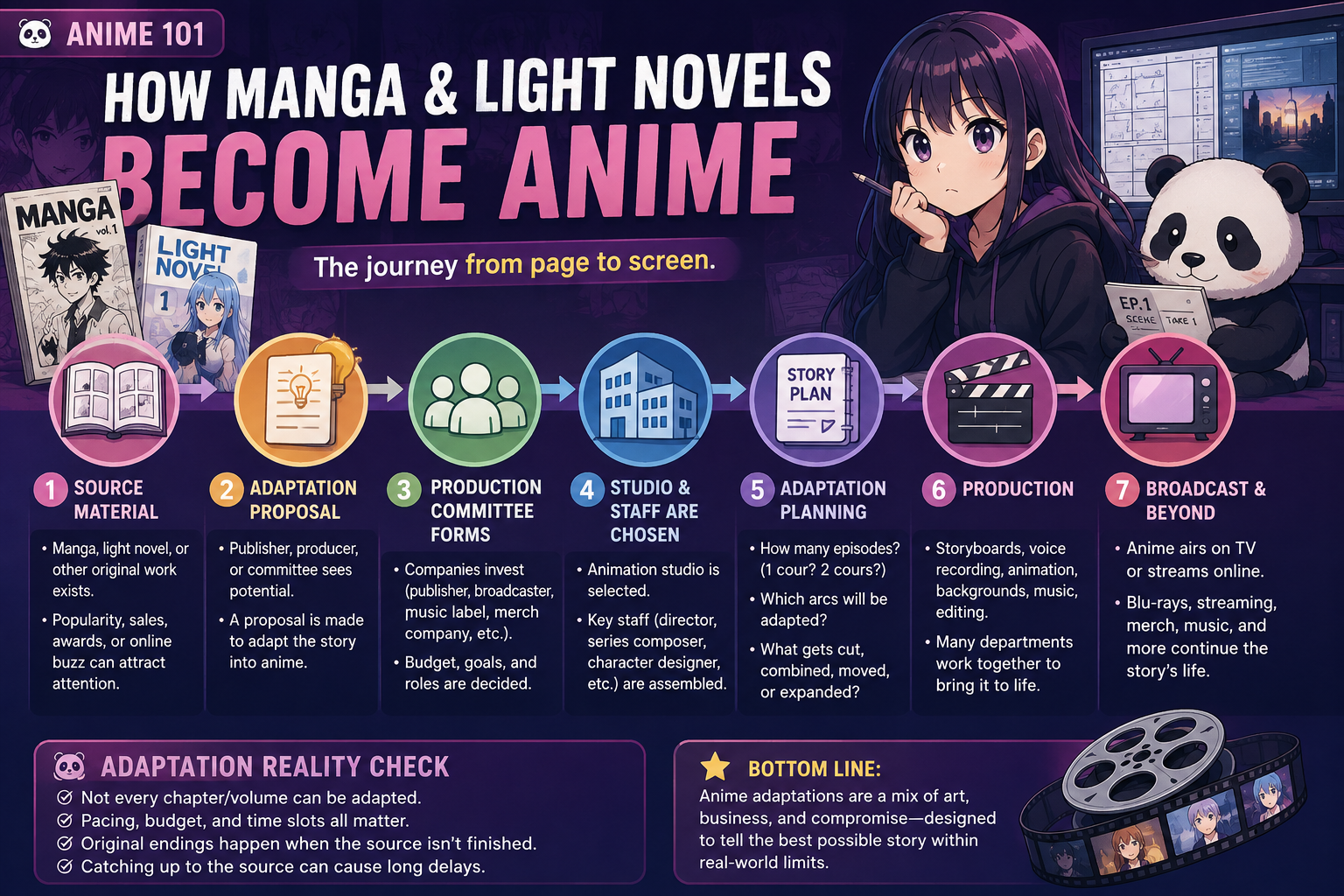
Anime and manga are different media, but Japanese animation is so often connected to publishing that international fandom regularly blends them together. Manga can serialize chapter by chapter before collected volumes appear. Light novels can build entire character arcs through narration and internal thought. Successful properties may accumulate readers for years before an anime introduces the same world to a much larger television or streaming audience.
Moving that story into animation creates decisions immediately. Manga gives the production visual composition, dialogue, expressions, and page rhythm, but the reader controls the speed. Anime fixes that timing and adds motion, voice performance, sound, editing, music, and color. Light novels create another problem because important information can exist inside a character’s head. Remove enough of that narration and the anime may keep the plot while quietly changing how intelligent, frightened, affectionate, or conflicted the character appears.
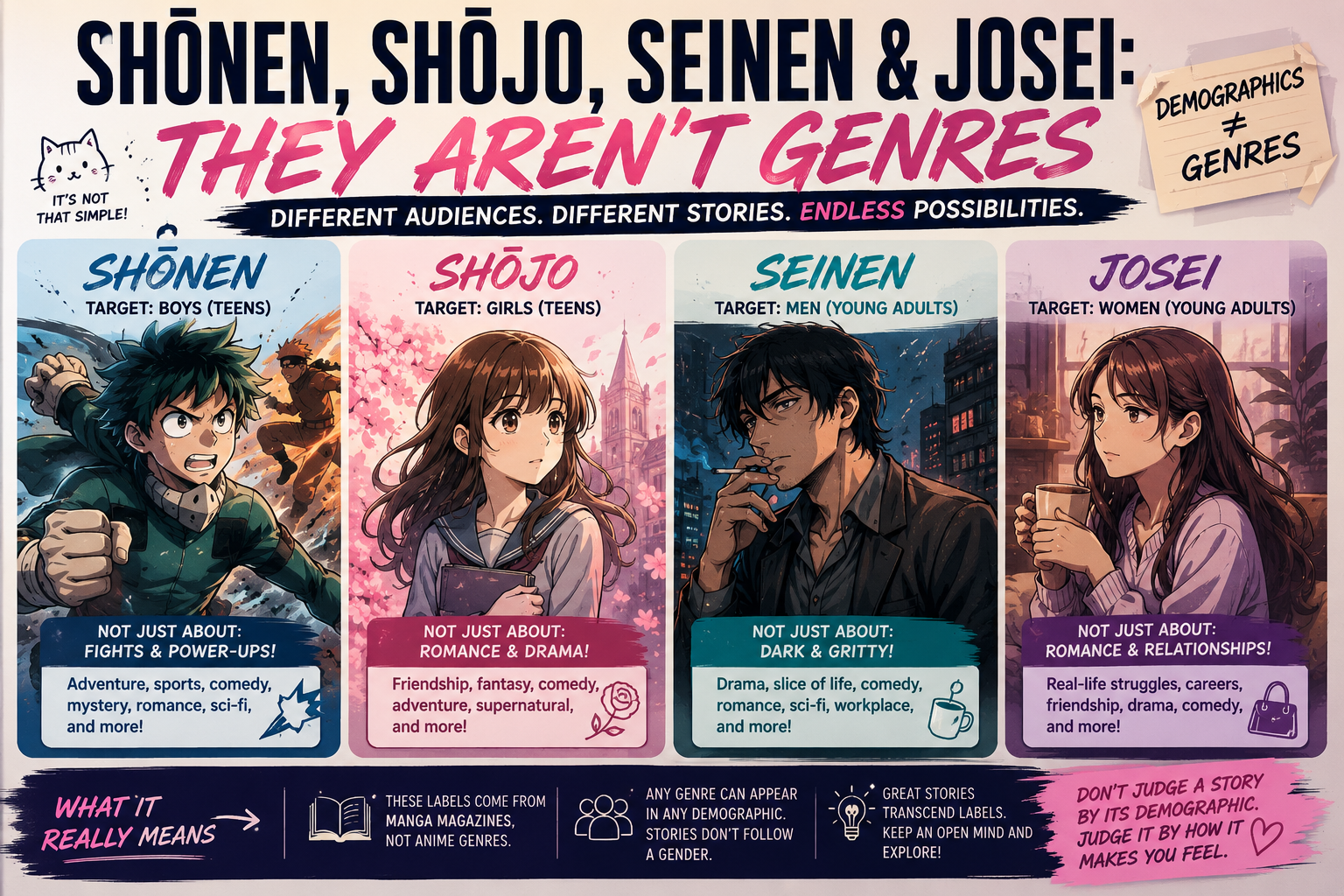
Publishing is also where fandom gets several famous labels wrong. Shōnen, shōjo, seinen, and josei describe broad manga readership and publishing contexts rather than four genres. Their stereotypical associations exist because certain types of stories became highly visible, but the publishing label does not imprison the story inside one genre.
Television, Cours, OVAs, ONAs & Streaming
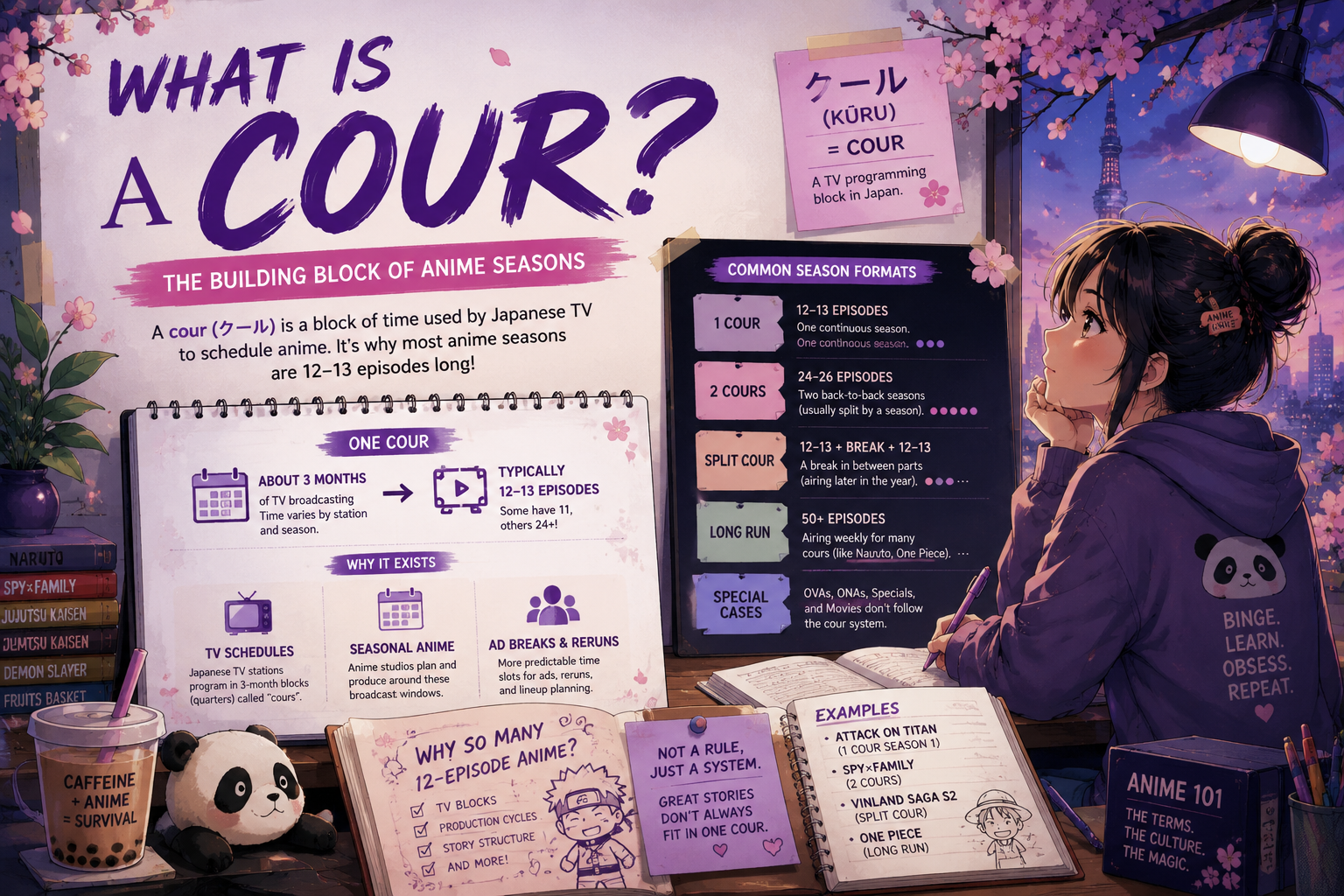
Japanese television scheduling is one reason anime fans encounter the same episode counts again and again. A cour is roughly one quarter of the television year, so weekly anime commonly occupy runs around twelve or thirteen episodes. A production can run for one cour, continue across two consecutive cours, or split a larger season into separate broadcast blocks with a break between them. That scheduling language describes the television calendar, not a universal law saying every twelve episodes create a new season.
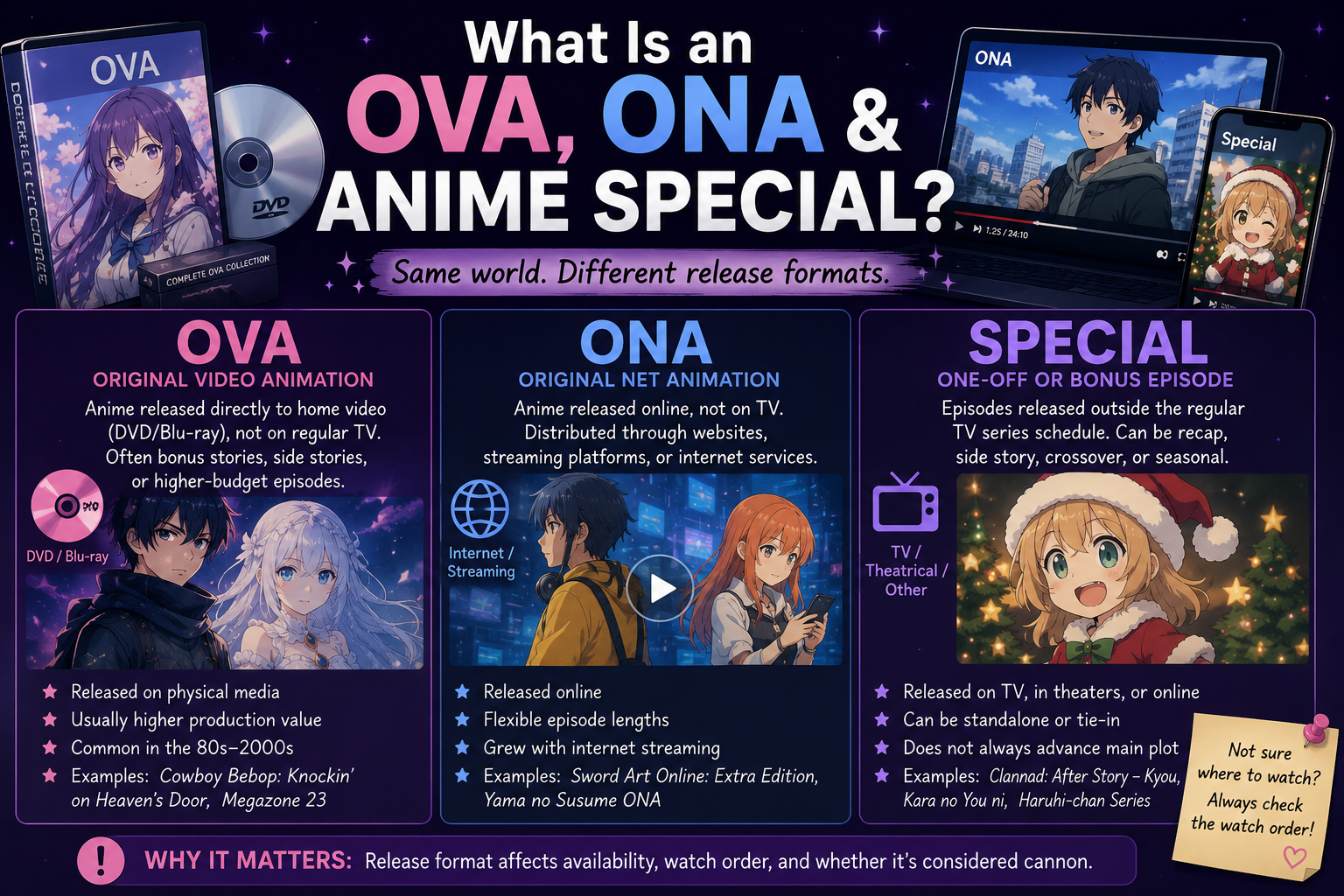
Television was never the only path. Japan’s physical-media market helped build Original Video Animation, allowing anime to be produced directly for home video rather than beginning on television or in theaters. Internet distribution later created another route through Original Net Animation. Specials sit even more loosely outside normal episode structures and can contain side stories, recaps, bonus material, or other releases that refuse to behave nicely inside a numbered season.
Streaming makes those older distinctions less visible because television anime, old OVAs, films, and internet-first ONAs can all appear inside the same app. International platforms may also regroup Parts, cours, Specials, and seasons according to their own catalog systems. That is why one platform’s “Season 3” may be another database’s Season 2 Part 2 without anyone necessarily forgetting how counting works.
The people behind Japanese anime
Anime fandom naturally centers characters, but every character sits on top of human performance and craft. Directors shape the visual interpretation. Series-composition writers help structure the larger story. Character designers translate artwork into designs that can survive repeated animation. Key animators create major movement and acting. Composers, sound directors, editors, background artists, compositors, animation directors, and many other people decide how the finished world feels.
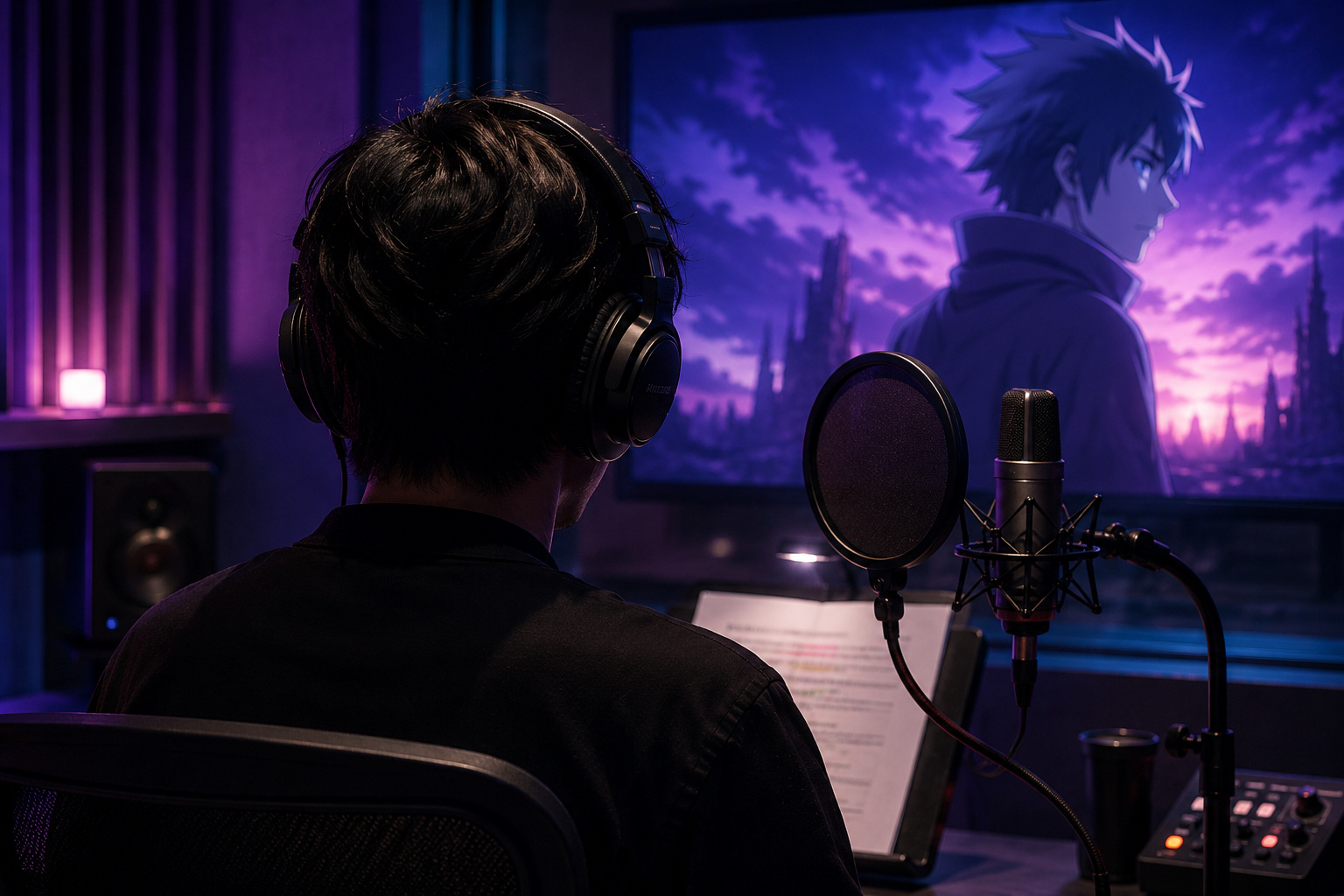
Seiyuu are particularly visible because the performer can follow fans outside the anime itself. A Japanese voice actor may work across television animation, films, games, foreign-media dubbing, narration, radio, music, character songs, and live events. Once you start following the actor instead of only the role, completely unrelated anime begin connecting through the same human voice.
That is why CVM Sekai keeps voice performers as their own profiles instead of burying their names as trivia at the bottom of a character page. Naruto introduces one performer. Sasuke introduces another. Their careers do not stop at the gates of Konoha.



Japanese animation existed long before most international fans discovered the medium
Japan experimented with animated film long before modern television anime existed. Early twentieth-century animators worked with techniques developing around the world while gradually building local production traditions. Animation appeared in theatrical shorts, educational material, commercial work, wartime media, and postwar film production. The industry that later produced the television anime familiar to global audiences did not arrive fully formed. The industry grew through changing technologies, studios, economics, artistic influences, and audiences.
Postwar theatrical animation helped establish larger-scale studio production, while the expansion of television created a very different demand: animation that could reach households every week. Television changed pacing, budgets, production techniques, episode structures, and the relationship between animation and advertising. Long-running series could now build familiarity across months and years rather than depending entirely on theatrical releases.
Manga publishing became especially important to that television ecosystem. Popular characters could move between magazines, collected volumes, television, toys, music, games, and merchandise, creating interconnected media properties instead of one isolated product. Anime did not become a synonym for manga adaptation, but the publishing relationship became strong enough to shape how fans still talk about adaptations today.
The home-video market created another major shift. Direct-to-video animation gave producers a route outside normal television scheduling and theatrical exhibition, helping fuel the OVA boom associated especially with the 1980s and 1990s. The format could support franchise extras alongside standalone work aimed directly at dedicated consumers. VHS and LaserDisc eventually gave way to DVD and Blu-ray, while the economic role of physical media continued changing around them.
Digital production transformed how anime was physically created, while the internet transformed how audiences found Japanese animation. International fandom once depended heavily on delayed television licensing, imported physical media, convention culture, fan communities, and unofficial distribution. Modern simulcasting and global streaming shortened the delay between Japanese broadcast and international viewing until overseas fans could participate in seasonal conversation while the show was still airing.
Streaming did not erase the older systems. Television cours still matter. Movies still matter. Physical releases still exist. Publishers continue adapting manga and novels. Seiyuu still move through anime, games, music, and events. Production committees still appear across many projects. Modern Japanese animation is layered because new technologies usually arrive on top of older structures rather than politely sweeping the entire previous industry off the table.
Keep Exploring Japanese Anime
Japanese anime coverage now stretches across franchise hubs, film reviews, episode Reacts, editorial Rants, production explainers, terminology guides, and Japanese performer profiles. These routes stay useful even when publication order changes.

Japanese anime is a medium, not a personality test or one giant genre
Naruto can bring somebody through the door, but Japanese animation does not end with battle series, school romances, or whichever title a streaming service pushed hardest that month. The medium includes family films, horror, workplace comedy, political science fiction, sports stories, children’s television, experimental shorts, historical drama, adaptations, and original work that does not fit the shortcuts international fandom keeps using.
The production side matters too. Characters exist because writers, directors, designers, animators, performers, editors, composers, sound teams, background artists, producers, publishers, broadcasters, and many other workers turned an idea into timed movement and sound. Understanding even one part of that process makes the finished animation easier to read and harder to reduce to a studio logo.
Come for the series or movie you already love. Leave with a larger map of Japanese animation than the recommendation algorithm gave you.