
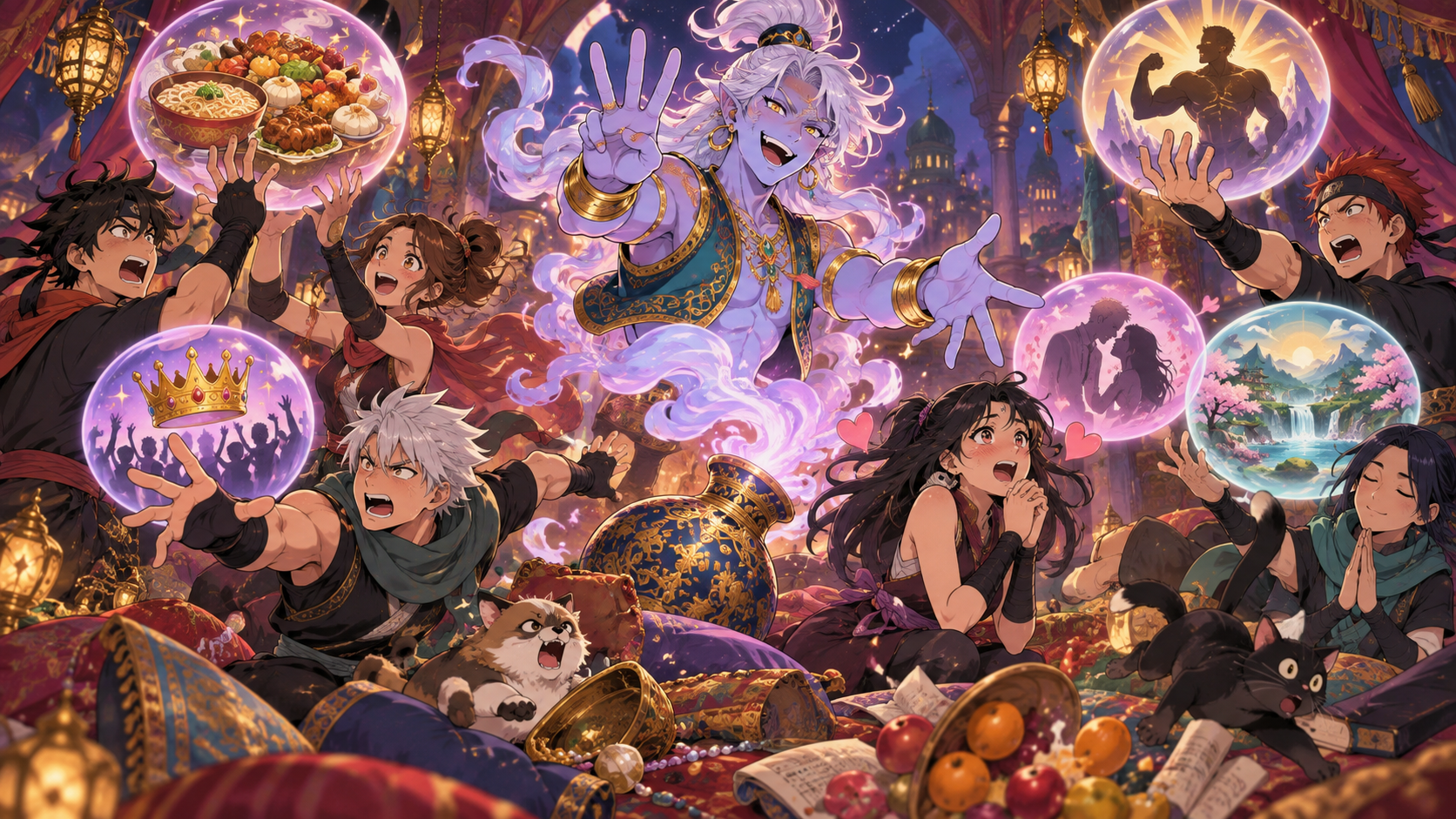
Excerpt: Naruto, the Genie, and the Three Wishes, Believe It! discovers that magical abundance does not end conflict when an entire friend group still has to decide whose desire counts first.
Focus keyword: Naruto Genie Three Wishes review
SEO title: Naruto, the Genie, and the Three Wishes Review | CVM Sekai
Meta description: Our Naruto, the Genie, and the Three Wishes review explores the movie-DVD bonus comedy, competing desires, wish scarcity, ensemble chaos, and official format.
Three Wishes Become a Group-Management Emergency
Naruto finds a bottle. A genie emerges. Three wishes become available.
This should be simple.
It is not simple because Naruto has friends.
Naruto, the Genie, and the Three Wishes, Believe It! takes a universal fantasy—unlimited magical possibility—and immediately traps it inside the most difficult resource-allocation system known to humanity: a group of people who all want different things at the same time.
Food, power, romance, recognition, comfort, and personal fantasies compete for a tiny number of wishes. Nobody agrees on priority. Every attempt to claim a wish reveals something embarrassing about the person reaching for it.
The short does not need a villain. Desire is enough.
That is the joke and the small truth beneath it. Abundance does not automatically produce harmony. The bottle may contain miraculous power, but the group still has to negotiate ownership, fairness, urgency, and whose dream deserves to become real.
Magic solves material limits. It does not solve people.
Naruto Is the Worst Possible Person to Give Shared Wishes
Naruto’s first instinct is rarely committee procedure.
He acts, speaks, reaches, and decides before a room has finished identifying the problem. That impulsiveness is useful when hesitation protects injustice. It is catastrophic when a scarce shared resource requires coordination.
The genie premise exposes this instantly.
Naruto wants things sincerely. He also assumes sincerity grants priority. His desires feel urgent because he experiences them from inside. Everyone else’s desires arrive as interruption.
That does not make him uniquely selfish. It makes him recognizable.
Groups often fail at distribution because each person understands the full emotional history behind their own request and only the surface of everybody else’s. Naruto’s hunger may connect to childhood deprivation. Another character’s romantic wish may carry loneliness. A power wish may hide fear of helplessness.
The short moves too quickly for deep confession, but the comedy depends on those invisible histories colliding.
Naruto’s volume makes him the center of chaos. The ensemble ensures he cannot simply turn centrality into control.
The Genie Is Less Dangerous Than the Queue
Genie stories often focus on malicious interpretation. A wish is phrased poorly, and magic produces an ironic disaster.
This short finds comedy earlier in the process.
Who gets to speak?
The limitation to three wishes creates scarcity inside abundance. The genie could theoretically transform the world, but the rules restrict access. Scarcity then produces competition, alliance, interruption, and attempted priority claims.
The structure resembles any group fighting over a limited opportunity. The resource becomes more valuable because others want it. People who had no clear wish develop one once exclusion becomes possible.
This is why the premise remains effective despite its simplicity. The bottle externalizes a social problem already present in teams. Shinobi cooperate because missions establish hierarchy and objective. Remove the mission, offer personal fulfillment, and consensus becomes much harder.
The genie does not create selfishness. The genie creates a visible deadline for it.
Wishes Reveal Character Faster Than Exposition
Asking what somebody would wish for is a compact character test.
Food suggests appetite, comfort, or remembered scarcity. Strength may signal ambition or fear. Romance can reveal longing, vanity, or the desire to skip vulnerability. Fame exposes the relationship between self-worth and public attention. Peace sounds noble until details reveal who controls it.
The short uses familiar cast traits for quick comedy. Viewers already know enough to understand why each imagined desire fits or exaggerates the character.
This is ensemble fan service with psychological efficiency.
The work does not need to resolve whether the wishes represent each character’s deepest truth. Comedy operates through recognizability, not sworn testimony. A ridiculous desire can still reveal the role somebody performs inside the group.
Naruto’s world is full of grand stated dreams—Hokage, revenge, clan restoration, recognition, peace. A genie reduces dreaming to immediate consumption.
What do these people want when no training or sacrifice stands between desire and result?
The answers are less heroic and more human.
Magical Power Does Not Create a Fair Process
The existence of the genie might suggest everyone can be satisfied if the wishes are used cleverly. The group could wish for more wishes, shared abundance, or a solution broad enough to include every person.
Genre rules usually block that escape because conflict requires limitation.
But even a clever solution would need agreement.
Who defines “everyone”? What counts as satisfaction? Does a shared wish erase individual autonomy? If one person wishes for peace, can that peace override another person’s desire?
The short does not turn into political philosophy, but its chaos rests on those questions. Power needs governance. A resource capable of changing reality becomes dangerous when possession is mistaken for legitimate authority.
Naruto stories return repeatedly to concentrated power inside bodies, bloodlines, artifacts, and offices. The genie bottle is the comedy version. Everybody understands immediately that power should be used—and nobody agrees on who should decide.
That disagreement is more realistic than the magic.
The Ensemble Is the Actual Special Effect
The genie supplies color and premise. Familiar relationships generate momentum.
Friends interrupt one another. Rivalries reactivate. Quiet characters reveal unexpected priorities. Strong personalities try to seize narrative control. The pleasure comes from watching a stable group lose stability over an impossible opportunity.
This requires cast density without confusion.
The short relies on viewers recognizing voices, silhouettes, and characteristic reactions quickly. Like Grand Sports Festival, it benefits from familiarity more than continuity.
The ensemble also prevents the genie from becoming the only source of comedy. Magic creates situations; people make them specific.
Naruto alone with three wishes would produce a brief character sketch. Naruto with friends produces governance failure.
That is funnier.
Desire Is Not Shameful—Entitlement Is the Problem
Comedy built around wishes can become moralizing: everyone wants something selfish, therefore wanting is bad.
This short is lighter and more generous.
The desires are funny because they are recognizable, not because the characters deserve punishment for having them. Food, affection, strength, rest, and acknowledgment are ordinary wants.
Conflict begins when desire becomes entitlement to a shared resource.
That distinction matters. Naruto’s hunger for recognition is foundational to his story. Telling him not to want would reproduce the village’s neglect. Teaching him that wanting does not automatically outrank everybody else is different.
The genie short creates a safe space for that lesson because the stakes remain comic. Nobody needs to become a moral monster. The group simply discovers that three wishes are insufficient once everybody treats personal urgency as collective priority.
The solution is not desirelessness. It is relationship capable of negotiation.
Movie-DVD Bonus Status Shapes the Story
The short appears as bonus animation associated with The Lost Tower home-video release, verified through Aniplex’s official movie-DVD record.
That context explains its freedom.
It does not need to fit between episodes, advance an arc, or establish a lasting magical artifact. The bottle can arrive, produce chaos, and disappear without changing Naruto’s access to reality-altering power forever.
Classifying the work as a movie-DVD bonus short protects it from the wrong continuity expectations.
It is not a television episode. It is not evidence that genies permanently exist inside the main narrative’s power system. It is not a canon mission requiring a timeline slot.
It is a licensed comedy object designed to accompany a movie release.
The format grants temporary permission for impossible abundance.
The Visual Design Makes Desire Legible
Wish bubbles, magical light, exaggerated reaches, and crowded composition allow the short to externalize competing fantasies quickly.
Comedy benefits when the audience can read desire before dialogue completes it.
Food, romance, strength, status, and peaceful landscapes become visual symbols. The genie remains at the center while the cast pulls attention outward, reflecting the loss of collective focus.
Color helps separate fantasy from the ordinary setting. The magical object changes the emotional temperature of the scene immediately.
The animation does not need theatrical combat fluidity. It needs expressive reactions and clear escalation.
The short’s strongest visual idea is abundance surrounding people who still experience scarcity.
Everything appears possible. Everyone still fears losing their turn.
Japanese Cast and Performance Notes
Junko Takeuchi gives Naruto the enthusiasm of someone already treating a wish as his before the group finishes reacting. The speed of his certainty drives the initial chaos.
The ensemble cast uses established vocal identities for rapid characterization. A single exclamation or interruption can communicate an entire relationship because viewers know the history underneath.
The genie’s performance has to remain playful rather than threatening. The character facilitates disorder while letting the group own the consequences.
Comic overlap is especially important. Wishes do not queue politely, and the voices should not either.
Where It Fits—and What It Is
Watch the short after the original Naruto/Shippuden ensemble is familiar. It contains no required continuity event and works through character recognition.
Aniplex’s official movie-DVD page verifies the animation as bonus material associated with The Lost Tower release. Classify it as a licensed animated short and movie-DVD bonus—not a numbered episode or canon OVA.
Timeline placement is unnecessary. The genie is a temporary comedy device, not a permanent addition to shinobi cosmology.
Final Verdict
Naruto, the Genie, and the Three Wishes, Believe It! is compact ensemble chaos with a durable premise.
The bottle offers abundance. The rule offers scarcity. The friend group supplies conflict.
No world-ending villain is required because unlimited desire plus zero meeting etiquette can destroy an afternoon without help.
The short understands something larger Naruto stories often dramatize through war: power does not decide how power should be used. Even miraculous capacity requires trust, process, and people willing to treat another person’s desire as real.
The genie can grant wishes.
It cannot make a committee functional.
Rating: 7.5/10 — A bright, efficient movie-bonus comedy that uses magical abundance to expose the familiar chaos of competing desires and limited turns.