
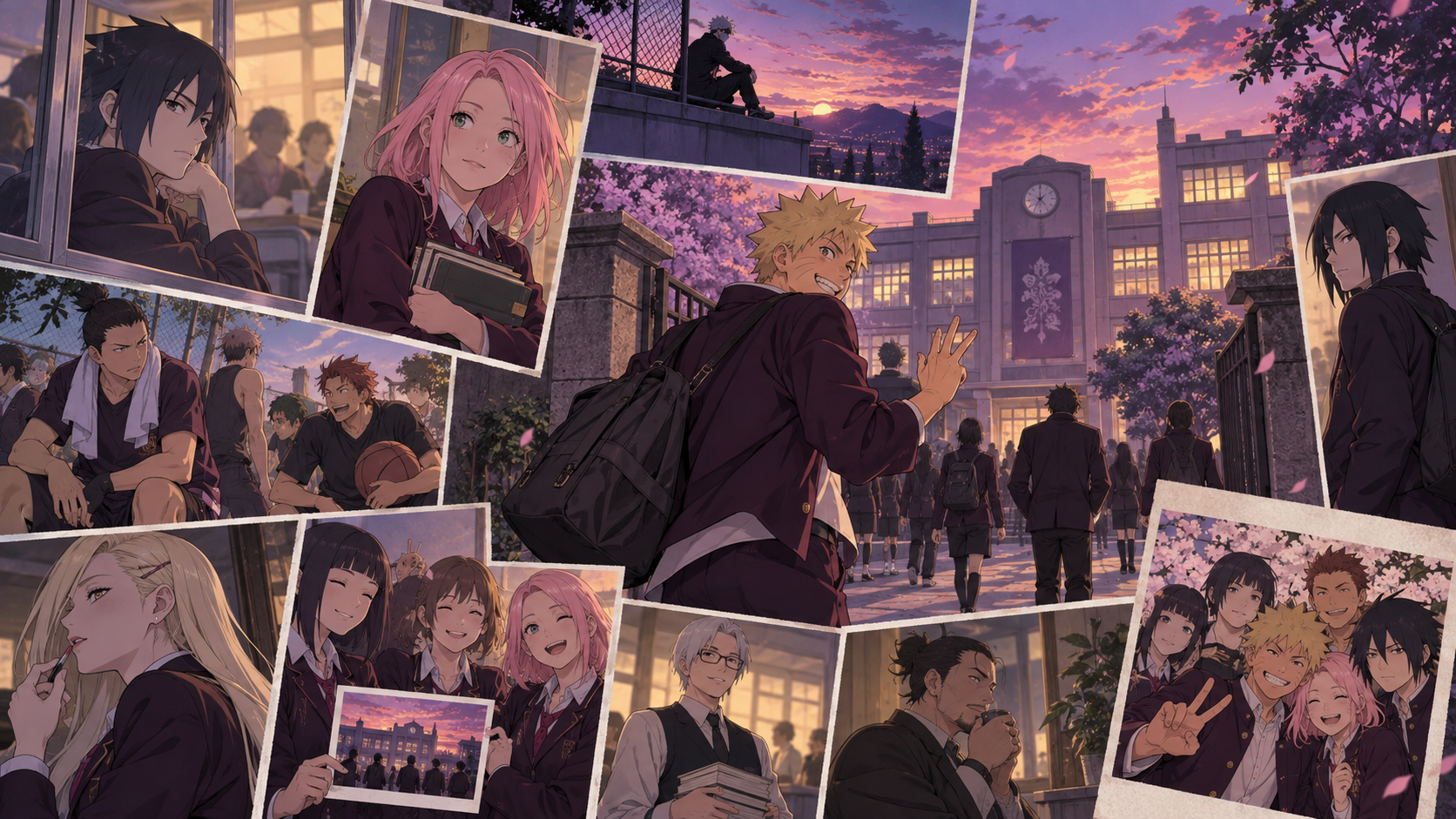
Excerpt: Shippū! Konoha Gakuen Den! removes ninja ranks, missions, and chakra battles to test whether the Shippuden cast remains recognizable inside a school-universe picture drama.
Focus keyword: Shippu Konoha Gakuen Den review
SEO title: Shippū! Konoha Gakuen Den! Review | CVM Sekai
Meta description: Our Shippū! Konoha Gakuen Den review examines the school-universe parody, picture-drama format, alternate character roles, visual stills, and official release context.
If You Remove the Ninja World, Who Is Naruto?
Naruto arrives at school with the energy of a delinquent protagonist who has already decided the building belongs to his future legend.
Sasuke becomes the cool rival. Sakura occupies the emotional and social center between familiar personalities. Teachers, clubs, crushes, uniforms, and school hierarchies replace missions, ranks, clans, and village duty.
Shippū! Konoha Gakuen Den! is not a standard animated episode. It is a picture drama, using illustrated stills, voice performance, composition, and limited motion to recast the Shippuden ensemble inside a school universe.
The format asks a useful fandom question: how much of a character survives after the world that produced them is removed?
Naruto without the Nine-Tails is still loud, ambitious, socially disruptive, and hungry to become visible. Sasuke without the Uchiha political structure remains distant enough to generate fascination. Sakura without shinobi missions still negotiates attraction, frustration, competence, and group identity.
The parody works when it identifies those portable traits.
It weakens when a character becomes only the school archetype that resembles them most.
That tension is the entire appeal of an alternate-universe recasting. Recognition has to survive transformation, or the cast becomes strangers wearing familiar faces.
Picture Drama Is a Format, Not an Apology
Viewers expecting fluid episode animation may initially read the limited movement as a budget problem. That expectation misunderstands the object.
Picture dramas are built from still illustrations, voice acting, editing, music, and transitions. The images do not pretend to be full animation. Composition carries action that frames per second would carry elsewhere.
This requires different attention.
A character’s pose, the relationship between panels, the order of reactions, and the vocal rhythm become primary. The production resembles an illustrated audio play more than a conventional OVA.
Correct classification therefore matters for review. Complaining that the picture drama is not fully animated is like criticizing a radio play for lacking camera movement. The question is whether the chosen stills and performances create enough momentum to sustain the parody.
At its best, Konoha Gakuen Den uses the yearbook-photo quality to its advantage. School life is already organized around snapshots: classroom portraits, club images, rooftop meetings, hallway glances, and group photos that imply stories outside the frame.
The form suits memory and fantasy.
Naruto Becomes a School Delinquent Without Losing His Core
The school-universe Naruto translates easily because his original character already contains delinquent imagery. He resists authority, performs confidence, seeks public recognition, and attaches enormous meaning to rivalries.
Move him from the academy of actual shinobi into a stylized secondary school, and the social engine remains intact.
What changes is the danger.
In the ninja world, Naruto’s disruption develops from state-sanctioned isolation and the weapon sealed inside him. In a school parody, rebelliousness can become aesthetic: loosened uniform, loud entrance, rooftop attitude, conflict with rules.
The reduction is part of the joke, but it also reveals how much political context gives the original character weight. Naruto is recognizable without trauma. He is not complete without it.
The picture drama succeeds when it uses the school type as a lens rather than a replacement. His need to be seen should still feel specific, even if the consequence is social reputation rather than village hatred.
Alternate worlds are most interesting when they preserve emotional geometry while changing circumstance.
Sasuke Fits the Cool-Rival Role Too Perfectly
Sasuke’s transition into school heartthrob and distant rival requires almost no explanation. His original-series presentation already includes admirers, aloofness, exceptional performance, and refusal to participate in the social attention surrounding him.
That easy fit is both funny and limiting.
If school Sasuke is only “the cool boy everyone wants,” the parody reproduces the surface of the character while removing the grief, ambition, and self-destructive focus that make the aloofness meaningful.
The stronger moments preserve discomfort beneath popularity. Sasuke should not merely enjoy being admired. Recognition has never solved his central problem.
The school setting can translate that alienation into another register: the student everybody knows and nobody knows.
Even when the picture drama remains playful, the audience supplies this depth from canon. A glance or solitary pose carries more because viewers remember the family history absent from the alternate world.
That imported knowledge is one of fandom parody’s main tools.
Sakura Gains a Social World Beyond the Battlefield
School AUs often benefit Sakura because the setting foregrounds interpersonal intelligence, routine competence, friendship, and self-presentation—areas the action-heavy main story sometimes treats as secondary.
She belongs naturally in classroom and social scenes.
At the same time, the parody risks returning her to romantic positioning between Naruto and Sasuke. School tropes can make crush dynamics even more central than the original series.
The character works best when the drama recognizes that Sakura is not only the girl reacting to two boys. She is a student with ambitions, social judgments, friendships, pride, and the capacity to organize people who would otherwise turn every day into a rivalry event.
The still-image format gives expressions unusual importance. Sakura’s reactions can direct tone without requiring action sequences.
Her role reveals the difference between translating a character and translating the franchise’s habits. The school setting should free possibilities, not merely put a uniform on old limitations.
School Hierarchy Replaces Ninja Hierarchy—Imperfectly
Clubs, classrooms, teachers, popular students, delinquents, and academic status offer substitutes for shinobi ranks and village roles.
The substitution is intentionally playful, but it shows that social hierarchy persists after military hierarchy disappears. Characters still sort themselves through competence, reputation, group belonging, and authority.
What changes is the consequence. Losing a club competition is not failing a lethal mission. Teacher disapproval is not the same as punishment from a militarized village.
That safety allows personality to become louder. Characters can be ridiculous without dying for it.
The school universe therefore functions as a pressure-release fantasy. People defined by war receive adolescence.
They can worry about crushes, uniforms, and classroom status because the world has room for those concerns.
This is more than a cute reskin. It offers the ordinary development the main story’s child soldiers rarely receive.
The parody does not need to announce that critique. The contrast performs it.
Familiar Archetypes Create Fast Comedy
The short format requires immediate readability. School archetypes supply it.
Viewers recognize the delinquent, honor student, athlete, aloof heartthrob, strict teacher, club obsessive, and gossip network without lengthy setup. The Naruto cast can then be mapped onto those roles for instant contrast.
Comedy appears in both fit and misfit.
Some characters slide into an archetype so naturally that the joke is inevitability. Others become funny because the school role exaggerates a minor canon trait or reverses expectations.
The risk is flattening. Once a character becomes “the athlete,” every appearance can repeat the same point.
The picture drama avoids total exhaustion through ensemble variety and short duration. It does not ask the premise to support a full season.
Fan imagination does the rest. School AUs are collaborative objects; viewers extend relationships beyond the official material through art, fiction, and discussion.
The production supplies a sanctioned playground.
Still Images Change How We Read Performance
Without continuous character animation, vocal performance has to create motion inside the scene.
Timing suggests turns, pauses, reactions, and changes in attention. A still face can feel different after another character speaks because the audience reinterprets the expression.
This gives the cast unusual control.
The familiar Japanese voices preserve identity even when costumes and setting change. Hearing Naruto, Sasuke, Sakura, and the ensemble in altered roles reassures viewers that the AU remains connected to the franchise rather than merely borrowing designs.
Music and editing also become structural. A transition between illustrations can function like a cut between animated shots, while sound effects imply action outside the frame.
The technique is modest but deliberate.
Viewers who accept the format may find the limited visuals charming. Viewers seeking fluid action will not be converted by good intentions. The work belongs to character-parody fans more than combat-animation fans.
Official Release Context Prevents Misclassification
Aniplex’s Japanese DVD records place the picture drama within the Naruto Shippuden home-video release context. That official receipt establishes what the work is.
It is not a television episode.
It is not an OVA simply because fandom sometimes uses “OVA” as a general label for every piece of bonus animation.
It is a picture drama: a distinct presentation format distributed as home-video bonus material.
This distinction improves the directory. Fans searching by format can understand why the visual experience differs, and continuity discussions avoid treating a school parody as evidence about the ninja-world timeline.
Naming the format correctly is not pedantry. It sets honest expectations.
The AU Reveals Which Traits We Think Are Essential
Every alternate-universe recasting makes an argument about character essence.
If Naruto remains Naruto because he is loud and wears a certain expression, then the definition is shallow. If he remains Naruto because he seeks acknowledgment while protecting people who begin as rivals, the definition travels farther.
If Sasuke remains Sasuke only through dark hair and aloof popularity, the AU has preserved branding. If the setting finds a new form for grief, distance, and destructive self-reliance, it has preserved character.
Konoha Gakuen Den operates mostly on the playful end of that spectrum. It relies on viewers to import complexity from the main story.
That reliance is acceptable for a bonus picture drama. It is also the reason the work appeals most to established fans.
The pleasure comes from measuring every school role against the person we already know.
Where It Fits—and What It Is
Watch the picture drama after the early Shippuden cast and relationships are familiar. It contains no required ninja-world event and does not belong on the main story timeline.
The official Aniplex home-video record identifies it as a picture drama connected to the Shippuden DVD release. Classify it as a school-universe parody and bonus picture drama, not a standard OVA or television episode.
Its value is character comparison: seeing what remains recognizable after the setting changes.
Final Verdict
Shippū! Konoha Gakuen Den! is a compact, charming sanctioned AU that knows the school setting will do half the work for it.
The picture-drama format limits visual movement but creates an illustrated-memory quality well suited to classrooms, rooftops, clubs, and group photos. Familiar voices carry identity across the setting change.
The parody is strongest when school archetypes reveal a portable emotional trait. It is weakest when characters become only the archetype easiest to assign them.
Still, the fantasy has real appeal.
Children raised for missions receive school days. Rivalries can become social instead of lethal. Familiar personalities are allowed to exist in a world where adolescence is not interrupted by war.
Sometimes fandom does not need another hidden battle.
It needs a yearbook from the life these characters might have lived.
Rating: 7.5/10 — A warm, format-specific school AU whose illustrated stills and familiar performances make the cast recognizable even when the ninja world disappears.