
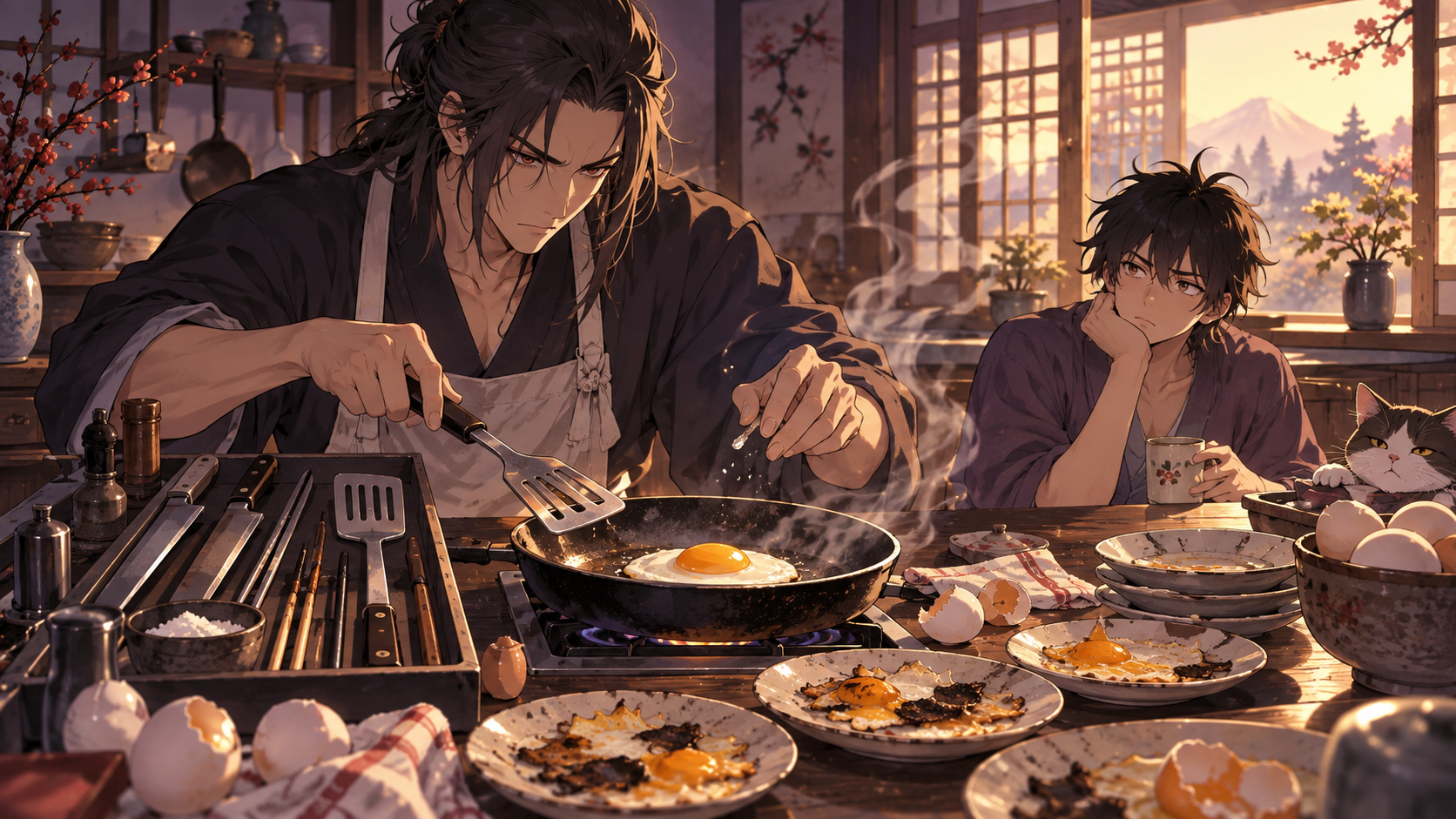
Excerpt: Sunny Side Battle! treats one perfect fried egg with the seriousness of an elite mission—and briefly gives two tragic brothers the ordinary morning canon denied them.
Focus keyword: Sunny Side Battle Naruto review
SEO title: Sunny Side Battle! Naruto OVA Review | CVM Sekai
Meta description: Our Sunny Side Battle review explores Itachi’s perfect fried egg, Sasuke, domestic care, tragic irony, game-bonus OVA status, and why the joke hurts.
Itachi Uchiha Has One Mission: Do Not Break the Yolk
Itachi approaches a frying pan with the concentration of a man preparing an S-rank operation.
The oil temperature matters. The timing matters. The shape matters. Sasuke’s standards matter most of all.
Sunny Side Battle! turns breakfast into combat choreography. Fried eggs fail with dramatic precision. Utensils become mission equipment. Itachi recalculates, tries again, and refuses to accept a result that does not meet his younger brother’s impossible ideal.
The joke is immediate: a shinobi associated with terrifying competence directs all of that skill toward one tiny domestic task.
The ache arrives underneath.
Itachi and Sasuke’s canonical relationship is defined by love distorted through secrecy, massacre, manipulation, revenge, and sacrifice. Ordinary care becomes almost unimaginable beside that history. The short creates a space where brotherhood can be measured through breakfast instead of blood.
That is why the comedy works harder than the premise should.
The perfect egg is funny because canon denied them enough peaceful mornings for imperfection to become ordinary.
Domestic Labor Becomes a Technique Sequence
Naruto animation teaches viewers how to read preparation. Hands move with precision. Tools are selected. Attention narrows. A character’s mastery becomes visible through controlled action.
Sunny Side Battle! applies that visual language to cooking.
The mismatch transforms routine labor into spectacle without suggesting the labor is actually trivial. Cooking for another person requires attention, repetition, and knowledge of preference. Itachi’s intensity exaggerates the task, but the care underneath is recognizable.
Domestic work is often treated as invisible because its result disappears quickly. The food is eaten. The pan is washed. The next meal arrives. By filming breakfast like a battle, the short makes the work impossible to ignore.
Itachi is not merely producing an egg. He is trying to deliver an experience precise enough to satisfy Sasuke, perhaps precise enough to express affection without saying it.
That emotional indirectness fits him. Itachi’s central tragedy is his belief that love can be protected through unilateral action and hidden intention. Even in comedy, he chooses perfect performance over conversation.
The egg carries what he will not name.
Sasuke’s Standards Are the Second Half of the Joke
The younger brother does not simply accept breakfast with gratitude. His judgment creates the mission.
That dynamic keeps the short from becoming a sentimental portrait of Itachi as selfless caretaker. Care happens inside relationship, and relationships contain irritation, expectation, and absurdly specific preferences.
Sasuke’s dissatisfaction is funny because it places him in the role of impossible client. It is also believable. Younger siblings often experience care as part of the world before recognizing the labor behind it.
Itachi accepts the challenge because competence has become one of his primary languages. If Sasuke can identify a flaw, Itachi will remove the flaw rather than ask whether perfection is necessary.
The loop reveals affection and dysfunction at once.
Sasuke wants the egg. Itachi wants to become incapable of disappointing him. Those are not equal needs.
In a longer story, that imbalance would require confrontation. In a short comedy, it produces increasingly ridiculous attempts and a final image fans can hold beside the tragedy.
The Short Is Funny Only After the Story Becomes Sad
Viewers who encounter Sunny Side Battle! without knowing Itachi’s history can still enjoy the cooking escalation. The animation and premise are legible.
The emotional value depends on spoilers.
Once viewers know the Uchiha massacre, Itachi’s assignment, Sasuke’s revenge, and the truth revealed after Itachi’s death, every peaceful domestic image becomes alternate history. We are not watching a memory that can fit comfortably into the canonical relationship. We are watching an impossible ordinary life.
That knowledge changes laughter.
Itachi’s persistence resembles the impossible burden he assumed elsewhere: solve everything alone, absorb every failure, and deliver a protected future to Sasuke without allowing Sasuke meaningful participation.
The scale is comic, but the pattern remains.
This is why the short should be watched after Itachi’s complete story is known. Earlier placement risks spoiling the relationship’s emotional shape while depriving the comedy of its most powerful undertone.
The egg is not tragic by itself. The audience brings tragedy into the kitchen.
Itachi’s Competence Is Allowed to Become Ridiculous
Itachi often appears through awe. Other characters describe his genius, fear his techniques, or reinterpret his choices after death. The seriousness can flatten him into symbol: prodigy, traitor, martyr, brother.
Comedy restores texture.
A person capable of catastrophic precision can still overthink breakfast. Mastery in one context does not eliminate absurdity in another. The short gently breaks the monument without disrespecting the character.
That matters for fandom. Beloved tragic characters can become trapped inside reverence. Every appearance is expected to confirm depth, pain, or superiority.
Sunny Side Battle! lets Itachi fail repeatedly at an egg.
The failure does not make him less intelligent. It makes intelligence visible as a habit that can become comic when applied beyond necessity.
Perfectionism is impressive from a distance. In a kitchen full of ruined breakfasts, it is also exhausting.
Sasuke’s presence prevents the comedy from becoming mockery. Itachi is ridiculous because he cares, and the short cares about that care.
A Peaceful Morning Is Its Own Form of Fan Service
Fan service is often discussed as spectacle: a favored fight, transformation, costume, pairing, or callback. This short offers something quieter.
It gives fans time the characters lost.
No village authority waits outside. No clan politics enter the room. No mission asks Itachi to choose institutions over family. Sasuke can be difficult in a way that remains harmless. Itachi can fail without anybody dying.
The fantasy is not that the brothers become emotionally perfect. The fantasy is that their imperfections receive room to be mundane.
That is more moving than an idealized embrace would be.
Healthy family life includes repetitive tasks, unreasonable preferences, mild annoyance, and food that sometimes goes wrong. Tragedy steals those low-stakes failures first. Every interaction becomes meaningful because there are too few of them.
The short briefly returns abundance.
There can be another egg. Itachi can try again. Morning has not yet become the last one.
The Game-Bonus Context Matters
Sunny Side Battle! is associated with Naruto Shippuden: Ultimate Ninja Storm Revolution as bonus animation. It should not be cataloged as a television episode or evidence of a secret canonical breakfast inside the main timeline.
The format creates freedom.
A game bonus can celebrate characters, parody established visual language, and construct an impossible scenario without explaining how it fits between missions. Its purpose is adjacent to the game’s all-star appeal: give fans another way to spend time with familiar people.
Correct classification protects the work from the wrong expectations. The short does not need to advance the plot, resolve the brothers’ history, or explain the Akatsuki. It needs to execute one premise with enough craft that the premise becomes memorable.
It does.
The official Bandai Namco game record provides the release context. That receipt establishes the animation’s relationship to the game; it does not transform the breakfast into manga continuity.
Format is not a downgrade. It is the condition that makes the joke possible.
Food Becomes a Love Language with a Control Problem
Cooking for somebody can be generous. It can also become a way of managing the relationship through service.
Itachi’s devotion repeatedly takes the form of deciding what Sasuke needs and acting without honest communication. In the main story, the consequences are catastrophic. In the kitchen, the pattern shrinks into perfectionism.
He will produce the correct egg. He will not ask whether Sasuke understands the effort, whether the standard is reasonable, or whether imperfect breakfast could still carry love.
That is the short’s accidental psychological truth.
Care becomes healthier when the receiver can see the caregiver and when the caregiver can tolerate being seen as imperfect. Itachi struggles with both conditions.
The comedy allows us to notice without turning breakfast into a diagnosis.
Sometimes an egg is an egg. Sometimes the determination not to break the yolk looks suspiciously like a man trying to prevent every relationship from revealing how fragile it already is.
Fandom can hold both readings.
Animation and Comic Timing
The short depends on contrast between cinematic seriousness and trivial objective. Camera angles, concentration, repeated attempts, and escalating preparation borrow the grammar of combat.
Timing keeps the premise from becoming one note.
Each failure has to differ enough to justify another attempt. Sasuke’s reactions establish the standard. Itachi’s refusal raises the stakes inside his own head. The kitchen accumulates evidence that perfection may cost more than breakfast deserves.
The sunny-side-up egg is also visually ideal for animation. The yolk’s shape provides an immediate pass-or-fail condition. Viewers understand the goal without culinary explanation.
Warm domestic colors soften the Uchiha association with night, fire, and violence. The short’s visual world itself becomes alternate emotional space.
Japanese Cast and Performance Notes
Hideo Ishikawa’s Itachi benefits from playing severe concentration without the lethal context usually attached to it. The familiar restraint becomes comic because the object of attention is breakfast.
Noriaki Sugiyama’s Sasuke supplies the exact younger-brother skepticism required. His responses make clear that Itachi’s standard is not entirely self-invented, while preserving the affection underneath the demand.
The performances avoid winking too aggressively at the audience. Playing the mission sincerely is what makes it funny.
Where It Fits—and What It Is
Watch Sunny Side Battle! only after Itachi’s full history and Sasuke’s understanding of it are known. The short assumes audience familiarity and gains emotional meaning from tragic irony.
It is a game-bonus comedy OVA associated with Ultimate Ninja Storm Revolution. It is not main-series continuity and not a lost television episode.
Treat it as an affectionate alternate-space character piece: a few minutes where domestic care replaces clan tragedy without pretending the tragedy never happened.
Final Verdict
Sunny Side Battle! is a tiny joke with unusual emotional afterlife.
Itachi attempts to cook the perfect fried egg for Sasuke. The production treats the task like an elite mission. Failure accumulates. Perfectionism becomes slapstick.
And beneath every laugh sits the knowledge that these brothers were denied enough ordinary mornings to learn how love survives an imperfect breakfast.
The short does not repair canon. It does not need to.
It opens a kitchen door, lets Itachi try again, and allows Sasuke’s complaint to remain the worst thing that happens.
For them, that is fantasy.
Rating: 8/10 — A beautifully judged game-bonus comedy whose battle-level breakfast direction becomes a tender gift of ordinary time to Naruto’s most tragic brothers.