
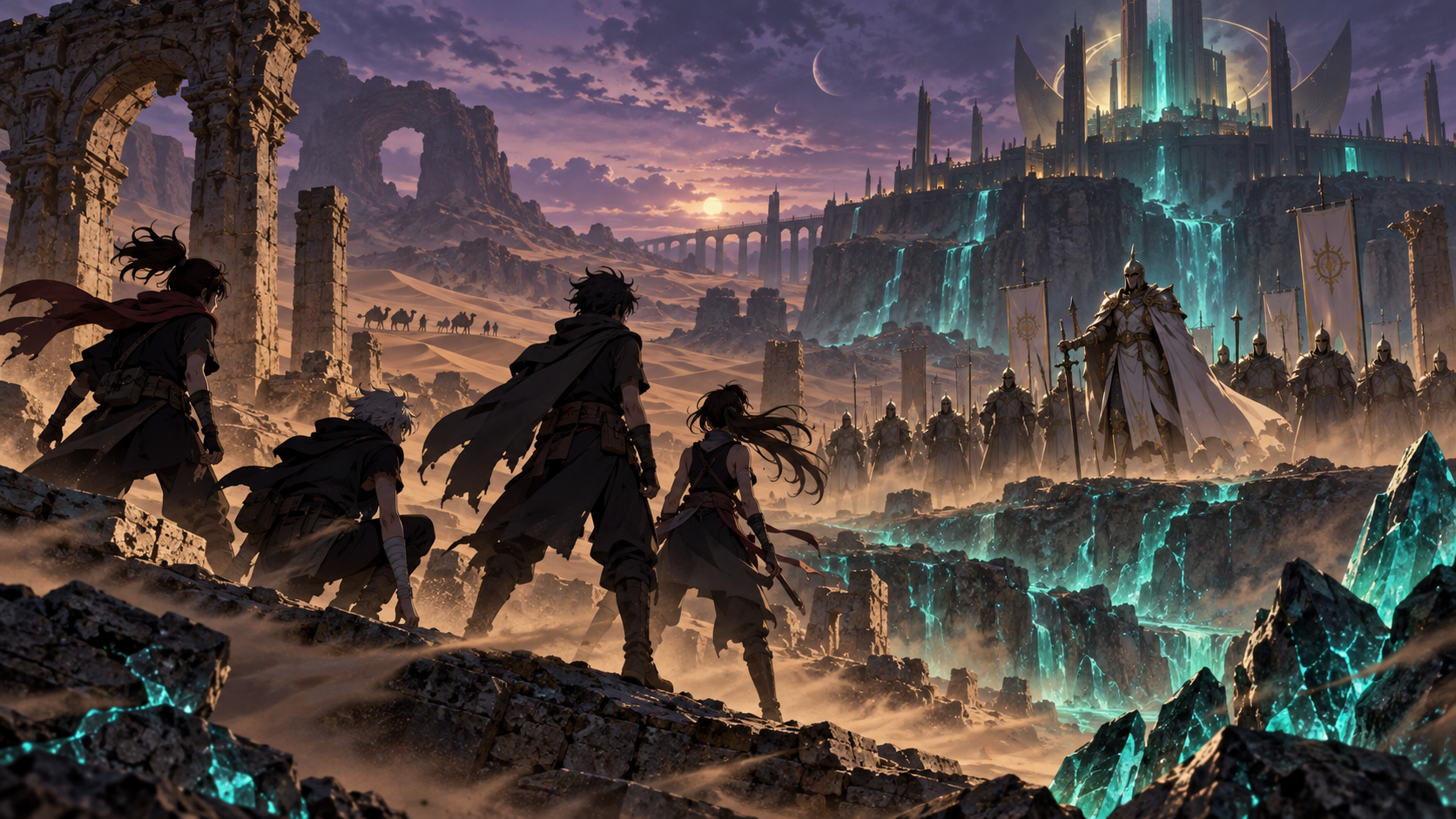
Excerpt: Legend of the Stone of Gelel gives Naruto a glowing mineral, a self-declared utopia, and one of the franchise’s clearest warnings about peace built on stolen land and disposable bodies.
Focus keyword: Legend of the Stone of Gelel review
SEO title: Legend of the Stone of Gelel Review | CVM Sekai
Meta description: Our Legend of the Stone of Gelel review digs into Haido’s false utopia, Temujin’s faith, stolen resources, Gaara, and Naruto’s refusal to call conquest peace.
A Utopia Is Still an Empire When Somebody Else Has to Bleed for It
There is a particular kind of villain who does not enter a room announcing that he wants power. He arrives talking about peace. He promises a world without borders, hunger, or war. He says the old divisions have failed—and because he is not entirely wrong about that part, people listen.
That is what makes Master Haido more interesting than the second Naruto movie initially lets him look. Legend of the Stone of Gelel begins with a lost-ferret mission, brings in a blond knight who appears to have wandered over from a different fantasy franchise, and throws Naruto into a mineral-powered conflict far away from Konoha. Underneath the genre pileup is a blunt political question: what does “peace” mean when the person selling it needs your land, your history, and your body to build his version of it?
The answer is not subtle. Haido’s utopia is conquest with better public relations.
That does not automatically make the movie great. Its ideas are often sharper than its structure, and the final act reaches for spectacle before it has fully earned the emotional weight it wants. Still, this is exactly the kind of side story worth reviewing instead of dismissing as filler. It sees something true about Naruto’s world. Adults repeatedly teach children to die for institutions, then rename that sacrifice honor. Haido simply packages the same extraction in prettier language.
The Ferret Mission Was Never Going to Stay Small
Naruto, Sakura, and Shikamaru begin the film trying to return a lost ferret. Sasuke is already gone, Kakashi is not leading the assignment, and the shape of the team immediately places the story in that uneasy stretch after the Sasuke Recovery Mission. Naruto has failed to bring his friend home, but the series has not yet moved him into Shippuden. He is still loud, impulsive, and absolutely convinced that sincerity can break through any wall if he hits it hard enough.
Then Temujin arrives.
His armor, sword, and formal loyalty to Haido make him feel deliberately foreign beside the shinobi cast. That contrast matters. The film is not merely giving Naruto a new rival. It is placing two child soldiers from different systems in front of each other. Naruto serves a hidden village whose violence he understands imperfectly. Temujin serves a charismatic leader whose violence has been hidden from him.
Both boys believe in a future without loneliness. Only one of them has been taught that the road to that future requires other people to disappear.
The Stone of Gelel powers Haido’s technology, strengthens bodies, and sustains his vision of a transformed world. It is also a resource guarded by a clan whose destruction Haido treats like an inconvenient historical footnote. The movie’s politics are clearest when the mineral stops being a magic object and becomes what powerful outsiders always call a valuable resource: something that supposedly belongs to everyone the moment somebody with an army wants it.
Temujin Is the Movie’s Real Emotional Center
Naruto is the title character, but Temujin carries the film’s most important wound. He is not foolish because he wants peace. He is vulnerable because Haido found that desire, praised it, and attached it to obedience.
That kind of manipulation works because the dream is sincere. Temujin has seen violence and believes Haido offers an alternative. He cannot recognize the empire growing around him because he has been given a role inside it, a uniform that makes him feel necessary, and language that turns every victim into an obstacle to the greater good.
The film could have done more with his realization. Temujin moves through betrayal, horror, and resistance quickly because the running time needs him positioned for the climax. But the core lands. Learning that your protector manufactured the world you needed protection from is not a simple plot twist. It is the collapse of an identity.
Naruto understands that kind of collapse better than he knows. He has spent his life chasing recognition from a village that concealed the truth of his body and made him carry its fear. The difference is that Naruto’s bonds eventually become specific. Iruka is not “the village.” Team 7 is not “the system.” His love attaches to people he can argue with, disappoint, forgive, and protect. Temujin has been taught to attach his love upward, toward Haido’s vision. That makes exploitation easier. A person can answer back. A vision only demands more.
Haido’s Peace Depends on Erasure
Haido is most frightening before the movie turns him into a physical monster. His speeches treat history as clutter. Old nations, clan memory, local claims, and inherited grief are problems to be swept aside by a unified future. That sounds progressive until we notice who gets to define unity.
Not the displaced clan. Not Kahiko, who carries the memory of Gelel’s danger. Not the people used in Haido’s experiments. Haido decides what the future costs because he has already decided that everyone else’s losses belong to the past.
This is where Legend of the Stone of Gelel feels unexpectedly current. Extraction is often sold as development. Occupation calls itself stabilization. Cultural destruction becomes modernization. The language changes first because people resist cruelty more easily when cruelty uses its own name.
Haido understands branding.
The film does not explore every consequence with the depth the premise deserves. We see the machinery of his conquest more clearly than the societies crushed beneath it. Even so, it gives Naruto something better than a villain who simply enjoys pain. Haido believes power grants him the right to redesign the world, and he has learned to speak as if the redesigned world asked him to do it.
Gaara and Kankurō Give the Conflict Necessary Weight
Gaara and Kankurō do not appear only because the movie needs familiar faces. Their presence changes the political scale. The Land of Wind is dealing with Haido’s forces too, which means the conflict cannot be contained inside Naruto’s latest accident. The Sand siblings make the invasion feel regional and remind us that hidden villages track threats through their own interests.
Gaara is especially effective because he wastes no time trying to compete with Naruto’s emotional volume. His fighting style supplies some of the movie’s strongest visual material, but his larger contribution is tonal. Naruto sees somebody in pain and runs directly toward the person. Gaara reads the battlefield, protects his territory, and responds with the restraint of someone who knows exactly what uncontrolled power can do.
Their different energies keep the action from becoming monotonous. Naruto’s battles are arguments with fists. Gaara’s are verdicts written in sand.
Kankurō also gets to operate as more than Gaara’s escort. Puppet combat fits beautifully against the movie’s armored soldiers and mechanical-fantasy aesthetic. The film is at its best when these traditions collide: shinobi techniques, knightly imagery, industrial machinery, and an ancient mineral all fighting to define what kind of story we are watching.
Sometimes that collision is messy. It is also memorable.
Sakura and Shikamaru Deserved More Room
Sakura and Shikamaru are the correct teammates for this stage of Naruto, but the screenplay rarely lets their intelligence reshape the story. Shikamaru should be dangerous to Haido because propaganda is a system, and systems are exactly what he is built to examine. Sakura should have more to do in a plot filled with bodily experimentation, forced transformation, and adults weaponizing young people.
They contribute. They do not own enough of the movie.
That imbalance reflects the original-series period in which the film was made. Sakura is present, capable, and still waiting for the writing to understand how much narrative authority her medical training and emotional perception will eventually give her. Shikamaru is recognized as clever but often deployed as the person who explains why Naruto’s impossible choice might work.
A stronger version of the film would let Shikamaru dismantle Haido’s logistical lie while Sakura confronts the human cost of Gelel-enhanced bodies. Instead, both are frequently routed toward support so Naruto and Temujin can hold the central ideological fight.
The focus makes sense. The lost opportunity remains.
The Action Looks Best When the Magic Has Consequences
The Stone of Gelel is visually effective because it does not behave like ordinary chakra. Its blue-green light cuts across desert stone, armor, and flesh as something ancient that modern ambition cannot safely control. The movie repeatedly frames the mineral as beautiful before showing what people become when they force it into service.
That beauty is important. Dangerous resources are rarely dangerous because nobody wants them. They are dangerous because they promise abundance, security, and transformation. Gelel looks like a miracle. Haido’s crime is not recognizing its power. His crime is deciding that recognition makes him its rightful owner.
The climax becomes busy, with transformations and collapsing structures competing for attention. Naruto movies often inflate the final battle until character-scale emotion has to shout through the debris. Here, the spectacle works when it reflects Temujin’s broken faith and Naruto’s refusal to accept sacrificial arithmetic. It works less when the mechanics of the energy source start doing more narrative labor than the people.
Even then, the film has an identity. The desert environments, medieval armor, caravans, ruins, and glowing mineral make it look unlike a long television episode with a theatrical budget. Side movies should use their freedom to travel somewhere the weekly show cannot comfortably live. Gelel does.
Japanese Cast and Performance Notes
Junko Takeuchi gives Naruto the exact balance this story needs: comic impatience early, moral fury once Haido’s project becomes visible, and unembarrassed conviction when Temujin’s faith collapses. Naruto can sound naïve on paper. Takeuchi makes his certainty feel earned through pain. He believes people can choose differently because he has needed that choice to remain alive.
Temujin’s performance has a harder assignment. He must sound disciplined without becoming empty, devoted without seeming stupid, and shattered without instantly turning into Naruto’s follower. The character is strongest when his formality begins to crack. We hear the boy underneath the knight before he knows what to do with that exposure.
The returning cast keeps the movie anchored even as its visual language drifts toward European fantasy. That anchoring prevents the setting experiment from feeling like a crossover nobody explained.
Where It Fits—and Whether It Is Canon
The cleanest viewing placement is after the Sasuke Recovery Mission and before the time skip. Sasuke is absent, Naruto has not left to train with Jiraiya, and Sakura and Shikamaru fit their late-original-series roles. Gaara’s presence also makes more sense once viewers understand the Sand siblings beyond their Chūnin Exam introduction.
The movie is an anime-original side story. The manga and later central continuity do not require its events. That is the useful meaning of “not canon” here. It is not an instruction to treat the film as worthless, and it is not permission to force it into the timeline until every travel day breaks.
Watch it as a thematic file. It asks what Naruto’s belief in peace looks like beside a leader who has turned the same word into propaganda.
Final Verdict
Legend of the Stone of Gelel is uneven, ambitious, and far more politically interesting than its lost-ferret opening suggests. Its supporting cast needs more agency, its final act becomes crowded, and Temujin’s emotional reversal deserves additional time. The movie also builds one of the original Naruto era’s better standalone antagonistic ideas: a man who sells empire as the end of war.
Haido does not fail because peace is childish. He fails because his peace has an owner.
Naruto’s answer is messy and incomplete, but it is rooted in relationships rather than possession. People are not raw material for a future designed without them. Land is not empty because an invader refuses to learn its history. A child soldier is not proof of a leader’s goodness because he smiles while obeying.
That is enough to make the second Naruto film worth more than completionist homework. The fantasy armor and glowing stone are decoration. The real conflict is between solidarity and conquest—and the conqueror, as usual, has practiced saying “peace” in a very convincing voice.
Rating: 7/10 — A visually distinct, politically sharper-than-expected side story whose false-utopia argument survives its crowded final act.