
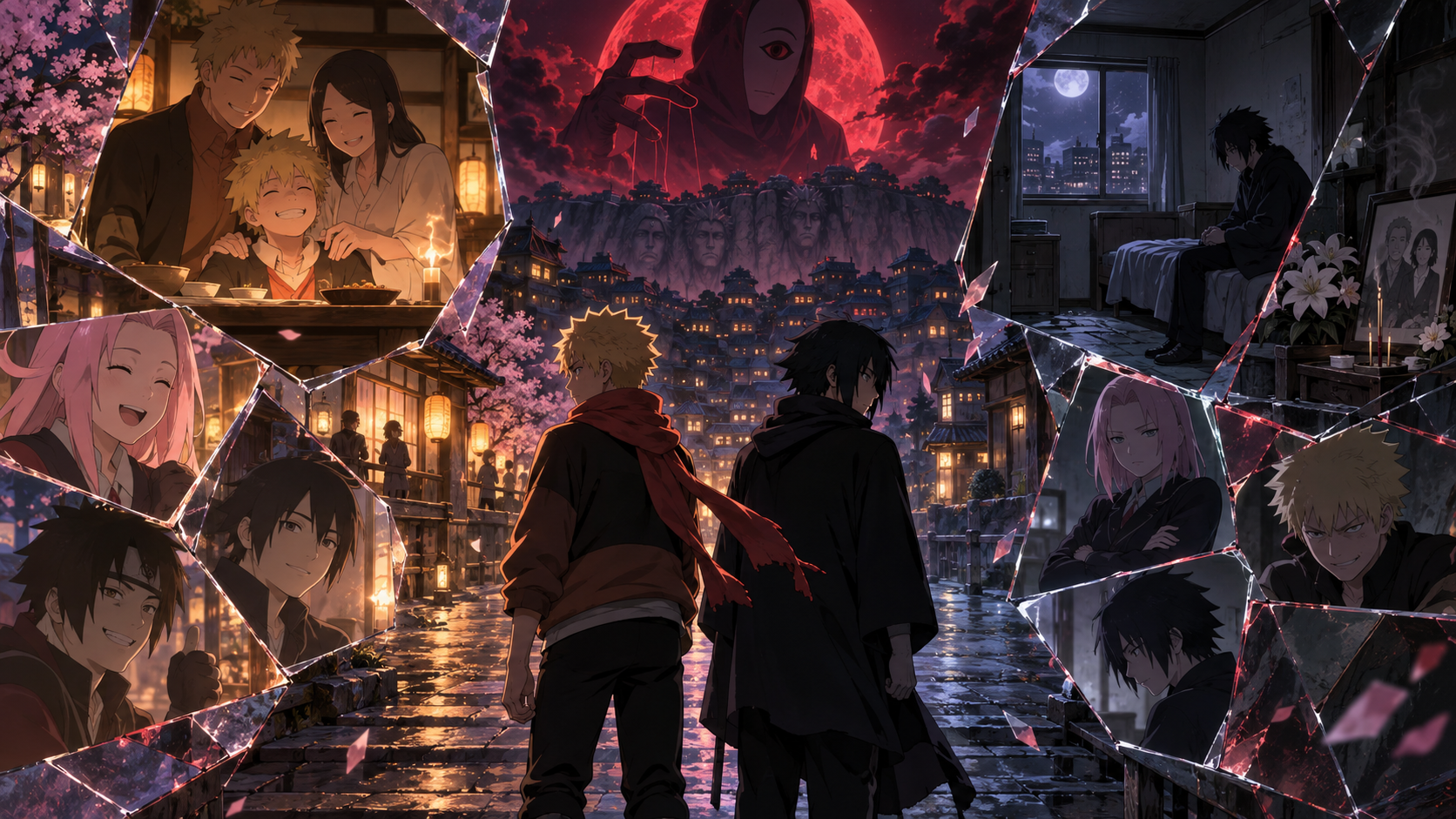
Excerpt: Road to Ninja gives Naruto the living parents he always wanted and asks whether grief can recognize a cage when the cage feels like home.
Focus keyword: Road to Ninja Naruto the Movie review
SEO title: Road to Ninja: Naruto the Movie Review | CVM Sekai
Meta description: Our Road to Ninja review explores Naruto and Sakura’s grief, the Limited Tsukuyomi world, reversed identities, false fulfillment, Minato, Kushina, and home.
The Cruelest Fantasy Is the One That Knows Exactly What You Wanted
Naruto comes home to an empty apartment while his friends return to parents celebrating their children’s advancement. Sakura storms away from a fight with her mother and wishes, in the reckless privacy of frustration, that she could trade families with somebody who has none.
Then the masked man gives both teenagers what they think they want.
Road to Ninja: Naruto the Movie builds its alternate world around emotional hunger. Naruto receives living parents. Sakura receives a home where nobody nags, embarrasses, or limits her. Familiar classmates arrive with personalities rearranged. Sasuke is available and attentive. Hinata is aggressive. Neji is shameless. Everything is recognizable enough to feel safe and wrong enough to keep the audience uneasy.
The Limited Tsukuyomi world does not simply reverse traits for comedy. It studies desire and constructs an environment designed to lower resistance.
That is what makes this one of the strongest Naruto films.
The fantasy does not tempt Naruto with power. It gives him dinner.
Kushina worries. Minato comes home. Family photographs include the child who grew up staring at other people’s windows. Naruto knows the world is false, but knowledge does not make the food taste less real or the care hurt less.
Grief recognizes the lie. Grief also wants to stay.
Naruto’s Apartment Has Always Been an Argument
The franchise often treats Naruto’s childhood loneliness as background once he becomes surrounded by friends. Road to Ninja returns to the physical evidence.
His apartment is not only small. It is unobserved. Nobody notices whether he ate, slept, came home injured, or left again. Independence was not granted because adults trusted him. It was imposed because the village had no family structure willing to claim the daily labor of raising him.
That history makes the opening celebration painful. Naruto’s friends are not wrong to enjoy their parents. Their ordinary joy reveals what he has learned not to request.
When Iruka fails to perform the parental recognition Naruto hopes for, the disappointment lands harder than the scene’s scale suggests. Naruto has accumulated mentors, comrades, and public respect. None of those automatically fills the chair across from him at dinner.
The movie refuses the easy claim that friendship replaces parents. Different bonds do different work. Naruto can love Team 7 and still grieve Minato and Kushina. He can belong to Konoha and still resent the years when belonging never included a home with another person in it.
The alternate world exploits that unfilled space.
Sakura Learns That Freedom from Family Is Not the Same as Freedom
Sakura’s frustration is ordinary in a way Naruto’s grief is not. Her parents embarrass her. Her mother criticizes her. Home feels restrictive because home contains people who have expectations and opinions.
The film does not punish Sakura for having a teenage argument. It places the wish beside Naruto’s reality and allows her to discover the difference between irritation and absence.
In the alternate world, Sakura’s parents are dead heroes. She receives status, sympathy, and an empty house. For a brief period, the freedom feels exhilarating. Nobody questions where she goes. Nobody interrupts. Nobody treats her as a child.
Then the silence becomes information.
Sakura’s arc is not “appreciate your parents because other people have it worse.” That reading reduces Naruto’s grief to a morality prop. The stronger lesson is that relationships create friction because other people remain present enough to resist our preferred image of ourselves. Total freedom from relational demand can become isolation wearing autonomy’s clothes.
Her parents are imperfect. Their imperfection is alive.
The alternate world teaches Sakura to distinguish the desire for more respect inside a relationship from the desire to erase the relationship entirely.
Menma Is Naruto Without the Same Network of Choices
The alternate Naruto, Menma, occupies the narrative space Naruto would have filled in this world. He is not merely an evil double designed for a final fight. He represents the danger of identity separated from the relationships that shaped its ethical direction.
Naruto and Menma share capacity, loneliness, and a connection to enormous power. What differs is the architecture around those traits.
The movie does not provide a complete psychological history for Menma, and the masked man’s manipulation complicates responsibility. Still, the double lets Naruto confront the fantasy of being special inside a family. Living parents do not guarantee the same self. A home can protect, but it cannot mechanically manufacture goodness.
Menma also destabilizes Naruto’s place in the alternate Minato and Kushina’s affection. Their love belongs to their son, and Naruto is inhabiting the emotional shape of that son without being him.
This prevents the fantasy from becoming uncomplicated adoption. Naruto receives care he desperately needs, but the care is attached to mistaken identity.
He cannot keep it without participating in the erasure of someone else.
That ethical limit helps him choose reality before the final battle makes the choice physically necessary.
Minato and Kushina Hurt Because They Feel Ordinary
The alternate parents are most effective when they are not delivering grand speeches.
Kushina worries, argues, protects, cooks, and occupies space with the overwhelming presence Naruto has imagined through absence. Minato is gentler and more cautious than the heroic father-image Naruto carries. They are not monuments. They are parents capable of fear, compromise, and daily affection.
Naruto initially resists them because accepting comfort feels like betraying truth. Then routine begins to work on him. A meal becomes harder to reject than an illusion’s spectacular promise.
This is the film’s emotional precision. Fantasy often imagines temptation as excess. Naruto is tempted by normalcy.
The alternate Minato’s caution also frustrates him. Naruto wants the father who died for the village, but a living father might prioritize returning to his child. Heroism looks different when the hero has somebody waiting at home.
That contrast complicates Naruto’s idealization. The parents he lost were brave enough to sacrifice themselves. The parents he meets are alive enough to be afraid.
Both forms of love matter.
The Reversed Konoha Cast Is More Than a Joke—Until It Is Not
The personality reversals provide much of the movie’s comedy. Hinata becomes openly possessive and confrontational. Sasuke performs flirtatious availability. Shikamaru loses his strategic sharpness. Kiba behaves like a cat person. Neji’s composure dissolves into inappropriate curiosity.
Some reversals are funny because they expose traits already present in smaller form. Others function as surface gags without much thematic purpose.
The strongest use of the altered cast is disorientation. Naruto and Sakura cannot rely on familiar social maps. A face no longer guarantees the response attached to it. The alternate world looks like home while constantly reminding them that recognition is not relationship.
Sasuke’s reversal is especially pointed for Sakura. She receives the attentive version she once wanted and discovers that easy availability removes much of the person she actually loved. Desire simplified him into a service.
That realization is important. Wanting somebody is not the same as wanting their full subjectivity. A fantasy partner who never resists may be convenient, but convenience is not intimacy.
The comedy occasionally becomes broad enough to flatten characters into single inverted traits. Still, the device supports the film’s central anxiety: if everybody behaves as wished, has anybody been loved?
Obito Understands That Grief Is an Entrance
The masked man’s Limited Tsukuyomi is a test version of the larger Infinite Tsukuyomi project. Instead of forcing an entire world into dream fulfillment, he targets Naruto and Sakura with a constructed reality.
His method is revealing. He does not defeat Naruto’s will through direct despair. He offers relief.
Obito knows grief because grief reorganized his own morality. He believes reality is unbearable and dreams are merciful. The alternate world is therefore not a random trap. It is his argument in miniature.
Why remain loyal to a reality that killed your parents, isolated you, and keeps producing war when another world can supply the love you missed?
Naruto’s answer is not that the dream feels fake. Parts of it feel intensely real. His answer is that fulfillment without freedom and shared history cannot become home.
Reality’s pain is not automatically virtuous. The movie avoids that trap by showing how much Naruto genuinely needs what the illusion offers. He chooses reality because relationships there include other people’s choices, not because suffering makes him morally pure.
Obito builds a world around the target. Naruto wants a world built with people.
Sakura and Naruto Finally Understand Each Other Better
The movie begins with an imbalance. Sakura complains about her parents in front of Naruto, who cannot retreat to parents after the conversation. Naruto longs for family recognition in ways Sakura initially reads only through her own frustration.
The alternate world swaps their emotional positions.
Sakura experiences the silence of a heroic orphan’s home. Naruto experiences parental attention. Neither experience perfectly reproduces the other’s life, but it creates enough displacement for empathy to move beyond abstraction.
Importantly, the film does not turn that empathy into romance. Their bond remains friendship shaped by shared knowledge. Sakura’s understanding of Naruto deepens. Naruto’s appreciation for Sakura’s ordinary family conflict becomes less dismissive.
The story lets two teenagers discover that envy edits reality. Naruto sees only the presence of parents, not every friction inside family life. Sakura sees only freedom from rules, not the cost of nobody waiting.
Both return with a more complete picture.
The Final Battle Turns Identity into Spectacle
Naruto’s confrontation with Menma and the masked man gives the film the large-scale action expected from a theatrical release. Dark power, mirrored techniques, and collapsing boundaries make identity physically visible.
The fight is emotionally legible because the movie has done the quieter work first. Naruto is not only defeating an alternate self. He is rejecting a version of belonging that requires surrendering truth and somebody else’s place.
The action occasionally grows busier than necessary, and the mechanics of the alternate world can blur. Yet the core remains visible: Naruto claims his name, his reality, and the imperfect network of bonds that chose him outside a dream.
The final return to Iruka matters because the film does not leave Naruto with abstract resilience. Iruka shows up. The ordinary act answers the apartment’s silence.
It is not Minato and Kushina. It does not need to pretend to be.
Japanese Cast and Performance Notes
Junko Takeuchi carries two versions of Naruto’s emotional shape without relying only on vocal opposition. Naruto’s defensive sarcasm around the alternate parents gradually softens into dangerous hope. Menma’s presence feels colder because the relationship to others has changed.
Chie Nakamura gives Sakura’s arc real tonal range. Early irritation, temporary delight, loneliness, fear, and renewed gratitude arrive without turning the character into a lesson-delivery machine.
Emi Shinohara and Toshiyuki Morikawa make Kushina and Minato’s domestic scenes work through ease. Their voices create the feeling of a household that existed before Naruto entered the room, which makes his inclusion comforting and ethically complicated.
The ensemble cast clearly enjoys the personality reversals, though the best performances keep a faint thread of recognition beneath the joke.
Where It Fits—and Whether It Is Canon
Watch Road to Ninja after the Five Kage Summit material and after Naruto knows the truth about his parents. The emotional premise depends on viewers understanding Minato, Kushina, Obito’s masked identity, and the scale of Naruto’s grief.
The movie is an alternate-reality side story and not part of the main manga timeline. Masashi Kishimoto’s story and design involvement gives the character exercise more authorial weight than a random promotional inversion, but it does not make the Limited Tsukuyomi events mandatory continuity.
Treat it as a thematic mirror. It tests Naruto and Sakura by constructing worlds from desires the central story cannot safely fulfill.
Final Verdict
Road to Ninja is one of the best Naruto movies because it understands that the most dangerous fantasy is not unlimited power. It is ordinary love delivered to the place grief left open.
The reversed-character comedy is uneven, the alternate-world mechanics can become cluttered, and Menma deserves more interior development. None of those weaknesses erase the film’s emotional intelligence.
Naruto receives parents who worry when he leaves and wait when he returns. Sakura receives independence without interference. Both discover that desire removes details. Parents are not only comfort. Freedom is not only solitude. A familiar face is not the person you knew if every difficult trait has been edited for your convenience.
Home cannot be defined only by how perfectly it soothes you.
The dream gives Naruto what he wanted. Reality gives him people who are free to arrive imperfectly—and Iruka, standing at the door, does.
Rating: 9/10 — An emotionally precise alternate-world story that turns fan-service reversals into a serious argument about grief, family, freedom, and false fulfillment.