
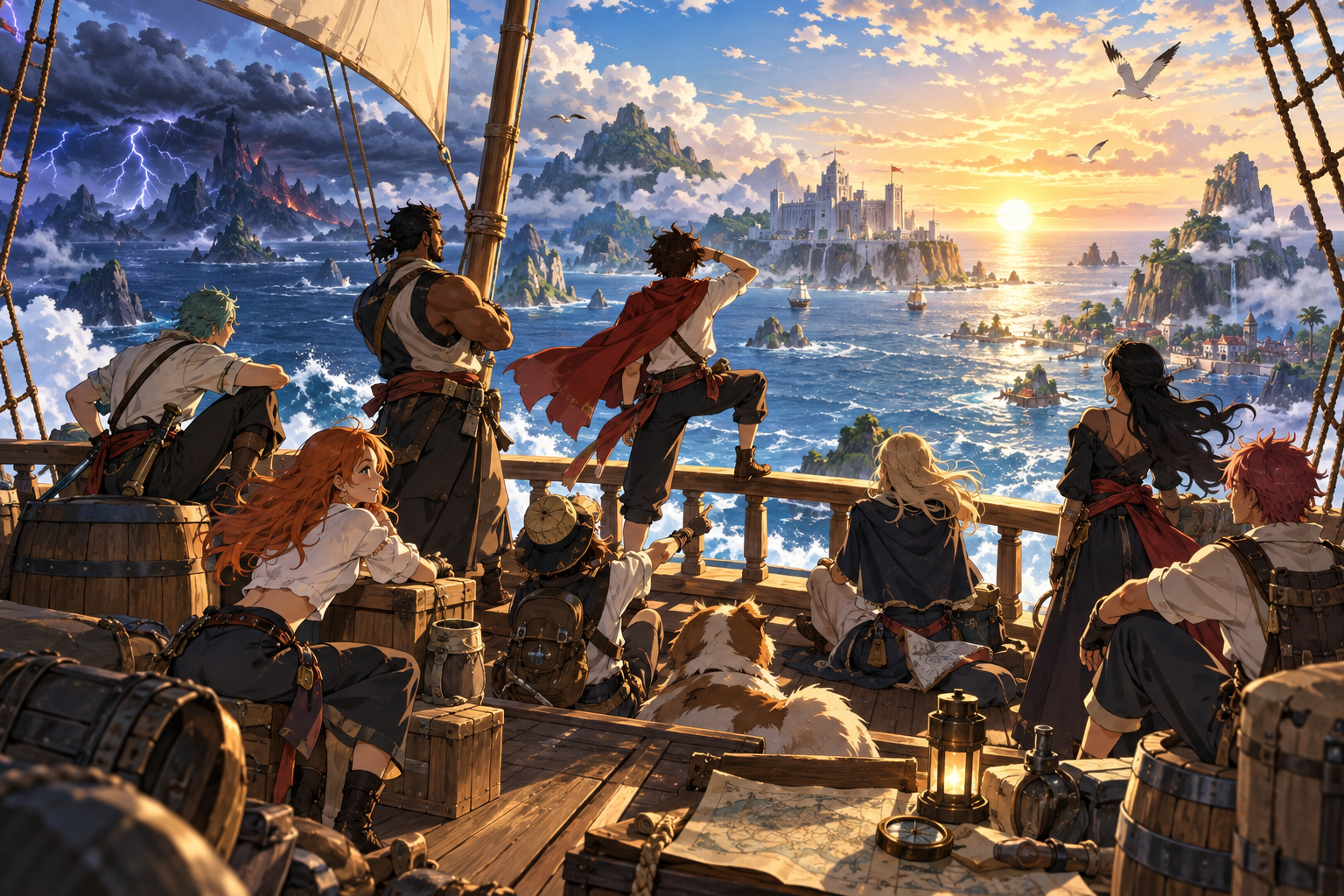
One Piece is a story about freedom that refuses to pretend freedom arrives without a bill. Monkey D. Luffy wants to become Pirate King because he thinks the Pirate King is the freest person on the sea. That sentence sounds wonderfully simple. The anime has spent decades complicating it with hunger, slavery, censorship, inherited violence, state propaganda, corrupt monarchy, chosen family, grief, labor, and the inconvenient fact that one person’s adventure can become somebody else’s cleanup shift.
This is a review of the television anime as a complete ongoing work, not an episode recap and not a victory lap for surviving more than a thousand installments. I love this ridiculous ocean. I also have complaints packed beside the emergency rations. Both belong here.
The verdict before we sail
At its best, One Piece is one of animation’s great long-form arguments for collective liberation. It understands that freedom becomes meaningful only when people can eat, remember, travel, speak, love, and choose a future without asking permission from the person holding the weapon or the history book. Its emotional architecture is patient enough to turn a whale, a broken ship, a bowl of rice, an old bell, or an empty chair into a promise.
At its worst, the anime confuses duration with depth. Pacing stretches until tension loses oxygen. Women’s bodies become running jokes the camera refuses to retire. Flashbacks repeat after the point has landed. Important political ideas sometimes receive cleaner emotional resolution than structural repair. The series can be generous, furious, funny, and maddening inside the same week.
RaeRae’s rating: 9/10 for the world, 10/10 for emotional memory, and a stern side-eye for the pacing decisions that made one punch feel like a semester.
Luffy is not a policy platform, and that matters
Luffy rarely arrives with a plan to reform an island. He notices one person being denied something basic, decides the arrangement is unacceptable, and punches the symbol of authority until the sky changes color. This is emotionally satisfying because he never asks an oppressed person to become respectable before helping them. Nami can lie. Robin can run. Vivi can hesitate. Sanji can push everybody away. Luffy’s loyalty is not a prize for perfect behavior.
That instinct is also incomplete. Removing a tyrant does not rebuild a food system, restore an archive, compensate labor, or guarantee that the next ruler will behave. One Piece knows this more often than fans admit. The crew leaves behind people who have to govern, farm, repair, grieve, and negotiate after the fireworks. The anime is strongest when those people remain visible instead of turning liberation into one heroic pose.
The Straw Hats work because nobody becomes furniture
The crew is not compelling because everybody agrees. They work because each person brings a private dream, a professional skill, and a boundary that can disrupt the captain’s momentum. Nami reads weather and money because adventure collapses without logistics. Zoro protects the line when improvisation becomes disaster. Sanji notices hunger before ideology. Chopper sees patients where institutions see monsters. Robin recognizes the violence hiding inside official language. Franky understands that invention can become shelter or weapon depending on who controls it. Brook carries the social damage of isolation. Jinbe brings political memory the younger crew cannot improvise.
Usopp may be the most important test of the crew’s values. He is not the strongest person on the ship, and the story repeatedly forces everyone to confront whether courage counts when fear remains visible. The Going Merry conflict hurts because it mixes grief with status, money, usefulness, leadership, and shame. Nobody gets to solve it by insisting friendship should erase the argument. The relationship survives only after pride stops impersonating protection.
Robin’s Enies Lobby story makes the same point from another direction. She does not need friends to declare that her life has value while ignoring what she believes. She needs enough safety to state a desire she has been trained to suppress. “I want to live” matters because the crew creates room for her answer and then accepts the responsibility attached to it.
The World Government understands the power of paperwork
One Piece villains do not rely only on strength. They control categories. Pirate. Criminal. God. Celestial Dragon. Illegal scholar. Dangerous bloodline. Disposable race. The World Government turns political decisions into neutral-sounding labels, then treats the label as proof that violence was necessary. Ohara is not merely destroyed; it is rewritten as a threat. Lulusia is not mourned; it is removed from the record. Bounties transform people into numbers that can circulate without context.
The anime keeps returning to archives because memory is material power. Poneglyphs survive institutions designed to control the past. Songs travel where documents cannot. Names cross generations. A bell can become evidence that two communities once shared a promise. History in One Piece is not background decoration. It is contested territory.
Food is the series’ most honest political language
Luffy’s appetite is funny until an arc places his full stomach beside somebody else’s empty bowl. Then food becomes a receipt. Who grows it? Who owns it? Who receives abundance? Who is expected to smile while hungry? From Cocoyasi and Alabasta to Dressrosa, Whole Cake Island, Wano, and beyond, the anime uses meals to expose whether liberation has reached ordinary life.
Sanji’s refusal to deny food is not soft characterization tucked between fights. It is an ethical position built from childhood starvation. Otama tasting red-bean soup carries more political weight than another throne-room speech because the scene lets pleasure reveal deprivation. One Piece understands that a revolution that never reaches the kitchen is still waiting to begin.
The anime’s pacing problem is real
The weekly production model has demanded an impossible balancing act: stay close enough to the manga to preserve the story, remain far enough behind to avoid catching it, and broadcast consistently enough to satisfy a television institution larger than any one creative team. The result includes astonishing direction, inventive anime-original expansion, beloved performances, and episodes that make three minutes of story feel like wet laundry being dragged uphill.
Slow pacing is not automatically bad. One Piece benefits when silence, reaction, landscape, and performance receive room. The problem is mechanical stretching: repeated shots, recaps inside scenes, held reactions that stop revealing new information, and movement broken into so many fragments that urgency becomes theoretical. The strongest recent episodes prove the production can expand material through visual interpretation instead of delay. When animators, directors, compositors, and performers are allowed to add perspective, the anime becomes adaptation rather than traffic control.
Women deserve better than the camera sometimes gives them
Nami, Robin, Vivi, Hancock, Big Mom, Bonney, Shirahoshi, Rebecca, Carrot, Yamato, and dozens of other women carry history, strategy, labor, rage, ambition, and grief. The writing often gives them enormous emotional and political importance. The camera does not always respect that work. Repeated body gags, shrinking costume logic, and framing that treats a serious scene like an excuse for anatomy remain weaknesses, not harmless decorations fans must accept to prove loyalty.
Criticism here is not a request to make the women less glamorous. It is a request to let glamour belong to the character instead of the lens. Nami can be sexy and still deserve shot composition that understands when she is negotiating, grieving, commanding, or terrified. Robin can be elegant without every costume pretending weather stopped existing. Affection for the series does not require pretending its visual habits are above criticism.
Performance keeps the impossible world human
The Japanese cast has carried these characters across decades without flattening them into catchphrases. Mayumi Tanaka gives Luffy a voice that can hold appetite, childish certainty, command, grief, and terrifying moral clarity. Kazuya Nakai lets Zoro’s restraint make rare breaks feel dangerous. Akemi Okamura keeps Nami’s intelligence audible even when panic enters the scene. Kappei Yamaguchi makes Usopp’s fear rhythmic without turning him into a joke. Hiroaki Hirata gives Sanji performance layers that often rescue the character from the camera’s worst habits.
The supporting cast matters just as much. One Piece asks performers to make a talking animal, a skeleton musician, a living cloud, a furious child, and an elderly revolutionary share emotional reality. The series works because the cast commits without winking at the audience. Absurdity is treated as a condition of the world, not permission to stop acting.
More than a thousand episodes later, the promise still holds
One Piece has outlived television eras, distribution models, aspect ratios, fandom platforms, and the patience of viewers who reasonably decided they did not want a second job. Its length is not automatically proof of quality. The achievement is that the story can make a detail planted hundreds of episodes earlier return with emotional force because the world remembers what institutions tried to bury.
I do not recommend rushing through it to join a conversation. The voyage works when islands have time to become places and side characters remain people rather than checkpoints. Use saga guides. Take breaks. Skip recap material when the format is not serving you. Watch the movies as separate productions, not secret homework. An episode React and a complete-series review perform different jobs, and neither should be filed as the other.
The final treasure may redefine the world, but the anime’s lasting argument is already visible: freedom is not one loud man doing whatever he wants. Freedom is the collective work of making room for other people’s dreams without turning them into tools for your own. The Straw Hats keep sailing because nobody has to surrender a private future to remain on the ship.
Final verdict: One Piece is sprawling, inconsistent, politically sharper than its reputation, visually frustrating in specific recurring ways, and emotionally generous enough to keep earning another horizon. The ocean is too long. The pacing is sometimes criminal. I am still on the ship.