
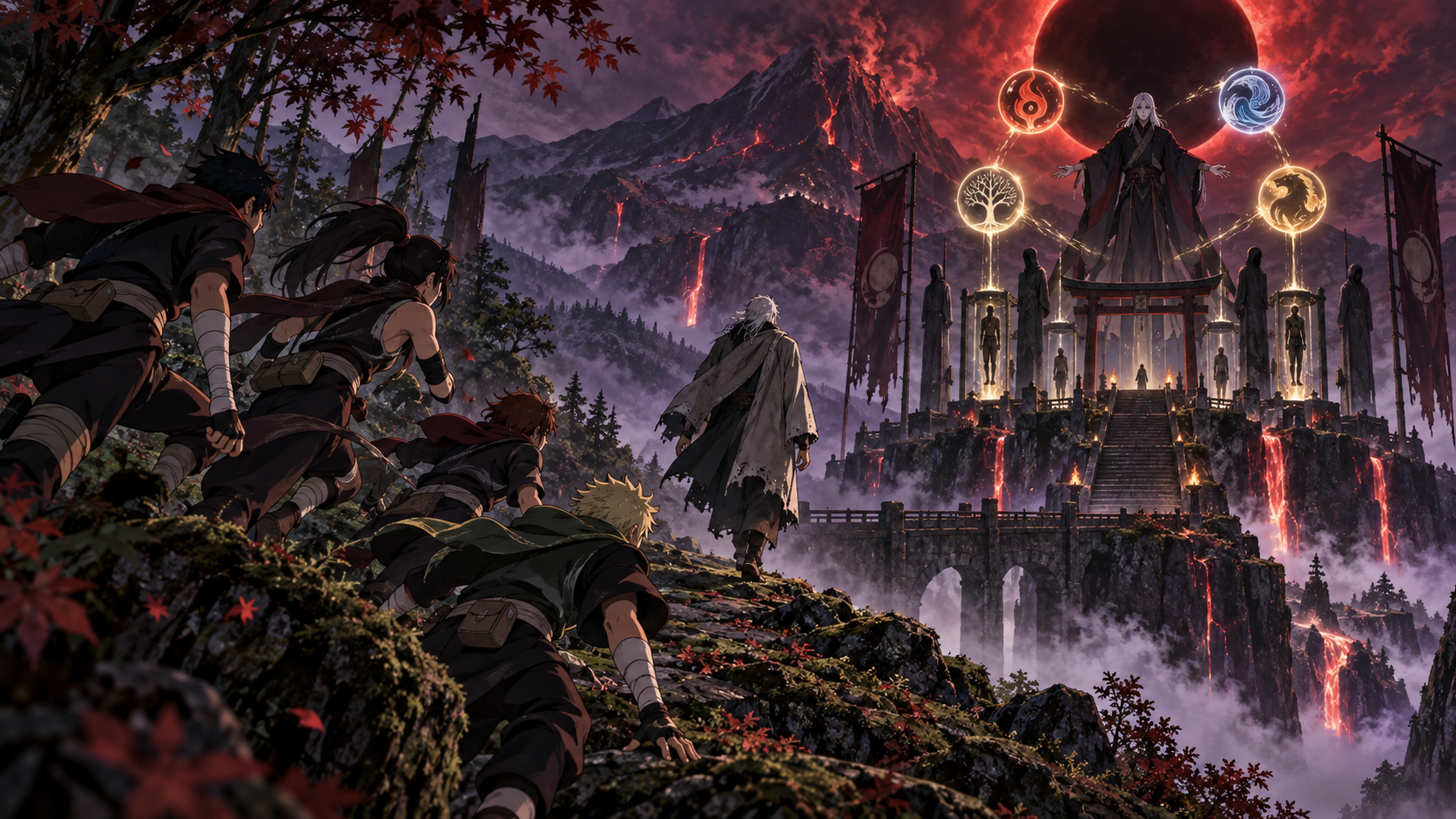
Excerpt: The Will of Fire asks whether protecting the village means surrendering one more person—or refusing the institution’s habit of calling disposability duty.
Focus keyword: Naruto Shippuden the Movie The Will of Fire review
SEO title: Naruto Shippuden: The Will of Fire Review | CVM Sekai
Meta description: Our Naruto Shippuden: The Will of Fire review explores Kakashi’s sacrifice, Hiruko’s bloodline theft, village duty, and Naruto’s refusal to accept necessary loss.
Konoha Has Another Plan That Requires One Person to Disappear Quietly
Five great nations are staring at one another across the possibility of war. Shinobi with kekkei genkai have vanished from four villages. The Land of Fire is the only major power that has not lost one, which makes Konoha look less fortunate than guilty.
Then Kakashi walks away to become the solution.
Naruto Shippuden the Movie: The Will of Fire understands one of the franchise’s ugliest recurring habits: institutions love sacrifice most when somebody else’s body performs it. The village calls the choice necessary. Leaders use the language of duty, balance, and survival. A single life becomes arithmetic beside the threat of war.
Naruto hears the calculation and recognizes the trick.
He has spent his entire life inside systems that decided some people were acceptable containers for everyone else’s fear. A tailed beast is sealed into a child because the village needs protection. Clan children inherit duties shaped by dead adults. ANBU disappear behind masks. Shinobi are praised for placing the mission above the self, even when the mission is protecting institutions that rarely return the devotion.
Kakashi’s willingness to surrender himself is heroic. It is also evidence of damage.
The movie’s central conflict is not simply Naruto versus Hiruko. It is Naruto versus every adult who looks at Kakashi’s trauma-trained self-erasure and calls it noble enough to permit.
Hiruko Turns Other People’s Inheritance into Property
Hiruko is a former Konoha shinobi who developed the Chimera Technique, allowing him to absorb kekkei genkai from other bodies. He does not merely copy a move. He transforms bloodline, history, and embodied identity into inventory.
That makes him a strong villain for the Naruto world. Kekkei genkai are never just powers. They are clan inheritance, political value, stigma, military leverage, and sometimes a death sentence. Villages protect bloodline secrets while deploying the people who carry them as strategic assets. Hiruko removes the institutional manners and treats the bodies exactly as resources.
His grievance begins in inadequacy. He trained beside the future Sannin and experienced himself as the one left behind. Orochimaru, Jiraiya, and Tsunade became legendary while Hiruko remained ordinary by comparison. Instead of questioning the system that defines worth through exceptional power, he accepts its logic and decides to win by collecting exceptional bodies.
The wound is understandable. The answer is monstrous.
Hiruko’s plan depends on a celestial event and the acquisition of Kakashi’s Sharingan as the final component. He frames theft as evolution. If the shinobi world respects inherited ability, then he will manufacture the ultimate inheritance inside himself.
The film sees the contradiction even when Hiruko does not. A person obsessed with proving his individual worth builds that worth entirely from other people.
Kakashi’s Sacrifice Makes Sense—and That Is the Problem
Kakashi is not hypnotized into becoming somebody unrecognizable. Hiruko’s technique influences and summons him, but the decision to move toward death fits a pattern already inside him.
This is a man who learned as a child that rules mattered more than comrades, then watched Obito die proving the opposite. He watched Rin die by his own hand. He lost Minato. He survived a generation of ghosts and built an adult identity around protecting the next group better than his own was protected.
Of course he believes his body is an acceptable price for preventing war.
Kakashi does not value himself the way Team 7 values him. His calm makes the sacrifice look considered rather than desperate. That composure is precisely why the village can accept it. Pain becomes easy to approve when the person carrying it uses professional language.
The movie gives Naruto the emotionally obvious position: save Kakashi. The adults hold the politically difficult one: what if saving one man risks thousands?
But the film refuses to let “difficult” become morally neutral. Institutions are responsible for searching beyond the sacrifice they find administratively convenient. Kakashi’s consent does not automatically cleanse the system accepting it, especially when his consent has been shaped by a lifetime of believing survival creates debt.
Naruto is not naïve because he refuses the first available corpse.
The Will of Fire Can Become a Beautiful Excuse
Konoha’s Will of Fire says that the village is a family and each generation must protect the next. At its best, the philosophy asks adults to build a future children can inherit. At its worst, “family” becomes a word used to demand obedience while disguising which members are always asked to bleed.
The movie presses on that contradiction.
If the Will of Fire means Kakashi should sacrifice himself for the village, then Naruto asks what the village owes Kakashi. If it means placing comrades above the self, then his students are not betraying the philosophy by chasing him. They are taking it seriously in the opposite direction.
That reciprocal reading matters. Duty cannot flow only upward. Citizens protect the village; the village must also protect citizens. Teachers protect students; students are allowed to decide that teachers are not disposable equipment. A philosophy of care becomes propaganda when only authority gets to determine whose care counts.
Naruto’s rebellion is therefore not anti-Konoha. It is an argument over what Konoha is supposed to be.
The title could belong to either side. Kakashi carries the fire toward sacrifice. Naruto carries it toward rescue. The movie’s moral choice is that inherited ideals remain alive only when the next generation is allowed to reinterpret them.
Tsunade Has to Govern, Not Merely Feel
Tsunade’s position is one of the film’s most uncomfortable. She cares about Kakashi and understands Naruto’s refusal. She also holds responsibility for a village facing international suspicion and possible war.
Leadership does not give her the luxury of making decisions only as a friend.
The story sometimes uses her as the wall Naruto must push against, but her dilemma deserves attention. A Hokage who openly risks multiple nations to retrieve one shinobi may appear irresponsible. A Hokage who accepts his death without exhausting alternatives becomes the administrator of sacrifice.
Tsunade’s strength as a leader has always involved the body. She is a healer, a survivor, and someone who knows how casually shinobi systems consume lives. That history makes her restraint here painful. She cannot simply follow Naruto into hope without accounting for everyone else under her protection.
The film resolves the conflict through action rather than allowing her political reasoning to develop fully. Still, her role prevents the story from pretending that love automatically produces easy policy.
Naruto can promise that nobody will die because he is the one running into danger to make the promise true. Tsunade has to prepare for what happens if he fails.
Team 7 Becomes Kakashi’s Rescue Mission
Naruto, Sakura, and Sai carry the pursuit, but the broader Konoha generation joins the resistance. That ensemble matters because Kakashi’s value is not limited to one student. He has trained, led, protected, and irritated enough people that his disappearance activates a network of relationships.
Naruto remains the loudest voice. Sakura brings a different claim: Kakashi is not only Naruto’s teacher to save. She has her own history with him, her own grief around Team 7, and her own refusal to lose another piece of that broken unit.
Sai’s presence is particularly useful. He entered Team 7 through an institution that trained emotional erasure as professionalism. Watching Naruto reject an approved sacrifice gives him another lesson in bonds that do not obey mission logic. Friendship is inefficient by Root standards. That inefficiency is exactly what makes it human.
The Konoha 11’s involvement turns Naruto’s personal refusal into a generational one. These are children raised to inherit the village’s values, and they are telling the village that protecting comrades cannot remain a slogan reserved for memorial stones.
The rescue becomes the Will of Fire arguing with itself.
Bloodlines, War, and the Politics the Movie Almost Reaches
The disappearance of kekkei genkai shinobi from multiple nations should create enormous political consequences. These are not only missing individuals; they are stolen military capabilities and evidence that borders cannot protect strategic bloodlines.
The film uses that premise efficiently to generate suspicion, but it does not fully explore the victims. Hiruko’s stolen bodies risk becoming components in his villain machinery rather than people with communities, names, and histories.
That absence weakens the critique. A story about reducing bloodline carriers to assets should work harder not to reduce them to plot devices.
Even so, the setup exposes the shinobi world’s hypocrisy. The great villages object to Hiruko stealing hereditary power, but those same villages organize families around preserving and weaponizing it. Hiruko is not alien to their logic. He is the endpoint they prefer not to see.
Kakashi’s Sharingan complicates this further. It was given through love and death, not inherited by blood or stolen through conquest. Hiruko sees only the ability. Kakashi carries the person.
The difference between possession and relationship is the film’s quietest argument.
The Action Works Best When It Expresses Loyalty
The movie gives Hiruko a collection of abilities designed for theatrical variety. His body becomes an archive of other people’s advantages, forcing the Konoha teams to respond to multiple combat logics inside one opponent.
The spectacle is effective, though the mechanics can become busier than the emotional confrontation. Hiruko wants Kakashi because the Sharingan completes a system. Naruto wants Kakashi because Kakashi is Kakashi. Everything important sits inside that contrast.
The fights among Konoha peers are also revealing. Orders place friends on opposite sides of the pursuit, and the young shinobi have to decide whether stopping Naruto protects the village or participates in a preventable death.
These clashes risk feeling like delay tactics, but they embody the franchise’s central difficulty: good people can inherit different interpretations of the same duty.
Naruto wins moral authority because he accepts the physical cost of his refusal. He is not asking others to risk what he will not.
Japanese Cast and Performance Notes
Kazuhiko Inoue gives Kakashi’s decision the calm that makes it dangerous. He does not sound like a man begging to be saved. He sounds like a professional completing the final unpleasant task, which forces the audience to hear how thoroughly self-sacrifice has been normalized inside him.
Junko Takeuchi answers that restraint with Naruto’s emotional violence. Naruto refuses to speak about Kakashi as an already completed loss. His volume is not ignorance of consequence; it is resistance to the language that makes consequence sound settled.
Chie Nakamura’s Sakura adds urgency grounded in shared history. She understands Naruto’s recklessness but does not accept the idea that maturity means watching Kakashi leave.
Hiruko’s performance moves between wounded comparison and theatrical superiority. The villain is strongest when insecurity remains audible beneath the accumulated power. He wants the world to acknowledge that he mattered. He has chosen a method that erases everyone else.
Where It Fits—and Whether It Is Canon
The most useful placement is after viewers understand Kakashi’s history with Obito and before the Fourth Shinobi World War consumes the timeline. The emotional logic depends on knowing why Kakashi would choose sacrifice and why his students would experience that choice as another inherited failure.
The film is an anime-original side story. The missing bloodline shinobi, international crisis, and Hiruko’s attack are not required by the manga’s central continuity.
Its thematic fit is strong even where calendar fit is optional. The main story repeatedly tests whether shinobi virtues protect people or merely make people easier to spend. The Will of Fire places that question directly inside Kakashi’s body.
Final Verdict
The Will of Fire is one of the more thematically coherent Naruto movies. Its international politics need greater depth, the stolen kekkei genkai victims deserve identities beyond their abilities, and some ensemble fights exist primarily to stretch the pursuit.
But the central argument holds.
Kakashi is willing to die because every important loss in his life taught him that the survivor must eventually pay. Hiruko steals inherited power because he accepted a world that equates extraordinary ability with worth. Konoha faces war and reaches for the solution shinobi institutions always find fastest: one disciplined body placed on the altar.
Naruto says no.
Not because sacrifice is never necessary. Not because leadership is simple. He says no because “necessary” should be the end of a search, not the word authorities use to avoid having one.
The Will of Fire is worth inheriting only if the next generation can stop it from becoming a furnace.
Rating: 8/10 — A strong Kakashi-centered side story that turns village loyalty into a real argument about reciprocal duty, stolen bodies, and institutional sacrifice.