
RaeRae Reviews · Animated Series
Boruto: Naruto Next Generations Complete Series Review
Boruto inherits peace from children who had to fight for it, then asks what that peace looks like to the kids who never saw the bill. That is a smart sequel idea. The anime finds real feeling inside it—and then buries too much of that feeling beneath a weekly machine that rarely knows when to stop.
The bottom line
A sequel with a better question than its reputation admits
My rating is 7 out of 10 for the complete 293-episode first part. The best Boruto material deserves more respect than it receives. The weakest material explains exactly why viewers lost patience. Both realities are visible without pretending the fandom must choose one.
Boruto begins from a fascinating reversal. Naruto wanted the village to notice him. His son wants the village—and especially the Hokage—to stop consuming his father. Boruto is not lonely because everybody hates him. He is lonely inside a loving family whose most powerful adult keeps treating public duty as the emergency that outranks private presence.
That conflict makes the sequel more than “Naruto with phones.” Modern Konoha has trains, television, scientific tools, franchise merchandise, and children who can imagine careers beyond immediate war. Peace produces new possibilities. It also creates selective memory. The village celebrates heroes more comfortably than it examines the institutions that made wounded children necessary.
Peace is not the absence of consequences
The early anime spends time showing daily life because daily life is the achievement Naruto’s generation fought to create. School trips, family dinners, video games, celebrity culture, scientific research, and low-stakes missions are not inherently betrayals of the franchise. They are evidence that history moved.
The problem is dramatic allocation. When nearly every small detour receives a full television commitment, ordinary life stops feeling observed and starts feeling scheduled. The anime often finds a sharp emotional premise—a child living beneath a clan expectation, a village carrying the leftovers of somebody else’s war, a parent who does not know how to speak peace—and resolves it before the consequences can deepen.
The scientific ninja tools are the clearest metaphor. Technology can distribute abilities once locked behind bloodlines and years of training. It can also separate power from judgment and let institutions call acceleration progress. Boruto cheating in the Chūnin Exams is personal dishonesty, but the device matters because the whole era is renegotiating what skill means.
Naruto becomes the adult his childhood did not prepare him to be
The sequel is hardest on Naruto when it shows him repeating institutional habits through good intentions. He loves Boruto and Himawari. He also sends a shadow clone to a birthday because the office has become the public version of the recognition he once needed to survive. The clone disappearing is not a scheduling mishap. It is a child watching symbolic absence become literal.
Naruto did not grow up inside a healthy family, so fatherhood is not a skill he inherited. That context earns empathy. It does not cancel the hurt. The anime is strongest when it refuses to make either side ridiculous: Boruto can be privileged and wounded; Naruto can be loving and failing.
Hinata holds the domestic center, but the writing too often makes her labor invisible because it functions smoothly. Himawari’s emotional intelligence is treated as sweetness instead of information. The Uzumaki household reveals the sequel’s central issue: peace still depends on somebody absorbing the labor that official history does not name.
The new Team 7 is not a photocopy—and thank goodness
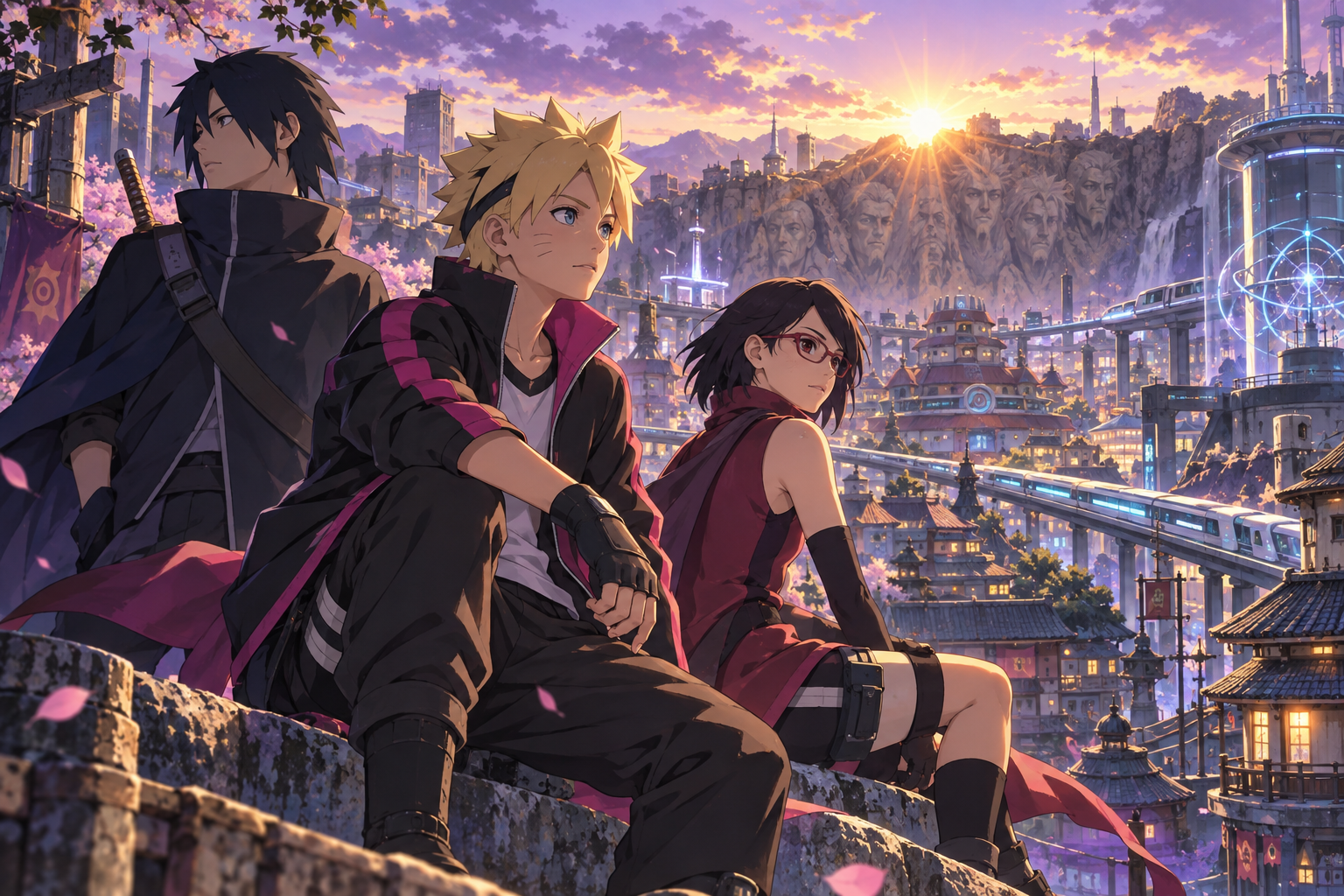
Boruto, Sarada, and Mitsuki begin with clearer communication than their predecessors, but clarity does not make them simple. Boruto’s instinctive talent creates impatience. Sarada wants the Hokage title Naruto finally won, yet her route is shadowed by the Uchiha history the village barely discusses. Mitsuki was engineered around another person’s expectations and has to discover whether devotion can become a self.
Sarada is the team’s moral organizer without being reduced to its mother. Her ambition is political: she wants to lead a village whose history is bound to the destruction of her clan. The anime gives her excellent moments of judgment and combat, especially when her Sharingan, strength, and tactical reading work together. It also leaves her waiting while the story increasingly centers the karma-marked boys.
Mitsuki’s search for a will of his own is one of the sequel’s best ideas. Orochimaru created a child and called choice part of the experiment. Every time Mitsuki acts for Boruto, the question remains: is this love, programming, or a decision repeatedly remade until the origin no longer owns it?
Kawaki gives the sequel the wound it was missing
Kawaki changes Boruto because his body makes exploitation impossible to keep abstract. Jigen and Kara treat him as property, test subject, container, and investment. Abuse trains him to read kindness as a trap with better lighting. Naruto’s care matters because it is patient, embodied, and connected to Naruto’s own history as a vessel.
The father-son bond between Naruto and Kawaki is emotionally persuasive. It is also dangerous because Kawaki turns safety into one person. Protecting Naruto becomes the principle capable of excusing anything, including stripping Boruto of agency. Trauma does not merely make Kawaki sad. It builds a political theory: if one irreplaceable person is safe, every other loss can be justified.
Boruto and Kawaki work as mirrors because both fear losing family from opposite positions. Boruto believes connection can survive conflict. Kawaki believes connection survives only if threats are removed. Their brotherhood is genuine, which makes the fracture more painful than a standard rival escalation.
The weekly machine keeps arguing with the story
Boruto’s visual quality swings widely across 293 episodes. Routine installments can look stiff and thin. Priority fights remind us exactly what Pierrot’s artists can do when time, staff, and scheduling align. Naruto and Sasuke versus Momoshiki remains the sequel’s visual declaration: speed, teamwork, spatial clarity, and emotional history operate in the same choreography.
The anime-canon label often becomes a shield instead of criticism. Material can be canonical to the television continuity and still be repetitive, underdeveloped, or badly placed. The useful question is not whether an arc “counts.” The useful question is what it changes.
The Japanese cast gives the era its identity. Yūko Sanpei lets Boruto sound cocky without hiding how quickly insecurity interrupts him. Kokoro Kikuchi gives Sarada authority and adolescent vulnerability. Ryūichi Kijima makes Mitsuki’s calm feel chosen and uncanny. Yūma Uchida turns Kawaki’s hostility into defense before the script explains it.
Sarada deserves to remain central when the mythology gets louder
Sarada enters with one of the franchise’s strongest inherited positions: Sakura’s discipline, Sasuke’s clan history, her own ambition, and a vision of Hokage leadership grounded in observation rather than applause. The anime repeatedly proves she can carry an episode. It does not consistently protect her importance once Karma and the Ōtsutsuki scale take over.
Chōchō receives confidence and comic freedom but is too often routed through appearance. Sumire moves from a compelling weaponized-child story into scientific support and romantic implication. Hinata and Sakura possess enormous expertise, yet the sequel uses their adulthood unevenly. Peace should have expanded women’s narrative territory. Too often it simply changes the room where they wait.
Final verdict
Boruto matters most when it refuses to worship inheritance
Boruto is not a failed sequel because it depicts peace, technology, or a protagonist who begins with advantages. It struggles because weekly volume dilutes consequence and because the franchise’s expanding alien mythology can crowd out the social questions that make its best material land.
At its strongest, the anime asks whether children owe gratitude for peace when adults use that peace to avoid honest conversations about how it was purchased. It asks whether Naruto can be a national symbol without disappearing as a father. It asks whether Kawaki can receive love without turning love into possession. It asks whether Boruto can inherit a legend without becoming merchandise inside it.
The answer is uneven, frustrating, and worth engaging. Use an arc guide if the pacing stops serving you. Do not skip the domestic conflicts because they are the sequel’s foundation. And do not let either nostalgia or backlash decide what you saw.
Connected Naruto reading
Official records