
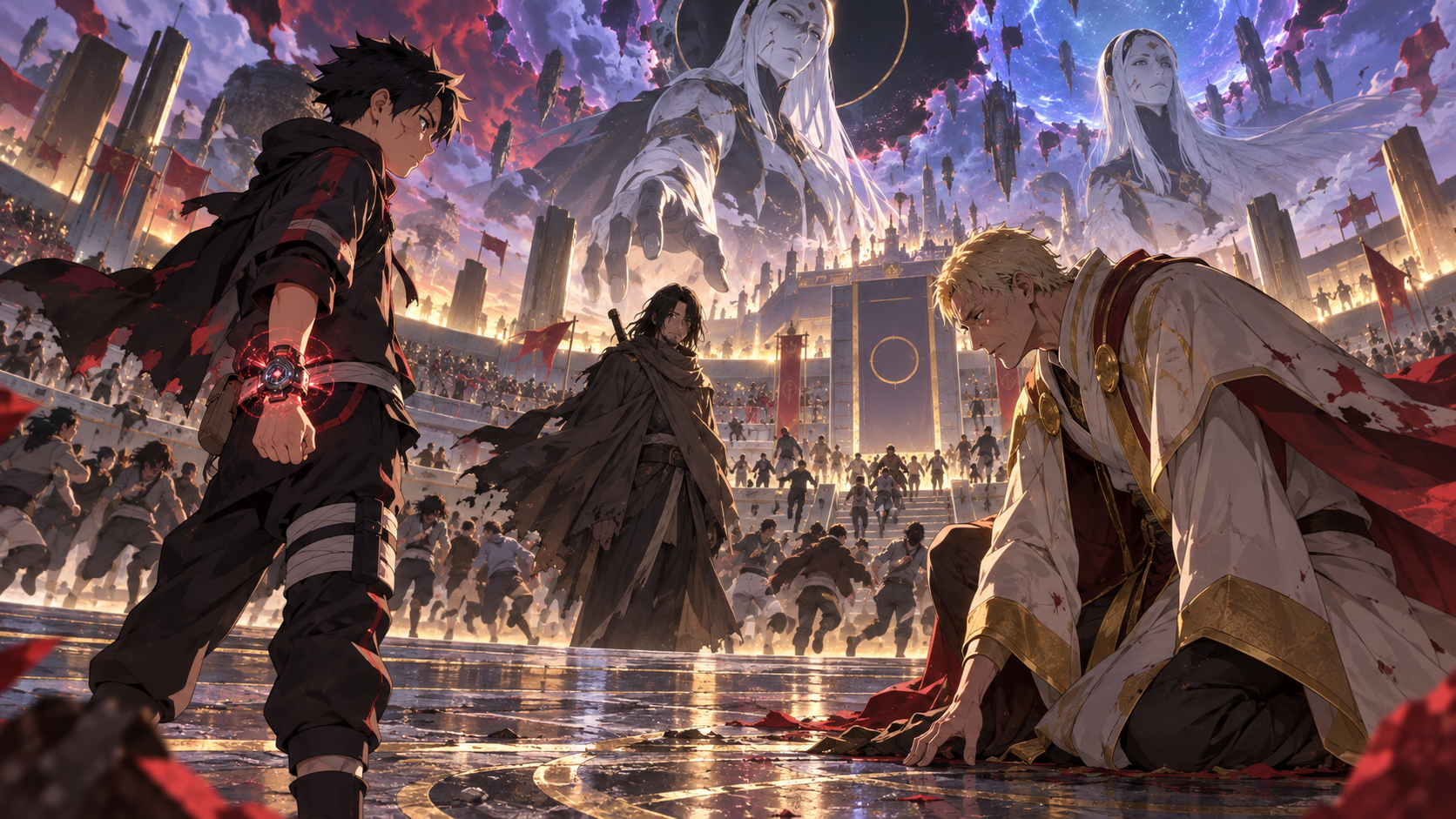
Excerpt: Boruto: Naruto the Movie turns a cheating scandal into a family argument about inherited fame, public duty, technological shortcuts, and the labor required to see a parent clearly.
Focus keyword: Boruto Naruto the Movie review
SEO title: Boruto: Naruto the Movie Review | CVM Sekai
Meta description: Our Boruto: Naruto the Movie review explores Boruto’s cheating, Naruto’s absent fatherhood, Sasuke’s mentorship, scientific ninja tools, and the Ōtsutsuki attack.
Naruto Became Hokage. His Son Still Has to Make an Appointment.
The dream came true.
Naruto Uzumaki is Hokage. His face watches over the village from the mountain. The child nobody acknowledged has become the adult whose attention everybody needs.
His family receives what remains.
Boruto: Naruto the Movie begins from the consequence most victory stories avoid. Achieving the office does not automatically make Naruto good at living inside it. He protects Konoha, attends meetings, processes emergencies, performs ceremonies, and uses shadow clones to stretch himself across obligations. The same technique that once turned loneliness into company now lets him send a copy home.
Boruto knows the difference.
That distinction drives the movie. Boruto is not simply a spoiled child who cannot appreciate a heroic father. Naruto is not simply an overworked public servant victimized by an ungrateful son. They are two people using understandable pain to misread one another.
Naruto sees the privileges Boruto has: parents, a sister, a respected name, a safe home. Boruto sees the absence inside those privileges. His father can save the world and still miss Himawari’s birthday.
The film’s emotional question is sharper than “will Boruto respect Naruto?” It asks whether inherited fame can become another form of neglect when the famous parent assumes the child should understand the sacrifice without being allowed to name its cost.
Boruto’s Anger Is Not a Failure of Gratitude
Boruto has everything Naruto lacked, which makes it easy for adults to dismiss his frustration.
He is not hungry. He is not ostracized. Nobody fears the body he inhabits. His father is alive. His mother is loving. His sister adores him. The village treats his family as important.
Pain is not a contest where the child with the safest house loses permission to hurt.
Boruto’s anger forms around repeated small failures. Naruto is physically absent, emotionally distracted, or represented by a clone that can disappear at the worst possible moment. Public duty always has a reason. The family is expected to absorb every reason quietly because the Hokage’s work matters.
It does matter.
So does Himawari waiting with a cake.
The movie refuses to solve the conflict by declaring either side entirely wrong. Naruto’s responsibility is real and historically meaningful. Boruto’s need for a present father is also real. Love does not transform absence into presence simply because the absent person had an honorable reason.
Boruto’s rebellion becomes theatrical because ordinary complaint has not changed the structure. He wants to embarrass Naruto into looking.
That desire makes the Chūnin Exams the perfect stage.
The Scientific Ninja Tool Makes Success Detachable from Labor
Katasuke’s scientific ninja tool allows a user to deploy techniques stored in scroll cartridges without personally mastering them. The technology could democratize access, support rescue work, reduce physical strain, and transform shinobi practice.
Inside the Chūnin Exams, Boruto uses it to cheat.
The film’s problem is not technology. It is unacknowledged authorship.
Boruto performs abilities before an audience that assumes the skill belongs to his training. The device separates result from labor while preserving the social reward attached to labor. He does not merely take a shortcut. He claims a false history of becoming.
That distinction matters because the shinobi world is already full of inherited advantages. Bloodlines, clan training, wealth, family techniques, and tailed-beast power make “fairness” complicated long before a wrist device appears.
The scientific tool exposes that complication rather than creating it.
Why is a hereditary dōjutsu legitimate while stored elemental ninjutsu is not? Why does training make one technology honorable and another corrupt? The movie offers a provisional answer: tools are not shameful, but context and transparency matter. An exam designed to evaluate a candidate cannot evaluate skill the candidate pretends to possess.
Boruto uses the device because he wants his father’s attention without submitting to the labor Naruto respects. He wants the result to arrive before the relationship.
Public Exposure Is Both Necessary and Brutal
Naruto discovers the cheating during the exam and disqualifies Boruto in front of the arena.
As Hokage, he has little choice. Allowing the deception to stand would damage every participant and the institution. As a father, the public handling deepens the wound.
Boruto engineered a public performance, so the consequence arrives publicly. Yet Naruto’s response remains formal at the exact moment his son needs both accountability and relationship.
The film does not let Boruto escape responsibility. Good. Cheating harms competitors and turns praise into theft. But shame alone cannot teach what labor means. It can only establish that the institution noticed the violation.
The Ōtsutsuki attack interrupts the conversation before father and son can move beyond exposure. That interruption is narratively convenient, but it also reflects their pattern: crisis repeatedly replaces intimacy.
Naruto and Boruto understand each other most easily when the world is ending. Ordinary family life remains the harder exam.
Sasuke Is the Mentor Boruto Chooses—and the Mirror Naruto Needs
Boruto asks Sasuke to train him because Sasuke represents power outside Naruto’s authority. The request contains admiration and revenge. If Naruto will not look at him as a son, Boruto will become the student of the man Naruto spends a lifetime chasing.
Sasuke understands the manipulation. He accepts anyway.
Their mentorship works because Sasuke refuses easy validation. He sees Boruto’s talent, arrogance, pain, and shortcuts without treating any one trait as the whole child. He also carries information about Naruto that Boruto cannot receive directly from his father.
To Boruto, Naruto is the busy man who misses home. To Sasuke, Naruto is the lonely child who failed constantly and kept standing up. Both are true.
Sasuke becomes translator between generations, which is almost funny considering how violently he once rejected every bond Naruto offered. Age has not made him socially smooth. It has made him capable of recognizing when silence becomes damage.
He does not replace Naruto. He creates the conditions under which Boruto can see Naruto as a person rather than an office.
The mentorship also forces Naruto to view his son through another adult’s respect. Sometimes parents cannot recognize growth until somebody outside the family names it.
Sarada Wants the Office Boruto Resents
Sarada Uchiha wants to become Hokage. Boruto, born inside the Hokage’s house, experiences the office as the thing taking his father away.
That contrast gives their friendship real political texture.
Sarada sees Naruto as the leader who acknowledges people, protects the village, and embodies a public ideal. Boruto sees the laundry left by that ideal at home. Neither perspective is complete.
She also carries Sasuke’s absence differently. Her father is away on missions, and the family has endured years shaped by his atonement and distance. Sarada’s admiration for Naruto may partly reflect what she needs from leadership and fatherhood.
The movie does not have enough time to fully explore her interior world, but she functions as more than Boruto’s sensible teammate. Her ambition asks whether the next Hokage can build an office that does not require the same family sacrifice.
Boruto’s resentment should become part of Sarada’s political education. Public service has a private cost, and leaders are responsible for how that cost is distributed.
The franchise will need more than shadow clones to solve it.
Mitsuki Drops a Family Revelation Like Casual Weather
Mitsuki completes the new Team 7 and brings an entirely different relationship to parentage. He is composed, observant, and connected to Orochimaru—a fact he reveals with a lightness that leaves Boruto and Sarada scrambling.
The joke works because Naruto’s generation treats Orochimaru as historical trauma while Mitsuki experiences the relationship as family reality.
His presence complicates the film’s inheritance theme. Boruto resists his father’s fame. Sarada seeks an office shaped by someone outside her family. Mitsuki is literally constructed through the legacy of a person whose crimes destabilize every simple idea about parenthood.
The movie uses him sparingly, but his calm creates contrast around Boruto’s emotional noise. He watches the father-son conflict without needing to compete inside it.
Team 7’s new formation suggests that inherited stories remain unavoidable. The question is whether children repeat them, reject them, or build identities capable of holding contradiction.
Momoshiki and Kinshiki Treat Power as Something to Consume
Momoshiki and Kinshiki Ōtsutsuki arrive seeking chakra. Their relationship to power mirrors Boruto’s cheating in a deliberately enlarged form.
They consume results.
Momoshiki absorbs techniques and returns them amplified. He bypasses the experience, discipline, and relationship through which power was developed. Kinshiki becomes consumable power for his superior. Entire lives are reduced to energy available for immediate use.
Boruto’s device is not morally equivalent to planetary predation, but the parallel teaches him what shortcut logic looks like without limits. Power detached from process makes people, teachers, and communities invisible.
Naruto’s generation built strength through bonds, rivalry, loss, and training. That mythology can become sentimental—hard labor does not automatically make power ethical—but it preserves the idea that ability has a history.
The Ōtsutsuki want only the output.
Boruto begins the film wanting the output too: victory, attention, and proof without the vulnerable time required to build them.
The invasion turns his private mistake into a cosmic mirror.
Naruto’s Capture Lets Boruto See the Man Behind the Monument
When Naruto protects the arena and is taken, Boruto loses the version of his father he resented before he has made peace with him.
The rescue mission gives Sasuke space to tell Naruto’s history. Boruto learns that the Hokage was not born competent, adored, or naturally unbeatable. The public monument hides a child whose progress required humiliating repetition.
This knowledge does not excuse Naruto’s absence. It changes the scale of Boruto’s understanding.
Children know parents first as structures. They provide, restrict, arrive, leave, approve, and disappoint. Recognizing a parent as a person requires information family roles often conceal.
Boruto needs to see Naruto’s history. Naruto needs to see Boruto’s present.
Their reconciliation works because both movements occur. Boruto gains respect for the labor beneath Naruto’s power. Naruto admits he has not known enough about his son and asks for connection instead of assuming family status guarantees it.
The film does not magically solve the work-life problem. It opens communication inside it.
The Final Rasengan Is Inheritance Made Collaborative
Naruto helps Boruto form a massive Rasengan for the final confrontation. The image gathers generations of labor into one technique: Jiraiya, Minato, Kakashi, Naruto, Sasuke’s influence, and Boruto’s own developing ability.
Unlike the scientific tool, the power is not presented as falsely self-generated. Boruto knows he is receiving help. The audience sees the hands behind the result.
That transparency is the difference.
Inheritance is not cheating. Pretending inheritance has no source is.
Boruto’s vanishing Rasengan also matters because it is his contribution, not merely a smaller copy of Naruto’s signature. He begins to move from inherited name toward authored identity.
The battle is spectacular, and later television adaptation expands it further. The film version remains emotionally clean: father and son combine power after finally acknowledging what each brings.
Naruto does not hand Boruto success. He entrusts him with the final action.
The Film and the Television Retelling
The central events of Boruto: Naruto the Movie were later expanded and revised in the Boruto: Naruto Next Generations anime, particularly episodes 51–66. The series version adds character time, develops the exam participants, adjusts the Ōtsutsuki battle, and integrates later continuity.
Viewers do not need both versions to follow the story. The television arc is the fuller ongoing-series account. The movie remains valuable as the original concentrated statement and for comparing how the franchise revised its next-generation launch.
Watching both reveals adaptation priorities. The movie centers father and son through compression. The series widens the world around them.
This is not a case where the film becomes meaningless because a longer version exists. Its pace and focus create a distinct emotional object.
Japanese Cast and Performance Notes
Yūko Sanpei gives Boruto enough abrasive confidence to make his vulnerability feel protected rather than absent. His anger sounds like performance because he wants Naruto to react to it.
Junko Takeuchi plays adult Naruto with fatigue layered beneath public composure. The voice retains the boy fans know, but responsibility has changed the rhythm. His quiet admission that he does not know enough about Boruto carries more weight than another heroic speech.
Noriaki Sugiyama’s Sasuke operates as the bridge between them. His restraint now reads less like rejection and more like attention disciplined by experience.
Kokoro Kikuchi’s Sarada and Ryūichi Kijima’s Mitsuki establish the new Team 7 without stealing focus from the central family conflict. The ensemble makes the generational handoff feel lived rather than ceremonial.
Where It Fits—and Whether It Is Canon
Watch the movie after the end of Naruto Shippuden, The Last, and the next-generation setup material. Naruto is Hokage, the adult families are established, and Boruto’s resentment depends on the office already shaping home life.
The story’s central events belong to franchise continuity, but the later Boruto anime retells and expands them. Viewers following the television series can watch episodes 51–66 as the fuller version instead of treating both as mandatory separate events.
For directory purposes, the film remains a movie review—not an episode React and not a separate canon branch.
Final Verdict
Boruto: Naruto the Movie succeeds because it refuses to treat Naruto’s victory as the end of his development. Becoming Hokage does not teach him how to father a child who never needed the kind of rescue Naruto did.
Boruto’s cheating is wrong. His anger is not. Naruto’s public duty is honorable. His family still bears the cost. Sasuke’s mentorship is useful because it translates history without excusing either side.
The scientific ninja tool, Momoshiki’s absorption, and the final shared Rasengan all ask who receives credit for power and whether the labor behind results remains visible.
Boruto begins by wanting his father to look at him. He ends by looking back with more understanding.
Naruto begins by assuming provision proves presence. He ends by asking to know his son.
That is not a perfect solution to work, fame, and family. It is a relationship finally beginning to speak.
Rating: 8.5/10 — A strong generational handoff that makes cheating, technology, and cosmic spectacle serve an honest father-son conflict about attention, labor, and inherited fame.