
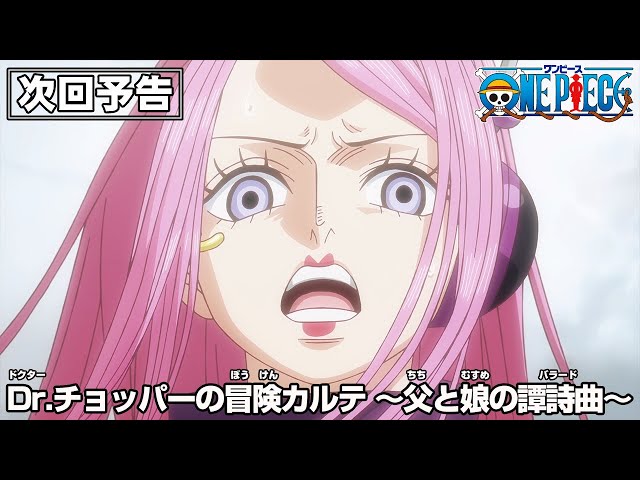
RaeRae Reviews: Dr. Chopper's Adventure Checkup: The Ballad of a Father and Daughter
Bottom line
The Ballad of a Father and Daughter is a recap special, which means the verdict depends on more than whether the old footage still works. A good recap chooses an argument. A weak recap inventories events. This production has a point of view, even when the format occasionally reaches for one clip too many.
The title says ballad because this history runs on love, repetition, and loss. Bonney spends years chasing a father the audience was trained to read as a weapon. Revisiting that trail after the Egghead revelations changes every earlier appearance. Kuma was never absent from her life in the way the Government wanted everybody to believe.
Release facts
The special aired on May 11, 2025 as part of the One Piece television schedule. The record belongs in Reviews, not numbered episode Reacts, because the production has no regular series episode number and is built as a separate retrospective program.
Chopper and Carrot trace the history of Bartholomew Kuma and Jewelry Bonney, from the Revolutionary Army and Sabaody through Mary Geoise and Egghead. The recap understands that their bond cannot be reduced to plot chronology. Kuma keeps choosing his daughter even when the World Government turns every choice into another form of punishment.
What the recap is really reviewing
Chronology is only the skeleton. The useful question is why these events need to be remembered now. One Piece brings old choices forward whenever the present finally reveals their cost. A face from hundreds of episodes ago can change the meaning of a current fight because the story never agreed that history was finished.
The title says ballad because this history runs on love, repetition, and loss. Bonney spends years chasing a father the audience was trained to read as a weapon. Revisiting that trail after the Egghead revelations changes every earlier appearance. Kuma was never absent from her life in the way the Government wanted everybody to believe.
The host format
Chopper makes sense as the anchor because he is curious, emotionally transparent, and medically incapable of leaving a mystery alone. The checkup framing treats the adventure like a patient with a ridiculous chart. Carrot brings warmth and impatience, while guest hosts keep the rhythm from becoming a lecture.
The hosts also remind viewers that memory belongs to characters, not databases. They react, misunderstand, interrupt, and care. That messiness is more faithful to One Piece than a solemn narrator reciting dates over clips.
The emotional spine
Carrot gives Chopper somebody emotionally open enough to interrupt the clinical language of a checkup. Their warmth keeps the recap from sounding like a case file. The strongest passages connect Kuma protecting the Straw Hats with Kuma protecting Bonney, two acts that once looked separate and now reveal the same stubborn moral center.
The special succeeds whenever a familiar scene returns with new context. Repetition is not automatically lazy. Repetition becomes storytelling when the audience knows something now that the audience could not know during the first viewing.
How the edit handles scale
One Piece is brutally difficult to compress. The anime carries more than a thousand episodes of friendships, betrayals, islands, promises, and visual callbacks. An editor can preserve every event or preserve momentum. Trying to do both creates a very long slideshow.
This special mostly chooses the relationships that make the current crisis readable. Action establishes consequence, but faces establish meaning. The better cuts land on somebody recognizing what a name, message, or arrival costs.
What worked
Carrot gives Chopper somebody emotionally open enough to interrupt the clinical language of a checkup. Their warmth keeps the recap from sounding like a case file. The strongest passages connect Kuma protecting the Straw Hats with Kuma protecting Bonney, two acts that once looked separate and now reveal the same stubborn moral center.
The review format also gives fans a bounded way into a specific branch of the anime. Nobody should have to scroll through 1,176 numbered React cards to find one unnumbered television special. Classification is part of editorial care on a franchise this large.
What did not work
The clip-show structure can only gesture at Ginny, the Sapphire Scales, and the cruelty of Kuma's bargain. Those details deserve silence and duration. Fast transitions sometimes make suffering feel like another bullet point, even when the hosts clearly care.
Recaps can mistake recognition for emotion. Showing a beloved moment does not automatically earn the original impact. The edit has to rebuild the cause, the pressure, and the choice around that moment. Whenever those pieces disappear, nostalgia does the labor that structure should have done.
Does the special replace the main episodes?
No. The special can restore names and stakes, but compression removes the small exchanges that make One Piece characters feel lived in. A glance on the Sunny, a stupid argument over food, or a quiet promise often carries more emotional weight than a plot milestone.
Use this recap to remember the route, not to claim the voyage. The main episodes remain the place where pacing, performance, music, and accumulated detail build the full experience.
Why this belongs in Reviews
Episodes are Reacts on CVM Sekai. This special is not a numbered episode and does not advance the weekly story as a regular installment. A Review can judge the full retrospective as an edited work: selection, framing, host chemistry, context, omissions, and usefulness.
The Special category also feeds the bounded One Piece Specials route automatically through its explicit image-card shelf. Clear relationships keep the hub navigable without mislabeling a recap as new story material.
RaeRae’s verdict
The title says ballad because this history runs on love, repetition, and loss. Bonney spends years chasing a father the audience was trained to read as a weapon. Revisiting that trail after the Egghead revelations changes every earlier appearance. Kuma was never absent from her life in the way the Government wanted everybody to believe.
The special earns its card because the chosen history matters to the present. The format has limits, and I am not grading those limits on a pity curve. Still, a focused recap can remind us that One Piece does not merely bring characters back. The story brings consequences back with them.
Official source and One Piece routes
Official release sourceTracking starts after the first collection
One Piece Anime Hub
One Piece Specials and ONA Reviews