
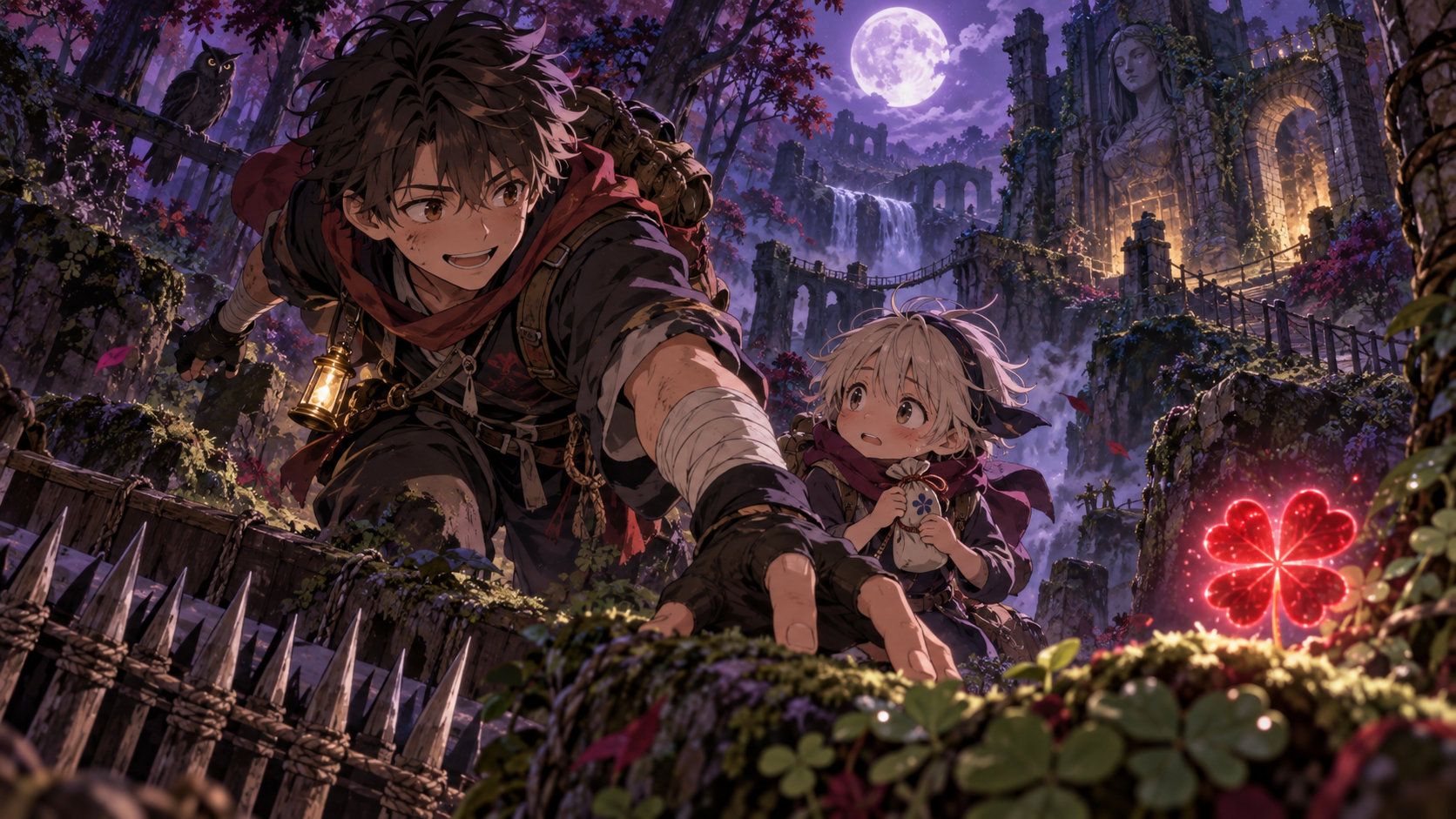
Excerpt: Find the Crimson Four-Leaf Clover! turns Konohamaru’s first crush into a lesson about effort, embarrassment, and caring for somebody without believing a lucky object can control whether they stay.
Focus keyword: Find the Crimson Four Leaf Clover review
SEO title: Find the Crimson Four-Leaf Clover Review | CVM Sekai
Meta description: Our Find the Crimson Four-Leaf Clover review explores Konohamaru, Kaede, Naruto’s mentorship, first love, luck, effort, and the Jump Festa special’s format.
Konohamaru Wants a Lucky Object to Solve an Unlucky Goodbye
Kaede is leaving the village.
Konohamaru likes her, does not know how to say what he feels, and discovers a legend about a rare crimson four-leaf clover capable of granting a wish. The solution appears obvious: find the clover, wish correctly, and avoid the terrifying possibility that another person’s future may not bend around his desire.
Naruto joins the search.
Find the Crimson Four-Leaf Clover! is an early Jump Festa special with a small emotional scale and a very Konoha solution to childhood romance. Other children might write a note. Konohamaru undertakes hazardous fieldwork for magical vegetation.
The comedy is affectionate. The underlying lesson is more useful than the premise initially looks.
Wanting somebody to stay is not the same as being entitled to keep them. A lucky object can organize effort, reveal sincerity, and create courage. It cannot replace Kaede’s choice.
Konohamaru begins by seeking control over an outcome. He ends closer to understanding what care can actually do: act honestly before the goodbye and accept that affection does not own the person receiving it.
Konohamaru’s Crush Is Serious Because He Is a Child
Adults often describe a child’s first love as cute, temporary, or unserious. To the child experiencing it, there is no emotional archive proving the feeling will pass.
Kaede’s departure feels enormous because Konohamaru has not lived through enough departures to scale it.
The special respects that intensity while finding comedy in his response. He is not mocked for caring. He is mocked gently for believing a mythical clover can turn relationship into guaranteed result.
This distinction preserves the character’s dignity.
Konohamaru is already surrounded by adult expectations attached to his grandfather’s title. His feelings for Kaede belong to him. The search becomes a rare problem not defined by being the Hokage’s grandson.
That personal ownership matters. Even a small crush can represent independence when the rest of a child’s identity arrives pre-labeled by family.
Naruto treats the mission seriously enough to help, which validates the feeling without validating every conclusion Konohamaru draws from it.
That is better mentorship than laughter from a safe distance.
Naruto Is the Perfect and Worst Romantic Adviser
Naruto understands longing. He understands wanting another person’s attention to prove something about your own worth. He also has almost no mature romantic experience during this period.
That combination makes him ideal for emotional solidarity and questionable for strategy.
He does not tell Konohamaru to stop caring. Naruto rarely responds to impossible desire with restraint. If a rare clover might help, then searching for it feels entirely reasonable.
The older boy’s participation transforms Konohamaru’s private embarrassment into shared action. Naruto makes feelings less shameful by treating them as worth effort.
At the same time, he reinforces the belief that enough determination can force a desired result. That belief powers many of Naruto’s greatest achievements. Relationships complicate it.
You can train harder to improve a technique. You cannot train hard enough to make another person choose the life you imagined for them.
The special does not lecture Naruto on this difference, but the situation exposes it.
His mentorship succeeds because he stays beside Konohamaru through the effort, not because he provides perfect emotional theory.
The Clover Is a Shortcut That Requires Work
Lucky objects promise effortless change. The crimson clover refuses to be effortless.
Finding it requires travel, risk, persistence, and cooperation. By the time Konohamaru reaches the object, he has already done the emotional labor the wish was meant to bypass.
This is a classic story structure for a reason. The quest transforms the seeker before the magical reward can transform the situation.
Konohamaru has to name what he wants, endure embarrassment, trust Naruto, and continue through obstacles. The clover becomes less important than the person capable of reaching it.
That does not make the object meaningless. Symbols help people organize courage. A keepsake, letter, flower, or ritual can carry feeling when direct speech feels impossible.
The problem begins only when the symbol is expected to override consent.
The special’s romantic wisdom rests there. A clover can help Konohamaru say goodbye. It cannot make goodbye disappear without erasing Kaede’s future.
Leaving Is Not Betrayal
Kaede’s move creates the crisis, but the special wisely avoids turning her into a villain for going.
Children often experience another person’s departure as abandonment because they have little control over adult decisions, geography, or family plans. The person leaving can become responsible for pain they did not choose to cause.
Konohamaru’s wish risks making Kaede’s life secondary to his sadness.
The story’s emotional growth requires recognizing that she can matter to him and still leave. Affection does not become false because distance arrives. A relationship can end or change without either person becoming cruel.
This is a small version of a central Naruto theme. The franchise is full of characters trying to prevent loss through control—of villages, bodies, memories, reincarnation, and power. Konohamaru’s clover search is gentle by comparison, but the impulse shares a root.
If loss hurts, perhaps enough power can make leaving impossible.
The healthier answer is not indifference. It is allowing connection to matter without converting it into ownership.
Early Naruto and Konohamaru Feel Like Brothers in Motion
The special captures the early relationship before Naruto becomes an international hero and Konohamaru becomes a working shinobi.
They are close enough in maturity for the mentorship to feel like older brother and younger brother rather than formal teacher and student.
Naruto possesses more experience, but not enough distance to become calm authority. He joins the quest physically and emotionally. Konohamaru can admire him without the power gap swallowing the friendship.
That dynamic is one reason early side stories remain valuable. Later continuity transforms both characters. Revisiting the stage when Naruto’s greatest gift is simply taking Konohamaru seriously preserves a different kind of influence.
Naruto does not mentor through rank. He mentors through recognition.
The village sees the Hokage’s grandson. Naruto sees a kid with an embarrassing problem worth solving.
That act of attention may matter more than the clover.
The Adventure Scale Fits Konohamaru’s Age
The quest uses forest danger, traps, ruins, and physical obstacles to make the search feel enormous without pretending the world is ending.
This is the correct scale for Konohamaru.
The risk feels real to a child but remains contained enough for a festival special. Naruto can protect and encourage without transforming the story into another rescue of civilization.
The environment also translates emotional anxiety into movement. Konohamaru cannot control Kaede’s departure, so he focuses on obstacles he can climb, dodge, and endure.
Action becomes displacement for feeling.
The special understands that children often process emotion through tasks. Finding the clover is easier to organize than speaking honestly. Each physical challenge delays the vulnerable moment while also preparing him for it.
The adventure therefore earns its place beyond spectacle.
Jump Festa Origins Shape the Special
The animation originated as a Jump Festa special and later received licensed regional home-video distribution, including the Madman Naruto Jump Festa Collection.
That context explains the compact story and celebratory cast focus.
It is not a numbered television episode and does not need an exact main-series date. It is an anime-original event special designed for fans already familiar with early Naruto and Konohamaru.
Correct classification prevents two common errors: treating every bonus animation as a generic OVA and treating licensed existence as proof of manga canon.
The special is official. It is also optional.
Those facts coexist.
Visual Style and Comic Timing
The early animation style carries the warmth and simplicity of original-series Naruto. Forest movement, exaggerated reactions, and the glowing clover create enough visual identity for a short adventure.
The crimson plant provides an immediate focal point. Its rarity and color make the object feel magical without requiring a complex new power system.
Comedy emerges from Konohamaru’s seriousness, Naruto’s enthusiastic reinforcement, and the disproportion between romantic problem and field mission.
The production does not need to turn Kaede into a grand tragic figure. Her leaving remains ordinary, which makes Konohamaru’s elaborate response funnier and more recognizable.
Japanese Cast and Performance Notes
Ikue Ōtani gives Konohamaru emotional urgency without turning the crush into parody. His embarrassment, hope, and determination feel continuous with the child who wants to escape inherited status.
Junko Takeuchi plays Naruto as enthusiastic co-conspirator more than wise mentor. The warmth comes from total commitment to Konohamaru’s problem.
Kaede’s performance benefits from remaining grounded. She is not a prize or mystical ideal; she is a child whose life is changing.
The vocal dynamic preserves the special’s scale: important to the characters, gentle to the world.
Where It Fits—and What It Is
Watch the special after Konohamaru’s introduction and before the Chūnin Exams broaden the series. Naruto is still an early genin, and their older-brother dynamic remains informal.
It is a Jump Festa anime-original special with later licensed regional distribution. It is not a required manga event or numbered television episode.
Treat it as an early character side story about first love, symbolic luck, and Naruto’s emerging role as somebody capable of giving another lonely child attention.
Final Verdict
Find the Crimson Four-Leaf Clover! is small, sweet, and more emotionally responsible than its magic-flower premise requires.
Konohamaru wants to prevent Kaede’s departure because losing access to somebody feels like losing the relationship itself. Naruto validates the feeling by joining the search. The clover turns longing into action.
But effort cannot own an outcome.
The special’s best lesson is not that luck is fake or childhood love is silly. It is that caring gives you responsibility for honesty—not control over the person you care about.
Konohamaru can search, confess, hope, and remember.
Kaede is still allowed to go.
Rating: 7.5/10 — A warm early Jump Festa adventure that treats a child’s first crush seriously while gently separating effort, luck, and emotional ownership.