
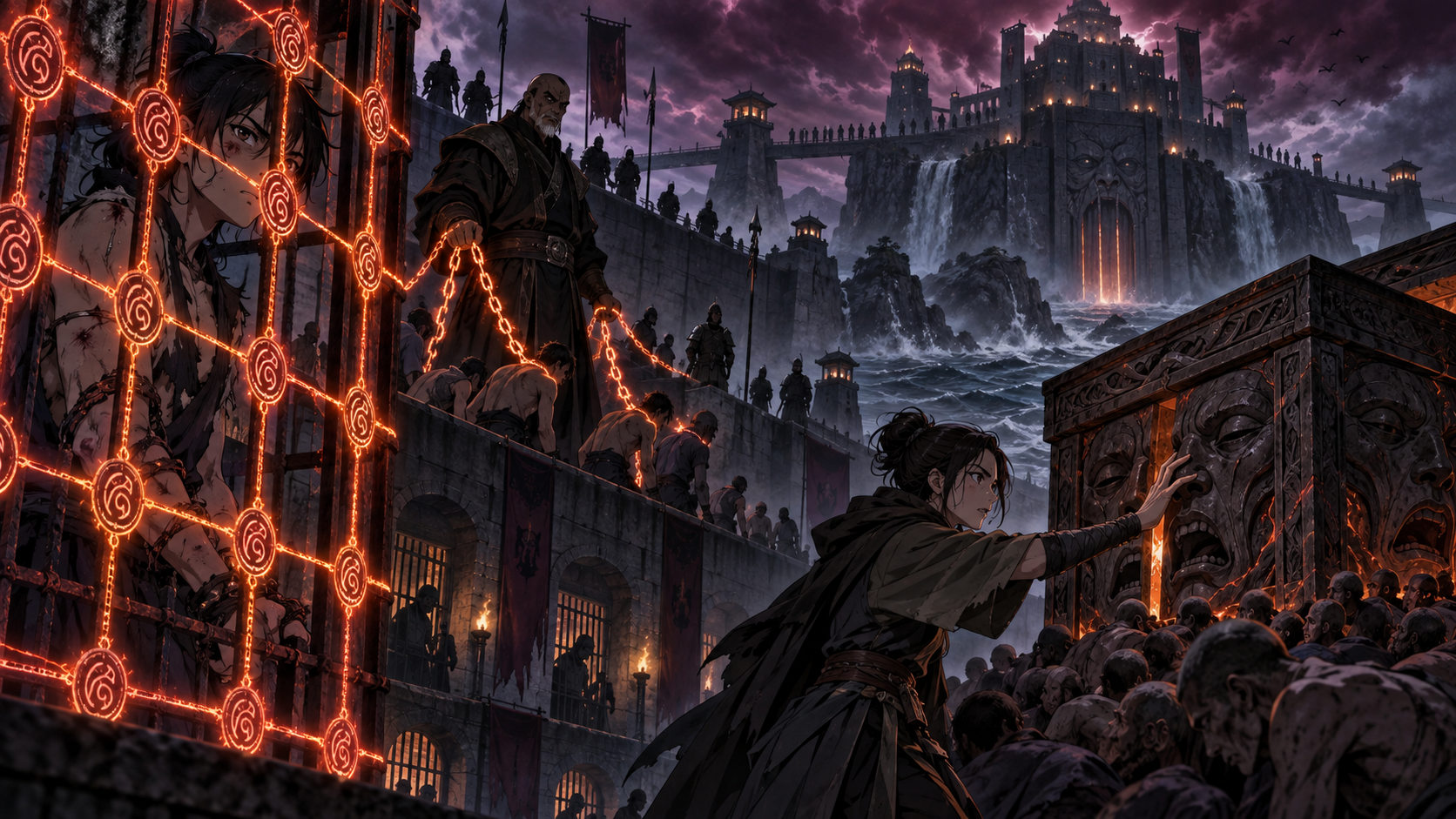
Excerpt: Blood Prison throws Naruto into Hōzuki Castle and asks how quickly shinobi institutions will erase one person’s rights when every village wants the same forbidden weapon.
Focus keyword: Naruto Shippuden the Movie Blood Prison review
SEO title: Naruto Shippuden: Blood Prison Review | CVM Sekai
Meta description: Our Naruto Shippuden: Blood Prison review examines Hōzuki Castle, Mui, Ryūzetsu, false imprisonment, the Box of Ultimate Bliss, and institutional betrayal.
The Villages Frame Naruto—and Expect Trust to Survive the Performance
Naruto is accused of attacking the Fourth Raikage and attempting to kill leaders from multiple villages. Konoha does not publicly fight the accusation. His chakra is sealed. He is transported to Hōzuki Castle, the “Blood Prison,” and placed under warden Mui’s control.
The setup is horrifying because the movie treats Naruto’s confusion as operationally necessary.
There is a larger plan. There are international stakes. Some people know more than they admit. None of that changes what Naruto experiences: the village he has nearly died protecting allows him to be branded a traitor and imprisoned without explanation.
Naruto Shippuden the Movie: Blood Prison wants the emotional intensity of institutional betrayal and the convenience of revealing that trusted adults had reasons. The two do not cancel each other out.
If anything, the later explanation sharpens the problem. Naruto’s loyalty is treated as a resource so dependable that authorities believe they can wound it safely. They assume he will understand after the mission. They assume the person chosen to carry public hatred will continue protecting the people who assigned it.
This is not new in Naruto’s life. Konoha made him a container before he could consent, hid the truth, and expected gratitude when he grew strong enough to become useful. Blood Prison compresses that history into a single brutal question: how much betrayal can an institution rename strategy before “family” stops meaning anything?
Hōzuki Castle Is a System, Not Merely a Location
The prison sits on an isolated island surrounded by violent water. Escape is made physically difficult before Mui adds the Celestial Prison technique, a fire-based seal that punishes prisoners who mold chakra or move beyond permitted limits.
Control is embedded in architecture and body.
Hōzuki Castle does not need guards watching every corridor because the punishment travels inside the inmate. The seal turns self-directed movement into pain. It is an elegant shinobi-world version of carceral logic: make the prisoner participate in confinement by attaching consequence to agency.
The institution is also politically convenient. Villages can send dangerous or unwanted people away and allow Mui to manage the moral mess at a distance. Once the prisoners disappear behind the fortress walls, their treatment becomes administrative detail.
The film populates the prison with genuine criminals, conspirators, spies, and people whose full histories we never receive. That mixture can tempt the audience to accept broad dehumanization. Naruto’s innocence exposes the danger. A system designed on the assumption that everyone inside deserves anything done to them is a system that cannot survive a false conviction ethically.
The prison does not become unjust because Naruto enters it. Naruto makes the existing injustice visible to viewers trained to recognize his humanity.
Mui Is Both Warden and Captive
Mui controls Hōzuki Castle with apparent certainty. His technique gives him extraordinary authority over incarcerated bodies, and his position places him between multiple villages, the Grass faction surrounding the Box of Ultimate Bliss, and his own grief.
His son Muku was consumed by the Box years earlier. Mui’s cooperation is tied to the hope of recovering him.
That does not absolve him. It explains the shape of his compromise.
Mui becomes a warden because he believes control can eventually reverse loss. Every prisoner harmed, every order enforced, and every sacrifice fed toward the Box is placed inside an imagined future where Muku returns. Grief narrows morality until only one person remains fully real.
The tragedy is that the Box does not restore what it takes. It weaponizes desire. Mui’s love for his son becomes the mechanism through which he helps repeat his son’s destruction across other bodies.
This is one of the film’s strongest ideas. Oppressive systems do not require every administrator to be emotionally empty. Sometimes they recruit grief, loyalty, and love, then redirect those feelings toward maintaining harm.
Mui is not outside the prison. He has simply been given the keys to his own cell.
Ryūzetsu Carries the Moral Knowledge Everyone Else Buried
Ryūzetsu enters as a member of the Hidden Grass faction trying to prevent the Box from being opened. She knows Muku, Mui, and the history that the prison’s official operations conceal.
Her role is essential because she refuses the seductive version of restoration. She understands that bringing somebody back through a weapon built on sacrifice does not return the person who was lost.
Ryūzetsu also recognizes Naruto’s innocence and the scale of the conspiracy around him. Unlike the institutions using Naruto as bait, she treats his body as belonging to him. Their alliance forms through shared danger rather than official permission.
The movie gives her courage, skill, grief, and ultimately a sacrifice that saves Naruto. That final choice is emotionally powerful, but it also exposes a franchise habit: a guest woman arrives with a complete moral world, then spends her life to preserve the male protagonist’s future.
Ryūzetsu’s death should not be treated as valuable only because Naruto survives. Her loss is an indictment of the entire plan that placed both of them near the Box.
The Dragon Life Reincarnation technique transforms her remaining life into his. The scene is intimate and devastating. It is also another body spent because institutions failed to protect people before individual heroism became the last available option.
The Box of Ultimate Bliss Is a Weapon Made from Wanting
The Box promises power and carries the mythology of granting wishes. In reality, it consumes people and releases Satori, a monstrous being capable of reading fear and responding to it.
The name is cruelly perfect.
“Ultimate bliss” invites people to project the one absence they cannot tolerate. Mui sees his son. Political factions see dominance. Villages see strategic balance. The prisoners become fuel because powerful people have decided their own desired future outweighs the prisoners’ present lives.
The Box does not create that moral failure. It reveals it.
Forbidden weapons in Naruto often externalize institutional appetite. The object appears dangerous, but the deeper danger is the coalition of adults certain they can control it after everyone else failed. Each group imagines itself uniquely qualified and treats previous catastrophe as evidence that the wrong people held power.
Satori’s ability to read fear adds a useful layer. The weapon thrives on what people conceal. It defeats direct attacks by anticipating the terror underneath them. Naruto cannot win through power alone; the emotional relationship around Muku and Mui must be confronted.
The monster is made of a child whose return was demanded without listening to what the child became.
Naruto’s Anger Is More Rational Than the Plan
Naruto spends much of the film furious because the world around him refuses to explain itself. That anger is sometimes framed as impulsiveness, but the adults’ strategy depends on denying him informed participation.
He is expected to endure the seal, survive the prisoners, investigate the conspiracy, and trust that Konoha has not truly abandoned him—all without the information necessary to distinguish mission from betrayal.
Why not tell him?
The usual answer is operational secrecy. Naruto might behave differently. Enemies might detect knowledge. The performance of guilt needs to be convincing.
Those concerns are real. They are not ethical magic.
Using somebody as bait without consent remains using somebody as bait. A village built on comradeship cannot demand unlimited faith while withholding every reason for it.
Naruto ultimately continues protecting people because that choice belongs to his character, not because the institutions earned immediate forgiveness. The movie rushes past the reckoning. It wants restoration without sitting long enough inside the injury.
That is the screenplay’s largest moral weakness. The premise opens a wound deeper than the ending treats.
Prisoners Are Not a Single Moral Category
Hōzuki Castle contains characters like Maroi, Mui’s operatives, and inmates with competing loyalties. The prison environment rewards suspicion because information, food, protection, and access all become currencies.
Naruto’s presence disrupts those arrangements. He refuses to accept that incarceration has erased the possibility of solidarity, even while he remains alert to betrayal.
The film does not individualize enough prisoners to fully examine how the system shapes them. Many remain threatening bodies, comic danger, or crowd material around the Box. That is a missed opportunity in a story whose politics depend on whether imprisoned people retain personhood.
Still, the setting lets Naruto experience a world where his status outside means nothing. He cannot invoke Konoha, his teachers, or his record of service. The seal reduces him to another controlled body.
For somebody whose entire life has been a fight to make the village see him, the prison creates a darker version of childhood invisibility. Once again, authority decides what he is and punishes him for refusing the definition.
Mui and Muku Turn the Climax into Family Horror
When the Box opens and Muku returns as Satori, Mui receives the answer grief refused to imagine. Restoration without consent is possession.
Muku’s anger is not an obstacle to the reunion. It is the truth of it.
He was sacrificed to adult ambition, trapped inside the Box, and then summoned because his father could not accept losing him. Mui’s love never asked what return would cost Muku. It focused on correcting the father’s pain.
That distinction makes the confrontation tragic rather than merely monstrous. Muku is not the sweet child preserved intact behind a magical door. Trauma changed him. The Box used him. The future Mui wanted no longer exists.
The film’s action becomes meaningful when it stays connected to that family failure. Satori can be defeated physically, but the emotional catastrophe began long before Naruto arrived.
Mui’s recognition comes too late to undo the bodies spent. That lateness is appropriate. Regret matters; it is not restitution.
The Action Is Claustrophobic Until the Box Makes It Huge
The prison setting gives the first half effective constraints. Naruto cannot freely use chakra. Escape routes are limited. The seal means every attempt carries bodily consequence. This forces him to rely on observation, physical endurance, and uneasy alliances.
Once the Box opens, the movie expands into familiar theatrical scale. Satori dominates the sky, the prison architecture becomes a battlefield, and multiple factions converge.
The large action is visually effective, but the smaller prison struggle is more distinctive. Naruto without easy access to his normal power has to confront institutional control rather than simply overpower it.
The climax regains emotional force through Ryūzetsu, Mui, and Muku. Their choices ensure the spectacle remains attached to loss.
The movie would be stronger if the political leaders who authorized Naruto’s treatment were made to face the consequences with equal clarity.
Japanese Cast and Performance Notes
Junko Takeuchi gives Naruto’s confusion and anger an unusually raw edge. He is not performing optimism for most of the prison sequence. He is hurt, suspicious, and determined to discover why people he trusts allowed this to happen.
Masaki Terasoma’s Mui carries authority weighted by grief. His control rarely sounds effortless; the performance suggests a man holding an entire institution rigid because any looseness might expose the father beneath the warden.
Mie Sonozaki gives Ryūzetsu conviction without making her emotionally simple. She carries history into every exchange with Mui and Naruto. Her final scenes work because the voice has established a person rather than a plot sacrifice.
The cast grounds a story whose conspiracy mechanics can become difficult to track.
Where It Fits—and Whether It Is Canon
The most practical placement is after Naruto has learned Sage Mode and before the Fourth Shinobi World War makes the timeline too crowded. The film assumes Naruto’s expanded abilities and his standing across multiple villages.
The movie is an anime-original side story. Its international accusation, imprisonment, and Box crisis are not required by the manga’s central continuity. The conspiracy also creates accountability problems that later canon does not carry forward.
Watch it as a thematic prison file rather than a missing mandatory arc. It asks questions the franchise often avoids: what rights survive incarceration, what consent means during secret operations, and whether a village can betray one of its own for strategic necessity without damaging the bond it claims to protect.
Final Verdict
Blood Prison is one of the darkest Naruto movies in premise and atmosphere. Hōzuki Castle feels like a system built to make people disappear. Mui’s grief becomes administration. The Box turns desire into a weapon. Ryūzetsu supplies the moral clarity that official institutions surrendered.
The movie’s largest weakness is its reluctance to hold Konoha accountable. Naruto’s framing is not a harmless trick revealed after the mission. It is a profound violation, and the ending moves toward restored trust faster than the injury deserves.
Even so, the film keeps returning to the bodies powerful people classify as expendable: prisoners, children, faction members, and Naruto himself. The Box opens because too many authorities believe somebody else can pay for their future.
Ryūzetsu closes that future with her life.
Her sacrifice saves Naruto. It should also leave every village ashamed.
Rating: 8/10 — A grim, politically charged prison story elevated by Ryūzetsu and Mui, even as its ending lets Konoha escape the accountability its betrayal demands.