
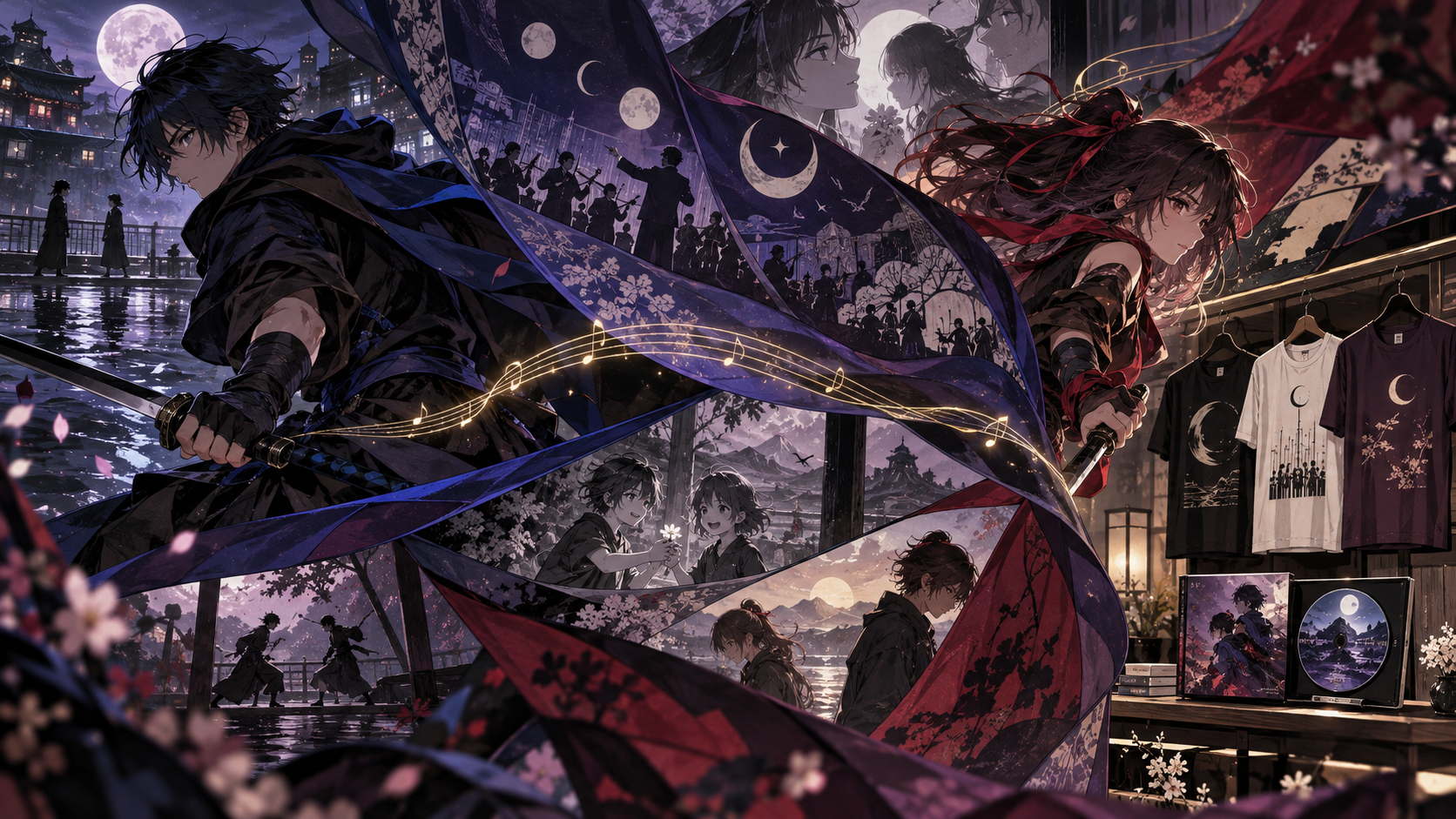
Excerpt: Naruto x UT compresses rivalry, memory, movement, music, and merchandise into a promotional animation that sells feeling more effectively than any logo could.
Focus keyword: Naruto x UT review
SEO title: Naruto x UT Promotional Animation Review | CVM Sekai
Meta description: Our Naruto x UT review examines the UNIQLO promotional animation, Naruto and Sasuke imagery, Aqua Timez music, branded storytelling, release context, and format.
The Product Is a Shirt. The Advertisement Sells Memory.
UNIQLO could have printed Naruto characters on fabric, photographed the collection, and stopped.
Instead, the collaboration included an original animation DVD. Studio Pierrot created new Naruto imagery. Aqua Timez supplied a special UNIQLO version of “Mayonaka no Orchestra.” Early buyers of the graphic T-shirts received a compact piece of franchise storytelling designed to travel through clothing, music, and retail.
Naruto x UT is advertising.
It is also animation worth reading as animation.
The distinction matters because branded media often hides behind one of two dishonest reactions. Fans may treat the work as pure art untouched by commerce, or dismiss it as commerce incapable of art.
This short makes the relationship visible.
The product gains value through emotional association. Fabric becomes connected to rivalry, grief, movement, and memory. The animation gains distribution through a retail campaign and reaches fans as a physical bonus object.
Nobody needs to pretend those systems are separate.
The interesting question is how efficiently the collaboration turns existing attachment into desire for something wearable—and whether the animation offers enough formal care to remain meaningful after the promotion ends.
It does, though not because it adds a hidden chapter to canon.
Naruto and Sasuke Are a Perfect Advertising Relationship
The franchise contains many bonds, but Naruto and Sasuke carry the largest concentration of recognizable emotional imagery.
Rivalry, friendship, separation, pursuit, shared childhood, opposing movement, and eventual collision can be communicated in seconds. A silhouette, opposing color, or familiar physical rhythm activates years of audience memory.
That efficiency makes them ideal for short promotional animation.
The work does not need to explain who they are. It arranges fragments and lets viewers supply the story. Naruto moving toward Sasuke already means something. Sasuke turning away already means something else.
Brand collaboration benefits from exactly this kind of compressed emotion. The product can borrow the relationship’s intensity without reproducing the full narrative cost.
That borrowing is not automatically cynical. Fans often want objects that hold a relationship they care about. Clothing becomes a public and bodily way to carry affiliation.
The short’s job is to make that carrying feel personal rather than transactional.
Naruto and Sasuke perform the emotional labor.
Music Creates Continuity Faster Than Plot
Aqua Timez is already tied to Naruto through earlier music, so the special version of “Mayonaka no Orchestra” arrives with franchise memory built in.
Music can connect images that do not form a conventional scene. A childhood fragment, battle movement, solitary figure, and final look become one emotional sentence when rhythm and melody organize them.
This is essential for a short whose purpose is not plot advancement.
The animation behaves more like a music video or visual memory montage than a narrative episode. Emotional continuity replaces chronological continuity.
That form suits promotion. Viewers do not need to process exposition before association arrives. Sound creates mood immediately, and the clothing campaign inherits the mood.
The special track version also makes the bonus feel exclusive. The buyer is not merely receiving images available everywhere. The object promises a variation tied to the retail event.
Exclusivity is a marketing strategy. It is also part of archival difficulty. Limited promotional media can become harder to access after the campaign, increasing fandom mythology around a work that was originally distributed as purchase incentive.
Official release records keep that mythology grounded.
Clothing Is Identity Made Public
Graphic T-shirts are not passive merchandise. Wearing a character, symbol, or franchise creates a public statement about taste and belonging.
The wearer turns a private attachment outward.
UNIQLO’s UT line understands this function. The graphics sit between mass retail and fandom signaling. A shirt can be ordinary clothing to one observer and a precise recognition cue to another.
The animation strengthens that cue by attaching motion and music to the designs. The garment becomes a still endpoint of a larger emotional experience.
This is why the collaboration sells feeling rather than only logo recognition. Fans are not purchasing cotton because they forgot shirts exist. They are purchasing a portable relationship to the franchise and perhaps a way for other fans to recognize them.
Naruto’s story is obsessed with acknowledgment. Merchandise built around visible affiliation participates in that theme unintentionally and perfectly.
Wear the image. Be seen by somebody who knows what it means.
Commerce and community meet on the same fabric.
Promotional Animation Has Different Obligations
Naruto x UT should not be judged like a television episode.
It does not need a complete mission, antagonist, character arc, or permanent consequence. Its obligations are shorter: establish mood, showcase characters and movement, connect with music, remain memorable, and direct attention toward the collaboration.
The work succeeds when it creates emotional density without pretending to be a missing narrative event.
Problems emerge when directories label every bonus animation “OVA” or “special episode” without explaining the promotional context. Viewers may expect plot and receive montage.
Calling it promotional animation is not dismissive. It is accurate.
Format determines intention. A music-video-like retail DVD can be formally interesting precisely because it is free from episodic structure.
The short uses that freedom to foreground visual association and motion.
Original Animation Adds Value Beyond Packaging
The collaboration could have assembled existing clips. New animation signals investment and gives collectors material unavailable in the broadcast series.
Originality here does not mean new canon. It means new production.
Fresh shots can reinterpret familiar relationships, choose different transitions, and align movement specifically with the promotional track. The animation becomes designed for this object rather than borrowed from another one.
That makes the DVD more than decorative packaging.
It also reveals how franchise ecosystems operate. Studios, music labels, publishers, retailers, and licensors coordinate to produce a small work whose value depends on every participant’s audience.
Fans often encounter the result as a personal emotional artifact. Behind it sits organized commercial collaboration.
Both levels are real.
The Short Compresses Pain into Aesthetic
Naruto and Sasuke’s relationship contains abuse, state violence, massacre, loneliness, attempted murder, and years of pursuit. Promotional montage cannot carry all of that context explicitly.
It condenses pain into color, distance, music, and motion.
This creates beauty and risk.
The beauty comes from formal concentration. A flowing sequence can express longing more efficiently than dialogue. The risk is that suffering becomes aesthetic texture detached from cause.
Fandom promotional media regularly performs this conversion. Trauma becomes a striking image on a shirt. Rebellion becomes palette. Grief becomes a chorus.
That does not make emotional response fake. It does require critical awareness.
The collaboration asks viewers to feel the relationship and then carry the feeling into consumption. Recognizing the mechanism does not prevent enjoyment. It makes enjoyment more honest.
The short is effective because the source relationship contains enough genuine weight to survive compression.
Brand Collaboration Can Preserve a Cultural Moment
The official UNIQLO corporate release dates the campaign: announced December 20, 2010, with distribution beginning January 1, 2011 for early buyers of the Naruto graphic T-shirts.
Those details place the animation inside a specific moment of Naruto’s global and Japanese commercial reach.
The franchise was not confined to television slots, manga volumes, or theatrical releases. It moved through retail clothing, limited bonuses, special music versions, and event-like purchase windows.
This matters for media history.
Promotional works often disappear from standard catalogs because they were never sold as independent titles. Without documentation, fans may know an animation exists but not what it was for.
The corporate release is therefore part of the review’s evidence. It confirms the relationship between T-shirts, DVD, original animation, song, and distribution.
The receipt is not boring metadata. It explains the object.
Visual Style and Montage Logic
The short’s strongest visual approach is associative editing. Opposed characters, recurring motifs, color contrast, and musical motion create a thread without requiring linear geography.
Naruto and Sasuke can appear separated across frames and connected through direction. One moves left, the other right. Fabric-like transitions and graphic composition echo the clothing context even when no product appears directly.
The animation’s brevity requires immediate legibility. Familiar silhouettes and relationship codes help.
If the work becomes too literal, it resembles a commercial reel. If it becomes too abstract, the franchise connection weakens. The balance lies in recognizable emotion presented with enough new visual organization to justify the bonus.
The music carries transitions that plot would otherwise need to explain.
Japanese Cast and Sound Notes
The promotional form places less emphasis on dialogue than a conventional episode. Music and image hold the center.
Aqua Timez’s special version of “Mayonaka no Orchestra” provides the emotional structure, benefiting from the band’s existing association with Naruto.
Where voices appear or character identity is implied, the audience’s memory of the Japanese cast fills gaps. Promotional montage often relies on this accumulated sound-world even when dialogue is minimal.
The result resembles a branded memory object more than a dramatic performance showcase.
Where It Fits—and What It Is
Watch Naruto x UT after Naruto and Sasuke’s major Shippuden relationship revelations are familiar. Its emotional shorthand and imagery can spoil the bond’s later shape for early viewers.
It is an official promotional animation DVD produced for the UNIQLO Naruto UT campaign and distributed to qualifying early buyers. It is not a television episode, not a narrative OVA, and not a canon event.
Classify it as promotional animation and branded DVD media.
Final Verdict
Naruto x UT is a small but revealing object in the franchise’s history.
It uses original animation and a special music version to turn Naruto and Sasuke’s relationship into portable emotional branding. The T-shirts sell identification. The DVD rewards purchase. The montage preserves enough formal care to outlive the campaign as something fans still want to locate and discuss.
The collaboration does not add lore.
It shows how lore becomes culture: worn on bodies, circulated through retail, remembered through music, and recognized by strangers who know why two silhouettes facing opposite directions can hurt.
The product is a shirt.
The advertisement sells the feeling of carrying the story with you.
Rating: 7.5/10 — A stylish, historically interesting promotional montage that demonstrates how Naruto merchandising learned to sell emotional memory rather than merely character graphics.