
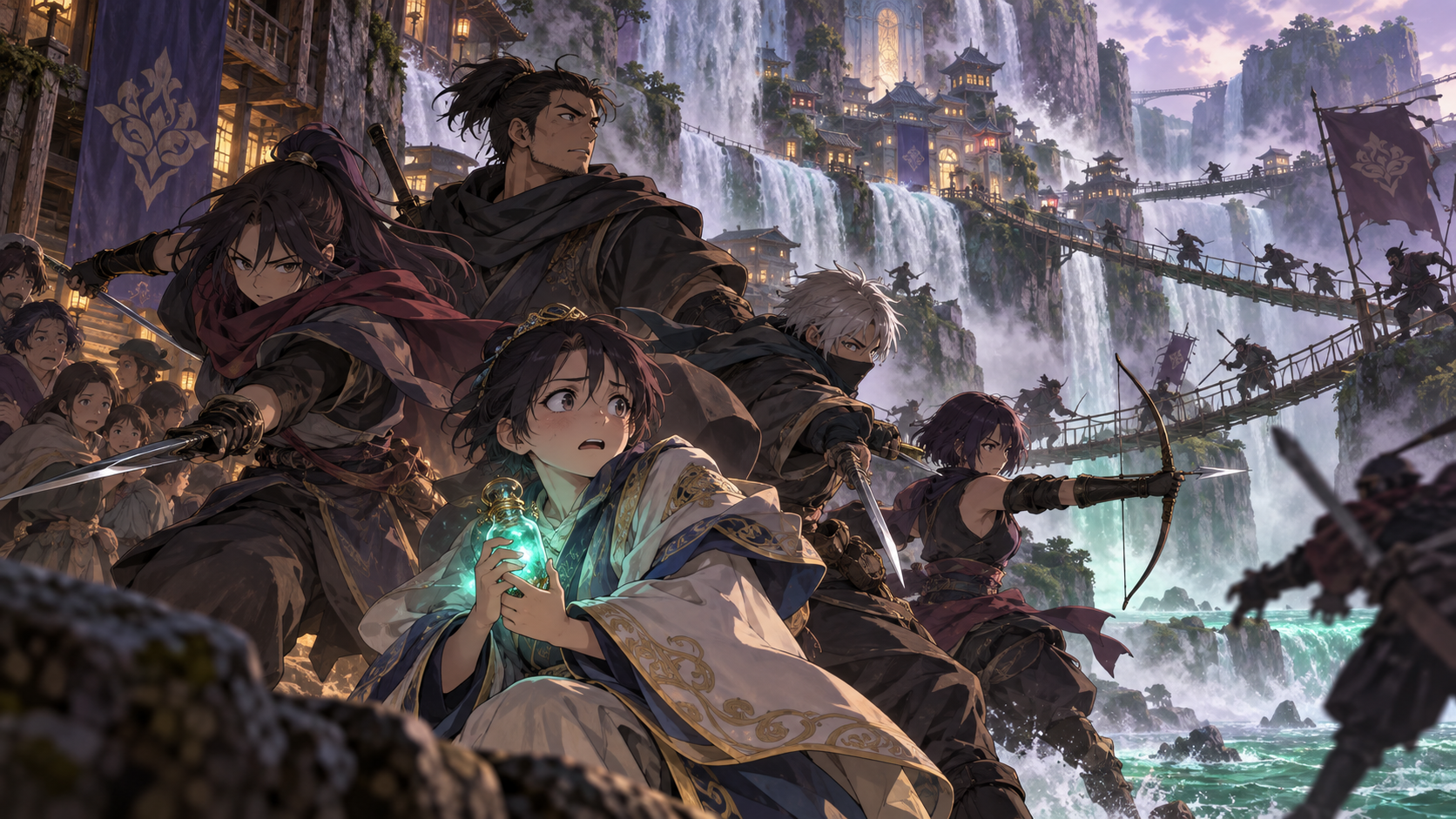
Excerpt: Mission: Protect the Waterfall Village! gives Naruto an early lesson in leadership: inheriting a brave parent’s reputation is not the same as knowing how to stand when people need you.
Focus keyword: Mission Protect the Waterfall Village review
SEO title: Mission: Protect the Waterfall Village Review | CVM Sekai
Meta description: Our Mission: Protect the Waterfall Village review explores Shibuki, the Hero Water, Team 7, inherited courage, village leadership, and the cost of borrowed power.
A Famous Father Can Leave Courage Behind—or Leave a Shadow
Team 7 is assigned to escort Shibuki, leader of the Hidden Waterfall Village, safely home. He does not look like the kind of leader Naruto expects.
Shibuki is nervous. He hesitates. He lacks the easy authority attached to his father’s reputation. The village remembers a brave man and looks at the son as if inheritance should have delivered the same courage automatically.
It did not.
Mission: Protect the Waterfall Village! is an early Naruto special with a straightforward plot, modest scale, and a better leadership question than its runtime initially promises. When rogue ninja attack and Kakashi is recalled elsewhere, Team 7 and a frightened young village head have to protect people who believe their leader should already know how to become heroic.
At the center sits the Hero Water, a sacred resource that can multiply chakra at a severe cost to the user’s life.
The name is the trap.
If courage can be swallowed from a bottle, then Shibuki never has to believe his own decisions count. He can borrow the body of a hero, pay the physical price, and satisfy a village that has confused leadership with spectacular self-destruction.
Naruto recognizes that bargain because Konoha has spent his entire childhood treating dangerous power inside a body as the same thing as the person’s worth.
The Hidden Waterfall Village Feels Small Enough to Need Everyone
The special’s setting distinguishes it from Konoha without requiring a theatrical worldbuilding budget. Waterfalls conceal the village. Rope bridges, cliffs, mist, and narrow paths make the community feel protected by geography and vulnerable once an enemy crosses the barrier.
This is not one of the Five Great Shinobi Countries. The village cannot summon an enormous military response. Its leader’s courage matters because there are fewer institutional layers between Shibuki’s fear and ordinary people’s safety.
That closeness helps the story.
Naruto often examines leadership at the level of Hokage, clan head, or war commander. Shibuki’s position is more intimate. The villagers know his family. They see him hesitate. Their disappointment is personal because leadership is not a distant office.
The geography also makes protection feel communal. Civilians cannot disappear into a vast city while elite fighters solve the problem elsewhere. The village’s hidden quality becomes fragile once Suien and his followers use insider knowledge to attack.
A secret location is not security when trust has already been breached.
Shibuki Is Not a Coward Because He Feels Fear
The special initially plays Shibuki’s anxiety broadly. Naruto judges him because Naruto’s idea of courage has been built through public defiance. Fear is something Naruto performs over until the performance becomes action.
Shibuki’s fear works differently.
He knows people will measure him against a dead father. Every decision risks proving the comparison correct. When someone grows up under heroic memory, failure does not feel personal; it feels like betrayal of the family story.
That pressure can make action harder, not easier.
The story’s growth is not that Shibuki stops being afraid. It is that he stops using fear as evidence he is unqualified to choose. Courage becomes behavior performed while fear remains.
This distinction is basic, but Naruto stories return to it because shinobi culture often rewards emotional concealment. A leader who admits fear appears weak. A leader who hides fear may make reckless decisions to preserve the image of strength.
Shibuki has to become visible enough to lead honestly.
Naruto helps because he is incapable of respecting a polished image more than the person underneath it.
The Hero Water Turns Leadership into Bodily Debt
The Hero Water grows from the village’s giant tree and dramatically increases chakra, but using it consumes the user’s life. It is a village resource that transforms emergency responsibility into literal bodily expenditure.
That makes it a perfect object for Shibuki’s crisis.
He can drink, become powerful, and finally resemble the heroic leader everyone expected. The cost even strengthens the symbolism: dying for the village would prove courage beyond dispute.
It would also leave the village without a leader.
The special understands that sacrifice and responsibility are not always identical. A spectacular death can be emotionally easier than the slow work of governing after danger passes. Shibuki must decide whether he is protecting people or performing the role of protector.
The Hero Water is not evil. In a genuine last resort, its cost might be chosen knowingly. The danger is cultural. Once a community stores heroism inside a lethal resource, leaders may feel obligated to consume themselves whenever ordinary ability appears insufficient.
Naruto’s intervention pushes toward another possibility: courage can be shared. Team 7, villagers, and Shibuki can act together rather than turning one body into the entire defense plan.
Suien Knows the Village’s Symbols Better Than Its People
Suien, a former Waterfall shinobi, leads the attack to seize the Hero Water. His betrayal carries insider weight. He understands the village’s defenses, sacred resource, and emotional attachment to heroic strength.
That knowledge lets him exploit both geography and mythology.
He does not need to convince the village that power matters. The village already built a ritual around concentrated power. Suien simply removes the moral restraints and treats the resource as something the strongest person deserves to own.
His motivation is not especially layered, and the special’s short format limits his depth. He functions as a clear external threat whose selfish use of the Hero Water contrasts with Shibuki’s self-sacrificial temptation.
Both men risk treating the resource as the source of legitimacy. Suien wants domination. Shibuki wants proof that he is worthy. Naruto’s presence insists that neither desire defines leadership.
Power may decide who wins a fight. It does not decide who deserves to be followed.
Team 7 Still Feels Like Team 7
The special belongs to the early-series period when Naruto, Sasuke, and Sakura operate under Kakashi as the original Team 7. Their roles are familiar but useful.
Naruto attaches emotionally to Shibuki’s insecurity and turns the mission into a referendum on courage. Sasuke reads danger more coolly and contributes the competence Naruto’s speeches cannot replace. Sakura supports the civilians and keeps the mission grounded in protection rather than only confrontation.
Kakashi’s temporary removal is narratively convenient, but necessary. If the elite adult remains available, Shibuki can continue waiting for somebody more qualified to solve the crisis. Team 7 also has to function without the teacher who normally absorbs strategic responsibility.
The young team’s presence makes Shibuki’s hesitation sharper. Children are acting while the adult leader doubts himself. But the story avoids making him worthy only after copying Naruto’s recklessness. His growth comes through accepting responsibility specific to his community.
Team 7 does not install courage. They create enough space for Shibuki to choose it.
Naruto Recognizes the Burden of a Story He Did Not Choose
Naruto does not know the full truth about his own father during this period, but he understands being defined by an inherited story.
The village looks at him and sees the Nine-Tails. Adults respond to history inside his body before responding to the child. Shibuki is defined differently—through admiration rather than fear—but both boys struggle against conclusions assigned by other people.
Shibuki is supposed to resemble his father. Naruto is supposed to resemble the monster.
Their connection works because Naruto refuses both forms of predestination. A person is not obligated to become the story attached to his name. He is obligated to choose what he does when people need him.
Naruto’s encouragement is loud and imperfect. He can be cruel toward fear because he has survived by attacking his own. Yet his faith gives Shibuki something the village’s comparison does not: permission to become brave as himself.
That is more valuable than borrowed reputation.
The Action Is Simple, and the Simplicity Helps
The special does not attempt the escalating spectacle of later Naruto films. Combat uses the waterfall terrain, the threat of the Hero Water, and Team 7’s early abilities.
That limitation keeps the emotional argument visible.
Shibuki’s choice matters because the battle has not expanded beyond human scale. A village, a resource, a handful of attackers, and a young team remain comprehensible. The consequences sit close to the people making decisions.
The animation shows its age and format, especially beside later theatrical work, but the environment provides enough visual identity. Water, mist, cliffs, and bridges create movement without requiring a world-ending monster.
The special is strongest when action proves a change already made internally. Shibuki does not become courageous because a power-up removes fear. He uses power after deciding that fear cannot make the decision for him.
The Licensed Novelization Is a Separate Adaptation
VIZ published a prose adaptation by Masatoshi Kusakabe with art by Masashi Kishimoto. That book adapts the special’s story; it is not another lost episode and does not create a separate canonical mission.
This distinction matters for a franchise directory. Different formats may preserve or expand the same narrative. A novelization should be connected to the animation without being counted as an additional OVA.
The existence of a licensed book also shows that the story occupied a more substantial place in early international Naruto publishing than a forgotten promotional short. Fans encountered the Waterfall mission through multiple routes.
Reviewing the animation means evaluating its pacing, performances, and visual storytelling—not treating prose publication as proof of main-manga continuity.
Japanese Cast and Performance Notes
Junko Takeuchi gives Naruto early-series bluntness, before later experience adds political patience. His encouragement of Shibuki is sincere and confrontational. He believes shame can be kicked into motion because that method worked on him.
Shibuki’s performance has to preserve sympathy through hesitation. The character sounds young beneath the title, which reinforces the sense that leadership arrived before confidence.
The returning Team 7 cast supplies the comfortable rhythm that makes the guest village accessible. Sasuke’s restraint, Sakura’s concern, and Kakashi’s authority establish the period immediately.
Suien is played as a direct threat rather than a morally ambiguous former comrade, appropriate to the special’s compressed structure.
Where It Fits—and Whether It Is Canon
The best placement is early in the original Naruto series, after Team 7 has formed and before the Chūnin Exams permanently expand the cast and power scale. Sasuke remains with the team, Kakashi leads them, and the mission feels like a larger version of their early fieldwork.
The animation is an anime-original special and not required by the manga’s central continuity. The licensed novelization adapts it but does not change that status.
Watch it as an early Team 7 leadership file: a compact story about inherited reputation, community trust, and the danger of confusing lethal power with courage.
Final Verdict
Mission: Protect the Waterfall Village! is modest, direct, and thematically cleaner than many larger side stories. Its villain is thin, Sakura deserves more agency, and the short format compresses Shibuki’s transition from hesitation to action.
The central idea survives.
Shibuki has inherited a title and a father’s legend, but neither can make his choices for him. The Hero Water offers power at the cost of life, turning public expectation into a temptation toward spectacular self-erasure. Naruto pushes him toward a harder definition of leadership: remain afraid, act anyway, and live long enough to keep serving after the crisis.
A village does not need its leader to imitate a dead hero.
It needs him to see the people who are alive.
Rating: 7/10 — A sincere early Team 7 special that turns a sacred power-up into a thoughtful argument about inherited reputation, fear, and leadership.