
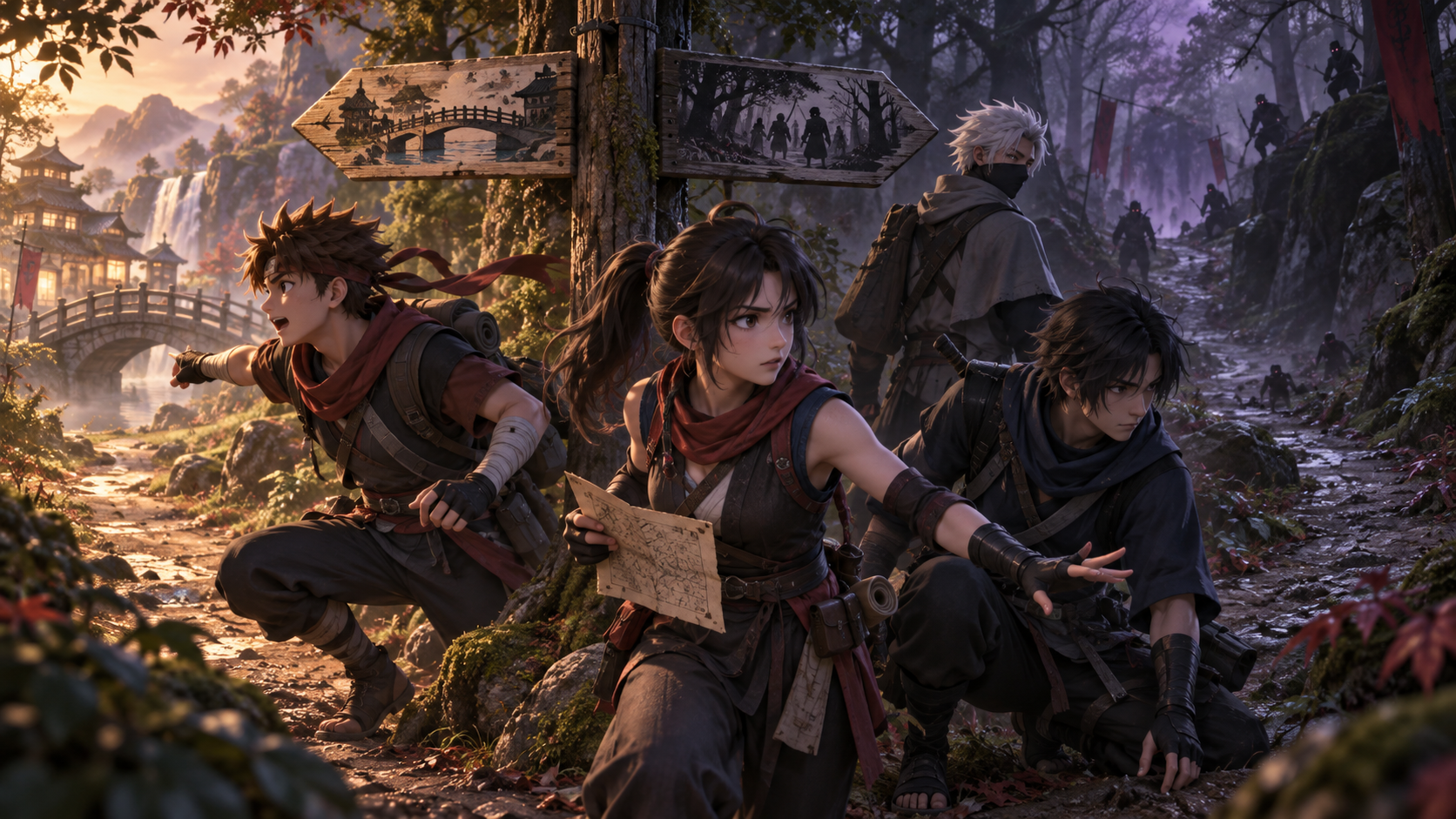
Excerpt: Naruto: The Cross Roads rebuilds early Team 7 in CGI and uses a familiar mission to show how much coordination existed before trust had learned how to speak.
Focus keyword: Naruto The Cross Roads review
SEO title: Naruto: The Cross Roads Review | CVM Sekai
Meta description: Our Naruto: The Cross Roads review examines early Team 7, the CGI experiment, unfinished teamwork, Jump Super Anime Tour release history, and canon status.
Team 7 Looks Different Before It Learns to Move Differently
Naruto, Sasuke, Sakura, and Kakashi enter a mission that feels familiar enough to lower everyone’s guard.
Naruto pushes forward. Sasuke measures the danger and Naruto’s mistakes at the same time. Sakura tries to keep the assignment from becoming a contest between boys. Kakashi observes, intervenes selectively, and lets the team reveal exactly how unfinished its coordination remains.
The difference is visible before the plot explains anything.
Naruto: The Cross Roads presents the early Team 7 period through computer-generated animation, giving familiar faces, movement, and combat a texture distinct from the television series.
That technical experiment is the special’s main historical interest. It is also thematically appropriate.
Early Team 7 is a group whose components do not yet fit smoothly. The CGI models sometimes feel recognizably Naruto and slightly strange at once. The team itself occupies the same condition: officially assembled, emotionally unintegrated.
The special does not reinvent the characters. It places their familiar friction inside a new production language and asks whether the ensemble’s identity survives the translation.
Mostly, it does.
A Crossroads Is a Choice Before It Is a Location
The title suggests more than a branching path.
Early Team 7 stands at multiple crossings. Naruto wants acknowledgment but has not learned cooperation. Sasuke wants power and has not yet abandoned the village. Sakura wants Sasuke’s attention while beginning to understand that being a shinobi requires more than social positioning. Kakashi knows teamwork matters because he survived what happens when rules and comrades are placed against each other.
Every mission therefore becomes a test of direction.
Will the team remain four individuals using the same route, or become a group capable of changing course for one another?
The special’s plot remains compact, but the familiar dynamics carry accumulated meaning. Viewers know where Sasuke’s path eventually leads. Watching the early group argue and coordinate gains melancholy from that future.
The crossroads is not only whether they complete this mission. It is the period when another outcome still appears possible.
Side animation can be valuable without adding new canon when it preserves emotional stages the main narrative moves through quickly.
Naruto Mistakes Motion for Leadership
Naruto often acts first because action is how he prevents other people from deciding he is irrelevant.
On an early mission, that urgency becomes a tactical problem. He moves before the team agrees, announces intention before gathering information, and treats visible courage as proof that he should lead.
The behavior is frustrating and emotionally coherent.
Naruto spent childhood ignored until disruption forced attention. Waiting feels dangerously similar to disappearing. Teamwork requires him to learn that pausing for another person’s input is not surrendering his place.
The special uses mission pressure to expose that lesson without transforming him into a suddenly disciplined student. Naruto’s growth comes through consequence and repetition. One adventure should not erase the habit.
His energy remains useful. Teams also need somebody willing to break paralysis. The question is whether Naruto can direct momentum toward a shared objective rather than making everybody else chase him.
Early Team 7’s charm lies in that instability. Their flaws are not yet organized into complementary strengths.
Sasuke Cooperates Before He Admits He Cares
Sasuke’s early-series relationship to Team 7 is clearest in action. His language maintains distance. His body repeatedly responds to their danger.
The special benefits from that contradiction.
Sasuke watches, evaluates, and positions himself as the competent counterweight to Naruto. Competition motivates him, but the mission also reveals coordination that pride refuses to name.
He does not need to declare friendship for viewers to see that his attention has changed. Naruto’s location matters. Sakura’s safety matters. Kakashi’s expectations matter.
This is why early Team 7 material becomes painful in retrospect. The bonds are real before the characters possess the maturity to protect them from larger grief and ambition.
The CGI performance has to communicate much of this through posture and timing. Sasuke’s economy contrasts with Naruto’s exaggerated motion. Different movement styles become character language.
The team works when those styles begin responding rather than merely competing.
Sakura Is the Team’s Social Cartographer
Sakura enters Team 7 with strong academic knowledge and weak confidence in how to apply it under danger. She also reads interpersonal shifts faster than the boys, even when her crush distorts judgment.
The special’s compact mission allows her to occupy the space between Naruto’s impulse and Sasuke’s restraint.
That role can become unfair. Female characters are often assigned responsibility for managing male conflict while receiving less narrative attention for their own growth.
Still, Sakura’s ability to recognize the team as a social unit is valuable. Naruto and Sasuke initially understand cooperation through competition. Sakura can see when the competition threatens the assignment.
The story would benefit from giving her more decisive tactical authority rather than using her primarily as connective reaction. Early-series side material repeatedly inherits the main series’ limitations around her.
But she remains essential to the team’s emotional map.
Without Sakura, the rivalry might consume every route choice. Without the boys, Sakura might never be forced to turn knowledge into action. The group’s imbalance is the point.
Kakashi Teaches by Allowing Friction
Kakashi could solve many early missions faster by directing every movement personally. He often chooses not to.
That restraint is pedagogical and occasionally reckless.
Team 7 needs opportunities to experience the cost of poor coordination while Kakashi still has capacity to prevent catastrophe. A teacher who removes every consequence produces dependence.
The special shows his familiar observational style. He reads the students, reveals less than he knows, and intervenes according to a threshold they cannot see.
This can look like indifference to children already uncertain whether adults will protect them. Kakashi’s mentorship is shaped by his own history, particularly the belief that comradeship must become embodied through crisis rather than merely taught through rules.
The mission becomes a controlled crossroads under his supervision. He cannot choose the team’s relationship for them.
He can make sure they encounter situations where choice becomes visible.
CGI Changes Weight, Timing, and Familiarity
The special’s computer-generated presentation is not neutral. Movement carries different weight from hand-drawn television animation. Faces may feel less flexible. Surfaces and camera motion create depth unavailable through the same production pipeline as ordinary episodes.
Some viewers will experience the result as stiff. Others will appreciate the experiment and historical snapshot.
The most successful moments use 3D space deliberately. Camera movement through environments, character positioning, and action paths can emphasize the literal crossroads and team geometry.
The weakest moments ask models to reproduce the exact expressiveness viewers associate with 2D designs. Familiarity becomes unforgiving. A small difference in face or timing can make a well-known character feel emotionally distant.
This does not mean CGI is inherently wrong for Naruto. It means translation requires decisions beyond modeling the same costume.
The special remains valuable partly because it shows the franchise testing that translation in 2009, before later anime productions normalized hybrid workflows.
Official Streaming History Makes It a Production Artifact
Shueisha presented the roughly thirty-minute special through the 2009 Jump Super Anime Tour, and J-Stream’s corporate release records official streaming of the complete work from November 30, 2009 through January 31, 2010.
That release history matters.
It establishes the special as an official franchise production with a documented distribution window, not a mysterious fan upload or mislabeled episode.
It does not make the events manga canon.
Official status and continuity status answer different questions. One concerns who produced and distributed the work. The other concerns whether the central narrative depends on its events.
Directories often collapse those questions, especially when a special becomes difficult to access legally after an initial window. Scarcity then encourages mythology.
The correct description is simpler: official CGI anime-tour special, anime-original story, optional continuity.
That is already historically interesting.
The Mission Is Familiar by Design
The story does not attempt to introduce a new cosmology, bloodline, or world-changing villain. Its familiarity lets production form and team interaction remain central.
A routine-looking assignment becomes dangerous enough to demand cooperation. That structure mirrors early Naruto arcs without competing with them.
The limitation can make the plot feel generic. Viewers seeking a major lost chapter will not find one.
The benefit is character clarity. Naruto, Sasuke, Sakura, and Kakashi behave like themselves at a recognizable stage. The special can be understood as a production experiment anchored by proven emotional dynamics.
Not every bonus work needs to expand lore. Some preserve atmosphere.
The Cross Roads preserves the period when Team 7 still had choices in front of it.
Japanese Cast and Performance Notes
The original Japanese cast provides continuity across the visual change. Familiar voices reassure viewers when models and motion feel new.
Junko Takeuchi gives Naruto the forward pressure that CGI must then embody. Noriaki Sugiyama keeps Sasuke’s vocal economy intact. Chie Nakamura supplies Sakura’s social and tactical urgency. Kazuhiko Inoue gives Kakashi the calm of a teacher watching a lesson become dangerous.
Voice becomes the strongest bridge between production styles.
The performances prove that character identity does not live only in line art. Rhythm, emphasis, silence, and response carry history.
Where It Fits—and What It Is
Place the special after Team 7 forms and before the Chūnin Exams. The characters belong to their early mission-stage dynamic, before later injuries and departures reshape the group.
It is an official CGI special from the 2009 Jump Super Anime Tour with a documented Shueisha streaming release. It is anime-original and not a numbered television episode or required manga event.
Treat it as a production-history artifact and early Team 7 character file.
Final Verdict
Naruto: The Cross Roads is more interesting as an experiment and emotional snapshot than as plot.
The CGI presentation varies in expressiveness, and the mission itself remains familiar. What survives is the geometry of early Team 7: Naruto’s impulse, Sasuke’s guarded cooperation, Sakura’s social awareness, and Kakashi’s controlled distance.
They are a team before they know how to trust being one.
The new visual language sometimes makes them feel strange. That strangeness fits a group assembled on paper and still becoming recognizable to itself.
At the crossroads, another future remains imaginable.
The audience knows which road canon takes.
Rating: 7/10 — A worthwhile CGI production experiment whose familiar mission preserves the unstable, painful possibility of early Team 7 before their paths divide.