
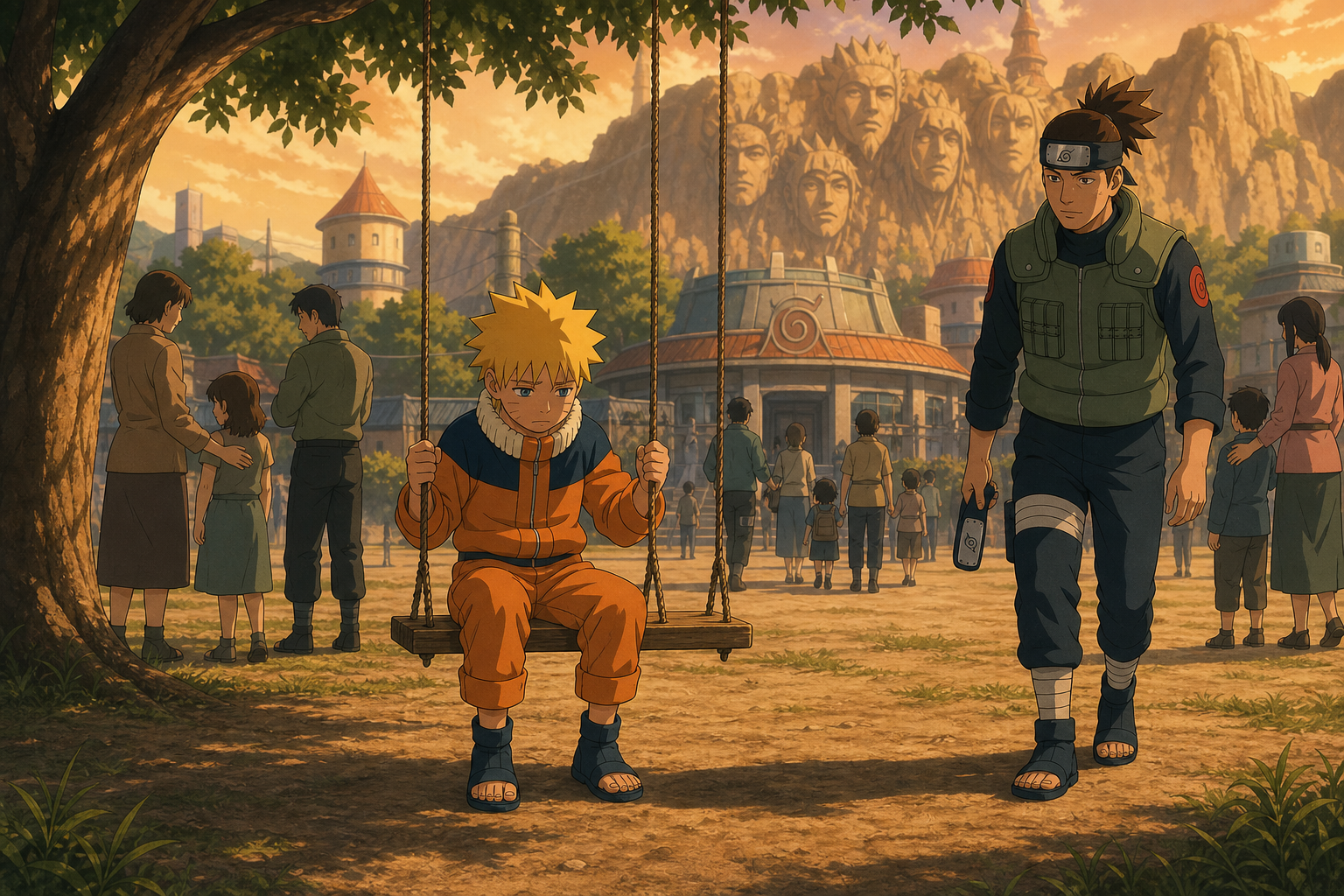
Problem Children Don’t Exist. Failed Villages Do.
A long-form rant about what Konoha owed Naruto, how adults mislabeled his behavior, and why survival does not excuse neglect.
Konoha wanted Naruto Uzumaki to be quiet, grateful, disciplined, loyal, and useful. The village gave him an apartment and a small stipend. Konoha did not give Naruto a parent or a steady guardian. The village also left Naruto alone with a secret burden that no child should have carried. When Naruto acted out, the adults treated his pranks as proof that he was the problem. This rant is about more than Naruto. The essay also examines every society that punishes neglected children for making neglect impossible to ignore.
Konoha used Naruto’s body for village security, withheld the truth needed to understand his own life, allowed public stigma to isolate him, provided no meaningful guardian, and waited until he became useful before offering collective love. Then everybody put on a headband and acted like this had been a group project.
In that one, Naruto Uzumaki is twelve. He has an apartment, but nobody waiting inside the apartment. He has enough money to remain technically alive, which is apparently where Konoha’s child-welfare budget ended. He knows the faces carved into the mountain. He does not know the names of the two people who died loving him. Every adult shares a secret about his body. He is the only person not allowed to understand the secret.
Episode 1: Enter Naruto Uzumaki!
Naruto Chapter 1
What does a village owe the child carrying its safety?
The argument, before anybody tries to escape through a technicality
This is not a rant claiming every civilian was personally evil. The argument does not demand that grief disappear after Kurama’s attack. The argument does not claim that nobody ever cared about Naruto. The central argument concerns responsibility.
Konoha made a child part of the village’s military defense system. That decision made the village responsible for Naruto’s food, guardianship, access to the truth, and protection from stigma. Konoha also had a duty to notice when a lonely child became vulnerable to manipulation by a resentful instructor. The village accepted the protection and treated the care like an optional side quest.
Why I am ranting about this now
Konoha is not ancient history with better headbands because modern institutions still make the same mistake. We call a child disruptive before asking why being disruptive is the only reliable way they can make an adult respond. We congratulate the first-generation student, the neglected kid, the survivor, or the employee who endured a broken system, then use their achievement as proof the system was secretly supportive. We turn “they succeeded anyway” into “we must have helped.”
Sometimes families provide the legal minimum and expect emotional gratitude for decades. Sometimes schools punish the symptom because investigating the cause would implicate adults. Some workplaces praise employees for being resilient while refusing to hire enough people to make the workload reasonable. Apparently, if you put the word resilience on the certificate, nobody is allowed to ask who created the emergency. That is why Naruto gets under my skin. His story shows how quickly a community can rewrite neglect as character-building once the neglected person becomes impressive.
I am not angry because Naruto struggled and still became good. I am angry because people keep pointing to his goodness as evidence that the struggle was good for him.
Charge one: Konoha normalized Naruto’s abandonment
Episode 1 gives Naruto noise first. Naruto paints the Hokage Monument, runs through the village, and shouts until the adults have no choice but to look at him. The episode then shifts from the noise of his prank to the quiet of his isolation.
The other Academy students graduate and leave with their families. Parents call their children’s names, fix their collars, and gather around them after the ceremony. Naruto sits alone on the swing, away from the crowd. His distance from the other families makes his exclusion clear, but no adult has to make an open decision to reject him because everyone simply walks past.
The scene stays with me because there is no obvious villain whose cruelty would let everybody else feel innocent. Instead, the scene shows how ordinary adults can ignore one lonely child until neglect becomes a pattern shared by the whole community.
Konoha did not throw Naruto away once. The village kept deciding, every day, that somebody else would pick him up.
His pranks make more sense from there. Even anger can feel preferable to being ignored. Punishment still requires somebody to say his name. When Iruka Umino chases him, lectures him, and drags him back toward the Academy, even irritation is proof that Naruto can still move another human being.
Modern adults can make the same mistake. We ask why the child is loud, defiant, clingy, withdrawn, or impossible in class. We rarely ask the more dangerous question: what need has gone unanswered so consistently that this behavior became the child’s most dependable language?
Charge two: Konoha protected the secret, not the child
The adults know Naruto carries Kurama. They remember the attack, the bodies, and the funerals. The villagers’ fear comes from a real history of loss. Naruto inherits the fear without the history.
The gag order may protect classified information. The gag order does not protect Naruto from everyone visibly reacting to that information. The adults stop speaking about the secret, but their reactions remain visible to their children. The younger generation learns the prejudice without ever hearing the reason behind the fear, while Naruto experiences the hostility without receiving an explanation.
The same pattern appears outside anime. Adults hold the context, the diagnosis, the family history, the policy decision, or the private meeting. The child receives the consequence while being told the explanation is not appropriate, not available, or somehow none of their business. Then everybody acts surprised when shame fills the space where truth should have gone.
Imagine being young enough to believe adults are usually right. Naruto enters rooms and feels the mood change. Parents pull their children closer, and shopkeepers treat him as though he has done something wrong, but nobody explains the source of the hostility. Eventually, a child stops asking what happened and starts asking what is wrong with him.
The seal protects Konoha from Kurama. Who protects Naruto from what the seal makes the village believe about him?
Charge three: Hiruzen had authority, not merely good intentions
I believe that Hiruzen Sarutobi cares about Naruto, which makes Hiruzen’s failure more complicated rather than less serious. Affection and failure can live in the same person. Hiruzen speaks gently to Naruto, monitors his welfare, and prevents adults from openly passing the secret to the next generation. He also knows who Minato Namikaze and Kushina Uzumaki were, knows what their son carries for the village, and still lets that son go home alone. That sentence is the entire case file.
The question is not whether money appeared or whether the Hokage occasionally checked in. The question is why the most powerful adult in the village could monitor a child’s survival without building him a life.
Konoha never answers the practical questions about Naruto’s daily care. Naruto needed someone to notice spoiled food, teach him to cook, help him understand grief, and spend enough time in the apartment for the space to feel like a home. Konoha provided shelter, but shelter alone did not give Naruto a home or a family. I would like the adults in this military village to aim slightly higher.
The same excuse appears in modern families. Food and housing matter, but material support establishes the minimum level of care rather than a complete childhood. Children need to be known, guided, corrected without humiliation, and loved before they become useful. “You had a roof” is not the same sentence as “you had a childhood.”
Charge four: Mizuki exploited a vulnerability Konoha maintained
Mizuki succeeds because he recognizes a need that the other adults have left unattended. He tells Naruto there is another way to graduate. Mizuki tells Naruto to steal the Scroll of Seals, learn a technique, and prove that he deserves to graduate. For once, an adult speaks as if success is close enough for Naruto to touch. The lie works because Mizuki’s promise resembles hope.
Predators do not always manufacture the wound. Sometimes they are simply the first person willing to call the wound by the name of a dream.
Konoha creates the vulnerability, and Mizuki takes advantage of the opening.
The first adult who stays
Before I accidentally assign one young teacher the complete workload of Konoha Child and Family Services, let me introduce him properly. Iruka Umino is Naruto’s Academy instructor, a chunin, an orphan of the Nine-Tails attack, and the increasingly exhausted owner of the village’s only functioning “perhaps ask why the child is screaming” department.
Iruka is not Naruto’s father, and the article should not treat him as a ready-made replacement parent. He is not old enough, settled enough, or emotionally prepared enough to become the flawless parental replacement the village should have provided. He is a young man with a classroom, his own unresolved grief, limited authority, and apparently no overtime agreement for becoming one neglected student’s teacher, advocate, emergency contact, lunch companion, moral witness, and self-appointed unpaid village social worker.
That distinction matters because I do not want to turn Iruka into another excuse for Konoha. One decent teacher cannot replace a guardian, a child-welfare system, truthful leadership, or an entire community’s responsibility. The fact that he begins filling those gaps says something lovely about him and something deeply embarrassing about everybody with more power.
He is also not a bad man who suddenly discovers goodness in the forest. Iruka is a wounded young adult trying to teach while the child in front of him resembles the public symbol attached to his parents’ deaths. Kurama’s attack killed Iruka’s parents and shaped his first response to Naruto. Naruto’s face sits uncomfortably close to the worst day of his life. His frustration is not proof that he hates Naruto. His frustration shows that grief and professional responsibility have been placed in the same classroom without nearly enough support.
He could call his fear instinct. He could call his distance caution. He could let grief make every decision and still find a room full of adults willing to understand. Instead, Iruka does the difficult, ordinary thing that Konoha keeps avoiding: he examines what he feels, separates the child from the catastrophe, and changes how he acts. When he takes the giant shuriken, his body says what Konoha has avoided saying clearly:
You are not the thing that hurt me. You are a child, and I am the adult here.
Then he gives Naruto his forehead protector. The forehead protector is the first piece of Konoha that Naruto receives from someone who sees all of him. Iruka sees Naruto as a child rather than as the fox, a nuisance, or a future weapon. Iruka does not heal a childhood in one night. Iruka offers something more believable than instant healing: one dependable relationship from which Naruto can begin rebuilding his trust in adults.
The bowl that means more than the speeches
Ichiraku Ramen matters because the restaurant offers ordinary, dependable care. There is a seat where Naruto is not a classified problem. The people at Ichiraku know Naruto’s appetite and usual order. His presence does not make the room colder. Somebody expects him to come back.
A bowl of ramen is not a welfare system. A bowl of ramen cannot replace guardianship, truth, education, or emotional care. But when a child has been treated like an interruption, being expected somewhere can feel almost like being loved. The Will of Fire is an ideal. A warm bowl placed in front of you is evidence.
Charge five: Konoha turned Naruto’s resilience into its alibi
I understand why people say pain made Naruto compassionate. He recognizes himself in Gaara. He keeps reaching for Sasuke Uchiha after everyone else reduces him to a threat or a mission. He challenges Tsunade when grief has made hope feel embarrassing. But pain did not lovingly hand him empathy. Naruto built empathy because he knew the experience of being misread and chose not to repeat the harm.
Suffering also made him reckless with his safety, desperate for recognition, terrified of losing bonds, and willing to carry emotional burdens nobody should have placed on a child. We praise the beautiful things he made from the damage and quietly stop looking at the damage.
Naruto’s resilience deserves admiration. Requiring resilience from a child is not admirable.
Resilience is one of our favorite ways to compliment somebody without apologizing to them. The word sounds warm and produces an appealing public story. The resilience narrative lets the institution celebrate the survivor while leaving the conditions that injured them politely offstage.
The scholarship ceremony does not tell you who studied hungry. The promotion announcement does not tell you who was doing three jobs. The triumphant adult does not erase the child who learned never to ask for help because help did not come.
Gaara is the other possible answer to Konoha’s experiment. The difference is not proof that Naruto’s village did enough. Naruto’s survival shows that a few relationships reached him before despair finished teaching him who to become.
The Will of Fire sounds different when the neglected child makes the promise
The Will of Fire says the village is family and the next generation must be protected. Naruto spends his childhood being asked to believe that before the village gives him much evidence.
Naruto believes the promise anyway, but not obediently. He takes the promise Konoha failed to keep and starts keeping the promise himself. He protects people before they praise him. He sees a person where villages see a weapon. He refuses to leave Gaara inside the word monster, Sasuke inside the word traitor, or Kurama inside the word beast.
Becoming Hokage eventually stops being only a lonely child’s request for applause. The goal becomes a demand that the title mean what Konoha always claimed the title meant. He does not inherit the Will of Fire cleanly. Naruto turns the promise right side up.
The phrase “problem child” is usually an adult alibi
The phrase itself does a suspicious amount of work for two little words. A “problem child” sounds like a complete diagnosis. The label places the cause of the trouble inside one student, which allows the surrounding adults and institutions to avoid examining their own roles.
Adults may list a child’s lying, attention seeking, refusal to follow instructions, restlessness, anger, and sarcasm as though the list explains itself. The description records what disrupts the room without asking what happened before the behavior appeared.
Except behavior is not a detachable moral stain. Behavior is communication, adaptation, rehearsal, protection, protest, and sometimes the only tool a child has left. A child who cannot make adults care may learn to make adults react. A child who expects rejection may provoke rejection early, because choosing the moment of abandonment feels safer than waiting for rejection. A child who is never welcomed may become impossible to ignore.
That is Naruto on the Hokage Monument. He is not vandalizing random architecture. He is painting his face across the most sacred symbol of public recognition in Konoha. The village has carved its leaders into a mountain and failed to hold one orphan in its collective memory, so the orphan writes himself onto the mountain. The gesture is not subtle, but the meaning has lasted because Naruto chooses the village’s largest symbol of public recognition.
The prank is funny because Naruto is funny. The prank is painful because Naruto has already learned a brutal equation: praise is scarce, but irritation is available. If affection will not gather a crowd, property damage apparently has excellent attendance.
The same pattern appears in school hallways, family group chats, neighborhood meetings, and social-service intake forms where adults discuss a child as though the child arrived fully assembled with a personal commitment to ruining Tuesday. We describe the disruption in magnificent detail. We become suddenly vague about the conditions surrounding the disruption.
A serious response would ask whether the child sleeps and eats enough, feels safe at home, carries unnamed grief, or has learned that good behavior only makes the child easier to overlook. Adults should also ask whether they are demanding emotional control that nobody has taken the time to teach. Calling someone a “problem child” often stops adults from asking how their own decisions helped create the behavior.
Children can cause problems, make harmful choices, and need firm boundaries. None of that proves the child is the origin of the problem.
Children need boundaries and consequences, and every student deserves a safe classroom. This is not an argument for turning every classroom into a consequence-free emotional petting zoo. The argument refuses the lazy fantasy that punishment alone explains, repairs, or prevents anything. Discipline without curiosity can stop a behavior for five minutes while teaching the child that their pain is inconvenient evidence. Konoha corrects Naruto constantly, but the adults rarely ask what need or experience is driving the behavior.
“Raising a child takes a village” describes an obligation, not a decorative pillow
People love the phrase “raising a child takes a village” because the saying sounds warm without assigning anybody a shift. The phrase evokes shared meals, borrowed wisdom, aunties with snacks, neighbors noticing a fever, teachers who remember birthdays, and somebody always close enough to say, “You are not walking home alone.” The warm idea fits neatly on a mug. The phrase becomes much less comfortable when an actual child needs sustained help from the community.
The child is grieving, loud, expensive, inconvenient, rude, frightened, behind in school, suspicious of kindness, or unable to perform gratitude on schedule. Suddenly the village becomes a collection of independent contractors. Adults can divide the problem into family, school, medical, disciplinary, and security concerns until each person decides that another office holds the real responsibility. When responsibility is shared only in theory, each adult can assume that someone else is handling the child’s daily needs.
Naruto makes the proverb literal because his parents are dead and no extended family plays a meaningful role in the childhood he knows. The state knows his identity, controls the secret inside his body, distributes his money, monitors his behavior, educates him for military service, and expects his loyalty. There is no clean division between private misfortune and public responsibility here. Konoha is not merely the setting where an orphan happens to live. Konoha is his guardian in every meaningful political sense.
The village therefore owed Naruto more than survival, including attachment, truthful age-appropriate explanations, continuity of care, protection from discrimination, help making meaning from loss, and adults whose relationship to him did not depend on whether he succeeded.
Institutions prefer measurable minimums because those numbers are easy to defend. Administrators can point to housing, food money, school enrollment, and occasional supervision as proof that the basic requirements were met. Those records do not change the fact that Naruto remained alone.
Housing and money kept Naruto alive, but neither resource created a close relationship, daily supervision, or a sense of belonging. The village met some material needs without actually raising him.
This is why I refuse the defense that Hiruzen checked on him. The leader of a surveillance-heavy ninja state could watch Naruto through a crystal ball, track threats to the village, maintain classified files, and deploy trained adults across nations. Yet the child’s daily life remained a mystery solved primarily by expired milk. Konoha had the intelligence resources to monitor Naruto, but the village never built the close and dependable relationships that he needed.
An apartment is not a childhood
There is a peculiar cruelty in praising material provision when the person describing deprivation was a child. Adults say, “But he had an apartment,” as though twelve-year-old Naruto should have reviewed the lease, compared the local market, and expressed gratitude for utilities.
Children do not experience care as an annual budget line. Children usually experience care through repeated, ordinary attention. Care develops through ordinary repetition: an adult wakes the child, notices an illness, teaches basic safety, prepares food, signs school forms, remembers tests, handles conflict, and returns after an argument. What mattered most was having an adult who remained present through ordinary days, mistakes, and conflict.
Naruto has objects that suggest life without the social fabric that makes a life feel held. His loneliness is not dramatic only when he sits on the swing. The loneliness continues through the ordinary hours that the series cannot show: waking with nobody already there, returning with nobody expecting him, being ill without another person changing plans, and learning adulthood by guessing.
The small acts in the story often carry more weight than the speeches. A meal at Ichiraku, explored further in The Naruto Food File, is not important because noodles defeat institutional neglect. A restaurant cannot replace a child-welfare system. The meal matters because being fed by a familiar person is a repeated message: The familiar meal tells Naruto that someone noticed his arrival, remembers his order, and welcomes his presence. Belonging often grows through practical routines, including a bowl of broth and a familiar person asking whether Naruto wants his usual order. That familiarity marks the difference between consuming calories and being expected.
Modern discussions of child poverty sometimes separate material scarcity from relational deprivation as if one cancels the other. Children need both material security and dependable relationships. Money cannot replace a dependable adult, and affection cannot pay rent. A just village does not force a child to choose between being housed and being held.
You cannot demand model students from children you refuse to see
Konoha wants Naruto to become a disciplined student before the village has made him feel like a legitimate member of the classroom. Konoha demands discipline before creating the belonging that would help Naruto learn. School is not only where children receive information. School teaches children whether public life has a place for them. A teacher saying a name with warmth, a classmate saving a seat, an adult noticing sudden silence, a rule applied without humiliation, these are civic lessons. They teach that institutions can be trusted, that attention does not always arrive as punishment, and that mistakes do not cancel membership.
Episode 1 shows a school system ready to measure Naruto’s performance and poorly equipped to interpret his life. Naruto genuinely fails the clone technique, and his painful childhood does not require the Academy to abandon every academic standard. But the Academy’s response exists in a vacuum created by its own refusal to address the conditions under which he is trying to learn. Failure is never only a number when every adult has already taught you that your number confirms what they believe about your worth.
Then Mizuki offers an alternative path to recognition. Naruto listens because the offer speaks directly to his need for recognition. The institution has made achievement feel like the only available evidence that he deserves inclusion. An authority figure tells him exactly how to obtain recognition. The scheme is criminal, but the desire beneath the scheme is ordinary: Naruto wants to complete the task, earn the symbol, and finally be one of you.
We recreate this trap when we tell marginalized, neglected, or traumatized children that education is their escape while constructing classrooms that interpret every survival response as disrespect. Be calm while your life is unstable. The demand to focus ignores how hunger and fear affect learning. Trust adults while adults exchange private information about you. Plan for the future while tonight remains uncertain. Perform excellence, then perhaps we will reconsider whether you belong. Calling those demands academic rigor ignores the fact that the child is being asked to earn the basic dignity and stability that should make learning possible.
A school can maintain expectations and still ask better questions. What support makes the standard reachable? Adults should also consider which relationship allows a child to hear correction without expecting rejection. What context changes the meaning of the behavior? What strength is hiding inside the strategy we currently punish?
Iruka eventually demonstrates the importance of that relationship. He does not pretend Naruto never misbehaves. He recognizes the need beneath the performance and refuses to let that recognition become sentiment without action. Iruka protects Naruto, tells him the truth, and places his own body between the child and danger. That is when discipline becomes credible, because the adult enforcing the boundary has proven he will not abandon the child at the boundary.
Konoha watched Naruto constantly and still failed to see him
One of the ugliest modern parallels is the difference between surveillance and care. Institutions often know an astonishing amount about vulnerable people. Schools record absences, test scores, incidents, accommodations, lunch balances, address changes, and every time a child used the wrong staircase. Agencies, digital platforms, employers, and governments all collect information about behavior, productivity, and risk. Collecting information can create the appearance of attention even when nobody has formed a meaningful relationship with the person being monitored.
Being observed is not the same as being understood. Sometimes the person is most visible at the exact moment their humanity disappears behind a category.
Konoha sees Naruto as jinchuriki, security asset, disciplinary headache, orphan, Academy failure, village risk, and eventually village hero. Those labels provide information, but none gives Naruto the dependable human relationship he needs.
The village knows where the Nine-Tails is. Does the village know where Naruto goes when he is lonely?
That question is bigger than anime. A school may know a student has fifteen absences and never ask whether she is caring for siblings. A workplace may know an employee’s output fell by twelve percent and never ask whether grief has made sleep impossible. A city may know which neighborhood has the most arrests and refuse to measure which neighborhood has the fewest counselors, safe parks, clinics, grocery stores, or adults with time. Surveillance asks, “How might this person disrupt the system?” Care asks, “What is happening to this person inside the system?”
Konoha is skilled at measuring the risk Naruto poses to the system. Naruto eventually forces the village to consider what the system has done to him.
A community secret becomes a child’s private shame
The secrecy around Naruto’s identity is often defended as protection. Konoha faces legitimate security concerns around jinchuriki information. The politics of jinchuriki are brutal, as the broader Jinchuriki and Tailed Beasts guide makes clear. Revealing his parentage or the full nature of the seal could expose him to enemies. Some information may need to remain secret for security reasons, but secrecy becomes dangerous when the affected child receives no explanation or support.
The adults are forbidden to name what happened, but their fear leaks into every interaction. The next generation inherits the social distance without the official explanation. Naruto receives contempt stripped of context. He experiences a verdict without being told the charge.
This is what families and institutions do when they bury trauma but continue organizing life around the hidden trauma. Nobody discusses the addiction, death, abuse, illness, migration, incarceration, debt, or betrayal. The child is “too young” for an honest explanation, yet apparently old enough to absorb every silence. Adults call the secrecy protection while the child builds a self-concept from tension. Children are excellent observers and terrible archivists. Children notice changes in a room even when adults refuse to explain the source. Without truthful guidance, they often decide the change is their fault.
The information inside Naruto’s body belongs to state security, and the information also belongs to Naruto’s identity. A humane approach would have asked what age-appropriate truth he needed, which adults would help Naruto process the truth, and how to protect him from the stigma Konoha’s leaders already knew existed. Instead, the village treated truth as a switch: either total secrecy or dangerous disclosure. That is bureaucratic imagination at its finest. Two options, both convenient for the bureaucracy, neither designed around the child.
The resilience story is where institutions launder their guilt
Resilience can describe something admirable, but public institutions also misuse the word. We call children resilient when they adapt to conditions adults should have prevented. We praise communities for recovering from harms created by policy. We celebrate workers for doing more with less until “resilient” starts sounding like “unlikely to file a complaint.” The praise may be sincere, but the story becomes dishonest when admiration for survival replaces accountability for the conditions that made survival difficult.
Naruto shows extraordinary resilience throughout the series. He reaches for connection after rejection. He protects people who misunderstood him. He learns, fails, trains, grieves, forgives, and keeps imagining a community better than the one he received. Those qualities belong to him and to the people who genuinely helped him develop them. Those qualities came from Naruto and from the people who genuinely supported him. Konoha cannot claim them as proof that the village handled his childhood well.
The village cannot point at the Hokage monument and say, “See, the neglect produced leadership.” That is the same logic that turns every survivor into an advertisement for the conditions they survived. If one child escaped the burning building, perhaps the fire was educational. His success shows that Naruto was unusually determined. Naruto’s success does not show that the conditions around him were healthy or necessary.
This distinction protects the meaning of resilience instead of diminishing resilience. Saying Naruto deserved better does not make him weaker. The distinction makes Naruto’s strength more legible. He did not need deprivation to become compassionate. Deprivation made compassion harder, and Naruto chose compassion anyway.
There is a version of hero worship that erases the hero’s wound because the wound makes the audience responsible. We prefer the clean inspiration: lonely child works hard, wins respect, saves village. We are less comfortable with the invoice: why did a child have to save the village before the village agreed to see a child?
Gaara is not Naruto’s evil opposite. He is the same indictment with a different ending
Gaara is often read as the warning of what Naruto could have become. That reading is valid but incomplete. He is also evidence that adult systems gamble with children and then moralize the outcomes.
Both boys carry tailed beasts and live with the fear attached to those roles. Both are feared by their communities. Both grow up with their bodies tied to military power. Both experience other people’s terror before they possess language for the fear. Their paths separate partly because of individual choices, but also because relationships interrupt Naruto’s isolation before isolation becomes his only law.
Gaara is not proof that some children are born monsters. He is proof that treating a child like a weapon can eventually teach him to understand himself as one.
The Chunin Exams place these children inside a system that calls itself evaluation. The tournament measures power, tactics, composure, loyalty, and readiness for military advancement. The exam does not measure how many adults failed the competitors before they entered the arena.
Then Naruto reaches Gaara not through institutional wisdom but recognition. Naruto recognizes Gaara’s hunger for connection and understands how pain can become emotional armor because both villages normalized similar forms of exclusion. The scene is moving because the boys recognize one another, but the exchange is also infuriating because Two traumatized children are performing the emotional labor their governments declined.
We see the same logic whenever peers are asked to compensate for institutional absence. Children translate for parents because services are inaccessible. Students become informal counselors because professionals are unavailable. Older siblings raise younger ones while adults praise maturity. Communities build mutual aid because official systems arrive late or not at all. The care is real and often heroic. The need for peer support exposes the institutional absence. Do not romanticize the child who became everybody else’s safe place because nobody built one for him.
Some pain is called promising. Other pain is called disruptive.
Sasuke Uchiha offers another uncomfortable comparison. His grief is visible, prestigious, and connected to a respected clan. He is quiet, talented, controlled, and academically successful. His trauma fits inside behaviors institutions know how to reward. Naruto’s grief appears through noisy and disruptive behavior. He seeks attention, breaks rules, struggles academically, and makes adults tired. His trauma arrives without elegant packaging.
Both children are suffering, but adults are more likely to call Sasuke promising because his pain appears as silence, control, and academic success.
This does not mean Sasuke is cared for adequately. He is catastrophically failed in different ways, and the Sasuke Recovery Mission exposes how little the system understood the force of his grief until Sasuke’s grief became a crisis. The comparison matters because societies sort pain by presentation. Quiet suffering can be mistaken for strength. Loud suffering can be mistaken for character. We reward the child whose trauma improves their résumé. We punish the child whose trauma interrupts the lesson.
Then we congratulate ourselves for discovering talent in the first child and controlling behavior in the second. Neither response asks what both children needed before achievement or crisis made the need impossible to ignore.
Episode 3 plays much of Team 7’s early friction for comedy, but the group carries three very different relationships to visibility. Naruto performs because public attention feels safer than continued invisibility. Sasuke withholds himself because being known has become dangerous. The classroom reads popularity, annoyance, talent, and rivalry. The classroom cannot yet recognize grief.
The “good child” is often just the child whose coping mechanism serves the room
Adults often praise the child who appears independent, quiet, helpful, mature, and academically successful, especially when that child requires little additional time or support. Some of those children are thriving, while others have learned that expressing a need feels unsafe.
The label “good” can hide distress as efficiently as “problem” can exaggerate blame. Both labels judge how convenient the child is for the surrounding system. One child externalizes pain and becomes difficult. Another child internalizes pain and appears impressive. The institution rewards whichever strategy protects institutional comfort.
Naruto refuses to make himself convenient in exchange for limited approval. His need arrives wearing orange and shouting its own name. This is annoying, funny, exhausting, and deeply healthy in one specific sense: some part of him continues to believe the world should answer. His continued belief that someone might respond helps him keep reaching for relationships instead of withdrawing from them completely.
Naruto’s refusal to withdraw also saves people around him, because Naruto refuses the social rule that wounded people should disappear politely. He pursues Sasuke long past the point where respectable people might call the effort irrational. Naruto argues with leaders, names pain in public, and treats connection as an ongoing responsibility rather than a passing feeling. His defiance is not the obstacle he overcomes before becoming a hero. When properly directed, Naruto’s defiance helps him become a hero.
Imagine if the Academy had recognized that sooner. The child who vandalized the monument had political imagination, audacity, physical coordination, persistence, and a frighteningly intuitive grasp of visual branding. I am not endorsing the paint. I am suggesting the faculty missed several competencies.
Social justice begins where the inspirational poster stops
The phrase “social justice” makes some people brace for slogans. The phrase can sound like a slogan, so the real question concerns and keep the question: how are burdens, protection, opportunity, dignity, and accountability distributed?
Konoha distributes the burden of collective safety into Naruto’s body. Konoha places the psychological cost back to the same child. Adults retain political authority, historical knowledge, and social belonging. Naruto retains the seal, the stigma, and the requirement to prove he deserves what others receive automatically. The imbalance is clear: the village receives protection from the power sealed in Naruto while Naruto carries most of the physical, social, and emotional cost.
Justice would not require every villager to stop grieving or pretend the Nine-Tails attack never happened. Justice would require the village to distinguish a child from the violence committed through the creature sealed inside him. Justice would require leaders to interrupt public stigma, not merely prohibit one form of speech. Justice would require resources proportional to the responsibility forced upon him. Justice would require Naruto’s best interests to matter alongside security. Most importantly, a just response would reject the idea that Naruto must earn ordinary care by becoming useful or heroic.
Naruto should not need to save Gaara, defend the village during the Konoha Crush, master impossible techniques, retrieve Tsunade during the Search for Tsunade, or eventually become Hokage before the village grants him ordinary tenderness. Rights that appear after heroism are rewards, not rights.
This is the part of the rant that applies beyond Konoha. Marginalized people are often required to be exceptional before institutions consider them sympathetic. The immigrant must be a valedictorian. The poor child must be gifted. The disabled person must be inspirational. Society often expects a survivor to forgive in a way that comforts everyone else. The grieving employee must remain productive. The neglected kid must become Hokage. Ordinary suffering does not photograph as well, but ordinary people deserve care too.
A traumatized community can still traumatize a child
Konoha’s civilians are not reacting to nothing. The Nine-Tails attack killed people they loved and damaged the village. Collective trauma can create fear, suspicion, silence, and the desperate wish to place chaos inside one understandable shape. The villagers use Naruto as the visible shape of their unresolved fear.
Recognizing the villagers’ trauma explains the stigma. That history does not excuse transferring the stigma to a child. Hurt people can hurt people, and communities can cause harm at scale while calling the result tradition, caution, common sense, or respect for the dead.
Accountability often collapses at this point. We think understanding a cause requires dismissing the harm, or naming the harm requires pretending there was no cause. Neither position can explain the full situation. Adults can grieve and still be responsible for how grief is organized. Leaders can understand fear and still prohibit discrimination. Victims of one disaster can become participants in another person’s isolation. A healthy community does not demand that pain disappear. A healthy community creates ways to carry pain without assigning the burden to the nearest powerless body.
Konoha needed memorials, truthful public education, trauma support, and leadership capable of saying: the fox attacked us; the child did not. Instead, silence allowed symbolism to do the talking. Naruto’s face became the place where unprocessed grief gathered. Naruto did not cause the village’s trauma, but adults made him carry its social consequences.
The village arrives for the victory photo
Institutions often become eager to claim neglected people once those people become successful. The school that barely supported the student adds them to the alumni brochure. The company that underpaid the worker shares the promotion announcement. The city that starved a neighborhood celebrates its famous artist. The family that dismissed the dream explains that talent always ran in the bloodline.
Konoha’s affection for Naruto grows as his usefulness becomes public. Naruto wins important fights, changes the minds of former enemies, and embodies the village’s ideals more convincingly than many of the adults responsible for teaching those values. Eventually, the community can recognize him without risk. That later recognition matters because people can change and communities can learn from earlier failures. The villagers’ later love is not fake simply because their earlier rejection was real.
Real repair requires the village to remember and admit what happened before celebrating how much Naruto achieved.
A transformed village should say, “We failed you, and we are building something different,” not “Look what we raised.” Gratitude cannot be demanded from the person whose survival exposed the institution’s weakness. Forgiveness cannot become a deletion request. Naruto may choose to love Konoha. Naruto alone has the right to decide what forgiveness and loyalty mean for his relationship with Konoha. The audience does not need to turn his generosity into an acquittal.
This distinction is emotionally important because survivors often love the people and places that failed them. Human attachment is rude like that. A person can understand an adult’s limitations, treasure the care that did exist, mourn what did not, and remain angry. Love and indictment are not opposites.
The mature reading is not that Konoha was entirely monstrous or secretly perfect. The contradiction comes from a community capable of producing deep bonds was also capable of abandoning a child in plain sight. That contradiction is why the story feels true.
The research agrees, which is deeply inconvenient for Konoha
This is the moment where I put down the emotional support ramen and bring receipts from outside the Land of Fire. The central idea of this rant is not that one sad anime boy proves a universal psychological law. Fiction is not a clinical trial, and Naruto is not a diagnostic instrument. The point is that the series dramatizes patterns that researchers, clinicians, educators, and child-rights advocates have documented across very different countries and disciplines.
Responsive relationships are not a sentimental bonus
The Harvard Center on the Developing Child describes responsive interaction with caregivers as foundational to development and as a buffer against the effects of adversity. When those relationships are absent or unreliable, the effects can appear in learning, health, and behavior. In other words, the warm adult is not decorative. The relationship changes what stress does to the child.
That makes Iruka more than the nice teacher who finally says the right thing. He becomes a case study in relational interruption. He cannot rewrite Naruto’s first twelve years. He can create a different immediate reality: an adult sees the whole child, recognizes the wound without reducing Naruto to the wound, and remains present when remaining has a cost.
A 2024 longitudinal study on friendship, childhood adversity, and social exclusion found that better friendship quality in early adolescence was associated with better resilient functioning in young adulthood. That does not mean friendship magically cancels adversity. The finding means social connection is part of the mechanism by which people process adversity. Naruto’s bonds are not rewards delivered after his character development. They are part of the development.
School belonging changes the equation
A longitudinal study of school connectedness examined belonging and supportive relationships at school as potential protective factors for young people exposed to violence and social deprivation. That framework gives us a sharper way to read the Academy. The question is not only whether Naruto attended or passed. The important question is whether school functioned as a site of connection strong enough to buffer what was missing elsewhere.
For most of Naruto’s early experience, the Academy did not provide that connection. The Academy measured him before Naruto felt that he belonged at the Academy. Iruka slowly changes that relationship, but the system should not depend on one grieving teacher reaching a moral breakthrough during an attempted murder.
That is another institutional trick worth naming. When one heroic adult compensates for a broken structure, we praise the adult and leave the structure intact. A teacher may buy supplies, a nurse may stay late, or a neighbor may provide childcare. Iruka takes the giant shuriken, but his sacrifice does not create the missing support system.
Loneliness and exclusion do not politely remain in childhood
An analysis of 87,545 UK Biobank participants found associations between reported childhood trauma and indicators of social exclusion in adulthood, with loneliness and depression contributing to those relationships. The authors are careful about limitations and do not claim a simple one-way destiny, which is exactly why the study is useful. Adversity is not fate, but adversity does not evaporate when the child turns eighteen or learns Shadow Clone Jutsu. Read the UK Biobank study on childhood trauma, loneliness, and social exclusion.
This matters because resilience stories often skip the cost. The hero survives, so the damage is treated as narratively complete. Real people can function brilliantly while still carrying hypervigilance, shame, distrust, loneliness, or the exhausting conviction that love must be earned repeatedly.
Naruto turns his hunger for acknowledgment into a public ethic of connection. Naruto’s choice remains inspiring. Naruto’s example also reminds readers that strengths and wounds can grow through the same opening.
Rights language exposes what the village treated as generosity
The UNICEF child-friendly summary of the Convention on the Rights of the Child emphasizes a child’s identity, family relations, privacy, protection, and the responsibility of governments to help restore identity when authorities have taken that identity away. Konoha’s decisions about Naruto collide with that framework in almost every direction.
Konoha withholds Naruto’s family history from him. His body contains a state secret. His reputation is damaged by information he cannot answer. His home is materially maintained without stable family care. Decisions justified as protection repeatedly exclude him from knowledge about himself.
Rights language matters because the framework changes the grammar. Care is not a favor bestowed on an especially likable orphan. Identity is not a prize unlocked after sufficient loyalty. The child’s interests belong inside the original decision, not in the apology tour.
Researchers have been reading Naruto this way too
I am also not the first person to look at Naruto and see more than an underdog with excellent cardio. A 2025 Korean journal article, The Impact of Adverse Childhood Experiences on a Shonen Manga Protagonist: A Case Study of Naruto and Bandura’s Social Learning Theory, analyzes how an adverse early environment and interactions with surrounding people shape the protagonist’s growth. Its use of social learning theory gives academic language to something the story makes emotional: Naruto grows by observing, testing, rejecting, and adopting models offered by other people.
A University of Leeds doctoral thesis on otherness and identity in shonen manga discusses jinchuriki as weapons and examines the exclusion attached to that identity. A separate clinical article on using Naruto as graphic medicine in conversational therapy treats the fox as a metaphor through which stigma, ostracism, coping, and identity can be discussed with clients.
The connection matters because Popular stories can lend people enough distance to approach experiences that are difficult to name directly. A reader may find greater safety in saying, “The village treated Naruto like the fox,” before saying, “My family treated me like the crisis that happened around me.” Fiction becomes a safe third object. We point at the character, and sometimes our own life enters the sentence quietly.
Kishimoto put his own hunger for recognition into Naruto
The smartest external connection may also be the simplest. In a 2025 interview published by the official Naruto site, Masashi Kishimoto said he initially wrote Naruto as someone struggling through an impoverished upbringing. He connected the character’s desire for recognition to his own childhood experience of coming from a rural town and wanting somebody to give him a chance.
That does not collapse author and character into one biography. Kishimoto’s comment confirms that recognition was not accidental decoration around the ninja plot. The need to be seen is built into the emotional engine.
So when millions of readers across languages and countries recognize themselves in the loud orphan on the swing, they are not misunderstanding the assignment. They are responding to a story about social visibility. The story asks who receives acknowledgment automatically, who must perform for recognition, what rejection teaches a child, and which relationships make a different future possible.
The comparison across countries works because the institutions differ while the basic question about recognition and care remains familiar. The institutions differ across countries, but the question about recognition and care remains familiar.
The global connection is not that every neglected child becomes Naruto. The connection comes from children everywhere learning who they are partly from the quality of the response that comes back when they reach toward the world.
Bronfenbrenner would have needed a larger diagram for all these ninjas
Developmental psychologist Urie Bronfenbrenner’s ecological approach is useful here because the framework refuses to isolate the child from the systems surrounding the child. An accessible overview from OpenStax on contexts and settings of development explains that development unfolds across interacting environments: close relationships, schools and peer groups, community structures, broader culture, and historical time. Naruto is practically standing in the center of the diagram waving both arms.
At the closest level, he lacks a stable caregiver. At school, he encounters mixed support, stigma, and performance demands. In the community, adults reproduce fear around his identity. At the political level, the village designs jinchuriki policy around military security. At the cultural level, the Will of Fire praises intergenerational protection while daily life leaves one child outside the circle. Across time, an earlier attack continues shaping how adults interpret a boy who did not cause the attack.
The ecological view makes pointing at Naruto’s personality and declaring the analysis complete much harder. He acts on his world, certainly. Naruto actively responds to and changes the environments surrounding him. But the world acts back through linked systems, and those systems amplify one another. The private apartment, the Academy, the classified policy, the village rumor, and the mountain of heroic faces are not separate background details. Together they form the developmental environment.
I use “villages” in the title because the responsibility extends beyond a literal municipality. A village can be a literal municipality, but a village can also mean the overlapping network responsible for whether a child is held: household, classroom, health system, neighborhood, media culture, law, and public memory. A child can have one loving teacher and still be failed by the larger arrangement. A child can have a well-intentioned leader and still go home alone.
Labels do not merely describe children. Labels also organize adult expectations.
The phrase “problem child” is especially dangerous because a label can influence what adults expect to see. A recent multiperspective study of teachers’ labeling of student behavior problems found that labeling tendencies were connected not only to behavior but also to personal and classroom characteristics. The authors carefully discuss the possibility that lower-achieving students may be perceived as having more behavior problems, or that some students have fewer tools for navigating conflict in ways teachers interpret favorably.
That is a much more sophisticated version of the point Naruto keeps screaming from the back row. Once the room expects trouble, ambiguous behavior becomes evidence. Once a teacher expects trouble, a joke can look like disrespect, a question can look like defiance, ordinary energy can look unstable, and any mistake can appear to confirm the label.
The label can also hide competence. The village sees a failed student and misses the child capable of mastering a forbidden technique under pressure. The institution sees attention seeking and misses political instinct. The institution sees reckless loyalty and misses an ethical refusal to discard people. When the institution finally recognizes those abilities, the institution presents those abilities as surprising qualities that appeared later rather than strengths the institution failed to identify early.
This is not an argument against diagnosis, specialized support, or accurate descriptions of behavior. Names can unlock services and help people understand themselves. The danger begins when the label becomes a ceiling, when the label explains everything the adult dislikes and nothing the environment contributed.
Bandura helps explain why Iruka matters without turning him into magic
The Korean study applying Albert Bandura’s social learning theory to Naruto adds another useful layer. Children learn not only from direct rewards and punishments but by observing models, interpreting consequences, and developing beliefs about what they themselves can do.
Iruka does not simply tell Naruto that he matters. He models a moral response to pain. He has his own grief connected to the Nine-Tails, yet he chooses to distinguish the child from the source of trauma. That choice gives Naruto evidence that pain does not have to become cruelty.
Gaara grows up with very different models for handling pain and power. The comparison demonstrates why “personal responsibility” and “social influence” should never be forced into a cage match. People make choices inside repertoires that relationships help build. Accountability remains, but prevention asks who taught which possibilities.
Even Naruto’s dream of becoming Hokage can be read through modeling and recognition. The monument represents the people whose faces the village agrees to remember. He initially wants the office because the office appears to guarantee visibility. Over time, through relationships and consequences, the meaning changes. Leadership becomes less about forcing everybody to look and more about building a community in which nobody has to set public property on fire to be noticed.
Naruto works as “graphic medicine” because metaphor can carry what direct language cannot
The Australian clinical article on using the series as graphic medicine is not claiming anime replaces therapy. Its importance is that shared stories can provide metaphors for experiences that feel dangerous, embarrassing, or impossible to describe directly.
Readers can use the fox to discuss stigma, the seal to discuss unwanted inheritance or trauma carried in the body, the swing to discuss exclusion, and the forehead protector to discuss conditional belonging. Shadow clones can even hold the exhausting performance of multiplying yourself because one ordinary version never seemed sufficient. That last one is my interpretation, not a clinical claim, but tell me the comparison does not fit.
Global audiences do not need identical lives to use the same image. A reader in Seoul, Chicago, Lagos, Manila, Paris, São Paulo, or a rural town like the one Kishimoto remembered can recognize the emotional structure: the desperate wish to be acknowledged by a place that has already decided what you mean.
Pop-culture criticism matters when a story gives people language for experiences that are difficult to discuss directly. Stories create public language for private pain. They let us test moral arguments at a safe distance. If we can see the injustice when the injustice happens to Naruto, perhaps we become slightly less willing to call the real child difficult before asking what their village has done.
What a real village would have owed Naruto
Criticism should also explain what a better response would have looked like. Konoha needed a basic plan for Naruto’s safety, care, education, and identity.
One accountable guardian
Not a rotating cloud of concerned adults. Not the Hokage occasionally looking in. One dependable person with authority, time, resources, and a duty to remain. Additional community matters, but responsibility needs a name.
Age-appropriate truth
Naruto did not need every classified detail at age six. He needed an honest story about his parents, the village’s loss, the seal, and why some adults behaved strangely. Truth can be staged without being denied.
Protection from discrimination
A gag order is not an anti-discrimination plan. Leaders needed to address conduct, support affected families, correct dehumanizing beliefs, and make clear that mistreating the jinchuriki child endangered both the child and the village.
Relational support at school
The Academy needed adults trained to understand behavior, grief, attachment, and stigma. The Academy also needed to provide practical tutoring for the skill gaps Naruto carried. Compassion without instruction would fail him too.
Ordinary life
Naruto also needed ordinary routines such as shared meals, birthdays, chores, neighbors, and an adult who complained about muddy shoes. Those everyday routines are part of care rather than cosmetic details. Ordinary life teaches a child that care continues when nothing cinematic is happening.
A voice in decisions about his body
The politics of sealing and consent cannot be solved neatly in a military emergency. But as Naruto grew, he deserved increasing knowledge and agency regarding the force inside him. Protection that permanently excludes the protected person from understanding himself becomes control.
Repair that does not demand performance
The village should have offered care before Naruto earned admiration, and accountability after Naruto received admiration. An apology is not payment for heroism. A sincere apology recognizes the harm without asking Naruto to erase the past.
Why the swing still makes me angry instead of merely sad
The swing scene is not only sad. The swing scene raises a practical question about which adults had the authority to intervene and why none of them took lasting responsibility.
The swing hurts because the scene is composed of choices so ordinary that nobody inside the frame needs to understand them as cruelty. Parents leave with their children, teachers finish the ceremony, villagers continue walking, and the Academy moves on to the next task.
No single adult needs to announce, “Let us abandon Naruto today.” Collective neglect is efficient precisely because the pattern can be produced by people who each believe the serious responsibility belongs elsewhere. The deeper imbalance comes from organized authority and scattered responsibility. The child experiences the combined force of decisions that no individual feels required to own.
Adults then discuss the consequences as Naruto’s individual failures: his vandalism, grades, attitude, and choices. The system becomes invisible at the exact moment the consequence becomes visible.
This is how societies manufacture personal failure from public abandonment. We underfund the school, overburden the teacher, isolate the family, remove the clinic, criminalize the neighborhood, and then stare in astonishment at the child who cannot regulate himself during second period. The child’s behavior is not mysterious when the surrounding conditions are documented so clearly.
Naruto eventually leaves the swing and builds relationships elsewhere. The danger is believing that movement proves the seat was harmless.
Final verdict: problem children do not exist. Failed villages do.
I do not mean children never create problems. Naruto creates enough problems to keep a municipal paint-removal department employed. Children can lie, hurt people, break trust, resist help, and make choices that require real consequences. I mean no child is a problem in the sense that allows the surrounding world to stop investigating.
The label cannot explain the loneliness, hunger, fear, grief, exclusion, disability, instability, discrimination, or unmet attachment underneath the behavior. The label cannot release adults from the duty to protect other children while still refusing to discard this one. The label cannot turn a social failure into a personality trait. Konoha called Naruto troublesome because “troublesome” described what his pain did to the room. The label did not describe what the room had done to him.
Konoha’s treatment of Naruto is the central reason I am angry with the village.
The village wanted a model student without giving the orphan a stable home. The village wanted loyalty without truth. The village wanted discipline without attachment. The village wanted Naruto to carry public safety as a private burden. Later, when he became extraordinary, the village wanted Naruto’s extraordinary goodness entered into the record as proof that the arrangement had worked. The arrangement did not work well. Naruto succeeded despite serious failures in the care around him.
Iruka made a difference through consistent care. The people who fed him, taught him, challenged him, protected him, and eventually chose him worked. Naruto’s stubborn belief that connection remained possible worked.
Naruto’s later success does not change the fact that his early treatment was neglectful.
So the next time somebody asks why the child is acting out, I want one more question placed beside the first question: what has the child been forced to act out? The next time an institution celebrates resilience, I want the emergency that required such resilience named.
The next time a community says raising a child takes a village, I want to know who is bringing dinner, who is attending the meeting, who is telling the truth, who is staying after the behavior becomes inconvenient, and who will accept responsibility if everybody else assumes somebody already did. Because the village does not earn credit for the child merely because the child survived long enough to save the village.
Naruto is not proof that neglect builds character. He is proof that a child can build character while adults are busy building excuses.
Sources and connected reading
Research and global context
- Naruto Official: Masashi Kishimoto and Mikio Ikemoto interview
- The Impact of Adverse Childhood Experiences on a Shonen Manga Protagonist: A Case Study of Naruto and Bandura’s Social Learning Theory
- Otherness and Identity in Shonen Manga, University of Leeds
- Using Naruto as graphic medicine in conversational model therapy
- Harvard Center on the Developing Child: What Surrounds Us Shapes Us
- Childhood trauma, loneliness, and social exclusion, UK Biobank study
- School connectedness as a protective factor
- Friendship quality, adversity, and responses to exclusion
- Teachers’ labeling of student behavior problems
- OpenStax: Bronfenbrenner and contexts of development
- UNICEF: Convention on the Rights of the Child, child-friendly version
- VIZ: Naruto Chapter 1
- Naruto Official: original anime series
- Episode 1 recap and reaction
- Jinchuriki and Tailed Beasts guide
- Who Knew Naruto Was Minato’s Son?
- The Naruto Food File
Keep reading
Naruto Uzumaki · Iruka Umino · Hiruzen Sarutobi · Mizuki · Gaara · Sasuke Uchiha · Tsunade · Naruto hub