
Naruto Character Encyclopedia · Complete Canon Profile
Hiruzen Sarutobi
A loving grandfather, legendary Professor and two-time Hokage whose patience kept leaving children to pay for compromises made above their heads.
01
Bottom line
Hiruzen Sarutobi is what happens when a decent man mistakes patience for protection.
He loves Konoha. He loves his students. He sincerely believes every child in the village belongs to one large family. Then he keeps making compromises that leave actual children carrying the bill.
That contradiction is the character.
Hiruzen is not the secret author of every tragedy in Naruto. Fandom sometimes blames him for events he did not order, information he did not possess and cruelty committed behind his back. That version is easy to hate because nobody has to read the record.
The opposite version is just as lazy. Hiruzen is not an innocent grandfather trapped in an office while meaner men run the village. He is Hokage. He retains Danzō. He delays hard decisions. He protects Naruto through money, law and selective intervention, yet Naruto still grows up publicly isolated. He seeks a peaceful answer to the Uchiha crisis, yet the state reaches massacre before his answer becomes action.
Love is real. So is responsibility.
Hiruzen knows more jutsu than most shinobi could name, earns the title Professor and can fight three dead legends on a roof while pushing seventy. Somehow, firing Danzō remains outside his legendary skill set.
That joke lands because the failure hurts.
02
Fast facts and canon boundaries
Hiruzen Sarutobi is written 猿飛ヒルゼン in Japanese. He serves as the Third Hokage of Konohagakure, retires after the Third Shinobi World War, then returns to office after Minato Namikaze dies during the Nine-Tails attack.
He first appears in manga chapter 1 and anime episode 1. The first official character databook lists his birthday as February 8, his age as 68 at that point in Part I, his height as 163.1 centimeters, his weight as 50.6 kilograms, his blood type as A and his ninja registration number as 000261. He turns 69 before dying during the Konoha Crush.
His rank is Kage. His home is Konoha. His clan is the Sarutobi clan. His known teams include Tobirama Senju’s unit and the three-student team later famous as the Legendary Sannin.
The same databook gives him perfect fives in ninjutsu, taijutsu, genjutsu, intelligence and hand seals, with threes in strength, speed and stamina. Those numbers describe an old Hiruzen whose technical command remains elite while his aging body has lost raw physical capacity.
No clean official mission-total record surfaced in the licensed and official material used for this profile. That row stays blank. A complete profile knows the difference between detail and decoration.
His favorite foods include hijiki and sardine fish balls in the official data translation. Narazuke is listed as a dislike. His personality is described as kind, tolerant and caring. The same trivia shelf includes his interest in talking to young girls, because Naruto occasionally remembers that its respected elders can be embarrassing men with terrible hobbies.
The profile treats the manga as the main chronology. Anime expansions, novels, films, OVAs and games receive separate labels. No game-exclusive move becomes proof of manga ability.
03
What his name and titles actually mean
Sarutobi evokes the famous fictional ninja Sarutobi Sasuke. Naruto gives Hiruzen a father named Sasuke Sarutobi, tying the clan directly to that ninja-story inheritance without turning every piece of folklore into literal franchise history.
Hiruzen’s given name is commonly associated with the hiruzen mountain name, but the series writes it in katakana. That matters. A profile can note the cultural echo without pretending Kishimoto printed a secret kanji thesis in the name.
Third Hokage identifies office and succession. Professor identifies technical breadth. Orochimaru and official franchise copy connect that title to Hiruzen’s knowledge of Konoha jutsu.
Fandom often turns Professor into “he knew every technique ever invented by anybody in Konoha.” Calm down.
The story establishes extraordinary range, all five basic nature transformations and deep knowledge of village techniques. The claim does not hand him every bloodline limit, every private clan art and every technique created after his death. Broad mastery is impressive enough without laundering exaggeration into fact.
God of Shinobi also appears around his reputation, but titles in Naruto are praise, politics and legend as much as measurement. A nickname cannot settle a cross-generation fight the manga never stages.
04
Design: the hat, pipe and office become a government
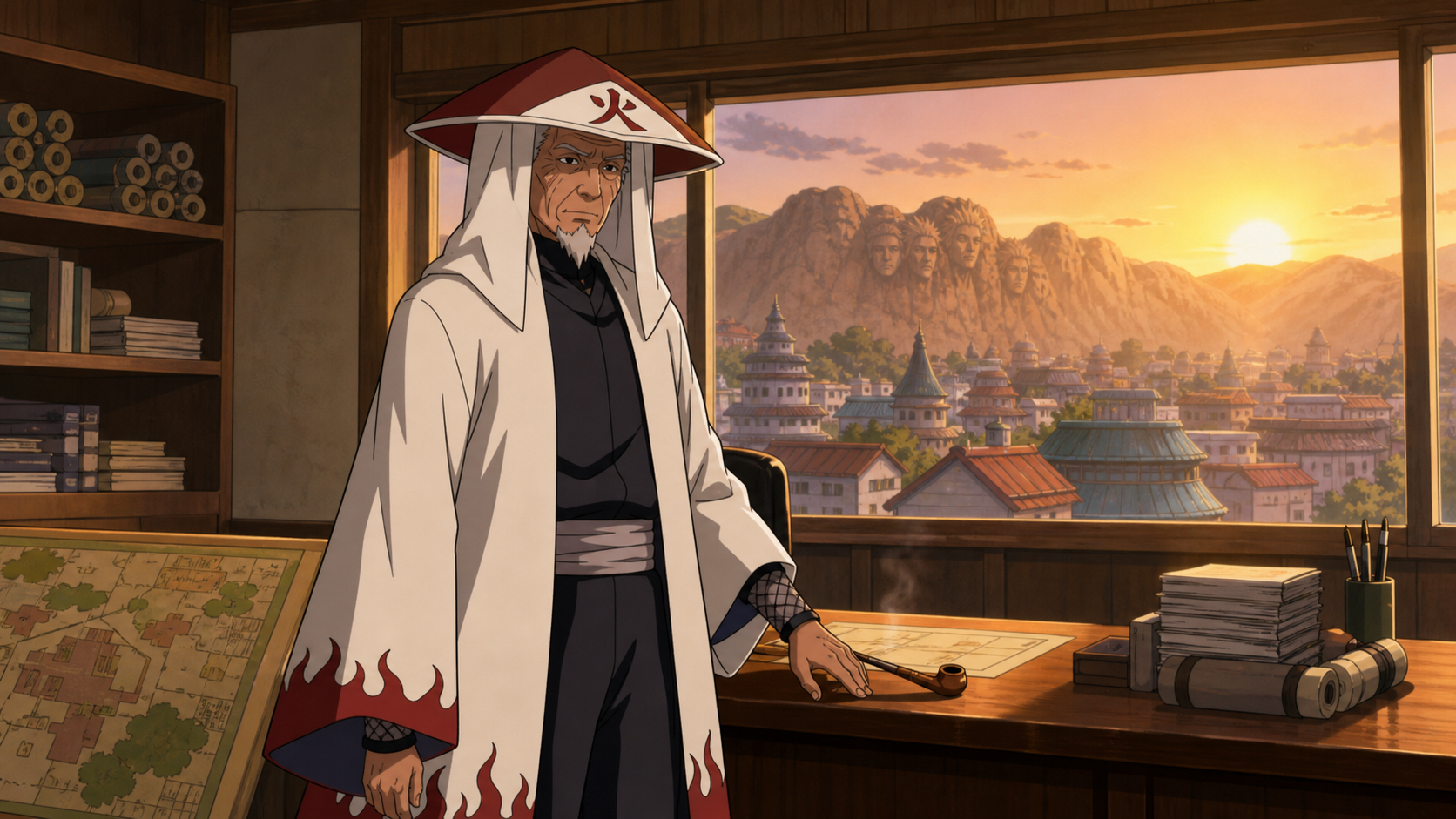
Old Hiruzen is short, lean and visibly aged. Gray hair, a narrow goatee, deep face lines and liver spots keep him from looking like an ageless wizard wearing an elder costume.
His formal Hokage clothing layers white-and-red ceremonial robes over darker clothes. The hat carries the fire mark. The visual language is simple: office, village, fire, father.
The pipe complicates that warmth. Hiruzen can look like somebody’s grandfather while reviewing military assignments, classified intelligence and children sent into danger. Naruto places domestic softness inside a war bureaucracy and waits to see whether we notice.
His combat clothing strips away ceremony. A dark fitted suit, mesh, armor pieces and a hooded forehead protector reveal the shinobi under the administrator. Youthful flashbacks give him darker hair, a fuller build and wartime armor associated with Tobirama’s generation.
The transition matters. Hiruzen does not begin as an old man behind a desk. He becomes one after decades of command.
The Hokage Monument outside his office keeps turning leadership into landscape. Hiruzen can look through a window and see his predecessors carved above the village. He also knows his own face belongs there. Public memory watches him while he makes private compromises.
05
Before the hat: Tobirama’s student and a village still becoming itself
Hiruzen grows up close to Konoha’s founding generation. He studies under Tobirama Senju alongside Danzō Shimura and serves in a unit that includes Homura Mitokado, Koharu Utatane, Kagami Uchiha and Torifu Akimichi.
That group matters because the later government does not appear from nowhere. Hiruzen, Danzō, Homura and Koharu share war, hierarchy and a teacher. Their adult arguments are family arguments inside a state.
Tobirama’s official birthday history identifies Hiruzen as his chief pupil. During the First Shinobi World War, the unit faces the Kinkaku Force. Someone must stay behind as a decoy so the others can escape.
Danzō wants to volunteer and hesitates. Hiruzen speaks first.
Tobirama chooses himself for the sacrifice and names Hiruzen the next Hokage.
That appointment is not a prize for the strongest attack. Tobirama reads readiness through conduct. Hiruzen places the team before himself in the decisive moment.
The lesson becomes Hiruzen’s political religion: the leader protects the village and develops the next generation.
The problem is that a heroic sacrifice during an ambush is clearer than governing. An enemy in front of you can be fought. A friend building an unofficial state inside your state requires a different courage.
06
The young Third Hokage inherits a war machine
Hiruzen becomes Hokage while the village system is still young and the shinobi world remains organized around recurring war.
He inherits the Will of Fire, an Academy, clan politics, intelligence services, mission markets and every unresolved argument hidden under the phrase village unity.
His long tenure creates real stability. Konoha survives wars, produces powerful shinobi and builds enough civic continuity for children like Naruto to imagine Hokage as a public dream rather than a clan possession.
That is not nothing.
Hiruzen also normalizes a government where the Hokage absorbs enormous personal authority while councils and covert units operate with inconsistent accountability. The structure depends on the leader being wise, informed, tireless and willing to confront old friends.
No human being clears that standard forever.
Hiruzen’s kindness makes the arrangement feel safer than it is. A gentle man can still preside over a brutal machine. Sometimes gentleness makes the machine harder to challenge because everybody can point to the kind man at the top.
07
Team Hiruzen contains three different arguments about power
Hiruzen trains Orochimaru, Jiraiya and Tsunade. Later history packages them as the Legendary Sannin, but they are never one blended student achievement.
Orochimaru is the prodigy. Hiruzen recognizes extraordinary intelligence and technical hunger. He hopes the student will inherit his will and perhaps his office.
Jiraiya begins as the less polished boy whose growth depends on persistence, travel and relationships. Hiruzen teaches him technique, but Jiraiya’s later philosophy grows through the Great Toads, war, Ame’s orphans, Minato and Naruto.
Tsunade carries founding lineage and terrifying talent. She also becomes the student who challenges village practice by demanding a medical ninja on every squad. Hiruzen’s generation teaches duty. Tsunade forces duty to include infrastructure that keeps people alive.
The team proves Hiruzen can identify and develop greatness.
The team also proves teaching skill does not guarantee control over what adults do with the lesson. Orochimaru pursues immortality through bodies. Jiraiya spends years trying to understand hatred. Tsunade leaves after grief makes the village’s sacrifice economy unbearable.
All three carry Hiruzen forward. None becomes a copy.
08
Orochimaru: the student Hiruzen could not stop loving
Hiruzen’s relationship with Orochimaru is his most intimate governance failure.
Official franchise history says Hiruzen hopes Orochimaru will inherit his will and strength. The student’s talent is obvious. So are the warning signs that follow.
When the Fourth Hokage must be selected, Orochimaru’s accomplishments are not enough. Hiruzen recognizes the darkness in his ideology and supports Minato instead.
That is a correct decision.
Then Konoha discovers human experimentation.
Orochimaru uses villagers and other victims as material in a search for techniques, knowledge and immortality. Hiruzen confronts him. The teacher has the criminal in front of him and cannot complete the punishment.
Orochimaru escapes.
Love explains the hesitation. Love does not excuse the bodies created after it.
Enma later judges Hiruzen for failing to kill Orochimaru when he had the chance. The summons is harsh because the relationship is old enough for honesty.
Years later, Orochimaru returns with an invasion. The student does not merely attack Konoha. He forces Hiruzen to fight the First and Second Hokage, the dead authorities who formed his political identity.
The roof becomes a classroom with every lesson reversed.
09
Minato’s succession and the office Hiruzen takes back
Minato Namikaze becomes Fourth Hokage after the war. Hiruzen retires.
The succession shows Hiruzen can release formal authority. That deserves credit in a franchise full of leaders who treat office like private property.
The Nine-Tails attack ends the retirement.
Minato and Kushina die while protecting the village and their newborn son. Hiruzen resumes the Hokage role because Konoha needs continuity immediately.
The return is duty, grief and political failure wrapped together. The village has lost a young leader. The old leader has to carry an office he already surrendered. Naruto becomes both an orphan and the container of the weapon that nearly destroyed Konoha.
Hiruzen prohibits public disclosure of Naruto’s jinchūriki status. The rule tries to stop adult hatred from transferring to a child.
Adults find ways to transfer it anyway.
10
Naruto: protected on paper, lonely in public
Hiruzen gives Naruto material support, watches him through the village administration and intervenes at key points. He does not announce Naruto’s parentage or turn him over to people seeking the Nine-Tails.
Those are protections.
Naruto still grows up alone in an apartment, eating badly, acting out for attention and learning from strangers’ faces that something about him is considered dirty.
Those are facts too.
The question is not whether Hiruzen secretly hated Naruto. He did not.
The question is whether the Hokage’s definition of care was enough.
Money keeps a child housed. A secrecy decree reduces one kind of open danger. Neither creates daily attachment, adult advocacy, nutritious meals, birthday rituals or a community willing to say the boy’s name without fear.
Hiruzen works through institutions, but the institutions do not make Naruto belong.
Iruka eventually does more of that emotional work. Teuchi and Ayame provide ordinary welcome. Kakashi, Team 7 and later Jiraiya build relationship around him.
Hiruzen helps create conditions where those bonds can form. He does not personally supply them.
Fandom often turns this gap into invented contracts, stolen inheritances and secret orders that the manga does not establish. We do not need fake evidence. A state can fail a child through inadequate care without a villain signing a cruelty memo.
11
Iruka turns policy into a human relationship
Iruka loses his parents during the Nine-Tails attack. Naruto contains the creature responsible. That history could reproduce hatred.
Hiruzen places responsibility on Iruka as an educator and reminds him to see the child rather than the beast.
Iruka makes the final choice himself.
In episode and chapter one, he protects Naruto, acknowledges him and gives him the forehead protector. The institution works because a teacher turns a principle into conduct.
After Hiruzen dies, Iruka explains the Will of Fire to Naruto and comforts Konohamaru. Official Naruto history connects that inheritance directly to Hiruzen’s teaching.
That may be Hiruzen’s best legacy.
Not the office. Not the monument. A teacher who stays with a grieving child.
12
The Hyūga affair: peace paid for with Hizashi’s body
Kumo’s head ninja attempts to abduct Hinata Hyūga. Hiashi kills him. Kumogakure then demands Hiashi’s body under threat of renewed conflict.
Konoha accepts a substitution. Hizashi, Hiashi’s twin from the branch family, dies in his place.
Later testimony frames Hizashi as choosing the sacrifice partly to save his brother and exercise agency. The clan system still shapes which body is available for the bargain.
Hiruzen governs the village that accepts it.
The decision may prevent war. That consequence matters. So does Neji growing up believing his father was discarded for the main house.
This is the ugly math of Hiruzen’s politics. Preserve the many by asking one family to absorb the wound.
Peace achieved through hidden bodily cost is still peace. The body remains dead.
13
The Uchiha crisis: negotiation loses to the machinery underneath it
The Uchiha clan is pushed toward revolt after years of suspicion and segregation sharpened by the Nine-Tails attack.
Hiruzen favors negotiation. He does not order Itachi to slaughter the clan in the main manga record.
Danzō believes force is the answer. He undermines Shisui, takes one of his eyes and works through the covert authority Hiruzen has repeatedly failed to eliminate.
Itachi receives an impossible choice inside that system. The massacre follows. Sasuke survives because Itachi makes him survive.
Hiruzen learns of the completed operation after the fact and agrees to protect Sasuke. He removes Danzō from his official position.
Then Danzō remains alive, influential and able to rebuild power.
This is where “Hiruzen did not order the massacre” becomes true and insufficient.
Leaders are responsible not only for commands they sign. They are responsible for the authorities they preserve, the subordinates they fail to restrain and the crises they let harden while hoping for one more peaceful meeting.
Hiruzen’s negotiation effort matters. His institutional weakness matters beside it.
The massacre is not proof that peace was foolish. The massacre is proof that peace without control over the coercive arm of government is a wish.
14
Danzō is the failure Hiruzen keeps delegating
Hiruzen and Danzō begin as teammates under Tobirama. The Kinkaku Force moment exposes their difference. Hiruzen volunteers. Danzō hesitates and spends a lifetime treating that hesitation as a wound somebody else caused.
Danzō builds Root around secrecy, obedience and sacrifice without public recognition. He frames cruelty as the burden required to keep Hiruzen’s hands clean.
That arrangement is politically convenient even when Hiruzen rejects its worst acts.
Hiruzen can embody the village’s fatherly face while Danzō claims the basement.
The problem is not that Hiruzen agrees with everything Danzō does. He plainly does not.
The problem is that disagreement rarely becomes permanent removal of capacity.
Hiruzen values old bonds, village unity and the possibility that people can return to better conduct. Those values become liabilities when applied to a man who treats every second chance as fresh operating room.
Danzō is not Hiruzen’s puppet. Hiruzen is not Danzō’s innocent victim. They are rival products of the same wartime classroom, and Konoha lives with both.
15
Homura and Koharu are colleagues, not a two-headed prop
Homura Mitokado and Koharu Utatane also grow from Tobirama’s generation into senior advisers.
They often favor institutional security, continuity and conservative judgment. Their advice can constrain later Hokage, but advice is not magic mind control.
Hiruzen owns his decisions.
The council structure shows how long memory can stabilize a village and fossilize it. Elders remember wars younger leaders did not experience. That knowledge can prevent repetition. Fear can also turn old emergency logic into permanent policy.
Konoha needs memory. It also needs a way to tell memory that the war is over.
16
Family at home pays for public fatherhood
Biwako Sarutobi is Hiruzen’s wife. She assists Kushina during Naruto’s birth and dies during the Nine-Tails attack.
Asuma is their son. His adult conflict with Hiruzen includes leaving Konoha and serving the Twelve Guardian Ninja before returning. The relationship reminds us that being called father of the village does not make fatherhood at home simple.
Konohamaru grows up as the “honorable grandson” before Naruto teaches him to demand recognition under his own name. Hiruzen loves him, yet the office turns family identity into public rank.
Mirai is Asuma and Kurenai’s daughter, born after Hiruzen’s death. She carries Sarutobi inheritance without meeting the grandfather whose office shaped her family.
The family record is not a cute sidebar. Biwako dies in a village crisis. Asuma distances himself from the Hokage father. Konohamaru has to separate his ambition from inherited status.
Public service enters the house whether the robe is hanging up or not.
17
The Konoha Crush brings the bill home
Orochimaru infiltrates the Chūnin Exams and launches the Konoha Crush with Sound and Sand forces.
The invasion traps Hiruzen inside the Four Violet Flames Formation. Orochimaru uses Reanimation to summon Hashirama and Tobirama.
Hiruzen faces his predecessors while fighting his student.
The battle demonstrates why Professor is earned. He reads techniques quickly, uses clones, counters elemental attacks, summons Enma and shifts between ninjutsu, taijutsu, weapons and sealing.
He is also old.
Orochimaru notices the reduced stamina. Enma’s transformed staff is heavy. Every clone divides chakra Hiruzen cannot replace. The fight refuses to let reputation erase biology.
Hiruzen uses the Reaper Death Seal on Hashirama and Tobirama, freeing their souls from Orochimaru’s control at the cost of his own.
He tries to take Orochimaru too.
His strength fails before he can extract the entire soul. Hiruzen seals Orochimaru’s arms and removes his ability to perform ordinary hand-seal ninjutsu.
The outcome is victory, failure and consequence at once. Konoha survives. Hiruzen dies. Orochimaru escapes alive but maimed. The student Hiruzen once spared becomes the enemy he can only partially stop by sacrificing himself.
18
Enma is a partner allowed to tell the Hokage the truth
Monkey King Enma is Hiruzen’s summons and long-term combat partner.
Enma transforms into the Adamantine Staff, changes length, strikes with enormous force and can create a protective prison configuration. He pushes back against dangerous techniques and gives Hiruzen reach his aging body no longer has alone.
Enma also speaks.
That should not be treated as decoration. He warns Hiruzen, criticizes the earlier failure to kill Orochimaru and acts according to judgment inside the battle.
Their partnership is one of the few places where Hiruzen’s authority does not require polite agreement. The Hokage needs somebody who can say, “You should have handled this years ago,” while the roof is actively exploding.
19
Complete ability and limit shelf
Hiruzen’s greatest ability is integration.
He has all five basic chakra natures: fire, wind, lightning, earth and water. During the Fourth War, clones let him launch all five transformations together against the God Tree’s branches. The feat proves simultaneous breadth. It does not mean every element is equally efficient in every living-body condition.
Fire Release includes the Fire Dragon Flame Bullet associated with his Konoha Crush battle. Earth Release gives walls, mud and projectile counters. Water Release without a convenient natural source demonstrates strong transformation skill. The war expands the on-page elemental shelf.
Shadow Clone Technique multiplies action at a steep chakra cost. Shuriken Shadow Clone Technique turns thrown weapons into a mass attack. Hiruzen’s hand-seal score and combat reading support rapid transitions between these tools.
Taijutsu remains technically elite even when age reduces speed and strength. Enma’s staff lets Hiruzen combine weapon work with changes in range and shape.
The Reaper Death Seal is not a dramatic finishing beam. The user offers their own soul to summon the death god and extract the target’s soul. Strength, grip and duration matter. Hiruzen can seal the resurrected Hokage, then only seal Orochimaru’s arms before dying.
Barrier work during the Fourth War includes joining the other Hokage in the Four Red Yang Formation around the Ten-Tails. Edo Tensei gives him regeneration and a different chakra condition from his final living fight.
Hiruzen has no confirmed bloodline limit. He does not display Sage Mode. He does not receive Hashirama-cell regeneration. He is not physically immortal because an old title sounds impressive.
Prime Hiruzen remains deliberately under-shown. The manga gives reputation, data and fragments rather than a complete youthful battle record. Any claim that prime Hiruzen definitely defeats a named later character is fandom math, not biography.
20
Death turns administration into inheritance
Hiruzen dies seeing Orochimaru through the memory of the student he once taught.
The village holds a funeral for those lost in the invasion. Konohamaru grieves. Iruka answers Naruto’s question about why people risk their lives for others.
The Will of Fire becomes concrete through absence.
Hiruzen’s death also creates a political problem. Konoha needs a Fifth Hokage. Jiraiya refuses the office and seeks Tsunade. Orochimaru seeks Tsunade for his arms. The three students continue arguing around the teacher’s final consequence.
Tsunade accepts leadership and returns with medical expertise, grief and a different understanding of institutional care.
Succession does not erase Hiruzen. It answers him.
21
Edo Tensei forces Hiruzen back into the argument
Orochimaru later releases the souls from the Reaper’s stomach and reanimates the four dead Hokage.
Hiruzen returns under conditions created by the student who killed him.
Sasuke asks the Hokage what a village and shinobi are. The conversation forces Konoha’s dead leaders to explain the system that formed Itachi’s life.
Hiruzen does not become the single narrator. Hashirama, Tobirama and Minato offer different histories and temperaments. That structure matters because no Hokage owns the village’s meaning.
On the battlefield, Hiruzen helps erect the barrier around the Ten-Tails, uses elemental combinations, fights the God Tree and responds when Naruto and others are endangered. His Edo body can recover from damage that would kill a living old man.
The return gives him action, not a retroactive acquittal.
He helps save the world. The Uchiha are still dead. Naruto still had a lonely childhood. Both truths survive resurrection.
22
Relationship atlas
Tobirama Senju
Tobirama gives Hiruzen training, office and a model of sacrifice. Hiruzen inherits both civic structure and unresolved suspicion around how Konoha manages clans and security. Respect does not make inheritance morally neutral.
Danzō Shimura
Danzō is teammate, rival and the shadow Hiruzen repeatedly fails to remove. Their relationship tests whether mercy toward an old friend can become cruelty toward strangers.
Orochimaru
Orochimaru is pride, fear, favored talent and the consequence of delayed action. Hiruzen’s final battle is not merely village defense. It is a teacher accepting the cost of his earlier refusal.
Jiraiya
Jiraiya carries Hiruzen’s teaching into a wider search for peace. He refuses the Hokage office but finds and prepares Hiruzen’s successor, then trains Naruto. The inheritance moves through mentorship rather than title.
Tsunade
Tsunade challenges the sacrifice economy, leaves, returns and becomes Fifth Hokage. She inherits an office from the teacher while correcting parts of the system that exhausted her.
Minato and Kushina
Minato is the chosen successor whose death returns Hiruzen to power. Kushina and Minato’s trust leaves Naruto inside Hiruzen’s institutional care. Their absence turns succession into a parenting obligation the village only partly meets.
Naruto Uzumaki
Naruto is Hiruzen’s belief in the village’s children tested against a real child’s loneliness. Hiruzen protects him from some dangers and fails to build daily belonging. Naruto later realizes the Will of Fire more fully than the government that taught it.
Iruka Umino
Iruka proves Hiruzen can teach people to interrupt inherited hatred. The teacher makes the principle live where policy cannot.
Asuma, Konohamaru and Biwako
They expose the domestic cost of public fatherhood. Hiruzen’s family loves him, argues with his office and loses people to the same village history he governs.
Itachi and Shisui Uchiha
Hiruzen values their peace efforts and relies on young operatives inside a crisis adults created. Danzō’s intervention does not erase Hiruzen’s responsibility for the system that gave Danzō room.
Hiashi, Hizashi and Neji Hyūga
Their family bears the bodily price of a diplomatic settlement. The affair forces Hiruzen’s village-wide protection ethic to confront the individual person selected for sacrifice.
Enma
Enma supplies force, judgment and honesty. The relationship works because loyalty includes criticism.
23
The original Japanese performance
Hidekatsu Shibata performs the adult and elderly Hiruzen in the original Japanese anime record used here.
The credit is firm. This profile does not invent pitch, breath or pause analysis without a controlled Japanese-audio rewatch.
The performance assignment itself carries an unusual burden. Hiruzen has to sound like a grandfather, military commander, teacher, politician and exhausted fighter without becoming five unrelated characters.
Episode-level Reacts can later examine how Shibata handles those shifts when lawful playback and exact scene receipts are available. A profile should not fake listening and call the result criticism.
No English-dub performers appear here.
24
Manga, anime, novels, films, OVAs and games
Hiruzen’s main biography comes from the Naruto manga and its television adaptation.
The anime expands portions of his younger life, village administration, Naruto interactions and pre-series history. Those scenes can enrich adaptation discussion when labeled. They cannot silently overwrite manga chronology.
Hiruzen appears in supplementary novel and game material, and in franchise film or OVA contexts such as cameos and alternate presentations. The Will of Fire film uses his office and village history in its own movie-scale crisis. A film appearance belongs in the media shelf, not automatically inside the manga timeline.
Games make Hiruzen playable and often expand his elemental or staff spectacle. Mechanics designed for a fighting roster are not missing manga chapters.
The distinction protects the character. Hiruzen already has enough real abilities. He does not need a controller combo mistaken for secret canon.
25
The Will of Fire promises family and creates a test
Hiruzen explains the village as a family whose people protect the next generation.
The ideal is powerful because Naruto repeatedly proves it can cross bloodline, clan and status. Iruka chooses Naruto. Team 7 chooses each other. Adults die so children can continue.
The ideal is dangerous when family language hides authority.
A father can ask for obedience. A family can punish dissent as betrayal. A village can call a child’s sacrifice love because the sacrifice protects everybody else.
The Will of Fire should therefore be judged by conduct.
Does the child eat? Does the branch family member live? Does the minority clan receive equal political trust? Can a subordinate be stopped before secrecy becomes atrocity?
Hiruzen speaks the promise better than he enforces it.
Naruto’s generation spends the series trying to close that distance.
26
Confucian office and the failure to rectify roles
This is a RaeRae reading, not an author-issued doctrine.
Confucian ethics place weight on roles: ruler, teacher, parent, child, elder and junior. A title creates obligation. Proper names and proper conduct should match.
Hiruzen occupies three roles at once. He is ruler, teacher and symbolic father.
He performs many duties well. He teaches skilled students, protects the village during invasion and accepts death before letting the office become a hiding place.
His failures often occur when roles blur.
He treats Danzō like an old teammate when the office requires treating him as an unaccountable official. He treats Orochimaru like a beloved student when the moment requires treating him as a murderer. He calls village children family while administrative care substitutes for parenting.
The problem is not excessive compassion. The problem is compassion aimed at the powerful person in front of him while distant people absorb the risk.
27
Buddhist attachment and the inability to release continuity
This is also an interpretive lens.
Hiruzen values continuity. The village must survive. Bonds must remain repairable. Old friends might return to right conduct. Students might rediscover the lesson.
Attachment turns those hopes into delay.
He cannot release Orochimaru when release means accepting the student has become an enemy. He cannot fully release Danzō because their shared history remains part of his own identity. He returns to office because the village needs him, then stays inside a system that has learned to depend on his endurance.
His final technique accepts impermanence completely. The Reaper Death Seal destroys the fantasy that he can preserve himself, the village and the student at once.
He protects what can continue by surrendering his own continuation.
The act is noble. The need for it grows from earlier attachment.
28
The industry loves a good grandfather because bureaucracy is harder to sell
Hiruzen’s visual branding is excellent. Pipe. Hat. Robes. Monument. Warm office. Stern eyes that soften around Naruto.
Merchandise can sell the Third Hokage as wise village grandfather more easily than it can sell a policy review of Root oversight.
Battle marketing moves the other direction. Professor becomes a roster full of elemental spectacle. Prime-Hiruzen arguments turn incomplete history into infinite potential.
Both versions flatten him.
The actual character is interesting because administration and combat cannot be separated. The man who knows how to counter five nature transformations also has to decide who receives protection, who gets surveilled and which old friend still has access to coercive power.
The roof fight is exciting because the paperwork failed first.
29
Fandom court
“Hiruzen was the worst Hokage”
That verdict skips the governing record and treats every Konoha failure as one man’s direct plan. Hiruzen stabilizes the village across wars, trains major leaders, supports Minato’s succession, protects Konoha during invasion and transmits an ethic Naruto later fulfills.
His failures remain severe. Rank them after reading them, not before.
“Hiruzen was Naruto’s perfect grandfather”
No. Warmth is not daily care. Naruto’s apartment, diet, acting out and social isolation are part of the evidence.
“Hiruzen ordered the Uchiha massacre”
The main record shows Hiruzen seeking negotiation and learning of the completed operation afterward. Danzō’s coercive role matters. Hiruzen’s failure to restrain Danzō also matters.
“Danzō did everything bad, so Hiruzen is clean”
A Hokage does not become innocent because a subordinate is worse.
“Prime Hiruzen beats everybody”
Prime Hiruzen has enormous reputation and limited direct combat evidence. Unknown is not another word for infinite.
“He knew every Konoha jutsu”
Professor describes breadth and mastery. It does not give him every bloodline limit, private clan secret and future invention.
“He was too kind”
Kindness is not the problem. Selective softness toward powerful intimates is.
30
Final verdict
Hiruzen Sarutobi believes the village is a family.
His life proves that belief can inspire sacrifice, mentorship and real care. His life also proves that calling people family does not protect them unless authority acts before the body count.
He gives Konoha decades of continuity. He trains the Sannin. He recognizes Minato. He helps Iruka see Naruto. He dies defending the village from the student he once failed to stop.
He also leaves Naruto lonely, accepts a Hyūga body as the price of peace, fails to control Danzō and reaches the Uchiha massacre with negotiation too weak to defeat the machinery under his own office.
That does not make him fake.
That makes him painfully sincere.
Hiruzen knows the right lesson. He passes it to people who sometimes live it better than he did.
Naruto’s village grows because the Third Hokage was wise enough to name the ideal and flawed enough to show why an ideal needs enforcement.
The Professor could master five elements.
The hardest technique was always making love become policy.
Sources and canon boundary
Editorial record: Manga chronology controls. Anime expansions, novels, films, OVAs and games are labeled instead of blended into canon. Interpretation is original CVM Sekai editorial work.
Primary franchise references: Naruto Official and VIZ Media Naruto.