
Naruto Uzumaki
The loudest child in the Hidden Leaf begins as a boy everyone has already defined. His life becomes an argument that birth, stigma, loneliness, prophecy, and even the monster placed inside a body do not get the final word on who a person chooses to become.
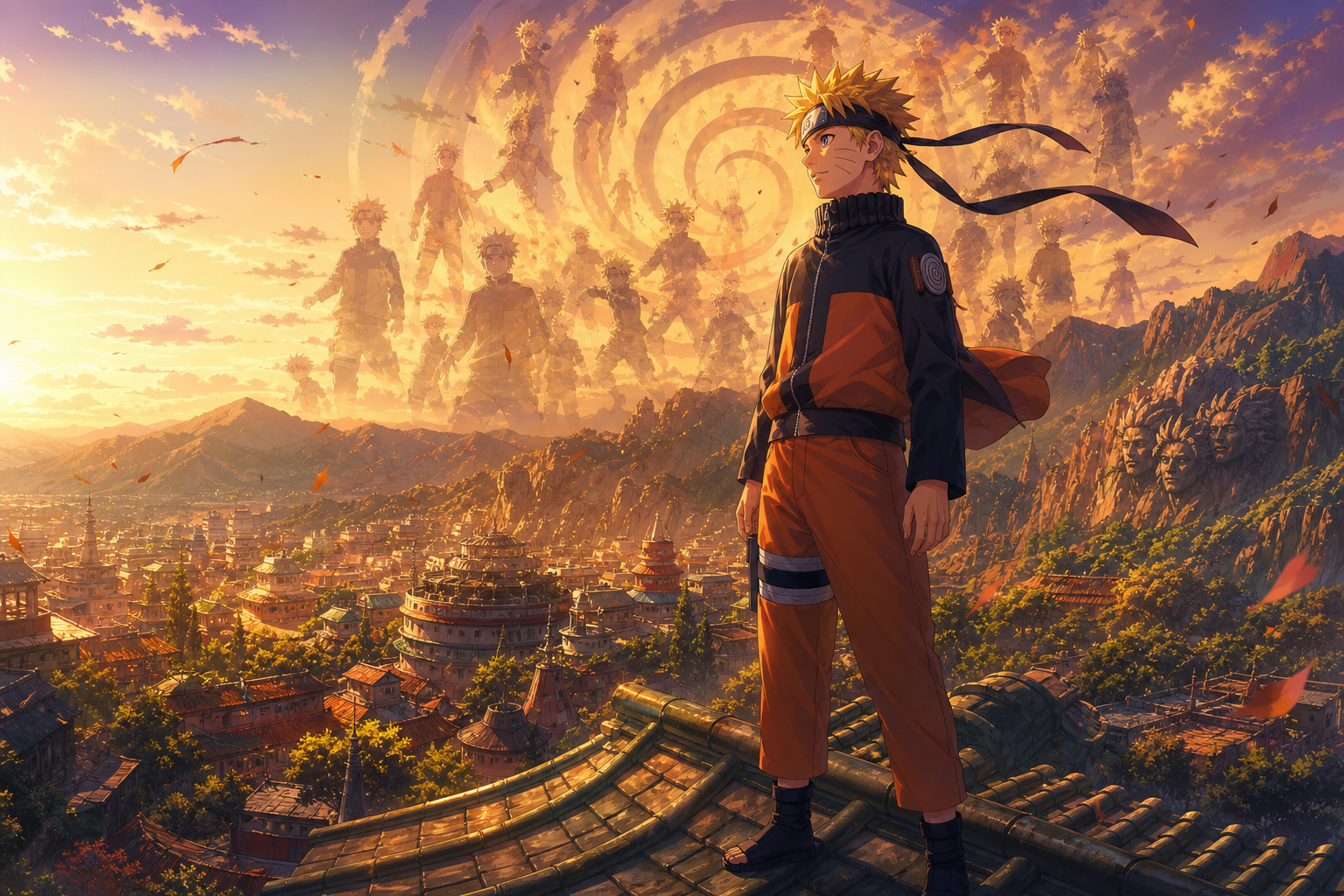
Profile
| Full name | Naruto Uzumaki | Japanese | うずまきナルト |
|---|---|---|---|
| Birthday | October 10 | Home | Konohagakure, Land of Fire |
| Starting rank | Genin | Primary team | Team 7 |
| Roles | Protagonist, jinchuriki, shinobi, eventual Hokage | First appearance | Manga Chapter 1, Anime Episode 1 |
| Original Japanese voice | Junko Takeuchi | ||
Spoiler map: The opening sections explain Naruto as viewers meet him in the original anime. The Complete Life File, later abilities, family, and legacy sections discuss the full manga and anime story through his adult life.
Who Naruto Is Before the Legend
Naruto Uzumaki enters the story as the loudest child in Konohagakure and one of its loneliest. He paints the Hokage Monument, interrupts class, invents vulgar transformations, and announces ambitions far larger than his apparent ability. Those actions are not random comic chaos. They are the survival language of a boy who has learned that punishment is still a form of recognition. If the village will not look at him with affection, he will force it to look at him with exasperation.
His first dream of becoming Hokage is therefore both noble and wounded. He wants to protect people, but he also wants the office to compel the village to admit that he exists. The series gradually transforms that desire. Recognition stops being a prize Naruto hopes authority will deliver and becomes something he earns by recognizing other people first. He sees Haku, Gaara, Tsunade, Neji, Nagato, Kurama, Obito, and Sasuke at the moment each believes pain has made mutual understanding impossible. His signature talent is not merely endurance. It is the refusal to accept that another person’s present identity is their final identity.
Naruto can be reckless, vain, impatient, tactless, and painfully slow to understand formal instruction. He is also observant in the ways neglected children often become observant. He notices isolation. He remembers contempt. He understands the difference between being surrounded and belonging. This emotional intelligence is why his apparently naive speeches can reach people that more polished arguments cannot. Naruto does not theorize about despair from a safe distance. He recognizes its grammar because he once spoke it.
The Complete Life File
Birth, inheritance, and the village’s secret
Naruto is born on October 10 to Kushina Uzumaki and Minato Namikaze, the Fourth Hokage. The masked attacker Obito Uchiha exploits the weakening of Kushina’s seal during childbirth, extracts the Nine-Tailed Fox, and turns it against the village. Minato and Kushina die protecting their son. Minato seals portions of the fox’s chakra into the newborn Naruto, making him the container of the disaster that has just traumatized Konoha.
The political decision that shapes Naruto’s childhood is not simply the sealing. It is secrecy without care. The adults know what happened, yet Naruto is denied an explanation while still being punished socially for it. A decree forbids open discussion of the Nine-Tails, but silence does not erase fear. It transfers fear into looks, avoidance, rumors, and behavior children copy from their parents. Naruto grows up feeling a verdict whose charge he has never been allowed to hear.
The Academy and Iruka’s recognition
Naruto repeatedly fails the graduation exam because the ordinary Clone Technique exposes his weak chakra control. Mizuki manipulates him into stealing the Scroll of Seals by promising a secret path to graduation. Naruto learns the Multiple Shadow Clone Technique, discovers that the fox is sealed inside him, and hears Mizuki frame him as the monster itself. Iruka Umino answers with the first public recognition that matters: Naruto is not the Nine-Tails. He is Naruto Uzumaki, Iruka’s student and a member of the village.
That distinction becomes the moral seed of the entire series. Iruka does not deny the catastrophe or Naruto’s dangerous power. He refuses the lazy substitution of vessel for person. Naruto defeats Mizuki and receives Iruka’s forehead protector. Graduation is therefore not merely academic. It is the first institutional symbol granted by someone who has chosen to see him accurately.
Team 7 and the first world beyond Konoha
Assigned to Team 7 with Sasuke Uchiha and Sakura Haruno under Kakashi Hatake, Naruto initially treats teamwork as an obstacle to individual recognition. Kakashi’s bell test teaches that shinobi rules are incomplete without loyalty to comrades. During the Land of Waves mission, Naruto confronts lethal fear, class exploitation, and enemies whose humanity does not fit the village’s simple categories. Haku’s devotion to Zabuza and Zabuza’s buried grief force Naruto to ask whether shinobi are merely tools. His answer, declared before he has the power to enforce it, becomes his lifelong project.
Sasuke is central from the beginning. Naruto envies his talent and attention, resents his aloofness, recognizes his loneliness, and measures himself against him. When Sasuke protects Naruto from Haku at apparent mortal cost, rivalry becomes a bond neither boy can comfortably name. Sakura begins as Naruto’s crush and frequent critic, but the missions steadily make her a teammate whose courage, pain, and growth he respects.
Exams, invasion, and the politics of destiny
The Chunin Exams enlarge Naruto’s world. Orochimaru marks Sasuke. Rock Lee demonstrates the nobility and danger of effort. Neji Hyuga turns family oppression into a doctrine of predestination. Gaara embodies what Naruto might have become if every offered bond had failed. Naruto’s victory over Neji rejects the idea that inherited systems have the last word, though the series later complicates that claim by revealing Naruto’s own extraordinary inheritances.
Against Gaara, Naruto recognizes another jinchuriki whose village converted a child into a weapon and then feared the result. Naruto wins not because he lacks rage, but because Iruka, Team 7, and the people met on missions have given him reasons to use strength for someone else. His empathy is not softness added after battle. It is the strategic insight that allows him to interrupt Gaara’s self-confirming cycle of violence.
Jiraiya, Tsunade, and the shape of a legacy
Jiraiya becomes Naruto’s teacher, godfather figure, source of comic frustration, and bridge to Minato’s generation. He improves Naruto’s access to the Nine-Tails’ chakra, teaches summoning, and passes on the Rasengan. The search for Tsunade brings Naruto into contact with an adult who has lost faith in the Hokage ideal because the office is entangled with the deaths of people she loved. Naruto’s stubborn commitment reawakens her willingness to serve.
The Rasengan is more than a powerful technique. It is an unfinished inheritance from Minato, transmitted through Jiraiya before Naruto knows the family connection. Naruto learns it through improvised stages and shadow-clone assistance, turning an emblem of genius into a record of adaptation. His method repeatedly follows this pattern: if conventional form excludes him, he invents a form that uses what he has.
Sasuke’s departure and Naruto’s first defining failure
Sasuke’s decision to leave Konoha for Orochimaru exposes the limit of Naruto’s early confidence. Naruto understands the emotional temptation of severing bonds but cannot yet defeat the power behind Sasuke’s choice. Their battle at the Valley of the End is intimate, ideological, and unfinished. Naruto fails to bring Sasuke home. That failure becomes a promise he carries through the time skip, sometimes with admirable loyalty and sometimes with a refusal to respect how complicated Sasuke’s agency has become.
Return, grief, and the education of power
After training with Jiraiya, Naruto returns older but not suddenly complete. The Akatsuki’s pursuit of tailed beasts makes his body a geopolitical target. Gaara’s abduction and death show Naruto the cost of jinchuriki policy on an international scale. Chiyo’s sacrifice restores Gaara and rebukes the older generation’s willingness to burden children with weapons and grudges.
Naruto develops the Wind Style: Rasenshuriken, but the technique damages him as well as his target. This is a recurring Naruto lesson: determination does not make every sacrifice wise. Kakashi and Tsunade help him refine both technique and judgment. Meanwhile, the search for Sasuke repeatedly tests whether love can survive betrayal without becoming possession.
Jiraiya, Pain, and the village that finally looks back
Jiraiya’s death removes one of Naruto’s last parental anchors and delivers an intellectual burden: how can the shinobi world escape its cycle of vengeance? Naruto’s Sage Mode training turns grief into disciplined attention. When Pain destroys Konoha, Naruto arrives as the village’s defender, yet physical victory cannot answer Nagato’s argument that every nation names its own violence justice.
Naruto’s decisive act is to listen while refusing surrender. He cannot present a complete peace plan. He offers a commitment to keep searching and grounds it in Jiraiya’s faith. Nagato reverses his final violence and restores many of the dead. Konoha welcomes Naruto as a hero, completing the recognition arc promised in Episode 1. The scene is emotionally triumphant and politically uneasy. The same village that isolated a child now celebrates the adult who saved it. Naruto accepts the love without pretending the earlier wound never existed.
War, Kurama, and inherited history
The Fourth Shinobi World War forces Naruto to confront the scale of the system he hopes to change. He learns to cooperate with the Nine-Tails rather than merely borrow or suppress its power. Calling the fox Kurama is a crucial ethical action. A weapon label becomes a name, and a captive power becomes a partner. Their relationship does not erase the harm Kurama caused or the coercion inflicted upon both of them. It creates responsibility through mutual recognition.
Naruto meets the preserved chakra of his parents, learns the truth of his birth, and gains context without receiving a magically repaired childhood. He also receives power associated with Hagoromo Otsutsuki and the reincarnated conflict of Asura and Indra. This revelation complicates the earlier celebration of self-made destiny. Naruto is heavily inherited. His achievement lies less in having no destiny than in choosing what to do with every inheritance, including the violent ones.
He shares chakra across the Allied Shinobi Forces, fights Obito and Madara, survives the extraction of Kurama, and helps seal Kaguya. His greatest war-time victories repeatedly involve turning isolated power into distributed power. Even when elevated to mythic status, Naruto’s instinct is communal.
The last battle and adulthood
Sasuke proposes a revolution built on concentrated loneliness: he will become the single enemy the world must unite against. Naruto rejects peace maintained by one person’s permanent damnation. Their final battle destroys an arm from each and exhausts every remaining argument. Naruto does not win by making Sasuke irrelevant. He proves that he will endure the bond without allowing Sasuke’s despair to define its terms.
As an adult, Naruto marries Hinata Hyuga, becomes father to Boruto and Himawari, and ultimately serves as the Seventh Hokage. The office fulfills his childhood declaration, but adulthood tests whether symbolic recognition can coexist with intimate presence. Hokage Naruto can protect an entire village and still struggle to give his family enough of himself. The legend therefore does not end with a perfect solution. It becomes a different kind of responsibility.
Relationship Atlas
Iruka Umino
Iruka is Naruto’s first dependable witness. Both lost parents to the Nine-Tails, which means Iruka’s acceptance is not ignorance of pain. It is a conscious refusal to transfer that pain onto a child. Their ramen meals, scoldings, and ceremonial moments give Naruto an ordinary family relationship before he learns his biological history.
Sasuke Uchiha
Sasuke is rival, brother figure, mirror, and ideological adversary. Both boys are isolated, but one performs noisily while the other withdraws. Naruto’s pursuit of Sasuke contains love, guilt, pride, and projection. At its best, it refuses to abandon a traumatized person. At its worst, it assumes persistence can substitute for listening. Their final reconciliation succeeds only after both exhaust the fantasy that power can sever mutual recognition.
Sakura Haruno
Naruto’s childhood crush begins with idealization, but their bond matures through shared danger and the mutual wound of Sasuke’s absence. Sakura heals Naruto, challenges him, lies to him in a misguided effort to release his promise, and fights beside him at the world’s end. She becomes family, not a romantic reward.
Kakashi Hatake
Kakashi teaches Naruto that comrades matter more than rigid rule and later helps translate Naruto’s unusual learning style into technical progress. Both inherit unfinished dreams from the dead. Kakashi provides restraint and tactical literacy without demanding that Naruto become emotionally cool.
Jiraiya
Jiraiya gives Naruto training, travel, intellectual inheritance, and a model of flawed adulthood. His death changes Naruto’s grief from a private ache into a political question. Naruto continues Jiraiya’s search for peace while correcting his teacher’s tendency to leave love and responsibility unresolved.
Hinata Hyuga
Hinata recognizes Naruto’s perseverance before public opinion changes. Naruto inspires her courage; she later protects him against Pain and restores his resolve during the war. Their adult partnership grows from long asymmetrical awareness into mutual commitment, though much of the romantic transition is developed outside the original weekly anime’s central narrative.
Kushina and Minato
Naruto’s parents leave him love, power, danger, and a public legacy he initially cannot name. Meeting their chakra imprints lets him receive explanations and affection, but it does not retroactively supply the childhood they lost. Their presence deepens rather than cancels Iruka’s role.
Kurama
Kurama begins as prisoner, threat, and source of borrowed strength. Naruto first demands power, later confronts hatred, and finally offers partnership and a name. Their bond is the series’ most literal demonstration that peace cannot be built by pretending coercion was consent.
Gaara
Gaara is the counterfactual Naruto. He shows what a lonely jinchuriki can become when fear is answered only with more fear. Naruto’s victory opens a path Gaara chooses to walk. Gaara’s rise to Kazekage then proves Naruto’s political dream is possible before Naruto achieves it himself.
Shinobi File: Power, Method, and Limits
| Ability | What it does | Why it matters |
|---|---|---|
| Vast chakra and Uzumaki vitality | Supports extreme stamina, recovery, clone volume, and repeated high-output techniques. | Raw capacity is an inheritance, but early poor control prevents it from functioning as effortless talent. |
| Shadow Clone Technique | Creates physical duplicates that return experience to the original when dispersed. | Naruto turns his childhood symbol of failed cloning into his most versatile tool. Clones make solitude tactical and allow accelerated learning. |
| Transformation and improvisation | Changes appearance and enables feints, combinations, and comic disruption. | His earliest apparent joke technique reveals a lifelong strength: attacking the assumptions behind an opponent’s attention. |
| Rasengan family | Shapes rotating chakra into a concentrated sphere, later expanded into many forms. | Connects Minato, Jiraiya, Kakashi, Konohamaru, and Naruto across generations. Naruto’s variants turn inheritance into authorship. |
| Wind Style: Rasenshuriken | Adds wind transformation to the Rasengan, producing microscopic cutting damage. | Marks Naruto’s first completed original nature transformation and teaches that a heroic technique can still be self-destructive. |
| Toad summoning | Calls allies from Mount Myoboku, including Gamabunta and later major battle partners. | Power depends on relationship and earned cooperation, not merely a contract. |
| Sage Mode | Balances natural energy with physical and spiritual energy, heightening strength, perception, and resilience. | Requires stillness from the story’s most restless hero. Naruto learns to receive the world rather than constantly shout into it. |
| Kurama chakra modes | Accesses progressively cooperative forms of the Nine-Tails’ chakra. | The visual evolution tracks an ethical evolution from extraction to partnership. |
| Six Paths power | Grants extraordinary perception, flight, healing, and power capable of confronting world-level threats. | Places Naruto inside mythic inheritance while testing whether his human commitments survive godlike scale. |
| Emotional recognition | Reads loneliness, persists in dialogue, and reframes enemies as moral agents capable of choice. | Often dismissed as “talking,” it is Naruto’s most consequential strategic ability. Battles establish the conditions; recognition changes the outcome. |
Combat intelligence
Naruto is not a conventional classroom prodigy, but calling him unintelligent misses how he fights. He uses clones to gather information, hides transformations inside transformations, converts terrain into misdirection, and builds combinations around what an enemy expects him to do. His intelligence is embodied, social, and iterative. He often needs to touch the problem before he can solve it.
Weaknesses
Early Naruto has poor control, limited formal knowledge, impulsive threat assessment, and dependence on power that can overwhelm his judgment. Later strength introduces different risks: carrying every burden himself, confusing refusal to abandon someone with the right to decide for them, and letting public responsibility consume private presence. His optimism is powerful because it survives evidence, not because it makes him incapable of error.
Design, Symbols, and Visual Storytelling
Orange as refusal
Naruto’s early orange clothing makes him impossible to absorb into the village’s muted military palette. For a character who claims to want stealth, the costume is a joke with a psychological truth: Naruto cannot bear invisibility. As his clothing matures, orange remains while the silhouette becomes more controlled. The adult does not erase the child. He gives the child’s need a disciplined form.
Goggles, forehead protector, and institutional belonging
The goggles worn before graduation imitate the placement of a shinobi forehead protector. When Iruka gives Naruto the real symbol, the substitution matters because the village’s mark has been mediated by personal recognition. The protector can represent conformity, but in Naruto’s case it first represents entry into a community that had withheld membership.
Whisker marks and spiral imagery
The three marks on each cheek visually connect Naruto to the Nine-Tails before the audience understands the seal. Spirals recur through the Uzumaki name and crest, the seal on Naruto’s body, the rotation of the Rasengan, and the series’ fascination with cycles. A spiral can repeat while still moving outward. That is a useful image for a story about inherited violence that resembles the past without being condemned to reproduce it exactly.
The Hokage Monument
Naruto first treats the carved faces as a surface to vandalize. He later joins their political lineage. The movement from painting the monument to being represented by it is not a simple triumph of obedience. Naruto forces the institution to expand its image of who may belong. The lingering question is whether becoming the monument risks making him less available to the living people beneath it.
Voice and Performance
Junko Takeuchi performs Naruto in Japanese across his comic bravado, adolescent strain, grief, battlefield command, and adult warmth. The performance makes roughness flexible. Naruto’s voice can crack with humiliation, harden in anger, race through a joke, or quiet into the dangerous calm that arrives when he truly understands an opponent.
For a series built around declarations, names, vows, and the power of being heard, vocal performance is not ornamental. Naruto’s growth can be traced through how he occupies silence. Episode 1’s boy fills every space. Sage Mode Naruto can stand still. Hokage Naruto can address a crowd, yet the most important scenes often reduce him again to one person trying to reach one other person.
Existential File: What Naruto Is Really About
Are we what a community says we are?
Naruto begins under an identity assigned by collective fear. The village does not merely dislike him; it mistakes him for an event that occurred before he could choose anything. The existential problem is severe: how does a person form a self when every surrounding adult behaves as if the self has already been decided?
Naruto’s answer is not solitary self-invention. “I know who I am” is never enough by itself because identity in this story is relational. Iruka’s recognition matters. Team 7 matters. The people Naruto recognizes in return matter. He becomes himself through promises, failures, labor, and reciprocal witness. The series therefore rejects both total social determinism and the fantasy of an isolated authentic self.
The hidden village as family and state
Konoha calls itself a village and speaks the language of family, sacrifice, and inherited Will of Fire. It is also a military institution that assigns children to dangerous work, manages secret weapons, preserves clan hierarchies, and controls public memory. Naruto loves the village because real people there love him. His love does not make its systems innocent.
This tension explains why the Hokage dream carries such weight. Naruto does not merely want the biggest chair. He wants the authority that once excluded him to testify that exclusion was wrong. Yet political recognition cannot by itself repair every person damaged by the system. Sasuke, Neji, Itachi, Gaara, Nagato, and the jinchuriki each reveal consequences the heroic village narrative struggles to contain.
Freedom inside inheritance
Naruto inherits parents, bloodline vitality, a tailed beast, teachers, prophecy, reincarnated conflict, and eventually immense sacred power. This can appear to contradict his early rejection of destiny. A more productive reading distinguishes inheritance from conclusion. Naruto does not choose what enters his life. He chooses whether power becomes domination, whether pain becomes permission, and whether a historical cycle deserves obedience.
Recognition versus revenge
Many Naruto antagonists seek a world that cannot wound them again. Some pursue domination, illusion, isolation, or concentrated hatred. Naruto’s alternative is less tidy: remain vulnerable to bonds and keep negotiating with people who can leave, fail, or disagree. This is why his philosophy sometimes feels emotionally persuasive but institutionally incomplete. He solves the encounter before he solves the structure. The adult world remains responsible for building systems equal to the compassion he demonstrates.
Why the loneliness still matters after victory
Once the village cheers Naruto, the story could pretend loneliness has been cured. It does not entirely do so. Public adoration differs from intimacy. The orphan who demanded attention becomes a Hokage whose attention is divided among thousands. Boruto’s frustration reveals a generational irony: Naruto succeeds at becoming everyone’s acknowledged protector and risks becoming unavailable as one child’s father. The existential task is never permanently completed. Every achieved identity generates new obligations.
Arc and Episode Compass
| Story stage | Essential Naruto movement | Start here |
|---|---|---|
| Academy graduation | Discovers the Nine-Tails secret and receives Iruka’s recognition. | Original Naruto Episode 1 |
| Land of Waves | Forms his shinobi ethic through Haku and Zabuza. | Original Naruto Episodes 6–19 |
| Chunin Exams and invasion | Challenges destiny, confronts Gaara, and earns widening recognition. | Original Naruto Episodes 20–80 |
| Search for Tsunade | Learns the Rasengan and renews an adult’s faith in the Hokage ideal. | Original Naruto Episodes 81–100 |
| Sasuke Recovery | Experiences the failure that defines his long promise. | Original Naruto Episodes 107–135 |
| Akatsuki escalation | Returns to a transnational jinchuriki crisis and develops new power. | Naruto Shippuden opening sagas |
| Pain’s Assault | Turns grief, Sage Mode, and dialogue into the village’s recognition. | Naruto Shippuden Pain arc |
| Fourth Shinobi World War | Befriends Kurama, meets his inheritance, and distributes power. | Naruto Shippuden war sagas |
| Final Valley | Rejects Sasuke’s solitary revolution and completes their unfinished argument. | Final Naruto Shippuden episodes |
| Seventh Hokage era | Tests the distance between public office and private presence. | Adult-era stories |
Easter Eggs and Close-Reading Notes
- Episode 1 contains the whole thesis in miniature. Naruto is mislabeled by the village, manipulated by an adult, accurately seen by Iruka, and saved through a technique created from the very category in which he failed.
- Shadow clones turn loneliness into multiplication. The visual joke becomes thematic architecture: one neglected body makes a crowd, then uses the crowd to learn how to cooperate.
- Ramen is ordinary belonging. Ichiraku matters because Teuchi and Ayame provide routine welcome without demanding that Naruto first become heroic.
- Naruto and Gaara share a premise, not a destiny. Their contrast demonstrates how small acts of recognition can become structural turning points in a child’s life.
- Naming Kurama changes the moral frame. “Nine-Tails” describes a category and weapon. “Kurama” addresses a person.
- The Rasengan is inherited but incomplete. Naruto’s many versions dramatize his relationship to legacy: receive it, struggle with it, then make it answer a new life.
- His promise to Sasuke is both beautiful and dangerous. The series invites admiration for loyalty while leaving room to ask when devotion becomes projection.
- The cheers after Pain answer the pilot. The village finally gives Naruto the gaze he demanded through vandalism, but now the gaze follows an act of protection rather than disruption.
Fandom Notes
Best introduction: Episode 1 establishes the wound; the Land of Waves reveals the ethic; the Gaara fight proves the mirror; the Pain arc completes the public-recognition movement; the final Sasuke battle tests the philosophy.
Most common shallow reading: Naruto succeeds because he never gives up. Persistence is important, but the more precise pattern is that he learns to turn persistence toward recognition, cooperation, and new technique. Stubbornness without listening is one of his recurring faults.
Central contradiction: He argues against predetermined identity while carrying extraordinary ancestry and prophecy. The contradiction is not a flaw to hide. It is the pressure point that lets readers debate what freedom means when no one begins from equal conditions.
Character tags: protagonist, jinchuriki, Team 7, Uzumaki clan, Konoha shinobi, Sage, Hokage, war hero, parent.
Icon File: Why Naruto Became Bigger Than His Own Series
Naruto’s silhouette is one of modern manga and anime’s most legible designs: spiked blond hair, cheek marks, forehead protector, orange clothing, and a body pitched forward as if still trying to close the distance between himself and everyone ahead. The design remains readable in a toy, game avatar, convention costume, mural, reaction image, or a few lines of fan art. Recognition does not depend on reproducing an exact frame.
His influence also survives outside explicit fandom. The forward-leaning “ninja run,” hand signs, clone imagery, orange-and-black palette, ramen obsession, and vocabulary of chakra and jutsu became entry points through which many international viewers learned the visual grammar of shonen anime. Some references are affectionate, some ironic, and some detached from their original scene. Cultural endurance includes all three.
The worldwide NARUTOP99 project invited fans across regions to vote in a franchise-wide character poll decades after the manga began. The scale and continued official attention demonstrate that Naruto is not remembered only as the title on an old series. He remains part of an active emotional world in which side characters, teachers, parents, villains, and inherited mysteries still generate new discussion.
Why the orange still works
Orange is not merely branding. It preserves the emotional logic of Episode 1. Naruto dresses like someone who refuses disappearance. Later designs darken, streamline, and dignify the palette without removing the original demand to be visible. The child who once painted faces onto a monument eventually becomes a face on it, but the color remembers why he looked upward.
Why audiences keep returning
Naruto combines a wish-fulfillment ascent with wounds that victory cannot perfectly erase. Viewers can enjoy the impossible power and still recognize the child who interprets being scolded as proof that someone noticed. He is funny without being emotionally trivial, idealistic without beginning morally complete, and chosen by destiny without ever feeling naturally at home inside it.
Leadership File: What Kind of Hokage Does Naruto Become?
Naruto’s childhood model of leadership is recognition from above. The Hokage is the person everyone sees, so becoming Hokage appears to guarantee that everyone must finally see him. His adult model reverses the direction. Leadership becomes the obligation to recognize the people below the monument, especially those whom a village can convert into categories, assets, or acceptable losses.
His greatest political strength is coalition through relationship. Naruto builds trust across village boundaries because Gaara, Killer B, the other jinchuriki, and former enemies know he has experienced weaponization rather than merely studied it. He can translate personal recognition into diplomatic credibility.
His weakness is the heroic assumption that sufficient personal effort can carry structural responsibility. As Hokage, Naruto multiplies himself, works beyond ordinary endurance, and allows office to consume family time. Shadow clones make overwork physically possible without making it emotionally cost-free. The technique that once answered loneliness can reproduce absence when every clone is assigned somewhere except home.
The promises he inherits
Hokage Naruto inherits the Will of Fire, Hiruzen‘s compromises, Minato’s sacrificial image, Tsunade’s administrative burdens, Kakashi’s postwar transition, and the unresolved histories of clans and jinchuriki. Loving Konoha does not erase those histories. His legitimacy depends on whether the village can remember its failures without treating memory as disloyalty.
The peace problem
Naruto excels at stopping a person from making despair final. Governing requires procedures that continue when Naruto is absent. The transition from savior to institution-builder is therefore his hardest unglamorous mission. A durable peace cannot depend forever on one uniquely persuasive man personally understanding every enemy.
Failure Ledger: The Moments Optimism Does Not Solve Cleanly
| Failure or limit | What Naruto learns | What remains unresolved |
|---|---|---|
| He cannot bring Sasuke home at the first Valley of the End battle. | Devotion without sufficient understanding and power cannot override another person’s decision. | His promise can become so absolute that Sasuke’s agency is treated as a problem Naruto must solve. |
| He arrives too late to save people he loves from grief or death. | Heroism cannot retroactively protect a childhood, prevent every sacrifice, or make mourning optional. | The series sometimes moves quickly from private grief back into mission momentum. |
| The Rasenshuriken initially harms him. | Determination does not convert self-destruction into good strategy. | Naruto remains culturally rewarded for absorbing extraordinary personal cost. |
| His answer to Nagato is a commitment, not a policy. | Honest uncertainty can be more ethical than a false complete solution. | The economic and military systems producing recurring war require more than mutual recognition. |
| His destiny becomes increasingly exceptional. | Freedom can mean choosing how to use inheritance rather than beginning without it. | Readers can reasonably question whether later sacred power weakens the early underdog argument. |
| Hokage work distances him from family. | Public love and intimate presence are different responsibilities. | Saving everyone can become another way of being unavailable to someone specific. |
The ledger does not diminish Naruto. It protects him from becoming a motivational slogan. His hope matters because it operates among consequences, contradictions, and genuine losses.
Name and Language File
Naruto
Within the story, Jiraiya creates the name for a character in his first novel, and Minato and Kushina choose it for their son. The naming scene turns fiction into lineage: a struggling writer imagines a persevering hero, parents give that imagined name to a child, and the child eventually inherits the writer’s unfinished peace project.
The name also evokes narutomaki, the spiral-patterned fish cake commonly served with ramen, and the Naruto whirlpools associated with the strait in Japan. Those associations join appetite, spiral design, and movement. The series repeatedly transforms a comic food connection into visual and thematic architecture.
Uzumaki
Uzumaki means spiral or whirlpool and belongs to a clan known for vitality and sealing traditions. Spirals appear on clothing, village symbols, seals, the Rasengan’s rotation, and the story’s cycles of inheritance. Naruto does not travel in a straight line away from history. He revisits its shapes while trying to widen the outcome.
Dattebayo and localization
Naruto’s Japanese verbal tic is less a sentence with one fixed dictionary meaning than a rhythmic signature marking emphasis and personality. English adaptations have handled that effect in different ways, most famously through “Believe it!” in early dubbed material. The localization became culturally memorable even though it does not map word-for-word onto every Japanese use.
Why People Love Him: The Contradiction File
- He wants attention but learns attention must flow both ways. The boy who interrupts everyone becomes the person willing to listen after battle.
- He is an underdog carrying extraordinary inheritance. Fans can identify with his exclusion while debating how later revelations change the promise of effort.
- He is emotionally intelligent and socially oblivious. Naruto may understand an enemy’s core loneliness while missing the immediate needs of a friend or family member.
- He is forgiving without being passive. Dialogue usually follows a battle in which he has refused to let another person’s ideology control the field.
- He is aspirational without being polished. His manners, jokes, academic gaps, jealousy, and errors keep the eventual icon connected to the difficult child.
- He makes belonging contagious. Iruka recognizes Naruto, Naruto recognizes Gaara and others, and those people build new relationships beyond him. Care becomes a chain rather than a private reward.
The fandom debate that should remain open
Was Naruto’s bond with Sasuke heroic loyalty, unhealthy fixation, or both at different moments? Does his inherited power fulfill the freedom theme or complicate it past repair? Did becoming Hokage transform Konoha deeply enough? A beloved character does not require unanimous answers. Naruto remains alive in fandom because the contradictions can support affection and argument at the same time.
Source Desk
This profile synthesizes the complete Naruto story and uses official franchise materials as its factual spine. Interpretation, relationship analysis, and existential reading are original CVM Sekai editorial work.
- Naruto Official: About the Naruto series
- Naruto Official: Original Naruto anime
- Naruto Official: Naruto birthday column, Part 1
- Naruto Official: Naruto birthday column, Part 2
- VIZ Media: Naruto
- NARUTOP99 official worldwide popularity project
Last editorial scope: complete original manga and anime chronology, including adult-era consequences. Major spoilers are marked near the top of the profile.