
Iruka Umino
The first adult to separate Naruto from the monster sealed inside him, and the ordinary teacher whose recognition changes the history of the shinobi world.
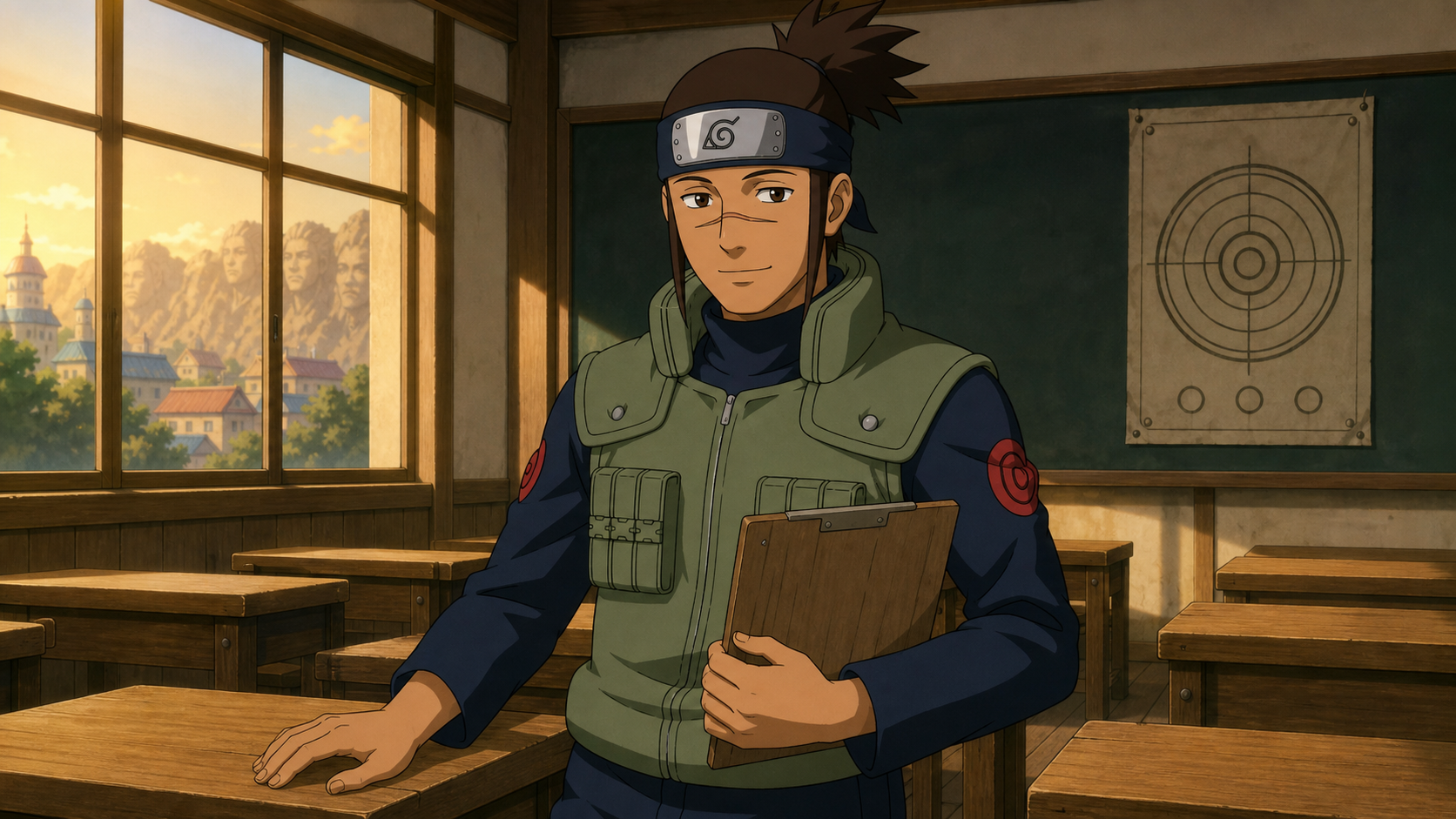
Bottom line: Iruka stops inherited grief at the child
Iruka is not the strongest teacher Naruto will have. He does not give him the Rasengan, Sage Mode, or control of Kurama’s chakra. He gives Naruto something every later achievement depends upon: a credible answer to the question of whether Naruto is a person or a container for other people’s terror.
In Episode 1, Mizuki weaponizes the village’s secret and tells Naruto that the adults see him as the Nine-Tailed Fox. Iruka has every biographical reason to accept that substitution. His parents died during the fox’s attack. Instead, he distinguishes grief from guilt. Naruto contains the being involved in Iruka’s childhood catastrophe, but the child did not choose the attack and is not identical to the attacker. That is the first great act of interpretation in Naruto.
Iruka’s ordinariness is essential. If only legendary shinobi could recognize Naruto, compassion would look like another supernatural power. Iruka is a working teacher with limited combat prominence, bureaucratic duties, imperfect patience, and his own wounds. His choice establishes that the moral future of the world can pivot on an adult doing an ordinary responsibility correctly.
Profile
| Full name | Iruka Umino |
|---|---|
| Japanese | うみのイルカ |
| Birthday | May 26 |
| Home | Konohagakure |
| Occupation | Academy instructor; later headmaster |
| Rank | Chunin |
| Original Japanese voice | Toshihiko Seki |
| First anime appearance | Original Naruto Episode 1 |
| Core roles | teacher, mentor, surrogate family, moral witness |
Spoiler map: The opening sections explain Iruka’s Episode 1 role. “Complete Life File” follows his history through the end of Naruto and his adult-era position.
Complete Life File
Childhood under the Nine-Tails’ shadow
Iruka loses his parents during the Nine-Tailed Fox’s attack on Konoha. Like Naruto, he responds to loneliness by performing for attention. He jokes and causes trouble because laughter can temporarily organize a room around him. The similarity later helps him read Naruto’s vandalism as pain rather than pure disrespect.
The important difference is social placement. Iruka is publicly understood as a bereaved child. Naruto is treated as the hidden cause of bereavement. One receives a legible tragedy; the other receives stigma without explanation. Iruka’s empathy emerges when he recognizes the shared need beneath those unequal positions.
Academy instructor
As an instructor, Iruka combines discipline with personal concern. He scolds Naruto, makes him clean the Hokage Monument, and refuses to pretend failed technique is success. His care is not indulgence. It is sustained attention. Naruto can trust the forehead protector Iruka gives him because Iruka has also been willing to say no.
Iruka initially carries unresolved ambivalence. The fox took his parents, and Naruto’s presence touches that grief. The series does not make acceptance meaningful by erasing the wound. Iruka acts ethically while the wound is real. This makes his protection of Naruto from Mizuki a decision rather than a sentimental reflex.
The Scroll of Seals night
When Naruto steals the scroll, Iruka pursues him as both instructor and shinobi. Mizuki reveals the jinchuriki secret and attacks. Iruka shields Naruto with his own body, then voices the distinction the village has refused to make. He speaks about Naruto’s loneliness and effort, recognizing not a future hero but the difficult child already in front of him.
Naruto overhears him. This matters because Iruka’s defense is not performed for praise. Naruto is hidden, and Iruka believes he may be speaking his final words. The testimony is trustworthy precisely because it is costly and apparently private.
After graduation
Iruka remains an emotional home base while Naruto moves into increasingly dangerous mentorships. Kakashi teaches teamwork, Jiraiya expands Naruto’s world, and Killer B helps him confront tailed-beast power, but Iruka represents continuity with the child before the legend. Ramen shared with Iruka is not a training scene. It is family routine.
He worries when Naruto is sent into danger and sometimes struggles to reconcile professional faith with protective fear. During the Fourth Shinobi World War, he is asked to help contain Naruto through trust. His written message and direct appeal acknowledge that Naruto is no longer merely a student to be controlled. Iruka must let the person he protected choose responsibility at a scale Iruka cannot manage for him.
A father at the wedding
Before Naruto’s marriage to Hinata, Naruto asks Iruka to attend in the role of his father. The moment formalizes what the story has built since Episode 1. Biological truth has restored Minato and Kushina to Naruto’s memory, but it does not displace chosen kinship. Iruka occupies a distinct parental place created through presence.
Adult-era educator
Iruka’s later work as Academy headmaster extends his importance from one child to an institution. The role suggests that Episode 1’s moral choice can become policy and educational culture. His legacy is not a secret technique. It is the possibility that the next isolated student will be seen before a crisis forces recognition.
Relationship Atlas
Naruto Uzumaki
Student, troublemaker, surrogate son, and proof that early recognition can outlive every later separation. Iruka gives Naruto belonging before Naruto can earn it through heroism.
Mizuki
A fellow instructor who exploits Naruto’s loneliness and targets Iruka. Mizuki treats knowledge as leverage; Iruka treats knowledge as responsibility. Their conflict makes the pilot an argument about what teachers do with a child’s vulnerability.
Hiruzen Sarutobi
The Third Hokage supervises a village whose secrecy shapes both Iruka and Naruto. Hiruzen recognizes Naruto’s humanity, yet the institutional response leaves the child socially exposed. Iruka supplies intimate care where policy proves insufficient.
Kakashi and later mentors
Iruka sometimes worries about the danger surrounding Naruto’s missions, but he does not compete for ownership. He remains the first layer of support while others provide specialized teaching.
The Academy students
Iruka’s relationship to later generations turns his personal history into educational practice. He understands that disruptive behavior may be communication, without abandoning standards.
Shinobi and Teaching File
| Area | Assessment | Narrative function |
|---|---|---|
| General ninjutsu | Competent chunin fundamentals, including transformation, clone work, barriers, and standard weapons. | He represents professional rather than legendary shinobi ability. |
| Combat judgment | Protective, alert, and willing to place himself between a student and lethal harm. | His decisive Episode 1 victory is ethical even before Naruto wins physically. |
| Classroom discipline | Sets boundaries, evaluates honestly, and assigns consequences. | Care becomes credible because it includes structure. |
| Trauma recognition | Reads attention-seeking behavior through his own childhood without assuming identical experience. | Turns biography into empathy rather than entitlement. |
| Institutional continuity | Moves from instructor to headmaster. | Suggests compassion can be embedded in systems, not limited to one exceptional encounter. |
Iruka’s limited battle profile is not missing importance. Naruto repeatedly distinguishes power from the reason power should be used. Iruka belongs to the second category. He creates the moral condition in which Naruto’s later abilities can become protection rather than revenge.
Design and Performance
Iruka’s horizontal nose scar gives his face a permanent visual interruption. It makes him instantly recognizable without turning him into a glamorous elite. His flak jacket and forehead protector locate him inside Konoha’s ordinary workforce. He looks like the institution, which makes his compassionate interpretation of institutional duty especially important.
Toshihiko Seki’s original Japanese performance must move quickly between comic irritation, teacherly authority, grief, and warmth. Episode 1 works only if the scolding and the love belong to the same person. Too much softness would make Iruka’s standards meaningless; too much severity would hide why Naruto trusts him.
Existential File: The Adult Who Refuses the Inherited Lie
Grief does not create guilt
The village’s adults carry authentic trauma from the Nine-Tails’ attack. Naruto carries none of the moral responsibility. Iruka’s ethical achievement is his refusal to make emotional causation into moral causation. The child reminds him of the fox; therefore the child awakens pain. But awakening pain is not the same as causing the original wound.
Recognition before achievement
Konoha eventually loves Naruto because he saves it. Iruka recognizes Naruto before the victories. This order matters. If belonging arrives only after extraordinary service, then belonging remains a wage. Iruka offers it as a human starting condition.
Teaching as worldbuilding
Shinobi society reproduces itself through academies. Teachers transmit techniques, rules, historical narratives, and assumptions about who counts. Iruka’s classroom is therefore a political site. His willingness to see the disruptive orphan changes not just one lesson but the kind of future leader that the village can produce.
The courage of ordinary scale
Later Naruto confronts gods, wars, and planetary threats. Iruka confronts a wounded child, a compromised colleague, and his own memory. The story needs both scales. Saving the world after a child has become powerful is spectacular. Seeing the child before the world values him is intimate courage.
Easter Eggs and Close-Reading Notes
- Iruka and Naruto both used mischief to answer childhood loneliness, giving Iruka an experiential key without making their circumstances identical.
- Iruka’s body becomes a shield before Naruto’s shadow clones become a weapon. Protection precedes power in the pilot’s moral sequence.
- The forehead protector is both graduation credential and personal inheritance. Naruto receives the village symbol through Iruka’s trust.
- Iruka’s eventual headmaster role quietly scales one compassionate choice into institutional influence.
- Naruto asking Iruka to stand as his father does not replace Minato. It acknowledges that chosen and biological relationships answer different absences.
Episode and Arc Compass
Essential starting point: Original Naruto Episode 1. Follow with Academy flashbacks, Naruto’s departures and returns, the Fourth Shinobi World War mobilization, and the wedding-era material that formalizes Iruka’s parental role.
Character tags: mentor, teacher, surrogate parent, Konoha chunin, Academy, chosen family, moral witness.
Character Psychology: Care Without Projection
The child Iruka remembers
Iruka’s identification with Naruto is powerful because it begins in resemblance. Both boys convert loneliness into public disruption. Both want a room to respond, even if the response is a reprimand. Yet responsible empathy cannot stop at “he is like me.” Naruto’s isolation is intensified by a secret Iruka did not carry, and the villagers’ hostility places him in a different moral position. Iruka succeeds when resemblance opens attention rather than closes inquiry.
This distinction protects their relationship from becoming self-congratulation. Iruka does not rescue a smaller version of himself and declare the work finished. He continues learning who Naruto is as Naruto develops beyond the Academy. The boy becomes a genin, traveler, Sage, military asset, and hero. Iruka’s affection remains stable while his understanding must keep changing.
Authority that can apologize through action
Iruka participates in the system that withholds Naruto’s history. He cannot repair the entire village, but he can change how authority arrives in Naruto’s life. He evaluates him fairly, feeds him, worries about him, and risks himself for him. These acts do not erase the institutional failure. They demonstrate how a person inside an imperfect system can refuse to reproduce its cruelest habits.
Protection and release
A parental figure faces two opposite failures: abandoning a child and refusing to let the child become independent. Iruka begins by shielding Naruto. Later, especially during wartime, protection requires acknowledging Naruto’s agency. Fear says keep him safe at any cost. Respect says tell him the truth, appeal to his values, and accept that his responsibility now exceeds the classroom. Iruka’s growth lies in moving from physical shelter to moral trust.
Iruka and the Architecture of Episode 1
The monument punishment
The opening prank establishes a conflict between Naruto and official memory. He paints the faces of leaders carved above a village that refuses to tell him his own history. Iruka makes him clean the damage, defending shared property and classroom expectation. Yet he also listens to Naruto’s Hokage ambition. The scene creates the pattern of their bond: boundary first, then curiosity about the need beneath the offense.
The ramen bargain
Naruto negotiates food in exchange for work. On the surface, it is comic bribery. Emotionally, it shows that he wants time with Iruka as much as he wants a meal. Eating ramen together offers a domestic rhythm that neither shinobi rank nor exam score can provide. Ichiraku becomes a neutral room where Naruto is a customer and a child, not a classified vessel.
The failed clone
Iruka does not pass Naruto out of pity. This refusal is crucial to the story’s respect for Naruto. Lowering the standard would provide a credential without competence and would confirm that adults see him as a problem to manage. Iruka’s fairness hurts in the moment, but it tells Naruto that he is capable of earning the same symbol as everyone else.
Mizuki’s false shortcut
Mizuki poses as the adult who finally shares forbidden knowledge. He offers Naruto exactly what loneliness makes tempting: special attention, a secret path, and the suggestion that ordinary rules were the only barrier to recognition. The manipulation works because it imitates mentorship. Episode 1 asks viewers to distinguish a teacher who meets desire by exploiting it from a teacher who understands desire while maintaining responsibility.
The overheard defense
Iruka’s most important words reach Naruto when Iruka does not know he has an audience. Naruto has been told that the village’s private truth is hatred. He then hears Iruka’s private truth is love. The scene restores choice. Naruto cannot control what the fox is or what adults feared, but he can decide which testimony will orient his next action.
The protector becomes witness
After Naruto defeats Mizuki with shadow clones, Iruka does not claim credit. He witnesses the boy’s competence and grants the forehead protector. Good teaching culminates in a student’s action that no longer needs the teacher to perform it for him. Iruka’s pride contains release.
The Politics of the Academy
The Academy turns children into state shinobi. It teaches chakra control and combat, but it also teaches a civic story about Konoha, its leaders, enemies, sacrifices, and virtues. This makes Iruka more than a homeroom teacher. He stands at the point where private childhood becomes public military identity.
Naruto’s case exposes the contradictions of that transition. The village expects him to serve an institution that has not trusted him with the facts of his own body. It asks discipline from a child whose social punishment has never been explained. Iruka cannot rewrite Konoha overnight, but he can refuse to confuse obedience with character. He recognizes that Naruto’s defiance contains both immaturity and a legitimate demand to exist publicly.
Later leadership at the Academy gives Iruka a chance to influence more than one student. The position is thematically fitting because his gift is preventive. Legendary medics repair bodies after injury. Legendary warriors stop invasions. A careful teacher may interrupt the creation of an enemy before anyone knows a battle was approaching.
This is also why Iruka belongs in conversations about the Will of Fire. The slogan can romanticize sacrificing younger people for the village. Iruka’s version places adult obligation first. The older generation must protect, teach, and accurately see the younger. Only then can inherited loyalty be ethical rather than coerced.
Comparative Mirrors
Iruka and Mizuki
Both possess authority and privileged information. Mizuki treats Naruto’s exclusion as an opening for manipulation. Iruka treats it as a reason for care. The difference is not knowledge but what an adult believes a child’s need permits him to do.
Iruka and Hiruzen
Hiruzen carries institutional responsibility and offers Naruto some personal kindness, but his protective secrecy does not prevent social harm. Iruka operates at smaller scale and greater daily proximity. The contrast asks whether distant benevolence can substitute for present care.
Iruka and Kakashi
Iruka grants primary belonging; Kakashi teaches mission belonging. One tells Naruto he is a person worth protecting. The other teaches that comrades must protect one another. Their work is sequential and complementary.
Iruka and Jiraiya
Jiraiya expands Naruto’s power and historical mission. Iruka preserves access to ordinary life. Jiraiya’s legacy is a global peace question. Iruka’s legacy is the meal, classroom, and family role that make the question worth answering.
Iruka and Minato
Minato gives his life and entrusts Naruto with terrible power in a crisis. Iruka gives years of ordinary presence after the crisis. Naruto’s life needs both sacrificial origin and sustained accompaniment.
Iruka and Naruto as teachers
Naruto later reaches enemies and students through the same premise Iruka demonstrated: describe the person beneath the assigned label. Naruto globalizes a form of attention first practiced on him.
What Iruka Does Not Solve
Iruka’s goodness should not be used to absolve Konoha. One compassionate teacher cannot undo years of ostracism, explain why no adequate guardianship structure protected Naruto, or answer every question about the village’s treatment of jinchuriki. Personal kindness and institutional accountability are not interchangeable.
He also cannot prevent Naruto from seeking recognition through danger. Once the boy joins the shinobi system, praise often follows willingness to risk his body. Iruka worries, but he remains part of the culture producing those missions. His position is morally valuable precisely because it is limited. He shows what one adult can do and, by contrast, how much more the surrounding system should have done.
Nor is his empathy perfect omniscience. Iruka understands Naruto’s loneliness, not every future decision. He sometimes responds protectively when Naruto needs trust. Their healthy bond survives because Iruka can revise his role. He does not require Naruto to remain the child whose rescue gave Iruka purpose.
Legacy File
Without Iruka’s choice on the night of the scroll theft, Naruto’s vast power might have confirmed the village’s worst prophecy. Mizuki gives Naruto a story in which betrayal explains the world. Iruka gives him a competing story in which pain can be understood without being repeated. Naruto chooses the second story, then spends the series offering versions of it to other people.
This makes Iruka an upstream cause of victories he never attends. When Naruto reaches Gaara, he extends the recognition Iruka gave him. When he listens to Nagato, refuses Obito’s final identity, and names Kurama, he practices the separation of person from imposed category. Iruka does not author every later insight, but he proves the method is possible.
His legacy is therefore larger than screen time. Fandom often ranks importance by combat feats, bloodlines, or episode count. Iruka resists that economy. The decisive feat is seeing correctly when an entire community has normalized seeing incorrectly.
The grief test: why Iruka’s choice is harder than simple kindness
Iruka’s parents die during the Nine-Tails attack. That fact cannot become decorative tragedy pasted behind a teacher appreciation card. Kurama’s violence shapes Iruka’s childhood, his loneliness, and the fear he feels when he looks at the boy carrying the fox. The ethical power of Episode 1 comes from the fact that Iruka has a real wound and refuses to make Naruto pay for somebody else’s act.
Konoha makes that choice harder. The village bans open discussion of Naruto’s condition, yet adults still communicate disgust through avoidance, whispers, and punishment. Naruto receives the emotional verdict without the evidence. Iruka works inside the institution that failed him, and early Iruka is not magically untouched by its prejudice. He has to recognize the transfer happening in his own mind: fox becomes vessel, vessel becomes child, and the child becomes a convenient target for grief.
That is why Iruka’s protection is not a vague lesson about being nice. He interrupts transference. He can mourn his parents without assigning their guilt to an infant who had no vote in the sealing. Naruto spends the franchise asking enemies to see the person under a weapon label because Iruka first performs that reading for him.
The series later gives Naruto larger speeches, louder battles, and prettier animation. Episode 1 already contains the operating system. A society survives its trauma only when somebody refuses to hand the unpaid emotional bill to the next child.
Mizuki and Iruka: two adults decide what a lonely child is for
Mizuki and Iruka are effective foils because both understand Naruto’s hunger for recognition. Mizuki treats that hunger as an access point. He offers a secret task, promises graduation, and directs Naruto toward the Scroll of Seals. The child becomes a tool that can steal what the adult wants while carrying the punishment if the plan fails.
Iruka also uses authority. He grades Naruto, disciplines him, and participates in the Academy system that repeatedly marks him as unsuccessful. The difference is not that Iruka avoids power. The difference is what he believes power owes the weaker person. When danger arrives, Iruka puts his own body between Naruto and Mizuki’s giant shuriken. Authority becomes responsibility instead of extraction.
Mizuki reveals the jinchuriki secret to break Naruto’s identity. Iruka answers by naming Naruto’s actual conduct: lonely, loud, difficult, persistent, hurting, and still his student. He does not invent a spotless child. He recognizes the whole one. That specificity matters because generic praise would sound like pity. Iruka’s testimony works because Naruto knows this teacher has watched him fail and kept watching.
The scene also tells us what Konoha’s secrecy policy produces. One malicious instructor can weaponize a classified truth because the child most affected by that truth has never been given an honest, supported explanation. Mizuki is personally guilty. The institution still built a hallway wide enough for him to run through.
The forehead protector is a public contract, not a participation trophy
Iruka gives Naruto his own forehead protector after Naruto defeats Mizuki with the Multiple Shadow Clone Technique. The gift marks graduation, but the emotional meaning is larger than a passed test. Naruto has spent the episode trying to steal recognition through a prank, a forbidden scroll, and an impossible shortcut. Iruka finally offers belonging through witnessed effort and moral trust.
The protector comes from Iruka’s body. That detail keeps the moment personal. He does not send Naruto back to administration for replacement paperwork while bleeding in the forest. He transfers the village symbol directly and tells Naruto that he can wear it.
Still, the symbol is not pure. A Konoha forehead protector also recruits a child into military labor. Naruto gains community and immediately enters a system of missions, lethal exams, secrecy, and adult political conflict. CVM Sekai can love the scene without pretending the institution attached to the metal plate is harmless.
Iruka’s act is therefore both tender and political. He claims that Naruto belongs to Konoha while quietly changing the terms of belonging. The village has treated Naruto as a container to fear. Iruka recognizes a student whose loyalty must be answered with care. The franchise will spend hundreds of episodes testing whether Konoha deserves the contract its teacher makes that night.
Teaching is shinobi infrastructure, even when nobody adds an explosion
Fandom power rankings punish Iruka for doing the job the story assigns him. He is a chūnin instructor, not a hidden god who forgot to activate a bloodline. His combat record shows competent fundamentals and real courage, but his defining work happens before spectacular missions begin.
The Academy teaches literacy, chakra basics, transformation, clone work, rules, teamwork, and the social habits that let young shinobi enter units without immediately becoming liabilities. A village that celebrates elite jōnin while treating teachers as background furniture is living off invisible labor. Kakashi cannot teach Team 7 cooperation if nobody taught the children to read an assignment, hold a kunai, recognize a command, or survive a classroom.
Iruka’s skill is diagnostic. He notices when Naruto’s misconduct is a demand for attention, when discipline needs warmth, and when fear cannot be allowed to make a child disposable. Those abilities do not replace combat strength. They prevent the village from producing more alienated children whose power grows faster than their trust.
The Pain invasion makes the distinction clean. Iruka cannot defeat Pain. He can refuse to reveal Naruto’s location while facing a threat far above his rank. Courage does not require a plausible victory condition. Sometimes courage means refusing to sell another person’s life simply because the enemy made resistance look ridiculous.
His ceiling should remain honest. Inflating Iruka into elite jōnin material would actually weaken the character. Naruto’s first recognition matters because an ordinary working adult makes the necessary choice before any prophecy, bloodline, or god-tier technique can force the world to pay attention.
Chosen father does not mean secret full-time guardian
Naruto asking Iruka to attend his wedding in a father’s role is one of the franchise’s clearest chosen-family statements. The request honors the adult who recognized him before the village wanted the association. The moment does not retroactively turn Iruka into Naruto’s live-in parent, legal guardian, or sole source of care.
That distinction protects both characters. Naruto still experiences neglect, food insecurity, dangerous isolation, and institutional failure. Iruka’s presence helps him, but one caring teacher cannot erase those years. Turning Iruka into a perfect off-screen father lets Konoha escape the indictment the story keeps writing.
Iruka’s relationship also does not need to defeat Kakashi, Jiraiya, Minato, Kushina, Teuchi, or every other attachment in a fandom father-figure tournament. Each bond answers a different need. Minato and Kushina give Naruto biological history and love interrupted by death. Jiraiya gives advanced training, travel, political inheritance, and grief. Kakashi gives team discipline and a model of surviving comrades. Iruka gives the first credible recognition and the routine of returning to somebody who knew the boy before the legend.
Chosen kinship grows through repeated presence, not a title card. The wedding request works because Naruto can name the role himself. Iruka does not seize ownership of Naruto’s story. He accepts the place Naruto freely offers.
Confucian duty, Buddhist attachment, and the Will of Fire argument
A Confucian reading makes the teacher-student relationship reciprocal. The teacher owes instruction, correction, moral example, and care. The student owes effort and respect, but respect is not blind obedience to a title. Iruka earns Naruto’s loyalty because he fulfills the adult side of the relationship when Konoha’s wider hierarchy does not.
A Buddhist lens sharpens Iruka’s grief. Attachment to pain can harden into identity, then demand a target. Iruka does not stop loving his parents or deny the attack. He loosens the false link between his loss and Naruto’s guilt. Compassion begins with seeing causes accurately.
The Will of Fire can describe that reciprocal care: adults protect children because a village exists across generations. The same slogan can also decorate a system that trains children for violence and asks them to inherit unfinished wars. Iruka represents the humane version when he treats Naruto as a life to nurture. The Academy represents the danger when belonging becomes permission to deploy that life.
Naruto eventually tries to reform the shinobi world from inside its highest office. Iruka’s classroom gives that political dream its smallest working model. Authority becomes legitimate when the person holding it sees the child, tells the truth, accepts responsibility, and refuses to convert grief into punishment.
Manga, anime, novel, and New Era boundaries
Manga chapter 1 and anime episode 1 control the core record: Mizuki’s manipulation, the Scroll of Seals, the giant shuriken, Iruka’s defense, Naruto’s clones, and the forehead protector. Later anime flashbacks expand childhood and school material. Expansion can deepen a relationship, but the profile labels adaptation additions instead of pouring every scene into one fake universal canon.
Konoha Hiden and its anime adaptation control the wedding material, including Naruto’s request that Iruka attend as his father. The versions arrange beats differently, so the emotional conclusion can remain stable while the route receives a medium label.
New Era Academy administration and Boruto-era school material depend heavily on anime continuity. Iruka’s later leadership fits his lifelong work, but the profile should not pretend every job title receives the same manga confirmation. A complete media shelf is useful only when it tells readers where a fact came from.
The original Japanese performance belongs to Toshihiko Seki. Credit is verifiable. Claims about pitch, breath, timing, or scene-specific delivery require an actually heard Japanese performance. CVM Sekai will not invent audio criticism because a biography looks more expensive with adjectives attached.
The record across media keeps the same center: Iruka is rarely the strongest person in the room, yet the franchise repeatedly returns to him when Naruto needs proof that recognition existed before fame.
Source Desk
Factual chronology is anchored to official franchise material. The ethical, educational, and existential analysis is original CVM Sekai editorial work.
- Naruto Official: Iruka birthday column
- Naruto Official: Original Naruto anime
- Naruto Official: About the series
- VIZ Media: Naruto
Spoiler scope: complete Naruto chronology, including the wedding and adult-era Academy role.