
Tsunade
Tsunade did not stop grieving. She turned grief into public infrastructure.
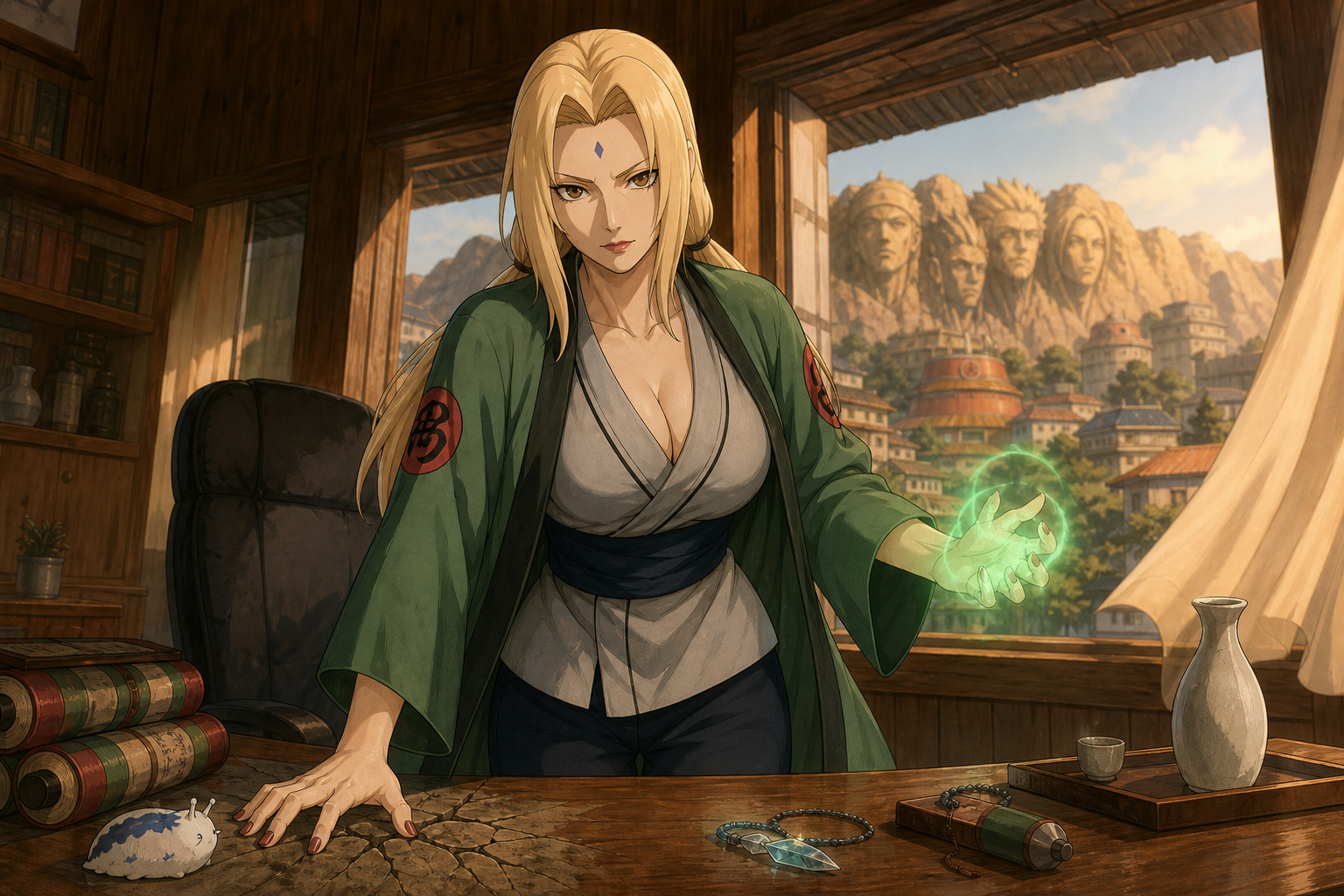
Tsunade loses her little brother to war, loses the man she loves while trying to hold his body together, develops a disabling fear of blood, leaves Konoha, and spends years gambling badly enough to become famous for losing. Then the village asks her to become Hokage because apparently the retirement plan for traumatized medical geniuses is more trauma with paperwork.
The easy version says Naruto inspires her, she gets over the fear, and the legendary healer returns. The actual story has more meat. Naruto reminds Tsunade that hope still exists, but he does not cure her like an inspirational vitamin. Tsunade chooses to act while terrified. She accepts office, rebuilds systems, performs impossible medicine, trains successors, fights political battles, trusts young shinobi, distributes her chakra across an entire village, and later lets Madara split her body without abandoning responsibility for the people beside her.
That is Tsunade’s bottom line. Her greatness is not that pain made her noble. Pain made her run, drink, gamble, snap at people, and doubt every dream attached to the Hokage title. Her greatness is that she eventually converts private loss into structures that help strangers survive. Healing becomes policy, education, battlefield logistics, leadership, and inheritance.
Databook record: a lifetime of work before the Hokage desk
The mission record credits Tsunade with 1,256 official missions: 40 D-rank, 236 C-rank, 467 B-rank, 418 A-rank, and 95 S-rank. Those numbers describe a career that existed long before Naruto found her at a gambling table. Five hundred thirteen A- and S-rank assignments put enormous high-risk experience behind the public title.
Her third-databook stat line gives ninjutsu 5, taijutsu 5, genjutsu 3.5, intelligence 5, strength 5, speed 3.5, stamina 4, and hand seals 4, totaling 35 out of 40. Stats do not settle every fight, but the shape destroys the lazy “healer who punches” summary. Tsunade combines top-level ninjutsu, physical combat, intelligence, and strength with high reserves and seals.
The Academy-graduation age of six belongs to a wartime generation and a databook record. That fact should disturb readers more than impress them. Konoha was founded partly to reduce the old clan system’s sacrifice of children. The village still sent exceptionally young children into military training. Institutional ideals and institutional practice rarely stay politely aligned.
Name, folklore, and the danger of flattening myth
Tsunade’s name comes from Japanese literary tradition, especially the tale commonly called Jiraiya Gōketsu Monogatari. The legendary Tsunade is associated with slug magic, while Jiraiya uses toad magic and Orochimaru uses snake magic. Naruto transforms that older triangle into the Sannin.
綱手 can carry the sense of a mooring rope or someone connected to rope-handling depending on reading and context. The folklore connection matters more than pretending a dictionary gloss explains her personality. Kishimoto inherits names, animals, and relationship echoes, then builds a different woman around them.
The myth does not make every Jiraiya and Tsunade interaction a completed romance contract. Literary source, affection, missed possibility, and canon relationship status remain different shelves.
Appearance: youth maintained, age revealed, identity preserved
Tsunade is an adult woman in her fifties during the main story. She uses a transformation to maintain a younger appearance. Her familiar design includes long blonde hair parted at the forehead and tied into low tails, brown eyes, red nail color, a violet diamond seal, a gray wrap-style top, dark sash and trousers, sandals, and a green haori marked with gambling-related kanji.
The neckline is part of the canonical design. A serious profile can acknowledge body design without turning leadership history into a cleavage tour. Tsunade is not less political because Kishimoto draws her chest, and she is not more feminist because fandom calls her hot.
The violet diamond is not decoration. The Yin Seal stores chakra over a long period. When released, markings spread across her face and body as the stored reserve fuels healing and combat. Visual beauty and terrifying function occupy the same symbol.
When chakra collapses, the maintained appearance fails and Tsunade’s aged condition becomes visible. That state is not a “true ugly form.” The body shows the cost hidden by the technique and the years hidden by presentation. She remains Tsunade in every face.
Childhood, young-Sannin, wandering, Hokage robes, war damage, depleted age, Blank-period retirement, and New Era appearances create a full chronology. Each variant belongs to a life stage rather than a ranking of which woman looks acceptable.
Hashirama, Mito, and inherited obligation
Tsunade is Hashirama Senju’s granddaughter. The Fourth Databook identifies Mito Uzumaki as Tsunade’s grandmother, connecting Tsunade to both founding Senju history and Uzumaki heritage. Tobirama is her granduncle through Hashirama. The parent between those generations remains unnamed in the published record, so no editor gets to complete the family tree with fandom mortar.
Lineage gives Tsunade access, symbolism, inherited objects, and political weight. Hashirama’s necklace carries extraordinary value and the dream of Hokage service. The family name makes her visible in a village that worships founders.
Lineage does not perform 1,256 missions, invent medical systems, heal Rock Lee, manage Pain’s assault, or fight Madara. Privilege and qualification can coexist. Pretending lineage does nothing is dishonest. Pretending lineage does everything is lazy.
Her strongest inheritance is not wood style. She carries the Will of Fire as a duty to protect people, then rewrites that duty through medicine.
Hiruzen’s team and the Sannin
After graduating, Tsunade trains under Hiruzen Sarutobi with Jiraiya and Orochimaru. The three develop into profoundly different answers to the same violent era. Jiraiya searches for prophecy and teaches. Orochimaru pursues knowledge and permanence through bodies. Tsunade pursues survival, then flees when medicine cannot defeat death.
During war, the team survives a battle against Hanzō of the Salamander. Hanzō recognizes their ability and names them the Three Great Shinobi of Konoha. “Legendary Sannin” grows from that encounter.
The title is both honor and receipt. Hanzō does not call them legendary because one passed a written exam. They survive a battlefield where other shinobi do not. Tsunade’s medical skill contributes to the team’s endurance even when later fandom treats support as something happening between the “real” attacks.
The trio’s friendship matters because each later confrontation carries history. Orochimaru’s offer reaches Tsunade because he knows which dead people still govern her choices. Jiraiya’s trust reaches her because he knows she can lead even when she doubts herself.
Nawaki and the necklace that keeps outliving dreams
Nawaki is Tsunade’s much younger brother. He admires Hashirama and dreams of becoming Hokage. On his twelfth birthday, Tsunade gives him the First Hokage’s necklace.
He dies in war the next day.
The necklace becomes associated with death because people who receive the object die while pursuing the Hokage dream. Fandom calls the necklace cursed. The stronger interpretation is structural. The office attracts people willing to place their bodies between the village and danger. War then charges the bill.
Nawaki’s death changes Tsunade’s professional argument. She pushes for a trained medical ninja on every four-person squad and for a system capable of producing those medics. Grief becomes policy before grief later drives her away.
This is the first major proof that Tsunade does not only heal wounds. She studies why people die and asks the institution to change deployment, training, and team composition.
Dan: love, medical limits, and blood that will not stop
Dan Katō supports Tsunade’s medical-reform proposal. He has also lost family in war and dreams of becoming Hokage so he can protect the village. Shared grief and political purpose bring them together.
Tsunade gives Dan the necklace. Later, Dan receives catastrophic wounds during a mission. Tsunade attempts treatment and cannot stop the bleeding. The official retrospective preserves the horror through repetition: stop spurting, stop, stop.
Medical knowledge does not make her a god. She understands exactly what is happening and still cannot save him. Expertise makes helplessness sharper because she can name every failure as the body continues dying.
Dan’s death produces hemophobia, commonly translated as a fear of blood. The reaction is not squeamish comedy. Blood becomes a trauma trigger connected to the sensory memory of failed care. Her hands, once associated with control and healing, remember the moment control disappeared.
Shizune and the labor that keeps wandering possible
Shizune is Dan’s niece and Tsunade’s apprentice. She travels with Tsunade during the years away from Konoha, manages practical needs, worries about debt and danger, supports medical work, and later becomes a central administrative and medical figure under the Fifth Hokage.
The relationship includes care in both directions, but the labor is not equal. Shizune often cleans up logistical, financial, and professional chaos created by Tsunade’s avoidance. Fandom treats that work as assistant comedy because unpaid-looking competence becomes invisible fast.
Tsunade teaches Shizune advanced medicine and trusts her. Shizune also confronts her, warns her, and carries institutional knowledge when Tsunade returns to office. Apprenticeship is not obedience without opinion.
Sakura later becomes Tsunade’s most famous successor, but Shizune is not the failed prototype. She represents a different medical and administrative specialization, one the village depends on while louder strength feats dominate edits.
Gambling and sake are not a personality substitute
Tsunade becomes known as the Legendary Sucker because she loses at gambling with astonishing consistency. A rare winning streak functions like a bad omen. She drinks heavily and accumulates debt while wandering.
The habits are funny because Naruto uses exaggeration, but comedy does not erase coping. Gambling creates motion without direction. Drinking dulls memory. Debt keeps Shizune busy. Tsunade can perform agency while avoiding the one place, office, and dream connected to everyone she lost.
She also genuinely enjoys gambling and sake. Trauma analysis should not confiscate every pleasure and file the bottle under symptoms. The point is proportion and consequence. Hobbies become avoidance when they organize years of flight.
Leadership does not make those traits vanish. Tsunade remains loud, impatient, willing to bet, and capable of drinking. Growth does not require turning her into a beige administrator with good sleep hygiene.
Orochimaru offers resurrection-shaped extortion
After Hiruzen seals Orochimaru’s arms, Orochimaru seeks Tsunade’s medical ability. He offers to resurrect Nawaki and Dan if she restores him.
The offer targets grief with surgical accuracy. Orochimaru knows Tsunade understands the cost of his future violence. Healing his arms would return a dangerous enemy to full function. Refusing means walking away from the possibility of hearing the two dead people she loves.
Tsunade considers the offer. That consideration does not make her secretly evil. The temptation proves the dead remain active in her choices. Ethical strength means little when no temptation exists.
Her eventual refusal rejects both Orochimaru’s bargain and the fantasy that restored bodies can repair the life grief interrupted. She chooses the living, even before she feels emotionally safe doing so.
The confrontation then becomes physical. Tsunade drugs Jiraiya before the planned meeting, goes to Orochimaru, and ultimately turns against the bargain. Kabuto uses a medical scalpel offensively and deliberately draws blood to trigger her hemophobia. Tsunade disrupts his nervous system with Body Pathway Derangement, but Kabuto studies the scrambled commands and relearns enough movement to counter her. Medical knowledge becomes a duel between two people who understand anatomy well enough to heal or weaponize the same body.
Naruto enters a fight far beyond his experience, completes the Rasengan under pressure, and takes Kabuto’s attack. Tsunade shields and heals Naruto while working through the blood trigger. Orochimaru summons Manda, Jiraiya summons Gamabunta, and Tsunade summons Katsuyu. Tsunade later uses Gamabunta’s sword against Manda and activates Creation Rebirth to keep fighting through wounds that should end the battle. The victory is collective. Naruto supplies conviction, Shizune resists Kabuto, Jiraiya returns to combat despite the drug, and three summons turn a private extortion attempt into a Sannin-scale clash.
Naruto is an echo, not a replacement child
Naruto declares that he will become Hokage and reacts to Tsunade’s contempt for the title. His stubbornness, age, dream, and willingness to wager his body echo Nawaki and Dan.
The story uses resemblance deliberately, but Naruto is not a replacement brother or lover because please behave. He is a new person whose dream forces Tsunade to decide whether every future must repeat the past.
Naruto learns the Rasengan, defends her, and refuses to surrender. When Kabuto harms him, Tsunade protects and heals him while facing blood. She acts through the trauma response rather than waiting for fear to leave politely.
Naruto catalyzes the return. Tsunade performs the return. Inspiration is an invitation, not a medical procedure.
She later gives Naruto Hashirama’s necklace and bets on his future. The object no longer marks a death sentence in her mind. The bet becomes trust. The necklace is eventually destroyed when Naruto loses control and enters a six-tailed form during Pain’s assault. Its destruction ends the object’s custody, not the promise Tsunade placed in Naruto.
Becoming Fifth Hokage means accepting the job she called foolish
Tsunade initially treats the Hokage dream as a fool’s path because Hashirama, Tobirama, Hiruzen, Nawaki, and Dan connect the title to early death. She has receipts. The office consumes people.
Accepting the Fifth Hokage role does not prove the earlier judgment wrong. She accepts because dangerous offices still need responsible people. Refusal protects her from grief while leaving the village to someone else’s judgment.
Her first period in office includes reconstruction after Orochimaru’s invasion, staffing, medicine, diplomacy, missions, political conflict, and preparation for Akatsuki. The Hokage job is not a chair reserved for whoever wins the loudest duel.
Tsunade brings a medical and systems mind to authority. She sees a village as bodies, teams, supply, recovery time, talent pipelines, morale, and risk. That perspective is military governance, not soft decoration around combat.
Rock Lee, Sasuke, Kakashi, and the retrieval team
Tsunade heals Sasuke and Kakashi after Itachi’s techniques leave them incapacitated. She evaluates Rock Lee’s injuries after Gaara crushes his arm and leg and offers high-risk surgery when other physicians see no path.
Lee has to consent knowing failure could end his life. Tsunade has to operate knowing confidence cannot remove probability. The surgery succeeds because skill meets risk, not because the story declares healing magic consequence-free.
After the Sasuke Retrieval Mission, Tsunade coordinates treatment for severely injured young shinobi. Chōji’s clan pills, Neji’s wounds, and the team’s condition require different care.
These scenes are governance receipts. Tsunade does not protect Konoha only by punching enemies outside the gate. She keeps future generations alive after commanders send them into violence.
Sakura and the infrastructure of succession
After Sasuke leaves, Sakura asks Tsunade for training. Tsunade teaches medical ninjutsu, chakra control, combat strength, discipline, triage rules, and the long accumulation required for the Strength of a Hundred Seal.
Sakura inherits techniques, but inheritance is not photocopying. She applies the system through her own intelligence, field experience, Team 7 relationships, war service, and later medical leadership.
Tsunade’s greatest institutional victory may be that healing no longer depends on Tsunade alone. A genius who refuses to teach becomes a bottleneck with good publicity. Tsunade builds successors.
Shizune and Sakura represent different outcomes of the same training culture. One becomes a vital medical-administrative professional. One reaches the forehead seal and frontline strength tradition. Neither woman needs to lose for the other to count.
The medical-nin rules and the Byakugō exception
Chapter 577 gives Tsunade’s medical laws as an ordered doctrine. First, a medical ninja must not abandon treatment while a teammate still lives. Second, a medical ninja must not stand on the front line. Third, a medical ninja must not die before the other members of the platoon. The system treats medical skill as scarce infrastructure, so survival is part of the job rather than cowardice.
The fourth law is the exception. A medical ninja who masters Ninja Art: Creation Rebirth, Strength of a Hundred Technique may discard the first three laws. That line does not give every healer permission to sprint toward Madara. The exception belongs to a practitioner who has built an enormous stored reserve, mastered regeneration, and can continue treating people while absorbing frontline damage.
The exception does not mean every medic should sprint toward the largest sword. Qualification matters. Years of chakra storage, control, diagnosis, and combat skill support the rule change.
The terms need their own lanes. Byakugō no In, the Strength of a Hundred Seal, is the forehead seal formed by storing precisely controlled chakra over a long period. Opening that seal releases the reserve. Ninja Art: Creation Rebirth uses chakra to stimulate rapid cell division and reconstruct damaged tissue. Ninja Art: Creation Rebirth, Strength of a Hundred Technique extends that regeneration into an automatic, sustained battle state while the released reserve lasts. A seal is storage. Creation Rebirth is regeneration. Strength of a Hundred is the sustained application. Throwing every diamond-shaped mark into one word erases the mechanics.
None of that means immortal. Chakra can run out. Bodies can suffer catastrophic separation. Cellular acceleration carries stated lifespan concerns. Regeneration allows Tsunade to keep functioning through damage that should stop a human, but every survival leaves a cost somewhere.
Complete abilities and limits: the woman has more than one punch
Tsunade’s famous strength comes from exact chakra control released at contact. A strike can split ground, break defenses, or launch an enormous opponent, but the method still requires timing, range, control, and enough body integrity to connect. Raw destruction is one branch of a medical specialist’s control, not a random second superpower.
Her medical shelf includes diagnosis, surgery, poison and antidote knowledge, Mystical Palm treatment, chakra transfer, recovery planning, and treatment of damage other healers consider impossible. She restores Kakashi and Sasuke after Itachi’s techniques, evaluates and operates on Rock Lee’s damaged body, treats major retrieval-team casualties, and trains Shizune and Sakura. Medicine still needs time, chakra, access to the patient, and sometimes equipment or additional hands. Expertise does not turn every wound into a green-glow delete button.
Body Pathway Derangement, introduced in chapter 164 and episode 93, converts chakra into an electrical disturbance that scrambles the nervous system’s commands after contact. Kabuto cannot move as intended, but his medical knowledge lets him map the altered signals and regain partial control. The counter matters. Tsunade’s technique is brilliant, not absolute, and Kabuto’s adaptation makes their fight an anatomy exam with attempted murder attached.
Katsuyu expands Tsunade’s reach. The slug can divide into many bodies, carry messages and observations across that network, shield or transport people, channel Tsunade’s healing chakra, and use acid offensively when concentrated enough to attack. Division improves coverage but does not create free energy. The healing network still depends on Tsunade’s reserve, Katsuyu’s available body, distance and communication, and the condition of the wounded.
Tsunade also maintains a younger physical appearance through a transformation. Exhaustion can break that presentation and expose her aged state. The technique changes appearance, not the number of years lived, and constant maintenance spends chakra. Her transformation is evidence of control and a revealing response to a culture that treats women’s age as public property.
Creation Rebirth and Strength of a Hundred let Tsunade survive impalement, organ damage, and sustained frontline injury, but regeneration accelerates cell division and carries an explicitly stated life-cost concern. The stored reserve can empty. Pain’s assault leaves her depleted and comatose. Madara’s damage exceeds what solitary regeneration can solve. Hemophobia incapacitates her until the Search arc recovery, and later survival depends on Katsuyu, allied healers, Karin’s chakra, Suigetsu’s physical assistance, and Orochimaru’s intervention. Team dependency is not a stain on a medical leader. Building a team is part of the power.
Katsuyu makes healing a network
Katsuyu is Tsunade’s slug summon and one of the most important support partners in the franchise. Katsuyu can divide into many smaller bodies, communicate across distance, protect people, transfer Tsunade’s healing chakra, gather information, and support evacuation. Offensive acid belongs to the wider ability record when directly shown.
During Pain’s assault, the division ability transforms one healer’s reserve into village-scale distributed care. Tsunade does not run from victim to victim like an exhausted emergency-room montage. She creates a network.
That is the infrastructure thesis in literal form. Central reserve, distributed nodes, communication, protection, triage, and sustained energy flow keep people alive.
Katsuyu is not a cute medical appliance. The summon communicates, advises, and acts as a partner. Tsunade’s relationship with Shikkotsu Forest should remain limited to what canon states; fandom theories about Sage Mode or unseen training do not become biography facts.
Jiraiya, affection, and grief without a marriage certificate
Tsunade and Jiraiya share decades of history, conflict, affection, teasing, trust, and missed timing. Jiraiya believes in her leadership. Tsunade understands his recklessness and the loneliness beneath performance.
Before Jiraiya leaves to investigate Pain, their conversation carries possibility and dread. Tsunade later grieves privately while maintaining public command.
Canon supports deep love in a broad sense and romantic possibility. Canon does not show a completed partnership, marriage, or settled mutual confession. Fandom can ship with enthusiasm. A factual profile does not stamp the ship as legal paperwork.
Jiraiya’s death tests Tsunade’s growth. Earlier losses send her away. This loss hurts while she remains Hokage. Staying does not mean caring less. Staying means the village can no longer afford for grief to remove its leader.
Pain and the largest care operation of her life
When Pain threatens Konoha, advisers argue that Naruto should be hidden because he is a jinchūriki target. Tsunade refuses to treat him as backup equipment. Naruto has grown, inherited Jiraiya’s will, and trained to defend the village.
Trusting Naruto carries risk. Leadership does not eliminate risk; leadership decides which people count as agents rather than assets.
As Pain attacks, Tsunade summons Katsuyu and channels chakra across the village. When Almighty Push destroys Konoha, she spends enormous reserves protecting and healing residents.
She does not defeat Pain in a duel. She keeps a population alive long enough for the next defense to matter. Powerscaling edits love a clean knockout. Civilian survival is the larger scoreboard.
The cost empties the seal, breaks the maintained appearance, and leaves Tsunade comatose. Care consumes the leader’s body. Danzō uses the political opening to move toward the Hokage office.
Tsunade’s coma shows how institutions become vulnerable when too much capacity sits in one person. Her medical network saves lives, but succession politics still exploit her absence.
Danzō and political vulnerability
Danzō represents a different model of protection: secrecy, control, sacrifice without consent, and the claim that harsh methods become moral because the village survives.
Tsunade also accepts military sacrifice. The distinction lies in trust, accountability, and who gets treated as a person. Her argument over Naruto makes the difference visible. She trusts a young shinobi’s growth rather than storing him like ammunition.
While Tsunade lies unconscious, the Fire Daimyō selects Danzō as Sixth Hokage candidate. Danzō exercises the office’s authority and attends the Five Kage Summit, but he dies before the formal inauguration that would settle the title. Kakashi is then prepared as the next candidate before Tsunade wakes. “Sixth Hokage” without that appointment boundary makes a contested transition look orderly.
Her awakening before the war restores the Fifth Hokage to active leadership. The return prevents Danzō’s model from becoming the settled future, though his own death and actions also shape that transition.
Five Kage leadership and Madara
Tsunade joins the Allied Shinobi Forces leadership during the Fourth Shinobi World War. The Kage must coordinate villages with histories of betrayal and bloodshed because extinction does not care who won the last diplomatic argument.
She reaches the battlefield through a transport method violent enough to damage the body and immediately uses healing to remain functional. Against Madara, Tsunade combines enormous strength, regeneration, diagnosis, team coordination, and refusal to stay down.
Madara dismisses her as weaker than Hashirama and insults her as a woman. Tsunade answers through the Will of Fire and her actual role. She does not need to reproduce Wood Release to inherit leadership. Hashirama founded. Tsunade keeps people alive inside what founders left behind.
The Five Kage still lose the battle. Teamwork and courage do not guarantee victory against overwhelming power. Failure to win does not erase how long they resist or what their resistance buys.
Bisection, body cost, and the refusal to prioritize herself
Madara leaves the Kage catastrophically wounded. Tsunade is bisected. She remains conscious, works through Katsuyu, and prioritizes healing the other Kage.
The scene should kill the “immortal” claim permanently. Katsuyu keeps the Kage alive but cannot restore them alone. Orochimaru arrives with Karin and Suigetsu. Karin lets Tsunade bite her to take restorative chakra, while Suigetsu helps Katsuyu bring Tsunade’s separated body together. Orochimaru coordinates the rescue. Regeneration, summons, allies, an Uzumaki healer’s reserve, physical assistance, and extraordinary endurance combine. Survival is a team outcome.
Her first instinct remains responsibility. That instinct is admirable and dangerous. Leaders who always place themselves last can become another single point of failure.
Medical care in Naruto is bodily labor. Chakra leaves the healer. Cells divide. Hands shake. Bodies age. Katsuyu stretches capacity. Tsunade’s power makes care visible as expenditure.
Dan returns, and grief becomes fulfilled responsibility
Edo Tensei returns Dan during the war. After the technique is released, Dan uses Spirit Transformation to travel to Tsunade, enters her body, and restores chakra to her Strength of a Hundred Seal. The contact protects her at a critical moment and gives them a brief reunion before his soul departs.
Tsunade tells him that she once ran from his memory but has changed. She became Hokage and carried forward what he wanted to protect.
The reunion does not reward her with permanent resurrection. Dan returns to death. The scene offers acknowledgment rather than reversal.
A Buddhist lens helps here. Tsunade first clings to the possibility of restoring the dead through Orochimaru’s bargain. Later she honors Dan by living the duty he could not complete. Impermanence remains painful. Acceptance changes the form of attachment.
Retirement and the New Era
After the war, Tsunade continues acting as Hokage while Kakashi delays formally accepting the office. In Kakashi Hiden, the Tobishachimaru crisis becomes the final push: Tsunade permits Kakashi to decide Kahyō’s sentence only if he does so as his first act as Sixth Hokage. Kakashi then succeeds her. Retirement is another leadership act. Institutions need succession before exhaustion or death chooses the date.
Tsunade remains alive into the Blank period and New Era. She researches White Zetsu material used in developing Naruto’s prosthetic arm. In Sakura Hiden, she meets Sakura for drinks, praises the children’s mental-health work, and tells her overworked student to rest. The Last places retired Tsunade in charge of evacuating Land of Fire civilians as the Moon crisis escalates. Later anime appearances bring her back for village, medical, social, and emergency contexts without quietly returning the Hokage office to her.
Kakashi and later Naruto inherit a village Tsunade kept functioning through invasion, Akatsuki pressure, mass destruction, and war. Her legacy is not a face on the mountain alone. The medical workforce, Sakura’s generation, surviving civilians, and leadership precedent remain active.
Masako Katsuki and the honest performance boundary
Masako Katsuki performs adult Tsunade in the original Japanese anime. The credit is verified. Detailed pitch, breath, comedic timing, drunken delivery, trauma response, command voice, and battle-performance claims require lawful Japanese-scene observation.
Relevant contexts include Tsunade’s first confrontation with Naruto, Orochimaru’s offer, the hemophobia battle, acceptance of office, Rock Lee’s surgery discussion, Jiraiya’s departure/death, the Pain command center, Madara, and Dan’s reunion.
This profile names the performer and scenes without inventing criticism. A cast list is better than fake expertise wearing headphones.
Manga, anime, novels, films, OVA, and games
The manga establishes Tsunade’s central chronology from the Search for Tsunade through Hokage governance, Pain, war, and epilogue. The anime adapts that story and adds missions, flashbacks, comedy, direction, music, and later-era material that requires episode labels.
The licensed prose shelf includes Kakashi Hiden, where she still carries Hokage responsibility during the Tobishachimaru crisis and forces Kakashi’s succession decision; Sakura Hiden, where she checks on Sakura and the postwar children’s mental-health program; and Konoha Hiden, where the retired generation belongs to Naruto and Hinata’s wedding-era village. These novels extend governance, mentorship, and community after the war rather than inventing a second secret Tsunade epic.
In Naruto the Movie: Blood Prison, a stand-alone anime-continuity film, Tsunade appears to condemn Naruto to Hōzuki Castle as part of the operation surrounding his false accusation. Road to Ninja: Naruto the Movie uses a Genjutsu World counterpart whose age presentation, body design, and temperament differ for comedy and contrast; that counterpart is not mainline Tsunade rewritten. The Last: Naruto the Movie gives retired Tsunade a civil-defense role during the Moon emergency within the postwar continuity.
The 2005 bonus animation Finally a Clash! Jōnin vs. Genin!! Indiscriminate Grand Melee Tournament Meeting!! has the Fifth Hokage create the village-wide competition. That comedy scenario belongs to the anime bonus shelf, not the manga chronology. Games provide a clearer representative record: Tsunade is playable in Naruto: Ultimate Ninja 2, later Ultimate Ninja entries, Naruto Shippuden: Clash of Ninja Revolution 3, and the Ultimate Ninja Storm line. Those adaptations repeatedly turn her medical techniques, super-strength, Katsuyu, and seal release into systems. Regeneration values, combos, support actions, and original game scenarios do not rewrite manga limits.
Fandom arguments that fail the paperwork test
“Tsunade was a bad Hokage.”
Audit reconstruction, medical restoration, Rock Lee’s surgery, retrieval-team care, Sakura’s training, Akatsuki response, Jiraiya intelligence decisions, Naruto recall, Pain’s village-scale protection, diplomacy, war alliance, and Madara resistance. Disagree with choices after doing the work.
“She is only a healer.”
Healing is battlefield logistics, education, policy, triage, surgery, poison knowledge, communication, population survival, and combat endurance. “Only” is doing unpaid misogyny.
“She only punches.”
The punches require chakra control. Add diagnostics, seals, cellular regeneration, Katsuyu, nervous-system disruption, training systems, leadership, and decades of missions.
“Naruto cured her.”
Naruto challenges despair. Tsunade confronts blood, makes the decision, fights, accepts office, and continues living with the history.
“Sakura is Tsunade 2.0.”
Sakura inherits a system and develops through different relationships, intelligence, war experience, and later medical work. Successful teaching creates resemblance.
“Jiraiya and Tsunade were canonically married in spirit.”
Affection and possibility are real. Completion is not. Let tragedy remain tragedy without forging a certificate.
“Her young appearance proves vanity makes her shallow.”
Presentation, identity, coping, espionage utility, ageism, and technique can coexist. Exhaustion reveals cost. Neither face cancels competence.
“Lineage handed her the office.”
Lineage gave access and symbolism. Mission history, Sannin status, medical revolution, survival, trust, administration, and willingness created qualification.
Confucian reciprocity and the Hokage’s duty
A Confucian lens treats leadership as reciprocal obligation. The Hokage receives loyalty and therefore owes protection, moral example, competent administration, and care.
Tsunade spends her chakra on civilians because office is not personal prestige. She trains Sakura because teacher authority creates duty to transmit knowledge. She challenges elders because seniority without trust in the next generation becomes stagnation.
Her lineage increases obligation. Descending from founders does not make the office private property. Inherited status means more people can reasonably demand that she serve.
The lens also reveals risk. Self-sacrifice can become unhealthy when leaders assume duty requires personal depletion every time. Sustainable institutions need trained successors, distributed care, and honest limits. Tsunade builds much of that structure even while violating her own limits.
Why Tsunade still matters
Tsunade changes what power looks like in Naruto. She can crack the ground, survive impossible wounds, and stand among Kage. Her deeper power is organizational. She asks why squads die, builds medical roles, trains healers, creates successors, distributes care through Katsuyu, and treats young shinobi as people whose futures deserve investment.
She also proves leadership does not require emotional purity. Tsunade is grieving, addicted to bad bets, fond of sake, vain about presentation, angry, funny, politically stubborn, and sometimes wrong. The village does not need a spotless woman. The village needs a competent leader willing to act.
Nawaki and Dan remain dead. Jiraiya remains dead. Hiruzen remains dead. Becoming Hokage does not redeem those losses with a promotion badge.
Tsunade’s answer is more useful than closure. Build the medic program. Train Shizune and Sakura. Heal Lee. Trust Naruto. Protect the village. Fight Madara. Hand the office forward before the office takes another life.
She did not conquer death. She made survival less dependent on luck.
Sources and canon boundary
Manga chronology controls this profile. Anime staging, databook material, novels, films, games, and later franchise appearances are labeled instead of being blended into one false continuity.
Primary franchise references: Naruto Official and VIZ Media Naruto. CVM Sekai’s conclusions about grief, medical labor, political leadership, succession, and the shinobi system are editorial analysis, not invented creator quotations.