
Jiraiya
Jiraiya saves the future without ever becoming safe himself
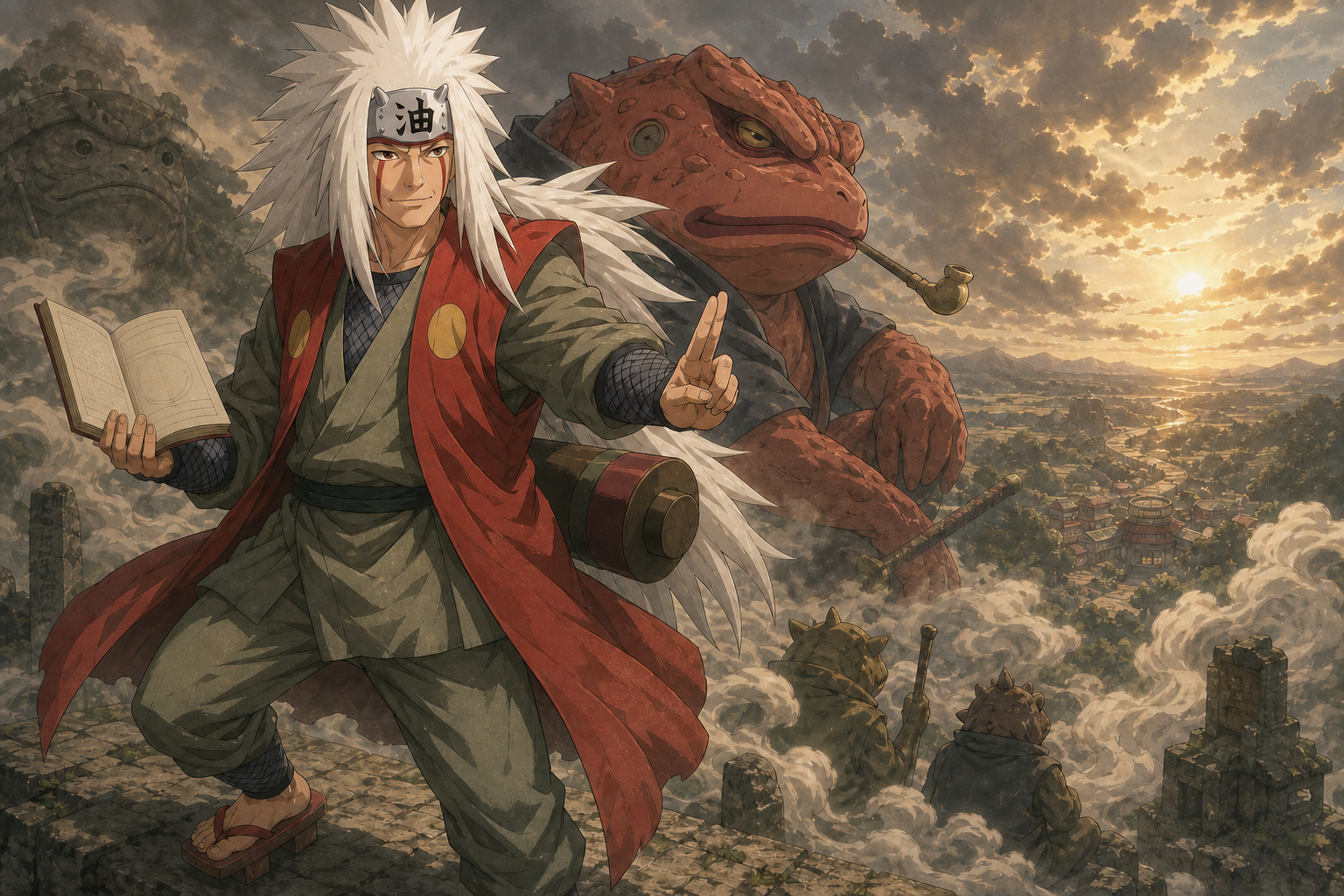
Jiraiya is one of the best teachers in Naruto, one of Konoha’s most useful intelligence agents, and one of the grown men most committed to turning sexual harassment into a personality brand. All three facts belong in the same profile. Hero worship does not get to delete his victims. Accountability does not require pretending his work for Naruto, Minato, Nagato, Yahiko, Konan, Tsunade, and Konoha meant nothing.
His bottom line is uglier and more valuable than sainthood. Jiraiya spends his life looking for the person who will change the shinobi world because prophecy gives him a job large enough to hide inside. He trains gifted children, travels instead of settling, gathers intelligence, writes books, chases Orochimaru, loves Tsunade without building a life with her, and keeps calling motion freedom. Sometimes the road is service. Sometimes the road is avoidance wearing sandals.
Then Rain forces him to face the bill. His former students built a revolution and a terror state after he left. His intelligence was incomplete. His assumptions about Pain cost him an arm, his throat, and his life. Jiraiya still turns failure into a usable receipt. He identifies the Six Paths’ secret, encodes the message, and sends knowledge home. He cannot finish the mission, so he makes sure someone else can.
That final choice explains his legacy better than “pervy old sage” or “the strongest Sannin.” Jiraiya matters because he keeps transmitting what he knows, even after his fantasy of being the main hero collapses. Naruto inherits technique, information, grief, and a question: can the next student build peace without repeating every teacher’s damage?
His name arrives with an older story attached
Jiraiya’s name comes through the Japanese popular tale usually known in English as The Tale of the Gallant Jiraiya. That tradition includes a toad-associated hero, a snake-associated Orochimaru, and a slug-associated Tsunade. Masashi Kishimoto did not invent the triangle from empty air. He inherited a cultural shelf and rebuilt the relationships inside a shinobi world.
That source matters because Jiraiya performs himself as a traveling hero before his life earns the ending. He narrates entrances, poses, declares titles, writes books, and interprets prophecy as though existence already has chapter headings. The old gallant name becomes both inheritance and pressure.
Folklore is not a personality test. The older story does not prove every choice, and Kishimoto’s Jiraiya is not a transcription of a nineteenth-century hero. The useful comparison is creative: Naruto takes a familiar trio, adds war institutions, teacher chains, village politics, comedy, exploitation, and failed peace projects, then asks whether a famous name can produce a better successor.
The character design turns performance into clothing
Adult Jiraiya is enormous, broad, and built to fill a panel. Long spiked white hair frames his body like a mane. Red markings run from his eyes. His forehead protector bears the kanji for oil and uses a horned plate rather than Konoha’s standard leaf symbol. A red sleeveless coat sits over green shinobi clothing, mesh armor, wrist guards, and wooden geta. A large scroll rides across his back.
The oil mark and toad equipment announce a professional identity created outside normal village uniform. Jiraiya belongs to Konoha, but he also belongs to a summoning tradition, a travel network, and a persona he built while absent. The design says “freelance sage” before the dialogue explains his job.
Childhood flashbacks show a smaller, impatient student trying to summon without a contract. Young-war designs retain the wild hair and growing confidence while placing him beside Tsunade and Orochimaru as a working unit. Sage Mode changes his face, nose, eyes, hands, and posture because his transformation is imperfect. The body does not become polished divine beauty. Jiraiya borrows power through a visible partnership with Fukasaku and Shima.
His Pain injuries destroy the heroic silhouette in stages. One arm disappears. His throat is crushed. Black rods and repeated attacks turn the great body into evidence. The series refuses a clean poster death because intelligence work has physical consequences.
Hiruzen’s team creates three different answers to war
Hiruzen teaches Jiraiya, Tsunade, and Orochimaru from childhood. The trio becomes famous during the Second Shinobi World War after surviving Hanzō in Amegakure. Hanzō names them the Three Great Shinobi of Konoha, usually shortened to the Sannin or Legendary Three.
The title celebrates survival inside a war that keeps manufacturing orphans. Jiraiya becomes a teacher and traveler. Tsunade transforms loss into medicine and later public administration. Orochimaru turns mortality into a research problem and other bodies into materials. Their fame does not mean the institution healed them.
Hiruzen gives each student knowledge but cannot stop their most destructive patterns. That failure repeats down the teaching chain. Jiraiya cannot bring Orochimaru home. Jiraiya later leaves the Rain children after teaching them to survive. Naruto cannot force Sasuke back through strength alone. Naruto keeps asking whether care means control and keeps answering no, then showing how badly people handle that answer.
Orochimaru is Jiraiya’s oldest failed rescue
When Orochimaru defects, Jiraiya tries and fails to stop him. The event becomes a private wound and a template. Jiraiya recognizes the same desperate pursuit when Naruto refuses to abandon Sasuke.
The parallel is useful but not exact. Orochimaru is an adult scientist who conducts human experiments and chooses defection. Sasuke is a traumatized teenager recruited by that adult. Naruto’s pursuit happens inside a different power relationship. Treating the pairs as interchangeable turns thematic rhyme into factual mush.
Jiraiya’s failure teaches endurance but also exposes his limits. He never finds the perfect speech that repairs Orochimaru. Love cannot substitute for accountability or containment. Years later, Jiraiya continues gathering intelligence about Orochimaru and Akatsuki because relationship failure does not erase public danger.
Mount Myōboku gives him prophecy, partnership, and a lifelong hiding place
As a young shinobi, Jiraiya attempts a summoning without a contract and reaches Mount Myōboku. He trains with toads and receives a prophecy from the Great Toad Sage: he will become a writer and teacher whose student brings enormous change, either destruction or stability, and Jiraiya’s choice will matter.
Prophecy gives him purpose. Prophecy also tempts him to treat people as candidates for a role. Nagato’s Rinnegan makes Jiraiya think he has found the child. Minato’s talent offers another possibility. Naruto eventually becomes his answer.
The story does not show a magical label floating over the correct baby. Jiraiya interprets incomplete information across decades. His choices help create the outcome he later calls destiny. Teaching Naruto, passing intelligence, and refusing to give up make the prophecy self-fulfilling through labor.
A Buddhist lens complicates the quest. Jiraiya travels to avoid attachment while remaining attached to Tsunade, Orochimaru, his students, his teacher, and the fantasy of a meaningful ending. Motion does not dissolve desire. The road merely lets him postpone choosing a home.
Nagato, Yahiko, and Konan expose the gap between rescue and responsibility
After the Sannin encounter three Amegakure war orphans, Orochimaru proposes killing them as mercy. Jiraiya refuses. He remains in Rain while Tsunade and Orochimaru return, gives Nagato, Yahiko, and Konan shelter, teaches them ninjutsu, and helps them become capable of defending themselves.
That choice saves their lives. Jiraiya feeds them, trains them, responds to Nagato’s Rinnegan, and tries to give war children tools the village system denied them. The three years matter. He is not a tourist who teaches one move and collects gratitude.
The departure still has consequences. Once the children can defeat a clone of his, Jiraiya decides they can survive and leaves. He later receives news that they died and accepts the report. He does not investigate deeply enough to learn that Yahiko died, Nagato survived, Konan remained with him, and their peace organization transformed under pressure from Hanzō, Danzō, Obito, grief, and the Rinnegan’s power.
Jiraiya did not cause every later crime. Hanzō’s coercion, Danzō’s interference, Obito’s manipulation, the village system, and Nagato’s decisions have their own authors. Yet “I taught them once” is not the same as sustained care. The profile has to hold rescue and absence together.
A Confucian teacher-duty lens asks what authority owes after instruction. Knowledge creates a relationship, not ownership. Jiraiya fulfilled the first duty by refusing abandonment in immediate crisis. He failed the longer duty of maintaining contact and verifying their fate. The shinobi world makes that continuity difficult, but difficulty is not innocence.
Minato inherits technique, trust, and a name from a book
Minato Namikaze becomes Jiraiya’s student and one of the people Jiraiya remembers as evidence that his life mattered. Minato develops the Rasengan; Jiraiya later teaches the technique to Naruto. The skill moves through teacher, student, and student’s child without requiring bloodline ownership.
Jiraiya writes The Tale of the Utterly Gutsy Shinobi. Minato reads the book, admires the hero’s refusal to give up, and chooses Naruto as his son’s name. Kushina agrees after hearing the meaning. Jiraiya becomes connected to Naruto before Naruto is born through authorship and mentorship.
English discussions often call Jiraiya Naruto’s godfather. The Japanese term and cultural function do not map perfectly onto a Western Christian godparent with automatic guardianship duties. Jiraiya is Naruto’s namesake-source, Minato’s teacher, later Naruto’s teacher, and a trusted adult. Those confirmed relationships are already enormous. A translation shortcut should not invent a legal custody arrangement.
Jiraiya is absent through Naruto’s isolated childhood. The text does not provide a neat scene proving he knew every detail and refused daily guardianship, nor a scene excusing the absence. Honest analysis leaves the administrative boundary open while recognizing the emotional fact: Naruto grows up without him and meets him only as a twelve-year-old.
Naruto gets a teacher who sees both the seal and the child
Jiraiya meets Naruto while spying on women at a hot spring and calling the behavior novel research. Ebisu’s training ends, Naruto demands instruction, and Jiraiya initially responds to the Sexy Technique because dignity has left the building.
Then the professional brain arrives. Jiraiya notices that Orochimaru’s Five Elements Seal is disrupting Naruto’s chakra balance and removes the interference. He teaches Naruto to draw on Nine-Tails chakra and sign the toad contract. When Naruto fails to access the necessary reserve, Jiraiya throws him into danger to force survival pressure. Naruto summons Gamabunta.
The method works and is wildly unsafe. Jiraiya reads Naruto’s capacity correctly, but success does not turn dropping a child into a ravine into modern pedagogy. The world trains soldiers, and Jiraiya is training one. The profile should name the institution rather than polishing every risk into quirky wisdom.
During the Search for Tsunade, Jiraiya teaches Naruto the Rasengan through staged control exercises. Naruto struggles, improvises with a shadow clone, and lands the technique on Kabuto. Jiraiya supplies structure. Naruto supplies the workaround. Good teaching creates conditions where the student can solve a problem differently.
They later travel together for roughly two and a half years. Jiraiya strengthens Naruto’s fundamentals, works on Nine-Tails control, and leaves a scar from a four-tailed incident that nearly kills him. The time skip does not give Naruto every elemental lesson or erase his weaknesses. Mentorship is not a download bar that reaches one hundred percent because the calendar moved.
Their bond becomes familial without becoming uncomplicated. Jiraiya feeds Naruto knowledge, takes his money for “safekeeping” and spends some, protects him, embarrasses him, trusts him, and gives him a framework for endurance. Naruto learns from a flawed adult rather than receiving a clean replacement father.
The voyeurism is harassment, even when the soundtrack plays comedy
Jiraiya spies on women bathing. He uses “research” for his erotic novels as a joke and professional excuse. Women did not consent to become field notes. That conduct is sexual harassment and a privacy violation.
The manga and anime frame much of the behavior as comedy. Genre framing explains why scenes are paced lightly. Framing does not transform the target’s boundary into consent. Tsunade’s violence, Naruto’s disgust, and other reactions often become part of the punch line, but a viewer can laugh at performance and still judge the behavior.
The industry context matters. Long-running shōnen frequently used the lecherous older master as a stock comic type. Cultural familiarity is not moral immunity. The trope made misconduct legible and marketable, then trained fandom to call criticism humorlessness.
Jiraiya’s care for Naruto does not repay strangers whose privacy he violates. His death does not erase the record. His harassment does not make the coded message false. Mature criticism can carry more than one folder at once.
The novelist and the spy share methods but not ethics
Jiraiya maintains an intelligence network across multiple countries. He tracks Orochimaru, Akatsuki, village politics, and rumors. He infiltrates hostile territory, interrogates captured shinobi through toad-based techniques, uses barriers and concealment, and packages findings so Konoha can act.
He also writes the Icha Icha novels that Kakashi reads and the earlier gutsy-shinobi story that inspires Minato. Writing becomes observation, ego, income, communication, and legacy.
The two jobs share attention to people and detail. That overlap does not cleanse voyeurism into spycraft. Intelligence gathering targets public threats under mission authority. Peeking into private baths targets women for personal gratification. Calling both “research” is Jiraiya’s joke because the ethical difference is obvious.
His final code uses the first word from selected pages of Icha Icha Tactics. A book fandom treats as horny background clutter becomes an intelligence key. The payoff is funny, specific, and structurally earned. Jiraiya’s least respectable brand carries his most important professional message.
Complete abilities: Jiraiya fights like a field department, not a single technique
Jiraiya has large chakra reserves, broad ninjutsu knowledge, physical strength, speed, durability, experience, and enough improvisational skill to move between infiltration, capture, defense, summoning, and direct combat. His Third Databook total reflects range. The page still needs mechanics because “Sannin level” is a reputation, not an explanation.
His basic elemental record includes Fire and Earth Release in the manga-era shelf, with later databook records also associating Water and Wind natures with him. He combines fire with toad oil to enlarge the burn area. Earth techniques help with concealment and movement. Anime additions require their own labels rather than being poured back into the manga.
Rasengan gives him a compact, high-powered shape-transformation attack inherited from Minato’s invention. Jiraiya can use the technique directly and teaches the control steps to Naruto. The relationship matters: the older teacher is not the inventor, and the younger student’s shadow-clone solution is his own adaptation.
Toad summons turn one fighter into a working ecosystem
Jiraiya signs the Mount Myōboku contract and can summon toads ranging from small utility partners to Gamabunta. Summons provide transport, containment, communication, oil, weapons, reconnaissance, and battlefield mass.
He uses a toad’s stomach as a trap, hides inside or uses toad-based infiltration spaces, and calls Fukasaku and Shima for Sage Mode. Gamabunta is not a pet attack stored in Jiraiya’s pocket. The chief toad has judgment, temper, priorities, and a relationship that requires respect.
Toad Oil Bullet creates a flammable medium. Fire Release: Flame Bullet ignites and expands attacks, while collaboration with a toad can create a much larger oil-fire technique. The combination demonstrates why summons matter beyond size. Different bodies contribute different materials and skills.
Fukasaku and Shima add sensory ability, strategy, techniques, and Demonic Illusion: Toad Confrontation Chant, often called Frog Song. Their sound genjutsu can immobilize opponents caught by the coordinated melody. The setup takes time, announces itself, and can be interrupted. Jiraiya’s lower personal genjutsu score does not mean the team lacks access to genjutsu. The technique belongs to collaboration.
Hair, barriers, sealing, and capture work fill the less glamorous shelf
Needle Jizō hardens Jiraiya’s hair around his body for defense. Wild Lion’s Mane extends hair to restrain or attack. Other hair techniques can fire needle-like strands. The mane is not just character design. Jiraiya weaponizes the silhouette fandom recognizes.
Barrier techniques help him detect movement and monitor enclosed spaces. Toad Flatness and transformation or disguise work support infiltration. He can seal dangerous fire, remove Orochimaru’s Five Elements Seal from Naruto, and use toad-based imprisonment or interrogation.
He also reads opponents quickly. During the Pain fight, Jiraiya tests bodies, vision, summoning patterns, and the contradiction between faces he recognizes and the student he expected. Intelligence is an active combat tool. He survives long enough to turn observation into a theory.
The limitation is information quality. A brilliant analyst can still begin with a false model. Jiraiya assumes one visible Pain may be Nagato, then learns multiple bodies share vision, then recognizes dead men he encountered in life. Each correction costs flesh.
Sage Mode is powerful because the partnership covers an imperfection
Jiraiya cannot enter a fully polished Sage Mode alone. He needs time to gather natural energy and summons Fukasaku and Shima to help maintain the balance while he moves. His appearance takes on stronger toad traits, which he dislikes aesthetically.
The form increases strength, durability, perception, chakra, and the reach of techniques. Fukasaku and Shima let the group gather natural energy, attack from multiple angles, use collaboration ninjutsu, and perform Frog Song.
The setup creates vulnerability. Jiraiya must buy time. The two sages can be separated or attacked. Shared vision among the Paths reduces the value of blind angles. Imperfect transformation is not evidence that Jiraiya is a fraud. The form is an honest display of how much elite power in Naruto depends on relationships.
Fandom often asks whether a “perfect” Sage automatically wins. That question deletes the actual Rain conditions: enemy territory, incomplete intelligence, six coordinated corpses, Rinnegan abilities, shared sight, a hidden controller, and Jiraiya’s decision to return after escaping long enough to send a message. Technique labels do not fight outside context.
His limits are professional, physical, and relational
Jiraiya has tremendous stamina, but reserves are finite. Sage Mode needs preparation. Large summons and collaboration techniques require chakra and partners. Genjutsu is not his personal specialty. His size and theatrical entrances can work against stealth once concealment breaks.
The four-tailed Naruto incident nearly kills him. Orochimaru escapes his attempted retrieval. Itachi and Kisame leave before a decisive fight, so that hallway does not provide a clean tier list. Pain removes his arm, crushes his throat, and overwhelms him through numbers, linked vision, unfamiliar abilities, and information asymmetry.
His interpersonal limits matter as much as battle loss. He mistakes travel for emotional resolution, does not maintain enough contact with the Rain students, fails to stop Orochimaru, and violates women’s boundaries. Competence in one domain does not create a moral force field.
Tsunade is a real relationship, not an unpaid widow role
Jiraiya and Tsunade share childhood, war, Hiruzen’s mentorship, Orochimaru’s loss, decades of banter, professional trust, grief, and affection. Jiraiya desires her. Tsunade repeatedly rejects his sexual advances and does not marry him.
Their relationship deepens beyond the gag. Jiraiya recommends Tsunade for Hokage, trusts her with intelligence, understands some of her losses, and speaks with her before leaving for Rain. Tsunade warns him about the risk. Their conversation holds tenderness and the possibility of a future neither person guarantees.
Jiraiya’s death hurts Tsunade. Grief does not convert rejection into retroactive consent. Calling her “basically his wife” steals her choice and turns a complicated adult bond into a prize delivered after the man dies.
The stronger reading lets uncertainty remain. Jiraiya loves Tsunade. Tsunade cares for him deeply, trusts him, and grieves him. Their final conversation leaves romantic possibility without proving a completed romance. They also spent years refusing or avoiding the choices that might have created a shared domestic life.
Rain is the mission where every old story returns with a knife
Jiraiya infiltrates Amegakure after tracing Akatsuki leadership there. The village’s constant rain is surveillance as weather and political mood. Pain rules through secrecy, religious imagery, fear, and the belief that he has become a god.
Jiraiya captures Rain shinobi, interrogates them, learns about Pain and the “angel,” and enters deeper despite Tsunade’s warning. Konan confronts him first. Jiraiya recognizes her paper techniques and realizes a former student stands inside the enemy structure.
Pain’s Rinnegan leads Jiraiya toward Nagato, but the body before him does not produce a simple reunion. Jiraiya enters Sage Mode with Fukasaku and Shima. Animal summons, shared vision, absorption, mechanized weapons, resurrection, and coordinated bodies force him to revise the model repeatedly.
He defeats three Paths through strategy and Frog Song. The apparent victory collapses when additional Paths arrive and the defeated bodies return. The Asura Path takes his left arm. Jiraiya eventually recognizes that the six faces belong to shinobi he met during earlier travels.
That recognition is the receipt. The bodies are not Nagato. “The real one is not among them” becomes the encoded conclusion he must send home.
Returning to the fight is both tactical choice and fatal attachment
Jiraiya creates an opening to escape. He could prioritize survival with partial information. Instead he returns to confirm the secret.
The decision is not automatically stupid or automatically pure. Konoha needs actionable intelligence against a leader who can kill on a village scale. Jiraiya also needs the ending to mean something. Professional duty and personal narrative hunger occupy the same body.
Pain crushes his throat and impales him. Unable to speak, Jiraiya writes the code on Fukasaku’s back. The message survives because he prepared a key from his own book and trusts a partner to carry the evidence.
His body sinks into the water. No rescue arrives. No last-minute medical miracle returns the mentor for applause. The death has weight because absence continues through Naruto’s grief, Tsunade’s silence, the code team’s work, and the later confrontation with Nagato.
“The Tale of Jiraiya the Gallant” is a rewrite made during death
As Jiraiya dies, he reviews his life as failure. He could not stop Orochimaru. He did not become Hokage. He did not win Tsunade. He did not protect Hiruzen or Minato. His student became Pain.
The accounting is emotionally honest and structurally incomplete. He trained people, protected children, served Konoha, gathered intelligence, wrote the book that named Naruto, and carried a message out of Rain after fatal injury. Depression is not an objective auditor.
He remembers Minato and Naruto, rejects giving up as an ending, identifies Naruto as the child of prophecy, and names Naruto’s life the sequel to his own story. The move is beautiful because Jiraiya finally gives up authorship. Naruto is not a character he controls. The sequel belongs to the student.
That is not redemption for harassment or absence. Death does not launder the page. The scene resolves his despair about usefulness, not every moral account attached to him.
Naruto’s grief proves mentorship has bodily consequences
Naruto responds to Jiraiya’s death with numbness, anger, isolation, and the inability to treat food or ordinary routine as normal. Iruka reaches him. Shikamaru gives him language about becoming the next generation. Work on the code gives grief a task without curing grief.
Naruto later trains in Sage Mode with Fukasaku and carries Jiraiya’s teacher chain into the Pain confrontation. He reads The Tale of the Utterly Gutsy Shinobi, understands the origin of his name, and chooses to hear Nagato instead of killing him immediately.
Jiraiya does not solve Pain. Naruto does not merely repeat Jiraiya. Naruto brings Jiraiya’s endurance together with Iruka’s recognition, Kakashi’s teamwork, Minato and Kushina’s truth, Fukasaku’s training, Hinata’s intervention, and his own experience of hatred. The student’s answer is collective because the teacher’s answer was unfinished.
Nagato is not proof that Jiraiya failed every student
Nagato’s crimes are real. So are Yahiko’s death, Konan’s loyalty, Hanzō’s coercion, Danzō’s intervention, Obito’s manipulation, Rain’s war history, and the great villages using smaller countries as battlefields.
Blaming Jiraiya for everything turns Nagato into an object with no agency. Absolving Jiraiya completely turns teaching into a three-year transaction with no aftercare. The honest reading distributes responsibility without making responsibility disappear.
Jiraiya teaches ninjutsu and a peace ideal. He does not build institutions capable of supporting the orphans after departure. Nagato later turns shared pain into forced deterrence. Naruto inherits the same peace question and rejects mass terror without pretending empathy alone repairs borders.
The chain shows why interpersonal love cannot carry an entire political system. Children need teachers. They also need food, safety, stable institutions, accountable leadership, and protection from foreign powers treating their home as convenient mud.
Masculinity: loud appetite hides fear of being chosen and staying
Jiraiya performs masculinity through size, appetite, travel, sexual pursuit, drinking, battle reputation, and claims of freedom. The performance protects him from a quieter truth: he wants intimacy and expects rejection.
Tsunade’s boundary lets him remain the longing man instead of testing whether he can become a reliable partner. The road lets him be missed without negotiating daily care. Students let him love through instruction, a role with built-in departure.
None of that makes his affection fake. Avoidant people can love deeply. The tragedy is that depth does not automatically produce consistency.
His most mature act is not winning a woman or overpowering Pain. He accepts that another person will complete the work. The gallant hero becomes a contributor.
Hōchū Ōtsuka and the original Japanese performance boundary
Hōchū Ōtsuka performs adult Jiraiya in the original Japanese anime. Public official material used for this profile does not expose a separate childhood performer credit, so no second name is promoted from a reference database.
Performance contexts worth close listening include Jiraiya’s theatrical introduction, ordinary training with Naruto, the Tsunade departure conversation, recognition of Konan and Nagato, Sage Mode collaboration, the coded final effort, and Naruto-era flashbacks. This profile does not invent pitch, breath, timing, or vocal texture without the heard Japanese scenes. A verified credit is better than fake criticism.
The anime has room to extend comic pauses, action rhythm, memory, music, and the emotional duration of death. Those choices belong to episode-specific analysis when observed. Manga panels establish the narrative spine; adaptation craft needs its own receipts.
Manga, anime, novels, films, OVAs, and games
The manga carries Jiraiya’s core record from chapter 90 through Naruto’s training, the Search for Tsunade, Akatsuki intelligence, Rain infiltration, death, code, Naruto’s grief, Nagato’s response, and later memory. The anime adapts that material and adds childhood, Sannin, travel, comedy, and alternate-story expansions that must stay labeled.
Anime-original material includes added training incidents and the Infinite Tsukuyomi dream adaptation built around Tsunade’s reading of Jiraiya’s novel. That dream story is an alternate narrative inside genjutsu, not a secret replacement canon where every character choice supersedes the manga.
Jiraiya appears in licensed film material through cameos, flashbacks, or alternate-world roles. Naruto the Movie: Ninja Clash in the Land of Snow supplies the cataloged movie debut. Road to Ninja: Naruto the Movie uses an alternate history where his research and death affect the Red Moon Scroll mission. Those film continuities cannot be used to add mainline accomplishments without a label.
His OVA debut is cataloged in Finally a Clash! Jōnin vs. Genin!! Indiscriminate Grand Melee Tournament Meeting!!, a bonus competition scenario outside the manga spine. Games make him playable in Naruto: Ultimate Ninja 2, later Ultimate Ninja entries, the Ultimate Ninja Storm series, Naruto Shippuden: Ultimate Ninja Impact, and crossover titles such as Jump Super Stars. Combos, damage values, team ultimates, and original missions are licensed adaptations, not manga feats.
Koji Kashin in Boruto uses Jiraiya’s genetic template, toad techniques, and visual echoes. Koji is a separate person created by Amado, not Jiraiya resurrected with memories intact. Clone discourse belongs in Jiraiya’s legacy shelf only when the identity boundary stays loud.
Fandom arguments that collapse under their own drama
“Jiraiya was the perfect teacher.”
He diagnoses Naruto’s seal problem, teaches summoning and Rasengan, strengthens him, loves him, and passes essential intelligence. He also uses dangerous methods, mishandles money, fails Nine-Tails control, leaves gaps, and does not maintain Rain relationships. Excellent is not perfect. Perfect is usually what fandom calls a dead mentor once accountability becomes inconvenient.
“The pervert stuff is harmless because comedy.”
Comedy explains presentation. Women still did not consent. Jiraiya’s other virtues do not purchase a harassment coupon.
“Jiraiya could defeat anyone if he entered Sage Mode first.”
Preparation, terrain, information, summons, sensory links, counters, stamina, and opponent behavior exist. A hypothetical that removes every condition from his technique is not analysis. That is loading a save file with cheat codes.
“Pain only won because Jiraiya lacked information, so the loss does not count.”
Information asymmetry shaped the fight. Gathering information was also the mission. Jiraiya’s ability to discover the secret under lethal pressure is part of his achievement, and Pain’s ability to hide the controller is part of Pain’s system.
“Tsunade was secretly his wife in every way that mattered.”
No. Their affection and possibility matter precisely because Tsunade’s choices remain hers. Grief is not a marriage license.
“Nagato proves Jiraiya was a fraud.”
One student’s violent choices do not erase immediate rescue and teaching. The later collapse still exposes failures of follow-up and institution-building. Two folders, babes.
“Naruto learned nothing during the time skip.”
Naruto returns without every flashy upgrade fans expected. He also returns with stronger fundamentals, improved combat judgment, a deeper relationship with Jiraiya, and dangerous experience with Nine-Tails control. Criticize the training’s limits without deleting the record.
“Koji Kashin is basically Jiraiya back from the dead.”
Genetic source is not personal continuity. Koji’s existence raises industry and identity questions, but cloning a body does not restore Jiraiya’s lived relationships, memories, choices, or accountability.
Confucian reciprocity makes teaching a continuing debt
A Confucian lens treats teacher and student as a moral relationship built through transmission, example, duty, and reciprocal respect. Jiraiya gives knowledge generously. Minato, Naruto, Nagato, Yahiko, and Konan take his teaching in different directions.
The same lens exposes discontinuity. A teacher who leaves once competence appears may satisfy training without fulfilling long-term care. Jiraiya’s wandering job, war conditions, and intelligence work complicate contact. They do not make contact irrelevant.
Naruto eventually repays the relationship by carrying the teaching farther, not by obeying every conclusion. He refuses Jiraiya’s despair, reads the book, uses Sage knowledge, understands Nagato, and writes a different sequel. Reciprocity becomes transformation rather than imitation.
Buddhist impermanence does not mean caring less
Jiraiya loses Hiruzen, Minato, his dream of bringing Orochimaru home, the imagined future with Tsunade, and eventually his own body. He keeps moving as though motion can make loss temporary.
His death finally requires release. He cannot control Naruto’s answer or see the result. He sends the message and lets the student inherit uncertainty.
Non-attachment here does not mean emotional vacancy. Jiraiya’s love gives the message urgency. The change is possession. He stops demanding that his life become the completed heroic book and allows another life to continue the work.
Jiraiya’s legacy is a network of unfinished people
Jiraiya does not leave a clean institution like Tsunade’s medical system. He leaves techniques, books, intelligence, relationships, mistakes, stories, and students.
That diffuse legacy can look less practical than a hospital. Then Pain attacks and the whole network activates. Fukasaku carries the code. Shikamaru’s team deciphers the book key. Naruto learns Sage Mode. Iruka and Shikamaru help Naruto survive grief. Tsunade trusts Naruto’s return. Naruto reaches Nagato through a novel and a shared teacher.
Jiraiya’s work matters because other people repair the gaps. The franchise does not prove that a singular great man saved the world. The franchise proves that a compromised teacher transmitted enough courage and evidence for a community to do what he could not.
He was brave. He was useful. He was loving. He was invasive, avoidant, irresponsible, insightful, ridiculous, and sometimes magnificent.
Jiraiya never finished the peace book.
He made sure Naruto had the next page.
Sources and canon boundary
Manga chronology controls this profile. Anime staging, databook material, novels, films, games, and later franchise appearances are labeled instead of being blended into one false continuity.
Primary franchise references: Naruto Official and VIZ Media Naruto. CVM Sekai’s conclusions about Jiraiya’s spycraft, teaching, failures, relationship with Tsunade, confrontation with Pain, and legacy through Naruto are editorial analysis, not invented creator quotations.