
Naruto Character Encyclopedia · Complete Canon Profile
Neji Hyūga
Neji is correct that the cage exists and wrong when he turns that knowledge against another child. Naruto can defeat his fatalism without proving the institution harmless.
01
Bottom line
Neji Hyūga is right about the first thing everybody wants Naruto to prove wrong: birth builds cages.
He is born into the Hyūga branch house. A seal placed on his forehead allows the main house to inflict pain, control him, and destroy the Byakugan after death. His father dies in place of the clan head during a political crisis. Neji’s talent cannot cancel the institution that owns his body.
Where Neji goes wrong is turning that institution into a universal law. He decides nobody can change and uses the same family violence against Hinata that created his rage. Naruto defeats that fatalism, not the caste system. Neji later chooses care, teamwork, and sacrifice. His growth is real. His death remains controversial because a branch-family prodigy still dies shielding the main-house heir.
Both truths have to stay. Calling the final act pure freedom erases the cage. Calling Neji a mindless slave erases the choice he fought to recover.
02
Neji Hyūga at a glance
- Name: Hyūga Neji, 日向ネジ
- Birthday: July 3
- Age: 13 to 14 in Part I; 17 to 18 in Part II
- Height: 160.1 cm at fourteen; 172.1 cm later
- Weight: 46.8 kg at fourteen; 54.2 kg later
- Blood type: O
- Village: Konohagakure
- Clan: Hyūga branch house
- Rank: Genin in Part I; jōnin in Part II
- Registration number: 012587
- Academy graduation: Age 12
- Chūnin promotion: Age 15
- Team: Team Guy
- Dōjutsu: Byakugan
- Manga debut: Chapter 36
- Anime debut: Episode 21
- Original Japanese performer: Kōichi Tōchika
- Status: Killed during the Fourth Shinobi World War
Neji’s name is written in katakana and sounds like the Japanese word for screw. Kishimoto later connects that wordplay to Boruto, or bolt, as something that joins parts together. The naming creates a posthumous family link. A hardware pun is not proof that Neji was born to die for a marriage.
03
The databook record confirms elite growth without making him invincible
Neji completes 62 official missions: 26 D-rank, 19 C-rank, four B-rank, eleven A-rank, and two S-rank. The large A-rank count and two S-rank missions support serious jōnin responsibility before his death.
His first-databook ratings are ninjutsu 2.5, taijutsu 3.5, genjutsu 2, intelligence 2.5, strength 2.5, speed 3, stamina 2, and hand seals 3. By the third databook, he reaches ninjutsu 4, taijutsu 4.5, genjutsu 2, intelligence 3, strength 2.5, speed 4.5, stamina 3.5, and hand seals 3.
The shape is a fast, technically advanced close-range specialist with improving chakra capacity. Conventional genjutsu and raw strength remain outside his center. The Byakugan, precision, Rotation, and Vacuum Palm give him answers ordinary taijutsu users do not possess.
He becomes the only member of the Konoha 11 promoted to jōnin during the time skip. That achievement matters. The story then gives him too little jōnin-level narrative work. A promotion is a fact. A developed leadership arc would have been a story.
04
His forehead protector is clothing and evidence concealment
As a child before the seal, Neji smiles more openly and leaves the forehead visible. After the Caged Bird mark, his Konoha protector covers the branded skin. The village symbol sits directly over the clan’s control mechanism.
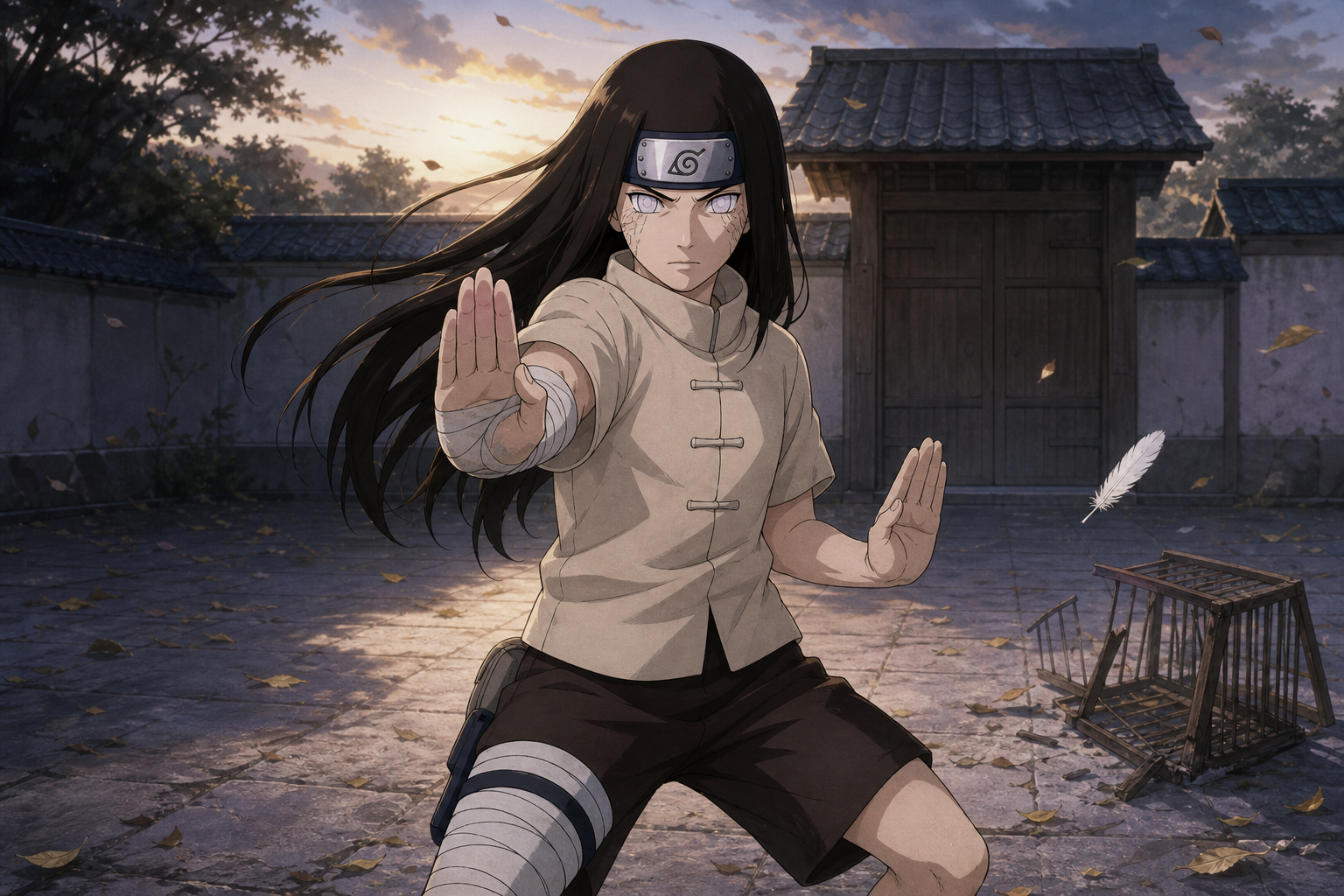
Part I gives him long dark hair, pale Byakugan eyes, a cream Hyūga shirt, dark shorts, bandaged limbs, and a precise Gentle Fist stance. The design is spare. Hair and clothing move; the face remains controlled.
Part II lengthens the hair and shifts him into white Hyūga clothing suited to his jōnin-era silhouette. The branch seal remains concealed. Improved status does not remove the mark.
Birds, cages, sky, and feathers recur around his worldview. Those images are not generic poetry pasted onto a pretty boy. He names himself a caged bird, watches birds while studying the Byakugan blind spot, and receives bird imagery after death. The symbol works because the institution is literal.
05
The Caged Bird seal makes family hierarchy physical
The Hyūga divide main and branch houses. Branch members protect the main family and carry a forehead seal. Main-house authority can activate the mark to cause extreme pain and punish disobedience. At death, the seal protects the Byakugan from theft by destroying or sealing the eye’s power.
Neji receives the mark when Hinata turns three. A main-house child’s birthday becomes the branch child’s branding day. Hinata does not choose that ritual. Neji still experiences her existence as the event that closes the cage.
The system controls labor, pain, succession, bodily autonomy, and postmortem property. The clan claims the right to decide who can use a person’s eyes after that person dies. `Protecting the bloodline` is the polite phrase. Ownership is the function.
MRT asks who becomes infrastructure. The main house inherits authority. The branch house supplies protection and disposable bodies. Neji can become the most talented Hyūga of his generation and remain structurally subordinate.
That fact makes his fatalism understandable. Understanding does not make every conclusion correct.
06
Hizashi chooses death inside conditions built to demand his death
Kumogakure attempts to seize Hinata and acquire the Byakugan. Hiashi kills the kidnapper. Kumo then demands the Hyūga clan head’s body to avoid renewed war.
Hizashi, Hiashi’s twin and Neji’s father, dies in Hiashi’s place. The Caged Bird seal ensures Kumo cannot recover useful Byakugan secrets from his corpse. Hiashi later explains that Hizashi chose the sacrifice to save his brother, clan, village, and son rather than simply obeying the branch role.
The choice matters. So do the conditions.
A branch man raised to protect the main house volunteers when the state demands a main-house body. He may act from love and personal agency. The institution has already shaped which body becomes available and why that substitution solves the diplomatic problem.
Calling Hizashi’s death purely forced erases his stated intent. Calling the death purely free erases the caste machinery. Freedom under coercive conditions is still constrained freedom.
Worse, the adults hide the truth from Neji. He grows up believing his father was ordered to die because a branch life could replace a main one. The clan lets a child build an identity around rage rather than explain the sacrifice.
07
Hiashi tells the truth only after Naruto does the emotional labor
After Naruto defeats Neji, Hiashi brings Hizashi’s letter and explains the decision. The revelation allows Neji to reinterpret his father’s death and relationship to destiny.
That conversation is important and late. Hiashi had the truth while Neji trained, suffered under the seal, and directed rage toward Hinata. The clan head waits until an outsider punches through the boy’s ideology.
Naruto deserves credit for challenging Neji. Hiashi still owes accountability for silence. Adults in Naruto love withholding one life-altering document until a child survives public violence. The filing system is undefeated.
Later, Hiashi trains Neji in techniques previously restricted to the main house, and family relations improve. That is meaningful repair. The manga does not provide a complete record proving the seal is removed or the branch system abolished.
A nicer uncle is not a constitution.
08
Team Guy gives him relationships not organized by blood
Might Guy leads Neji with Rock Lee and Tenten. The team contains three radically different approaches to worth. Lee lacks ninjutsu and genjutsu talent but works obsessively. Neji possesses inherited genius and initially believes effort cannot overcome assigned nature. Tenten brings weapons discipline and practical observation while receiving criminally little narrative investment.
Lee’s rivalry irritates and challenges Neji. Lee wants to defeat the prodigy through work. Neji reads the goal as denial of reality. Naruto eventually proves effort, unpredictability, and external power can break his certainty, but Lee has been pressing the philosophical bruise from the beginning.
Guy teaches through volume, emotion, and visible belief. Neji’s reserve resists that style. The teacher does not require every student to perform youthfulness the same way.
Tenten often mediates information and watches both boys. A full profile cannot turn her into the person standing near Neji when Lee is busy. Team relationships need all three edges.
The team’s Kazekage Rescue experience later forces each member to fight a duplicate of the self. The device is blunt but thematically useful. Neji can no longer define growth only through defeating someone assigned above him. Progress means exceeding the version of himself already recorded.
09
Lee makes effort impossible for Neji to dismiss as naïveté
Rock Lee chooses Neji as a rival because Neji represents natural talent, clan technique, and the judgment Lee keeps hearing from adults. Lee wants to prove that disciplined taijutsu can overcome the genius label.
Early Neji treats that ambition as denial. His worldview needs Lee to remain below him because fixed limits make the universe predictable. If Lee can change the result through work, Neji has to face the possibility that his own fatalism protects him from hoping.
Lee’s fight with Gaara complicates the lesson. Training produces astonishing speed and power, yet effort does not prevent catastrophic injury. `Work beats talent` is too simple. Bodies, teachers, risk, access, and opponents still matter.
Neji later respects Lee without becoming a shouting convert to the Power of Youth. That quiet respect is more credible than a personality transplant. He can revise the hierarchy while keeping his own temperament.
Masculinity operates differently across the pair. Lee performs feeling openly. Neji treats composure as control. Guy gives both boys affection without demanding one emotional style. Team Guy quietly offers Neji a male family where care is not enforced through pain on the forehead.
10
Tenten deserves more than standing near his technique explanations
Tenten trains beside Neji and Lee, observes their rivalry, and trusts Neji’s judgment. The manga gives her too little individual relationship material with either teammate.
That scarcity often causes profiles to call her `like a sister` or assign hidden romance because fandom dislikes an empty space. The honest record is stronger: she is a long-term teammate whose weapons skill, field presence, and grief should have received more page time.
Neji’s death removes a colleague she has known through training, exams, retrieval aftermath, rescue missions, and war. The story focuses more heavily on Naruto and Hinata’s reaction. Team Guy bears a separate loss that romance framing cannot absorb.
Creative labor matters too. Neji’s close-range precision, Lee’s direct taijutsu, and Tenten’s weapon range create a useful combat triangle. The manga repeatedly chooses to showcase the boys while treating the woman as equipment delivery. That imbalance is an industry choice, not evidence that Tenten contributed nothing to Neji’s life.
11
Hinata’s Chūnin Exam match is trauma turned downward
Neji faces Hinata in the preliminary round. He reads her fear, describes her personality as fixed, and insists people cannot change. His analysis is sharp because they share family history and Byakugan perception.
He then uses Gentle Fist to close tenketsu and inflict internal damage. Hinata continues after Naruto encourages her. Neji escalates beyond what the exam needs, and the jōnin intervene before he can deliver a fatal strike.
The branch system explains his rage. Hinata did not brand him, order Hizashi’s death, or design succession. Neji targets a nearby main-house girl because the actual institution is harder to hit.
That is displaced violence. Victimhood does not prevent someone from becoming an aggressor.
Hinata’s refusal to surrender challenges his worldview before Naruto enters the arena. She is frightened and physically outmatched. She still changes her behavior in front of the person insisting behavior cannot change.
Neji wins the match. He loses the argument in stages.
12
Naruto defeats the ideology without freeing the body
In the final-round fight, Neji uses Byakugan and Gentle Fist to close Naruto’s chakra points. Naruto accesses Kurama’s chakra despite that closure, returns to the fight, survives Rotation, and tricks Neji through an underground attack.
The tactical upset matters. Neji believes he has read Naruto’s limits and fixed the result. Naruto possesses a second chakra source and a habit of refusing conclusions.
Naruto argues that people can change and points to his own failure-to-contender path. The speech lands because the fight produces evidence. Neji’s destiny claim cannot explain the person rising after his system says the match ended.
Still, Naruto does not remove the Caged Bird seal. He does not reform the Hyūga. He changes how Neji understands agency inside constraint.
That boundary protects the story from motivational-poster nonsense. Mindset matters. Material cages also matter. Telling an oppressed child to believe harder is not liberation.
13
The Byakugan sees nearly everything and leaves one lethal gap
The Byakugan gives near-360-degree vision, detailed sight of chakra pathways and tenketsu, long-distance observation, and penetration through many objects. Neji develops impressive range and precision.
A small blind spot extends from the upper back near the base of the neck. Most opponents never discover the gap. Kidōmaru does because he tests range, defense, and reaction from a distance.
The blind spot is a technical limit, not proof the Byakugan is bad. Ordinary humans have far larger visual gaps. A tiny predictable opening becomes dangerous only when an intelligent enemy can locate and target the moving angle.
Creatively, the flaw gives Neji a body-level contradiction. The boy who believes he sees destiny clearly cannot see one narrow path behind himself.
14
Gentle Fist makes precision more dangerous than muscle
Gentle Fist injects chakra through contact to damage the chakra network and internal organs. Byakugan sight guides strikes toward tenketsu. External wounds can look small while internal function collapses.
Eight Trigrams Sixty-Four Palms traps an opponent inside Neji’s divined field and strikes 64 tenketsu in an escalating sequence. The technique can shut down chakra flow and bodily movement.
Eight Trigrams Palms Revolving Heaven releases chakra from tenketsu around the body while Neji rotates, creating an all-direction defense. The technique belongs to main-house secret practice, yet Neji reproduces the principle through talent and observation before later receiving fuller instruction.
Vacuum Palm extends force to mid-range. Vacuum Wall Palm combines the technique with another Hyūga user. Gentle Fist Art One Blow Body releases chakra to break restraint or repel contact where shown.
Eight Trigrams One Hundred Twenty-Eight Palms is an anime expansion, not a manga technique Neji uses against Kidōmaru. The animation is memorable. Memory does not print panels retroactively.
Guidebook Fire, Earth, and Water Release classifications do not supply an unseen elemental arsenal.
15
Rotation is defense built from a technique the branch house was not meant to own
Revolving Heaven is one of the Hyūga’s celebrated defensive techniques. Chakra released from the body’s tenketsu combines with rotation to repel attacks across nearly every direction.
Neji’s early access is politically important. Main-house secret instruction is supposed to control advanced knowledge. A branch prodigy reconstructs the technique anyway. Talent becomes a leak in the caste wall.
The move also embodies his first worldview. Rotation creates a sealed sphere with Neji at the center. Threat approaches, the body spins, and the outside world is rejected. The defense is brilliant and isolating.
Kidōmaru responds by staying outside the radius and studying. War-scale barrages later strain the premise that one rotating body can answer every projectile. Defense always has throughput. Chakra, timing, footing, awareness, and the number of simultaneous attacks create limits.
Vacuum Palm shows Neji adapting beyond the sphere. He projects force outward and can combine with Hinata. Growth changes defense from solitary perfection into coordinated reach.
That shift matters more than another numerical strike count. The former fatalist learns a technique that works better with another person.
16
Kidōmaru turns the blind spot into a long-range death sentence
During the Sasuke Retrieval Mission, Neji remains behind to fight Kidōmaru so the team can continue. Kidōmaru uses webs, spider summons, Sticky Gold armor, and curse-mark transformations.
Sticky Gold blocks Gentle Fist because the chakra-hardened material prevents direct access to tenketsu. Kidōmaru then studies Neji’s defense from outside close range. Projectiles test the Byakugan field until he identifies the blind spot.
He creates a bow and guided arrow connected through chakra thread. Neji senses enough to shift the first lethal trajectory away from a vital point. Kidōmaru improves the next shot with rotation and guidance. The arrow pierces Neji.
Neji uses the connecting thread against the archer. Chakra travels back through the line, damages Kidōmaru internally, and creates the opening for a final Gentle Fist strike.
The fight is extraordinary because Neji wins through the limitation. He cannot erase the blind spot, so he lets the attack create a path back to the enemy.
Victory nearly kills him. Medical rescue keeps him alive. Surviving does not make the damage decorative.
17
Jōnin promotion should have opened a leadership story
During the time skip, Neji advances through chūnin to jōnin. His 62 missions include eleven A-rank and two S-rank assignments. Hiashi trains him, and his Gentle Fist repertoire expands.
The promotion suggests judgment, leadership, and village trust beyond combat. The manga mostly keeps Neji as a capable team member rather than exploring what branch-house jōnin authority means inside the clan.
That missing story is enormous. Can a branch member command main-house shinobi on missions? Does jōnin rank change access to clan decisions? Can Neji protect younger branch children from sealing? Does village authority outrank the clan mark?
The text gives no complete answers. Fanfiction has been running that policy office for years because canon left the lights off.
18
Part II gives him competence and not enough interior life
Team Guy joins the Kazekage Rescue operation, fights Kisame’s thirty-percent duplicate, and confronts self-duplicates at the barrier. Neji provides Byakugan reconnaissance and jōnin-level coordination.
He supports broader village missions, responds during Pain’s aftermath, and serves in the Second Division during the war. His rank and skill remain visible. His internal conflict receives far less development than Part I.
That underuse affects the death. The story asks readers to feel the end of a major arc after spending years giving Neji limited new interior material. Earlier investment carries the scene. Part II could have shown the man he became, not only the prodigy he remained.
Industry analysis matters here. Ensemble shōnen casts expand until only the central power line receives sustained arcs. Neji’s technical style is precise and visually distinct, but the plot escalates toward giant chakra warfare. A palm-strike prodigy becomes harder to stage beside meteors unless the writer remains interested in institutions and relationships.
19
Chapter 614 gives him a choice and repeats the branch pattern
During the war, the Ten-Tails launches wooden projectiles toward Naruto and Hinata. Hinata moves to shield Naruto. Neji moves in front of them and takes the lethal strike.
He dies after explaining that Hinata was willing to die for Naruto and connecting his own choice to the people he loves. The Allied forces later adopt a bird formation in his memory.
Neji chooses the act. Nobody activates his seal or orders him to move. He protects two people with whom he has repaired relationships.
The structure remains brutal. A branch-house man dies shielding the main-house woman, echoing Hizashi’s death for Hiashi. The story frames repetition as transformed because love replaces compulsion. Readers are allowed to ask why liberation still ends with the same body on the ground.
Some fans say Neji dies only to push Naruto and Hinata together. The death clearly affects their bond and the handholding sequence that follows. Reducing Neji to a shipping device repeats the dehumanization. Denying the authorial romance function entirely is also evasive.
The honest verdict is uncomfortable: Neji’s agency is real, the sacrifice is thematically prepared, and the caste symbolism remains unresolved.
20
Buddhist freedom is not the same as pretending conditions disappear
Neji’s fatalism resembles a crude theory of karma where present suffering proves an unchangeable destiny. Buddhist thought is more demanding. Actions arise through conditions, and conditions can change through new action, understanding, and relationship. No isolated self stands outside cause and effect.
Naruto helps Neji see that conditioned does not mean fixed. The seal, father’s death, family secrecy, and talent shape him. They do not dictate every response forever.
The bird image works inside that distinction. Freedom is not a soul escaping all material conditions. A bird still has a body, weather, hunger, predators, and limited strength. Flight is a capacity exercised within conditions.
Neji’s final act can therefore be chosen without becoming proof that the caste no longer matters. He acts from love rather than formal compulsion. The historical pattern remains one of the conditions shaping what protection means to him.
Confucian duty adds another tension. Family members owe care across hierarchy, but the Hyūga main house demands service without equal reciprocity. Neji’s later care for Hinata becomes ethical because the relationship has changed. The clan cannot claim credit for love produced after its own cruelty nearly destroyed both children.
21
His death turns bodily autonomy into the final argument
The Caged Bird seal controls Neji’s body in life and protects clan property in death. Chapter 614 presents the body making a final choice before the institution can issue an order.
That can be read as reclaimed autonomy. Neji decides where to stand and whom to protect. The decision belongs to him.
The cost is that death ends every other possible use of autonomy. He cannot lead reform, train branch children, challenge Hiashi politically, teach Boruto, build a family, or discover adulthood beyond service. Sacrifice produces immediate meaning and cancels future agency.
Shōnen storytelling loves death because one decisive body can settle an emotional argument quickly. Institutional repair is slower and less cinematic. A funeral feather needs one panel. Abolishing a hereditary pain seal needs policy, conflict, enforcement, and survivors speaking.
That creative economy helps explain why the death feels moving and insufficient. Neji earns the emotional scene. The Hyūga storyline still owes the structural ending.
22
The cage cannot be declared open without a reform receipt
After Neji’s death, the story presents improved Hyūga family relations and honors his memory. Boruto’s name carries the screw/bolt wordplay connecting him to Naruto and Hinata’s family.
No memorial name can substitute for institutional change. The manga does not clearly document abolition of the Caged Bird seal, removal for living branch members, shared clan governance, or reparations.
Naruto promised to change the Hyūga when he became Hokage. The sequel should show the policy, not assume a wedding completed the paperwork.
Neji’s legacy belongs in that missing audit. If his death teaches only that chosen sacrifice is nobler than forced sacrifice, the branch body remains useful to the same hierarchy. If his life helps end the seal, the story needs evidence.
23
Kōichi Tōchika and the original Japanese performance
Kōichi Tōchika performs Neji in the original Japanese anime and films. His credit is verified.
Some records list Keiko Nemoto for younger-child appearances. This profile leaves that credit out until the source clears the same standard.
No claims about pitch, timing, breath, or vocal transformation belong here without a lawful Japanese scene-observation pass. The listening route should include the Hinata fight, Naruto final, Hizashi revelation, Kidōmaru, Team Guy material, and chapter 614 adaptation.
No English-dub material belongs here.
24
Anime, films, OVAs, games, and parody record
The anime adapts Neji’s central manga arc and expands childhood, Team Guy missions, techniques, and war encounters. One Hundred Twenty-Eight Palms belongs to that adaptation shelf.
Neji appears in licensed Naruto films and OVAs, including Legend of the Stone of Gelel, The Will of Fire, Blood Prison, Road to Ninja, and ensemble comedy material where verified. Road to Ninja uses an alternate-world characterization that cannot define the core Neji.
Rock Lee & His Ninja Pals turns Team Guy into parody. Exaggerated behavior belongs to gag continuity.
Games across Ultimate Ninja, Clash of Ninja, and Ultimate Ninja Storm expand Hyūga move sets for play. Game ultimates do not create manga feats.
25
Eight fandom misreadings that need to leave the cage
`Neji was wrong because destiny is fake`
Birth determines his house, seal, labor, and bodily control. His structural diagnosis is correct. He becomes wrong when he treats conditioned reality as unchangeable nature.
`Naruto freed Neji`
Naruto changes his worldview and helps trigger truth from Hiashi. The seal remains. Emotional liberation is not institutional abolition.
`Neji is just a bully`
He abuses Hinata and remains accountable. He is also a traumatized branch child directing systemic rage toward the wrong person. Both facts matter.
`Hizashi chose death, so the clan did nothing wrong`
Choice exists inside a system that makes the branch twin the useful substitute. Love does not erase coercive conditions.
`Neji used 128 Palms in the manga`
No. The technique is anime-original. Manga Kidōmaru analysis must use the published 64-palms and thread/arrow sequence.
`He was universally the strongest Hyūga`
Neji is an extraordinary prodigy and jōnin. Universal rankings across eras, Hiashi, Hinata, Hanabi, and later descendants require more evidence than fandom slogans.
`His death was only for NaruHina`
The death affects the relationship and serves romance structure. Neji also acts from repaired family/team bonds and a long freedom/sacrifice arc. `Only` is the dishonest word.
`Choosing the sacrifice proves the caste symbolism is gone`
Agency changes the moral meaning. The branch body still dies protecting the main-house body. Symbolic repetition remains available for criticism.
26
Final verdict
Neji Hyūga begins as a child who understands that the cage is real and decides the cage must be destiny. He hurts Hinata, loses to Naruto, learns the truth about Hizashi, survives Kidōmaru, becomes a jōnin, repairs family bonds, and chooses to protect people rather than serve a title.
That growth deserves respect. The ending deserves argument. Neji learns how to choose inside a cage, but the story kills him before proving the cage was dismantled. A white feather is beautiful. RaeRae still wants the policy receipt.
Sources and canon boundary
Editorial record: Manga chronology controls. Anime expansions, novels, films, OVAs and games are labeled instead of blended into canon.
Primary franchise references: Naruto Official and VIZ Media Naruto. CVM Sekai’s conclusions about clan hierarchy, fate, reform, sacrifice, and Neji’s death are editorial analysis, not invented creator quotations.