
Naruto · Complete Character Profile
Rock Lee
His limitation is real, his access is unequal, and his body keeps receiving the bill for a village that treats pain as proof of worth.
The bottom line
Rock Lee does not prove that hard work always beats talent. Gaara nearly ends his career after Lee delivers the most spectacular labor of the Chūnin Exams. That loss matters. Lee proves something harder, less marketable, and far more useful: a person can deserve education, access, and professional respect even when the standard system was not built for his body.
Konoha teaches ninjutsu, genjutsu, and taijutsu as though every future shinobi can use the same toolbox. Lee cannot perform the first two. The institution reads that limitation as evidence that he cannot become a ninja. Might Guy looks at the same child and asks a better question: what could Lee become if someone taught the body he actually has?
That shift changes Lee’s life. Guy does not cure him. Lee does not wake up with a hidden bloodline, convenient elemental gift, or chakra beast waiting to cover the difference. He trains one route until specialists, prodigies, and monsters have to respect the route. Then the story makes us watch the bill arrive in his bones.
That is Rock Lee’s real argument. Inclusion without resources is a speech. Mentorship without limits can become exploitation. Perseverance is valuable, but a child should not need to destroy himself before adults agree that he belongs.
His limitation is specific, not mystical
Lee is often described as having no chakra. That shortcut is wrong. The Eight Gates regulate chakra flow through the body, and Lee opens them. His advanced taijutsu also depends on physical and chakra control. His problem is an exceptional inability to perform ninjutsu and genjutsu, the two technique families the Academy treats as basic professional requirements.
That distinction changes the entire profile. Lee is not a civilian who muscles his way into magic through push-ups. He is a chakra-using shinobi whose technique access is unusually narrow. His body can produce extraordinary speed and force, but the standard curriculum offers almost no path for turning those strengths into graduation-level competence.
Konoha’s first response is basically, “Have you tried being built differently?” Very useful. Revolutionary pedagogy. Somebody engrave that on the Academy wall.
Guy supplies the missing educational work. He identifies taijutsu as a viable specialization, teaches Lee techniques suited to his abilities, builds a conditioning program, and gives him a professional model. Lee performs the labor, but the labor becomes productive because a teacher stops measuring him only by tasks he cannot do.
The bowl cut is a lineage
Lee’s design makes the mentorship visible before anyone explains the relationship. The bowl cut, enormous eyebrows, green jumpsuit, orange leg warmers, bandaged hands, and waist-worn forehead protector echo Guy so closely that Team Guy might as well arrive with matching family portraits.
The resemblance begins as admiration. Lee copies the adult who first treats his future as real. That can look goofy, especially when Guy adds poses, shining teeth, tears, and sunrise speeches. Beneath the comedy sits a child building an identity from the first trustworthy mirror available.
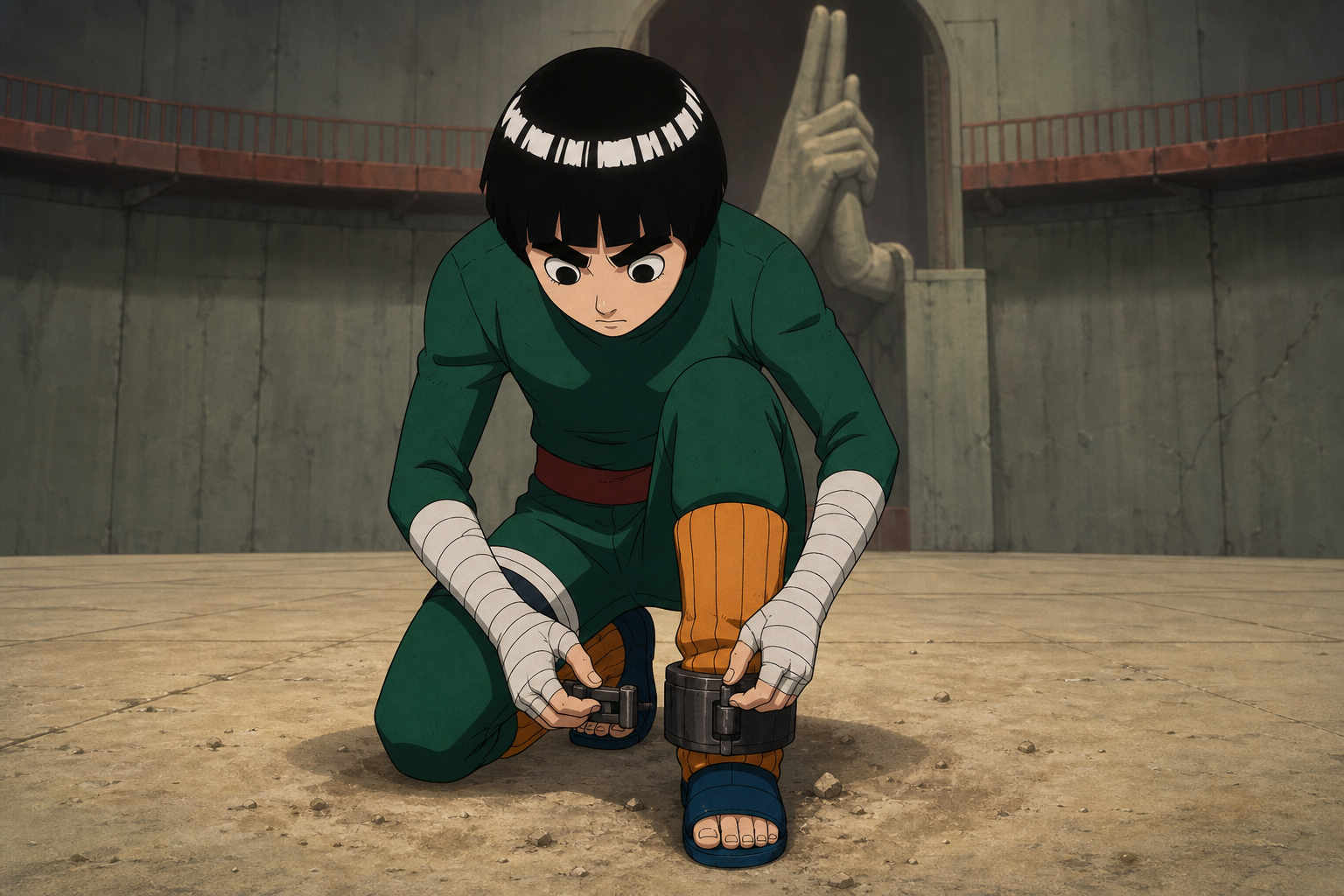
Part I Lee is compact and almost aggressively plain beside clan heirs and fashionable prodigies. The heavy ankle weights reveal that the plain silhouette contains hidden labor. Part II adds height and a flak jacket in many mission settings, but the green foundation remains. The Last and New Era designs mature his face and frame without discarding the visual inheritance.
The design joke works because the emotional fact works. Lee is not cosplaying strength. He is wearing proof that somebody believed him.
Before Guy, effort had nowhere to go
Lee trains obsessively during his Academy years and still struggles. Classmates mock his ambition because the village’s definition of a ninja appears to exclude him. Repetition alone does not solve a curriculum mismatch. A thousand hours spent at a locked door cannot turn the wrong key.
This is where the popular “effort versus talent” slogan becomes too small. Lee has talent. His proprioception, pain tolerance, memory for movement, balance, speed potential, and ability to survive advanced conditioning are not ordinary. Neji also works relentlessly despite being labeled a genius. Sasuke trains. Gaara’s automatic defense comes from horrifying circumstances, not laziness. The series never gives us a clean warehouse where one shelf contains effort and another contains talent.
Lee’s problem is access. His strengths do not match the institution’s preferred entry tests. Guy creates another route, and Lee proves that route can produce professional competence. That is not a fairy tale about wanting something badly enough. That is an argument for specialized instruction.
Might Guy gives him access and a dangerous gospel
Guy sees Lee’s persistence and promises that taijutsu can become his ninja way. The promise is material. Guy trains him, supervises him, teaches restricted techniques, advocates for him, and stays emotionally present when the body fails. Plenty of adults in Naruto offer children inspiring words before sending them into traffic. Guy actually does the work.
Their bond also carries risk. Guy’s own ethic worships endurance. He gives Lee tools that convert bodily safety into short bursts of power. When Tsunade presents surgery with a serious chance of death, Guy promises that if Lee dies, he will die too. The scene communicates absolute love to Lee. The scene also places an adult’s life on a frightened teenager’s medical choice.
Both readings belong on the page. Guy is the teacher who makes Lee’s career possible. He also teaches Lee that devotion looks like shared self-destruction. Their affection is genuine. Genuine affection can still carry terrible ideas about masculinity, pain, and worth.
Guy’s rules create power, not wishful thinking
Lee’s training succeeds because Guy builds rules. Goals receive deadlines. Failure creates an additional exercise. Techniques require permission. The weights remain on until a specific threshold. The gates exist inside a known risk ladder. The system can become excessive, but the system is not random inspiration.
That point separates Lee from generic underdog writing. He does not win attention because the universe rewards purity of heart. He develops measurable speed, repeatable combinations, and tactical knowledge through a program designed around his actual capacities. Guy also controls access to the most dangerous tools, at least until competition pressure and Lee’s own identity push those limits.
The Gaara fight shows why rules matter. Weight removal changes speed. Sand armor changes the damage calculation. Gate release changes both output and injury. Gaara’s automatic defense and Lee’s close-range specialization collide under clear constraints. The spectacle feels earned because each escalation answers a visible problem.
The same clarity exposes the danger. Lee has no safe ranged answer, no healing technique, and no defensive shell comparable to Gaara’s. His solution is to spend more of his own body. A power system becomes morally interesting when the cost does not vanish after the animation budget finishes sparkling.
Team Guy is more than one rivalry
Neji becomes Lee’s measuring stick because Neji appears to possess everything Lee lacks: clan training, rare eyes, technical precision, and effortless-looking mastery. Lee wants to defeat him. The rivalry helps organize his training, but Neji is not a lazy foil. Neji’s skill also comes from punishing practice under a violent family system.
Tenten occupies the least glamorous but most necessary position. She witnesses the competitions, translates Guy-and-Lee intensity into ordinary human proportions, and trains beside both boys without receiving equivalent narrative investment. A full Lee profile cannot use her as punctuation. Team Guy’s balance depends on a weapons specialist whose competence is regularly treated as background because she does not scream her dream at sunrise.
Guy builds a team where three different combat logics coexist. Neji reads internal systems. Tenten controls space and equipment. Lee closes distance and turns his body into the weapon. Their best teamwork appears when difference becomes coordination instead of a ranking.
Sasuke learns that seeing is not the same as moving
Lee meets Team 7 before the written Chūnin Exam and challenges Sasuke. Sasuke expects the Sharingan and Uchiha reputation to carry the exchange. Lee’s speed exposes the gap between perceiving an attack and having a body trained to answer.
That distinction becomes one of the series’ cleanest early power lessons. The Sharingan can read motion. Reading does not automatically grant the conditioning, timing, or muscle response needed to stop that motion. Lee overwhelms Sasuke with direct taijutsu until Guy interrupts.
Lee’s victory is not proof that bloodline abilities are useless. Sasuke is still developing, and Lee has spent years specializing in the exact area being tested. The scene punctures inherited prestige without pretending inheritance stops mattering. More importantly, Lee gets to enter the exam as a threat rather than a pity project.
Sakura does not owe him romance
Lee announces his affection for Sakura quickly and loudly. His sincerity is real. Her rejection is also real. Bravery performed near a girl does not create a romantic invoice.
That boundary matters because the Forest of Death gives Lee a genuinely heroic choice. He sees Sakura defending Naruto and Sasuke from the Sound trio and intervenes alone. He uses the Front Lotus, takes serious risk, and loses when Dosu’s sound-based attack bypasses the kind of defense Lee understands. Team 10 eventually joins the defense.
Lee’s action deserves respect without rewriting Sakura’s consent. He protects somebody he values because protection is right, not because protection purchases her. The story sometimes plays his declarations for comedy, but the better version of Lee learns that affection can motivate care without entitling him to a return.
Gaara versus Lee is a masterpiece about losing
The preliminary match against Gaara becomes iconic before Lee opens a gate. Gaara’s sand moves automatically, shielding him from attacks while he stands almost still. Lee’s ordinary speed cannot penetrate the defense. Guy gives permission to remove the training weights.
When those weights hit the floor, the arena learns that Lee has been carrying a private workload everywhere. His speed jumps. He strikes Gaara repeatedly and forces the sand to fail in ways nobody in the room expected. The moment feels like liberation because the audience finally sees what routine discipline built.
Then the fight refuses to become a motivational poster.
Gaara’s sand armor absorbs damage beneath the automatic shield. Lee uses the Front Lotus and later opens multiple gates to drive the Reverse Lotus. Each release raises speed and force while tearing muscle fibers and stressing the body. Lee reaches the Fifth Gate. He dominates the visible rhythm of the fight. He still does not secure victory.
Gaara crushes Lee’s left arm and leg and leaves spinal damage severe enough to threaten his career. Guy stops the match. Lee then rises into a fighting stance while unconscious, his body obeying the command to continue after consciousness can no longer consent.
Fans remember the dropped weights because the sequence is pure electricity. The unconscious stance is the darker receipt. Lee has trained persistence so deeply that stopping feels less available than bodily ruin.
The gates do not make pain imaginary
The Eight Gates are chakra limiters within the body. Opening them removes normal restrictions and permits explosive performance beyond safe capacity. The First Gate supports the Front Lotus. Additional gates enable the Reverse Lotus and increasingly extreme speed and force. Against Gaara, Lee opens five.
Nothing about the technique is free. Muscles tear. Bones and joints face forces the body normally prevents. Coordination deteriorates. Recovery becomes necessary, and catastrophic injury remains possible. Lee’s talent for opening gates does not cancel his disability, and his disability does not make the gates a magical equalizer with no cost.
Later material allows Lee to progress further, including use of the Sixth Gate in franchise continuity. He never earns permission from the text to be casually credited with all eight. Powerscaling loves handing characters abilities because their teachers possess them. That is not evidence. Guy’s ceiling belongs to Guy until Lee demonstrates his own.
Tsunade’s surgery is not a training montage
After the Chūnin Exams, Lee confronts the possibility that his arm, leg, and spinal injuries will prevent him from serving as a shinobi. Tsunade evaluates him and offers a dangerous operation. The success odds are frightening. Failure could kill him.
The choice reaches deeper than employment. Lee has constructed his identity around proving he can belong in this profession. Retirement does not sound like a career change. Retirement sounds like the institution’s original verdict returning after he nearly disproved that verdict.
Tsunade does not sell false confidence. She studies the procedure, confronts the risk, and gives Lee a route medicine previously could not guarantee. Her labor matters as much as his courage. “He worked hard and recovered” deletes the surgeon, the diagnostic judgment, the research, the rehabilitation, and every person who keeps a damaged body alive.
Guy’s promise to die with Lee if the operation fails gives Lee emotional permission to choose surgery. The promise is loving, coercive, and desperate at once. Lee accepts. The operation succeeds. Success does not prove the risk was wise in every possible world. Success means a specific medical team and patient survived the risk they actually took.
Kimimaro meets a patient who escaped rehabilitation
Lee joins the Sasuke Recovery pursuit before his recovery is complete. He reaches Naruto’s fight with Kimimaro and takes over so Naruto can continue after Sasuke. The timing is thrilling and medically ridiculous. Konoha’s discharge planning has apparently been outsourced to destiny.
Lee accidentally drinks alcohol instead of medicine and enters Drunken Fist, a style in which his movements become erratic enough to disrupt Kimimaro’s reading. The sequence is funny because Lee’s formal personality collides with unpredictable movement. The health context cannot disappear. A recently operated minor consumes alcohol by mistake and fights a lethal opponent while impaired.
Kimimaro adjusts. Lee returns to sober taijutsu and remains physically limited. Gaara arrives and takes over the battle, creating a relationship reversal with real weight. The boy who crippled Lee now saves him. Gaara’s action shows change without undoing the injury. Repair begins through different conduct, not retroactive innocence.
What Rock Lee can actually do
Strong Fist and speed
Lee specializes in Strong Fist taijutsu, which damages an opponent through direct external force. His conditioning produces exceptional acceleration, balance, combinations, aerial control, and the ability to alter tempo at close range. Removing his weights reveals stored speed rather than a new transformation.
Front Lotus and Reverse Lotus
The Front Lotus uses a high-speed setup, binding motion, rotation, and a dangerous drop. The Reverse Lotus follows deeper gate release with a faster combination built to overwhelm an opponent before Lee’s body fails. Both demand proximity and place Lee at risk.
Leaf techniques
Lee uses Leaf Whirlwind variations and direct entry attacks across manga and anime material. Named variants should retain exact continuity labels because adaptation and games expand his vocabulary. A title appearing in a game menu does not automatically become a manga technique.
Drunken Fist
Alcohol makes Lee extraordinarily unpredictable after a tiny amount. Drunken Fist is not a sober technique he can activate on command. The style carries obvious safety and consent problems, especially because he is a minor during the Kimimaro fight.
Hard limits
Lee depends heavily on close range. Ranged attacks, battlefield control, durable automatic defenses, and opponents who can survive his burst create problems. Gates damage him. Surgery history and recovery matter. He needs teammates and medical care. None of those facts make him weak. They make his combat profile honest.
Part II gives him a jacket and less story
Lee returns in Shippūden taller, stronger, and promoted to chūnin. Team Guy participates in the Kazekage Rescue mission, fights Kisame’s proxy, and confronts duplicate versions of themselves. The arc shows growth and team competence, but Lee no longer receives the sustained interior focus that made the Gaara and surgery material land.
Later appearances place him in village defense and Allied Shinobi Forces operations. He contributes taijutsu during the Fourth Shinobi World War, including a major strike that helps disrupt Madara’s connection to the Ten-Tails. Anime episodes expand his battlefield work and supporting missions, but those additions need anime labels.
The reduction in focus creates a strange fandom split. Some viewers treat adult Lee as proof that his theme failed. Others inflate every brief feat to protect the childhood promise. Neither response fixes the writing choice. Lee becomes competent and useful. The main narrative simply spends less time exploring what that competence costs or changes.
Underuse is not incompetence. A camera looking elsewhere does not erase a career.
The industry knew the dropped weights would sell forever
Lee’s Chūnin Exam material became durable franchise currency because the creative team builds a perfect reveal. The plain green boy becomes the fastest person in the room. Physical objects hit the floor. Dust rises. Experienced adults react. Gaara finally has to move. The sequence communicates years of invisible labor without stopping for a lecture.
That success creates a trap. Merchandise, games, clips, and anniversary material can replay the weight drop indefinitely while leaving the surgery and reduced Part II role behind. Spectacle becomes portable. Consequence is harder to package.
The comedy spin-off responds by making Lee the center of a universe where intensity itself powers the joke. That project gives him attention the main plot no longer provides, but parody Lee cannot repair main-continuity underdevelopment. The versions perform different jobs.
The creative lesson is not that every underdog needs a bigger transformation. Lee already received an unforgettable transformation. The missing material concerns adulthood, teaching, accommodation, recovery, and what happens when a person whose identity depends on effort enters a life stage where effort cannot control every outcome. Metal Lee offers that bridge. The franchise has only partly walked across.
Metal Lee and the blank space fandom filled
In the New Era, Rock Lee is an adult shinobi and Metal Lee’s father. He trains a new generation and preserves the visual and pedagogical lineage he received from Guy. Metal’s anxiety complicates the family pattern: discipline alone cannot solve every nervous-system response, and public performance can make skill harder to access.
Canon does not confirm Metal’s mother. Tenten is not Lee’s wife merely because fandom can place two unmarried teammates in the same spreadsheet. A missing answer remains missing. Shipping can have fun. Canon still does not name Metal’s mother, and the missing answer stays missing.
Adult Lee’s most meaningful possibility is not whether he surpasses Guy in a hypothetical death match. The question is whether he can give Metal the accommodation Guy gave him without repeating the belief that love must be proven through bodily destruction.
Disability, access, and the splendid-ninja promise
Lee’s story works best when read through access rather than cure. His limitation remains. He does not become valid because the limitation disappears. He becomes a shinobi because training, mentorship, technique selection, and institutional flexibility create a route that recognizes his capacity.
That route is still brutal. Konoha accepts Lee once his specialized labor becomes spectacular enough to serve the village. The institution celebrates the output while Guy and Lee carry most of the adaptation cost themselves. Nobody appears to redesign the Academy because Lee exposed a gap. One exceptional teacher catches one exceptional student.
That is not systemic inclusion. That is a rescue story.
The distinction matters outside anime. Disabled people are routinely praised for overcoming barriers that institutions chose not to remove. Inspiration becomes a way to admire effort without funding access. Lee’s training is his achievement. The locked door was never his moral failure.
Masculinity with tears and broken bones
Guy and Lee reject one narrow masculinity while reinforcing another. They cry openly, express affection, praise each other, hug, and treat emotional devotion as strength. That tenderness is valuable in a military story packed with boys who communicate mainly through trauma and punching.
Their version of manhood also worships endurance. Pain becomes evidence. Training becomes confession. The body proves sincerity by surviving what should have stopped his movement. Lee’s unconscious stance against Gaara looks noble because the series has taught him, and us, that quitting is the shameful option.
A healthier inheritance would preserve the tears and lose the martyr contract. Lee does not need less feeling. He needs permission to remain worthy while resting.
Confucian reciprocity and the teacher who earns loyalty
The Guy-Lee bond carries a strong teacher-student hierarchy, but the hierarchy works because Guy practices reciprocity. He demands extraordinary discipline while offering extraordinary attention, instruction, advocacy, and care. Lee’s loyalty is not obedience floating in empty air. Guy invests first and repeatedly.
The danger arrives when mutual obligation becomes mutual annihilation. A teacher should share consequence, but promising death can make separation feel like betrayal. Confucian responsibility at its best asks the superior party to protect and cultivate the junior. Guy fulfills much of that duty. His most extreme promise risks centering devotion over Lee’s freedom to choose without carrying Guy’s life too.
Buddhist discipline without worshipping suffering
Lee practices repetition, attention, and disciplined action. Those habits resemble a useful Buddhist reading of cultivation: transformation emerges from sustained practice rather than a fixed essence. His Academy reputation is not destiny.
The story also warns against attachment. Lee becomes attached to one definition of a splendid ninja and to bodily output as proof of worth. Suffering does not automatically purify that attachment. More pain does not produce more truth.
The strongest Buddhist reading is not “endure everything.” The stronger reading asks Lee to see that identity changes, bodies are impermanent, and worth cannot depend entirely on forcing one form to continue. Surgery lets him return. His humanity could not depend on the surgery succeeding.
Yōichi Masukawa in Japanese
Yōichi Masukawa performs Rock Lee in the original Japanese anime, Naruto: Shippūden, the New Era material, and Rock Lee & His Ninja Pals. His credit is verified across Lee’s long anime record.
That restraint matters because Lee’s voice moves between formal earnestness, explosive declarations, comedy, injury, and grief. A cast list can establish who performs him, but it cannot prove pitch, timing, breath, or scene-level choices. This profile does not fake that criticism from credits alone.
Manga, anime, films, OVAs, games, and parody
Lee’s core biography comes from Masashi Kishimoto’s manga and its television adaptation. Anime-original missions expand his workload and relationships but do not silently rewrite manga chronology.
He appears in franchise films, including Naruto the Movie: Guardians of the Crescent Moon Kingdom, where he joins the principal mission team, and later Shippūden films such as The Will of Fire. The Last: Naruto the Movie supplies a Blank Period design and role within the franchise timeline. Exact film actions belong under each film’s continuity label.
OVAs and games reuse and expand Lee’s techniques for event storytelling and playable combat. Game move lists are not manga evidence. Rock Lee & His Ninja Pals is a super-deformed comedy spin-off centered on Lee and Team Guy. The parody exaggerates personalities and rules on purpose. A joke universe cannot be smuggled into the main biography because everybody wore the same forehead protectors.
Six fandom shortcuts that flatten Rock Lee
“Hard work beats talent”
Lee loses to Gaara. His story proves that disciplined specialization can challenge inherited and supernatural advantages. The story never guarantees victory.
“Lee has no chakra”
Wrong. He opens chakra gates. His limitation concerns ninjutsu and genjutsu performance.
“He was robbed because he deserved the win”
Emotion is not a scorecard. Lee controls much of the match and fails to overcome Gaara’s full defense before his body collapses. The loss creates the consequence the arc explores.
“Sakura should have chosen him”
No. Protection is not courtship currency. Sakura’s boundary remains hers.
“Tenten must be Metal’s mother”
Canon has not confirmed Metal’s mother. Proximity is not documentation.
“Part II proves Lee became useless”
Part II underwrites him. Reduced narrative focus is not the same fact as zero professional value.
The final verdict
Rock Lee is one of Naruto’s best characters because his greatest scene is a loss. He reveals the work hidden beneath easy labels, forces an institution to recognize a path the institution failed to teach, and makes physical consequence impossible to ignore.
The weights falling are thrilling. The body rising unconscious is the warning.
Lee deserves every cheer for the life he builds. Konoha does not deserve credit for making the door so narrow that a child had to break himself against the frame before somebody opened another one.
Sources and canon boundary
Editorial record: Manga chronology controls. Anime expansions, novels, films, OVAs and games are labeled instead of blended into canon.
Primary franchise references: Naruto Official and VIZ Media Naruto. CVM Sekai’s conclusions about disability, access, training, bodily cost, Team Guy, the Eight Gates, and Rock Lee’s place in a system built around ninjutsu are editorial analysis, not invented creator quotations.