
Naruto · Complete Character Profile
Gaara
Suna built a child into a weapon, feared the result, and later called him Kazekage. His repair matters because it takes years of public conduct, not one sad flashback.
The bottom line
Gaara’s redemption works because Naruto does not reveal a sweet child who never harmed anyone. Naruto reveals that the murderous child was manufactured, not born, and Gaara spends the rest of his life choosing conduct the state never taught him.
That distinction protects the whole story. Trauma explains why Gaara becomes violent. Trauma does not resurrect the people he kills. Naruto’s recognition changes the direction of his life. Recognition does not complete the repair. Gaara earns trust later through protection, diplomacy, accountability, and public labor.
Sunagakure seals a military asset inside him before birth, isolates him when the experiment becomes frightening, and orders his death when the investment stops behaving. Gaara eventually becomes Kazekage of the same village. That is not proof the system was secretly right. That is a survivor taking control of the institution that tried to turn his body into policy.
His name becomes a wound, then a choice
Yashamaru tells young Gaara that his name means a demon who loves only himself. The explanation arrives inside a planned psychological attack. Gaara later carves the kanji 愛, love, into his own forehead and embraces self-love as survival through violence.
“Gaara of the Desert” or “Gaara of the Sand” is an epithet, not a surname. The name is commonly written with kanji that carry the self-love interpretation, but a profile should not treat every character as a simple dictionary equation. The meaning matters because somebody weaponizes that meaning against a child.
After Naruto changes his direction, the mark does not disappear. Gaara does not erase the years when love meant isolation. He changes what love requires. Protection of others becomes a way to build connection without surrendering the self he fought to preserve.
The design keeps every era visible
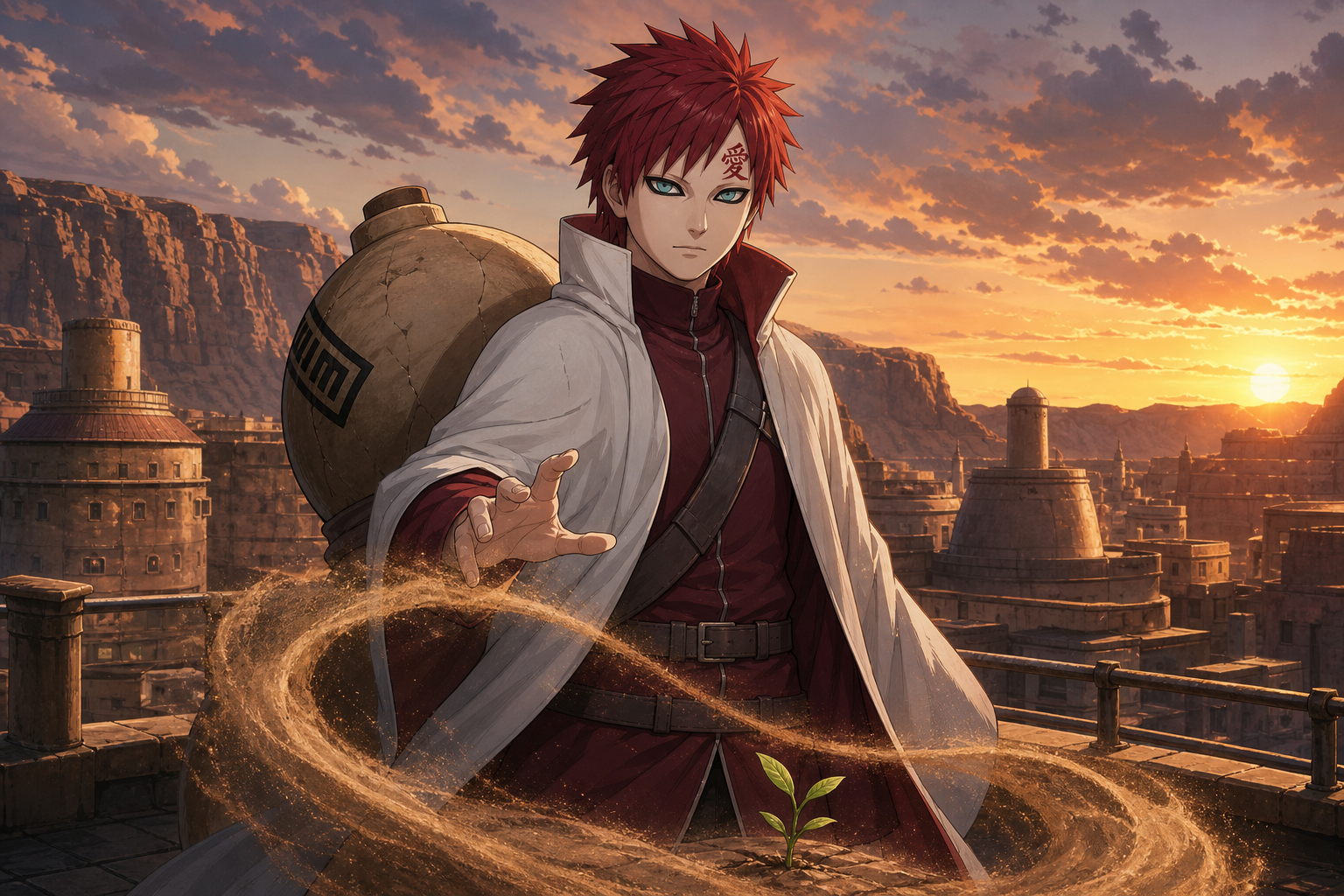
Gaara’s red hair, pale skin, teal eyes, dark rings, forehead mark, and enormous sand gourd make him instantly recognizable. Part I clothing wraps him in dark fabric and straps, with the gourd occupying almost as much visual space as his body. The object announces that sand is never far away.
The dark eye rings are tied to chronic sleeplessness and his relationship with Shukaku, not fashionable eyeliner placed by a very committed twelve-year-old. Sleep carries the risk of losing control, so exhaustion becomes part of his face.
Kazekage-era design adds a long coat and formal authority while preserving the gourd and mark. War clothing shifts function without changing the central silhouette. New Era Gaara presents a more settled adult appearance and different hair styling, though fandom has filed several formal complaints with the barber.
The visual arc does not remove the frightening child. The leader wears the same mark. Public responsibility grows around the scar.
Karura’s pregnancy becomes a military program
Rasa, the Fourth Kazekage, orders Shukaku sealed into Gaara before birth. Chiyo performs the sealing because Gaara is compatible. Karura dies during childbirth.
The village treats a pregnant body and unborn child as national infrastructure. Gaara enters the world assigned a military purpose before he can form a desire. His compatibility becomes consent by bureaucratic magic. Very efficient. The baby cannot file an objection.
Later revelation attributes Gaara’s automatic sand protection to Karura’s love and protective will rather than Shukaku alone. The fact repairs a foundational lie: his mother did not curse or reject him.
That revelation needs boundaries. Karura’s love explains the automatic defense within the story. The profile should not turn her into an unlimited ghost controlling every grain or reduce her entire person to maternal sacrifice. Naruto gives us little of Karura outside pregnancy, death, and protection. The limitation belongs to the source.
Rasa creates a weapon and blames the weapon
Rasa wants a controllable jinchūriki who can strengthen Suna under economic and military pressure. When Gaara’s instability threatens villagers, Rasa judges the experiment a failure. He orders multiple assassination attempts against his own son.
The Kazekage has a duty to protect the village. That duty makes the situation serious. The duty does not absolve the man who created the danger, isolated the child, and then repeatedly attempted to kill him.
Rasa’s policy follows a familiar state pattern. Institutions build a weapon, deny the weapon care, and treat the resulting harm as proof the subject was naturally monstrous. Responsibility flows downward until the smallest body carries the whole invoice.
Gaara later tells Rasa that he understands the burdens of Kazekage leadership. Understanding pressure is not the same as declaring the assassination program ethical. Forgiveness belongs to Gaara. Historical accuracy still belongs to the reader.
Suna’s resource crisis does not make a child disposable
Sunagakure operates in a harsh environment and depends on mission income, political support, trade, and military credibility. The Wind daimyō’s decisions and competition with other villages place pressure on the Kazekage. Rasa’s Gold Dust helps address economic strain while his jinchūriki program seeks deterrence.
Material pressure belongs in the analysis because leaders do not make policy in a vacuum. Desert geography, limited resources, and declining contracts can make military weakness dangerous. None of those conditions turns Gaara’s body into public property.
Rasa treats investment logic as family logic. Gaara is compatible, therefore Gaara receives Shukaku. Gaara becomes unstable, therefore the village tests whether the asset can be controlled. The asset fails, therefore disposal becomes reasonable. Every step erases the child’s right to exist outside utility.
Adult Gaara changes the political calculation by treating protection as a relationship with citizens rather than ownership of them. His alliance work also reduces the zero-sum pressure that encouraged villages to manufacture human weapons. Cooperation is not sentimental decoration. Cooperation changes the budget for fear.
The series does not give a full ledger of Suna reform under Gaara. We should not invent laws he never passes. His conduct provides evidence of a different leadership ethic. Structural abolition still requires more than one good Kazekage.
Yashamaru teaches pain, then becomes pain
Yashamaru, Karura’s sibling, serves as Gaara’s caretaker. Young Gaara asks about physical pain because automatic sand has protected him from ordinary injury. Yashamaru explains that wounds of the heart can hurt more deeply and that love motivates care.
The lesson gives Gaara language for connection. Then Rasa orders Yashamaru to test or kill him. Yashamaru attacks in disguise. After Gaara mortally wounds him, Yashamaru reveals his identity and tells the child that Karura never loved him, that his name represents self-love, and that Yashamaru accepted the mission from personal hatred.
Yashamaru then triggers explosives in a final attempt. Gaara survives. His belief in love does not.
Later truth establishes Rasa’s manipulation and Karura’s protection. Yashamaru’s inner feelings remain ethically complicated by coercion, grief, and the words he chooses under orders. The profile cannot flatten him into a loving uncle with no responsibility. He participates in a calculated psychological destruction of a child who trusts him.
The assassination creates the monster Suna expected
Gaara carves love into his forehead and decides to live for himself alone. Violence becomes evidence that he exists. Killing confirms power and reduces the possibility of being hurt first.
That psychology explains his Part I conduct. Gaara murders opponents and threatens siblings. Those victims do not become unreal because the village traumatized him. Accountability begins by holding cause and consequence together.
The automatic sand reinforces isolation. Other people cannot touch him easily. Shukaku disrupts sleep. Villagers fear him. His father hunts him. The one caretaker who described love turns the lesson into a bomb.
Gaara learns a coherent, terrible rule: attachment creates access for betrayal. Self-love through domination appears safer than dependence.
Temari and Kankurō grow up beside the weapon
Temari and Kankurō are Gaara’s older siblings, teammates, and early fear managers. Part I interactions show them monitoring his mood and adjusting behavior around possible violence. Family intimacy has been replaced by threat assessment.
They are also children inside Rasa’s policy. Their fear is not betrayal. Gaara has harmed people and can lose control. The siblings receive no healthy method for loving him safely.
After Naruto defeats Gaara, the family begins to change. Temari and Kankurō support his political rise and later protect him as Kazekage. Gaara apologizes and behaves differently. Repair becomes reciprocal because siblings get evidence that closeness no longer requires surrendering safety.
New Era family material shows a warmer uncle and brother. The outcome is meaningful precisely because the beginning was not secretly warm.
Shukaku is not Gaara’s evil personality
Shukaku is the One-Tail, a sentient tailed beast sealed inside Gaara. The beast has its own history, anger, personality, and relationship with human captivity. Gaara’s violence cannot be assigned entirely to Shukaku, and Shukaku cannot be reduced to a demon-shaped diagnosis.
Part I understanding of Shukaku includes folklore-like descriptions that later tailed-beast lore revises or expands. Early claims about a corrupted priest and kettle history should remain tied to what characters know at that stage.
Sleep allows Shukaku greater control, making chronic sleep deprivation a survival strategy. Gaara can manifest partial features and later uses the Feigning Sleep Technique to surrender control during the Konoha invasion.
Their relationship differs from Naruto and Kurama’s eventual partnership. Gaara does not achieve the same internal reconciliation before extraction. Later cooperation with Shukaku occurs after separation and does not mean the beast was permanently resealed.
What Gaara can actually do
Automatic defense and conscious control
Karura-linked sand moves automatically to protect Gaara, while Gaara consciously controls additional sand for attack, defense, transport, and large-scale terrain manipulation. The distinction explains why some reactions occur before deliberate thought.
Gourd sand and terrain sand
The gourd carries sand infused and prepared for speed/control. Gaara can grind surrounding minerals and earth into more sand, expanding supply at a higher operational cost. Foreign or heavier material can change responsiveness.
Coffin, burial, armor, and shields
Sand Coffin restrains a target. Sand Burial crushes after capture. Sand Armor covers Gaara’s body as a secondary defense but consumes chakra and adds weight. Shields, spheres, walls, and layered barriers scale from personal protection to village defense.
Sand eye, clones, platforms, and sealing
Gaara forms an eye for remote vision, sand clones, airborne platforms, hands, restraints, and later large sealing structures. Exact technique names and manga/anime appearances need individual labels.
Shukaku transformations
Part I Gaara uses partial transformation and eventually manifests Shukaku through sleep. Those forms depend on jinchūriki status. Post-extraction Gaara retains sand control without retaining Shukaku inside him.
Magnet Release boundary
Guide and later franchise material associate Gaara with Magnet Release. Rasa’s Gold Dust is a separate personal application. Gaara’s ordinary sand should not be renamed Gold Dust, and every elemental classification should not become an invented on-panel technique.
Limits
High-speed penetration can breach defenses. Sasuke’s Chidori does so. Protecting large populations divides attention and reserves, as Deidara exploits. Sand Armor drains chakra and slows movement. Close combat is weaker than his ranged control. Emotional destabilization and sleep were severe Part I vulnerabilities.
Defense is his personality before defense becomes policy
Gaara’s sand first appears to confirm emotional isolation. The automatic shield prevents ordinary touch. Sand Armor adds a second skin. The gourd keeps protection attached to his back. Every layer says the world reaches him only after passing through force.
The Chūnin Exams dismantle that fantasy layer by layer. Lee outruns the automatic response. The armor cracks. Sasuke penetrates with Chidori. Naruto reaches the frightened child beneath Shukaku. Gaara discovers that defense can delay pain without answering what pain means.
As Kazekage, the same visual language changes direction. Sand spreads over Suna to protect citizens. Platforms carry allies. Walls interrupt attacks aimed at other people. Restraints and seals support a coalition. The technique does not become morally good by changing color. Gaara changes who the defense serves.
That transformation is creative payoff, not a new power-up. The boy and leader use recognizably connected tools. Character development alters the target selection.
The limits keep the symbolism honest. Defending the whole village leaves Gaara vulnerable to Deidara. Care divides attention because other lives become part of his tactical calculation. Part I Gaara considered that division weakness. Adult Gaara accepts the risk as leadership.
Rock Lee makes him bleed
Gaara enters the Chūnin preliminary against Rock Lee with an undefeated defensive aura. Lee removes his weights, outruns the automatic sand, and lands repeated strikes. Gaara’s sand armor absorbs much of the damage, but Lee eventually makes him bleed.
The blood shocks Gaara because ordinary injury is unfamiliar and because the wound pierces the identity built around untouchability. His response escalates toward cruelty. After surviving Lee’s gates and Reverse Lotus, Gaara crushes Lee’s left arm and leg and attempts further harm until Guy intervenes.
Lee loses the match. Gaara wins and still emerges destabilized. The fight exposes the labor behind Lee’s speed and the terror behind Gaara’s defense.
Later friendship does not erase the injury. When Gaara rescues Lee from Kimimaro, changed conduct creates a new receipt. He protects the person whose body he once destroyed.
Sasuke breaches the shield
Sasuke trains with Kakashi, copies Lee-influenced movement, and develops Chidori to penetrate Gaara’s defense. During their final-round match, the lightning thrust wounds Gaara and triggers panic, partial transformation, and the invasion’s next stage.
The sequence matters because Gaara’s defense is not absolute. Speed alone challenged the automatic layer. Concentrated lightning penetration breaks through more directly.
The attack also demonstrates how shinobi knowledge travels. Lee’s method influences Sasuke. Kakashi provides a different tool. Gaara’s body becomes the battlefield where copied labor and inherited ability combine.
Konoha Crush turns a child into siege equipment
Suna and Orochimaru’s Sound village use the Chūnin Exams as cover for invasion. Gaara’s Shukaku power is central to the plan. When his control deteriorates after Sasuke’s attack, Temari and Kankurō move him away while Team 7 pursues.
Gaara transforms further and eventually uses sleep to let Shukaku emerge. The village that tried to kill him now expects him to function as siege equipment on command. Nobody has solved the underlying instability. They have scheduled the instability near an enemy.
Naruto summons Gamabunta, wakes Gaara, and defeats him. The battle stops the immediate threat. The emotional confrontation changes the future.
Naruto is a mirror, not a magic cure
Naruto recognizes Gaara’s loneliness because he also grew up feared as a jinchūriki. Their lives diverge through relationships. Iruka, Team 7, Hiruzen’s imperfect protection, and later mentors give Naruto points of connection Gaara lacks.
Naruto fights to protect other people even while exhausted and afraid. Gaara sees strength produced through attachment rather than domination. That evidence breaks his belief that self-isolation is the only safe path.
Naruto does not remove trauma with a speech. Gaara chooses to change after the encounter. The change requires later apology, restraint, sibling repair, work, leadership, and willingness to protect a village that harmed him.
“Naruto fixed Gaara” turns Gaara’s labor into protagonist magic. Naruto opens a possibility. Gaara walks the road.
Saving Lee from Kimimaro is an early repair receipt
During the Sasuke Recovery mission, Gaara arrives to assist Konoha and takes over Lee’s fight with Kimimaro. He uses large-scale sand control against a lethal opponent whose bone defenses withstand enormous pressure.
The rescue carries political and personal weight. Suna is repairing relations after the invasion. Gaara protects the boy he crippled. He does not demand forgiveness or narrate his goodness. He acts differently.
Kimimaro nearly kills Gaara and Lee before illness ends his life. Gaara recognizes the danger of devotion to a harmful person through Kimimaro’s bond with Orochimaru. The observation also reflects Gaara’s own history of turning pain into loyalty toward destructive rules.
Redemption earns credibility through scenes like this. The former aggressor accepts risk for somebody else without making the rescued person manage his guilt.
Becoming Kazekage is not a popularity makeover
Between Part I and Part II, Gaara becomes Fifth Kazekage. The promotion is extraordinary for his age and history. Suna elders resist or distrust him, while his siblings and younger supporters help build legitimacy.
Gaara seeks office partly to connect with and protect the village. Leadership becomes the opposite of his childhood self-love doctrine. He still preserves selfhood, but public responsibility now organizes power.
The appointment also creates tension. The same institution that weaponized and hunted him can display his redemption as proof of village virtue. Gaara’s success should not launder Suna’s policy. A survivor reaching the top does not prove the staircase was fair.
He earns trust by doing the work: making decisions, protecting civilians, accepting diplomacy, and treating people as more than inputs to state power.
Deidara wins by making Gaara choose the village
Deidara attacks Sunagakure to capture Shukaku. Gaara fights above the village, using massive sand defenses and offensive pressure. Deidara threatens the population with a large explosive.
Gaara diverts enormous sand resources to shield Suna. That protection divides attention and creates the opening Deidara needs. He is captured because he chooses the village over the cleanest personal fight.
The loss demonstrates leadership more clearly than an easy victory would. Part I Gaara uses other bodies to secure himself. Kazekage Gaara spends his own safety to keep thousands alive.
Deidara’s strategy also exposes a jinchūriki governance problem. A village concentrates leadership and tailed-beast value in one target. Akatsuki can attack the person, the military asset, and the political office at once.
Extraction kills him
Akatsuki extracts Shukaku over a three-day ritual. Tailed-beast removal kills Gaara. Naruto, Sakura, Kakashi, Chiyo, and Team Guy arrive too late to prevent death.
The scene pays off every institution that treated Gaara as a container. Akatsuki wants the beast. Suna once wanted the weapon. The human body disappears between those objectives.
Naruto’s rage is personal and political. He understands that villages create jinchūriki, isolate them, then act shocked when criminals target the asset they embedded in children.
Gaara’s death is not a metaphorical low point. His life ends. The revival that follows requires another life.
Chiyo repairs one part of what her generation built
Chiyo sealed Shukaku into Gaara under Rasa’s order. Years later, she uses One’s Own Life Reincarnation to restore Gaara, with Naruto supplying chakra support. The technique transfers life at the cost of her own.
Calling the act ordinary healing erases the exchange. Chiyo dies. Gaara returns. Naruto’s friends and Suna villagers surround him, providing the social answer to his childhood belief that nobody would mourn or protect him.
Chiyo’s sacrifice carries accountability because she participated in the system that made him a jinchūriki. One death cannot undo every policy or victim. The act still redirects her remaining life toward a future she once doubted.
Repair is strongest here because the story holds complicity and change together. Chiyo is neither pure villain nor instant saint. She leaves the next generation more life than her decisions once allowed.
The Five Kage Summit shows a different young leader
Gaara arrives at the Five Kage Summit as the youngest leader in the room and one of the few willing to speak plainly about cooperation. Older Kage question his experience. He has already survived the policy failures their institutions normalize.
When Sasuke attacks the summit, Gaara attempts to reach him through the shared history of isolation and revenge. Sasuke rejects the route Gaara took. Gaara weeps after confronting the fact that recognition cannot force another person to choose repair.
Gaara still fights and protects summit participants. Empathy does not require surrendering security. His leadership combines emotional understanding with boundaries Naruto sometimes struggles to establish.
The summit makes Gaara more than Naruto’s successful conversion. He becomes an interpreter of Naruto’s political promise among adults who have reasons to distrust one another.
Commander Gaara speaks across village lines
During the Fourth Shinobi World War, Gaara serves as Commander General of the Allied Shinobi Forces and leads the Fourth Division. His speech asks shinobi to set aside village grievances against the shared threat.
The symbolism is heavy and earned. A child harmed by village militarism becomes the person asking those villages to cooperate without pretending their histories vanished. He does not claim unity is natural. He argues for unity as a choice.
Leadership here is emotional labor and logistics. Gaara must move troops, manage information, counter reanimated Kage, protect allies, and maintain morale. Sand scales from personal defense to public infrastructure.
His authority rests on experience with the cost of treating people as weapons. The war still asks him to command weapons. The contradiction belongs to the shinobi world, not a failure of his speech.
Rasa returns and finally learns what protected Gaara
Kabuto reanimates Rasa during the war. Father and son meet as Kazekage. Gaara tells him that Shukaku was extracted, that Gaara died, that Chiyo revived him, and that he has friends.
Rasa learns that the automatic sand came from Karura’s love. He had helped Gaara believe the opposite. The truth dismantles the psychological foundation of the assassination test.
Gaara forgives his father and understands the burden of village leadership. The scene gives Gaara emotional release and allows Rasa remorse. The scene does not transform child murder attempts into sound governance.
Rasa’s greatest shock is not Gaara’s combat power. His shock is that people love the son he taught to expect hatred. Gaara’s life becomes evidence against his father’s entire policy.
Forgiveness is Gaara’s release, not Rasa’s acquittal
Gaara’s response to Rasa has frustrated viewers who want an explicit prosecution. The frustration makes sense. Rasa orders the death of his own child repeatedly and engineers the Yashamaru attack. Remorse arrives after death, reanimation, and proof that Gaara became useful beyond expectation.
Gaara chooses understanding because leadership has shown him the terror of deciding for a village. He also no longer needs Rasa’s punishment to confirm his own worth. That emotional release belongs to the survivor.
Readers can respect Gaara’s choice without converting forgiveness into a verdict that the abuse was acceptable. Forgiveness changes Gaara’s relationship to the wound. Accountability describes what Rasa did. Institutional reform asks whether another Kazekage can ever order the same experiment.
The scene resolves the father-son exchange more fully than the policy question. Suna celebrates Gaara, but the manga provides limited proof that jinchūriki weaponization, elder power, or child-protection structures were formally rebuilt. A beloved leader is not a substitute for safeguards.
Shukaku after extraction
Gaara retains sand manipulation after Shukaku is removed. The continuing ability proves that his complete skill set was never borrowed possession alone.
Shukaku later cooperates with Gaara and the Allied forces during the tailed-beast conflict. Their relationship grows beyond the captive-host hostility of Part I. Cooperation after separation has different ethics because Gaara is no longer functioning as an involuntary container.
The story should not rush that relationship into uncomplicated friendship. Shukaku experienced human sealing and use. Gaara experienced sleeplessness, fear, and weaponization. Mutual action can begin without pretending captivity was a misunderstanding.
Shinki and the family Gaara chooses
New Era continuity presents Gaara as Shinki’s adoptive father. Shinki uses Iron Sand and carries his own guarded intensity. Gaara responds as a parent who knows what happens when adults see a child’s power before the child.
Exact adoption scenes and chronology vary by manga, anime, and supplemental material, so the profile must label the source. The emotional importance remains clear. Gaara builds a family relationship through choice rather than bloodline policy.
His bond with Temari, Kankurō, Naruto’s family, and Shikadai also shows the expansion of kinship. The boy who believed love created only vulnerability becomes an adult whose identity includes brother, uncle, friend, Kage, and father.
That growth does not require marriage. Gaara Hiden explores political pressure to marry and the Hakuto situation during the Blank Period. Novel material belongs on its own labeled shelf, not compressed into a canon romance headline.
Masculinity without domination
Part I Gaara performs masculinity through threat, emotional isolation, and the ability to make other bodies disappear. Vulnerability feels lethal. His face stays controlled until blood or Naruto breaks the system.
Adult Gaara becomes powerful without returning to domination as identity. He speaks softly, protects publicly, cries, apologizes, listens, and leads. The sand remains overwhelming. The man no longer needs fear to prove the power exists.
That change matters in a genre where redeemed men often keep the same violent social habits and receive a nicer soundtrack. Gaara’s behavior changes. His siblings can stand near him without calculating escape routes.
Confucian duty and failed hierarchy
Rasa’s family and political authority should create reciprocal duty. Instead, he uses children as instruments and calls village protection sufficient justification. The hierarchy fails because the father-Kazekage demands sacrifice while withholding care.
Gaara later occupies the same office and chooses a different model. He protects subordinates, listens across ranks, values alliance, and accepts personal cost. Authority becomes legitimate through reciprocal responsibility rather than inherited title.
His forgiveness of Rasa can be read as filial release. Forgiveness should not be imposed as a cultural requirement. Gaara chooses the relationship he can carry. Readers are not required to call Rasa’s policy reasonable because the son understands pressure.
Buddhist attachment and the self-love mark
Young Gaara attaches survival to a fixed identity: the self exists through killing. Naruto shows that identity is conditioned, not permanent. New relationships allow different action.
Buddhist interpretation should not tell an abused child to detach from pain and become serene for everyone else’s convenience. The useful lens asks how clinging to hatred reproduces suffering while acknowledging the conditions that created the hatred.
Gaara keeps the love mark. Nonattachment does not require forgetting history. He releases one meaning and lives another.
The jinchūriki system is state violence
Villages seal sentient beasts inside children to create military deterrence. The child carries health risk, social stigma, strategic targeting, and loss of bodily autonomy. Leaders call the arrangement protection while placing the cost inside one family.
Gaara’s case removes any comforting ambiguity. Rasa orders the sealing, condemns the instability, and attempts disposal. Chiyo supplies technical labor. Villagers supply fear. Akatsuki later harvests the result.
Gaara’s successful leadership does not redeem the system. His success indicts how much human capacity the system nearly murdered.
Akira Ishida in Japanese
Akira Ishida performs Gaara in the original Japanese anime and relevant franchise animation. His credit is verified. Akira Ishida’s verified credit matters more than fake performance criticism built from a cast list.
The role spans a sleepless child, violent threat, wounded sibling, restrained leader, grieving friend, military commander, and adult father. Those contexts show the range the role demands without pretending that a credit alone proves how any scene sounds.
Manga, anime, novels, films, OVAs, and games
Kishimoto’s manga controls Gaara’s core biography. The television anime expands childhood, missions, Shukaku interaction, leadership, family life, and New Era material. Those additions belong to anime continuity unless the manga or a named novel supplies the same event.
Gaara Hiden: A Sandstorm Mirage explores Blank Period political marriage pressure and Hakuto under novel continuity. Gaara appears in franchise films including Road to Ninja, The Last, and Boruto: Naruto the Movie, with each film’s timeline and alternate premises preserved.
OVAs and games expand team combinations, transformations, and playable sand techniques. Game move lists are not manga evidence. Alternate-world Gaara cannot be used to diagnose the main character.
Eight fandom shortcuts that erase the receipts
“Gaara was always good inside”
Gaara was a traumatized child who committed real violence. Humanity and accountability can coexist.
“Naruto fixed him in one fight”
Naruto opens a path. Gaara earns trust through years of changed conduct.
“Shukaku controlled every murder”
Gaara and Shukaku are separate agents. Trauma, sleep loss, state abuse, and Gaara’s choices all matter.
“Rasa did what any good Kage had to do”
Rasa created the experiment, denied care, and ordered repeated child assassinations. Pressure explains; pressure does not absolve.
“Yashamaru secretly loved him, so the attack is fine”
Possible affection does not erase participation in psychological torture and attempted killing.
“Lee really won”
Lee delivered the more beloved performance. Gaara survived the attacks and won the official match, then inflicted catastrophic injury.
“Gaara lost sand after extraction”
He retains sand manipulation. Shukaku and Gaara’s complete sand skill are not identical.
“Shinki proves Gaara married”
Shinki is adopted. Gaara’s marriage is not established by adoption.
The final verdict
Gaara begins as the result of adults turning pregnancy, childhood, sleep, and love into weapon systems. He harms people. Naruto recognizes him. Gaara then does the slow work the word redemption usually skips.
He protects Lee. He earns Suna. He dies for the village, returns through Chiyo’s life, leads former enemies, confronts his father, and chooses family.
The forehead mark never leaves. Good. Healing that deletes the scar would let Suna forget the crime. Gaara makes love mean something larger while forcing the village to look at where the old meaning came from.
That is not a tidy redemption bow. That is governance, grief, family repair, and accountability continuing after the applause stops.
Sources and canon boundary
Editorial record: Manga chronology controls. Anime expansions, novels, films, OVAs and games are labeled. Facts, adaptation notes and RaeRae interpretation are not blended together.
Primary franchise references: Naruto Official and VIZ Media Naruto. CVM Sekai’s conclusions about state violence, trauma, redemption, governance, and repair are editorial analysis, not invented creator quotations.