
Orochimaru
Orochimaru is brilliant enough to change the shinobi world and selfish enough to use other people’s bodies as storage. This complete profile follows the Sannin from Hiruzen’s gifted student through human experimentation, Sasuke, repeated rebirth, the war, Mitsuki and the political bargain that keeps a useful criminal under surveillance.
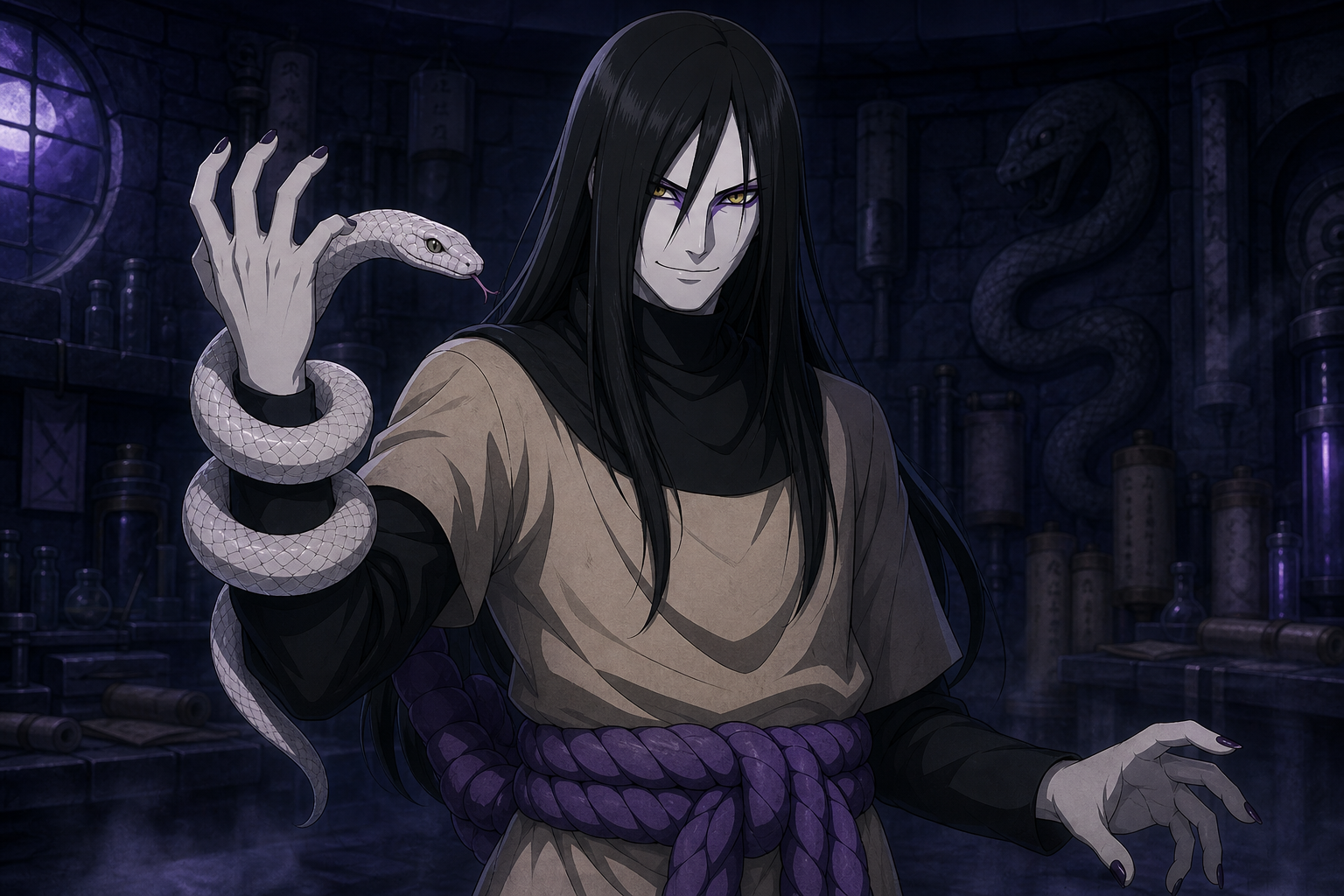
Bottom line: curiosity without consent becomes extraction
Orochimaru is brilliant. That brilliance becomes the problem before becoming the appeal.
He looks at death and sees a technical limitation. He looks at a forbidden technique and sees unfinished research. He looks at another person’s rare body and sees storage space for knowledge he wants. Intelligence gives him options. Fear of limitation gives him motive. A missing ethical boundary turns villagers, prisoners, students, hosts, sacrifices and children into equipment.
Later cooperation does not make the earlier bodies disappear.
Orochimaru helps Sasuke question the former Hokage. He contributes during the Fourth Shinobi World War. He raises Mitsuki. He works under surveillance instead of running another open invasion. Those choices matter because conduct matters. They do not travel backward and obtain consent from Anko, Sasuke, Yamato or the people who never received enough page space for the story to give them names.
That is the useful version of Orochimaru’s profile. He is not a redeemed science parent because Boruto-era comedy finds him entertaining. He is not a one-note monster whose research produced nothing. He is a gifted shinobi who made bodily autonomy somebody else’s inconvenience, then survived long enough to become useful to the state that once tried to stop him.
The nastiest question is not whether Orochimaru changed.
The nastiest question asks how much change a village demands once the village wants the research.
Orochimaru fast facts
- Name: Orochimaru, 大蛇丸
- Birthday: October 27
- Blood type: B in the databook record
- Original-body age: 50 to 51 during Part I and 54 during Part II
- Original-body height and weight: 179.4 centimeters and 63.9 kilograms in the First Databook record
- Registration number: 002300 in the databook record
- Original affiliation: Konohagakure
- Later affiliation: missing-nin, Akatsuki member and founder of Otogakure
- Team: Hiruzen Sarutobi‘s students with Jiraiya and Tsunade
- Title: one of the Three Great Shinobi of Konoha, usually called the Legendary Sannin
- Academy graduation: age 6 in the databook record
- Chūnin promotion: no confirmed age supplied in the controlling record used here
- Birthday-page favorite food: eggs
- Databook hobby: creating techniques
- Databook favorite words: destruction and chaos
- Formal manga debut convention: Chapter 45 while disguised as Shiore, with the named confrontation following later
- Anime debut convention: Episode 27
- Original Japanese performer: Kujira
Those measurements need a warning label because Orochimaru changes bodies. A host’s height and weight do not become a clean biological growth chart for the consciousness using the body. Reference sites often line up multiple measurements as though Orochimaru went through an ordinary adult growth spurt. No. The body is part of the plot.
The official Naruto birthday retrospective confirms October 27 and traces the life record through Hiruzen, the Sannin, human experimentation, Akatsuki, Otogakure, Sasuke, repeated returns and the war. Databook values fill the conventional profile box. When a public official page does not expose a value, this profile does not promote a fan-maintained number into holy text.
The Third Databook credits Orochimaru with 1,468 completed Konoha missions: 16 D-rank, 332 C-rank, 521 B-rank, 491 A-rank and 108 S-rank. That is a career, not a spooky-lab montage. The record explains why Hiruzen and the village valued him before the crimes became undeniable.
The same databook rates ninjutsu 5, taijutsu 3.5, genjutsu 5, intelligence 5, strength 3.5, speed 4.5, stamina 3.5 and hand seals 5, totaling 35 out of 40. Those numbers describe breadth at the point of publication. They do not prove that Orochimaru wins every matchup, knows every technique or keeps identical physical capacity across damaged and replacement bodies.
The name brings an older snake story into Naruto
Orochimaru’s name comes through the Japanese popular tale commonly translated as The Tale of the Gallant Jiraiya. That older tradition links Jiraiya with toads, Tsunade with slugs and Orochimaru with snakes. Masashi Kishimoto inherits the triangle and rebuilds the relationship inside a world of villages, war economies, teachers, forbidden research and inherited violence.
The folklore connection explains the creative shelf. Folklore does not decide the character’s morality for him.
Snakes carry several useful associations in Orochimaru’s design: shedding, renewal, poison, hidden movement, appetite and a body that seems continuous after the skin changes. The series turns those associations into mechanics. Orochimaru sheds damaged forms, extends his body, summons snakes, survives through stored material and treats identity as something that can move between containers.
The symbol is doing real work. The symbol is not an excuse.
His face stays recognizable while the body becomes unstable
The familiar Orochimaru has long black hair, pale skin, gold eyes with vertical pupils and purple markings extending around the eyes. The beige tunic, black underlayer and thick purple rope belt make the silhouette readable even before a snake enters the frame.
That recognizable face creates a deliberate contradiction. Orochimaru speaks as one continuous person while the biological body underneath the face can belong to somebody else. The visual continuity comforts the audience. The story underneath should not.
Childhood material presents a gifted, watchful Konoha student. War-era material places him beside Jiraiya and Tsunade as a celebrated shinobi. Akatsuki clothing, Sound disguises, host bodies, the white-snake true form, damaged arms, war restoration and New Era presentation create different stages of the same self-authored legend.
His presentation can be masculine, feminine or deliberately difficult to place depending on body and scene. The main story generally refers to Orochimaru with masculine language. Boruto-era conversations also make the father-or-mother question part of Mitsuki’s family context. Precision matters more than forcing a modern label the text does not settle.
Gender is not the horror. Theft of bodily autonomy is the horror.
The body-host chronology cannot be reduced to costume changes
The Forest of Death appearance begins behind Shiore’s stolen identity. Orochimaru removes the Grass ninja’s face and uses the disguise to enter an exam full of children. That disguise is not automatically a completed Living Corpse Reincarnation. Face theft, transformation and full soul transfer are different violations and need different labels.
The familiar face later peels away to expose the female host whose body carries Orochimaru during the Konoha Crush era. The series deliberately leaves the victim’s biography thin. Lack of a name does not turn the host into an outfit.
When the sealed arms and deteriorating body make waiting impossible, prisoners are forced into a selection process. Gen’yūmaru becomes the next host because Sasuke has not arrived in time. Orochimaru then wears the familiar face over another stolen life while preparing to replace that body with Sasuke’s.
Sasuke reverses the transfer attempt and absorbs him. Itachi later seals the portion that emerges. During the war, Sasuke restores Orochimaru from Anko’s curse mark with Kabuto-derived material. Orochimaru regains sealed spiritual access through the Reaper Death Seal ritual and takes a White Zetsu body.
That sequence matters because “Orochimaru came back” hides the labor. Every return has material, timing, technique and another body underneath.
Hiruzen recognizes a genius before he recognizes a danger
Orochimaru trains under Hiruzen Sarutobi with Jiraiya and Tsunade. The official birthday retrospective describes Hiruzen seeing enough talent to hope the child might inherit his will and strength.
That hope is understandable. Orochimaru learns quickly, observes deeply and treats ninjutsu as a system whose principles can be studied rather than a bag of family tricks. He becomes the kind of student who makes a teacher imagine history moving forward through him.
Hiruzen also sees the emotional coldness and ambition that later block Orochimaru from becoming Fourth Hokage. Recognition arrives. Intervention arrives too late.
The teacher’s failure matters, but fandom sometimes uses Hiruzen as an accountability dumpster. Hiruzen favored him. Hiruzen hesitated when he discovered the laboratory. Hiruzen helped create an institution where extraordinary talent received extraordinary patience. None of that moved Orochimaru’s hands during an experiment.
Institutional failure and personal authorship can exist in the same file.
His parents’ death becomes a question he refuses to leave unanswered
The story connects Orochimaru’s early interest in rebirth to losing his parents and encountering the image of a white snake. The white snake is discussed as a sign associated with rebirth and good fortune. Later adaptation material gives the memory more screen time than the core manga record.
The safe conclusion is not “grief made him evil.” Plenty of children in Naruto bury family without building laboratories full of stolen bodies.
The important point is how Orochimaru responds to impermanence. Death does not become a condition to grieve and live around. Death becomes an insult to solve. One lifetime cannot contain every jutsu, so the lifetime must be extended. One body decays, so another body must become available.
Fear becomes theory. Theory becomes procedure. Procedure needs subjects.
That chain is where private grief turns into public danger.
The Sannin title celebrates survival, not healing
Orochimaru, Jiraiya and Tsunade fight Hanzō in Amegakure and survive. Hanzō names them the Three Great Shinobi of Konoha. English materials commonly call them the Legendary Sannin.
The official English birthday retrospective labels the encounter as occurring during the Third Great Ninja War, while the established manga timeline places the Hanzō encounter in the Second War. That translation inconsistency belongs in the source notes, not smuggled into a clean chronology.
All three return from war with different answers to mortality. Tsunade builds medical systems after unbearable loss. Jiraiya turns teaching, travel and prophecy into a reason to keep moving. Orochimaru tries to abolish the limit itself.
The trio is not a balanced poster where slug, toad and snake receive matching moral arcs. They are three war survivors whose abilities become famous before their wounds become policy.
Losing the Hokage seat does not create the experiments
When Konoha considers a Fourth Hokage, Orochimaru’s ideology becomes a reason to reject him despite his accomplishments. Minato receives the office.
The official retrospective suggests the rejection may have pushed Orochimaru farther into inhumane research. “May have” matters. Political disappointment can intensify resentment. Political disappointment cannot manufacture an entire ethics system from nothing.
Orochimaru wants authority, recognition and access. More than that, he wants time enough to learn every jutsu and the principles behind them. The lifespan of one body feels offensively small beside that ambition.
He does not respond by building a school, preserving archives or training a generation of independent researchers.
He builds a way to continue himself.
That choice tells us the project is not knowledge alone. The project is knowledge owned by Orochimaru forever.
Konoha’s laboratory turns citizens into material
Orochimaru experiments on fellow villagers and other human subjects. The official retrospective names First Hokage cell research, forbidden Reanimation Jutsu and the mounting cost in lives.
Yamato, then known as Tenzō, survives one Hashirama-cell experiment that kills the other infant subjects in the group. His Wood Release later becomes strategically valuable to Konoha. That usefulness does not make the experiment a success story. A surviving child is not a positive trial result.
Hiruzen eventually discovers the laboratory. His horror is real. His hesitation is also real. Orochimaru escapes because the teacher cannot immediately kill or contain the student he once imagined as an heir.
The moment is painfully human and politically disastrous.
Konoha benefits later from Yamato’s abilities, studies forbidden techniques and repeatedly uses knowledge born inside violent systems. The village does not become equivalent to Orochimaru. The village does inherit a duty to remember how its useful assets were made.
Anko is a person before she is a curse-mark file
Anko Mitarashi trains under Orochimaru and receives the Cursed Seal of Heaven. The official Orochimaru retrospective confirms the teacher relationship. Her later life confirms that surviving his attention does not mean escaping consequence.
The curse mark gives the user access to power while exposing the body to pain, corruption, transformation and control. Orochimaru treats survival as evidence of usefulness. Anko has to live with a mark tied to the missing-nin who abandoned her.
Anime material expands their training and separation. That expansion must stay labeled instead of being poured backward into every manga gap.
During the war, Anko’s curse mark becomes one component in Orochimaru’s restoration. Sasuke uses the stored material and Kabuto-derived flesh to bring him back. The mechanic is clever. The ethical image is ugly: a former student’s body still carries recoverable infrastructure for the teacher who marked her.
Anko is not a USB drive with anger issues.
She is a survivor whose body remains inside his continuity plan.
Akatsuki gives him another organization to use
Orochimaru joins Akatsuki after leaving Konoha. The official retrospective connects him to Kabuto’s defection, Sasori and an internal intelligence arrangement.
He also wants an Uchiha body. Itachi’s Sharingan represents a bloodline ability Orochimaru cannot reproduce through ordinary study. He attempts to take the younger man’s body and loses the encounter.
The loss establishes a limit before Sasuke enters the plan. Orochimaru can build a transfer technique. He cannot assume every will and every eye will submit.
He leaves Akatsuki and later constructs his own network. Fandom sometimes treats the departure as proof that he was too independent for the group. The less flattering reading works better: he wanted the organization’s resources until the relationship stopped serving his private collection.
Otogakure is a village-shaped research supply chain
Orochimaru founds the Village Hidden in the Sound and expands facilities across several lands. The official birthday retrospective says the laboratories support human experimentation on a larger scale.
The word village can make the project sound like nation-building. Otogakure operates far more like a distributed network of hideouts, recruited talent, prisoners, experiments and military cover.
Kimimaro’s devotion, the Sound Four’s service, Karin’s sensory value, Suigetsu’s body, Jūgo’s biology and Kabuto’s intelligence all become resources inside the network. Each person has a separate reason for arriving and a separate degree of agency. Loyalty does not make the power relationship healthy.
Orochimaru is good at finding people whose pain has made belonging urgent. He offers purpose, training and recognition. Then he attaches those gifts to a system that expects bodies to remain available.
That is recruitment with a bill.
The Chūnin Exams turn education into a hunting ground
Orochimaru enters the Chūnin Exams under a stolen disguise and targets Sasuke in the Forest of Death. The official retrospective describes the curse mark as a way to tether the boy forcibly to him.
Sasuke is a child inside an exam. Orochimaru is an adult teacher, criminal and body thief identifying a future host.
The curse mark exploits everything Sasuke already carries: massacre trauma, hunger for power, fear of being weaker than Itachi and frustration with the pace of ordinary training. Orochimaru does not invent the wound. He recognizes the wound and markets himself as the answer.
That distinction is why “Sasuke chose him” cannot close the ethics file. Sasuke makes choices. Orochimaru engineers the available choice around coercion, secrecy and promised power while withholding the intended cost.
The Konoha Crush weaponizes institutions and corpses
Orochimaru murders the Fourth Kazekage and uses the Kazekage’s identity to coordinate the invasion of Konoha. Sound and Sand forces become labor inside a private revenge and destabilization plan.
He confronts Hiruzen and uses Reanimation Jutsu to return Hashirama and Tobirama as controlled weapons. The technique turns dead leaders into forced labor and living sacrifices into containers. Zaku and Kin, Sound genin used during the exams, pay the hidden bodily cost of the summons.
Hiruzen uses the Reaper Death Seal. He cannot take Orochimaru’s whole soul, but he seals the revived Hokage and the use of Orochimaru’s arms.
The teacher dies stopping the student he once spared.
Orochimaru shows emotion during the fight. Tears are not acquittal. Feeling grief while continuing the attack proves emotional capacity, not moral innocence.
Tsunade refuses to turn grief into payment
With his arms spiritually damaged, Orochimaru approaches Tsunade for healing. He offers to restore Dan and Nawaki, the people whose deaths shattered her life.
The offer is cruel because Orochimaru understands exactly what grief makes imaginable. He does not merely request medical care. He tries to purchase treatment with the dead.
Tsunade considers the impossible bargain, then refuses to become the medical worker who restores his capacity to attack Konoha. Her choice is not cold professionalism. Her choice is grief refusing to become somebody else’s leash.
Kabuto fights beside Orochimaru. Naruto, Jiraiya and Shizune become part of the confrontation. The three Sannin reunite without the story pretending reunion means reconciliation.
Sasuke receives real training inside a possession plan
Sasuke leaves Konoha and spends roughly three years training under Orochimaru. The official retrospective states that Orochimaru delivers on the promise of power while preparing to take the young Uchiha’s body.
Both facts matter.
Sasuke becomes faster, more controlled and more dangerous. Orochimaru is a capable teacher with a vast technical library. Training quality does not cancel grooming for possession. A chef can make dinner and still plan to eat the guest.
Orochimaru’s current host deteriorates. Sasuke chooses the moment of weakness and attacks. When Orochimaru initiates the transfer ritual, Sasuke’s Sharingan and will reverse the expected power relationship. Sasuke absorbs him.
The intended container becomes the person who contains the thief.
That reversal is satisfying because the mechanics carry the ethics. Orochimaru assumes superior knowledge guarantees ownership. Sasuke proves the host has a will.
Kabuto becomes the mirror Orochimaru did not request
Kabuto serves as medic, spy, recruiter, assistant and interpreter of Orochimaru’s system. He also has an identity history that existed before the laboratory.
After Orochimaru’s apparent defeat, Kabuto incorporates his biological material and begins accumulating bloodlines, techniques and borrowed identities. The imitation becomes so extensive that Kabuto’s own self nearly disappears inside the collection.
Orochimaru later looks at Kabuto’s failure and becomes curious about Sasuke’s different path. The official retrospective treats that contrast as part of his war-era shift.
That observation is not repentance. The observation begins an intellectual correction. Orochimaru finally sees a version of his own method reaching a dead end in somebody else.
Itachi seals the return Sasuke could not fully prevent
Orochimaru remains inside Sasuke after absorption. During Sasuke’s fight with Itachi, exhaustion gives the stored presence an opening. Orochimaru emerges in a many-headed snake form.
Itachi is prepared. Susanoo’s Totsuka Blade seals Orochimaru.
The sequence reinforces the limit already established in Akatsuki. Uchiha power is not passive inventory waiting for the collector. Orochimaru’s desire for those eyes repeatedly places him against people capable of attacking the transfer itself.
His survival strategy is powerful because material remains distributed. The same distribution makes identity dependent on marks, hosts and stored fragments. Immortality is less a clean unbroken life than a network of backups built inside other bodies.
Sasuke restores him because the dead still hold political evidence
During the Fourth Shinobi World War, Sasuke restores Orochimaru using Anko’s curse mark and material taken from Kabuto. Orochimaru then uses a Reaper Death Seal mask to release what had been sealed and restores the former Hokage through Edo Tensei.
Sasuke wants answers about Konoha, the Uchiha, the village and what a shinobi system deserves. Orochimaru becomes useful because he can open a room history tried to lock.
He follows Sasuke’s decision rather than claiming personal investment in the war. He later assists the Allied side and helps save the Five Kage with Karin, Suigetsu and Katsuyu involved in the rescue chain.
Useful conduct is still useful.
The war does not conduct a trial. Cooperation does not create a receipt saying paid in full.
Living Corpse Reincarnation makes immortality somebody else’s eviction
Orochimaru’s body-transfer technique moves his consciousness into a host. The host is not a suit hanging in an empty closet. Another person has to lose control of the body.
The technique has conditions and limits. A host deteriorates. Transfer cannot be performed casually every afternoon. Orochimaru’s failing host and the delayed attempt to acquire Sasuke prove that timing constrains the plan. Strong resistance can reverse the ritual, as Sasuke demonstrates.
Orochimaru also alters his body beyond ordinary human structure. He sheds damaged outer forms, extends his neck and limbs, survives injuries through replacement and reveals a white-snake composition beneath the familiar face.
Fandom calls that immortality because death keeps failing to stay final. The more precise description is persistent continuity through stolen or stored biology.
The mind survives because other bodies pay rent.
Snakes are partners, weapons, shelter, transport and threat
Orochimaru summons snakes through a formula on his left wrist. The original TV Tokyo character material verifies the summoning relationship.
Snake techniques support capture, movement, attack, body extension and concealment. The Kusanagi sword adds a weapon that can extend and move in ways ordinary swordsmanship cannot. Shedding techniques turn apparent fatal damage into discarded skin.
Manda is not a cuddly mascot. The summon demands compensation and resents control. Orochimaru’s summoning ecosystem reflects his broader relationship style: secure power through bargains, leverage or intimidation, then call the result loyalty.
The arsenal is wide, but “knows every jutsu” remains false. Mastering all jutsu is the goal that drives the project. Desire is not completion evidence.
Named snake and body techniques need separate mechanics
Hidden Shadow Snake Hands sends snakes from the sleeve or arm to capture, bite or restrain. Larger variants increase reach and volume. Formation of Ten Thousand Snakes floods the field with bodies and blades, turning one caster into an area-control threat rather than a single-target striker.
Soft Physique Modification lets Orochimaru stretch and twist beyond ordinary joints. Neck and tongue extension create attack angles that look impossible because the body has already stopped obeying normal anatomy.
Orochimaru-Style Body Replacement sheds a damaged outer body through the mouth and emerges restored. The technique can escape catastrophic-looking injury, but repeated replacement consumes chakra. Regeneration is not free immortality.
The Eight Branches Technique reveals a gigantic eight-headed white serpent form during the Itachi battle. The spectacle represents accumulated snake transformation and stored survival. Susanoo’s Totsuka Blade still seals the form. Bigger mythology does not cancel a direct spiritual counter.
Defense, sword work and conventional ninjutsu prove he was elite first
Orochimaru summons Rashomon gates as physical defense. Against four-tailed Naruto, three gates absorb and redirect part of the destructive force while still failing to make the attack harmless. The scene gives the technique a real limit instead of treating a summoned wall as invulnerability.
Kusanagi can emerge from the mouth, extend and move under control. Orochimaru combines the sword with abnormal reach and snake movement, so ordinary distance becomes unreliable.
Wind Release: Great Breakthrough establishes large-area wind force early. Earth movement and concealment support infiltration. Fire techniques, barriers, sealing, summoning and transformation broaden the working shelf across manga and databook records. A full nature list belongs only where the databook page confirms each affinity.
The official Naruto merchandise interview identifies multiple recognizable faces as central to Orochimaru’s identity and highlights Rashomon as a defining visual motif. Merchandise is not a battle guide, but the production note confirms that body ambiguity and layered defense are deliberate franchise-recognition cues.
Cursed seals convert Jūgo’s biology into controlled distribution
Orochimaru studies Jūgo’s unusual ability and builds cursed-seal systems that distribute senjutsu-related power through marks. The marks can increase strength and transform the body. They also cause pain, threaten survival and create dependency.
Most recipients do not survive or remain unchanged. Survival also does not prove consent. Different marks, bodies and stages produce different outcomes, so one neat fandom statistic cannot govern every cursed-seal case.
Anko, Sasuke, Kimimaro and the Sound Four do not receive interchangeable products or identical outcomes. A complete profile explains each mark where relevant instead of treating everybody as a sample row in Orochimaru’s spreadsheet.
Research skill is real. Consent remains missing.
Edo Tensei is a labor system built from corpses
Tobirama invents Reanimation Jutsu. Orochimaru studies and uses a version. Kabuto later expands control and battlefield scale.
Credit and blame need that chain.
The technique requires a living sacrifice as the material body for a dead person’s return. Control suppresses the revived person’s autonomy. Memories and personality can remain present while the body is forced to act.
The Konoha Crush uses dead Hokage as weapons against their student and village. The war-era use allows Sasuke to question the Hokage before they enter battle with more agency than Orochimaru’s earlier version permitted.
Improved control does not change the foundation. Edo Tensei makes death reversible by making bodies replaceable.
That is Orochimaru’s worldview in one technique.
His limits are technical, bodily and relational
Orochimaru has broad elemental knowledge, summoning, sealing, barriers, sword skill, infiltration, disguise, medical/scientific expertise and enormous survival capacity.
He still has limits.
Hosts deteriorate. Transfer timing matters. Hiruzen seals his arms. Tsunade refuses treatment. Sasuke resists possession. Itachi seals an emergence. A strong opponent can attack the soul, the ritual or the stored fragment rather than playing whack-a-snake with the latest body.
His relational limits may matter more. He understands desire well enough to recruit people but often misunderstands autonomy. He can predict what Sasuke wants and still fail to predict that Sasuke will refuse being owned. He can create Mitsuki and still has to build a test around whether the child can choose independently.
Knowledge about people is not the same as respect for people.
Mitsuki turns creation into a parenthood test
Official Naruto material describes Mitsuki as a clone Orochimaru creates through genetic engineering and raises. TV Tokyo’s Boruto material calls Mitsuki Orochimaru’s son.
The family language matters. So does the laboratory language.
Mitsuki and Log emerge from a program involving repeated attempts, memory management and a staged conflict designed to push Mitsuki toward an independent decision. In The Path Lit by the Full Moon, Mitsuki refuses the simple choice offered by Orochimaru and Log, takes the material connected to his origin and chooses his own direction.
Orochimaru appears pleased that the child can step outside the script.
That is meaningful later conduct. The method remains disturbing parenting. Manufacturing a crisis and altering memory is not Montessori with snakes.
The ethical test is not whether Orochimaru produced an impressive child. The test is whether he can accept that Mitsuki’s life belongs to Mitsuki.
Log proves a clone is not a spare part
Log shares a biological connection to Mitsuki and a history inside Orochimaru’s project. Calling either person a clone does not make the individual disposable.
Orochimaru’s earlier immortality system treats bodies as replaceable containers for one continuing self. Mitsuki and Log create the opposite possibility: similar genetic material can produce separate people with separate memory, loyalty and choice.
That difference is the philosophical pressure point in his New Era life.
If Orochimaru learns anything, the lesson cannot be “I found a better body.” The lesson has to be that continuity does not require possession and creation does not grant ownership.
Postwar surveillance exposes the village’s convenient morality
After the war, Orochimaru remains alive, researches and sometimes cooperates with Naruto and Sasuke. Yamato monitors him in New Era material.
The exact legal arrangement needs careful language. The story shows surveillance and restricted tolerance more clearly than a public trial, sentence or complete pardon.
Konoha has practical reasons to keep him observable. He knows forbidden techniques, hidden laboratories, genetic systems and threats other people cannot easily analyze. Killing him may destroy knowledge or trigger another return. Allowing unrestricted work would be absurd.
The compromise is politically useful and morally uncomfortable.
Villages in Naruto repeatedly condemn rogue violence while absorbing useful outcomes from the same systems. Orochimaru becomes the cleanest case because nobody can plausibly forget what he did. The comedy of Yamato watching him works only because the underlying arrangement is ridiculous.
Gender is not a punch line and bodies are not costumes
Orochimaru’s body history complicates ordinary sex and gender categories. Host bodies vary. Presentation shifts. The familiar identity persists. Mitsuki treats the parent as a parent even when “father” or “mother” becomes uncertain.
The correct response is precision, not a joke.
Use Orochimaru’s name. Use the pronouns the official translation uses for the scene or era. State when the body belongs to a host. Do not decide that body transfer automatically makes Orochimaru transgender, nonbinary, genderfluid or “actually a woman” unless the text makes that self-identification.
Those identities belong to real people. They are not fandom decorations for supernatural body theft.
The ethical issue remains consent and ownership. A female host is not scary because femininity contaminated a male villain. The host is a victim because her body was taken.
Relationship atlas: knowledge moves through people and leaves scars
Hiruzen Sarutobi
Hiruzen is teacher, admirer, failed early boundary and final opponent. His love explains hesitation. Love does not excuse the hesitation. Orochimaru’s betrayal does not prove the teaching relationship was fake.
Jiraiya
Jiraiya is teammate, pursuer and ideological mirror. Jiraiya cannot bring Orochimaru home. That failure later shapes how Naruto understands Sasuke. Friendship creates duty without granting control.
Tsunade
Tsunade is teammate, medical counterpoint and person whose grief Orochimaru tries to weaponize. She builds care systems. He builds continuity for himself. Their war cooperation does not erase the bargain involving Dan and Nawaki.
Anko Mitarashi
Anko is student, marked survivor and later involuntary component in his return. Any profile that discusses her only as a curse-mark source has learned Orochimaru’s worst habit.
Kabuto Yakushi
Kabuto is recruit, spy, medic, assistant, imitator and independent author of later crimes. Orochimaru shapes the environment in which identity accumulation becomes attractive. Kabuto still makes choices.
Sasuke Uchiha
Sasuke is talented student, recruited minor, intended host, defeater and later reviver. Training and coercion coexist. Sasuke’s agency grows when he uses Orochimaru’s knowledge without surrendering his body or final decision.
Kimimaro and the Sound Four
They bring devotion, rare bodies and combat labor. Orochimaru gives recognition and purpose while accepting sacrifice as usable. Loyalty does not make disposability loving.
Karin, Suigetsu and Jūgo
Each becomes valuable through a body or ability Orochimaru studies. Each later acts beyond the role his facilities assigned.
Mitsuki and Log
They are created people, not proof of rehabilitation. Their freedom matters because Orochimaru’s earlier life is built around denying that freedom.
The unnamed victims
The missing names are part of the crime. Experiments do not become less personal because the manga lacks room for fifty biographies.
Kujira gives the original Japanese Orochimaru a stable identity
The official Naruto anime page credits Kujira as Orochimaru in the original Japanese production.
That verified credit belongs in the profile. Unsupported claims about pitch, breath, seduction, gender coding or vocal transformation do not.
Performance analysis needs heard scenes. Useful future checkpoints include the Forest of Death reveal, Hiruzen confrontation, Tsunade bargain, Sasuke transfer attempt, war return and Mitsuki-era parent scenes. Those moments ask the performer to carry menace, amusement, injury, intellectual appetite, familiarity and later restraint.
Until the Japanese audio is observed under controlled conditions, the profile stops at credit and narrative context. Fake close listening is still fake.
Manga, anime, novels, films, OVAs and games
The manga supplies the core record: Chūnin Exams, Konoha Crush, Search for Tsunade, Sasuke’s departure/training, Tenchi Bridge reunion, absorption, Itachi sealing, war return, Hokage restoration, Team Seven support and the later Mitsuki/parenthood shelf.
The Naruto and Shippuden anime adapt that record and add childhood, Anko, laboratory, comedy and mission material. Each addition needs an anime-only label when the manga does not support the event.
Boruto manga and anime material expand Orochimaru’s surveillance status, Mitsuki, Log and laboratory family context. Anime episodes can add everyday parenting or comic appearances without automatically becoming evidence for manga policy.
Films and OVAs often use cameos, flashbacks or alternate histories. Road to Ninja is an alternate-world project, not a replacement biography. Games such as the Ultimate Ninja and Ultimate Ninja Storm series make Orochimaru playable and expand move sets. A licensed combo is still not a manga feat.
Fandom arguments that need the laboratory lights turned on
“Orochimaru is redeemed because he is a good parent now.”
Mitsuki provides evidence of later care and a willingness to observe independent choice. The same project includes cloning, memory management and staged crisis. Growth is possible. Redemption requires more than producing a beloved child.
“Hiruzen caused everything by being a bad teacher.”
Hiruzen’s favoritism, hesitation and institutional failures matter. Orochimaru conducted the experiments. Explanation is not a transfer seal for blame.
“Sasuke chose Orochimaru, so there was no grooming.”
Sasuke chose to leave under pressure created by trauma, promised power and a curse mark. Orochimaru intended to steal his body. A minor’s decision does not legalize the adult’s hidden plan.
“The science was worth the cost because Yamato survived.”
Dead infants do not become acceptable because one subject later helps save people. Yamato’s life has value independent of the experiment’s research yield.
“Orochimaru is harmless in Boruto.”
Surveillance exists for a reason. Reduced visible violence is welcome. Harmless is a claim the record has not earned.
“Body switching means gender does not matter.”
Gender still matters to the people whose bodies and identities exist. Orochimaru’s supernatural continuity does not make everybody else’s embodiment disposable.
“Orochimaru knows every jutsu.”
He wants to. Ambition is not an achievement badge.
Confucian teacher duty breaks across generations
A Confucian lens treats teaching as a relationship with continuing moral duty. Hiruzen transmits knowledge and expects will. Orochimaru receives technique without accepting reciprocal responsibility to village or teacher.
Orochimaru then repeats a distorted chain with Anko and Sasuke. He teaches real skills while making the student’s body answerable to his private project.
Mitsuki creates a possible correction. If the child can leave, choose friends, reject the script and remain a son, then transmission no longer requires possession.
The question is whether Orochimaru accepts reciprocity or merely enjoys watching an interesting experiment.
Buddhist impermanence is the limit he refuses
Orochimaru cannot accept that one body ends before one mind knows everything. Impermanence becomes the enemy.
The attempted solution produces deeper attachment. He clings to continuity, knowledge, identity and possibility so fiercely that other people become containers for the self he refuses to release.
Buddhist non-attachment does not require ignorance or passive death. The contrast is possession. Knowledge can pass through teaching, books, institutions and students. Orochimaru initially rejects those forms because they allow the knowledge to continue without guaranteeing that Orochimaru remains the owner.
Mitsuki again becomes the test. A created child can carry knowledge forward without being a replacement body.
The shinobi state prefers accountability until expertise becomes useful
Konoha condemns Orochimaru, fights him and loses people to his invasion. Later, the village benefits from Yamato, uses information tied to his networks, accepts his help during war and tolerates research under surveillance.
That arrangement does not prove secret forgiveness. The arrangement proves states make bargains.
The industry layer works the same way. Orochimaru is marketable. The horror design sells figures. The strange-parent comedy makes sequel episodes memorable. Nostalgia encourages audiences to remember the tongue, laugh and theme music before remembering the unnamed subjects.
CVM Sekai is not confiscating the fun.
We are keeping the receipt beside the fun.
Final verdict: knowledge has to survive without owning the person
Orochimaru begins with a reasonable terror. One life is short. Knowledge is enormous. Death interrupts work.
Then he makes the worst possible conclusion: if the body is temporary, somebody else’s body can become his.
Everything follows from that theft. Laboratories. Curse marks. hosts. sacrifices. Sasuke. Anko. Sound. Reanimation. Backup fragments hidden in survivors.
His later life introduces another answer.
Teach. Observe. Cooperate. Create a child and allow the child to leave. Let knowledge continue in a person who does not belong to you.
Orochimaru has not earned a clean redemption ribbon. The victims do not vanish because the snake learned domestic comedy.
He has, however, reached the only question that could make continued life mean something.
Can he watch another person become more than his design without trying to climb inside?
That is harder than immortality.
Receipts and canon boundaries
- The official Naruto site’s Orochimaru birthday retrospective anchors Hiruzen’s student record, Anko, the Sannin title, Hokage rejection, human experimentation, immortality project, Akatsuki, Otogakure, Sasuke, repeated returns, war-era curiosity and postwar cooperation: https://naruto-official.com/en/news/01_1629
- The official Mitsuki birthday retrospective confirms Mitsuki as a clone created by Orochimaru through genetic engineering and supplies Boruto manga chapter references: https://naruto-official.com/en/news/01_1860
- The official Naruto anime page credits Kujira as Orochimaru in the original Japanese cast: https://naruto-official.com/en/anime/naruto1
- TV Tokyo’s original-series Sound Village page anchors the anime-era village, Chūnin Exams target and snake-summoning formula: https://www.tv-tokyo.co.jp/anime/naruto2002/chara/chara_oto2.html
- VIZ’s official Naruto catalog controls licensed chapter access and English wording: https://www.viz.com/shonenjump/chapters/naruto
Main-manga facts, anime expansions, Boruto-era material, databook values and RaeRae interpretation remain separate throughout this profile. A body-transfer statistic, game move or adaptation-only memory does not enter the core record merely because a reference site lists the material on one page.