
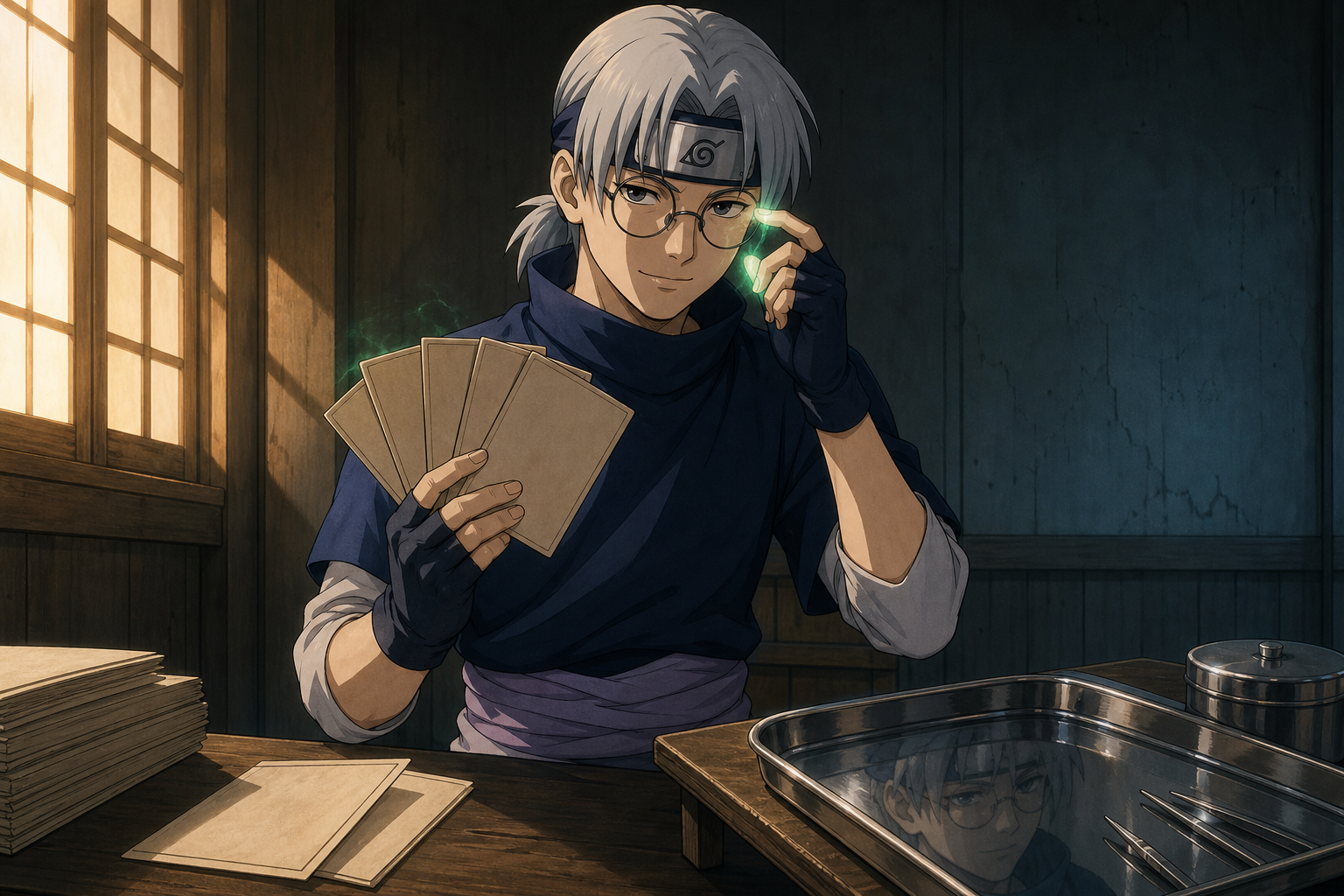
Kabuto Yakushi
A child without a remembered name is taught to survive by becoming whatever an intelligence service needs. His tragedy is not emptiness. It is being rewarded for assembling a self from usefulness, disguise, and somebody else’s body.
The essential file
Kabuto is what happens when care is made conditional on service: a brilliant healer and spy who keeps borrowing identities until power can no longer answer the simplest question,who are you when nobody is giving the assignment?
| Name | Kabuto Yakushi, 薬師カブト |
|---|---|
| Birthday | February 29 |
| Age | 19 to 20 in Part I; 23 to 24 in Part II |
| Height | 176.2 cm in Part I; 177 cm in Part II |
| Weight | 65 kg in Part I |
| Blood type | AB |
| Known affiliations | Konoha Orphanage, Root, Konohagakure, Otogakure, Orochimaru, and briefly Sasori’s intelligence network |
| Childhood caregiver | Nonō Yakushi |
| Primary specialties | Medical ninjutsu, espionage, anatomy, body modification, senjutsu, and Impure World Reincarnation |
| Part I cover | Konohagakure genin and repeated Chūnin Exam candidate |
| Later state | Dragon Sage and director of the Konoha Orphanage |
| Manga debut | Chapter 39 |
| Anime debut | Episode 23 of Naruto |
| Japanese performers | Nobutoshi Canna; Mariko Mizuno as a child |
| Status | Alive in the New Era |
The nameless child given glasses and a place
Konoha shinobi find an injured boy after battle with no clear memory of his identity. Nonō Yakushi, former Root operative and director of an orphanage, heals him. When he struggles to see a clock, she gives him her glasses. The object becomes his first stable way of seeing and being seen.
Nonō names him Kabuto and the orphanage gives him routine, siblings and work. His medical talent develops inside care. That beginning matters because later crimes do not prove care was false. They prove systems can exploit a person’s gratitude for having once been saved.
Danzō threatens the orphanage’s funding and children unless Nonō returns to espionage and Kabuto joins Root. Institutional charity becomes leverage. The home that created identity is used to extract the child from it.
Root erases recognition before ordering murder
Kabuto travels through villages as a long-term infiltrator, changing names, allegiances and behavior. Root sends Nonō altered photographs over time so she will gradually stop recognizing him. It then arranges for them to meet as enemies.
Kabuto fatally wounds Nonō and rushes to heal her. She asks who he is. The question destroys him because her recognition anchored every disguise. Root has manufactured the moment in which his mother’s dying eyes confirm his fear that no self exists beneath assignments.
Orochimaru appears, explains the manipulation and offers Kabuto a place where identities can be studied, collected and remade. The offer resembles rescue because it names the injury accurately. It is also recruitment by another adult who sees the child’s wound as strategic opportunity.
Orochimaru’s assistant, and the spy watching his master
Kabuto becomes Orochimaru’s medical specialist, researcher, infiltrator and operational right hand. He heals damaged bodies, prepares experiments, manages hideouts and enters Konoha under a genin identity.
His loyalty is genuinely difficult to read because ambiguity is his craft. He serves Orochimaru, reports at times to Sasori’s control network and retains independent curiosity. Orochimaru values that uncertainty; a subordinate capable of betrayal is more interesting and useful than a mindless servant.
Unlike many followers, Kabuto understands that Orochimaru intends to take other bodies. He admires a model of identity based on acquisition: if the self feels empty, perhaps enough techniques, cells and knowledge can fill it.
Chūnin Exams: the helpful senior is gathering a database
Kabuto presents himself as an experienced but unthreatening genin who has repeatedly failed the exams. His Ninja Info Cards display detailed data about participants, making him useful to Naruto’s group while quietly revealing the reach of his intelligence work.
He withdraws before the finals and later assists the invasion. The performance works because he makes competence look noncompetitive. People disclose themselves around someone who appears to have accepted a lower position.
His confrontation with Kakashi at the hospital shows an entirely different level of speed and disguise. The gap between persona and ability is the character’s central method.
Tsunade and Naruto: medical knowledge without a moral direction
After Hiruzen seals Orochimaru’s arms, Kabuto accompanies him to recruit Tsunade. Kabuto fights her using chakra scalpels, anatomical precision and rapid adaptation after she scrambles his nervous system.
He deliberately cuts himself to exploit her fear of blood. Medical intelligence becomes psychological violence. The same knowledge that can restore function can identify where a person is easiest to break.
Naruto catches Kabuto’s blade through his own hand and lands the Rasengan. Kabuto survives through advanced healing, but the encounter confronts him with a less elegant identity: a boy whose self is built through bonds and repeated declarations rather than perfect disguise.
The Chūnin Exams put three Kabutos on the same page
The friendly senior, the Sound operative, and the independent observer all occupy the same exam. Kabuto approaches Team 7 after the first confrontation with the Ame trio and offers his intelligence cards. He knows too much, appears patient with Naruto’s questions, and positions himself as a guide who has already endured the process several times.
When the written test reveals that covert information gathering is the actual skill being measured, Kabuto’s entire cover becomes a demonstration. He has been doing the advanced version for years. The exam room rewards stealing answers without being caught. Root built a childhood around that rule and removed the classroom boundary.
At the hospital, Kabuto moves toward Sasuke while Kakashi guards him. The scene exposes the physical ability hidden by the harmless-genin act. Kabuto escapes through misdirection and a corpse-based technique instead of committing to a fair fight. Fair fights are for people whose biographies can survive witnesses.
He later supports Orochimaru’s invasion logistics, uses medical knowledge around wounded Sound forces, and helps manage the collapse after Hiruzen seals Orochimaru’s arms. The Chūnin Exam does not introduce a late-blooming villain. It reveals that an adult intelligence professional has been sitting among children and grading them for a different employer.
The Search for Tsunade proves medicine has no automatic ethics
Orochimaru needs his arms restored after the Reaper Death Seal destroys their function. Kabuto accompanies him to recruit Tsunade and understands that her grief over Nawaki and Dan creates the opening. The offer to resurrect them weaponizes mourning while the threat to Konoha raises the cost of refusal.
When negotiation collapses, Kabuto fights as both medic and assassin. Tsunade disrupts his nervous system with Body Pathway Derangement, making his brain’s commands produce the wrong movements. Kabuto maps the mismatch under combat pressure and regains function. That is one of his cleanest intelligence feats because nothing is borrowed. He reads his own body like a damaged field report.
He then cuts himself because Tsunade’s hemophobia can be triggered by blood. The move is tactically smart and morally ugly. He knows the origin of her medical greatness, sees the trauma that limits it, and attacks the wound rather than the reputation. Medical literacy does not arrive with a tiny ethics committee attached.
Naruto’s Rasengan breaks through Kabuto’s plan. Kabuto anticipates damage and begins healing before impact, yet still goes down. The boy he dismissed has built persistence through relationships rather than perfect control. Kabuto survives, but the scene places two identity methods beside each other: Naruto declares himself until community answers, while Kabuto edits himself until nobody can answer.
From Orochimaru’s defeat to Obito’s war room
After Sasuke defeats and absorbs Orochimaru, Kabuto takes tissue from the remains and grafts it into his own body. The material begins spreading. He frames resistance as proof that he will surpass the master, even though the project makes Orochimaru the biological measure of success.
He studies the source of Jūgo’s natural-energy adaptation, reaches Ryūchi Cave, trains under the White Snake Sage, collects genetic material, improves the reincarnation technique, and assembles an army from dead shinobi. Black Zetsu’s involvement in providing Madara’s corpse belongs to the war conspiracy record, but Kabuto’s modifications to the revived Madara are his own research gamble.
His negotiation with Obito is classic Kabuto. He arrives offering force, demonstrates leverage through coffins, and keeps the Madara body as the threat that changes the room. Obito does not trust him. Kabuto does not need trust. He needs the other man to calculate that refusal costs more.
The alliance remains unstable because both men treat people as deployable assets. Obito wants the tailed beasts and Eye of the Moon Plan. Kabuto wants Sasuke, research access, battlefield results, and proof that his perfected technique places him beyond Orochimaru. Shared dehumanization is enough to sign the contract. It is not enough to make either partner safe.
After Orochimaru: grafting the master into the body
After Sasuke defeats Orochimaru, Kabuto implants Orochimaru’s remains into himself. The cells spread, threatening to consume him. Kabuto initially describes resistance as a way to surpass the master.
The experiment reveals the contradiction. He wants an identity beyond Orochimaru and attempts to achieve it by placing Orochimaru physically inside himself. Independence is imagined as successful assimilation of the person whose approval organized him.
He later incorporates abilities and biological material associated with the Sound Five, Karin, Jūgo, Suigetsu and others. His body becomes an archive of borrowed solutions.
Powers and transformations
Medical ninjutsu
Kabuto heals severe damage, understands anatomy and adapts bodily systems under pressure. His chakra control makes medicine, espionage and assassination continuous skills.
Chakra scalpel
He forms precise chakra blades that cut tissue and muscle without ordinary external wounds. Medical technique becomes close-range disabling force.
Dead Soul Technique
Kabuto temporarily animates corpses and uses them as decoys. The jutsu turns bodies into misdirection, foreshadowing his later war-scale necromancy.
Body modification
He integrates regenerative, sensory, liquefaction and other traits from multiple sources. Adaptation becomes literal identity assembly.
Snake Sage Mode
Training at Ryūchi Cave lets Kabuto absorb natural energy continuously through Jūgo-derived modifications. Horns, scales and serpentine features mark the state he calls a dragon.
White Rage and inorganic animation
Sage techniques overwhelm sight and hearing or animate the cave environment itself, making terrain part of Kabuto’s nervous system of control.
Impure World Reincarnation and war as an identity collection
Kabuto perfects Orochimaru’s Impure World Reincarnation and supplies the Allied war with resurrected shinobi. He uses living sacrifices as vessels, forces dead people into combat and attempts to control even Madara Uchiha.
The army is the logical endpoint of his identity philosophy. Bodies are containers, abilities are collectible and death does not protect a person from being reassigned. He becomes Root and Orochimaru at larger scale while believing accumulated mastery proves independence.
His alliance with Obito is mutual leverage. Kabuto reveals Madara’s coffin to secure cooperation, showing that information remains his oldest weapon even after his body becomes extraordinary.
Itachi, Sasuke and Izanami
Reincarnated Itachi and Sasuke confront Kabuto in Ryūchi Cave. Kabuto controls the environment, disables ordinary vision and explains that he has surpassed Orochimaru. Itachi cannot simply kill him because releasing the reincarnation requires Kabuto’s actions.
Itachi uses Izanami, trapping Kabuto in a sensory loop that repeats until he accepts himself and chooses a different action. The technique is thematically tailored: Kabuto has survived by changing masks whenever reality threatens the current one. The loop removes escape through another disguise.
Izanami raises ethical questions because coerced self-acceptance is still coercion. Within the story, however, it forces him to recognize that being Nonō’s child was not invalidated when she failed to recognize the altered adult. An identity can remain real without external confirmation at every moment.
Return to the orphanage
After escaping Izanami, Kabuto returns to the battlefield, heals Sasuke and helps prevent another death. Later he becomes director of the Konoha orphanage, caring for children including the many Shin Uchiha clones.
The circular ending is not absolution by job title. Kabuto participated in mass violation, war and experimentation. Caregiving does not erase accountability. It does place his skills back inside the kind of relationship from which they first emerged.
He becomes the adult Nonō tried to be before Root weaponized her position: someone who gives children names, treatment and a place without making service the price of belonging.
Relationship atlas
Kabuto ↔ Nonō
She names, heals and teaches him. Root engineers her failure to recognize him, but the relationship remains the emotional truth every later identity attempts to replace.
Kabuto ↔ Orochimaru
Orochimaru understands his wound and exploits it, offering freedom through endless transformation. Kabuto’s attempt to surpass him repeats his worldview inside the body.
Kabuto ↔ Danzō
Danzō turns orphanage care into leverage and identities into disposable covers. Kabuto’s methods remain marked by the institution he escapes.
Kabuto ↔ Itachi
Itachi defeats him through a technique that requires an internal decision rather than physical overpowering. Both men were shaped by systems demanding identity sacrifice.
Kabuto ↔ Sasuke
Sasuke first treats him as Orochimaru’s subordinate, later faces the transformed Sage and is finally healed by him. Their paths ask different versions of who remains after revenge.
Kabuto ↔ Tsunade
Both are medical prodigies. Tsunade builds systems to preserve persons; Kabuto repeatedly uses persons as systems to be modified.
Shinobi file: details worth keeping
- Glasses: Nonō’s gift becomes the most stable piece of his visual identity, retained through disguises and transformations.
- Name: “Yakushi” is associated with medicine and the healing Buddha, fitting both his gift and its moral contradiction.
- Info cards: he channels chakra into cards to reveal stored intelligence, turning knowledge into a collectible visual interface.
- Repeated exam attempts: apparent failure maintains his cover and grants access to new cohorts of targets.
- Dragon claim: after mastering snake Sage power, he insists he has become a dragon,an identity upgrade still defined by comparison.
- Healing Sasuke: the act demonstrates changed direction through the same medical expertise, not a magically different personality.
Appearance and design: the face survives every borrowed body
Kabuto’s Part I design is deliberately plain enough to pass through a crowd: ash-gray hair tied low, round glasses, dark clothes, fingerless gloves, and a Konoha forehead protector supporting a village identity he is already betraying. The glasses do the real visual work. Nonō gave them to a child who could not see the clock, so the object is both medical aid and the oldest piece of care he keeps wearing.
His Sound-era clothing shifts toward Orochimaru’s visual grammar with looser layers, a purple rope belt, and more obvious medical and laboratory associations. After grafting Orochimaru’s remains, pale tissue spreads across his body. Snake traits intensify until Sage Mode adds horn-like projections, eye markings, scales, a brille protecting the eyes, and a long serpentine lower body. He calls the result a dragon, but the design keeps exposing the parts list.
That is the joke hiding in the horror. Kabuto believes enough additions will make him singular. The audience can still identify Orochimaru, Jūgo, Karin, Suigetsu, the Sound Four, and Kimimaro in the finished body. His most customized form is also his least private.
Personality and ideology: useful is not the same as real
Kabuto is courteous, observant, patient, and very good at letting another person underestimate him. None of that requires a secret “true personality” waiting behind the smile. Espionage made selection itself into personality. He chooses the tone, posture, information, and degree of vulnerability that will produce the next opening.
He is also curious in a way that easily becomes invasive. Bodies are puzzles, bloodlines are resources, and private histories are files. Medicine gives him the skill to preserve a person. Root and Orochimaru teach him to separate the skill from consent. Once usefulness becomes the only stable measure of worth, another body can look like raw material for proving that he matters.
This is why his later power does not cure him. Mastery answers what he can do. It cannot answer what relationships he will protect when no superior is assigning value. That answer finally appears through caregiving, not another transformation.
The spy chronology matters because Kabuto was trained to disappear slowly
Root does not merely send Kabuto on one mission. It builds him into a long-term infiltrator able to enter several hidden villages, learn local behavior, and surrender one cover for another. The exact order of every unnamed assignment is less important than the method: prolonged immersion, medical usefulness, information capture, and controlled abandonment.
Nonō is forced back into the same system. Altered photographs gradually teach her the wrong adult face, turning memory into a weapon before the fatal meeting. Danzō’s operation does not gamble on ordinary confusion. It manufactures nonrecognition, then places mother and son where one will injure the other.
Orochimaru arrives at the psychological crime scene with the right explanation and the wrong solution. He tells Kabuto who manipulated him, gives his intelligence a new employer, and offers endless transformation as freedom. Knowing the truth about abuse does not make the next recruiter safe. Sometimes it just makes the recruitment pitch better targeted.
Ninja Info Cards turn surveillance into a friendly interface
The cards store intelligence through chakra and present data in a form other candidates can read. They list names, villages, mission histories, techniques, and observed strengths. Kabuto uses them to seem helpful while demonstrating how much private information has already been collected.
The scene teaches the Chūnin Exam’s real rule before the written test says it aloud: information is part of combat. Naruto sees collectible stats. Kabuto sees a room full of targets whose reactions can update the database. The cards are cute enough to merchandise and creepy enough to explain the profession.
His repeated exam failures are cover maintenance, not evidence that he cannot qualify. Remaining a genin keeps him among new cohorts and lowers adult suspicion. The village reads rank as identity. Kabuto uses that assumption as camouflage.
A complete medical and combat shelf
Medical ninjutsu and diagnosis
Kabuto has exceptional chakra control, surgical knowledge, diagnostic skill, and the ability to heal serious injury. Orochimaru compares his talent favorably with elite medical standards, but that does not make every medical feat equal to Tsunade’s full career, leadership, or village-scale system building. Skill comparison is not professional equivalence.
Chakra scalpel and anatomical attacks
His chakra scalpel cuts muscles and internal tissue without needing a conventional blade. It is precise, dangerous at close range, and tied directly to anatomy. Against Tsunade, he adapts after Body Pathway Derangement scrambles the electrical signals controlling his movement. He consciously relearns the mismatched body map fast enough to keep fighting, which is intelligence expressed through nerves, not a speech about genius.
Healing, regeneration, and their limits
Kabuto can pre-activate healing around an expected injury, as he does when preparing for Naruto’s Rasengan. Preparation reduces the damage; it does not make him immortal. Severe force still overwhelms him, sustained repair consumes chakra, and early Kabuto relies on knowledge and timing rather than an endlessly self-restoring body.
Dead Soul Technique
He briefly animates corpses and changes their appearance for deception. The technique is smaller than Impure World Reincarnation because it does not restore a soul or create a durable immortal soldier. The thematic line is already visible, though: a dead body becomes an assigned role.
Summoning, snakes, and Manda II
After taking in Orochimaru’s remains, Kabuto develops snake summons and biological modification on a larger scale. Manda II is a cloned, enhanced snake used during the war. Anime-only modified snake variants stay inside anime continuity. A laboratory product being powerful does not make it a naturally inherited summon contract.
Dragon Sage mechanics: natural energy plus a stolen laboratory
Kabuto reaches Ryūchi Cave and learns senjutsu from the White Snake Sage. Sage Mode boosts perception, physical ability, resilience, and technique power. His Jūgo-derived modification lets his body continually gather natural energy, helping him maintain the state without the same stillness problem associated with other Sage training.
White Rage Technique creates a bright, vibrating assault that overwhelms sight, hearing, and bodily balance. The brille over Kabuto’s eyes helps him function through the flash. Inorganic Reincarnation injects natural energy into nonliving material and makes the cave itself move. This is not ordinary Earth Release. It is environmental control through senjutsu.
Strange Transmission Distant Shadow lets him manifest abilities drawn from incorporated genetic material. The shelf includes traits associated with the Sound Four and Kimimaro, plus recovery and bodily adaptations taken from other test subjects. The exact ability still belongs to a source body before Kabuto repurposes it. Calling the collection “his powers” is mechanically convenient and morally incomplete.
His limits in the Uchiha fight matter. He prepares against visual genjutsu, controls the cave, regenerates, and cannot simply be killed because Itachi needs the reincarnation released. Even with those advantages, he cannot solve Izanami by adding another technique. The failure is structural: every escape route repeats the refusal to accept the current self.
Impure World Reincarnation is an army built from stolen endings
Kabuto refines the forbidden technique to resurrect many powerful shinobi close to their living strength. A living sacrifice becomes the vessel, a dead soul is bound into the body, and a control talisman can suppress choice. He often leaves personality partly intact because memory makes the soldiers more effective and makes their presence psychologically devastating to opponents.
That choice is not mercy. It is optimized cruelty. A reanimated teacher can recognize a student while attacking them. A parent can speak to a child while the body is marched by somebody else. Kabuto turns relationships into weapons and calls the result efficient.
Control has limits. Reanimated shinobi can resist, pass information, or exploit gaps depending on the control imposed. Itachi escapes through Kotoamatsukami. Madara knows the release hand seals and severs the contract after Kabuto is forced to end the technique. The army is enormous, but it is not a clean collection sitting obediently on a shelf.
The technique also exposes labor at war scale. Kabuto supplies bodies to Obito’s campaign while living soldiers and resurrected people absorb the cost. He positions himself in a cave and calls remote domination partnership. Babes, that is not partnership. That is subcontracted apocalypse.
War consequences do not fit inside Kabuto’s personal breakthrough
The reanimated army forces survivors to fight dead loved ones, former leaders, teachers, jinchūriki, and enemies whose deaths had already shaped political history. Sealing units spend lives and chakra putting those bodies down again. The emotional damage is not a decorative effect behind Kabuto’s identity crisis.
Izanami interrupts the technique and begins his change, but inner recognition does not repair every family forced into a second funeral. The story gives Kabuto a future because Naruto’s world often prefers the possibility of changed conduct over permanent disposal. That choice can be meaningful without pretending accountability has been itemized and paid.
Healing Sasuke is a concrete reversal because Kabuto uses medical skill to preserve a person he does not own. Returning to the orphanage is another because care is offered as daily structure. Neither act erases the war. Both show what his talent looks like when consent and another person’s future matter.
Yakushi, healing, and the Buddhist name he keeps contradicting
Yakushi invokes medicine and is associated with Yakushi Nyorai, the Medicine Buddha in Japanese Buddhist tradition. That cultural resonance fits a healer whose gift keeps being pulled between relief and violation. It does not mean Kishimoto wrote Kabuto as a one-to-one religious allegory or that a surname predicts moral destiny.
The sharper reading is practical. Healing knowledge can reduce suffering, and the same knowledge can be used to control bodies. Buddhist language about attachment also fits his attempt to end uncertainty by collecting permanent traits. He does not release attachment to identity. He builds a warehouse inside his skin.
Izanami requires a different relationship to change. Acceptance does not mean freezing himself as the abused child, the spy, or the war criminal. It means he cannot keep escaping consequence by claiming the next form is the real one.
Media, adaptation, and continuity boundaries
Kishimoto’s manga controls the core orphanage, Root, Orochimaru, Chūnin Exam, Sannin battle, body-modification, war, Izanami, Sasuke-healing, and postwar direction. The television anime expands childhood missions, laboratory work, war operations, and later orphanage life. Those additions remain labeled as anime material when the manga does not supply the same event.
Kabuto appears across licensed games, including the Ultimate Ninja and Ultimate Ninja Storm lines, where base, snake-modified, and Sage forms become playable combat packages. Game move lists are adaptations, not retroactive manga chapters. Film and OVA appearances are part of the franchise shelf but do not automatically add new canon techniques or relationships.
The New Era orphanage and Shin-clone caregiving matter because they show an ongoing social role rather than a single battlefield apology. The available record still does not provide a public trial, detailed restitution program, or exhaustive testimony from people harmed by his war. The profile should not invent one to make the ending tidier.
Eight fandom shortcuts that flatten Kabuto
“Kabuto was always secretly loyal to Orochimaru”
His service, admiration, surveillance, ambition, and capacity for betrayal coexist. A spy trained to survive through divided allegiance does not become simple because one employer fascinates him most.
“He is just Orochimaru with glasses”
Orochimaru fears mortality and pursues endless knowledge. Kabuto’s central wound is unstable identity built through institutional use. Their methods converge because the mentor offers a body-based answer to a recognition wound.
“Izanami brainwashed him into being good”
The technique coerces him into a loop until he changes his response. The story presents that as acceptance, not a complete moral pardon. Ethical discomfort with the method is fair.
“Sage Kabuto owns every borrowed bloodline”
He can deploy incorporated traits. The people, experiments, and bodies from which those traits came do not disappear because the ability menu uses his name.
“He surpassed every medical ninja”
His surgical control and regeneration are elite. Tsunade and Sakura also build training, emergency systems, teams, and village-scale care. Combat medicine is one measure, not the entire profession.
“Returning to the orphanage erases the war”
Caregiving shows changed conduct. It does not resurrect sacrifices, restore stolen corpses, or complete public accountability.
“Kabuto had no real self”
He had relationships, choices, habits, talents, and memories. The belief that only an assigned identity could be real was learned, reinforced, and then weaponized.
“His power-up is random”
The mechanics escalate dramatically, but the theme is painfully consistent. He keeps treating acquisition as the cure for not knowing who he is.
Japanese performance: Nobutoshi Canna
Nobutoshi Canna performs adult Kabuto in the original Japanese anime, and Mariko Mizuno performs him as a child. Those credits are verified across the character’s long anime record.
The role moves from helpful exam senior to clinical assistant, displaced experimenter, Sage antagonist, and postwar caregiver. A cast list establishes the performers and the contexts. It does not prove pitch, timing, breath, or scene-level choices, so this profile does not fake criticism from credits alone.
No English-dub material belongs in this profile.
What Kabuto is really about
Kabuto’s question is not “Who am I?” as though one hidden answer waits beneath the masks. It is “What makes an identity real?” Root says repeated usefulness. Orochimaru says accumulated bodies and techniques. Nonō’s orphanage says care, naming, memory and daily belonging.
His crimes begin where uncertainty becomes entitlement: because he feels unreal, other bodies become material for constructing certainty. Healing offers a different relationship to uncertainty. A medic acts without owning the life being treated.
Existentially, Kabuto’s return does not recover the child untouched. That child cannot be restored. He can choose which inheritance to practice next. Identity becomes less a specimen discovered in the self than a pattern sustained through action.
Sources and canon boundary
Manga chronology controls this profile. Anime staging, databook material, novels, films, games, and New Era appearances are labeled instead of being blended into one false continuity.
Primary franchise references: Naruto Official and VIZ Media Naruto. CVM Sekai’s conclusions about Root, identity, medical labor, bodily exploitation, war crimes, Izanami, and repair are editorial analysis, not invented creator quotations.