
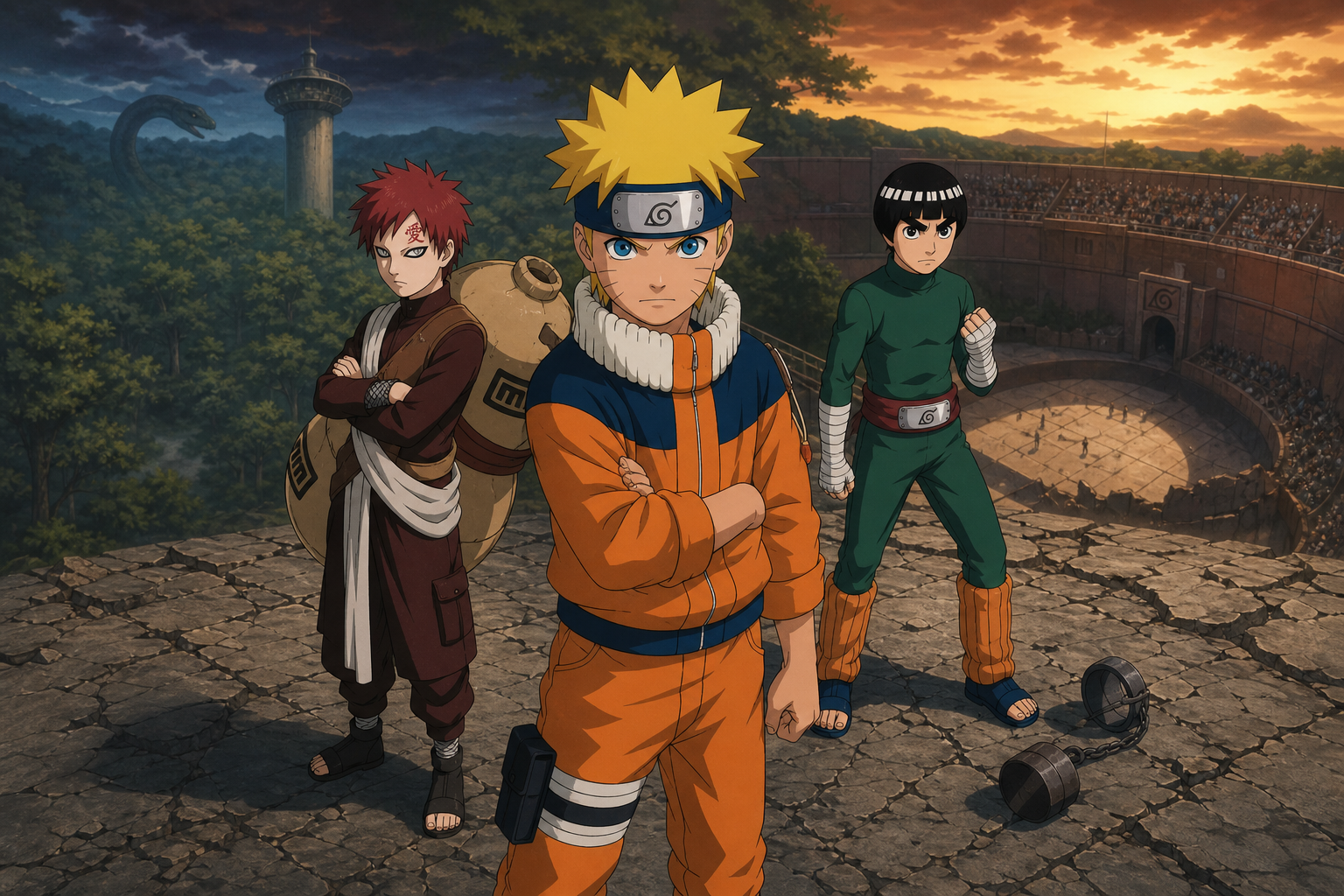
The Chūnin Exams
A promotion test becomes intelligence operation, survival trial, tournament spectacle, invasion prelude, and predator’s hunting ground. Naruto’s world expands,and every new child arrives carrying a village, clan, teacher, political use, or private wound on their back.
The one-sentence truth
The Chūnin Exams claim to identify leadership under pressure, but the arc reveals that the shinobi world measures children inside systems already distorted by military competition, inherited power, political theater, and adults willing to weaponize their futures.
- Anime episodes: 20-67
- Manga material: chapters 34-114, with adaptation adjustments
- Primary locations: Konoha Academy exam room, Forest of Death, preliminary arena, final tournament stadium
- Exam phases: written intelligence test, five-day survival exercise, preliminaries, one-month preparation, finals
- Central threats: Orochimaru, Gaara’s instability, hidden invasion plan
- Emotional spine: talent, effort, inheritance, fear, and what recognition costs
- Previous arc: Land of Waves
- Next arc: Konoha Crush
Why the story suddenly gets crowded
The Land of Waves proves that Team 7 can matter to one another. The Chūnin Exams ask what that small bond means inside an entire military society. New teams arrive from rival villages. Clan heirs carry techniques older than their personalities. Teachers evaluate students they also love. Adults watch from balconies while children turn inherited trauma into public spectacle.
This is not cast expansion for novelty alone. Each entrant is an argument about becoming a shinobi. Naruto believes effort can force recognition. Sasuke treats talent as insufficient unless it can defeat the past. Sakura has knowledge without confidence in field identity. Rock Lee has discipline without access to ninjutsu or genjutsu. Neji has genius organized around fatalism. Hinata possesses lineage without family approval. Gaara has overwhelming inherited power and almost no relational self outside it.
Put them in one examination system and the bracket becomes philosophy with bruises.
Phase One: cheating as intelligence work
The written test is designed around a contradiction. The questions exceed what most genin can reasonably answer, yet cheating is punished. The real task is therefore not knowledge recall but covert information acquisition under surveillance. Ibiki Morino is not testing whether children memorized the textbook. He is testing whether they can identify sources, gather intelligence, conceal method, protect teammates, and tolerate the fear of consequences.
This makes the classroom a miniature shinobi state. Everyone knows information has value. Everyone knows official rules do not describe the true rule. Success requires reading the institution behind its instructions.
Naruto’s blank page
Naruto cannot solve the questions and lacks the subtlety to steal answers cleanly. His apparent disadvantage becomes the emotional center of the tenth question. Ibiki threatens permanent exclusion if a team answers and fails, allowing withdrawal before the final risk. Naruto refuses to retreat even though his paper is nearly empty.
The choice is irrational if the exam only measures information. It is revealing if the exam measures leadership under fear. Naruto stabilizes the room by refusing to let imagined future failure define the present decision. His courage is socially contagious. He does not provide answers; he provides permission to remain.
Why Sakura matters here
Sakura can answer the written questions legitimately. That competence is not a joke or filler detail. The arc repeatedly contrasts different forms of intelligence: academic recall, sensory information, tactical improvisation, emotional reading, and political interpretation. Sakura’s problem is not absence of ability. It is the gap between possessing ability and trusting the self who possesses it.
Phase Two: the Forest of Death
Anko Mitarashi explains a survival exercise whose rules institutionalize uncertainty: teams must acquire both Heaven and Earth scrolls, protect their own, reach the tower, and survive other candidates. The forest makes every alliance temporary and every encounter ambiguous. It also gives Orochimaru cover.
Orochimaru turns an exam into a selection ritual
Orochimaru does not enter because the exam failed to secure its perimeter accidentally. He exploits the political openness the exam requires. Multiple villages, unfamiliar personnel, violent conditions, and normalized injury create the perfect hunting ground for an adult predator interested in gifted children.
His attention to Sasuke is a corruption of mentorship. Kakashi sees skill and tries to build a team around it. Orochimaru sees vulnerability and offers power designed to isolate its recipient from every protective relationship. The Curse Mark is not merely a combat upgrade. It is coercion made bodily: temptation, pain, identity invasion, and a promise that trauma can be solved through greater capacity for violence.
Sakura cuts her hair,and the metaphor only works because the fight hurts
With Naruto and Sasuke incapacitated, Sakura must protect them. Her hair has carried social meaning: femininity, rivalry, attractiveness, and the self she performed around Sasuke. Cutting it during combat is not a complete transformation. It is a first refusal to let that performance determine her next action.
The important detail is that courage does not make her instantly stronger than the Sound attackers. She bleeds, improvises, holds ground, and receives help. Growth begins before victory. Sakura’s stand matters because she chooses responsibility without assurance that the choice will succeed.
Team 10 answers an old social debt
Ino’s intervention complicates the rivalry. Childhood kindness, later competition, pride, and genuine concern return at once. The arc uses team battles to reveal that the social history children deny still influences whom they will risk themselves for.
The preliminaries: a bracket of private wounds
Too many teams survive the forest, so immediate one-on-one matches reduce the field. The preliminary arena converts hidden development into public evidence. Teachers, rivals, and future opponents watch each child reveal the limits of body, technique, strategy, and belief.
| Match | What the fight is really testing | What changes |
|---|---|---|
| Sasuke vs. Yoroi | Can Sasuke act without feeding the Curse Mark? | He adapts taijutsu observed from Rock Lee and begins negotiating with dangerous power rather than simply possessing it. |
| Shino vs. Zaku | Does visible force understand hidden systems? | Shino’s insects turn certainty into a trap; observation defeats spectacle. |
| Kankurō vs. Misumi | What happens when an opponent reads the wrong body? | Puppet technique makes identity and vulnerability spatial problems. |
| Sakura vs. Ino | Can either girl define herself outside comparison? | The draw refuses to crown a simple winner; both expose growth and unfinished identity. |
| Temari vs. Tenten | Can preparation survive a catastrophic matchup? | Competence is not immunity from incompatibility. Temari’s wind domination is decisive and humiliating. |
| Shikamaru vs. Kin | Can boredom conceal leadership intelligence? | Shikamaru weaponizes geometry and environment, previewing the strategist others will later depend upon. |
| Naruto vs. Kiba | Can improvisation overcome contempt and cleaner fundamentals? | Naruto’s endurance, clones, observation, and shameless unpredictability force the room to revise him. |
| Hinata vs. Neji | Who gets to define a person: lineage, family judgment, or chosen resolve? | Hinata loses physically while refusing the identity Neji assigns her. Naruto inherits the argument. |
| Gaara vs. Rock Lee | What is effort allowed to mean when victory is not guaranteed? | Lee makes the impossible visible, while Gaara reveals how inherited power without care can become terror. |
| Chōji vs. Dosu | Can straightforward loyalty withstand an opponent built around sound? | The match closes the preliminaries with a reminder that courage and matchup remain separate facts. |
Rock Lee drops the weights
Few images explain Naruto’s moral appeal more efficiently than the weights hitting the floor. Lee has been introduced as awkward, intense, and limited by his inability to use ninjutsu or genjutsu. His teacher, Might Guy, does not pretend the limitation is secretly irrelevant. Instead, he builds a path around what Lee can train.
When the weights fall, private labor becomes public velocity. The arena’s astonishment is recognition arriving late. Lee has already lived the work; spectators are only now receiving evidence.
But the fight refuses the comforting version of effort mythology. Lee can be extraordinary and still lose. He can exceed expectation and still be injured by a system that treats children’s bodies as acceptable proof. The emotional power comes from holding both truths: effort transforms possibility, and effort does not create a universe obligated to reward it.
Gaara as Naruto’s unrescued mirror
Gaara’s sand protects him automatically, symbolizing a childhood in which power replaced human protection. Naruto’s sealed beast made villagers reject him; Gaara’s upbringing taught him to convert rejection into proof that only the self exists. The exam places Naruto’s hunger for recognition beside Gaara’s theology of terror before their direct battle begins.
One month: teachers, inheritance, and unequal preparation
The finalists receive time to train, but the month reveals that “individual merit” is inseparable from access. Naruto gains Ebisu, then Jiraiya. Sasuke gains Kakashi’s concentrated attention. Neji arrives with clan technique. Gaara carries a weaponized body. Every contestant is judged individually through resources that were never individually produced.
Naruto learns to access power rather than merely contain it
Jiraiya identifies the Five Elements Seal disrupting Naruto’s chakra and introduces summoning. Training Gamabunta is not simply acquiring a larger attack. Naruto must negotiate with power that has agency. The relationship differs from the village’s treatment of him as container: a summon can refuse, test, demand, and eventually cooperate.
Sasuke and Chidori
Kakashi teaches Sasuke a technique that matches speed, perception, and elemental affinity, but the preparation also intensifies Sasuke’s isolation from Team 7. The teacher recognizes the Curse Mark’s danger and tries to supply disciplined power before Orochimaru’s promise becomes irresistible. The tragedy is that good mentorship arrives inside a competition that keeps translating growth into comparison.
The finals: military theater in a stadium
The public tournament serves several audiences at once. Daimyō and clients assess village strength. Villages display future military assets. Teachers evaluate students. Crowds consume violence as entertainment. Candidates pursue promotion. Orochimaru hides an invasion inside the spectacle.
The exam therefore resembles the shinobi economy in miniature. Children are individuals, representatives, advertisements, and weapons simultaneously. A victory can increase personal status and village prestige. A compelling loss can still demonstrate value. Promotion is not identical to winning because leadership judgment matters,but the tournament’s public structure ensures performance is always political.
Naruto versus Neji: fate argues with persistence
Neji’s fatalism is not foolish. It is a theory produced by the Hyūga branch system and his father’s death. He has watched hierarchy write itself onto bodies. Naruto’s refusal matters because he also carries a bodily destiny assigned by adults, yet insists that assigned meaning can be contested.
The fight’s emotional limit is important: Naruto does not abolish the Hyūga system by punching Neji. He interrupts Neji’s claim that the system has already explained every future. The distinction keeps hope from becoming magical social repair.
Shikamaru’s surrender and actual chūnin judgment
Shikamaru reaches a winning tactical position against Temari, recognizes depleted resources, and concedes. The crowd reads failure; evaluators read judgment. His promotion later proves the exam’s stated ideal: a chūnin must make decisions that protect a team, not merely accumulate personal victories.
The irony is that the institution identifies leadership accurately in a boy who openly dislikes effort while repeatedly failing to protect other children from the adults manipulating the exam itself.
Sasuke arrives late
Sasuke’s entrance with Kakashi is staged like prestige arriving on schedule after making everyone wait. Chidori pierces Gaara’s defense and draws blood, an event Gaara experiences as existential violation. The match is interrupted before resolution because the tournament was never merely a tournament.
Character atlas
Naruto Uzumaki
Turns refusal into social courage, defeats contempt through adaptation, and begins confronting the kind of isolated child he might have become.
Sasuke Uchiha
Receives the Curse Mark, copies Lee’s movement, learns Chidori, and discovers that every gain still feels inadequate beside Itachi.
Sakura Haruno
Moves from watching teammates to physically holding the line, then confronts how much of her identity has been organized around Ino and Sasuke.
Rock Lee
Makes effort visible without receiving the consolation of victory. His injured body becomes both inspiration and indictment.
Gaara
Embodies inherited weaponization without protective relationship. The arena first sees a monster; the story keeps revealing the child built inside it.
Hinata Hyūga
Loses the match while refusing her family’s verdict, transforming apparent weakness into chosen courage under Naruto’s attention.
Neji Hyūga
Uses real structural oppression to justify total fatalism, then encounters a person whose existence makes certainty harder to maintain.
Shikamaru Nara
Demonstrates the gap between motivation and capacity. Leadership appears as resource calculation, prediction, and willingness to stop.
Orochimaru
Turns examination access into predation, targeting talent by exploiting grief, ambition, and institutional blind spots.
Kakashi Hatake
Balances team responsibility against Sasuke’s acute vulnerability, choosing concentrated mentorship in the shadow of Orochimaru.
What Kishimoto is really building
A hidden village is a school attached to a military economy
The exams make Konoha’s contradiction visible. Children attend classes, form friendships, and worry about crushes; they are also trained to acquire intelligence, survive lethal terrain, represent national power, and accept bodily risk. The arc’s excitement works because the tournament is excellent character theater. Its discomfort works because the theater is politically useful.
Merit is real,and never isolated
Lee’s effort is real. Neji’s genius is real. Naruto’s endurance is real. So are clan inheritance, teacher access, sealed beasts, political lineage, medical intervention, and luck. The arc does not erase merit; it places merit inside infrastructure. This is why “hard work versus talent” is too small a summary. The deeper question is who gets support, whose body pays, and which kinds of achievement the institution can recognize.
Predators speak the language of potential
Orochimaru’s interest in Sasuke sounds flattering because it identifies real capacity. Predatory mentorship often does. It offers exceptional status to someone terrified of inadequacy, then makes separation from protective relationships look like proof of seriousness.
Recognition can rescue or consume
Naruto wants the crowd to see him. Lee wants his way of becoming a ninja to be acknowledged. Hinata wants to stop disappearing under family judgment. Gaara forces recognition through terror. The exam supplies an audience, but an audience cannot decide whether visibility becomes belonging, exploitation, or spectacle.
How the anime keeps forty-eight episodes readable
The Chūnin Exams could collapse into a tournament spreadsheet. The adaptation avoids that by giving each phase a different visual grammar. The written test uses stillness, eye lines, surveillance, and tiny acts of cheating. The Forest of Death uses distance, weather, branches, bodies disappearing from sight, and the unease of not knowing whether another team is candidate or predator. The preliminaries compress everyone into one arena where private wounds become public evidence.
Under Hayato Date’s series direction, the anime preserves the ensemble without pretending every contestant has equal narrative weight. Repeated reaction shots turn the balcony into a social map. Teachers read students. Rivals study future opponents. Clan members watch family judgment land. A fight’s meaning is often written on the faces outside it.
Toshio Masuda’s score helps the arc move between test anxiety, horror, comedy, tactical concentration, and emotional release. The exam is exciting because its form keeps changing. The danger is that spectacle can make the institution’s cruelty feel like a festival. The story uses injuries, Orochimaru, and the invasion setup to keep puncturing that comfort.
The verified Japanese cast expands with voices attached to characters who will matter for decades, including Masashi Ebara as Might Guy, Yōichi Masukawa as Rock Lee, Romi Park as Temari, Akira Ishida as Gaara, and Kujira as Orochimaru. Those credits establish continuity across an enormous ensemble. This file does not pretend a cast list alone proves scene-specific pitch, breath, or timing analysis.
Rock Lee dropping the weights remains the adaptation’s purest visual thesis. The floor breaks before anyone can verbally summarize his work. Private conditioning becomes public force, and the audience’s astonishment arrives after the labor. The direction gives effort a sound and a crater.
The Forest of Death also shows where television pacing can stretch. Repetition and reaction can slow momentum, but the extra time lets Sakura’s defense, Team 10’s intervention, and Orochimaru’s threat live as more than bullet points. The best adaptation choice is not always speed. Sometimes fans need long enough to feel a child decide.
What the exams change before the invasion begins
Naruto gains public evidence that refusal can stabilize other people. His blank paper does not help anyone academically, but his tenth-question stand changes the room. Later victories against Kiba and Neji turn village laughter into attention. Recognition is arriving, but still through dangerous performance.
Sasuke leaves the forest with Orochimaru’s mark inside his body and Kakashi’s counterseal over it. He also leaves the training month with Chidori and sharper taijutsu. Protective mentorship and predatory recruitment now compete through the same language of exceptional potential.
Sakura proves she can hold a line, make tactical decisions, and confront Ino as an equal. The draw denies a simple ranking. Her growth is real, while the arc still routes much of her motivation through the boys beside her. Both receipts stay.
Lee’s injuries change how the story talks about effort. Hard work can produce astonishing capacity and still meet a body that breaks. Guy’s permission to open the Gates is loving, risky, and shaped by a system that asks a child to make his worth visible through damage.
Hinata loses physically and revises the meaning of weakness. Neji wins the family match and later loses his certainty. The Hyūga structure remains. Personal courage creates an opening, not a policy update.
Shikamaru becomes the only promoted genin because evaluators value judgment over spectacle. That is the exam’s best institutional decision and its sharpest hypocrisy. The same system identifies leadership while failing to detect an adult invasion built inside the event.
Gaara’s automatic defense is pierced, and the experience destabilizes the identity built around invulnerability. Naruto will confront him after the tournament breaks apart. The bracket cannot finish their argument because their real fight concerns what a village made each child believe about love.
The exams therefore succeed and fail simultaneously. They reveal talent, judgment, and relationships. They also advertise children, normalize lethal risk, give Orochimaru access, and become camouflage for war. A useful institution can still be a dangerous one. That is Naruto’s favorite kind of mess.
Easter eggs and details worth watching
- The written test’s seating and proctors turn eye lines, reflections, insects, puppets, and sensory techniques into a catalogue of intelligence methods.
- Kabuto’s information cards preview both his skill and the suspicious depth of his knowledge before his allegiance becomes clear.
- Orochimaru’s Grass disguise weaponizes the exam’s multinational openness.
- Sakura’s hair carries changing symbolic weight from Ino’s childhood gift to a combat liability she chooses to cut.
- Sasuke reproduces Lee’s taijutsu movement before possessing Lee’s conditioning, showing the difference between copying form and building the body that sustains it.
- Lee’s dropped weights convert invisible preparation into literal impact on the arena floor.
- Hinata and Neji’s match embeds the Hyūga branch system inside a family confrontation rather than explaining it as detached lore.
- Naruto’s underground uppercut against Neji turns misdirection,often treated as clever shinobi practice,into the answer to a fighter whose Byakugan appears to see everything.
- Shikamaru’s surrender anticipates why promotion is based on judgment rather than tournament victory alone.
- Gaara’s blood shock reveals that automatic defense has protected not only his body but his entire belief about invulnerability.
Where the arc ends, and why the next file begins before it feels finished
Episode 67 stops at the moment the final tournament’s hidden purpose can no longer remain hidden. Sasuke and Gaara’s match has opened both Gaara’s defense and his psychological instability. Genjutsu spreads through the stadium. Sand and Sound forces move. Orochimaru’s selection of Sasuke becomes inseparable from his attack on Konoha.
The Chūnin Exams do not conclude cleanly because the institution was compromised from inside its own assumptions. The Konoha Crush is not an unrelated invasion interrupting a successful exam. It is the political truth concealed inside the spectacle.
Source shelf and adaptation boundary
Arc boundaries, exam phases, match outcomes, and Konoha Crush transition use the core manga/anime record and the official Naruto anime archive. Staff and original Japanese cast credits use the same official series page, with character-specific official retrospectives supporting Naruto, Shikamaru, Neji, and other key participants. Analysis and judgment are original to CVM Sekai.
The television adaptation changes pacing, inserts material, and stages some violence differently from the manga. Episode boundaries follow the anime. This file separates formal promotion from tournament victory and does not treat a public match as a complete measure of rank, morality, or power.
Continue the mission
Official story references: Naruto Official anime archive. This arc file synthesizes the original Japanese anime and manga storyline; episode boundaries follow the television adaptation.