
Naruto Character Encyclopedia · Complete Canon Profile
Might Guy
Might Guy turns a joke silhouette into Naruto’s sharpest argument about effort, disability, teaching, and the terrible price of making the body prove its worth.
01
Bottom line
Might Guy is not comic relief who accidentally became powerful. His comedy is the delivery system for one of Naruto’s most serious ethics: people deserve teachers who can see ability outside the standard test. Guy changes Rock Lee‘s life because he recognizes a viable ninja where the Academy sees a failed template.
His tragedy lives inside the same gift. Guy inherits love from a father who proves devotion through death. He builds self-rules that convert promises into physical punishment. He offers Lee educational access, fierce protection, and unconditional belief, then teaches the boy that shared destruction is the final receipt for sincerity.
Guy is loud because quiet shame already tried to define him. He cries because tenderness is not weakness. He opens the Eighth Gate because a military culture taught generations of shinobi to spend their bodies for tomorrow. Naruto saves his life. Survival does not erase the sacrifice. Survival forces the story to keep the consequence in the room.
02
Might Guy at a glance
- Japanese name: マイト・ガイ, Might Guy
- Birthday: January 1
- Blood type: B
- Registration number: 010252
- Village: Konohagakure
- Rank: Jōnin
- Team: Leader of Team Guy with Rock Lee, Neji Hyūga, and Tenten
- Father: Might Duy
- Age: 26 to 27 in Part I; 30 to 31 in Part II
- Height: About 184 cm across adult guide records
- Weight: About 76 kg across adult guide records
- Manga debut: Chapter 38
- Anime debut: Episode 22
- Japanese performer: Masashi Ebara
- Specialty: Taijutsu and the Eight Gates
- Defining relationships: Duy, Kakashi, Lee, Neji, Tenten, and Kisame
- Academy graduation: Age 7
- Chūnin promotion: Age 11
- Official mission record: 788 total: 86 D-rank, 270 C-rank, 210 B-rank, 199 A-rank, and 23 S-rank
- Databook stat shape: 31.5 total, with 5s in taijutsu, strength, speed, and stamina across the first three stat tables
- Child Japanese performer: Mayuki Makiguchi
The mission record makes the “comic relief who got one lucky war moment” reading collapse on contact. Two hundred twenty-two A- and S-rank assignments sit behind the green suit. The stat table is a period guide, not a universal power-ranking machine, but its repeated shape is clear: Guy’s specialization is extraordinary physical combat supported by enough general shinobi skill to lead a jōnin team.
03
The green suit is a public argument
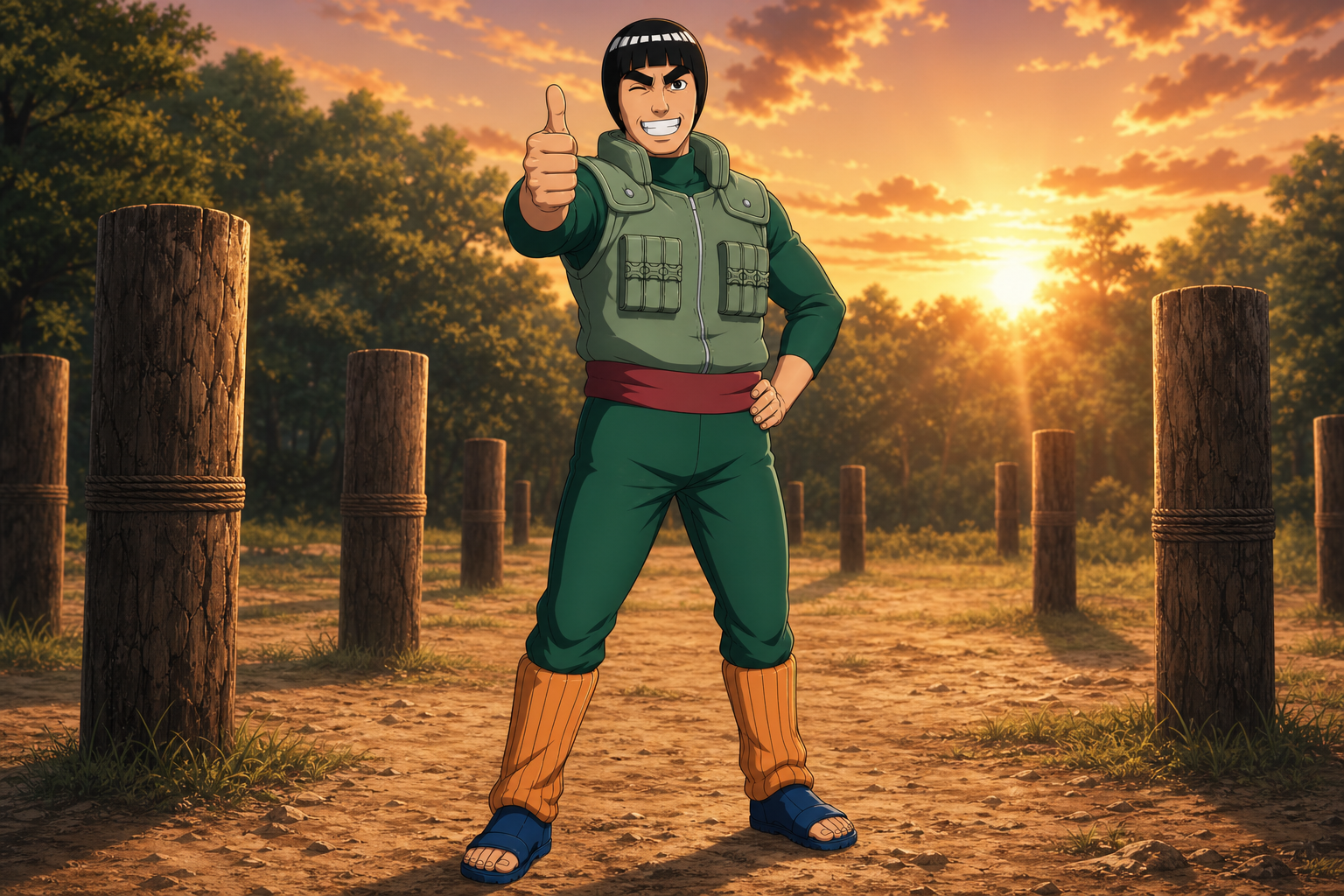
Guy’s bowl cut, heavy eyebrows, green jumpsuit, orange leg warmers, blue sandals, red belt, and flak jacket make subtlety pack a bag and leave town. He poses. He winks. Light catches his teeth. Sunsets arrive like salaried supporting actors.
The design makes him funny, but the joke never cancels physical authority. Guy’s body is visibly trained. The flak jacket establishes rank. His stance shifts from ridiculous display to lethal control without changing clothes. The same silhouette can deliver a thumb-up to Lee or kick an enemy through a battlefield.
That consistency matters. Guy does not become worthy when the green suit stops looking silly. The series teaches other characters, and the audience, to revise the assumption that dignity must look cool in one narrow way.
Rock Lee later adopts the silhouette because clothing becomes lineage. Guy once used Duy’s example to survive ridicule. Lee uses Guy’s example to imagine a future. Fashion is doing family work.
04
His appearance changes less than his status
Child Guy carries the recognizable hair and eyebrows before his adult confidence fills the frame. Youth flashbacks emphasize the distance between the boy struggling for institutional recognition and the jōnin who later treats every entrance like a parade.
The adult Part I design combines the green training suit with Konoha’s flak jacket. The suit represents personal lineage and chosen practice. The jacket represents institutional rank. Guy does not discard the supposedly embarrassing part of himself after the village validates him.
Part II preserves the same silhouette because his central identity remains stable. War damage produces the major bodily redesign. After the Eighth Gate, his right leg no longer supports ordinary combat mobility. New Era depictions use a wheelchair and adapted movement while keeping the hair, brows, expression, and green clothing vocabulary intact.
The visual continuity refuses a before-and-after morality play. Disabled Guy is not a different, lesser character. The body changes. The design keeps saying his name.
05
Guy can use ninjutsu
Guy is sometimes described as another Lee who cannot perform ninjutsu or genjutsu. That is inaccurate. Guy can summon tortoises, a ninjutsu demonstration that settles the basic question. His childhood struggles and adult specialization do not equal Lee’s specific limitation.
The distinction protects both characters. Guy understands Lee partly because he knows exclusion, hard training, and comparison with a celebrated genius. He does not need the exact same body to provide useful mentorship. Good teachers can recognize a barrier they do not personally share.
Guy chooses taijutsu as his dominant route and becomes extraordinary through that specialization. Lee requires taijutsu as his only viable major route. Those statements can sit beside each other without flattening either biography.
06
Might Duy gives him dignity and a death rule
Might Duy is known as the Eternal Genin. Other shinobi mock his low rank, appearance, and claims about training. Guy feels the social cost of having a father the village treats as a joke. Duy answers humiliation with self-rules, repetition, and absolute belief that effort can create value.
Duy trains for twenty years to master the Eight Gates. His rank does not measure the one ability he develops beyond ordinary limits. When young Guy, Genma, and Ebisu encounter the Seven Ninja Swordsmen of the Mist, Duy opens the Eighth Gate to protect them.
The manga confirms the confrontation and sacrifice. The anime specifies that Duy kills four swordsmen. Fandom claims about six manga deaths circulate more confidently than the available panel receipt deserves. A factual profile does not count bodies for dramatic inflation.
Duy’s final lesson is loving and dangerous: use the death rule only to protect something precious. Guy survives because his father spends his life. The act proves Duy was never worthless. The act also binds paternal recognition to martyrdom.
Guy inherits both messages. Your rank does not define your worth. Your death may prove your love.
07
Self-rules turn promises into a training engine
Guy sets conditions for himself. If he loses a contest, he completes an extreme exercise. If he fails that exercise, another consequence follows. The system turns disappointment into motion and reduces negotiation with fear.
Self-rules can build consistency. They externalize commitment and make goals concrete. Guy’s famous rivalry tally with Kakashi converts everyday contests, including rock-paper-scissors, into a lifelong practice of showing up.
The rules can also become compulsive punishment. Five hundred handstand laps do not become necessary because a friend won a game. Guy treats physical suffering as proof that words matter. The body guarantees sincerity when ordinary trust feels insufficient.
That ethic passes to Lee. Training goals, consequences, and permission structures help Lee progress. The punishment logic also teaches him to answer limitation with more damage. Guy’s pedagogy contains accommodation and ableist self-discipline in the same green package.
08
Kakashi is the rival Guy refuses to abandon
Guy declares Kakashi his eternal rival and records their wins and losses across competitions ranging from combat to nonsense. Kakashi often responds with flat indifference. The running joke makes Guy look desperate for attention.
The deeper chronology changes the joke. Kakashi grows through repeated bereavement, guilt, ANBU violence, and emotional withdrawal. Guy keeps approaching. Competition gives Kakashi a relationship that does not require direct confession. Guy can challenge him, irritate him, and stand nearby without demanding a trauma speech.
Their rivalry is asymmetrical in presentation but reciprocal in endurance. Kakashi trusts Guy’s combat judgment. They fight together against Akatsuki and war threats. Guy understands how Kakashi tracks movement and develops a way to engage Sharingan users by reading feet and lower-body cues rather than staring into their eyes.
Guy is not too stupid to notice Kakashi’s grief. He is tactful enough to offer companionship in a language Kakashi can tolerate.
09
Team Guy is differentiated education
Guy leads Lee, Neji, and Tenten, three students with radically different tools. Lee relies on taijutsu and conditioning. Neji brings Byakugan precision and Gentle Fist. Tenten manages weapons, storage, and range.
The team works because Guy does not demand identical expression from every student. He gives Lee the most visible emotional investment because Lee’s need mirrors his own history. That focus saves Lee’s career. The focus also raises questions about what Neji and Tenten receive off panel.
Neji carries hereditary violence and fatalism. Tenten carries an underexplored professional ambition. A great teacher should notice the student who never asks for rescue too. Guy’s record with them is competent, affectionate, and narratively thin.
His strongest teaching principle remains sound: find the route each person can actually use. Konoha’s Academy should have institutionalized that lesson instead of depending on one loud jōnin to catch the children who fall through.
10
The Chūnin Exams test the teacher too
Guy enters the Chūnin Exam story through Lee’s unauthorized challenge to Sasuke. He stops the fight, disciplines Lee, and greets Team 7 with enough teeth and tears to make Kakashi’s students question the entire profession. Comedy establishes authority without turning authority cold.
The Forest of Death and preliminary rounds expose how far Lee will go when Guy is not beside him. Lee uses the Front Lotus against the Sound team and opens five gates against Gaara. Guy authorized weight removal, not unlimited self-destruction. Once Gaara moves to crush Lee after the decisive injury, Guy intervenes.
That intervention breaks tournament neutrality. Good. A teacher’s first duty is not preserving the bracket while a child dies. Guy also recognizes that his instruction helped create the danger. Teaching a forbidden technique means accepting responsibility for the student’s use, especially when the student has built identity around never quitting.
The exam does not simply prove Guy taught Lee well. The exam forces Guy to confront where encouragement, permission, and oversight failed to protect him.
11
Lee receives access because Guy pays attention
Guy sees Lee’s relentless training and recognizes the possibility of a splendid ninja built through taijutsu. He supplies instruction, progression, rules, gates, advocacy, and belief. Lee supplies the labor. Neither contribution replaces the other.
During the Chūnin Exams, Guy interrupts Lee’s attempted finishing move against Sasuke and later authorizes weight removal against Gaara. When Gaara’s attack threatens to kill Lee, Guy physically enters the match and stops him. The teacher places the student’s life above tournament procedure.
After Lee’s catastrophic injuries, Guy grieves his own failure to stop the escalation sooner. When Tsunade offers dangerous surgery, Guy promises that if Lee dies, he will die too. The promise gives Lee courage. The promise also puts the teacher’s life on a teenager’s medical decision.
Love can be sincere and coercive at once. Guy should share responsibility, not make Lee responsible for two deaths. The scene feels moving because both characters believe annihilation proves devotion. That belief is exactly why the scene needs scrutiny.
12
Neji and Tenten deserve more than proximity
Guy challenges Neji’s fatalism indirectly by building a team where effort, cooperation, and different specialties matter. Neji becomes a jōnin and deepens his relationships with Lee and Tenten. The manga gives little direct Guy-Neji interior work compared with Guy and Lee.
Tenten often serves as Team Guy’s practical counterweight. Guy trusts her on dangerous missions and benefits from her logistics. The story rarely shows him developing her craft with the specificity he gives Lee.
That imbalance may reflect the protagonist-centered narrative more than Guy’s fictional conduct. A profile must still name the visible record. “He probably mentored them beautifully offscreen” is not evidence. The series gives Guy a legendary teaching bond and leaves two-thirds of his team underwritten.
Neji’s death should change the surviving teacher. Guy loses a student during a war where he later chooses his own death technique. The plot races toward Madara and gives the grief little room. That missing emotional bridge matters.
13
What Might Guy can actually do
Taijutsu and physical conditioning
Guy possesses elite speed, strength, reflexes, endurance, and close-combat precision. His attacks can generate pressure effects through physical force. He handles nunchaku and coordinates effectively with Kakashi and other high-level shinobi.
Turtle summoning
Guy summons tortoises, including Ningame in adaptation and franchise material. The technique proves basic ninjutsu access. His combat identity remains taijutsu-centered.
Sharingan counterstrategy
Guy trains to read an opponent’s feet and body rather than meeting the eyes. The method reduces direct exposure to Sharingan genjutsu and reflects years of rivalry with Kakashi. The strategy is not universal immunity. Avoiding eye contact creates information limits of its own.
The Eight Gates
The gates regulate chakra flow and protect the body from unsafe output. Opening them releases progressively greater speed and power while increasing damage. Guy can reach all eight. Mastery means controlled access to catastrophe, not freedom from consequence.
English localization varies on some gate names. The sequence is commonly rendered as Opening, Healing, Life, Pain, Limit, View or Joy, Wonder or Shock, and Death. A profile should preserve translation boundaries rather than declare one English list sacred.
Earlier gates remove mental and physical restraints. Middle gates raise circulation, output, heat, speed, and destructive force. Later gates generate pressure effects that resemble elemental attacks even when taijutsu remains the mechanism. The Eighth Gate punctures the heart area and drives the body beyond survivable operation.
Guy’s technique shelf cannot be separated from medical fact. Each gate solves a battlefield problem by borrowing capacity from the user’s future. The loan grows predatory with every release.
14
Morning Peacock and the Sixth Gate
Guy opens the Sixth Gate against a Kisame proxy during the Kazekage Rescue mission. Morning Peacock uses an extreme series of punches whose speed and friction create a peacock-like display of flames around the target.
The attack shows how Naruto blurs physical technique into visual spectacle without converting every effect into elemental ninjutsu. Guy’s body remains the engine. The gate increases output. Air, heat, and movement become the image.
Sixth Gate use causes strain, but Guy retains more operational capacity than Lee possessed when opening five as a teenager. Age, conditioning, experience, and body differences matter. Students do not inherit a teacher’s tolerance merely by learning the same system.
15
The Kisame encounters form a three-part escalation
Guy first clashes with Kisame when Itachi and Kisame enter Konoha. The contact establishes a physical counterweight to Akatsuki pressure and begins the joke that Guy does not remember Kisame’s face.
During the Kazekage Rescue mission, Team Guy encounters a body carrying a fraction of Kisame’s chakra. Guy opens the Sixth Gate and uses Morning Peacock. The victory is real, but the proxy limit matters. Defeating a thirty-percent substitute is not the same claim as defeating the original at full capacity.
The final island encounter involves the actual Kisame attempting to escape with intelligence. Guy pursues, escalates to the Seventh Gate, and uses Daytime Tiger. Kisame mistakes the incoming force for chakra and answers with an absorption strategy. Compressed air does not feed that defense as expected.
The progression gives the rivalry shape: introduction, partial proxy, and full tactical resolution. Guy finally remembers Kisame not because the enemy earns friendship, but because death and conviction force recognition.
16
Daytime Tiger is compressed air, not a chakra tiger
Against Kisame on the island, Guy opens the Seventh Gate and uses Daytime Tiger. He forms a hand position and delivers a strike that compresses air into a massive pressure attack. The tiger shape is visualized force, not a summoned animal or elemental chakra beast.
That distinction matters tactically. Kisame’s techniques absorb chakra, but Daytime Tiger operates as taijutsu-generated air pressure. The matchup undercuts an opponent built to consume conventional ninjutsu.
Guy defeats Kisame and helps secure the intelligence Kisame carries. Kisame then takes his own life through summoned sharks to prevent interrogation and protect Akatsuki secrets. Guy responds by promising to remember his name.
The respect does not sanitize Kisame’s crimes. Guy recognizes commitment in an enemy without confusing commitment with moral goodness. A shinobi system can produce loyalty on every side and still send those loyal people to kill each other.
17
Guy and Kisame meet through labor
Their repeated encounters create a rivalry without friendship. Kisame initially feels insulted when Guy does not remember him. Guy’s face memory becomes a running joke. By the final encounter, the joke ends with deliberate remembrance.
Both men convert bodies into institutional service. Kisame destroys himself to protect Akatsuki intelligence. Guy repeatedly opens gates to protect comrades and later chooses the Gate of Death. Each calls sacrifice honorable within a different organization.
The parallel does not make the organizations equal. The parallel exposes how easily military cultures turn self-erasure into professional excellence. Guy can admire Kisame’s resolve because the same logic lives inside him.
18
War makes the rivalry with Kakashi operational
Guy fights beside Kakashi against Obito and the reanimated jinchūriki. Their different methods become coordinated rather than competitive. Kakashi reads space-time mechanics and uses Kamui. Guy supplies speed, pressure, defense, and the confidence of a partner who has studied Kakashi for years.
The war validates all those ridiculous contests. Rivalry built familiarity. Guy knows Kakashi’s timing. Kakashi trusts Guy to act at lethal speed. Social persistence becomes battlefield infrastructure.
The partnership also carries grief. Kakashi confronts Obito, the friend whose apparent death shaped his life. Guy cannot solve that history. He can keep enemies away long enough for Kakashi to face the truth.
19
The Red Beast chooses death
Ten-Tails Madara reaches a level where ordinary ninjutsu offers little effect. Guy opens the Seventh Gate and uses Daytime Tiger without meaningful damage. He then announces the end of the Blue Beast and the arrival of the Red Beast.
Opening the Eighth Gate, the Gate of Death, accelerates his blood and heat until red vapor surrounds him. The technique grants extraordinary power while guaranteeing death under normal conditions. Guy knows the rule. His father died through the same formation.
This is not a rage accident. Guy chooses the technique to protect the future of the shinobi around him. The self-rule has reached its intended final condition: something precious enough to justify his life.
The act is heroic. The inherited belief that heroism must culminate in self-erasure remains tragic.
20
Evening Elephant and Night Guy
Evening Elephant uses high-speed punches to produce compressed-air cannons that strike Madara in sequence. Allies help create openings and manage the Truth-Seeking Balls, making the assault a coordinated operation rather than a solo powerscaling clip.
Lee, Kakashi, Minato, and Gaara contribute to the operation around Guy. Minato removes dangerous Truth-Seeking Balls at immense personal risk. Kakashi uses Kamui to clear another obstacle. Gaara carries and positions allies. Lee supplies support while watching his teacher enact the final version of the doctrine Lee inherited.
That cooperation matters because Madara’s defenses are not a punching bag. Guy’s speed needs a corridor. The team builds one. Treating the sequence as an isolated duel erases the strategic labor that lets Night Guy reach its target.
Night Guy concentrates the final attack into a kick so forceful that space visibly distorts around the charge. Guy breaks bones through his own movement and severely damages Madara. Madara declares him the greatest taijutsu user he has faced.
Guy does not defeat Madara. Madara regenerates. The distinction does not shrink the feat. An ordinary-born Konoha jōnin using a technique inherited from an Eternal Genin pushes a Six Paths-enhanced legendary enemy closer to death than almost anyone present.
The scene completes Duy’s argument about rank. The village laughed at the father. The son’s body makes the world’s most arrogant shinobi acknowledge the craft.
Madara’s praise is precise. He recognizes Guy’s taijutsu as the greatest he has encountered. The statement does not automatically rank Guy above every shinobi across genjutsu, sealing, regeneration, space-time techniques, endurance, or sustained combat. Eighth Gate power exists inside a fatal time limit.
Powerscaling discussions often remove that limit because temporary peak output is easier to compare than a whole life. Guy’s profile refuses the shortcut. The power and the death condition are one technique.
21
Naruto saves him, not his old body
The Eighth Gate begins turning Guy toward ash. Naruto arrives with Six Paths power and prevents immediate death. Guy survives.
Survival does not undo the Gate of Death. His right leg remains severely damaged, and New Era material shows him using a wheelchair or other mobility support. The body carries the choice forward.
Some viewers argue that rescue cheapens the sacrifice. That reading treats death as the only serious consequence. Disability, changed work, dependence, rehabilitation, and continued life after the grand heroic moment can demand more narrative courage than a beautiful corpse.
The series does not explore every part of that adjustment deeply enough. Still, Guy’s continued presence refuses one cruel assumption: a mobility-impaired shinobi has no meaningful future.
22
Disability does not cancel youth
Adult Guy travels, mentors, competes, remembers, and participates in village life. Mobility changes. Identity continues. His chair is equipment, not a defeat symbol.
The treatment can slide into comedy, especially when Guy’s energy collides with access logistics. Humor is not automatically disrespectful. The target matters. Guy can remain funny. His disabled body should not become the joke that proves a formerly powerful man has fallen.
His survival also gives him a chance Duy never received. Guy can examine the death rule from the other side. He can teach Lee and later generations that devotion includes staying alive, adapting, and accepting care.
Whether the franchise fully uses that chance is another question. The possibility itself changes the inheritance.
Accessibility also changes the meaning of teamwork. Before the war, Guy is often the person carrying, rescuing, or creating the opening. After the war, ramps, transport, medical follow-up, and companions become part of his own participation. Receiving support does not reverse his authority. The change proves that reciprocity was never supposed to flow in only one direction.
A village willing to praise Night Guy should also fund ordinary life afterward. Hero worship without accessible infrastructure is gratitude with the invoice missing.
23
Masculinity with tears, touch, and terrible contracts
Guy cries openly, hugs students, praises friends, expresses love, and refuses the emotionally frozen masculinity common among elite shinobi. His tenderness is not coded as a loss of strength. The strongest taijutsu practitioner in the war can sob in public.
That matters. Boys watching Naruto receive an adult man who treats emotion as fuel for connection rather than shame.
Guy also ties manhood to endurance, promises, physical punishment, and willingness to die. His version is kinder than silent stoicism but still dangerous. “Real men cry” is progress. “Real men prove the tears by destroying their bodies” needs revision.
The best Guy does not become less passionate. He learns that care can be measured through rest, boundaries, accessible training, and the ordinary work of returning tomorrow.
25
Buddhist practice without attachment to annihilation
Guy’s repetition and attention resemble disciplined cultivation. Rank and reputation are impermanent labels. Duy demonstrates capacity the village cannot see. Guy transforms through sustained practice rather than fixed essence.
The danger comes from attachment to the self-rule. Guy treats one promise structure as sacred enough to override the body’s signals. He releases attachment to reputation but clings to sacrifice as identity.
A Buddhist reading should not romanticize suffering. Pain can teach. Pain can also be pain. The deeper release would allow Guy to protect precious people without needing his death to certify the protection.
26
The military loves a body willing to disappear
Konoha benefits enormously from Guy’s ethics. The village receives elite taijutsu, a strong team, victories over Akatsuki, and an Eighth Gate attack against Madara. Most of the cost is carried privately through Duy’s death, Lee’s injuries, Guy’s damaged body, and the emotional labor of their family-like bond.
Institutions love self-motivated workers because self-rules reduce management expenses. Guy supplies his own punishment, inspiration, and emergency override. The village gets a weapon who cheers while sharpening himself.
That does not make his service fake. Guy chooses his people. The structural question asks why a good society repeatedly needs personal martyrdom to cover institutional failure.
27
Original Japanese performances
Masashi Ebara performs adult Might Guy in the original Japanese anime and related franchise animation. Mayuki Makiguchi performs Guy as a child. Both credits are verified.
The role spans youth comedy, rivalry, teaching, grief, battle command and the Eighth Gate’s final resolve. I am not inventing pitch, breath or comic timing analysis without the heard Japanese scenes. A correct cast record and honest performance context are better than fake precision wearing a critic hat.
28
Manga, anime, films, games, and parody
Guy’s core biography comes from Kishimoto’s manga and the television adaptation. The anime expands his childhood, Duy material, missions, comedy, Team Guy dynamics, and New Era life. The anime’s count of four Seven Swordsmen deaths belongs to adaptation continuity.
Guy appears in franchise films including Naruto Shippūden the Movie, Blood Prison, Road to Ninja, and The Last. Film actions require individual continuity labels. Games expand gate attacks and team combinations for playable systems. Game finishers are not additional manga feats.
OVAs and Rock Lee & His Ninja Pals amplify Guy’s youth comedy. Parody preserves recognizable traits while changing scale and consequence. A gag version cannot establish main-continuity medical or combat facts.
29
Seven fandom shortcuts that miss the man
“Guy cannot use ninjutsu”
He can summon tortoises. Taijutsu is his specialization, not his only possible technique family.
“Guy is stronger than every character”
Madara praises his taijutsu. Guy severely damages but does not defeat him. Universal ranking claims require more than one category and one temporary death state.
“Naruto ruined the sacrifice by saving him”
Guy survives with permanent consequences. Death is not the only valid cost.
“Duy killed six swordsmen in the manga”
The manga confirms sacrifice against the group without securely printing that popular count. The anime specifies four.
“Kakashi does not care about the rivalry”
Deadpan responses do not erase decades of trust, competition, and battlefield coordination.
“Guy is a perfect teacher”
He gives Lee life-changing access and love. His suicide promise and pain doctrine remain ethically dangerous.
“The wheelchair makes him pathetic”
Mobility support keeps him participating. Disability changes his body and work, not his human value.
30
The final verdict
Might Guy sees worth before institutions do. He turns ridicule into instruction, rivalry into companionship, and emotion into public strength. He gives Rock Lee another door.
He also inherits a fire that demands bodies. Duy dies. Lee nearly loses his future. Guy opens the Gate of Death. The love is real, and the pattern is real.
Naruto saves Guy before the fire consumes him. The most meaningful future for the Blue Beast is not proving he could die beautifully. The meaningful future is teaching the next child that staying alive can be a splendid promise too.
Sources and canon boundary
Editorial record: Manga chronology controls. Anime expansions, novels, films, OVAs and games are labeled instead of blended into canon.
Primary franchise references: Naruto Official and VIZ Media Naruto. CVM Sekai’s conclusions about disability, access, mentorship, rivalry, bodily cost, the Eight Gates, and survival are editorial analysis, not invented creator quotations.