
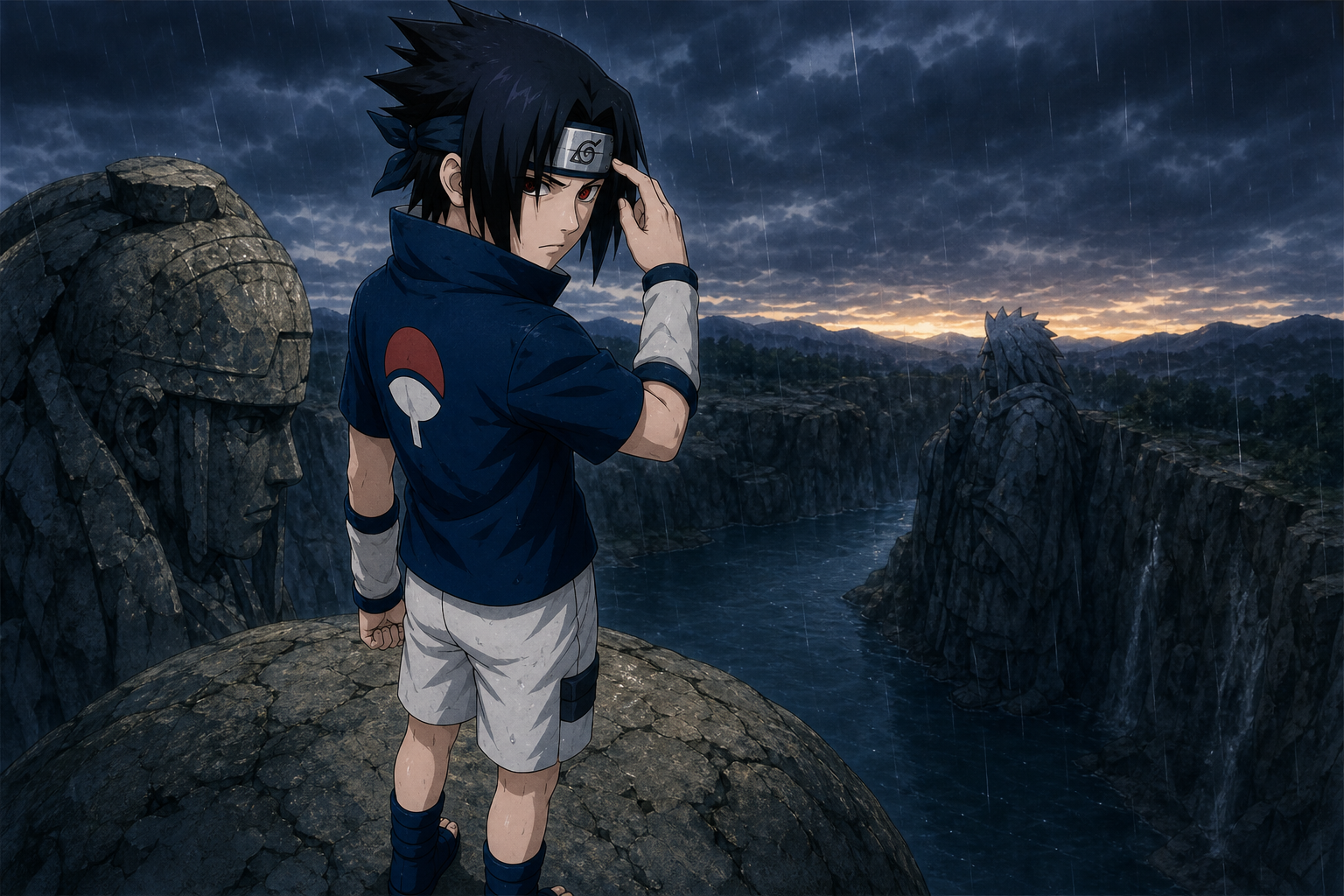
Naruto Character Encyclopedia · Complete Canon Profile
Sasuke Uchiha
Sasuke is a massacre survivor, a gifted child, a weapon recruited by predators, and an adult still trying to make justice out of secrets everyone else expected him to carry quietly.
01
Bottom line
02
Bottom line
Sasuke Uchiha does not choose revenge because he is incapable of love.
He chooses isolation because love gives the world another person to take from him.
The difference matters.
Sasuke is a massacre survivor raised inside a lie. His brother kills the clan, forces him to watch it happen through Tsukuyomi and assigns hatred as his reason to live. Konoha gives him an apartment, an Academy seat and no truthful adult account of why every person in his family is dead.
Team 7 becomes his first real attachment after the massacre.
That attachment terrifies him.
Naruto, Sakura and Kakashi offer belonging. Orochimaru offers power with fewer emotional conditions. When Itachi returns and crushes him again, Sasuke decides connection has made him weak. He leaves.
The choice hurts people. It also grows from harm.
Later truth does not calm him. It changes the target. Itachi shifts from murderer to sacrificed brother. Konoha shifts from home to beneficiary. Danzō wears stolen Uchiha eyes on his arm. Sasuke moves from revenge against one man to revenge against a system, then to a revolution where he plans to execute the Kage and hold the world’s hatred alone.
Naruto refuses that solitary throne.
Naruto does not win by dragging an irrational boy home. He proves relationship can survive truth, rage, distance and accountability without becoming another cage.
Sasuke’s final surrender is not the moment anger disappears.
It is the moment he stops treating loneliness as the only honest form of power.
03
Fast facts and complete era boundaries
Sasuke Uchiha is written うちはサスケ in Japanese. His given name references Sarutobi Sasuke, the famous fictional ninja, and he shares the name with Hiruzen’s father in the franchise’s clan history.
He debuts in manga chapter 3 and appears in anime episode 1, with speaking and featured-introduction conventions depending on the database field. His birthday is July 23. His blood type is AB, and his Konoha registration number is 012606.
He is 12 to 13 during Part I and 16 to 17 during Part II. Official data lists his height across Part I at 150.8 to 153.2 centimeters and weight at 42.2 to 43.5 kilograms. In Part II he is 168 centimeters and 52.2 kilograms. Blank Period data places adult Sasuke around 182 centimeters where the licensed record supports the value.
He graduates from the Academy at twelve. His formal rank remains genin through the main series because he leaves Konoha before normal promotion and never returns to climb the ordinary ladder.
Adult Sasuke functions as a high-level protector sometimes described as the Supporting Kage. That is a role, not proof somebody quietly completed his chūnin paperwork while he was dimension-hopping.
His affiliations change: Uchiha clan, Konoha, Team 7, Orochimaru’s network, Hebi, Taka, temporary Akatsuki alignment and later Konoha-linked shadow work.
The profile follows original Naruto, Shippūden, Blank Period novels and films, Naruto Gaiden, Boruto and the current sequel only where published evidence is verified. Current sequel status receives spoiler labeling and exact chapter boundaries.
04
Design evolution: every costume answers who owns his direction
Child Sasuke wears blue and white with the Uchiha crest visible on his back. Shorts, arm guards and the high collar make him recognizable before the Sharingan appears.
The crest matters. Sasuke is clan survivor before he becomes Team 7 member.
During the Chūnin Exams, curse-mark influence alters the body. Later Part I styling becomes darker as the Sound Four path opens.
Orochimaru-era Sasuke wears open, pale clothing, a purple rope belt and sword. The design mixes distance, mobility and visual association with the mentor he plans to use and eventually destroy.
Hebi and Taka periods add the cloak and team identity. Akatsuki-associated clothing marks the moment revenge expands from Itachi toward Konoha.
War-era Sasuke carries Eternal Mangekyō eyes and later the Rinnegan. After losing his left arm in the final fight, adult Sasuke refuses a replacement and travels in a dark cloak with sword and one arm.
The missing limb is consequence made visible.
Adult designs often hide the left Rinnegan beneath hair. The asymmetry communicates observation, secrecy and work performed outside village ceremony.
Later loss of the Rinnegan changes that record again. Artwork and prose must match the era. A complete profile cannot give every version of Sasuke every body part and eye because the toys look cleaner that way.
05
Family before the massacre
Fugaku and Mikoto Uchiha are Sasuke’s parents. Itachi is his older brother.
Young Sasuke wants Fugaku’s acknowledgment and Itachi’s time. He trains Fire Release and works to prove he belongs in a family defined by talent and public expectation.
Fugaku’s praise often reaches Sasuke through comparison with Itachi. Sasuke experiences his brother as both beloved model and impossible standard.
Mikoto offers warmth and interprets Fugaku for the boys. Her quieter position in the main manga should not make her disposable in the biography.
Sasuke’s early life is not a cold clan montage. It contains meals, training, embarrassment, rivalry and the ordinary ache of wanting a parent to notice.
The massacre destroys a whole social world, not only three named relatives.
Neighbors, police, extended family, clan elders and children vanish. Sasuke becomes the living person forced to represent everybody after death.
That is too much identity for one seven-year-old body.
06
The massacre and Tsukuyomi turn memory into a prison
Sasuke returns to find the Uchiha dead.
Itachi presents himself as sole monster and uses Tsukuyomi to force Sasuke to witness their parents’ deaths repeatedly.
He tells the child to hate, survive, become strong and kill him.
Sasuke’s revenge is therefore not a random personality trait.
It is the survival instruction given by the person who destroyed his world.
Konoha hides the political context. Danzō’s coercion, the planned coup, Hiruzen’s negotiation failure and Obito’s participation remain outside Sasuke’s reach.
The boy knows only the scene Itachi authors.
Trauma does not freeze memory in the past. Sasuke organizes future decisions around preventing powerlessness from returning. Strength becomes safety. Isolation becomes control. Attachment becomes the opening where another Itachi can enter.
The village praises his talent and rarely addresses the lie holding his life together.
07
Academy rivalry and the loneliness mirror
Naruto and Sasuke notice each other before friendship has language.
Naruto envies Sasuke’s skill and attention. Sasuke recognizes Naruto’s isolation while resisting the resemblance.
Both boys are lonely.
The village treats those lonelinesses differently. Naruto is publicly rejected and acts out. Sasuke is admired, pursued and placed on a pedestal built over a mass grave nobody discusses.
Their rivalry gives each a person who refuses indifference.
Naruto wants to beat Sasuke because Sasuke’s acknowledgment matters. Sasuke responds because Naruto’s persistence makes him visible as more than clan genius.
The accidental kiss becomes comedy, but the creative function is immediate. The series ties their bodies together before either boy can control the narrative.
They spend hundreds of chapters arguing with that fact.
08
Team 7 and the bell test
Kakashi places Naruto, Sasuke and Sakura on Team 7.
Sasuke initially centers revenge as his ambition. Naruto centers Hokage recognition. Sakura centers romantic desire and rivalry.
The bell test teaches that individual talent cannot replace team responsibility.
Sasuke is the most technically polished genin. He still cannot complete Kakashi’s test alone.
When the team shares food with Naruto against orders, Sasuke participates in the first important violation of his solitary logic. A rule matters less than a hungry teammate.
Kakashi passes them because comrades come before rigid mission instruction.
Sasuke understands the lesson.
The later tragedy is not that he never learned connection. He learned it and decided connection threatened the revenge keeping him alive.
09
Land of Waves: his body moves before the revenge plan
The Land of Waves mission places Team 7 in real combat.
Sasuke adapts quickly against the Demon Brothers and Zabuza conflict. Inside Haku’s Demonic Mirroring Ice Crystals, he develops Sharingan perception under pressure.
Then he moves to protect Naruto.
Sasuke believes he may die. The revenge against Itachi remains unfinished. His body still chooses his teammate.
Official Sasuke history repeatedly returns to the contradiction. He says revenge defines the future. Attachment acts before the statement can stop it.
Naruto’s Nine-Tails rage after Sasuke falls proves the bond works both ways.
The scene is not secret romance or proof destiny made their choices. It is the first battlefield evidence that Sasuke has rebuilt a human tie strong enough to interrupt the massacre script.
That makes future defection harder, not less believable.
10
Chūnin Exams: Orochimaru brands the opening
The Chūnin Exams test Sasuke’s skill and emotional vulnerabilities.
Rock Lee demonstrates a speed and taijutsu gap. Orochimaru attacks Team 7 in the Forest of Death and places the Cursed Seal of Heaven on Sasuke.
The mark is not a free power-up.
Orochimaru uses pain, temptation and bodily alteration to establish future access. Sasuke becomes a desired vessel before he consents to the relationship.
When the mark erupts around Sakura’s injuries, power and protectiveness blend with cruelty. Sakura stops him through physical contact and recognition.
That intervention matters. She is not only the girl watching boys become strong. She identifies when Sasuke is becoming somebody he does not want to be.
Kakashi later seals the mark and warns that relying on it threatens agency.
The seal constrains influence. It does not remove the offer.
11
Chidori, Gaara and Naruto’s accelerating growth
Kakashi trains Sasuke in Chidori and speed before the final Chūnin Exam match.
The technique concentrates lightning chakra in the hand and requires speed plus Sharingan perception to manage the tunnel-vision risk.
Sasuke penetrates Gaara’s defense and wounds him.
The Konoha Crush transforms tournament competition into village emergency. Sasuke pursues Gaara and continues fighting despite curse-mark danger.
Naruto ultimately defeats Gaara through strength, summons and recognition.
Sasuke sees the teammate he once outclassed perform at a level he cannot reach.
Pride is part of the reaction. Fear is deeper.
If Naruto can grow through bonds while Sasuke remains unable to reach Itachi, perhaps Sasuke’s path is wrong. Admitting that would require rebuilding the purpose he has used since childhood.
The curse mark offers a simpler answer.
More power. Fewer questions.
12
Itachi returns and opens the wound again
Itachi and Kisame enter Konoha after Hiruzen’s death.
Sasuke rushes toward his brother.
Itachi defeats him, breaks him physically and uses Tsukuyomi to force the massacre into his mind again.
The encounter is not a neutral power comparison. Itachi is deliberately managing Sasuke’s hatred.
Sasuke wakes in the hospital with proof that years of work did not close the gap.
Naruto has learned Rasengan under Jiraiya. The rooftop confrontation turns insecurity into technique.
Chidori and Rasengan move toward collision before Kakashi intervenes.
Sasuke sees the damage Naruto’s technique does to the water tank and realizes the rival has advanced beyond the comparison Sasuke expected.
The moment is often summarized as jealousy.
Jealousy is present. So is terror that connection has distracted him from the only task that gives the massacre meaning.
13
The Sound Four convert fear into a recruitment pitch
The Sound Four arrive after Sasuke’s humiliation.
They demonstrate curse-mark power and tell him Orochimaru can offer more.
The recruitment succeeds because it meets the wound Itachi reopened.
Sakura confronts Sasuke at the village exit. She offers love, memory and a future in Konoha.
Sasuke thanks her and renders her unconscious before leaving.
The gratitude is real. The violation is real.
He chooses defection, leaves teammates to face the retrieval mission and pursues a predator’s power.
Sasuke is not kidnapped in the ordinary sense. Orochimaru has groomed and marked him. Sasuke actively takes the offered route.
Victimhood and agency occupy the same decision.
14
First Valley of the End: he refuses the final blow
Naruto catches Sasuke at the Valley of the End.
Their fight brings every Part I argument into one landscape: bond, revenge, strength, loneliness and whether bringing somebody home can become force.
Sasuke plans to sever the bond and gain Mangekyō through Naruto’s death under Itachi’s instruction.
He cannot do it.
Official birthday history emphasizes that Sasuke refuses the final blow when the opportunity arrives.
He claims he will not gain power by following Itachi’s exact method.
The choice is pride and attachment together. Sasuke will leave Naruto wounded, reject his plea and enter Orochimaru’s world. He will not turn Naruto into the corpse Itachi prescribed.
Neither boy wins what he wants.
Naruto cannot bring him home. Sasuke cannot make the bond disappear.
15
Orochimaru years: using the predator before he can use you
Sasuke trains under Orochimaru during the time skip.
He learns swordsmanship, expands Chidori, develops lightning transformations and gains control over curse-mark power.
Orochimaru intends to take his body.
Sasuke knows.
The relationship becomes a race between acquisition and betrayal. Sasuke uses the training while preparing to resist possession.
At their confrontation, Orochimaru is weakened. Sasuke overwhelms him and turns the body-transfer space against him.
The victory does not mean the grooming was harmless because the student outplayed the predator.
It means Sasuke retained enough agency to reverse the intended consumption.
Orochimaru remains inside the curse-related system and later emerges during the Itachi battle. The boundary between victory and containment stays unstable.
16
Team 7 reunion shows how far he has moved
Naruto, Sakura, Sai and Yamato encounter Sasuke at Orochimaru’s hideout.
Sasuke is stronger, colder and willing to attack former teammates.
Sai enters with his own hidden Root order. Yamato tries to contain the crisis. Naruto carries the promise and the Nine-Tails risk.
Sasuke considers killing them and approaches a larger technique before Orochimaru stops escalation for strategic reasons.
The reunion rejects the idea that Sasuke is secretly waiting to be rescued at every moment.
He has chosen a path and built competence inside it.
Naruto’s refusal to give up must therefore confront Sasuke’s agency rather than imagine it away.
That is why the relationship takes so long.
17
Hebi gives revenge a team
After defeating Orochimaru, Sasuke recruits Suigetsu Hōzuki, Karin and Jūgo.
The team becomes Hebi.
Each member has an individual reason to join. Suigetsu pursues swords and autonomy. Karin has sensory and healing skill plus a complicated attachment to Sasuke. Jūgo sees Sasuke as a stabilizing link to Kimimaro and a restraint on violent transformation.
Sasuke says the objective is Itachi.
He also creates another set of bonds while insisting bonds are distractions.
Hebi members save one another, share information and make Sasuke’s hunt possible.
The team is not Team 7 replacement furniture. Their agency and later harm matter independently.
18
Deidara and tactical survival
Deidara targets Sasuke partly through anger about Itachi and the Sharingan.
The battle demonstrates Sasuke’s analytical style. Lightning counters earth-based explosive clay. Sharingan reads movement. Summoning and substitution preserve survival under catastrophic conditions.
Deidara turns his body into a final explosion.
Sasuke survives through a demanding escape sequence involving Manda.
The victory shows preparation, elemental knowledge and willingness to use a summon under extreme risk.
Manda’s death is part of the cost. Sasuke treats the summon as means during an emergency.
Power analysis should not erase the creature because the matchup chart is busy.
19
The Itachi battle completes one lie and opens another
Sasuke reaches Itachi at the Uchiha hideout.
The fight moves through genjutsu, fire, Amaterasu, Kirin and Susanoo. Orochimaru emerges and is sealed by Itachi’s Totsuka Blade.
Itachi dies after approaching Sasuke and touching his forehead.
Sasuke believes revenge is complete.
Then Obito tells him the massacre served Konoha’s secret peace and Sasuke’s survival.
The revelation does not heal him.
It removes the moral world holding his revenge together.
Itachi becomes brother and victim. Konoha becomes beneficiary. Sasuke’s own victory becomes participation in Itachi’s planned death.
Grief needs another target.
20
Taka forms when revenge becomes political
Sasuke renames Hebi as Taka and declares Konoha the target.
The team aligns temporarily with Akatsuki and receives the mission to capture Killer Bee.
Bee defeats them repeatedly, exposing how much Sasuke depends on Karin, Suigetsu and Jūgo.
They save his life and one another.
Sasuke’s ocular power grows through crisis, but the operation fails its true objective because Bee escapes through a substitution strategy.
The fight corrects the lonely-avenger fantasy. Sasuke has elite skill. He survives because a team carries him.
He responds by continuing toward isolation.
That is not a lack of evidence. It is refusal to accept what the evidence means.
21
The Five Kage Summit pushes him toward the moral floor
Sasuke attacks the Five Kage Summit seeking Danzō.
He fights samurai, the Raikage, Gaara, Mei and Ōnoki under escalating Mangekyō strain. Obito and Zetsu manipulate positioning.
Gaara tries to reach him as another person once consumed by hatred.
Sasuke refuses.
The arc presents power growth alongside moral collapse. Susanoo becomes stronger while judgment narrows.
Sasuke is not calmly executing justice. He is burning through body, team and future to reach one official.
22
Danzō’s arm turns the massacre into physical evidence
Sasuke confronts Danzō and sees multiple Sharingan implanted in his arm, plus Shisui’s eye in his socket.
The official who argued the Uchiha had to die wears the clan as equipment.
Sasuke studies Izanagi’s timing and uses genjutsu to manipulate Danzō’s count.
The battle is strategically sharp and emotionally grotesque.
Sasuke kills Danzō, but the act cannot answer the whole system. Hiruzen is dead. The elders remain. Konoha’s public still lacks the truth. Itachi remains dead.
Revenge removes a person and leaves the structure.
That lesson pushes Sasuke toward revolution later.
23
Karin’s body becomes a line Sasuke crosses
Danzō takes Karin hostage.
Sasuke pierces through her to strike him.
The decision is not a cool proof that revenge has made him ruthless.
It is betrayal of a teammate who healed, tracked and repeatedly saved him.
Karin’s attachment does not erase her right to bodily safety. Danzō’s hostage-taking does not excuse Sasuke’s choice.
Sakura later approaches Sasuke with an attempted killing plan and cannot complete it. Sasuke tries to kill her. Kakashi intervenes. Naruto arrives.
Team 7 meets at the point where affection alone cannot solve accountability.
Naruto does not say none of it matters.
He says he will carry the confrontation to its end.
24
Edo Itachi disrupts Sasuke’s certainty again
During the war, Sasuke encounters reanimated Itachi.
Itachi is moving to stop Kabuto and Edo Tensei. Sasuke follows because truth remains unfinished.
The brothers fight Kabuto together.
Sasuke sees Itachi operate without illness and without the villain performance. He hears admissions rather than another instruction set.
Izanami forces Kabuto into a loop with an exit based on accepting self. Itachi stops Edo Tensei.
Before disappearing, Itachi shares memory and says he will love Sasuke no matter what Sasuke chooses.
The statement frees Sasuke from the demand to honor Itachi through one prescribed politics.
Freedom does not produce immediate peace.
It produces a new question.
What is a village worth choosing?
25
The four Hokage become witnesses rather than answers
Sasuke revives Orochimaru and brings back the four Hokage through Edo Tensei to ask about Konoha, shinobi and Itachi.
Hashirama tells the founding history and conflict with Madara. Tobirama explains institutions and Uchiha dynamics through his own biases. Hiruzen confronts the consequences of his era. Minato connects village history to Naruto.
Sasuke listens.
This is a major change.
Earlier Sasuke receives truth from Itachi or Obito and converts it directly into target selection. Here he collects competing testimony before choosing action.
He decides to protect Konoha and enter the war, but not because the village is innocent.
He wants to understand and eventually redefine Hokage.
26
Team 7 reunites during the war
Sasuke joins Naruto, Sakura and Kakashi on the battlefield.
He declares an intention to become Hokage.
The claim sounds absurd after attacking the summit and threatening Konoha. It becomes serious when understood as a plan to replace the existing political structure rather than win an election.
Team 7 fights the Ten-Tails and later larger threats.
Sakura activates Strength of a Hundred. Naruto and Sasuke combine techniques. Kakashi coordinates and later receives temporary power through Obito.
The reunion is functional before it is emotionally repaired.
That order matters. They can save the world together while still owing one another difficult truth.
27
Rinnegan, Kaguya and the lost arm
Hagoromo grants Sasuke Six Paths power. Sasuke awakens a tomoe Rinnegan in his left eye.
The eye enables Amenotejikara exchanges, space-time applications and other Six Paths functions under chakra and distance limits.
Naruto and Sasuke become central to sealing Kaguya with Sakura and Kakashi contributing essential actions.
After Kaguya’s defeat, Sasuke uses the Rinnegan to control the tailed beasts and places them under Chibaku Tensei.
The eye that helps save the world becomes a tool for solitary revolution.
Power does not settle politics.
During the final Valley fight, Naruto and Sasuke each lose an arm in the last clash.
Sasuke later refuses a replacement.
The missing arm becomes atonement, consequence and personal choice. It should not be glamorized as suffering required for moral worth. It is the body left after two boys push inherited conflict to the limit.
28
Revolution is Itachi’s isolation scaled to the world
Sasuke plans to kill the current Kage, control the tailed beasts and become the single target of world hatred.
Official Sasuke and Naruto histories describe the plan directly.
He calls the project revolution and defines Hokage through Itachi’s example: one person hated by all while protecting the system from the shadows.
Sasuke has recognized Konoha’s institutional failure and drawn the wrong lesson from Itachi’s sacrifice.
Instead of ending solitary control, he proposes perfecting it.
The world will unite because Sasuke remains the permanent enemy. No succession, public accountability or distributed trust is required.
The plan turns trauma into sovereignty.
If connection can betray, rule alone. If institutions lie, become the only institution. If hatred is inevitable, own all of it.
Naruto refuses because one human body cannot become a healthy political system.
29
Second Final Valley: Naruto fights without accepting Sasuke’s disappearance
Naruto and Sasuke return to the Valley of the End.
Their powers reach mythic scale. Kurama clashes with Susanoo. Sasuke draws on the tailed beasts and uses Indra’s Arrow. Naruto answers with accumulated relationships and chakra.
The spectacle rests on a personal argument.
Sasuke believes severing Naruto is necessary for revolution. Naruto believes their bond can survive confrontation.
They exhaust ninjutsu, chakra and finally their bodies.
The last exchange removes an arm from each.
Sasuke admits defeat after recognizing Naruto will not stop choosing him, even when choice requires fighting rather than sentimental agreement.
The Unison Sign forms through their bloodied arms.
The symbol transforms Academy competition into reconciliation without pretending conflict was never real.
30
Surrender, pardon and the decision to travel
Sasuke releases the tailed beasts and helps end Infinite Tsukuyomi.
He is detained and later pardoned through Kakashi’s authority and Naruto’s role, with his contribution to ending the war part of the judgment.
Pardon is not innocence.
It is a political decision about punishment, service and future risk.
Sasuke chooses to travel rather than settle immediately into Konoha life. He calls the journey atonement and investigation.
The road lets him see the world beyond revenge targets and village myth.
Travel can also continue his habit of handling burden alone.
The adult profile must keep both possibilities visible.
31
Sakura is not a reward for coming back
Sakura loves Sasuke across the series. Sasuke protects, dismisses, thanks, attacks, apologizes to and eventually builds a family with her.
No single gesture erases that history.
The forehead tap he gives before leaving echoes Itachi while changing context. Sasuke does not command hatred. He acknowledges bond and promises future contact.
Later material establishes marriage and shared parenthood.
Sakura is not a prize awarded after Naruto wins the fight. She is a medical leader with her own work, judgment and history of harm from Sasuke.
Sasuke’s love does not make attempted violence romantic. Sakura’s forgiveness does not mean accountability never mattered.
Their relationship needs scene-based development across Blank Period and family material rather than a shipping verdict pasted over gaps.
32
Sarada turns absence into a question he cannot answer with power
Sasuke and Sakura have a daughter, Sarada Uchiha.
Sasuke spends long periods away investigating threats connected to Kaguya and the Ōtsutsuki.
The work protects the village and family.
Sarada still grows up with limited memory of her father.
Naruto Gaiden brings the cost forward. Sarada questions parentage, identity and whether family bond requires physical presence. Sasuke initially fails even basic recognition during their reunion under threat.
He cannot solve the problem with Rinnegan.
Sakura’s consistent care, Sarada’s anger and the family’s later connection rebuild trust.
Adult Sasuke’s absence is not equivalent to Itachi’s abuse or Hiruzen’s Naruto policy. It belongs to the same franchise question: when does protection at a distance stop being enough?
33
Adult shadow work makes Itachi’s role public enough to challenge
Sasuke investigates dimensional threats, Kaguya’s legacy and Ōtsutsuki danger outside ordinary village visibility.
He is sometimes called a Supporting Kage because his work complements Naruto’s public Hokage role.
The arrangement resembles Hiruzen and Danzō only at the level of visible leader plus hidden operator.
The moral difference is accountability and relationship. Sasuke reports to Naruto, collaborates with allies and does not build a tongue-sealed private army.
The risk remains. Shadow work can become an excuse for absence and unilateral decisions.
Sarada, Sakura, Boruto and Naruto keep the operator connected to people who can answer back.
34
Boruto mentorship reverses parts of Sasuke’s childhood
Boruto Uzumaki seeks Sasuke as a mentor partly because Sasuke stands outside Naruto’s public office.
Sasuke trains him, evaluates him and later supports him through Ōtsutsuki conflict.
The relationship reverses earlier patterns. Sasuke was a child whose gifted capacity attracted exploitation. Adult Sasuke must teach another gifted child without making pain the curriculum.
He is not perfect.
He still values dangerous field experience and can communicate sparsely. Boruto receives something Sasuke rarely had: a mentor who understands revenge, isolation, ocular power and the cost of mistrusting bonds.
During the altered-memory crisis, Sarada asks Sasuke to trust her and protect Boruto. Sasuke acts despite his own perceptions telling him Boruto is the enemy.
That choice is Shisui’s consent problem inverted.
Sasuke does not rewrite Sarada’s mind. He trusts her judgment over the false certainty inside his own.
35
Rinnegan loss and the body after mythic power
In the Boruto-era conflict, Sasuke loses the Rinnegan when his left eye is attacked under Momoshiki’s control of Boruto.
The loss removes space-time and ocular capacities central to his adult work.
It does not remove experience, swordsmanship, Sharingan, tactical intelligence or relationship.
Fandom treats major power loss as character deletion because weekly debate often values the move list over the person.
Sasuke’s story has always been about what remains after the thing organizing identity is taken.
Clan. Brother. Revenge. Arm. Eye.
The answer keeps becoming people.
36
Current sequel boundary
The current Boruto sequel places Sasuke inside another extreme consequence linked to protecting Boruto under altered collective memory.
Published chapters establish an incapacitated state tied to the Divine Tree/claw-grime crisis and a derivative enemy connected to his chakra or identity.
Exact terminology, chapter status and later changes must be verified against the latest licensed release before publication because this portion remains ongoing.
The profile will not convert an active serialization into a finished biography.
What can be said safely is structural. Sasuke again places his body between a young person and a world calling that young person enemy. This time the choice grows from trust in Sarada rather than a secret plan imposed on the child.
That is meaningful change.
37
Kakashi can teach the technique but cannot close the wound
Kakashi is one of the few adults who recognizes Sasuke’s revenge as a threat before the boy leaves Konoha.
That recognition matters because Kakashi understands loss. His father died by suicide. Obito and Rin became the center of a grief he carried into ANBU service and adult isolation. Kakashi knows how a dead person can keep directing a living one.
He also misses the scale of Sasuke’s problem.
The lecture after the hospital rooftop asks Sasuke to give up revenge because revenge produces emptiness. Kakashi speaks from experience, and the warning is morally sound. The timing is awful. Sasuke has just been tortured again by Itachi, watched Naruto’s power accelerate and learned that Konoha cannot protect him from the brother who destroyed his family. A teacher telling him to release revenge without exposing the state secret behind the massacre sounds like another adult asking the child to live quietly with an unanswered crime.
Kakashi does offer training, attention and a version of himself. Chidori is personal instruction, not a technique handed out to the whole class. The problem is that combat training cannot substitute for political truth or sustained trauma care. Kakashi can improve Sasuke’s speed and still leave the central wound untouched.
Their later confrontations expose the cost. At the Five Kage Summit, Kakashi accepts responsibility for failing to stop his student and prepares to kill him. The choice is not casual. Sasuke has attacked the summit, joined Akatsuki activity, endangered Karin and announced violence against Konoha. Kakashi cannot pretend those acts belong only to an injured child.
Sasuke also cannot be reduced to a rogue assignment Kakashi needs to clean up.
The teacher-student relationship failed inside a system built on secrecy. Kakashi did not order the massacre. He did not know the truth during Sasuke’s childhood. He still worked for a village that demanded loyalty while hiding what that loyalty had cost the Uchiha.
During the war, Kakashi watches Team 7 function again without pretending the old team has simply returned. Trust becomes tactical before it becomes personal. Sasuke helps save the world, then declares revolution. Kakashi’s later use of Hokage authority in the pardon becomes a judgment about what Sasuke did, what he helped prevent and whether punishment alone can repair anything.
This relationship is why the profile cannot settle for either lazy verdict. Kakashi was not a useless teacher who caused every choice. He was not a perfect mentor defeated by one bad student. He was a grieving adult with real insight, limited information and institutional habits that failed a grieving child.
38
Konoha’s pardon exposes selective justice
Sasuke’s pardon is easier to understand when the whole ledger stays open.
He deserts the village, attacks Killer Bee’s group, invades the Five Kage Summit, kills Danzō, attacks former allies, threatens Konoha and later imprisons the tailed beasts while declaring revolution. Those actions create victims and political consequences. Ending the war does not erase them.
Konoha’s own record is also dirty.
Danzō converts state authority into secret violence, steals Sharingan, manipulates the Uchiha crisis and pursues power through Root. The elders preserve silence. Hiruzen fails to stop the disaster. Itachi is used as a child operative and then publicly remembered as a criminal. Sasuke grows up inside a false official history.
The village can legally pardon Sasuke because the new Hokage holds power, Naruto advocates for him and his wartime service is extraordinary. Law does not automatically become moral repair because the paperwork changes.
RaeRae’s bottom line is simple: Konoha punishes the visible survivor after protecting the structure that helped make him dangerous.
That does not make every Sasuke action self-defense. Killer Bee did not order the massacre. Karin did not cause the clan’s isolation. Sakura, Kakashi and Naruto are not substitute bodies for the elders. Trauma explains the path and sharpens responsibility. Trauma does not transfer guilt to whoever stands nearby.
A credible justice reading therefore holds two truths at once. Sasuke needs accountability for chosen harm. Konoha needs accountability for state crime, secrecy and the habit of treating useful violence as noble when the village commissions it and treason when the wounded person redirects it.
The series gives Sasuke travel, investigation and shadow service as atonement. That work matters. He studies threats, protects the village from outside its public structure and accepts a life without applause. The arrangement also lets Konoha keep depending on hidden labor. The village solves part of its Sasuke problem by making him useful in the same darkness that once consumed Itachi.
That echo should make fans uncomfortable.
Adult Sasuke chooses the role with more knowledge and agency than Itachi had as a child. Choice changes the ethics. Choice does not remove the institutional convenience. A healthy ending requires Sasuke to share information, return to family, accept help and stop treating disappearance as the purest form of service.
Pardon opens that possibility. Pardon does not finish the work.
39
Complete ability and limit shelf
Sasuke begins with Fire Release, shuriken skill, wire tactics and rapidly developing Sharingan perception.
Kakashi teaches Chidori. Sasuke expands the lightning technique into variants for range, sword channeling, streams and senbon-like attacks. Kirin uses atmospheric lightning prepared through heat and weather rather than relying only on generated chakra.
The curse mark increases power and enables transformed states at bodily and identity cost. Itachi removes Orochimaru’s embedded presence and the curse-related system during their final battle.
Sasuke’s Mangekyō gives Amaterasu and control through Kagutsuchi. Eternal Mangekyō reduces the blindness progression after Itachi’s eyes are transplanted.
Susanoo develops from skeletal defense through armored and complete forms. War-era Six Paths power supports larger applications and Indra’s Arrow under the specific condition of tailed-beast chakra.
The Rinnegan enables Amenotejikara exchanges, portals and dimensional travel, plus selected Six Paths techniques. Chakra use and recharge matter. Adult interdimensional work repeatedly taxes capacity.
Summoning relationships include snakes, Aoda and a hawk. Manda’s forced use during the Deidara escape carries consequence.
Sasuke is an elite swordsman and tactical analyst. Genjutsu can control, interrogate or misdirect targets. Sharingan prediction never becomes omniscience.
His main limits change by era: child stamina, curse-mark influence, Mangekyō blindness, chakra depletion, emotional tunnel vision, lost left arm, Rinnegan cost and eventual eye loss.
No version of Sasuke owns every era’s full arsenal at once.
40
Relationship and accountability atlas
Naruto Uzumaki
Naruto is rival, mirror, chosen brother and the person who refuses Sasuke’s solitary death logic. Naruto’s pursuit sometimes crosses into force, but the bond survives because he continues listening and accepting confrontation.
Sakura Haruno
Sakura is teammate, healer, love and person Sasuke repeatedly hurts. Marriage does not erase attempted violence. Her forgiveness and continued agency belong to her, not his redemption score.
Kakashi Hatake
Kakashi teaches Chidori and the value of comrades while carrying his own Sharingan and loss history. He later faces Sasuke as teacher responsible for stopping a former student.
Itachi Uchiha
Itachi is brother, abuser, target, protector and source of competing political lessons. Sasuke’s life cannot be reduced to completing Itachi’s sacrifice.
Fugaku and Mikoto Uchiha
They are parents, clan memory and the ordinary home beneath the political tragedy.
Orochimaru
Orochimaru is predator, teacher, body threat and tool Sasuke chooses to use. Sasuke defeats him, later revives him for answers and never becomes proof the exploitation was beneficial.
Karin, Suigetsu and Jūgo
Taka members give skill, rescue and companionship. Sasuke depends on them, then crosses a moral line through Karin’s body. Later cooperation requires their choices, not automatic loyalty.
Danzō Shimura
Danzō turns village responsibility into a target and wears stolen Uchiha bodies as power. Killing him gives revenge and no institutional repair.
Obito Uchiha
Obito reveals truth and manipulates its direction. Sasuke receives essential information through a narrator with a war agenda.
Sarada Uchiha
Sarada is daughter, inheritor and the person whose trust later redirects Sasuke against false memory. She exposes the cost of protection through absence.
Boruto Uzumaki
Boruto is student and the next child carrying world-scale power. Sasuke’s mentorship tests whether he can teach without reproducing trauma as method.
41
Noriaki Sugiyama and the original Japanese performance
Noriaki Sugiyama performs Sasuke across the original Japanese franchise.
The credit is verified. Infant or younger-version credits require exact episode evidence before inclusion.
Sasuke spans child rivalry, curse-mark pain, controlled hostility, grief collapse, revolutionary certainty, adult restraint and awkward fatherhood.
A responsible performance section must analyze exact heard scenes rather than praising a “cool voice.”
Broadly, the long-running casting gives one performer room to age the character across decades of production. Episode Reacts can later examine the vocal work with lawful playback and credit receipts.
42
Manga, anime, novels, films, OVAs and games
The manga supplies the main Naruto/Shippūden biography and Naruto Gaiden family story.
The anime expands Academy material, Orochimaru years, adult missions and family scenes. Those additions should be labeled rather than silently inserted into manga chronology.
The Last and Blank Period novels bridge war-era Sasuke toward adult atonement. Sasuke Shinden and Sasuke Retsuden provide additional travel, investigation and relationship material with their own continuity and adaptation histories.
Boruto manga, anime and novels do not always cover identical missions. Current sequel claims require the latest licensed chapter.
Films such as Road to Ninja use alternate or supplementary contexts. Games expand moves, fights and original scenes.
One enormous media shelf does not mean one seamless timeline.
43
Confucian family duty, clan duty and state betrayal
This is a RaeRae interpretive lens.
Sasuke inherits obligations as son, brother, clan survivor, teammate, village shinobi, husband and father.
Those roles repeatedly conflict because institutions betray reciprocity.
Konoha demands loyalty while hiding the massacre. Itachi demands revenge while hiding love. Clan identity demands remembrance after no clan elders remain to guide it.
Sasuke initially answers through vengeance. Later he tries solitary rule. Adult life moves toward reciprocal duty: report to Naruto, build family with Sakura, mentor Boruto and trust Sarada.
The change is not obedience to Konoha.
It is choosing relationships where duty can be answered by another living person.
44
Buddhist attachment and revenge as a fixed self
Sasuke attaches identity to one future: kill Itachi.
When the future arrives, truth destroys it.
He attaches to Konoha’s destruction. Itachi’s return disrupts that. He attaches to revolution. Naruto refuses to disappear.
Each transformation follows the collapse of a fixed self.
The story does not ask Sasuke to stop caring. It asks whether pain must own the next action.
Atonement begins when he can travel without one corpse serving as destination.
Attachment remains in adult shadow work. Sasuke can still turn responsibility into solitary absence. Family and mentorship keep calling him back into reciprocity.
45
Masculinity and the lie that silence is control
Sasuke rarely receives permission to express grief in community.
The shinobi world rewards controlled faces, technical competence and private pain. Itachi models secrecy as love. Fugaku models restrained approval. Kakashi understands loss but teaches inside a military structure.
Sasuke turns emotion into action because action is culturally available.
Train. Fight. Leave. Kill. Rule.
Calling him “emo” is not analysis. It is fandom using a gendered insult to avoid reading a boy whose entire family was murdered and whose surviving brother engineered his trauma.
The danger is not feeling too much.
The danger is believing silence makes the feeling harmless.
46
The industry can sell every Sasuke without resolving any of them
Child rival Sasuke sells nostalgia. Curse-mark Sasuke sells transformation. Hebi Sasuke sells cool rebellion. Mangekyō Sasuke sells darkness. War Sasuke sells mythic power. Adult Sasuke sells cloak, sword and tired-father appeal.
The franchise has every reason to keep each era visually available.
That encourages composite fan identity where all powers, outfits and attitudes exist at once.
They do not.
Sasuke is marketable because he changes dramatically while remaining recognizable. The profile must preserve that chronology instead of building one ultimate action figure and calling it biography.
47
Fandom court
“Sasuke is just emo”
He is a massacre survivor subjected to repeated genjutsu torture and state secrecy. Style jokes cannot replace the record.
“Naruto should have let him go”
Sasuke has agency. Naruto also has agency to pursue a bond and oppose harmful plans. The ethical question is how pursuit respects personhood, not whether friendship creates ownership.
“Sakura should never forgive him”
Readers can reject the relationship. Sakura’s forgiveness belongs to her characterization and must coexist with the harm, not erase it.
“Sasuke never cared about Team 7”
Land of Waves, Gaara pursuit, first Valley refusal and war cooperation contradict that. He leaves partly because care threatens the revenge structure.
“He was right about revolution”
His diagnosis of institutional failure has force. His solution is permanent solitary coercion, Kage execution and tailed-beast control.
“Itachi’s truth justifies everything Sasuke does afterward”
Truth explains the shift. It does not make Karin disposable or summit violence consequence-free.
“Adult Sasuke is a deadbeat and nothing else”
His absence harms Sarada and serves high-risk protective work. Read both sides.
“Losing the Rinnegan made him useless”
That verdict confuses one ability with decades of skill, intelligence, swordsmanship and relationship.
48
Consequence ledger
Sasuke’s choices reshape Team 7, Orochimaru, Taka, Akatsuki strategy, the Five Kage Summit, Danzō’s death, the Fourth War, the tailed beasts, Naruto’s political future, Sakura’s family life, Sarada’s identity and Boruto’s survival.
Every team reveals the same truth.
He says he works alone. Other people keep carrying him.
Team 7 gives initial belonging. Hebi makes Itachi pursuit possible. Taka saves him against Bee. Edo Itachi gives truth. The Hokage give testimony. Team 7 seals Kaguya. Naruto survives the revolution. Sakura and Sarada turn adulthood into family. Boruto gives mentorship a future.
Sasuke’s growth is not from revenge to goodness in one clean line.
It is from solitary authorship toward shared consequence.
49
Final verdict
Sasuke Uchiha spends the series trying to become impossible to hurt.
Every strategy creates another wound.
Revenge gives purpose and lets Itachi control him. Orochimaru gives power and wants his body. Isolation protects attachment and leaves him dependent on teams he refuses to name as family. Revolution promises honest hatred and recreates Itachi’s lonely sacrifice at world scale.
Naruto defeats the plan by refusing the premise.
Love does not have to mean obedience. Bond does not have to mean returning unchanged. Accountability does not require abandonment.
Adult Sasuke remains imperfect. He spends too much time away. He trusts shadow labor. He carries responsibility alone until Sarada and Boruto force trust back into the equation.
That imperfection is the point.
The last Uchiha child does not restore the clan by becoming untouchable.
He restores a future by letting other people matter without treating their possible loss as a reason to leave first.
Sources
Editorial record: Manga chronology controls. Anime expansions, novels, films, OVAs and games are labeled instead of blended into canon. Character interpretation and accountability analysis are original CVM Sekai editorial work.