
Konoha Crush
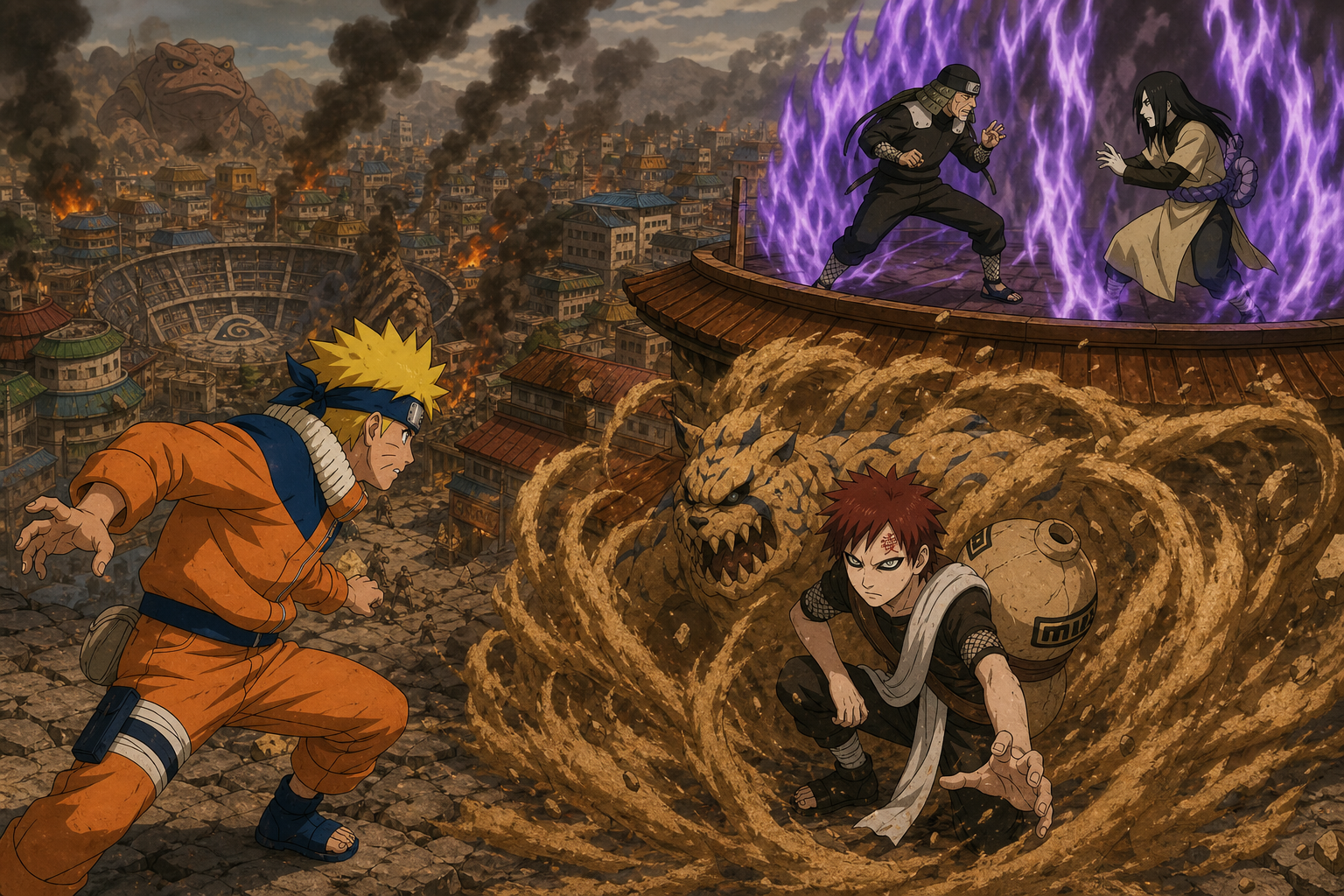
The tournament was never only a tournament. Genjutsu drops the audience, Sand and Sound strike, a teacher returns to kill the village that formed him, and two jinchūriki answer childhood abandonment in opposite languages.
The one-sentence truth
Konoha Crush exposes the hidden village as both home and war machine: worth defending because people live there, vulnerable because leaders convert children into weapons, and haunted by the students its institutions failed to stop becoming monsters.
- Anime episodes: 68-80
- Manga material: chapters 115-138
- Primary fronts: exam stadium, Konoha streets, Hokage rooftop, forest pursuit
- Invading forces: Otogakure and manipulated Sunagakure units
- Central battles: Hiruzen vs. Orochimaru; Naruto vs. Gaara
- Village loss: Third Hokage Hiruzen Sarutobi
- Previous arc: Chūnin Exams
- Next arc: Search for Tsunade
The invasion hidden inside applause
The finals concentrate leaders, clients, elite shinobi, foreign delegations, civilians, and promising young fighters in one stadium. That concentration is the exam’s diplomatic purpose,and its strategic vulnerability. The spectacle tells outsiders that Konoha remains strong. Orochimaru turns the same spectacle into cover for attack.
Genjutsu sends much of the audience into unconsciousness. Sand and Sound forces move. The Fourth Kazekage beside Hiruzen is revealed as Orochimaru in disguise. A promotion ceremony becomes war because the political theater already placed every necessary target in one room.
The arc does not abandon the Chūnin Exams’ themes. It reveals their underside. Children were demonstrating military value while adults negotiated national interest around them. The invasion simply removes the polite distance between demonstration and use.
Why Sunagakure joins, and why manipulation is not absolution
The Wind Daimyō shifts missions toward Konoha, increasing economic pressure on Sunagakure. A hidden village depends on contracts, reputation, and state support. Losing work means less money, weaker staffing, and fear that military relevance is shrinking while a rival profits.
Orochimaru exploits that resentment after murdering the Fourth Kazekage and assuming his identity. His deception controls the operation’s top command. It does not invent every Sand grievance, recruit every participant from nothing, or remove responsibility from the units that invade.
This distinction matters because fandom loves one clean villain. Orochimaru is the architect and impersonator. Sunagakure is also a military institution willing to turn economic anxiety into attack. The Land of Wind’s funding decisions, the Kazekage’s leadership culture, and Konoha’s market advantage create a field the impersonator can weaponize.
Gaara sits at the center of that policy failure. His father ordered Shukaku sealed into him and treated the child as strategic capacity. The invasion deploys the result. When Gaara destabilizes, adults describe the weapon as malfunctioning instead of asking what kind of government built a son this way.
The later alliance has emotional value because Temari, Kankurō, Gaara, and Konoha characters form real relationships. Political repair still needs memory. “Orochimaru tricked us” is an explanation for command capture, not a solvent poured over every Sand choice.
The arc therefore links war to money without reducing war to money. Economic pressure shapes incentive. Ideology, fear, leadership, and individual decisions determine what people do with it. Budgets do not throw kunai by themselves, babes, but they decide which arguments arrive already sharpened.
Three battles, one inherited problem
Hiruzen vs. Orochimaru
A teacher confronts the student whose brilliance he loved, feared, and failed to stop. The village’s past becomes bodily combat on a roof.
Naruto vs. Gaara
Two children made into containers decide whether pain proves no one can be trusted,or proves no child should be left alone with it.
Konoha vs. invasion
Ordinary shinobi protect streets, civilians, and one another, revealing that “the village” is not identical to its leadership or monuments.
The rooftop: a teacher’s failure returns
Orochimaru seals the roof inside the Four Violet Flames Formation, preventing intervention while forcing Konoha’s shinobi to watch. The barrier turns the duel into ritual. Hiruzen cannot delegate the past anymore.
Orochimaru was the exceptional student: gifted, curious, inventive, and increasingly willing to treat human bodies as material. Hiruzen recognized the danger but hesitated at the decisive moment. Affection, hope, guilt, and institutional pride softened enforcement. Years later, the student returns wearing another person’s face and commanding the dead.
Edo Tensei makes history fight its heir
Orochimaru summons the First and Second Hokage, transforming Konoha’s founding authority into weapons against the Third. The symbolism is brutal. Hiruzen is not merely fighting predecessors. He is fighting the village’s inherited power after it has been stripped of consent and repurposed by a student who believes mastery means ownership.
The reanimated Hokage also expose the cost of reverence. Konoha monumentalizes leaders, but Orochimaru understands bodies, techniques, and forbidden systems well enough to turn monuments back into machinery.
Enma and the old professor
Hiruzen’s summon Enma does not flatter him. Their coordination carries the familiarity of long practice. The Adamantine Staff gives the aging Hokage reach and force, but the fight continually acknowledges bodily limit. Hiruzen knows more techniques than almost anyone; knowledge cannot restore youth or undo hesitation.
The Reaper Death Seal
Unable to fully defeat Orochimaru, Hiruzen chooses the same sealing method used by Minato against the Nine-Tails. He sacrifices his soul to take what he can: the resurrected Hokage and Orochimaru’s arms, damaging the invader’s ability to perform jutsu.
The act is heroic and incomplete. Hiruzen saves the village from immediate catastrophe but cannot remove Orochimaru from history. His death embodies the series’ complicated view of leadership: responsibility may require sacrifice, yet sacrifice does not retroactively repair every decision that made sacrifice necessary.
The forest pursuit: Team 7 leaves the stadium
Sasuke pursues Gaara because the interrupted match remains unfinished and because the Chidori has given him a new measure of self. Sakura follows; Naruto and Shikamaru are sent after them with Pakkun. The pursuit converts tournament rivalry into survival mission while the invasion spreads behind them.
Shikamaru stays behind
Shikamaru chooses to delay pursuing Sound ninja so the others can continue. This is the leadership the exam identified. He does not stay because the fight flatters him. He calculates survival odds, accepts likely defeat, and spends himself to preserve the group’s objective. Asuma’s intervention saves him, but the choice belongs to Shikamaru before rescue arrives.
Sasuke discovers that Chidori is not enough
Sasuke wounds Gaara and penetrates defenses no one had breached. Yet the Curse Mark, chakra limits, and Gaara’s transformation make the victory he imagined impossible. This matters psychologically. Sasuke has trained intensely under Kakashi, acquired an elite technique, and still encounters power beyond him. The experience will later sharpen his terror of stagnation.
When Sakura is captured, Sasuke protects her as far as his body permits. Team 7’s bond is real even while his future departure is already becoming possible.
Naruto and Gaara: the same loneliness, different theology
Naruto and Gaara are both jinchūriki whose villages treated them as danger before person. Both experienced isolation, public fear, and adult decisions written into their bodies. The difference is not moral essence. It is relationship.
Naruto found Iruka, then Team 7. Recognition did not erase his childhood, but it gave pain somewhere to move besides outward. Gaara’s father attempted to kill him. Yashamaru’s final deception taught him that apparent care had always concealed hatred. He converts that lesson into doctrine: the self exists by killing others and proving its own reality.
Fear comes before courage
Naruto is terrified. He has already seen Gaara’s power and feels physically inadequate. The fight matters because courage is not an absence of fear or an unlimited reserve of confidence. Naruto moves because Sakura is threatened and because Sasuke has already spent himself.
Gamabunta and negotiated power
Summoning Gamabunta allows Naruto to confront transformed Gaara and Shukaku at scale. Unlike a sealed beast treated as involuntary weapon, Gamabunta has agency. He argues, refuses, judges, and cooperates for his own reasons. Naruto’s relationship to power is becoming relational rather than purely extractive.
The headbutt
After giant transformations and spectacular chakra, the final emotional contact is intimate and almost primitive: Naruto crawls forward and headbutts Gaara. Both are exhausted children again. Naruto explains not through abstract compassion but through demonstrated recognition. I know the pain, and I also know people changed what the pain required of me.
Gaara loses not only a fight but a closed theory of existence. Naruto proves that another version of the same origin story survived.
The village fights back
Konoha’s defense matters because it decentralizes heroism. The Hokage is isolated behind a barrier. Team 7 is in the forest. Across the village, shinobi evacuate civilians, counter summoned snakes, engage invaders, protect students, and respond to sudden war.
This is where “village” becomes more than government. Konoha contains hierarchy, secrecy, prejudice, and failures serious enough to create Orochimaru and isolate Naruto. It also contains people who choose one another under attack. The arc refuses both propaganda and total cynicism. A flawed institution can still be home; defending home does not prove the institution innocent.
Suna was manipulated, not absolved
Orochimaru murdered the Fourth Kazekage and used his identity to direct the alliance. Sunagakure’s participation also arose from material resentment and strategic calculation. Manipulation explains the immediate operation without erasing the political conditions that made cooperation plausible.
After defeat, Suna seeks reconciliation. The speed of diplomatic repair reminds us that hidden villages treat violence and alliance as strategic instruments. Young fighters experience enemies personally; states can redefine them administratively.
Character atlas
Hiruzen Sarutobi
Dies protecting Konoha while confronting the human cost of hesitation, affection, and leadership exercised too late.
Orochimaru
Turns student-teacher history, forbidden research, stolen identity, and multinational grievance into an assault on the village that formed him.
Naruto Uzumaki
Defeats his most dangerous mirror by combining fear, attachment, summoning, endurance, and the recognition Gaara never received.
Gaara
Moves from weaponized solitude toward the first possibility that pain does not require domination.
Sasuke Uchiha
Sees Naruto surpass the limit he cannot cross, intensifying the comparison that will later make Orochimaru’s promise more persuasive.
Sakura Haruno
Becomes the person teammates spend themselves to protect while continuing to act within the pursuit rather than remaining stadium spectator.
Shikamaru Nara
Demonstrates chūnin judgment by choosing the unglamorous delaying action that protects the mission.
Temari and Kankurō
Begin as Gaara’s frightened handlers and move toward siblings capable of witnessing his change.
The funeral and the meaning of the leaves
Hiruzen’s funeral slows the series after constant combat. Rain, black clothing, photographs, flowers, and assembled villagers replace jutsu explanation. Death is not processed as a scoreboard. The village has lost a leader, teacher, parent figure, political authority, and flawed old man whose decisions shaped many lives.
Iruka explains the village through leaves: generations fall, and new growth inherits the light. The Will of Fire can sound like state ideology,and it is used that way,but at its best it names intergenerational care. The question is whether adults protect children as future people or spend them as future assets.
Hiruzen’s death leaves both readings alive. He sacrifices himself for the next generation. He also leaves the next generation to repair problems his own generation could not solve.
What the arc is really saying
Teachers create futures through action and hesitation
Hiruzen’s love for Orochimaru prevented decisive action when it might have mattered. Jiraiya’s attention gives Naruto a relational route to power. Kakashi’s focused training strengthens Sasuke but cannot answer the wound driving him. Teachers do not simply transfer techniques; they shape what students believe power is for.
A jinchūriki is a political decision living as a child
Naruto and Gaara make sealed beasts personal, but their suffering began in state strategy. Villages wanted deterrence and military capacity. Children absorbed the social cost. The arc’s empathy does not depoliticize loneliness; it shows policy becoming psychology.
Home is not innocence
Naruto defends Konoha even though Konoha mistreated him. That does not make the mistreatment imaginary. Love of home can arise from chosen bonds inside a place rather than approval of everything the place has done.
Recognition interrupts repetition
Gaara is not redeemed because Naruto wins harder. He changes because someone with comparable pain recognizes him without fear, flattery, or use. The encounter creates a possibility no adult institution had offered him.
How the anime splits one invasion across four emotional fronts
Konoha Crush asks viewers to track a rooftop duel, a forest pursuit, a village defense, and a stadium waking from genjutsu. The adaptation keeps those fronts distinct through location and purpose. The roof is inherited responsibility. The forest is Team 7’s relationship under pressure. The streets are communal labor. The stadium is spectacle collapsing into war.
Under Hayato Date’s series direction, cutting between Hiruzen and Naruto creates a generational argument. The old Hokage fights the student he failed to stop while the youngest genin fights a child another Kage weaponized. Both battles concern what leaders leave inside the next generation.
The Four Violet Flames barrier is especially effective staging. Elite shinobi can see the crisis and cannot enter. Hiruzen’s responsibility becomes physically enclosed. The audience watches an institutional failure demand a personal payment from the person who once postponed it.
The Japanese cast places Hidekatsu Shibata as Hiruzen, Kujira as Orochimaru, Junko Takeuchi as Naruto, and Akira Ishida as Gaara at the center of those parallel conflicts. Those verified credits matter because the arc’s emotional architecture depends on teacher-student history and child-to-child recognition. This file does not invent acoustic detail that a credit cannot prove.
Toshio Masuda’s music and the adaptation’s funeral pacing let the arc end in grief rather than a victory montage. Rain, portraits, flowers, and silence restore weight after summoned beasts and giant chakra forms. The village does not simply gain a heroic memory. It loses a person whose choices were both protective and insufficient.
The invasion also demonstrates why anime battle scale works best when geography remains readable. Viewers know where civilians are, why the barrier matters, who pursues Gaara, and what Shikamaru is delaying. Spectacle stays attached to consequence instead of becoming colorful weather.
Easter eggs and details worth watching
- The feathers falling over the stadium signal Kabuto’s genjutsu before most spectators understand the invasion has begun.
- Shikamaru pretends to sleep through the genjutsu, preserving his established avoidance while revealing that he saw through it.
- The Four Violet Flames barrier forces Konoha’s elite to become witnesses, turning Hiruzen’s private responsibility into public history.
- Orochimaru’s use of the First and Second Hokage makes Konoha’s founding power literally attack its current leader.
- Hiruzen’s Reaper Death Seal visually links his sacrifice to Minato’s, reinforcing the generational cost of containing catastrophic threats.
- Sasuke’s second Chidori reaches Gaara but accelerates his own physical limit and Curse Mark pressure.
- Gaara’s transformation proceeds as psychological collapse and bodily weaponization at once.
- Naruto’s Gamabunta transformation strategy depends on the Nine-Tails’ image, foreshadowing how sealed power and chosen cooperation will later intersect.
- Temari’s astonishment at Gaara’s defeat begins the family’s ability to imagine him as more than a terror they must manage.
- The funeral’s rain externalizes grief without allowing spectacle to replace silence.
Arc consequences: the invasion ends, the inheritance does not
Konoha loses Hiruzen and inherits his unfinished work
Hiruzen dies protecting the village, leaving a leadership vacancy during recovery. His sacrifice stops the immediate rooftop threat. It does not repair the Uchiha massacre, Naruto’s childhood, Orochimaru’s research history, or the village’s dependence on old men making fatal decisions at the last minute.
Orochimaru escapes injured, not defeated as a system
The Reaper Death Seal damages his arms and blocks ordinary jutsu performance, but his laboratories, followers, body-transfer plan, and interest in Sasuke remain. Hiruzen removes capacity without dismantling the network that capacity built.
Gaara receives the first crack in his theology
Naruto defeats and recognizes him. Temari and Kankurō carry him away as siblings rather than handlers guarding a weapon. The shift does not complete Gaara’s reform on the forest floor. It gives later choices a relationship to grow from.
Naruto gains recognition and a more dangerous comparison
Defending Konoha and defeating Gaara revises how others see Naruto. It also revises how Sasuke sees him. The strength Sasuke dismissed now surpasses him in a fight Sasuke could not finish. Naruto’s rise feeds the insecurity Orochimaru is waiting to exploit.
Shikamaru’s leadership becomes official
His delaying action proves the Chūnin Exam judgment was not tournament theory. He accepts an unglamorous risk so others can continue. Promotion will give that judgment authority, but it will also give the village more ways to spend it.
Suna and Konoha must rebuild political trust
Orochimaru murdered the Fourth Kazekage and manipulated the operation. Sunagakure still made choices inside economic resentment and military calculation. Renewed alliance requires more than discovering one impersonator. It requires both villages to remember how easily grievance became invasion.
The next leadership search opens the door to Tsunade
Jiraiya is considered and refuses, redirecting attention toward Tsunade. Konoha’s need is not merely a stronger fighter. The village requires medical leadership, reconstruction, political legitimacy, and someone willing to inherit a chair full of ghosts.
Akatsuki enters the village’s recovery period
Itachi and Kisame arrive seeking Naruto while Konoha is grieving and reorganizing. The jinchūriki the village increasingly celebrates remains a target because political recognition did not remove the weapon sealed inside him.
The invasion succeeds even after the attackers lose
Konoha survives, but survival is not restoration. Hiruzen is dead, the village is damaged, Suna has been manipulated, and the children who fought must carry what the adults failed to prevent. Winning the final battles cannot return the political world to its earlier shape. That consequence is the arc’s real ending.
Source shelf and adaptation boundary
Arc boundaries, invasion events, Hiruzen’s death, Naruto versus Gaara, and the funeral use the core manga/anime record and the official Naruto anime archive. Staff and original Japanese cast credits use the same official series page. Analysis and judgment are original to CVM Sekai.
The anime and manga vary in pacing and staging. This file follows television episode boundaries, separates Sunagakure’s political responsibility from Orochimaru’s impersonation, and treats Hiruzen’s sacrifice as consequence rather than proof that earlier leadership failures no longer matter.
Continue through Naruto
Official story reference: Naruto Official anime archive. Episode boundaries follow the original television adaptation.