
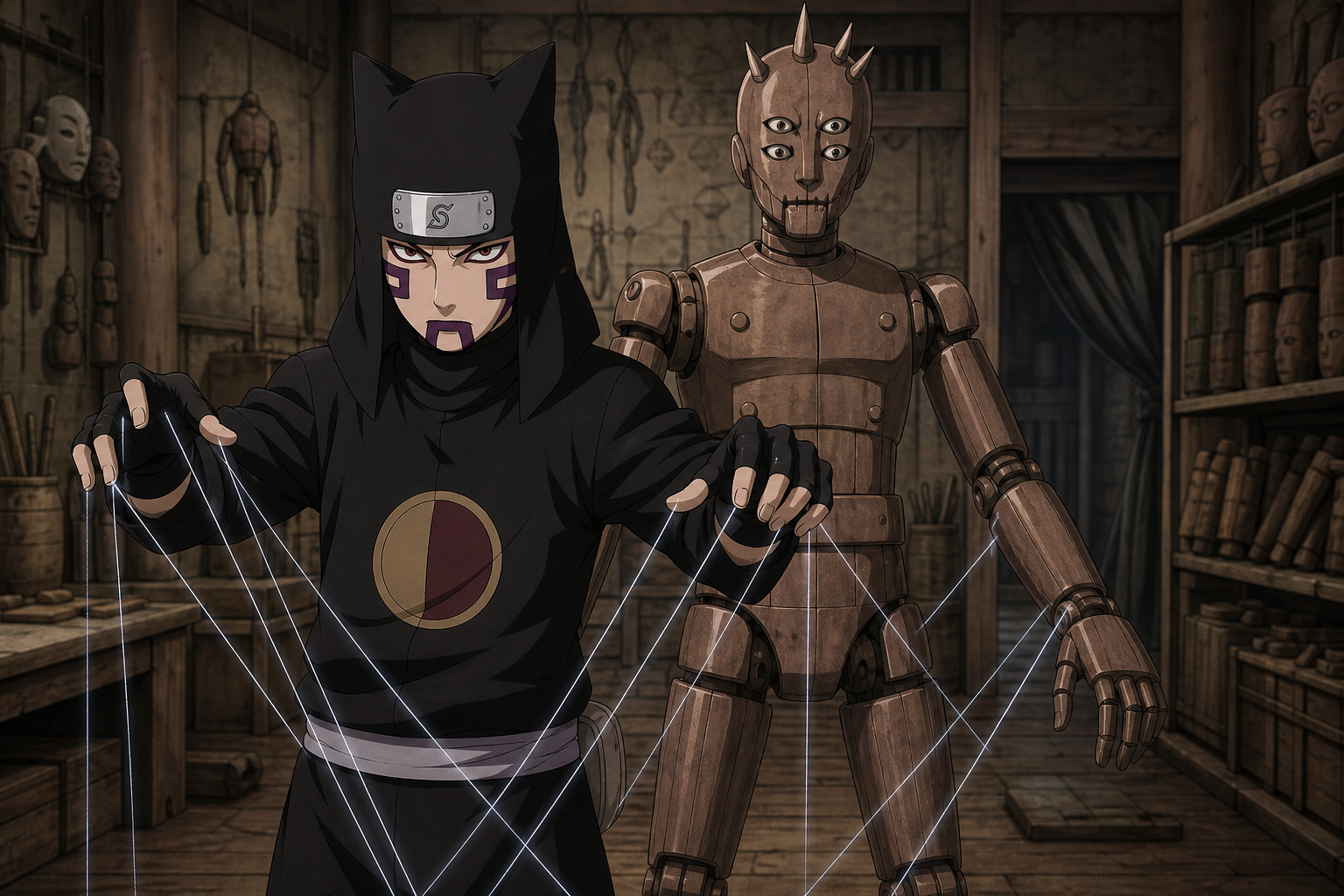
Naruto Character Encyclopedia · Complete Canon Profile
Kankurō
A frightened older brother turns secrecy, poison and inherited puppets into command, craft, and the practical work of keeping Suna alive.
01
Bottom line
Kankurō is not merely Gaara‘s less-famous brother carrying creepy dolls. He grows up unable to control the danger inside his family, masters a profession built around controlling bodies at a distance, and eventually inherits the machines of a man who turned human beings into objects.
That craft could repeat Sasori’s violence. Kankurō changes the purpose. His puppets capture enemies, defend allies, carry inherited knowledge, and help lead a war division. He never becomes the most powerful Sand sibling. He becomes the sibling who understands mechanisms, poison, preparation, and what abandoned tools can do in different hands.
His growth also begins in an uncomfortable place. Part I Kankurō is frightened of Gaara and redirects some of that fear downward. He bullies Konohamaru because the smaller child appears safe to intimidate. Later bravery does not delete that introduction. Growth becomes meaningful when the profile keeps both versions.
02
Kankurō at a glance
- Japanese name: カンクロウ, Kankurō
- Surname: None confirmed
- Birthday: May 15
- Blood type: B
- Age: 14 to 15 in Part I; 17 to 19 in Part II
- Height: 165 to 167 cm in Part I; 175 cm in Part II; 180 cm in the New Era record
- Weight: 60 to 61.2 kg in Part I; 61.2 kg in Part II
- Registration number: 54-002
- Village: Sunagakure
- Rank: Genin in Part I; jōnin in Part II
- Academy graduation: Age 12
- Chūnin promotion: Age 16
- Recorded missions: 43 total: 0 D-rank, 9 C-rank, 10 B-rank, 23 A-rank, and 1 S-rank
- Family: Rasa, Karura, Temari, Gaara, Yashamaru, and later nephew Shinki
- Manga debut: Chapter 35
- Anime debut: Episode 20
- Japanese performer: Yasuyuki Kase
- Specialty: Puppet Technique, chakra threads, poison, traps, capture, defense, and battlefield command
- Signature puppets: Karasu, Kuroari, Sanshōuo, and later Sasori’s artificial body
The databook progression gives Kankurō 19 total ability points in the first record, 24.5 in the second, and 26.5 in the third. Ninjutsu rises from 3.5 to 4. Taijutsu climbs from 1.5 to 2.5 and then 3. Intelligence jumps from 2 to 3.5, while stamina rises from 2.5 to 3.5 and then 4. Hand seals reach 4 in the second record and stay there. Speed remains his lowest physical mark even as it improves from 2 to 2.5.
That stat shape fits a puppeteer whose body is not supposed to win a footrace with the weapon. Kankurō grows by controlling more moving parts, reading traps, maintaining distance, coordinating poison, and turning inherited machines into a system he understands. His rising taijutsu does not secretly make him Guy. It shows that the operator becomes less helpless when an enemy crosses the strings.
His 43 recorded missions include no D-rank assignments, 9 C-rank, 10 B-rank, 23 A-rank, and 1 S-rank mission. Like Temari, his record is heavy with high-risk service. That makes sense for a Kazekage bodyguard, pursuit fighter, poisoned survivor, rescue participant, war-division captain, and adult security leader. The count does not replace the scenes. It gives the off-page labor a measurable floor.
03
His name and face borrow from performance
Kankurō’s name resembles the pattern of Japanese Kabuki stage names, most famously the Nakamura Kankurō line. His changing face paint, dark costume, exaggerated hood, and performance-based combat reinforce theatrical associations.
The connection needs precision. Kabuki actors are not chakra puppeteers. Bunraku puppet theater uses human operators and visible control conventions, but Naruto’s Puppet Technique belongs to a fantasy system with chakra strings, concealed weapons, poison, and remote movement. Cultural influence is not identity.
Kankurō’s face paint changes across arcs and eras. Those patterns signal visual development and keep him readable when his hood or clothing changes. A profile should document the shapes without inventing a secret emotional code for every purple line.
The paint makes his face a chosen surface. In a family defined by Gaara’s involuntary forehead mark and Rasa’s political uniform, Kankurō controls how his own face enters the room.
04
The cat-eared hood carries a workshop onto the battlefield
Part I Kankurō wears a black hood with pointed, catlike ears, a Suna forehead protector, dark clothes, gloves, and purple face paint. Karasu travels wrapped on his back, initially allowing the bundle to be mistaken for an ordinary carried object or even Kankurō himself during a substitution trick.
Part II changes his hood and paint while expanding the puppet loadout. Scrolls, chakra strings, and larger mechanisms show professional development. War clothing adds command function without turning him into a standard sword-carrying officer.
The puppet master silhouette is supposed to feel unsettling. Extra joints, wooden mouths, detachable limbs, hidden blades, and strings turn the human outline into a trap. Kankurō uses theater’s basic promise: the audience sees a body and guesses wrong about who is moving whom.
His canonical hero belongs in a workshop because the craft requires maintenance. Puppets do not heal between episodes. Hinges loosen. wood cracks. poison reservoirs empty. Somebody has to know what every compartment does.
05
Puppet mastery begins before the strings appear
A puppet fight starts in the workshop. The operator needs a body plan, balance, joint range, storage compartments, reliable latches, repair materials, compatible poisons, replacement ammunition, and a transport method. Combat control only reveals the final layer of that labor.
Kankurō inherits Sasori-built machines, but inheritance does not eliminate skill. Keeping Karasu, Kuroari, and Sanshōuo operational after field damage requires diagnosis and repair. Modifying Sasori’s shell requires understanding mechanisms designed by a superior and highly secretive creator.
The craft also needs rehearsed combinations. Kuroari’s capture chamber becomes lethal because Karasu’s blades align with specific openings. Chakra-thread control must position both bodies while Kankurō protects his own. A slight error can waste the trap or destroy valuable equipment.
This is why `he only uses Sasori’s puppets` is a weak dismissal. A concert pianist did not build the piano. Performance still requires mastery. Credit the maker and the operator without stealing from either.
Suna’s puppet tradition represents accumulated institutional knowledge. Monzaemon, Chiyo, Sasori, and Kankurō occupy different generations and ethics. The village benefits from craft even when the craftspeople disagree about what bodies are allowed to become tools.
06
He grows up between Rasa and Gaara
Kankurō is Rasa and Karura’s son, Temari’s younger brother, and Gaara’s older brother. Karura dies giving birth to Gaara. Rasa converts the youngest child into a jinchūriki project and later orders repeated assassination attempts.
Kankurō grows inside the blast radius. Gaara is dangerous, sleep-deprived, isolated, and capable of killing people with automatic sand. Rasa is the father and Kazekage who created the danger while requiring the older siblings to function around that danger.
Part I Kankurō obeys Gaara because he is afraid. Temari reads the same threat. Their fear is rational. The family receives no safe language for loving Gaara and no meaningful protection from the policy that destabilized him.
That context explains Kankurō’s caution. The context does not turn every later choice into innocence. Frightened people can still harm somebody smaller.
07
Konohamaru receives the fear kicked downhill
Kankurō collides with Konohamaru before the Chūnin Exams and grabs or threatens the younger child after the accident. Naruto intervenes, and Sasuke embarrasses Kankurō from a distance.
The scene establishes arrogance and displaced control. Kankurō cannot safely challenge Gaara or Rasa. A small Konoha child offers a target with lower consequences. Power travels downhill because fear rarely files its complaint with management.
Calling the moment sibling stress does not excuse bullying. Kankurō chooses intimidation. The later profile improves because he eventually directs protective force toward vulnerable people rather than proving status through them.
The encounter also previews his combat psychology. He wants opponents to underestimate what he carries. Sasuke reverses the gaze and makes him feel watched before Kankurō can stage the reveal.
08
The Chūnin Exams make secrecy more important than promotion
Kankurō enters the Chūnin Exams with Temari and Gaara while Suna prepares its invasion alliance with Orochimaru’s Sound forces. The formal promotion process doubles as military cover.
During the preliminaries, Kankurō is matched with Shino Aburame. He withdraws rather than reveal puppet mechanisms needed for the invasion. The decision can look cowardly. Strategically, preserving classified capability matters more than winning a public bracket.
That distinction fits a puppet user. Kankurō’s advantage depends on hidden compartments, feints, poison, and uncertainty. Once an opponent knows which body contains the operator and which limb fires the weapon, part of the system loses value.
Shino remembers the unfinished match and pursues him during Konoha Crush. The exam result has only postponed the tactical question.
09
Shino turns strings into an information problem
Kankurō uses Karasu and puppet deception against Shino during the invasion. Shino studies the chakra strings and sends insects to track or obstruct the operator. Both fighters rely on small controlled agents that extend their reach beyond the human body.
Kankurō’s poison wounds Shino. Shino’s insects reach Kankurō and drain chakra. Both collapse. Temari later removes Kankurō from danger while Shino receives help.
The result is not a clean humiliation for either fighter. Kankurō demonstrates lethal preparation. Shino demonstrates that hidden control still leaves a detectable connection.
The matchup exposes a foundational weakness. Chakra strings are invisible or difficult for many enemies, but the operator remains part of the network. Cut, trace, overload, or bypass the connection, and the person behind the puppet becomes reachable.
10
Chakra strings make distance feel like ownership
The Puppet Technique uses chakra threads from the user’s fingers to control articulated bodies, weapons, and mechanisms. Fine control determines movement quality. More puppets and complex actions require greater concentration and chakra management.
Distance protects Kankurō from direct exchange, but distance is not absence. His hands perform constantly. His attention occupies every joint. Damage to a puppet changes the available sequence even when his flesh remains untouched.
The technique’s visual language raises a body-autonomy question. A person stands apart while another body obeys. Sasori takes that logic toward human puppets and conversion of his own body. Kankurō mostly controls constructed objects and Sasori’s emptied artificial shell.
Mechanically similar strings can serve different ethics. The operator’s choices, source of the body, and purpose of control matter.
11
Karasu is the attack body
Karasu means Crow. Sasori originally creates the puppet, and Kankurō later wields, maintains, repairs, and deploys the machine. The provenance matters. Kankurō does not deserve creator credit because he uses the work well.
Karasu carries multiple limbs, concealed blades, projectile launchers, poison delivery, detachable parts, and jointed attacks. The puppet can separate into components, turning apparent destruction into a new attack angle.
Kankurō also uses disguise and substitution around Karasu. An opponent who strikes the body expected to be human may discover wood, bandages, or a weapon system instead.
Karasu’s purpose is pressure and finishing force. The puppet becomes especially lethal when Kuroari supplies confinement.
12
Kuroari is the capture chamber
Kuroari means Black Ant. The puppet’s large torso opens to trap an opponent. Additional limbs and mechanisms support containment and execution combinations.
Kankurō uses Kuroari with Karasu in the Black Secret Technique Machine One Shot. Kuroari captures the target. Karasu separates into bladed components that enter corresponding slots and strike the confined body.
The technique is efficient and horrifying. Puppet combat converts a person into material inside a box. The theatrical reveal ends with no room to dodge.
Part I Kankurō uses the combination against Sakon and Ukon. Later versions and anime/game expansions increase scale. Every named variant needs its medium label.
13
Sanshōuo is the defense Kankurō needed
Sanshōuo means Salamander. The puppet broadens the arsenal from attack and capture toward protection. Sasori also created this core puppet.
The manga shows Sanshōuo in the Part II loadout, while the anime develops shield panels, interior shelter, and the ability to protect multiple people from heavy impact. Those capabilities belong to adaptation continuity unless a manga panel demonstrates the same function.
The addition reflects professional growth. Kankurō no longer builds every answer around trapping and killing the opponent. A commander needs cover, evacuation, and survival mechanisms.
Defense also mirrors sibling repair. He once watched Gaara’s sand provide automatic protection while the family remained emotionally unsafe. His own craft eventually includes a body designed to shelter others on purpose.
14
Poison turns small contact into a delayed battle
Kankurō coats weapons and deploys poison through puppet mechanisms. Poison rewards preparation because a minor wound can decide the fight after the visible exchange ends.
The Shino battle demonstrates that delayed consequence. Kankurō can be physically overwhelmed and still leave a lethal problem inside the opponent. The Sasori encounter later reverses that advantage.
Poison also depends on knowledge, formulation, storage, dosage, and antidotes. “Puppet master uses poison” is not enough. Sasori develops a formula beyond Kankurō’s immediate ability to counter. Sakura and Chiyo save him through medical analysis and pharmacology.
The craft has an ethical edge because targets may suffer after surrender or battlefield exit. Shinobi war does not prohibit ugly methods merely because the user wears face paint instead of a snake logo.
15
Antidotes are part of the weapons race
Poison creates an arms race between chemists, medics, spies, and weapon users. A formula remains valuable while enemies cannot identify or counter the compound. Once an antidote exists, dosage and delivery still matter, but strategic surprise shrinks.
Kankurō’s own poison use does not prepare him for every toxin. Sasori develops a more advanced compound and understands Suna puppet construction. Kankurō enters the pursuit with familiar professional tools and discovers that the older craft lineage has moved beyond his countermeasures.
Sakura’s antidote demonstrates why medical intelligence belongs inside military history. She does not overpower the poison through will. She analyzes, compounds, and administers treatment under time pressure. Chiyo contributes local knowledge. Kankurō supplies the living case they are racing to preserve.
The cure later becomes operational intelligence against Sasori. Saving one patient changes the next battle. Care work produces strategy.
16
Sakon and Ukon learn what the box contains
During the Sasuke Recovery mission, Suna sends support to Konoha. Kankurō arrives as Kiba and Akamaru face Sakon and Ukon. The alliance reverses the invasion relationship: Sand shinobi now protect Leaf operatives.
Kankurō studies the fused brothers’ position, uses Kuroari to capture them, and deploys Karasu’s blades through the chamber. The victory is decisive.
The fight fits his system better than a tournament duel. He enters with information, uses surprise, selects the correct mechanism, and finishes before the enemy can rebuild momentum.
He also saves Kiba without demanding emotional repayment. Political repair becomes conduct. Suna cannot undo the invasion. Suna can show up when Konoha’s children are dying in the field.
17
Gaara’s change lets Kankurō become a brother
After Naruto defeats Gaara, Gaara begins changing his relationship to power and attachment. Temari and Kankurō no longer need to organize every interaction around fear.
Kankurō supports Gaara’s rise to Fifth Kazekage despite opposition and distrust inside Suna. That support carries more than family loyalty. He has seen the violent child and the work required to become a protector.
When Akatsuki captures Gaara, Kankurō pursues immediately. He is not escorting a military asset. He is trying to save his brother.
The shift shows why redemption changes other people’s lives. Gaara’s new conduct gives his siblings room to choose love without treating love as self-endangerment.
18
Sasori knows every weakness because he built the puppets
Kankurō catches Sasori while pursuing Gaara’s abductors. He deploys Karasu, Kuroari, and Sanshōuo. Sasori recognizes the mechanisms because he created them.
Creator knowledge destroys the surprise advantage. Sasori anticipates functions, breaks puppets, and poisons Kankurō. The encounter establishes a hierarchy of craft without declaring Kankurō incompetent.
Kankurō is using inherited technology against the original engineer. The loss reveals a supply-chain vulnerability: tools carry the assumptions and back doors of their maker.
Sasori also embodies the endpoint Kankurō has not chosen. He turns his own body into a puppet, converts corpses into weapons, and treats human permanence as a craft problem.
19
Sakura and Chiyo win the poison fight
Sasori leaves Kankurō dying from an advanced poison. Sakura analyzes the toxin and creates an antidote with Chiyo’s knowledge and available resources.
Medical work changes the entire rescue mission. Without diagnosis, chemistry, dosage, and treatment, Kankurō becomes another corpse before Gaara can be recovered.
The scene establishes Sakura’s Part II growth and shows why Suna-Konoha cooperation matters. Kankurō’s military skill cannot solve a molecular problem inside his own blood. Survival depends on expertise outside his specialty.
That dependence is not weakness. Shinobi teams exist because no professional body contains every answer. The poison master needs the medic. The village that once invaded Konoha receives life-saving knowledge from a Leaf kunoichi.
20
Sasori’s artificial body becomes inherited equipment
After Sasori’s defeat and death, Kankurō later uses Sasori’s artificial puppet body. The living core has been removed. Kankurō repairs or modifies mechanisms and integrates the shell into his Black Secret Technique arsenal.
Precise wording matters. Kankurō does not kill Sasori and manufacture a human puppet from his corpse. Sasori had already converted himself into an artificial body that housed a living core. The empty shell becomes equipment after death.
The ethics remain uncomfortable. A body-shaped object built from a person’s self-conversion carries identity and history. Kankurō uses the shell against reanimated Sasori during the war.
That choice can read as desecration, inheritance, tactical justice, or all three. The story frames Kankurō as the craft successor who gives Sasori’s abandoned creations a future beyond the creator’s nihilism.
21
The Surprise Attack Division fits his real strength
During the Fourth Shinobi World War, Kankurō leads the Surprise Attack Division. The role validates preparation, traps, concealment, capture, coordination, and tool knowledge.
He is not assigned command because he can produce the largest explosion. Surprise units need timing, intelligence, contingency planning, and the ability to turn limited openings into secure outcomes.
The division confronts reanimated Sasori, Deidara, and manipulated Shin. Kankurō coordinates with Sai, Omoi, and others while using puppets for capture and defense.
Leadership extends the same skill he developed at home. Control becomes coordination rather than domination. Other people do not become puppets. Their distinct abilities become a plan.
22
Command tests control against trust
Puppet mastery rewards precise obedience. A wooden body moves exactly as the operator directs until damage or resistance interrupts the command. Human teammates should not work that way.
The Surprise Attack Division includes shinobi with separate motives, specialties, grief, and judgment. Sai’s encounter with Shin carries personal consequence. Omoi brings Cloud training and skepticism. Kankurō has to build a plan without reducing those people to replaceable mechanisms.
That contrast gives his promotion meaning. Technical control gets him into the room. Leadership requires information sharing, delegation, adjustment, and consent. The best commander creates conditions where specialists can act, not strings that prevent them from thinking.
Kankurō’s childhood family taught control through fear. Gaara could alter the room with one threat. Rasa controlled the family through office and secrecy. Adult Kankurō inherits authority and chooses coordination instead.
23
Kankurō defeats Sasori’s philosophy
Reanimated Sasori lacks his former puppet collection and uses living/reanimated bodies through chakra strings. Kankurō uses Sasori’s old shell and inherited craft against him.
The confrontation is not a simple rematch proving Kankurō’s raw power exceeds prime Sasori. Conditions are radically different. Sasori is reanimated, separated from much of his arsenal, and confronting the afterlife of his work.
Kankurō argues that a puppet master’s soul lives in the creations passed onward. Sasori recognizes that his art and the Mother/Father puppets can continue through another practitioner. He releases his attachment and entrusts those puppets to Kankurō.
Kankurō wins tactically with a team and wins philosophically by refusing Sasori’s belief that permanence requires turning life into an object. Craft survives through transmission, not frozen ownership.
24
Mother and Father carry grief into another generation
Sasori created the Mother and Father puppets from longing for parents who died during war. Chiyo later uses the pair in battle. Their embrace once fails to give the child the warmth he wanted.
Passing those puppets to Kankurō transfers intimate family artifacts, not merely two weapon slots. He inherits Sasori’s grief and Chiyo’s modifications alongside the machines.
Possession does not prove he instantly masters every Chiyo technique. The profile must separate receipt from possibility.
The inheritance gives Kankurō a stewardship role. He can preserve the history without repeating the choice to convert actual living people into collectible power.
25
Puppet combat and bodily autonomy
Puppetry is visually thrilling because one body makes another body move. The same image becomes terrifying when the controlled body is human, dead, reanimated, or unwilling.
Kankurō mostly operates constructed puppets. Sasori crosses into human puppets and self-conversion. Kabuto’s reanimation creates another layer of forced bodily use during the war.
The Surprise Attack confrontation therefore stages competing control systems. Kabuto controls souls and corpses. Sasori controls bodies through strings. Kankurō controls crafted tools while coordinating consenting teammates.
The mechanical vocabulary overlaps. The ethics depend on consent, origin, and purpose. Chakra strings are not evil. Treating persons as inventory is.
26
Masculine fear under the face paint
Kankurō begins with swagger that collapses when Gaara speaks. The shift exposes fear beneath performance. He can threaten Konohamaru because the child feels controllable. He cannot confront the family system creating the fear.
Later masculinity becomes less theatrical and more reliable. He pursues Gaara despite danger, accepts medical dependence, serves as jōnin, leads a mixed division, and cares for the next generation.
The face paint remains. Growth does not require replacing performance with emotional blankness. Kankurō learns to direct courage upward and protection downward.
28
Buddhist impermanence and inherited craft
Sasori wants permanence. Human bodies decay, so he converts bodies into puppets and seeks art that does not change. The desire produces murder and isolation.
Kankurō repairs broken tools, changes their mechanisms, and passes knowledge forward. His craft accepts that objects break and meaning changes with use.
The war confrontation releases Sasori when he accepts transmission rather than ownership. Kankurō becomes evidence that a creator can end while craft continues.
Nonattachment here does not mean disrespecting objects. The opposite. Stewardship honors history without freezing the artifact or person into one purpose forever.
29
The New Era makes him uncle and institutional memory
Gaara adopts Shinki in New Era continuity, making Kankurō an uncle within the chosen family. Anime and manga differ in how much daily family material they show, so exact scenes need labels.
Kankurō continues serving Suna and supporting Gaara’s leadership. New Era anime places him in dangerous missions involving Urashiki and Shinki, including an apparent self-sacrificial stand whose outcome belongs to that anime arc.
His adult value is continuity. He remembers Rasa’s household, Gaara’s violence, the invasion, alliance repair, Akatsuki, Chiyo, Sasori, and the war. Shinki inherits a Sand village where those histories should inform how adults respond to powerful children.
The puppet workshop can teach more than combat. Maintenance, patience, design, and respect for what a tool can do are alternatives to treating power as bloodline destiny.
30
Yasuyuki Kase in Japanese
Yasuyuki Kase performs Kankurō in the original Japanese anime and relevant franchise animation. His credit is verified through agency and franchise records. The role moves through swagger, comic irritation, fear of Gaara, poisoned weakness, sibling desperation, craft authority, war command, and adult family care.
I am not inventing vocal texture, dialect effect, breath, or timing analysis without the heard Japanese scenes. Naming the contexts describes the performance task. It does not turn a cast record into criticism.
31
Manga, anime, films, OVAs, games, and novels
Kishimoto’s manga controls the core biography. The anime expands puppet mechanisms, Suna missions, family scenes, war choreography, and New Era duty. Sanshōuo’s shelter functions are especially adaptation-heavy and must stay labeled.
In Naruto the Movie: Legend of the Stone of Gelel, Kankurō helps defend Suna forces on the coast, battles the armored invaders, attacks Temujin after finding the captive children, defeats Kamira through puppet trapping, and helps evacuate the children as the ruins collapse. That is an actual supporting role, not a face in a crowd.
In Naruto Shippūden the Movie: The Will of Fire, he appears with the Suna force during the confrontation created by the Konoha misunderstanding. His part is brief. The Last: Naruto the Movie gives him a clearer village-duty beat: he joins Gaara and Temari in Suna’s meteor defense and later hears Ino’s broadcast confirming Naruto’s team saved the world.
In Boruto: Naruto the Movie and the related Momoshiki adaptation, Kankurō accompanies Gaara to the Chūnin Exam finals and helps move civilians when the attack begins. The Hidden Leaf Village Grand Sports Festival! OVA includes him as a franchise-comedy appearance. Neither a movie cameo nor an OVA gag belongs in manga chronology.
Gaara Hiden gives Kankurō substantial political and technical work through the Maizuru operation, the arranged-marriage crisis, security duty, and a staged coup used to expose Tōjūrō. Shikamaru Shinden places him beside Gaara at a Kage Summit. Games such as Naruto RPG 2: Chidori vs. Rasengan, Clash of Ninja Revolution 3, Ultimate Ninja 4, and Naruto Mobile make him playable and expand puppet combinations for combat systems. Those moves are game design unless manga or anime supplies the same technique.
32
Seven fandom shortcuts that cut the strings
“Kankurō built Karasu, Kuroari, and Sanshōuo”
Sasori created the core puppets. Kankurō inherited, maintained, repaired, modified, and mastered their use.
“He is a coward”
He begins fearful and sometimes bullies downward. He later pursues Akatsuki alone and leads a war division. Both stages belong in the record.
“Shino destroyed him”
Both fighters incapacitate one another through insects and poison. The matchup exposes both systems.
“Kankurō beat prime Sasori”
War Sasori fights under different conditions without his full living arsenal. Kankurō’s team victory and philosophical succession remain impressive without false equivalence.
“Using Sasori means Kankurō made a human puppet”
He uses Sasori’s already artificial shell after the living core is removed.
“Puppets are weak because the operator hides”
Distance, concealment, poison, capture, and modular tools are the combat system. Refusing a fistfight is not professional shame.
“He is only Gaara’s assistant”
Kankurō becomes a jōnin, war captain, puppet successor, sibling, and institutional craft holder.
33
The final verdict
Kankurō starts as a boy trying to feel powerful near somebody smaller because his own home makes him afraid. He grows into the adult who pursues his brother, accepts another village’s medicine, leads specialists, and carries a dead artist’s work without inheriting the dead artist’s contempt for human life.
The strings do not make him important. The choices at the other end do.
Sasori builds the machines. Kankurō proves that inheritance is not obedience. A tool can remember its maker without repeating the maker’s purpose for other people.
That distinction is his real legacy in Suna. Kankurō receives mechanisms built for secrecy, poison, capture, and death. He keeps the technical knowledge, rejects human-puppet nihilism, and turns control into coordinated protection. Craft does not arrive morally finished. Every generation decides what the inherited hands will be asked to do next.
Sources and canon boundary
Editorial record: Manga chronology controls. Anime expansions, novels, films, OVAs and games are labeled instead of blended into canon.
Primary franchise references: Naruto Official and VIZ Media Naruto. CVM Sekai’s conclusions about puppet craft, poison, Gaara, Temari, Sasori, war command, performance history, inheritance, and repair are editorial analysis, not invented creator quotations.