
Shino Aburame
The boy everyone forgets becomes the teacher who notices quiet children. His restraint is discipline, observation, pride, and an entire living insect network.
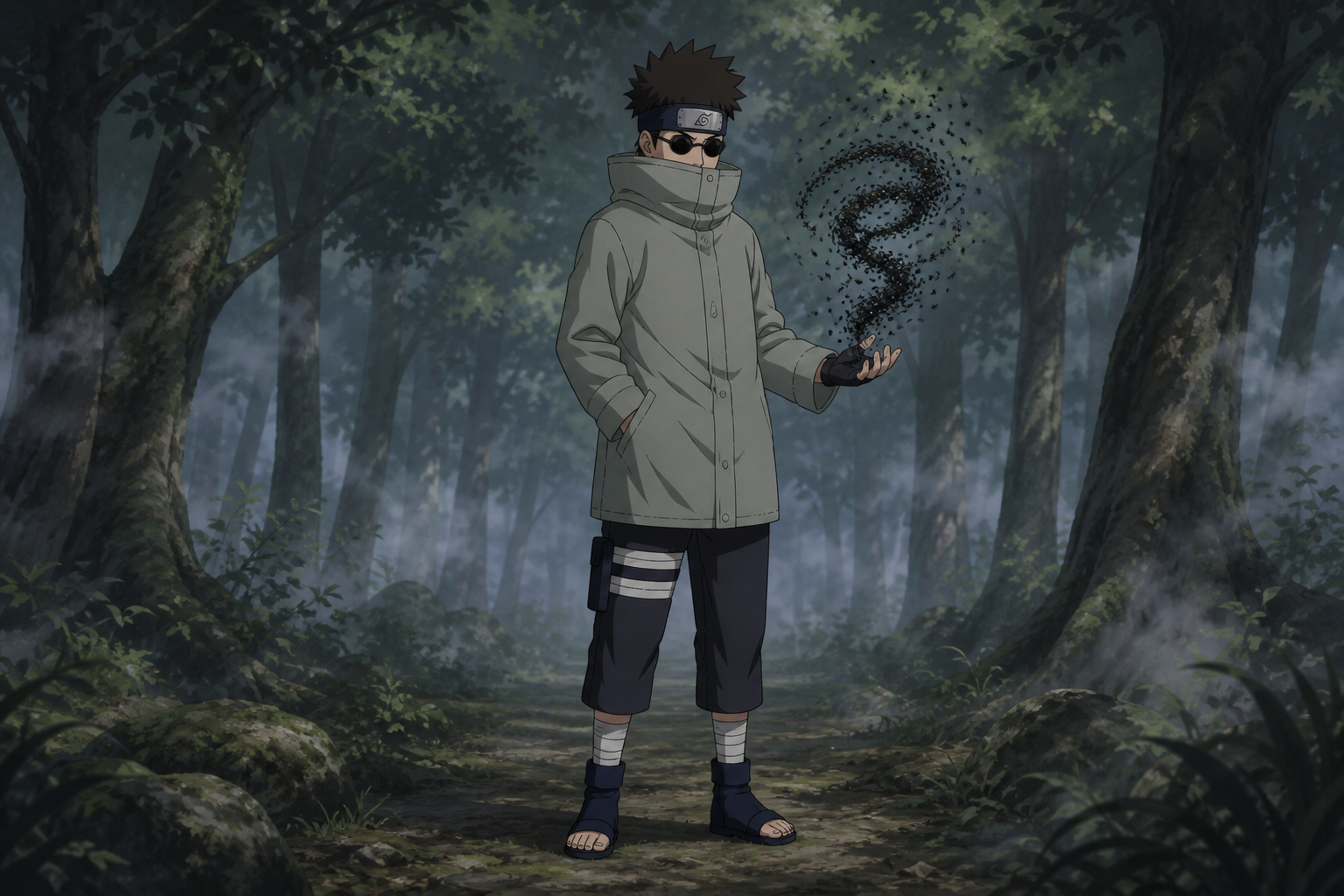
Shino Aburame is not emotionless. He is a boy who learned to communicate through restraint, observation, and thousands of insects living inside his body. He wants his friends to remember him. He gets irritated when they do not. He takes pride in preparation, hates being underestimated, and eventually chooses a job where noticing the quiet child matters more than winning the loudest battle.
Naruto often uses Shino as a joke about forgetting somebody who is standing right there. The joke works because his design hides so much of him: dark glasses, high collar, hands in pockets, flat delivery. The joke also exposes the series. Shino is one of the smartest young tactical fighters in Konoha, and the narrative repeatedly forgets to use him.
His body complicates every easy idea about individuality. Kikaichū live inside him, consume his chakra, reproduce, scout, defend, and attack. Shino says `I`, but that `I` is already a working community. The clan calls the relationship symbiotic. A serious profile must hold the mutual adult partnership beside the fact that the arrangement begins at birth, before any child can consent.
His databook record shows the exact kind of growth fandom overlooks
The second databook records seven D-rank missions and five C-rank missions for Shino at that stage. The total is modest because the snapshot catches him early. Mission count should never be padded with anime episodes unless the source labels the continuity.
His first-databook ratings are ninjutsu 3.5, taijutsu 1.5, genjutsu 2, intelligence 3, strength 1.5, speed 1.5, stamina 2, and hand seals 2. By the third databook, ninjutsu reaches 4, intelligence 4, speed 3, and stamina 3, while the remaining categories stay stable.
The shape fits. Shino wins through technique, analysis, range, patience, and distributed action. Raw strength and conventional taijutsu are not his center. His insects allow simultaneous scouting, feints, pursuit, defense, and chakra pressure, so one body can manage several tasks without turning him into a physically dominant brawler.
Databook scores do not prove the fandom claim that Shino is secretly unbeatable. They establish a smart specialist with real growth and clear physical limits. `Underrated` is not a coupon for unlimited power.
The high collar is not a substitute for personality
Part I Shino wears round dark glasses, a Konoha forehead protector, a pale gray-green coat with a collar covering most of his lower face, dark cropped pants, and shinobi sandals. His hands often remain in his pockets. The design blocks ordinary emotional signals and pushes the viewer toward posture, insects, and voice.
Part II makes him taller and more concealed. A hood, darker glasses, and a higher collar turn the body into a near-anonymous column. That visual language fits surveillance and insect work. Enemies cannot easily read his eyes, mouth, breathing, or hand position.
The New Era gives Shino a visor-like face covering that fans compare to a toaster or virtual-reality headset. The design is clunky, yes. RaeRae has eyes. The useful question is what the clunkiness communicates. Adult Shino has become an Academy teacher in a modernizing village, and his old concealment grammar gets translated into technological-looking eyewear. The result loses some quiet menace and gains awkward educator energy.
Fashion criticism is allowed. Treating his adult job as punishment because the goggles are ugly is not analysis.
The Aburame body is home, workplace, weapon system, and inherited obligation
Aburame children receive kikaichū as bodily hosts from birth. The insects live within the human body and feed on chakra. In return, they obey commands and provide tracking, defense, restraint, clones, and chakra-draining attacks.
`Symbiosis` describes mutual benefit. The word does not answer the consent question. A newborn cannot choose a lifelong internal colony, understand the physical cost, or refuse clan tradition. Adult Shino can value the insects, cooperate with them, and experience the arrangement as identity while the origin remains nonconsensual.
That tension does not make the Aburame monsters. Naruto’s clan system routinely places children inside inherited obligations before informed choice: eyes, seals, techniques, political expectations, arranged teams, and family labor. The Aburame version makes the bodily dimension impossible to ignore.
MRT asks whose body becomes infrastructure. Shino’s chakra feeds a living network that serves family and village missions. The village benefits from surveillance and combat capacity. The individual host carries daily maintenance, sensory load, social stigma, and battlefield danger. Calling the arrangement a cool power without examining the labor is fandom doing unpaid advertising for Konoha again.
The insects are partners, but not one interchangeable black cloud
Kikaichū are the core chakra-feeding insects associated with Aburame hosts. They can scout, swarm, consume chakra, form shapes, and follow scent or command. Other insect types have different properties.
Kidaichū are giant parasitic insects used in later high-impact techniques. Rinkaichū are nano-sized poisonous insects associated with Shikuro and Torune. Bikōchū appear in an anime-original tracking mission. Those names are not decorative synonyms.
Shino breeds, directs, and studies insects. His databook interest in insect ecology matters because technique depends on living systems. Temperature, toxins, predators, breeding cycles, food, host chakra, and environment can all change performance.
The insects also die. A swarm is visually replaceable because individual bodies are tiny and numerous. That scale can hide the moral cost. Shino’s techniques spend living collaborators, even when reproduction makes the population recover. Naruto rarely pauses over insect death because the camera reserves grief for bodies with faces.
Buddhist interdependence fits Shino better than generic `hive mind` mysticism. No participant exists alone. Human chakra sustains insects; insects extend the human’s senses and reach; environment sustains both. The self is a relationship before the philosophy lecture begins.
Shibi protects his son through the same system that makes the clan dangerous
Shibi Aburame is Shino’s father. During the Konoha Crush, Shino collapses from Kankurō’s poison after their fight. Shibi uses insects to remove the poison and save him.
The rescue matters because Aburame technique is not only offensive. The same distributed biological system that drains an enemy can extract contamination from family. Care and combat share infrastructure.
Anime material expands the household through Torune. After Shikuro’s death, Shibi takes responsibility for Torune, and Torune becomes Shino’s foster or adoptive brother. Danzō seeks a young Aburame recruit for Root; Torune goes in Shino’s place. That history is emotionally important in the anime and absent as a full childhood relationship from the manga.
The continuity label protects both versions. Manga Torune is an Aburame Root operative with lethal rinkaichū. Anime Torune becomes a brother whose sacrifice shields Shino from institutional conscription. Importing the expanded bond without a label makes a strong adaptation choice look like a hidden manga fact.
Team 8 gives Shino several ways to be seen and several ways to disappear
Kurenai leads Shino with Kiba, Hinata, and Akamaru. The team is built for reconnaissance. Hinata reads distance and chakra through the Byakugan. Kiba and Akamaru map scent. Shino distributes insects across terrain. Kurenai understands perceptual manipulation through genjutsu.
Shino’s calm can stabilize Kiba’s impulsiveness. Kiba’s noise can pull Shino into social exchange. Hinata shares his observational reserve but carries different insecurity. Kurenai has to notice a student who rarely requests attention directly.
Shino does request attention indirectly. He becomes irritated when Naruto recognizes Kiba quickly but fails to identify him after the time skip. He explains himself with `the reason is` constructions that turn a simple feeling into a formal report. The comedy reveals longing. Somebody who does not care about belonging does not keep records of being forgotten.
His team loyalty also appears through absence. Shino misses the Sasuke Retrieval Mission because he is away with Shibi. He later regrets not being present and believes his contribution might have changed the outcome. That belief may overestimate one fighter’s ability to reverse Sasuke’s choice, but the regret proves attachment.
Zaku loses because Shino attacks the weapon’s assumption
During the Chūnin Exam preliminaries, Shino fights Zaku Abumi. Zaku’s arms contain pressure tubes that produce destructive air attacks. Zaku believes keeping one functional arm preserves the advantage.
Shino sends insects into the openings and blocks the system. When Zaku forces pressure through the obstructed tubes, the attack backfires and severely damages his arms. Shino then finishes the match.
The tactic is elegant because Shino does not overpower the blast. He changes the conditions inside the weapon. Small bodies occupy a channel the opponent assumes is empty.
The consequence is brutal. Zaku is a child used by Orochimaru, already injured, and desperate to prove usefulness. Shino fights the opponent in front of him and does not possess the full Sound exploitation file. Readers do. Tactical admiration should not turn another abused child losing an arm into a victory meme.
Shino’s stated habit of never underestimating even a small insect becomes an ethical and strategic principle. Size does not determine consequence. The series applies that truth to bugs more consistently than to children.
Kankurō proves Shino can win a plan and still lose the body
Shino is scheduled to face Kankurō in the final Chūnin Exam round. Kankurō forfeits to protect the secrets of his puppet before the invasion. When the Konoha Crush begins, Shino follows and takes the fight anyway, allowing Sasuke to continue pursuing Gaara.
Kankurō controls Karasu through chakra strings and attacks from distance with hidden weapons and poison. Shino’s insects eat or sever the chakra connection, forcing interruptions in puppet control. He also uses a female insect as a scent marker so the broader swarm can find Kankurō.
Kankurō’s poison gas still reaches him. Shino drains Kankurō’s chakra and incapacitates him, then collapses from poison. Shibi later extracts the toxin.
That is mutual incapacitation followed by paternal rescue, not an undefeated-statistic flex. Shino’s plan succeeds. Kankurō’s poison succeeds. Both truths belong in the result.
The fight also shows two forms of remote labor. Kankurō acts through a puppet connected by chakra thread. Shino acts through insects connected by command and host relationship. Each fighter tries to break the other’s network while keeping the vulnerable human body out of direct reach.
Missing the Sasuke Retrieval Mission becomes part of his social wound
Shino is absent when Shikamaru assembles the retrieval team. The story gives a practical reason: he is away on a mission with his father. The absence also removes one of Konoha’s best trackers and most patient trap-builders from a mission defined by pursuit.
Fans love asking whether Shino would have changed everything. He could have helped. Insects could track, scout, pressure chakra, and complicate several matchups. None of that guarantees Sasuke returns. Sasuke leaves through choice, coercion, curse-mark pressure, and a willingness to fight former friends.
Shino’s regret matters more than the hypothetical tournament. He wanted to be included. His repeated experience of being overlooked meets the one absence he did not choose. The boy who hides his mouth still wants somebody to notice the empty place in the formation.
Afterward, he works on teamwork with Kiba and Hinata in adaptation material. Growth does not require turning him into an extrovert. Shino needs methods for making commitment legible to people who cannot read insects.
Kurenai, Hinata, and Kiba each ask for a different kind of communication
Kurenai is Shino’s jōnin leader and the adult responsible for integrating three clan specialists whose senses do not overlap neatly. Her genjutsu background makes her a sensible supervisor for a student whose insects can confirm whether perceived reality matches physical movement. The manga gives too little direct instruction between them, so the profile cannot invent long private lessons. Team architecture is evidence. Imaginary conversations are not.
Hinata and Shino share quiet observation, but their silences come from different places. Hinata enters Team 8 with damaged confidence and fear of judgment. Shino’s reserve contains confidence that other people fail to recognize. He does not need someone to tell him he is capable. He needs teammates to remember that he is present.
Their abilities can cross-check one another. The Byakugan sees chakra flow and distant bodies. Insects occupy terrain, enter narrow spaces, and report through distributed movement. A visual blind spot may still contain insects. A genjutsu that fools one sensory channel can face another.
Kiba is Shino’s loudest contrast. Kiba announces conclusions, complains openly, and treats momentum as a moral virtue. Shino explains after observing. Their friction can become useful because each exposes the other’s failure mode. Kiba can force action before Shino overprocesses. Shino can prevent Kiba from sprinting directly into the trap with excellent enthusiasm.
Akamaru also matters. Shino works with living nonhuman partners every day, so Kiba’s communication with a ninken should not look childish or strange to him. Team 8 contains more than four human nervous systems. Their intelligence network includes insects and a dog, which makes ordinary spoken command only one layer of coordination.
A complete technique shelf is a distributed system
Parasitic Destruction Insect Technique is the foundational Aburame method. Kikaichū consume chakra and respond to the host’s commands. Shino can send them to track, surround, infiltrate, or drain a target.
Insect Clone creates a human-shaped duplicate from insects. Striking the clone can disperse the body without harming Shino, after which the insects remain available for movement or counterattack. The clone is a decoy made from living units rather than a conventional solid double.
Insect Sphere surrounds an opponent in a dense swarm and drains chakra. Insect Jamming spreads insects to interfere with sensory detection. Exact names and appearances vary across manga and anime records, so the publication version must keep the shelf labeled.
During the war, Shino uses Parasitic Giant Insect: Bug Bite against Ten-Tails spawn. A planted kidaichū consumes chakra and grows rapidly inside the target before bursting outward. The visual is body horror, and the technique is powerful. The manga scene does not prove Shino can automatically kill any tailed beast or god-tier opponent from the inside. Delivery, scale, defenses, and target biology still matter.
Guidebooks associate him with Fire, Earth, and Yang Release. The manga does not provide a broad shelf of fireballs or earth walls. Nature classification is not a coupon for unseen techniques.
Insect communication is skilled translation, not magical telepathy with subtitles
Shino can issue commands and interpret insect response, but the manga does not present every kikaichū as a tiny person delivering complete spoken sentences. Information may arrive through movement, clustering, return patterns, scent, chakra consumption, absence, or behavior the host has learned to read.
That distinction matters because translation is labor. Shino must know what a species can detect, how quickly individuals travel, what environmental conditions distort the signal, and whether a missing group found danger or simply failed to return. A swarm can gather enormous data while still requiring a human interpreter who understands uncertainty.
Ecology gives his skill intellectual depth. Insects occupy niches, respond to temperature, reproduce on different schedules, and interact with predators, plants, soil, water, and disease. A technique user who ignores those relationships would burn through colonies and misread the field.
The Academy-teacher career makes that knowledge socially valuable beyond combat. Insect study can teach observation, patience, classification, ecosystems, and respect for life forms children are trained to crush without thinking. Shino can turn the thing classmates find creepy into a lesson about how much work remains invisible under every leaf.
That is also why generic insect horror misses the character. Naruto sometimes stages a swarm as bodily threat because thousands of small moving forms trigger disgust. Shino lives inside that visual fear without being corrupted by the insects. The unsettling image belongs to the viewer’s boundary anxiety more than to his morality.
His limits are biological, social, and narrative
Shino supplies chakra to the insects. Large operations must still draw on host resources. Species need appropriate conditions and breeding. Heat, poison, area attacks, insect predators, sealed spaces, and rapid destruction can reduce a swarm.
His lower strength and taijutsu ratings make close physical pressure a risk, even though he can defend himself. Poison incapacitates him against Kankurō. Space-time evasion prevents a successful strike on Tobi even after Shino helps identify the mechanism.
Socially, reserve causes information loss. Shino may understand a plan without making teammates understand him. Being correct after everyone has moved is not the same as coordinating before the move.
Narratively, his techniques are difficult to stage beside giant chakra avatars. Thousands of small actions require panels, animation, and explanations. The industry often chooses one bright explosion instead. That production preference becomes character hierarchy if viewers mistake screen time for in-world competence.
Part II lets him diagnose Tobi without catching him
Shino returns as a chūnin in Team 8 and later joins the Eight Man Squad searching for Sasuke and Itachi. His insects add distributed tracking to Hinata’s sight, Kiba’s smell, Kakashi’s ninken, and broader team intelligence.
Against Tobi, Shino observes that attacks appear to pass through the body rather than simply being dodged. That distinction moves the team closer to understanding the space-time defense.
His insects still cannot secure Tobi. Detection, diagnosis, and capture are separate stages. A specialist can solve one stage while the enemy’s system defeats the next.
Shino’s contribution is easy to miss because no dramatic impact frame rewards the explanation. The fight confirms his core function: he turns observation into a better question.
Pain and war use the Aburame clan as a collective defense network
During Pain’s assault, Shino appears with Shibi and other Aburame members against Konan. The confrontation reinforces clan-scale deployment. Paper bodies and distributed insects create a natural contest between swarms, but the manga does not give a long decisive showcase.
In the Fourth Shinobi World War, Shino serves in the Fifth Division and joins the Konoha generation against Ten-Tails spawn. Bug Bite provides his major manga escalation.
The anime adds a personal confrontation with reanimated Torune. That story connects Root recruitment, foster-brother sacrifice, toxic rinkaichū, antibodies, and grief. The material can deepen anime Shino substantially. The episode remains an adaptation-original branch.
War turns insects into surveillance, identification, offense, and medical possibility. War also turns living populations into expendable supply. An ecological reading asks what militarized breeding does to species selected only for useful traits. Naruto rarely follows that consequence home.
Becoming an Academy teacher is not a downgrade
In the New Era, Shino becomes an Academy teacher and holds jōnin status in the broader character record. Some fans treat the job as proof that the sequel nerfed him into childcare.
Teaching fits. Shino observes before acting. He understands specialized bodies, unconventional communication, teamwork across difference, and the pain of being overlooked. He studies ecology. He has lived inside a clan tradition since infancy and can recognize when inherited ability is not the same as chosen identity.
The Boruto anime uses his social awkwardness for comedy and sometimes shows him struggling to connect. That struggle does not invalidate the career. Knowing children deserve attention and knowing how to hold a lively classroom are different skills. Teachers learn too.
Confucian teacher duty becomes practical here. Authority must create conditions where students can develop, not simply demand obedience. Shino’s childhood gives him a specific ethical advantage: he knows that quiet children can be full of activity nobody else sees.
His arc forms a clean line. The boy who resents being forgotten becomes the adult whose job is remembering every name.
Education gives him power without requiring another war
The shinobi Academy is not neutral. The school teaches literacy, chakra basics, weapons, discipline, teamwork, village history, and the first habits of military identity. A teacher helps children become capable, but the institution also prepares those children for missions.
Shino therefore inherits an ethical problem larger than classroom management. He knows what clan techniques can demand from a child before consent. He knows classmates can overlook a quiet student until the exam asks that student to bleed publicly. He knows village service can turn specialized bodies into infrastructure.
A good teacher can use that knowledge to widen choice. He can distinguish a child who needs encouragement from one who needs space. He can recognize nonverbal communication, sensory difference, clan pressure, and the gap between test performance and useful intelligence. None of that abolishes Konoha’s military structure. Daily practice can still make the structure less careless.
Boruto-era comedy often places Shino behind an unruly class whose technology, family privilege, and peacetime expectations differ from his childhood. His awkwardness is credible. Adults do not become perfect educators because their thematic résumé looks good in an essay.
The consequence is more interesting than instant mastery. Shino must make warmth visible. Children cannot grade intentions hidden behind a collar and visor. The teacher who once wanted friends to infer his feelings has to learn that care sometimes needs plain language.
Industry analysis should also resist calling classroom stories `filler` whenever no god needs punching. A franchise about generational inheritance should care how the next generation is taught. Education is where slogans become habits before a battlefield tests them.
Shinji Kawada and the original Japanese performance
Shinji Kawada performs Shino in the original Japanese anime. His credit is verified. Toshihiko Seki is sometimes mistakenly attached to Shino in secondary summaries, but Seki performs Iruka Umino. That error must not enter the site.
The verified performance contexts include the Zaku match, Kankurō fight, post-timeskip recognition joke, Tobi analysis, Torune’s anime story and Academy teaching. I am not inventing pitch, timing, breath or deadpan analysis without the heard Japanese scenes. A verified credit with honest context is better than fake precision.
No English-dub material belongs here.
Anime, films, OVAs, novels, and games
The original anime adapts Shino’s Chūnin Exam and Konoha Crush material and gives Team 8 additional missions. The bikōchū search is an important anime-original tracking story. Naruto Shippūden adapts his Part II and war appearances while adding the Torune confrontation.
Shino appears in licensed films and OVAs as part of the broader Konoha cast. Road to Ninja includes an alternate-world version whose behavior belongs to that film’s constructed setting, not the core personality record. A cameo and a supporting role should remain distinct in the final media shelf.
Novel and New Era materials support the transition toward teaching where specifically credited. The Boruto anime supplies far more classroom content than the original manga epilogue.
Games use Shino as playable or support material across Ultimate Ninja, Clash of Ninja, and Ultimate Ninja Storm lines. Swarms become walls, spheres, traps, and ranged pressure for gameplay. Game-exclusive move names do not establish manga species or techniques.
Seven fandom misreadings that should be released into the wild
`Shino has no emotions`
He shows pride, irritation, loyalty, loneliness, confidence, regret, and desire for recognition. His expression channel is restrained. Restrained is not empty.
`Shino is undefeated`
He defeats Zaku. The Kankurō fight ends with both incapacitated, and Shibi saves him from poison. Tobi evades his insects. The meme inflates a strong tactical record into fake perfection.
`All Aburame insects are the same`
Kikaichū, kidaichū, rinkaichū, and bikōchū have different roles and continuity records. `Bug` is not a species sheet.
`Torune is canonically his brother in every version`
The anime expands Torune into Shino’s foster/adoptive brother and protector from Root recruitment. The manga does not provide that complete childhood relationship.
`He became a teacher because he was too weak for field work`
No. Teaching matches observation, patience, ecology, and his experience of being overlooked. The career uses strengths combat fandom refuses to count.
`The New Era goggles ruined the character`
The visor is awkward. A bad accessory does not delete a personality, résumé, or profession. Fashion court is adjourned.
`Shino could secretly beat anyone if the author let him`
His insects are versatile, not omnipotent. Heat, toxins, speed, range, defenses, host chakra, delivery, and story-specific counters still exist.
Final verdict
Shino Aburame is a tactical specialist, living ecosystem, loyal teammate, overlooked friend, and teacher whose quietness contains far more feeling than the series often pauses to hear. His best fights are not power contests. They are systems problems. He finds the channel, string, scent, or assumption holding an enemy’s method together and sends something small into the gap.
The insects make his body communal. His friends make his identity social. His students make his adulthood consequential. Shino spends childhood asking people to notice him and adulthood learning how to notice children. That is not a downgrade. That is the answer.
Sources and canon boundary
Manga chronology controls this profile. Anime staging, databook material, novels, films, games, and later franchise appearances are labeled instead of being blended into one false continuity.
Primary franchise references: Naruto Official and VIZ Media Naruto. CVM Sekai’s conclusions about Shino’s kikaichū partnership, Team 8 tactics, clan practice, teaching career, social isolation, and New Era growth are editorial analysis, not invented creator quotations.