
Hinata Hyūga
Her clan called gentleness weakness until she proved courage can remain visibly afraid, refuse inherited cruelty, and still step into the fight.
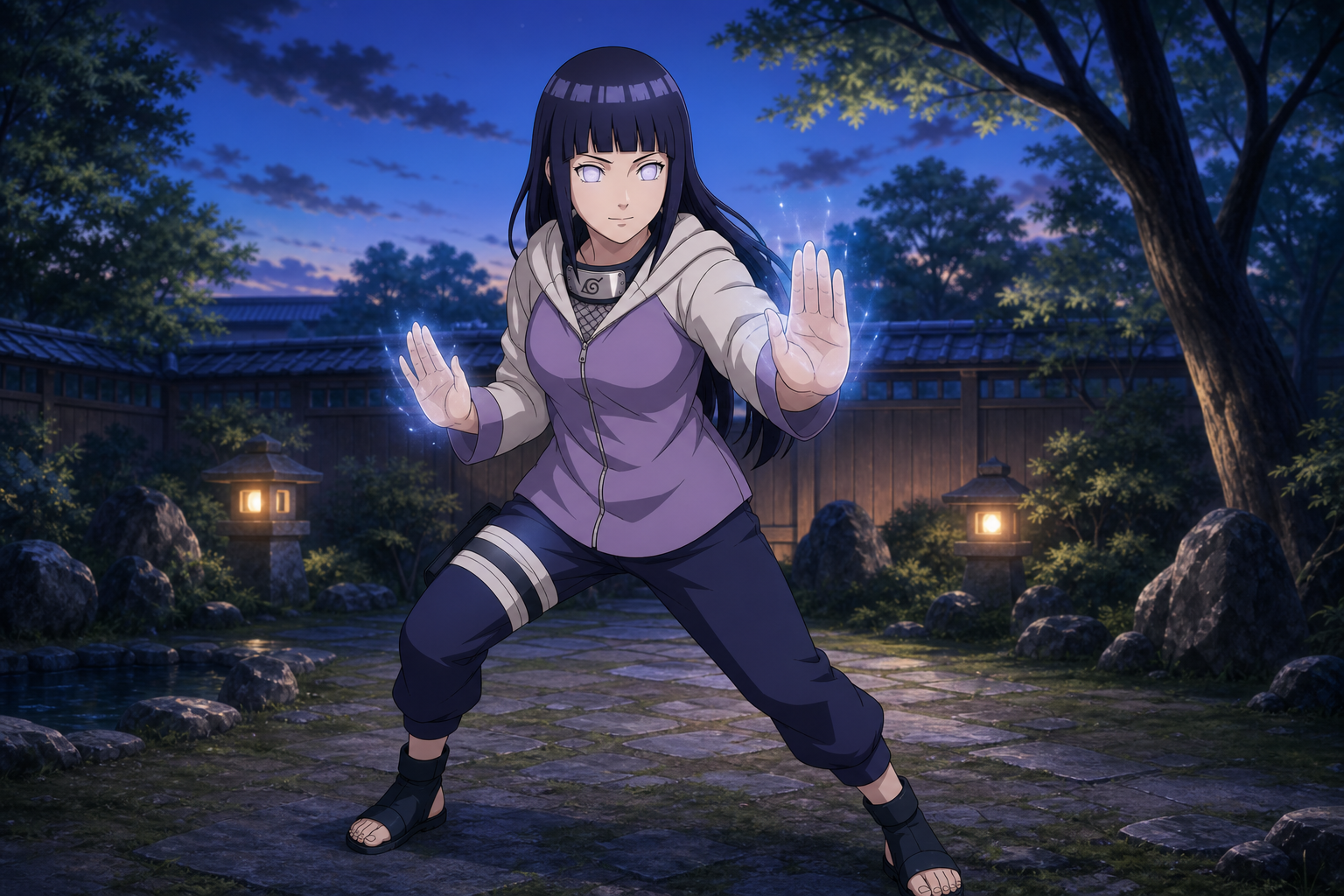
Hinata Hyūga is not brave because quiet women are secretly purer than everybody else. She is brave because one of Konoha’s most powerful families trains her to experience her own presence as failure, and she keeps stepping forward anyway.
Naruto inspires her because he refuses the shame other people assign him. He does not install courage inside her like a software update. Hinata watches, chooses, fails, trains, speaks, and chooses again. The distinction matters. A love story can support self-authorship. A love story should not confiscate authorship and hand the credit to the boy.
Her complete profile also has to confront the Hyūga system. Main-house authority, branch-house control, the Caged Bird seal, Hiashi‘s rejection, Hizashi’s death, Neji‘s rage, Hanabi‘s comparison, and Hinata’s expected succession all shape the child before romance enters the frame. Later, The Last gives her central plot work while surrounding that agency with kidnapping, coerced marriage, mind control, and rescue. The New Era gives her a family and then repeats Naruto’s old habit of treating domestic labor as background.
Hinata is gentle. Gentle is not the same word as passive. The whole franchise keeps learning that lesson and forgetting by the next commercial break.
The databook record measures growth the clan refused to predict
Hinata’s first guidebook snapshot records five D-rank missions and three C-rank missions. By the later period, the mission record reaches 33 total: ten D-rank, fourteen C-rank, eight B-rank, one A-rank, and no S-rank assignments.
Her first-databook ratings are ninjutsu 1.5, taijutsu 2.5, genjutsu 1, intelligence 2.5, strength 1, speed 2, stamina 1.5, and hand seals 2. By the third databook, she reaches ninjutsu 3, taijutsu 3.5, genjutsu 2.5, intelligence 3.5, strength 1.5, speed 2.5, stamina 2, and hand seals 3.
Every category rises. The strongest development appears in ninjutsu, genjutsu, intelligence, hand seals, and Gentle Fist practice. Raw strength remains low because Gentle Fist does not depend on winning a conventional punching contest. Precision can damage the chakra network and internal organs without producing Sakura-sized pavement receipts.
The first databook says the clan found her fighting ability lacking while noting conspicuous latent potential. That sentence captures the family failure. Hyūga evaluation sees an heir who does not match the desired temperament and treats current performance as identity. The same official guide material sees room to grow.
Her design moves from protection toward chosen visibility
Part I Hinata has a short dark indigo hime cut, blunt fringe, pale lavender eyes, and a cream-lavender hooded jacket. She wears her Konoha forehead protector around her neck. The oversized layers make her look protected from the world and physically smaller inside her own clothing.
Part II gives her longer hair, a more fitted lavender-and-cream jacket, dark pants, and a steadier Gentle Fist silhouette. The palette remains soft, but the body no longer reads as if she wants to disappear inside the hood.
War scenes place the same design under exhaustion, dust, injury, and mass casualty. The Last creates a young-adult wardrobe for missions, scarf-making, festival scenes, and Toneri’s coerced wedding environment. The wedding garment cannot be discussed as a pretty bridal transformation without naming the coercion surrounding the clothing.
New Era Hinata is styled primarily through home and family. That visual shift reflects chosen domestic life and an industry habit of removing married women from action language. Both can be true. Clothes do not prove whether retirement feels fulfilling, limiting, temporary, or complicated.
The Hyūga clan turns vision into hierarchy
The Hyūga possess the Byakugan and divide family power between main and branch houses. The branch-family Caged Bird seal allows the main house to control members, inflict pain, and protect the Byakugan after death. Calling that arrangement tradition does not clean the violence.
Hinata is born to the main house as Hiashi’s elder daughter and expected heir. Her cousin Neji belongs to the branch house through Hiashi’s twin brother, Hizashi. When Hinata turns three, Neji receives the seal. A child’s birthday becomes another child’s permanent subordination.
Hizashi later dies in place of Hiashi during the diplomatic crisis with Kumogakure. The official account frames the substitution as a choice, but the branch-house structure makes free choice morally unstable. A man raised under compulsory sacrifice volunteers to protect the main house. Gratitude does not erase the system that made his body the available substitute.
Neji grows up inside that contradiction. He resents the main house, believes destiny cannot be escaped, and directs the clan’s violence toward Hinata during the Chūnin Exams. Hinata did not create the seal. She still benefits from the house position that marked him.
Structural accountability means refusing two lazy answers. Hinata is not personally guilty for being born main-house. Neji is not irrational for hating a system that owns his forehead.
Hiashi mistakes temperament for incapacity
Hinata struggles during training and hesitates in conflict, especially against family. Hiashi compares her with Hanabi and concludes the younger daughter is better suited to lead. His judgment carries the force of a father, clan head, and military authority at once.
The problem is not merely that he selects the stronger child. He treats gentleness as evidence of unworthiness and withdraws faith before Hinata’s development is complete. A parent can identify current weaknesses without making the child feel disposable. Hiashi chooses the second method because the clan rewards hardness.
Secondary summaries often say he disowns Hinata and hands her to Kurenai. The manga does not establish a clean legal transfer. His rejection is severe enough without invented custody paperwork.
Later reconciliation cannot become a magic eraser. Hiashi changes, fights beside family, and participates in the grandchildren’s lives. Good. The adult relationship may heal. Healing does not rewrite the childhood that produced Hinata’s fear.
Confucian filial duty is corrupted when elders demand reverence without reciprocal care. A child owes respect inside a relationship. A parent owes protection, instruction, patience, and moral example. Hierarchy without reciprocity becomes domination wearing family clothes.
Hanabi is sister, rival, replacement heir, and another child under the same system
Hanabi is younger, talented, and willing to fight with the directness Hiashi rewards. The clan compares the sisters and uses one child’s performance to measure the other’s failure.
That setup can make Hanabi look like an antagonist in Hinata’s biography. She is also a child shaped by succession pressure. Becoming the preferred heir does not mean she designed the competition.
Their later relationship grows beyond rivalry. The Last centers Hinata’s decision to rescue Hanabi after Toneri takes her and steals her eyes. The adult bond matters because the clan once positioned them as mutually exclusive futures.
Sisterhood here is not automatic sweetness. The family makes their bodies political: whose eyes, whose temperament, whose heirs, whose leadership. Choosing one another after that conditioning is active repair.
Kurenai supports Hinata without becoming her replacement mother
Kurenai leads Team 8 and recognizes Hinata’s effort, fear, and potential. During the Chūnin Exams, she watches the Neji match with concern and understands why the fight carries more than tournament stakes.
Fandom sometimes promotes Kurenai into a full surrogate mother after claiming Hiashi abandoned custody. The published record supports meaningful teacher care. The record does not need a fake adoption to make that care important.
Team 8 gives Hinata peers outside the Hyūga hierarchy. Kiba‘s confidence can be overwhelming, but his directness also keeps anxiety from controlling every decision. Shino shares an observational temperament without sharing her self-doubt. Akamaru adds nonjudgmental companionship and working-animal intelligence.
The team is built for reconnaissance. Hinata’s sight, Kiba and Akamaru’s smell, Shino’s insects, and Kurenai’s genjutsu knowledge create overlapping ways to test reality. Hinata’s Byakugan matters as part of a network, not only as inherited proof that she belongs to a famous family.
Naruto gives her an example, not a personality transplant
Hinata watches Naruto fail publicly and continue. He is loud where she is quiet, but the deeper similarity is shame. Villagers call Naruto dangerous and useless. The clan calls Hinata inadequate. Naruto rejects the verdict with noise. Hinata begins rejecting hers through persistence.
Her affection grows from recognition. She sees effort before victory makes him popular. That does not mean every instance of watching him is automatically romantic surveillance. They are classmates and shinobi in the same village. The stalker label often turns a shy girl’s repeated attention into criminal comedy while ignoring actual boundary violations elsewhere in the franchise.
Still, the manga gives too much of Hinata’s internal language to Naruto. Her nindō, courage, confession, war encouragement, scarf, and marriage all connect to him. A responsible profile cannot fix underdevelopment by pretending romance is incidental.
The stronger reading separates influence from ownership. Naruto demonstrates a way to resist shame. Hinata chooses that method, adapts the method to her temperament, and acts when Naruto himself cannot guarantee the outcome.
The Neji fight is a family trial disguised as an exam
Hinata faces Neji in the preliminary round. He tells her people cannot change and describes her as weak based on family history and close observation. His Byakugan reads her physical response. His resentment reads the main-house position standing in front of him.
Naruto encourages Hinata from the audience. She continues despite fear and severe injury. Neji closes tenketsu, damages her internally through Gentle Fist, and keeps attacking after the result is functionally clear. Jōnin intervene before the conflict becomes fatal.
Hinata loses the match. She wins no secret technical victory. Her achievement is refusing the identity Neji assigns her, even while her body cannot overcome his skill.
That courage has a cost. Shōnen stories sometimes celebrate refusal to surrender without questioning adults who let children sustain catastrophic injury for character development. Hinata’s choice deserves respect. The exam structure deserves side-eye.
The fight also complicates Neji. He is victim and aggressor. Branch-house oppression explains the rage. Explanation does not excuse directing lethal violence toward a cousin who did not brand him.
The Byakugan sees almost everything except the politics around the eye
The Byakugan provides near-360-degree vision with a small blind spot, long-distance sight, penetration through many objects, and detailed perception of chakra pathways and tenketsu. Range and clarity vary by user and development.
Activation makes veins rise around the eyes. The visual reminds viewers that enhanced sight is physical work, not a floating camera filter. Distance, obstacles, chakra use, and sustained attention still matter.
The eye creates military and political value. Enemies seek Byakugan bodies. The Hyūga seal branch members partly to protect the eye after death. A biological ability becomes family capital, village asset, inheritance law, and kidnapping target.
MRT asks who owns perception. Hinata sees through walls and bodies, but institutional rules decide when that sight becomes authorized reconnaissance. Vision is power. Privacy does not stop mattering because the viewer is kind.
The blind spot matters symbolically without becoming a fortune cookie. The clan can see chakra networks in exquisite detail while failing to see the cruelty inside its own family system.
Gentle Fist weaponizes precision instead of raw impact
Gentle Fist channels chakra through strikes aimed at the target’s chakra network and internal organs. The user needs Byakugan precision and close-range control. Small external contact can produce serious internal consequence.
Hinata’s low raw-strength score therefore does not describe the whole threat. She does not need to punch like Tsunade. She needs to enter range, see the tenketsu, and place chakra accurately.
The same requirement creates limits. Close range exposes her to stronger or faster opponents. A superior Gentle Fist user can control the exchange. Disruption, blind-spot exploitation, distance attacks, and overwhelming force can prevent precise contact.
Anime material gives Hinata Protective Eight Trigrams Sixty-Four Palms and other expanded techniques. Those moves are visually associated with her but remain anime-original where the manga does not supply them.
Guidebook Fire and Lightning classifications, where recorded, do not prove a hidden shelf of elemental attacks. Nature potential is not the same as a published fireball.
Twin Lion Fists give her a high-level main-family technique
Gentle Step Twin Lion Fists forms lion-shaped chakra around Hinata’s hands. The technique requires fine chakra control and Byakugan-assisted Gentle Fist skill. Manga and adaptation records use the technique during major Part II confrontations.
The chakra shrouds extend and intensify close-range contact. Claims about exactly how much chakra they drain need licensed wording because fandom frequently upgrades visual effects into universal negation.
The lions matter creatively. Hinata’s design language moves from hiding inside a soft jacket to placing visible animal forms around both hands. Gentleness and ferocity occupy the same body.
Mastering a main-family secret also rejects the clan’s early assessment. Hinata does not need to reclaim heir status for the skill to count. Ability can outgrow the office that once measured her.
Pain is an impossible fight she chooses with open eyes
During Pain’s destruction of Konoha, Deva Path pins Naruto and leaves the village’s strongest defender unable to move. Hinata enters despite understanding the gap. She confesses love and attacks.
The manga encounter is brief and devastating. The anime expands the choreography and gives her a longer display. Both versions end with Pain defeating and severely injuring her. Naruto believes she has been killed and loses control to the Nine-Tails.
Hinata does not enter because she thinks she can solo Pain. She enters because watching passively would violate the person she has worked to become. Courage is not confidence in victory. Courage is action under honest fear.
That choice still deserves ethical scrutiny. Sacrificing oneself can help, distract, communicate, or trigger catastrophe. Naruto’s transformation nearly releases Kurama further. Hinata cannot predict every consequence, but the scene should not be flattened into love saves the day. Love helps break paralysis and also detonates grief.
Her confession is active. The narrative then leaves Naruto’s response unresolved until much later, because shōnen romance apparently requires a moon emergency to process one sentence.
The war gives her battlefield presence and takes Neji away
Hinata fights with the Allied Shinobi Forces, uses her Byakugan and Gentle Fist, and contributes against White Zetsu and Ten-Tails threats. Twin Lion Fists and coordinated Hyūga combat show technical growth beyond the Chūnin Exam child.
Neji dies protecting Naruto and Hinata from the Ten-Tails’ attack. His choice is personal and immediate. His body also carries the history of a branch-family member raised to die for the main house.
The story frames his act as freely chosen love rather than imposed sacrifice. That distinction matters to Neji. The symbolism remains uncomfortable because the former branded branch child still dies shielding the former main-house heir.
His death cannot become a shipping coupon that pushes Naruto and Hinata’s hands together. Hinata mourns her cousin, recognizes Naruto’s collapse, and uses touch and direct speech to return him to the collective fight. The relationship moment works only if Neji remains a person rather than romantic scaffolding.
Hinata tells Naruto that his life and convictions are not his alone. Friends and comrades have carried him. She turns the lesson he once gave her back toward him. Reciprocity completes the circuit.
Clan reform cannot stop at Hiashi becoming a nicer grandfather
The later family picture suggests that main and branch relations improve. Hiashi treats Naruto’s children warmly, Hanabi and Hinata maintain a sisterly bond, and the New Era does not foreground the same open branch-house cruelty.
Personal warmth is welcome. Structural repair requires more. A complete answer would tell readers whether the Caged Bird seal is abolished, whether existing seals can be removed, how branch members participate in leadership, who controls technique instruction, and what protections prevent another Hizashi substitution.
The manga does not provide a full constitutional reform report. Fans sometimes infer that Naruto and Hinata’s marriage fixed the clan automatically. Marriage into the Hokage household may shift power. A powerful son-in-law is not the same as justice.
Hinata’s position creates possibility and risk. She understands main-house privilege from inside, loves Neji, and raises children outside the old succession contest. She could challenge the system. The published story rarely gives her the political speech or institutional work needed to prove how far that challenge goes.
That missing consequence matters because Naruto builds its moral world around changing inherited hatred. If the most explicit hereditary caste system in Konoha fades offscreen, the franchise has avoided the receipt. A peaceful family dinner is evidence of healing. A peaceful family dinner is not evidence that every branded forehead became free.
The Last gives Hinata a central mission and keeps stealing her freedom
The Last: Naruto the Movie takes place after the war and before the wedding. Hinata makes a scarf for Naruto while struggling to express love. Toneri Ōtsutsuki targets the Hyūga line, kidnaps Hanabi, steals her Byakugan, and proposes marriage to Hinata under coercive conditions.
Hinata accepts the appearance of cooperation so she can reach Toneri’s Tenseigan system and rescue Hanabi. Hamura’s spirit identifies her role in stopping the plan. Her Hyūga lineage and chakra become necessary to the mission.
The film gives her strategic deception and a sister-centered objective. The same film repeatedly confines, controls, rescues, or speaks over her. Toneri destroys the scarf, traps her, and uses mind control. Centrality does not automatically equal agency.
Naruto experiences Hinata’s memories through a genjutsu and finally understands her long-standing feelings. They work together against Toneri, recover Hanabi’s eyes, stop the Tenseigan threat, confess mutual love, and kiss.
The romance lands because years of one-sided attention finally become reciprocal recognition. The machinery remains clumsy. Naruto needs magical memory cinema to notice what the audience has known since Part I. Babes, a conversation was available.
The film also introduces Hamura-chakra and Byakugan Princess language that fandom inflates into permanent god-tier combat status. Hinata receives the necessary franchise role for this mission. The published record does not support assigning every later hypothetical Otsutsuki ability to her forever.
Marriage is a relationship, not the end credits for her personhood
Hinata and Naruto marry and have Boruto and Himawari. Their home contains love, humor, strain, absence, discipline, and the practical labor created when the Hokage belongs to the village before dinner.
Hinata performs much of the domestic work. Cooking, cleaning, scheduling, emotional mediation, child care, and maintaining family memory are labor even when manga panels do not attach mission ranks.
Calling her a housewife who did nothing is misogyny wearing a powerscaling badge. Calling the arrangement perfect is also too easy. The sequel should ask whether she wanted other professional work, how labor is divided, what support the Hokage’s family receives, and how resentment changes when one parent is symbolically everybody’s father and physically absent from his own table.
Naruto’s childhood explains why family matters to him. Childhood deprivation does not automatically teach time management. Hinata’s compassion should not become a blank check for institutional neglect.
The family surname and public status also matter. Hinata moves from a clan that judged her bloodline performance into the household of the village’s most visible leader. Privacy remains scarce, just in a different building.
Romance gives her recognition and exposes how little the manga let them talk
Naruto and Hinata share foundational moments across years, but mutual romantic development remains thin inside the original manga. Hinata knows Naruto through sustained attention. Naruto knows that she supports him and recognizes her courage, yet the story delays conscious romantic understanding until The Last.
That imbalance explains why the film relies on memory-sharing genjutsu. The writers need Naruto to review emotional evidence the manga rarely lets him process in conversation. The device creates intimacy quickly while also proving the adaptation is repairing missing connective tissue.
Shipping fandom often responds by choosing one extreme. Either every glance proves a perfectly developed romance, or the relationship is fake because Naruto needed the film. Both erase the actual construction. The foundation exists. The reciprocal romantic bridge is underbuilt.
Hinata’s confession during Pain should have required an aftermath conversation long before the moon tried to fall. Naruto’s silence is partly plot delay and partly his emotional illiteracy. Trauma, social isolation, and fixation on Sakura complicate his understanding. None of those conditions make a direct response impossible for several hundred chapters.
The eventual relationship can still be meaningful. Criticism of pacing is not hatred of the couple. RaeRae can enjoy a kiss and still ask why planetary debris had to schedule the date.
Gendered softness becomes acceptable only after the woman serves everybody
Hinata’s kindness is treated as weakness when the clan wants an heir, admirable devotion when Naruto needs support, and maternal virtue after marriage. The trait stays similar. Institutions change the grading rubric depending on whose needs she serves.
That pattern appears across media. A shy girl becomes marketable as pure, loyal, and nonthreatening. Her body receives increasingly sexualized attention in some promotional and adaptation framing while her professional interior receives less space. Fandom then praises modesty while discussing her measurements. The contradiction is doing cartwheels in the courtyard.
MRT and gender analysis ask who benefits from softness. Hinata’s compassion helps teammates, Naruto, children, and the household. Compassion should also protect Hinata’s time, ambition, rest, anger, and right to be more than emotionally available.
The story gives her anger in flashes, especially when family is threatened. Those moments should not be treated as the only proof that she has strength. Anger is one register. Boundaries, precision, patience, refusal, and sustained care are others.
The adult profile therefore cannot solve representation by inventing a secret career. The honest criticism is stronger: the franchise creates a capable chūnin with elite clan technique, then shows too little curiosity about how she might combine motherhood, community work, training, and self-directed purpose.
Boruto and Himawari inherit power, pressure, and two unfinished family histories
Boruto and Himawari carry Uzumaki and Hyūga ancestry. The children are not proof that the clan’s eugenic logic was correct. They are people born from a relationship, not a breeding chart.
Hinata understands what parental comparison can do because Hanabi was used as evidence against her. That history should shape how she responds to siblings with different abilities and temperaments.
Himawari’s Byakugan expression and Boruto’s unusual ocular/chakra story invite fandom to turn Hinata into genetic delivery infrastructure. The children inherit from both parents and develop through their own experiences. A mother’s narrative value cannot be measured by the rarity of her offspring’s eyes.
Boruto’s anger at Naruto’s absence places Hinata between spouse and child. She can explain Naruto without erasing the child’s wound. Confucian family duty runs in every direction: the Hokage owes the village, the father owes the child, the spouse owes the partner, and no title cancels the others.
Nana Mizuki and the original Japanese performance
Nana Mizuki performs Hinata in the original Japanese anime, films, and later franchise material. Her credit is verified.
Her verified performance contexts span the Neji match, conversations with Naruto, the Pain confession, the war speech after Neji’s death, The Last, and New Era parenting. I am not inventing pitch, breath, stammer timing, or vocal-growth analysis without the heard Japanese scenes. A verified credit with honest context is better than fake precision.
Performance analysis needs special care because timid speech can be mistaken for a fixed feminine essence. Direction, age, fear, confidence, and scene purpose all change delivery. No English-dub material belongs here.
Anime, films, OVAs, novels, and games
The anime adapts Hinata’s manga arc and expands Team 8 missions, training, techniques, Pain choreography, war moments, wedding preparation, and New Era family life. Protective Eight Trigrams Sixty-Four Palms and several medical/sealing appearances are anime-specific.
Hinata appears across Naruto films and OVAs. Road to Ninja presents an alternate version whose aggressive personality belongs to that constructed world. The Last is the central film text for her adult relationship and Hyūga/Otsutsuki plot.
Licensed novel material includes The Last novelization and wedding/New Era stories where credited. Film, novel, anime, and manga versions may alter internal thought, sequence, or emphasis.
Games use Hinata across Ultimate Ninja, Clash of Ninja, and Ultimate Ninja Storm lines, often expanding Gentle Fist and Twin Lion visual effects. Game combos are not canonical manga feats.
Eight fandom misreadings that need their chakra points closed
Hinata is a stalker
She watches and admires Naruto, struggles to speak, and follows his example. The manga does not present a campaign of invasive surveillance. The label turns shyness into criminality for a joke.
Naruto made her strong
Naruto inspires her. Hinata trains, chooses, fights, loses, returns, and develops technique. Inspiration is not authorship.
She is useless because she loses to Neji and Pain
Neji is the Hyūga prodigy who knows her system intimately. Pain has already destroyed the village and pinned Naruto. Losing those fights says nothing useful without matchup and objective.
Hiashi disowned her and gave her to Kurenai
Hiashi rejects her as heir and treats her harshly. Kurenai supports her. The neat custody story exceeds the manga record.
Neji died for the ship
Neji protects Naruto and Hinata inside a war, personal bond, and branch-house history. Romance follows the consequence. Reducing his death to matchmaking repeats the dehumanization.
Hinata is the strongest Hyūga forever
She becomes skilled and masters high-level technique. The franchise does not provide a clean universal ranking across every era and member. Byakugan Princess language is not a tournament bracket.
Hamura chakra makes her permanently god-tier
The Last gives her a specific lineage/chakra role in stopping Toneri’s plan. Long-term combat extrapolations need explicit evidence the later story does not consistently provide.
Choosing home means she failed as a woman
Domestic care is real work. The valid criticism targets the franchise’s lack of curiosity about her adult choices and professional options, not motherhood itself.
Final verdict
Hinata Hyūga begins as a child whose family confuses softness with failure. She survives public defeat, rejects Neji’s fixed destiny, develops the Byakugan and Gentle Fist, steps toward Pain, fights in war, reaches for Naruto when grief breaks him, saves Hanabi inside Toneri’s coercive plan, and builds a family beyond the clan office that once defined her value.
Her courage never requires becoming loud. Her love for Naruto remains central without owning every choice. Her motherhood matters without canceling the professional life the sequel barely imagines. Hinata does not become brave by becoming somebody else. She becomes brave by refusing her family’s definition of her.
Sources and canon boundary
Manga chronology controls this profile. Anime staging, databook material, novels, films, games, and later franchise appearances are labeled instead of being blended into one false continuity.
Primary franchise references: Naruto Official and VIZ Media Naruto. CVM Sekai’s conclusions about Hinata’s Byakugan, clan abuse, relationship with Neji, growth, Naruto, The Last, motherhood, and legacy are editorial analysis, not invented creator quotations.