
Shikamaru Nara
Shikamaru’s genius is not the IQ number. The bill is responsibility.
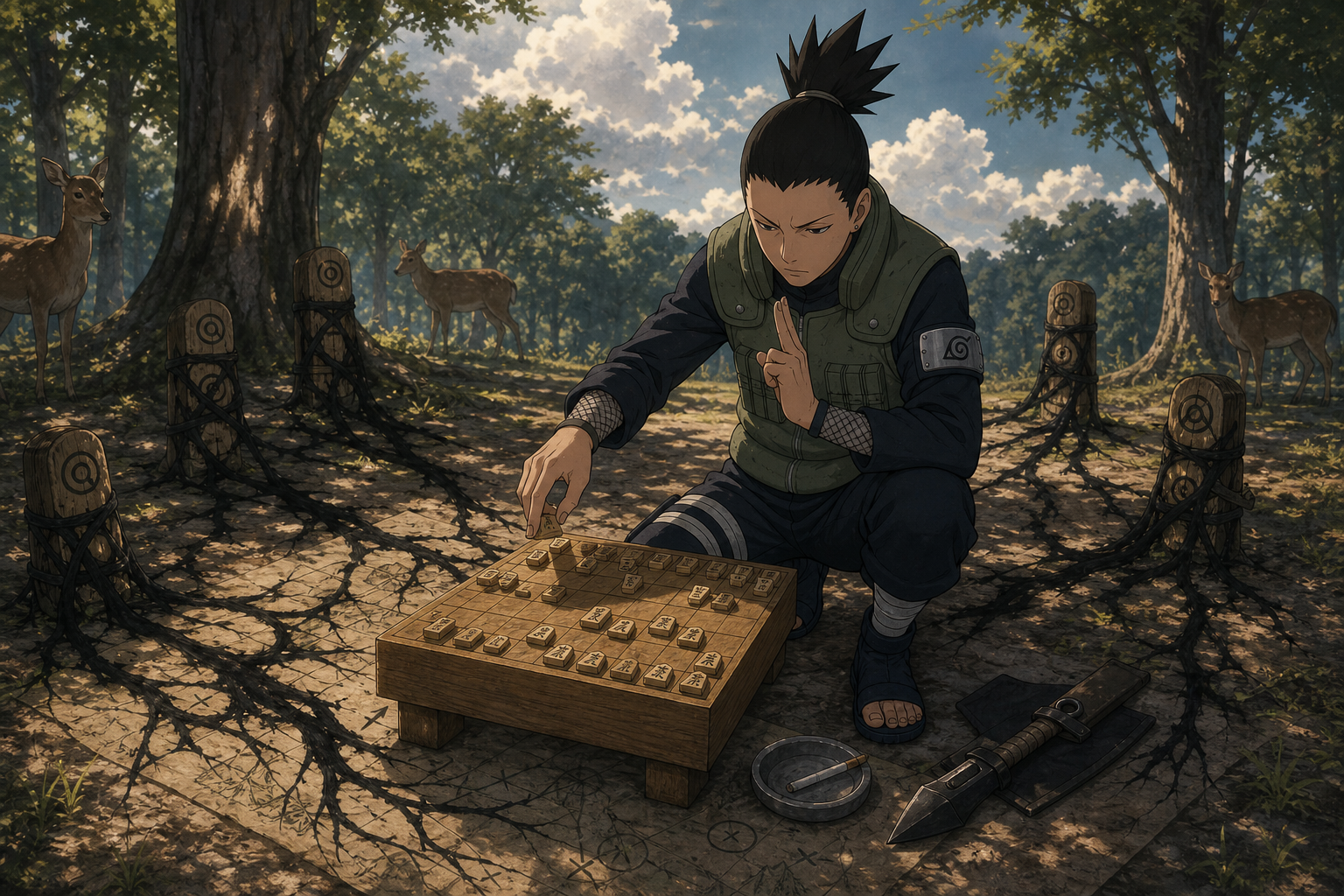
Shikamaru enters Naruto wanting naps, clouds, shōgi, and the smallest possible relationship with effort. The franchise responds by handing him command of injured children, a dead teacher, a war room, a dying father’s strategy, Naruto’s administration, an international security crisis, and eventually the Hokage desk he never auditioned for. Apparently saying “what a drag” near destiny counts as consent.
The easy profile calls him lazy but brilliant, lists an IQ over 200, praises the Hidan plan, and goes home early. Nada, babes. Intelligence is only the first layer. Shikamaru matters because the story keeps testing whether thought can become care. He has to plan around teammates’ bodies, admit when a mission failed, grieve without abandoning duty, inherit work from Asuma and Shikaku, and make decisions whose consequences land on people he loves.
His record is not spotless. He repeats sexist complaints about women. His first command nearly gets everyone killed. Revenge becomes a beautifully staged act of burial that still depends on Kakashi, Ino, Chōji, Naruto, Yamato, Sakura, and prior intelligence. Adult competence turns him into the man expected to absorb state anxiety while everyone else gets a sunrise speech.
That is Shikamaru’s bottom line. The shadow is not less important than the person standing in light. The danger is that institutions learn to treat the shadow as free labor.
The name, the deer, and the circle around a boy’s name
Nara is the name of a real Japanese place strongly associated with deer. Shika means deer, while maru is a common masculine name ending with long historical use. The Nara clan’s deer forest and medicine traditions turn the association into worldbuilding rather than a trivia sticker.
The deer matter because Shikamaru’s power is not isolated from land and family. The clan maintains a forest, protects access, gathers medicinal material through antlers, transmits shadow techniques, and carries a position inside Konoha’s political structure. His “natural genius” arrives with inherited technique, educated parents, a clan network, and a father who can beat him at shōgi.
Privilege does not erase talent. Talent does not erase infrastructure. Both truths fit without throwing a chair.
His design makes thought visible through stillness
Part I Shikamaru wears his dark hair in a high spiked ponytail, simple clothing, mesh armor, and the Konoha forehead protector on his upper arm. The silhouette is compact and deliberately unshowy. He looks like someone who dressed to avoid discussing clothes.
After promotion and through Part II, the flak jacket marks responsibility before his face shows enthusiasm. His shadow techniques transform ordinary light and ground into tactical space. Fingers join in a familiar focusing gesture while black shapes stretch, fork, climb and bind.
War-era and Blank-period designs mature the frame without turning him into a different man. Adult Shikamaru carries the adviser’s vest, sharper features, the same ponytail, and later formal or office clothing. The visual continuity says adulthood added duties rather than replacing temperament.
Shōgi boards, Asuma’s trench knives, cigarettes, deer and the Nara forest become recurring objects around him. Each needs its own meaning. Shōgi represents relational planning. The knives become inheritance. Cigarettes mark grief and imitation but also a harmful habit. Deer connect clan ecology and guarded space. One mood board cannot flatten them into “smart guy aesthetic.”
Chōji is the first proof that Shikamaru’s intelligence can become kindness
Shikamaru befriends Chōji before prestige makes the choice useful. Other children judge Chōji’s size, appetite, and performance. Shikamaru watches him, decides the social verdict is stupid, and shares space without demanding a transformation first.
That relationship matters more than an IQ claim. Pattern recognition becomes moral when he notices a person instead of a category.
Shikamaru does not deliver a diversity seminar in the Academy yard. He simply refuses the cruelty around him. Chōji later trusts him with life-threatening mission choices because their bond existed before either boy became strategically valuable.
The friendship also limits Shikamaru’s worst tendencies. A lazy boy can avoid abstract duty. A friend in danger makes avoidance concrete. Chōji turns “the team” from a diagram into a body Shikamaru cannot casually sacrifice.
Team 10 is inheritance with personalities attached
Shikamaru, Ino, and Chōji form the new Ino-Shika-Chō under Asuma. Their clans have maintained a cooperative formation across generations. The structure gives them techniques designed to interlock: Ino controls or communicates through minds, Shikamaru restrains through shadows, and Chōji converts body mass and force into impact.
Inherited teamwork can become empty ritual if the members never trust each other. Team 10 works because Asuma learns their personalities, uses meals and shōgi to build relationship, and recognizes abilities the Academy record hides.
Ino is not decorative support between two boys. Her sensory, medical, communication, and mind techniques become essential across the story. Chōji is not the muscle after the genius finishes thinking. His judgment, loyalty, and power make plans executable. Shikamaru coordinates a system whose other members still own agency.
The team also inherits clan expectations before adulthood can consent. The formation is prestigious, functional, and political. Family tradition gives belonging and assigns labor at the same time.
The Chūnin Exams promote him after a loss because command is not a highlight reel
Shikamaru defeats Kin Tsuchi by understanding how shadow, wall position, and copied movement interact. He does not overpower her. He makes the environment finish the trap.
Against Temari, he extends his shadow through holes and objects, uses the sun’s changing angle, hides timing inside apparent retreat, and catches her after a long sequence. Then he surrenders.
Fandom sometimes treats the surrender as proof of laziness and sometimes as proof of galaxy-brain superiority. The scene contains both calculation and limitation. Shikamaru has little chakra left and no confident finishing route. Winning the bind does not guarantee winning the match. He stops before exhaustion turns tactical advantage into stupidity.
He becomes the only participant promoted to chūnin from that exam group. The evaluators value planning, composure, awareness of limits, and protection of a team over a tournament win. Naruto can defeat Neji and Gaara and still lack the command judgment the rank requires at that moment.
The promotion makes sense and creates a problem. Konoha sees a twelve-year-old capable of adult judgment and responds by giving him adult responsibility.
The Sasuke Retrieval Mission is a leadership disaster he refuses to disguise
Tsunade assigns newly promoted Shikamaru to retrieve Sasuke with a rapidly assembled team. He chooses Naruto, Chōji, Kiba and Neji, later receiving help from Rock Lee and the Sand siblings as the pursuit fractures into individual fights.
Shikamaru creates formations, assigns roles, interprets the Sound Four’s barriers and tactics, and keeps the pursuit moving. He also watches each teammate stay behind against an opponent while the mission’s margin disappears.
The team fails to return Sasuke. Multiple children suffer catastrophic injuries. Chōji uses clan pills that may kill him. Neji nearly dies. Kiba, Akamaru, Lee and Naruto absorb severe damage. Sand intervention prevents worse outcomes.
When Shikamaru receives the report, he does not celebrate clever matchups. He breaks under the possibility that his first command killed his friends. Temari criticizes his emotional response. Shikaku pushes him to understand that quitting leadership would leave future teams with someone less capable and would not repair the wounded.
The lesson is not “men stop crying and get back to work.” Shikamaru cries, accepts care, evaluates failure and continues. Accountability without self-erasure becomes the actual promotion exam.
Temari sees the strategy and refuses to worship the strategist
Temari first meets Shikamaru as an opponent and later rescues him from Tayuya. She understands his intelligence while remaining unimpressed by excuses, sexism and low effort.
Their relationship develops through diplomatic work, exams, missions, novel-era conflict and repeated mutual challenge. Temari is not a babysitter assigned to make a lazy man functional. She is a Sand kunoichi, diplomat, strategist, sister to the Kazekage and adult with her own temper and state obligations.
Shikamaru’s recurring claim that women are troublesome belongs to his adolescent sexism, not timeless wisdom. Yoshino, Ino and Temari often appear in the joke structure as forceful women who manage him. The pattern makes his complaint look self-protective while forcing women into disciplinarian labor.
Marriage does not prove the jokes harmless. The adult relationship works when both people retain judgment, careers, anger, affection and the right to challenge each other. Temari choosing Shikamaru is not evidence that every earlier comment passed feminist inspection.
Asuma teaches him that the king is the next generation
Asuma recognizes Shikamaru’s strategic ability through shōgi and asks him to think about the “king” Konoha shinobi protect. Shikamaru initially assumes the Hokage. Asuma later identifies the unborn and future children of the village.
The lesson shifts leadership away from loyalty to one powerful office. A village exists to protect continuity, ordinary lives and people who cannot yet return service.
Asuma also smokes, feeds the team, trusts Shikamaru and carries the contradictions of Hiruzen’s son serving inside the institution he once resisted. Their relationship includes warmth and professional expectation rather than inspirational speeches only.
When Hidan and Kakuzu enter the Land of Fire, Shikamaru serves with Asuma, Izumo and Kotetsu. He studies Hidan’s ritual, identifies the connection between blood, the symbol and reflected injury, and uses Shadow Possession to pull Hidan outside the circle.
Kakuzu’s intervention breaks the advantage. Hidan re-enters the ritual and kills Asuma through the curse. Ino and Chōji arrive too late to save their teacher. Asuma dies with Team 10 around him and passes final words to each student.
No strategy makes that body less dead.
Grief enters through smoke, shōgi, and a father who lets him collapse
Shikamaru begins smoking Asuma’s cigarettes around the revenge period. The image communicates imitation, grief, adulthood and anger. The habit is also smoking. Symbolism does not remove lungs.
Shikaku plays shōgi with his son and gives him enough emotional safety to stop performing control. Shikamaru overturns the board and cries. The father does not solve grief with a lecture about toughness.
That scene matters because “the smart one” is often denied the right to become incoherent. Everyone expects strategy from Shikamaru, so grief looks like a workplace outage. Shikaku treats him as a son before returning him to duty.
The next plan grows from mourning, professional analysis and revenge. Calling the operation pure justice erases anger. Calling the operation irrational erases preparation. Shikamaru is grieving and strategic at the same time.
Hidan’s burial is brilliant, collective, and morally severe
Team 10 sets out against Hidan and Kakuzu with Kakashi joining. Shikamaru uses Asuma’s chakra blades to extend shadow restraint, separates the immortal partners, and leads Hidan into a prepared Nara forest.
He secretly uses Kakuzu’s blood in Hidan’s ritual. Hidan believes he is cursing Shikamaru, then injures Kakuzu instead. Explosive tags collapse the prepared ground. Shikamaru dismembers and buries the still-living Hidan in a pit guarded by the Nara clan.
The plan earns its reputation. Shikamaru studies the ritual, acquires material, manipulates expectation, uses terrain, separates complementary enemies, and creates a containment answer for immortality.
The victory is not solo magic. Kakashi obtains the blood and fights Kakuzu. Ino and Chōji participate. Naruto and Yamato arrive against Kakuzu. Sakura supports the larger team. Prior intelligence and Nara land make the trap possible. “Shikamaru with prep” means Shikamaru with people, evidence and infrastructure.
Burial alive is severe. Hidan murdered Asuma and remains a lethal immortal combatant. Containment answers a practical problem, but the scene also gives Shikamaru private revenge in family territory. The Will of Fire language does not turn cruelty into incense.
Complete shadow techniques: light, distance, geometry, chakra, and other people’s resistance
The Nara clan’s signature Shadow Possession Technique connects Shikamaru’s shadow to a target and forces the target to mirror his movement. The technique is restraint before damage. Success depends on reaching the target, maintaining the connection, managing chakra, and accounting for the surface between them.
Shadows lengthen naturally with light angle and can travel through the shadows of objects or people. Shikamaru repeatedly uses trees, holes, weapons, parachute cloth, teammates and terrain to extend reach or hide direction. Geometry is part of the jutsu.
Targets can resist through physical strength, chakra, distance, disruption or attack on the user. Multiple targets increase the control burden. Darkness is not automatically infinite power, and bright conditions are not automatically useless. The relevant question is what connected shadow path Shikamaru can create and sustain.
Shadow Neck Binding converts restraint into a choking or neck-breaking attack by forming shadow hands. Shadow Sewing produces tendrils that can pierce, bind or manipulate across several directions. Later techniques broaden scale and target count, while clan formations combine shadow with Akimichi and Yamanaka abilities.
Asuma’s trench knives add another application. When infused with Shikamaru’s chakra, the blades can pin a target’s shadow and immobilize the body. The weapon turns inheritance into a literal anchor.
The power has a clean limit: Shikamaru is rarely the strongest body in the room. Restraint creates an opening, but teammates often provide sensing, range, healing, force or finishing power. That dependence is design, not embarrassment.
Strategy is a process, not psychic fan service
Shikamaru observes rules, generates hypotheses, tests reactions, tracks resources, predicts incentives, creates branches and accepts tradeoffs. Shōgi gives the series a visual grammar for that work, but people are not wooden pieces with fixed movement.
His best plans include contingencies. The Temari trap uses changing sunlight. The Sound Four pursuit uses formations and sacrifice points. The Hidan plan exploits ritual rules, partner dynamics, stored blood, terrain and psychological certainty. War strategy distributes information across thousands of moving bodies.
He still gets surprised. Sasuke escapes. Asuma dies. Madara and the Ten-Tails exceed conventional planning. Eida’s Omnipotence corrupts memory at a scale normal evidence cannot easily defeat. Intelligence reduces uncertainty. Intelligence does not cancel reality’s right to be rude.
The IQ-over-200 line comes from Asuma’s evaluation of Shikamaru’s exceptional mind. Fictional IQ supplies quick characterization, not a peer-reviewed certificate proving wisdom in romance, parenting, ethics and every combat scenario. A five in databook intelligence does not stop a teenager from saying sexist nonsense.
Pain forces the strategist to work inside mass casualty
During Pain’s assault, Shikamaru suffers injury and contributes to understanding the enemy while Konoha’s intelligence, sensory, medical and combat systems collapse under coordinated attack.
Jiraiya’s code, Fukasaku’s testimony, the captured body, Inoichi’s information and Shikamaru’s reasoning form a collective investigation. The village solves Pain through distributed expertise, not one genius discovering six corpses from a desk.
Tsunade protects civilians through Katsuyu. Naruto returns with Sage training. Hinata intervenes. Minato repairs the seal crisis. Nagato later makes his own choice. Shikamaru belongs to the support structure that makes Naruto’s confrontation possible.
The arc reinforces his real specialty: connecting other people’s work under pressure.
The Five Kage crisis turns friendship into political judgment
After Sasuke attacks the summit and becomes an international threat, the Konoha generation has to confront the distance between the boy they remember and the actions attached to his name.
Shikamaru considers village security, diplomatic consequences and Naruto’s inability to accept killing Sasuke. The conversation is painful because no plan can preserve every bond without cost.
Naruto’s loyalty is morally powerful and politically destabilizing when other villages have casualties and claims. Shikamaru’s realism is necessary and can become cold when state logic consumes the person. Their adult partnership grows from this tension: sunlight needs shadow, and shadow needs someone who remembers why the village exists.
War turns the Nara family into a command relay
Shikaku serves as a central Allied strategist while Shikamaru fights in the Fourth Division and coordinates battlefield responses. Father and son perform similar cognitive labor at different scales.
Shikamaru restrains enemies, supports the allied force and helps carry strategy through rapidly changing battles. Ino’s communication network becomes essential because a perfect plan trapped in one skull is decorative.
The Ten-Tails destroys Allied headquarters. Shikaku and Inoichi use their final moments to send strategy and personal meaning through the communication link. Shikamaru receives a father’s death as information while the battle continues.
The cruelty is structural. War does not pause for grief. A young commander has to process loss and execute the dead man’s plan inside the same minute.
Shikamaru later imagines a future serving Naruto as adviser. The desire is affectionate and alarming. He responds to losing Shikaku by volunteering to become indispensable to another leader. Duty gives grief direction and creates a new route toward burnout.
Shikaku’s inheritance is not “be the smartest man forever”
Shikaku teaches through shōgi, blunt judgment, trust and room for emotion. He is a clan head, strategist and father whose competence makes Shikamaru’s inheritance visible.
Yoshino’s role is often reduced to the loud wife who controls two lazy men. That comedy framing hides domestic management and family authority. A profile cannot praise the Nara men’s strategic labor while treating the woman organizing their household as background noise.
Shikamaru inherits clan leadership and public strategy. He also inherits a model in which care can be indirect, sarcastic and reliable. The challenge is not copying Shikaku’s every habit. The challenge is giving Shikadai enough relationship that duty does not become the only family language.
Shikamaru Hiden makes the shadow walk beyond Naruto’s immediate light
In Shikamaru Hiden: A Cloud Drifting in Silent Darkness, Shikamaru works under Kakashi during the postwar transition and investigates Gengo’s Land of Silence movement. The story pushes him into covert political labor, mental manipulation and isolation.
Gengo recruits through dissatisfaction with the shinobi order and uses voice-based control. Shikamaru’s vulnerability is not low intelligence. Exhaustion, secrecy and alienation make a person easier to separate from community.
Temari, Ino and Chōji help recover him. The rescue refuses the fantasy that the strategist always saves himself by thinking harder. Relationship interrupts coercion.
The anime adapts the novel across Naruto Shippuden episodes 489 through 493, changing or compressing material for television. Novel and anime belong in adjacent folders, not one blended summary.
The arc also moves Shikamaru and Temari toward acknowledged intimacy. Their bond develops through work, frustration, rescue and the possibility of a future neither adolescent version planned.
Kakashi and Naruto turn him into the government’s invisible nervous system
Under Kakashi, Shikamaru grows from field commander into high-level adviser and diplomatic worker. He helps translate war victory into administration, alliances and policy.
Under Naruto, the role becomes central. Shikamaru manages schedules, security, intelligence, negotiations, mission decisions and the gap between Naruto’s enormous moral ambition and finite office hours.
The partnership works because their strengths differ. Naruto reads pain, inspires trust, takes symbolic responsibility and supplies overwhelming force. Shikamaru models consequences, processes information, challenges assumptions and protects administrative continuity.
Calling Shikamaru “the real Hokage” erases Naruto’s leadership. Calling him “just an assistant” erases the labor that makes leadership executable. Executive power and administrative cognition are related jobs, not a masculinity contest.
Temari, marriage, and the work fandom calls nagging
Shikamaru and Temari marry and raise Shikadai. Their household joins Konoha’s Nara clan to Suna’s ruling family, making private relationship part of international kinship.
Temari retains her identity, Sand ties, combat ability and political understanding. Shikamaru’s workload and avoidant habits create domestic friction. Fandom often translates her anger into “nagging” while treating his absence as evidence that important men are busy.
That double standard needs side-eye. State labor does not make family labor disappear. A man can protect a village and still owe presence at home.
Shikamaru loves Temari and Shikadai. Love should be read through choices, repair, protection, trust and failures, not through a demand that every family scene look soft. The relationship is allowed edges. The profile is not allowed to turn those edges into an excuse for gendered contempt.
Shikadai inherits a technique and a father already occupied by the state
Shikadai receives Nara shadow techniques, Sand ancestry, strategic talent and expectations from two political families. He resembles Shikamaru without becoming a carbon copy.
Adult Shikamaru recognizes his son’s intelligence and can still reproduce the emotional distance created by work. Naruto’s administration, Ōtsutsuki threats, Kara, Code and village security consume attention.
The father-son relationship asks whether succession can include more than skills. Shikaku gave Shikamaru room to cry. Shikamaru’s challenge is giving Shikadai access to the person behind the adviser role.
The New Era keeps making his caution look cruel until danger arrives
As Naruto’s adviser, Shikamaru is skeptical of threats, suspicious of outsiders and willing to consider severe containment. Kawaki, Amado, Code, Eida and Daemon create security problems whose abilities break ordinary assumptions.
Some caution is earned. Amado manipulates information. Kawaki acts through trauma and extreme protective logic. Eida’s charm and Omnipotence alter social reality. Code targets Konoha. A leader who treats every stranger as a redemption project can get civilians killed.
Caution also risks becoming dehumanization. Shikamaru’s institutional role rewards worst-case thinking. Naruto’s presence historically balances that pressure by insisting people are more than threat profiles.
The conflict is not smart man versus naive man. Effective government needs security analysis and moral limits. Remove either and the village becomes vulnerable or monstrous.
Eighth Hokage is a working title under an unresolved appointment
After Kawaki seals Naruto and Hinata away and Omnipotence rewrites public memory around Boruto and Kawaki, Konoha believes the Seventh Hokage is dead. Shikamaru assumes Hokage functions during the three-year gap.
Boruto: Two Blue Vortex calls him the current or Eighth Hokage in public operation, but chapter 6 explains that he resisted formally accepting the permanent title and sought a three-year delay because Naruto’s death lacked physical proof. The absence of a new Hokage Monument face supports the unresolved status without replacing the text.
The precise description is acting or provisional Eighth Hokage performing the office while formal acceptance remains contested. A directory badge can say Eighth Hokage only if the profile immediately explains that institutional wrinkle.
Current material also places him under political scrutiny while he quietly tests the contradiction between his memories, Sarada’s insistence and evidence from Boruto. Omnipotence attacks the strategist at the foundation: memory itself has become unreliable data.
His response is important. Shikamaru does not defeat supernatural memory alteration through IQ. He creates a private operating hypothesis and acts cautiously around evidence his mind keeps trying to reject. Intelligence becomes epistemic humility.
Shōtarō Morikubo and the original Japanese performance boundary
Shōtarō Morikubo performs Shikamaru across the original Japanese anime and later franchise material. The credit is verified.
Performance contexts worth close observation include bored Academy delivery, the Temari surrender, the failed retrieval report, Asuma’s death, the shōgi breakdown, Hidan’s burial, Shikaku’s last communication, Temari conflict, adviser work and New Era command.
His original Japanese credit is verified. I am not inventing pitch, pauses, breath, grief texture or comic timing without the heard scenes. A performer credit is a receipt. Imaginary headphone criticism is cosplay.
Manga, anime, novels, films, OVAs, and games
The manga establishes Shikamaru from chapter 34 through the Chūnin Exams, Sasuke Retrieval, Asuma/Hidan, Pain, the Five Kage crisis, war, epilogue and the New Era continuation. The anime introduces him in episode 1 and expands Academy life, missions, relationships and postwar material.
Shikamaru Hiden gives him a starring postwar intelligence story, adapted with changes in Shippuden episodes 489 through 493. Kakashi Hiden places him in the leadership transition. Konoha Hiden connects him to the wedding period. Shikamaru Shinden: A Cloud Dancing in Forlorn Falling Petals follows adult diplomatic and adviser strain in the New Era. Each novel has its own continuity position and adaptation record.
His film debut is Naruto the Movie: Legend of the Stone of Gelel, where he joins Naruto and Sakura in the central mission. He later appears in multiple films, including the postwar The Last, where he leads the team sent to rescue Hanabi and confront the Moon crisis. Film-original events need labels even when they fit the timeline.
His OVA debut is Hidden Leaf Village Grand Sports Festival!. Games feature him throughout the Clash of Ninja, Ultimate Ninja and Ultimate Ninja Storm families. Game shadows, combo duration, team ultimates and alternate missions are licensed systems, not new manga evidence.
Fandom arguments that need to sit down near a window
“Shikamaru is smarter than everyone, so every loss is bad writing.”
Intelligence manages limited information. Opponents hide rules, bodies resist, allies act independently and time runs out. A strategist who never loses is not smart. A strategist who never loses is an author’s cheat code.
“He beat Hidan alone.”
Shikamaru designed the decisive trap and executed the final containment. Kakashi acquired Kakuzu’s blood, Team 10 fought, Naruto and Yamato handled Kakuzu’s endgame, and Nara territory made burial possible. Credit survives context.
“Temari is his babysitter.”
Temari is a diplomat, combatant, strategist, Sand leader’s sister, wife and mother. Reducing her to the woman who corrects a lazy husband turns her labor into a prop for his charm.
“The cigarettes are beautiful because grief.”
The symbol is effective. Smoking remains harmful. Asuma’s memory does not need lung damage to stay meaningful.
“He was a bad captain because Sasuke escaped.”
The mission failed and nearly killed the team. Shikamaru owns that consequence. Tsunade also sent an under-resourced child squad into an emergency pursuit, and the Sound Four held major advantages. Command accountability and institutional accountability can coexist.
“He deserves Hokage more than Naruto.”
Their leadership functions are complementary. Naruto’s legitimacy, symbolic role, power, empathy and relationships matter. Shikamaru’s administration, planning and skepticism matter. Turning the partnership into a crown fight misunderstands both.
“He is too weak to be Hokage.”
The office requires more than duel strength, and his present status is provisional. Combat limits remain real. So do intelligence, alliance management, institutional knowledge and crisis command.
“Omnipotence fooled him, so the genius label was fake.”
The ability rewrites memory and social certainty at scale. Shikamaru’s achievement is noticing contradictions and acting under a hypothesis his altered mind resists. No shōgi lesson immunizes a brain against supernatural reality editing.
Confucian reciprocity turns inheritance into obligation
Shikamaru receives clan technique, Shikaku’s teaching, Asuma’s trust, Team 10’s loyalty and village authority. Those gifts create duties toward students, teammates, family and future citizens.
The “king” lesson is reciprocal governance. Children owe the village nothing merely for being born. Adults with power owe them protection and a future.
Teacher and student succession works when the younger person transforms the lesson. Shikamaru does not become Asuma or Shikaku. He carries their concern into different institutions.
The risk is over-identification with duty. Confucian service without humane limits can turn a person into an office appliance. Family, rest and dissent are not betrayals of the state.
Buddhist impermanence appears every time the board changes
Asuma dies. Shikaku dies. Naruto disappears. Children become commanders. The board never keeps the same pieces.
Shikamaru’s early fantasy is a quiet life where nothing demands too much. Impermanence refuses that contract. His growth comes from acting without believing control can stop every loss.
Revenge gives Asuma’s death an action but cannot return Asuma. Advising Naruto honors Shikaku but cannot preserve the father. Acting as Hokage protects continuity without proving Naruto is dead.
The mature shadow holds attachment and uncertainty together. Shikamaru can love people, plan fiercely and leave room for facts he does not possess.
The final verdict: stop praising the brain while spending the person
Shikamaru becomes valuable because he notices patterns, but the village keeps him valuable by giving that mind relationships worth protecting. Chōji teaches him loyalty. Ino and Team 10 make strategy collective. Asuma gives the king lesson. Shikaku gives him emotional room and command inheritance. Temari refuses worship. Naruto gives state labor a human purpose. Shikadai makes the future personal.
His greatest strength is not predicting twenty moves. His greatest strength is accepting that every move touches somebody.
The franchise still needs to watch the bill. Smart people are not bottomless. Advisers are not spare Hokage organs. Fathers are not calendars with ponytails. A village that depends on invisible cognitive labor owes rest, shared responsibility and honest authority in return.
Shikamaru wanted to watch clouds.
Konoha turned him into weather control.
Sources and canon boundary
Manga chronology controls this profile. Anime staging, databook material, novels, films, games, and later franchise appearances are labeled instead of being blended into one false continuity.
Primary franchise references: Naruto Official and VIZ Media Naruto. CVM Sekai’s conclusions about Shikamaru’s strategy, grief, Team 10 bonds, relationship with Temari, wartime command, family, and political labor are editorial analysis, not invented creator quotations.