
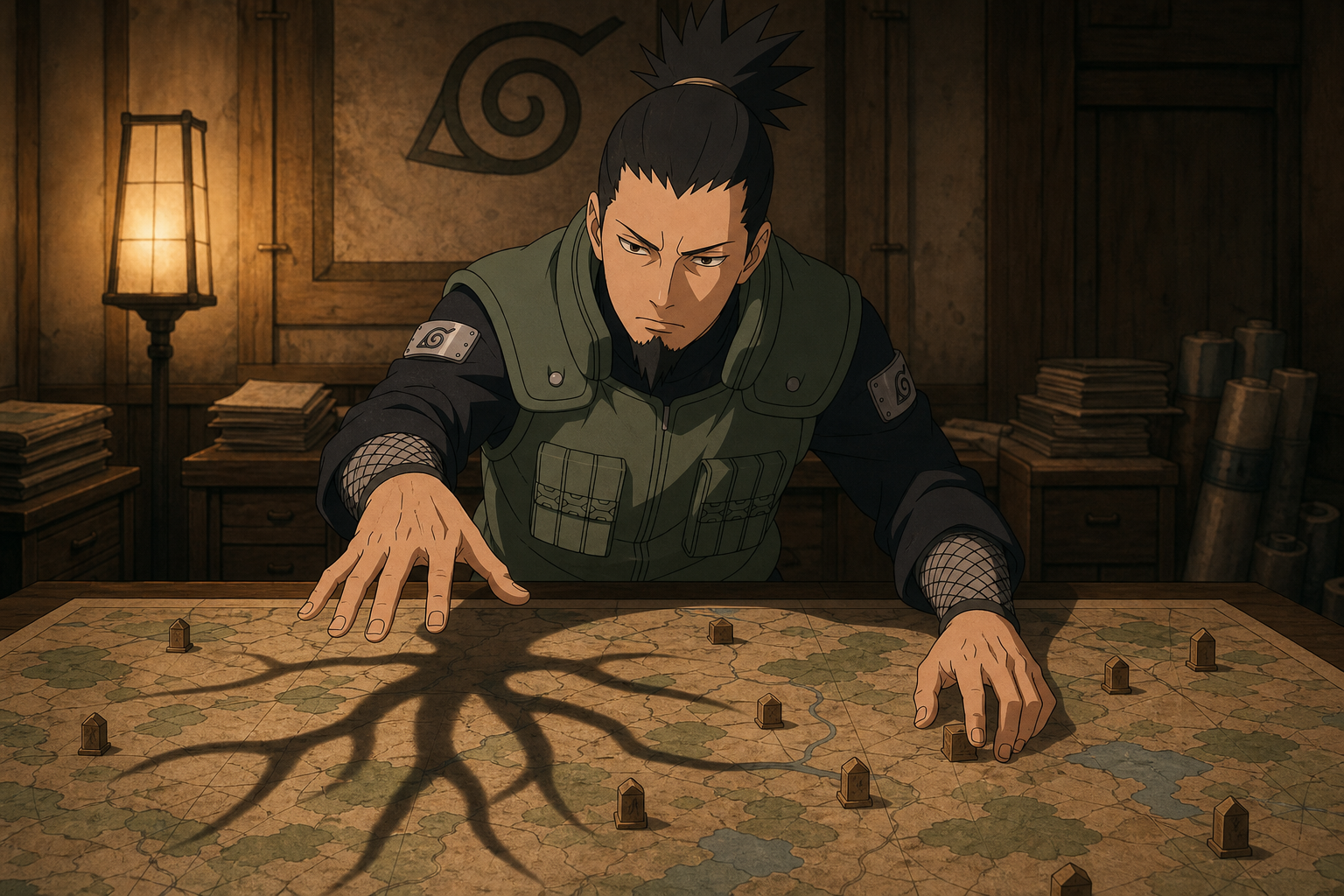
Shikaku Nara
Konoha’s best strategist becomes meaningful because he never mistakes people for disposable pieces, even when the war puts every life on his board.
Bottom line: intelligence is only useful when it protects people
Shikaku Nara is not important because the story hands him a giant IQ label and asks us to clap. He matters because he understands that a correct plan still lands on frightened bodies, grieving children, tired medics, and families waiting for someone to come home. His best strategy is never detached cleverness. It is clear thinking that keeps human consequence inside the calculation.
That is also why his relationship with Shikamaru works. Shikaku does not confuse laziness with moral failure, grief with weakness, or reluctance with cowardice. He pushes his son toward responsibility while making room for the emotions responsibility creates. Then the war takes Shikaku’s body and leaves Shikamaru the method: look at the whole board, tell the truth, and never forget that the pieces are people. Nada, babes, that is not “smart dad exposition.” That is inheritance with a body count.
Shikaku Nara at a glance
- Japanese name奈良シカク, Nara Shikaku
- BirthdayJuly 15
- Blood typeB
- Age38 in Part I; 41 to 42 in Part II
- Height175.2 cm
- Weight59.8 kg
- Registration005491
- Village and rankKonohagakure jōnin; Jōnin Commander
- Clan workNara clan head and deer keeper
- War roleChief strategist, then proxy commander, Allied Shinobi Forces
- FamilyYoshino, wife; Shikamaru, son; Shikadai, posthumous grandson
- Original teamInoichi Yamanaka and Chōza Akimichi
- Manga debutChapter 137
- Anime debutEpisode 59
- Japanese performerHiroshi Yanaka
- StatusDeceased during the Fourth Shinobi World War
The published character record does not provide Academy graduation age, chūnin promotion age, a mission-count breakdown, or a numerical databook stat sheet for Shikaku. Those fields stay unknown here. Filling them with numbers copied from a fanon profile would make the box look fuller and the article less true.
The Nara name comes with shadows, deer, medicine, and paperwork
Shikaku inherits more than a shadow technique. As head of the Nara clan, he sits inside a family institution responsible for hiden knowledge, deer herding, medical reference work, and an old alliance with the Akimichi and Yamanaka clans. The Nara forest is not cute background decoration. It supplies protected space, clan resources, and a living responsibility that exists whether war is fashionable that week or not.
The clan’s medical encyclopedia is one of the quietest examples of useful knowledge in the series. Information preserved by the Nara helps Tsunade treat Chōji after the Three Coloured Pills nearly kill him. Shikaku’s intelligence therefore lives in cabinets and accumulated records as well as battle maps. A village survives because somebody remembers antidotes, documents side effects, tends animals, and keeps the information readable for the next crisis. Genius with filing discipline is less sexy than a fireball. It also saves the child.
His design makes family resemblance look like professional history
Shikaku’s dark hair rises into the same spiky ponytail that later makes Shikamaru and Shikadai readable at a glance. He has dark eyes, a goatee, pierced ears, and two clear scars on the right side of his face. The scars distinguish the father from the smoother adolescent silhouette of his son without turning him into a walking trauma billboard.
In Part I he wears mesh beneath his flak jacket, hand guards, and a deer-hide layer that connects the active jōnin to the clan’s animal stewardship. Part II moves him closer to standard Konoha military clothing as his command role becomes more visible. At home he can wear a light kimono and haori marked with the Nara crest. The design tracks three jobs at once: fighter, clan administrator, and father who has to walk back through his own door after advising a village.
The older Ino-Shika-Chō is a working relationship before it becomes nostalgia
Shikaku becomes a genin beside Inoichi Yamanaka and Chōza Akimichi. Their children inherit a formation, but the formation works because three families have practiced complementary labor across generations. Yamanaka telepathy and intelligence gathering move information. Nara shadows restrain and organize the field. Akimichi size and force convert the opening into physical consequence.
The trio is not proof that destiny assigns every child one acceptable friendship. It is institutional memory made tactical. The danger is that inherited cooperation can become inherited pressure. Shikaku’s better contribution is not forcing Shikamaru to reenact him perfectly. It is giving the next trio access to tested knowledge while allowing Asuma and the children to build their own trust. Tradition survives because people renew it, not because surnames perform a ritual on command.
The anime expands the adult history before the main story notices him
The manga keeps Shikaku’s earlier service mostly outside the frame. The anime adds a late Third Shinobi World War mission in which the older Ino-Shika-Chō helps deliver a peace-treaty request to Iwagakure. They choose a meeting point near the Land of Wind border so the Fourth Kazekage’s oversight can discourage open fighting. That is adaptation continuity, but it fits Shikaku’s later habit of using geography and political incentives before anyone throws a punch.
The anime also places the trio in Konoha’s defense during the Nine-Tails attack. Shikaku recognizes the possibility that Minato redirected the beast’s Tailed Beast Ball. These scenes do not grant him secret authority over the event. They show a veteran learning that village survival depends on information arriving faster than panic. Labeling them anime additions keeps the history useful without smuggling it into Kishimoto’s manga record.
Shikaku sees the child beneath the inconvenience
Shikamaru Nara is lazy, brilliant, sexist in the casual way the early story often treats as comedy, and allergic to effort that feels pointless. Shikaku recognizes himself in parts of that behavior without treating resemblance as ownership. He does not need his son to be a miniature commander by breakfast.
Most importantly, Shikaku is among the parents who do not order their children to avoid Naruto. He lets Shikamaru decide what kind of person Naruto is through observation. That sounds small until we remember the village spent years turning one orphan into a social contamination warning. Shikaku’s choice interrupts prejudice at the household level. He does not deliver a grand tolerance speech. He simply refuses to recruit his son into the village’s cruelty. Sometimes ethical parenting is the rule you decline to pass down.
The Chūnin Exams introduce the father before they reveal the commander
Shikaku’s manga debut arrives late in the Chūnin Exam material, while the anime introduces him during the festival period. He appears with Inoichi and Chōza, teases Inoichi about having a daughter, and asks Shikamaru why he is not enjoying the event. The first impression is domestic and social rather than militarized.
That choice matters because the series later asks us to accept Shikaku as one of Konoha’s sharpest senior officers. The father at the festival and the strategist at headquarters are the same man. Leadership does not switch on only when a map appears. He is already reading mood, friendship, and avoidance. Shikamaru’s boredom is information. A good parent notices it without turning every sigh into a disciplinary hearing.
Konoha Crush proves that the strategist can kill
During Konoha Crush, Shikaku reunites with Inoichi and Chōza to repel the Sand and Sound invasion. He uses Nara shadow techniques to bind attackers and applies Shadow-Neck Binding with lethal force. The frightened enemy in front of him does not receive a philosophical seminar. Shikaku is defending his village during an active assault.
That context explains the violence without sanitizing it. His intelligence does not make him gentle by default, and fatherhood does not remove his capacity to kill. Naruto repeatedly asks professional shinobi to carry home lives alongside battlefield lives. The discomfort belongs in the profile. If we only discuss his soft conversation with Shikamaru, we turn the jōnin commander into a parenting quote account. If we only discuss the killing, we erase the discipline required to return from defense and continue raising a child.
After the Sasuke mission, he refuses to let failure become Shikamaru’s identity
Shikamaru’s first command assignment nearly destroys him. Sasuke is not recovered, the team returns badly injured, and the new chūnin concludes that resignation might be the responsible answer. Shikaku disagrees. He tells his son that a future team without his leadership could suffer worse casualties, while a team with him might return intact.
This is not empty “never give up” syrup. Shikaku does not claim the mission succeeded or that the injuries do not matter. He separates accountability from self-erasure. Shikamaru must study what went wrong, accept that command has consequences, and become better enough to protect the next team. The lesson is institutional as well as personal. A village that discards every young leader after one failed mission guarantees that only the shameless remain in charge.
Promotion changes the relationship from protection to professional training
After Shikamaru becomes a chūnin, Shikaku takes greater interest in his formal development and begins teaching deeper Nara techniques. The timing respects status and readiness. Clan knowledge is not a bag of cool moves thrown at a child because viewers want upgrades. It carries risk, history, and responsibility.
The father does not disappear when the teacher arrives. Shikaku can challenge Shikamaru at shōgi, correct his tactical habits, and still understand when the boy needs emotional shelter. That integration is the point. Naruto contains many adults who train children by humiliating them, endangering them, or calling abuse preparation. Shikaku is imperfect, but his best teaching does not require breaking the student to prove the lesson entered.
Asuma’s death is where Shikaku’s emotional intelligence earns the title
After Asuma Sarutobi dies, Shikamaru tries to hold grief behind analysis. Shikaku does not congratulate him for being stoic. He creates privacy, offers shōgi, and tells his son to release the anger and sorrow instead of pretending a strategy can cauterize them.
The scene understands that competence can become avoidance. Shikamaru knows what happened, why Hidan is dangerous, and what tactical problem revenge presents. None of that knowledge performs mourning for him. Shikaku gives him permission to be furious before returning to the board. This is masculine care without inspirational vitamin language. He does not demand tears, forbid revenge, or force premature forgiveness. He makes emotional truth part of preparation.
The king lesson is about continuity, not obedience to whoever owns the chair
Shikaku and Shikamaru discuss Asuma’s idea of the “king,” the people whose future the village must protect. The metaphor can sound conservative if reduced to “serve the institution.” The stronger reading is intergenerational duty. Adults hold power temporarily. Their choices should leave children with more life, knowledge, and room than they inherited.
That is why Shikaku’s parenting belongs beside his military strategy. He is not protecting an abstract leaf emblem while treating his son as expendable material. He wants Shikamaru capable of carrying responsibility after him, but he also wants the boy alive enough to have a future worth carrying. Confucian family duty appears here as reciprocity, not one-way obedience. The parent owes cultivation and care. The child’s eventual service does not erase that debt.
During Pain’s assault, trusting Naruto becomes a strategic decision
Shikaku survives Pain’s destruction of Konoha with Shikamaru and Shiho. He understands enough about senjutsu to warn Shikamaru not to interfere with Naruto’s battle. After Naruto defeats the Six Paths, Shikaku and Inoichi search for Nagato’s real body. Naruto asks them not to follow because he intends to speak with the enemy.
Inoichi objects, reasonably, because conversation sounds reckless after mass murder. Shikaku remembers Shikamaru’s judgment of Naruto and chooses to trust the younger generation’s evidence. Nagato later revives the people killed in the attack. The resurrection does not make the danger fake, but it confirms that restraint created a possibility force alone would have closed. Shikaku’s genius includes knowing when another person has the better read.
The Hokage succession meetings show him inside real governance
With Tsunade unconscious after Pain’s assault, Shikaku joins the group summoned before the Fire Daimyō to discuss reconstruction and succession. He supports Kakashi rather than Danzō. Danzō undermines the recommendation and receives the daimyō’s approval as Hokage candidate, but he dies before a normal inauguration can settle the office.
When the council reconvenes after Danzō’s death, Shikaku again supports Kakashi. Tsunade’s awakening interrupts that appointment path and restores the Fifth Hokage. The distinction matters because fandom often compresses candidate, appointee, acting authority, and inaugurated Hokage into one mushy title. Shikaku’s role is evidence that village politics includes persuasion, institutional reputation, and ugly power contests. Strategy does not stop at the battlefield border.
The war council turns family intelligence into multinational infrastructure
As the Fourth Shinobi World War approaches, Tsunade includes Shikaku and Shikamaru in Konoha’s planning. Shikaku worries that his son is too young for the room, which is fair because “genius” does not cancel adolescence. He then accompanies Tsunade to the alliance summit and advises hiding Naruto and Killer B from the enemy.
Once the Allied Shinobi Forces form, Shikaku becomes chief strategist. That appointment requires more than solving puzzles quickly. Five villages must share techniques, intelligence, command channels, and grudges after generations of war. His job is to turn difference into coordinated action without pretending everyone suddenly became family. The system works through Inoichi’s telepathy, Mabui’s logistics, Ao’s sensing, Katsuyu’s communication, and commanders willing to update plans when reality changes.
The Kinkaku operation proves that strategy is a relationship network
When Kinkaku threatens the battlefield, Shikaku builds a sealing plan around the new Ino-Shika-Chō. He does not merely announce that the children have inherited their parents’ formation. He identifies what each person can do under the current conditions and sends the plan through Inoichi’s telepathic network.
He later assigns Shikamaru, Ino, and Chōji to confront the reincarnated Asuma because their knowledge of their teacher creates the best chance to subdue him without unnecessary casualties. That choice is emotionally brutal. It is also tactically honest. Shikaku does not pretend relationships vanish during war. He uses them carefully, knowing familiarity can create both vulnerability and precision. The plan succeeds because trust carries technique.
White Zetsu infiltration is the nightmare version of incomplete information
White Zetsu copies allied chakra and appearance, turning every camp into a trust crisis. Shikaku reviews the available abilities and concludes that Naruto’s capacity to sense negative emotions offers the best counter. The answer depends on a person the Kage originally tried to keep away from the battlefield.
This is good command because Shikaku updates the plan when the facts change. He does not cling to the earlier decision just to protect his authority. He contacts Naruto and Killer B, explains the reincarnated army and the Eye of the Moon Plan, and uses Naruto’s shadow clones as distributed detection. The solution is not “Shikaku knew everything.” It is “Shikaku recognized which person now knew what headquarters could not.”
Proxy command means carrying responsibility after the famous leaders leave
When Tsunade and A depart headquarters, Shikaku becomes the operational center. He coordinates divisions, watches sensor reports, redirects reinforcements, and keeps information moving through Inoichi. The role is less photogenic than fighting Madara. It is also why thousands of fighters do not become isolated squads guessing in the dark.
The Fourth Raikage’s praise matters because it comes from outside Konoha. He understands why the Leaf has been difficult to defeat after seeing Shikaku process a multinational battlefield. That compliment should not become nationalist worship. The alliance succeeds precisely because no single village owns every useful method. Shikaku’s skill is synthesis. He makes other people’s knowledge usable at scale.
The Ten-Tails targets headquarters because coordination is a weapon
The enemy eventually recognizes Allied headquarters as a strategic threat. When the Ten-Tails launches a distant Tailed Beast Ball toward the command center, Shikaku understands that escape is not available. He does not perform fake suspense for the people in the room. He tells them to keep working until the end.
Through Inoichi, Shikaku sends the Alliance one last strategy and says farewell to Shikamaru. The headquarters is destroyed, killing Shikaku, Inoichi, Mabui, Ao’s colleagues, and the other personnel caught inside. Their deaths are not a tidy transfer-of-power montage. The Alliance loses its communication and planning brain while still facing the creature that killed them. Consequence means the survivors must execute a plan while grieving the people who made it possible.
His final conversation refuses to make fatherhood a résumé
Shikaku worries that all he gave Shikamaru as a father was shōgi. Shikamaru rejects that accounting. Watching his father, arguing with him, being understood after failure, and sharing the board were enough to build a method and a relationship.
The exchange hurts because neither man has time to turn it into polished closure. Shikaku leaves the analytical future of the war to his son because he trusts him, not because death magically makes the child ready. Shikamaru inherits command under catastrophic pressure. The story’s answer to Shikaku’s doubt is not that he was perfect. It is that presence repeated over years became training no final speech could reproduce.
Yoshino is not the punchline standing between two male geniuses
Shikaku’s marriage to Yoshino is often filtered through jokes about a strong wife and a “whipped” husband. Early Naruto likes that gender comedy far too much. The joke can hide the actual household structure: Yoshino is a direct parent, clan partner, and the person who will survive both husband and war while helping carry the family forward.
Shikaku’s own comments about wanting women to be sweet do not become profound because a genius says them. They are ordinary sexism, softened by affection but still available for criticism. The healthier reading of the marriage is not that Yoshino dominates a helpless mastermind. It is that the strategist lives with someone whose judgment he cannot reduce to a piece he controls.
Inoichi and Chōza make his intelligence executable
Shikaku’s plans travel through Inoichi and gain physical force through Chōza. During the war, Inoichi becomes the communications infrastructure connecting headquarters to entire divisions. That means Shikaku’s final plan exists only because his friend can deliver it while both men are about to die.
Chōza survives the headquarters strike because he is serving elsewhere, leaving the original trio permanently broken. The cost is interpersonal, not just tactical. Their children inherit names and techniques, but they also inherit absences. The old formation proves that intelligence, communication, and embodied force are mutually dependent. Shikaku is the planner, not the whole machine.
What Shikaku can actually do with shadows
Shikaku uses the Nara clan’s Yin Release hiden to extend and shape his shadow. Shadow Imitation binds an opponent’s movement to his own. Shadow-Neck Binding converts restraint into lethal pressure. During Konoha Crush he controls multiple invaders efficiently, demonstrating experience beyond Shikamaru’s early one-target limitations.
The anime adds Black Spider Lily and larger multi-target control, including cooperation with Chōza’s expanded shadow. Those additions must stay labeled as anime technique expansion. Shadows still depend on geometry, light, reach, chakra, and the user’s ability to keep concentration under pressure. His war role does not mean his technique can casually bind a Ten-Tails because the word “genius” appeared nearby.
His intelligence is process, not psychic magic
Shikaku defeats Shikamaru at shōgi before his son realizes the loss is already built into the position. Kakashi considers him capable enough for Hokage-level responsibility, and the Kage trust him with Allied strategy. Those are strong receipts. They do not turn him into an omniscient narrator.
His intelligence works through collected reports, comparison, prediction, and revision. He needs sensors, communicators, field commanders, and accurate descriptions of unfamiliar techniques. When information changes, he changes the plan. That distinction protects the character from fandom math that treats IQ like chakra. Shikaku is brilliant because he builds usable decisions from incomplete data while respecting the specialists who supply it.
The limits are physical, informational, political, and moral
Shikaku’s direct combat record is small compared with his reputation. He can kill invading shinobi and master clan techniques, but the manga does not stage a long solo duel proving endless stamina or universal counters. His published profile also lacks numerical stats and mission totals. Absence is not permission to inflate.
More importantly, he operates inside institutions that can be wrong. Konoha produces Danzō, isolates Naruto, deploys children, and accepts war as an economic structure. A smart commander can improve decisions without making the system innocent. Shikaku’s best moral moments come when he notices that institutional reflex is insufficient: trust Naruto, protect Shikamaru’s capacity to grow, and choose cooperation over pride.
Confucian duty works only when responsibility moves both directions
Shikaku occupies several hierarchy positions: clan head, father, jōnin commander, strategist, and adviser. A shallow Confucian reading would praise obedience and stop. The richer lens asks whether each role practices reciprocal duty. The superior owes guidance, competence, and care. The junior owes effort and respect, but not silent self-destruction.
Shikaku’s parenting succeeds when he treats Shikamaru as a developing moral person rather than family property. His command succeeds when he listens to specialists and adapts. His final act fulfills duty to the Alliance, but the story does not ask us to call death desirable. Sacrifice has meaning because lives matter, not because hierarchy enjoys consuming them.
Buddhist nonattachment is the ability to release the plan that stopped fitting
Strategy tempts attachment because a plan can become proof of the planner’s intelligence. Shikaku repeatedly avoids that trap. He trusts Naruto when the expected pursuit of Nagato would close a better path. He brings Naruto into the war response when White Zetsu makes the original containment policy obsolete. He keeps adjusting as the Ten-Tails changes form.
Nonattachment here does not mean emotional distance. Shikaku loves his son, mourns losses, and understands fear. He releases rigid control so action can match reality. The final plan survives him because he does not confuse his own continued presence with the goal. That is sad, not spiritually tidy.
Seven Shikaku fandom shortcuts that need to leave the board
“He is just older Shikamaru”
They share design, clan techniques, and tactical talent. Shikaku has different political authority, war history, marriage, and parenting responsibilities.
“He has a confirmed IQ number higher than everyone”
The story proves exceptional intelligence through shōgi, command, and praise. A precise number for Shikaku is not part of his published profile.
“He never fights”
He kills invaders during Konoha Crush with Nara techniques. The fact that strategy defines him does not erase combat.
“He was a perfect father”
He offers unusually strong emotional guidance, but the household still carries sexist jokes and shinobi expectations.
“The final plan defeated the Ten-Tails by itself”
The plan guides coordinated action. Thousands of fighters, Kurama’s chakra, communications, and later interventions execute survival.
“Headquarters deaths are background casualties”
The strike removes named parents, specialists, and the Alliance’s command infrastructure.
“Shikamaru replaces him immediately”
Shikamaru inherits responsibility while grieving. Competence does not cancel the loss.
Hiroshi Yanaka and the original Japanese performance
Hiroshi Yanaka performs Shikaku in the original Japanese anime. His credit is verified. The role’s major contexts include domestic comedy, the Sasuke Recovery conversation, Asuma grief, Pain-era restraint, Hokage politics, Allied headquarters command, and the final transmission to Shikamaru.
I am not inventing pitch, breath, pauses, or emotional-timing analysis without the heard Japanese scenes. Listing the contexts shows the range demanded by the role. It does not turn a cast record into criticism. No English-dub material belongs in this character profile.
Manga, anime, film, OVA, and game record
Kishimoto’s manga controls Shikaku’s central chronology from Chapter 137 through the war headquarters strike. The anime debuts him in Episode 59 and expands the older Ino-Shika-Chō history, the late Third War treaty mission, Nine-Tails defense, domestic comedy, extra Nara techniques, and additional war coordination. Those expansions belong to anime continuity.
Naruto the Movie: Blood Prison uses Shikaku within the Konoha leadership context surrounding Naruto’s covert prison assignment. The Hidden Leaf Village Grand Sports Festival! OVA includes him in franchise-comedy continuity. He enters games through Naruto: Ultimate Ninja 2 and appears in later rosters and story adaptations. Game move sets can make command or shadow techniques playable without becoming manga evidence.
Legacy is not “Shikamaru became him”
Shikamaru carries forward strategic work, Nara leadership, and the habit of thinking several moves ahead. He does not become a copy. His generation faces different institutions, different technologies, and a peace that creates new political problems. Shikadai later visits Shikaku’s grave in the anime after a mission loss, using family memory to understand duty.
The deeper legacy is a method for holding intelligence and care together. Shikaku teaches that failure requires analysis, grief requires room, and leadership requires better information rather than louder certainty. His death leaves those practices unfinished. The survivors must choose whether to repeat them.
Final verdict: the board matters because the people do
Shikaku Nara is one of Naruto’s best arguments that intelligence should be measured by what it protects. He can bind enemies, advise leaders, preserve medical knowledge, raise a difficult genius, and coordinate a multinational army. None of those achievements makes him emotionless. The point is that feeling and analysis are not enemies unless a culture trains men to lie about both.
His final strategy matters. His quieter decisions matter more than fandom admits: do not teach your child to shun Naruto, do not let one failed mission become a life sentence, do not make grief perform competence, and do not cling to a plan after reality changes. Shikaku dies at headquarters, but the values inside his method keep moving through Shikamaru, Inoichi’s last transmission, Chōza’s survival, and the Alliance that acts on the information. The board matters because every square contains somebody’s future.
Sources and canon boundary
Manga chronology controls this profile. Anime staging, databook material, novels, films, games, and later appearances are labeled instead of being blended into one false continuity.
Primary franchise references: Naruto Official and VIZ Media Naruto. CVM Sekai’s conclusions about the Nara clan, Shikamaru, Ino-Shika-Chō, shadow techniques, Allied strategy, fatherhood, death, and legacy are editorial analysis, not invented creator quotations.