Ino Yamanaka
Ino begins by helping one girl lift her head and ends by connecting an army
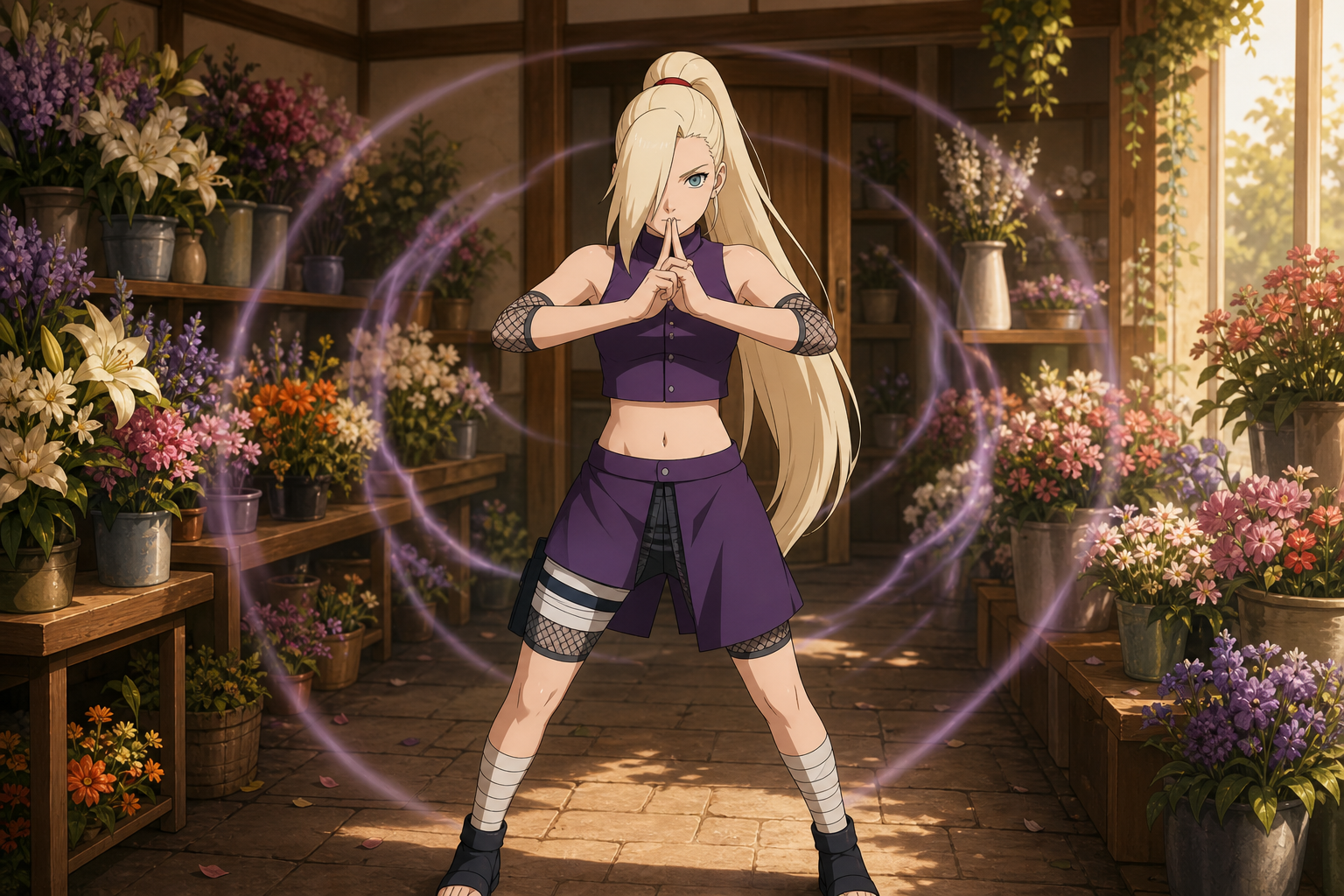
Ino Yamanaka’s story starts with a ribbon, a bullied child, and a girl confident enough to tell Sakura to stop hiding. Her story grows into mind possession, medicine, sensory intelligence, a father’s final transmission, a battlefield communication network, a postwar mental-health clinic, a flower business, a marriage, a son, and Konoha’s barrier security.
Fandom remembers “Sakura’s rival who liked Sasuke” because reducing girls to crushes is apparently a renewable energy source. The actual record is louder. Ino saves Sakura before rivalry begins. She keeps Team 10 emotionally and tactically connected. She enters enemy minds knowing damage can rebound into her own body. During the war, she redirects the Ten-Tails, links an army after Inoichi dies, and becomes the communication infrastructure everybody else uses to perform their bigger-looking attacks.
That is Ino’s bottom line. Her power is not less important because other people move through the connection. A nervous system does not become useless because the fist gets the action shot.
She also stays feminine. Ino likes flowers, appearance, shopping, romance and competition. Competence does not require a beige vest over every joy. The profile does not need to “redeem” her by pretending she stopped being a woman the genre knows how to underestimate.
Her name carries mountains, boar wordplay, and flowers that speak
Yamanaka means among or within the mountains. Ino can support the “Ino-pig” wordplay through inoshishi, wild boar, which Sakura uses during their childish insult exchange. The Ino-Shika-Chō formation also draws on the boar-deer-butterfly card combination familiar from hanafuda.
That cultural layer matters because the trio’s names are not random sound effects. Clan identity, inherited formation and game imagery reinforce each other.
Flowers belong just as deeply. The Yamanaka family operates a flower shop. Ino gives Sakura a ribbon and uses flower language to explain growth, confidence and possibility. Her favorite phrase in databook material concerns the many meanings of flowers.
The symbolism stays useful when the profile avoids turning every bouquet into destiny. Ino works with plants, understands presentation and builds a business. Flowers are labor, commerce, ritual, beauty and communication before becoming metaphors.
Design chronology: femininity is not tactical camouflage
Part I Ino wears blonde hair in a high ponytail with a long fringe covering one eye, a purple crop top and skirt, mesh, bandages and her Konoha forehead protector as a belt. The design is fashion-conscious and movement-ready inside the series’ stylized logic.
Part II lengthens her hair, updates the purple outfit and keeps the one-eye fringe. War clothing and flak elements appear according to scene. Blank-period and adult designs mature the silhouette while preserving lavender-purple color, ponytail and confident posture.
Later Ino moves between flower-shop clothing, field gear, sensory command work and family scenes. The wardrobe reflects multiple jobs rather than a single combat costume.
Fandom sometimes praises her adult competence by saying she became less shallow. The body and clothes were never proof of shallow character. The girl liked beauty and also ran toward danger. The woman likes beauty and also guards Konoha’s mind border.
Sakura meets a protector before she meets a rival
Young Sakura is bullied over her forehead and retreats into insecurity. Ino approaches her, offers friendship, gives her a ribbon and encourages her to stop hiding the feature other children target.
Ino also confronts the bullies and brings Sakura into a social circle. The relationship changes Sakura’s life before Sasuke enters the conflict between them.
The girls later discover a shared crush and declare rivalry. Romance becomes the trigger for distance, but the deeper conflict concerns equality. Sakura does not want to remain the protected junior. Ino has to recognize the friend as a peer.
That transition is messy and adolescent. Neither girl becomes fake because twelve-year-olds make bad friendship decisions around a popular boy. The genre chooses to stage female rivalry through romance more readily than male rivalry, and that creative pattern deserves criticism without turning the girls into idiots.
The ribbon is care, hierarchy, and a gift that has to be returned
The ribbon helps Sakura hold her head differently. A gift can empower and still mark an unequal relationship if one girl always gives and the other always receives.
Sakura eventually returns the ribbon when declaring rivalry. The return is not rejection of everything Ino did. Sakura wants to meet her without the permanent role of rescued child.
Ino accepts the challenge because her confidence includes competitiveness. Their bond becomes friend-rival rather than protector-dependent.
The Chūnin fight later pays off that emotional architecture. Both wear forehead protectors properly and ask the other to witness growth.
Team 10 makes mind, shadow, and body interdependent
Ino forms the sixteenth Ino-Shika-Chō with Shikamaru and Chōji under Asuma. The formation is inherited across Yamanaka, Nara and Akimichi clans.
Shikamaru restrains and plans. Chōji supplies force, scale and protection. Ino targets minds, senses danger, communicates and later heals. Those labels describe starting roles, not complete people.
Mind Body Switch is dangerous when used without protection because Ino’s original body becomes vulnerable. Team formation answers that weakness. Shadow restraint can hold a target still. Chōji can guard or strike. Ino creates an opening from inside.
The trio’s success depends on trust across bodies. One person literally leaves her body while friends keep the body alive. “Support” is not the bench. Support is consent to become vulnerable because the team will hold the line.
Asuma sees leadership under the confidence
Asuma trains Team 10 through missions, meals and personal observation. Ino is outspoken, socially influential and willing to push teammates.
Those traits can become bossiness in shallow summaries. On a battlefield, the same traits become command presence. She identifies emotional paralysis, tells Chōji what nobody else can make him hear, and keeps formation moving.
Asuma’s final words recognize each student. For Ino, his instruction includes caring for Shikamaru and Chōji and not losing to Sakura in ninjutsu or love. The line reflects affection and the era’s tendency to tie a kunoichi’s professional and romantic life together.
Ino carries the team duty forward without becoming their mother. Male teammates are not children assigned to a competent woman.
The Chūnin fight is tactical before the mutual knockout
Ino and Sakura meet in the preliminary round. Their history makes the match personal, but the combat has mechanics.
Ino cuts her hair and uses the scattered strands as a trap, making Sakura think the haircut is emotional theater while creating a chakra line that restricts movement. The move compensates for Mind Body Switch’s central weakness: a moving target can dodge the projected consciousness.
Ino successfully enters Sakura’s mind. Sakura resists from within, strengthened by identity, emotion and Naruto’s call from outside. Ino is expelled, and the fight returns to physical exchange.
They continue until both collapse in a mutual knockout. Neither advances.
The draw is not proof both girls are equally useless. The fight establishes Ino’s planning, Sakura’s resistance, their physical parity at that stage and the emotional fact that neither can return to the old hierarchy.
Mind Body Switch is possession with severe vulnerability
The Yamanaka Mind Body Switch Technique sends the user’s consciousness into a target, allowing control of the target’s body. The transfer travels along a line and can miss. An alert or mobile target can evade unless restrained or deceived.
While Ino occupies another body, her original body is unconscious or defenseless. Harm to the controlled body can transfer consequences back to the user. A strong target may resist, disrupt or complicate control.
Those limits explain Team 10’s structure. Mind possession is powerful because the risk is real.
The technique raises a consent question the shinobi world handles through mission necessity. In combat, Ino invades an enemy body to prevent harm. Outside combat, the same capacity would be horrifying without boundaries. A profile should not turn bodily autonomy into a cute psychic aesthetic.
Mind Body Disturbance and later control expand the shelf
Mind Body Disturbance affects a target’s actions while the user remains in her own body, depending on the named form and continuity record. Later war applications show Ino controlling more than one target and coordinating bodies under pressure.
During the reanimated-Asuma battle, Ino uses her technique through Chōji and additional targets to keep the formation alive when Chōji freezes. Controlling an ally’s body is not a casual choice. The battlefield and team relationship provide the consent context the scene assumes.
Her speed and range improve dramatically. Ino can seize Obito long enough to redirect the Ten-Tails’ attack. Duration is brief because the target and power scale are enormous. Brief does not mean meaningless when the result is thousands of people not being erased.
Sensory and telepathic work become her real adult scale
The Yamanaka clan specializes in mental communication, sensing, interrogation and information transfer. Ino grows beyond single-target possession into network work.
During the war she connects minds, relays strategy and eventually communicates across the Allied Shinobi Forces with Naruto’s chakra support. A battlefield with thousands of bodies cannot execute a plan without shared information.
Adult Ino leads Konoha’s Barrier Team and sensory security. She detects unfamiliar chakra entering the village and helps coordinate response.
The flower-shop owner is also border infrastructure. The contrast is not a twist. Civilian business and military responsibility coexist in a village where clans carry public functions through family expertise.
Medical ninjutsu belongs to her growth with a continuity label
By Part II, Ino is identified and used as a medical ninja. She supports treatment and works beside the wider Konoha medical system.
The manga shows the role without a long apprenticeship arc. The anime expands her decision to study medicine and places more training around Sakura and Tsunade’s system. That expansion belongs to anime continuity, not a retroactive manga chapter.
Ino’s medical path matters because Team 10 gains in-field care and because her later work with Sakura grows from shared professional concern rather than childhood rivalry alone.
She does not become Sakura 2.0. Mind techniques, sensory command and barrier leadership remain her specialization. Medical skill adds capacity.
Asuma’s death turns friendship into active formation
Ino and Chōji arrive after Hidan’s ritual mortally wounds Asuma. She attempts to assess or help, but the damage exceeds what the team can reverse. Asuma dies surrounded by his students.
Ino grieves and still joins the operation against Hidan and Kakuzu. She contributes mind techniques, observation and team coordination while Shikamaru builds the trap and Kakashi provides veteran combat support.
The revenge arc is often edited into Shikamaru’s solo masterpiece. That framing repeats the larger problem. Ino’s work becomes invisible because connection looks quieter than burial explosions.
The team survives through multiple contributors, including Chōji, Kakashi, Naruto, Yamato, Sakura and village medicine. Strategy without communication and bodies is a document.
Pain makes support work visible through collapse
Pain’s assault destroys Konoha’s normal lines of communication, treatment, command and physical safety. Ino works within the intelligence and support response as the village tries to understand several linked bodies.
Jiraiya’s code, Shizune’s investigation, Inoichi’s interrogation skill, sensory information and Shikamaru’s reasoning combine into an answer. No single person solves Pain.
The structure matters. Ino’s clan works on minds and messages while Tsunade distributes healing through Katsuyu. Naruto eventually confronts Nagato. The spectacular fight rests on infrastructure built by people fandom calls side characters.
Pain attacks the village as a system. Konoha survives as a system.
Reanimated Asuma forces Ino to carry the team’s emotional center
During the Fourth Shinobi World War, Team 10 faces Asuma’s reanimated body. Kabuto’s technique turns the dead teacher into a weapon.
Chōji cannot strike him. Ino understands the paralysis and also understands the battlefield will not wait. She protects Chōji, admonishes him, takes control where needed and helps rebuild the formation around his eventual choice.
Her role is easy to misread as the loud girl yelling at the gentle boy. The scene gives her a cruel responsibility. Ino has to keep everyone alive while grieving the same man.
When Chōji finds resolve, the trio performs a completed Ino-Shika-Chō formation and defeats Asuma. His praise confirms technical growth. The emotional victory belongs to all three.
Inoichi teaches a daughter who eventually exceeds his reach
Inoichi Yamanaka leads his clan, serves Konoha’s intelligence division and becomes a central communications officer during the war. His skills create the professional model Ino inherits.
Father and daughter share mind techniques, sensory work and blunt communication. Inoichi recognizes her growth and later notes the speed and quality of her transfer.
The relationship is not only clan pressure. Inoichi understands the flower symbolism attached to his daughter and takes pride in her bonds.
His final message arrives while headquarters faces a Ten-Tails attack. Ino hears her father’s pride through the same communication system he is using to send the alliance its last plan.
Private love and public strategy share one channel because war has no respect for emotional file organization.
The Ten-Tails sequence proves communication can redirect apocalypse
Ino reaches the main battlefield with the Konoha force. With Hinata’s assistance creating the opening, Ino uses Mind Body Switch on Obito and diverts the Ten-Tails’ Tailed Beast Ball away from Naruto’s group.
The possession lasts only moments. Moments are enough.
After Obito and Madara target Allied headquarters, Inoichi and Shikaku deliver final instructions before the blast kills them. Ino cries and then continues.
She uses improved mind techniques against Obito again, supports the large-scale Ino-Shika-Chō formation and saves Chōji from the Ten-Tails’ wooden attack. She also connects Shikamaru to Kitsuchi so defensive Earth Release instructions can reach the battlefield.
With Naruto’s chakra supporting the network, Ino transmits across the entire alliance. The feat is not “just talking.” Thousands of people receive one plan without delay while a god-scale creature attacks.
Grief becomes bandwidth because the war refuses another schedule
Ino loses Inoichi and immediately inherits part of his function. The transition is brutal. No funeral, sleep or private collapse arrives before the next attack.
The story praises endurance, but analysis has to name the exploitation inside the praise. A teenager becomes replacement communications infrastructure because the adult command center is gone.
She succeeds. Success does not make the demand humane.
After the war, leadership has to mean more than celebrating how well children performed under catastrophe. Training successors, distributing knowledge and building systems that do not depend on one family’s nervous system are institutional obligations.
Adult Ino’s barrier leadership shows continuity. The lingering question is whether Konoha shared the burden or simply promoted the person who survived carrying too much.
Sakura friendship outlives the boy who started the rupture
Ino and Sakura remain competitive, affectionate and professionally connected after Sasuke stops being the center of every conversation.
Sakura becomes Tsunade’s principal medical successor. Ino develops medicine, mind techniques and sensory work. Their skills overlap without becoming identical.
In Sakura Hiden, they work around a children’s mental-health clinic for young people affected by war. That choice closes a thematic loop. Two girls once disciplined by bullying, insecurity and rivalry help build care for children carrying mass trauma.
The friendship becomes infrastructure. A ribbon helped one child. A clinic attempts to help a generation.
Neither woman needs to lose for the symbolism to work. Sakura can be the stronger medical specialist. Ino can be the wider sensory communicator. Competence is not a single chair women must fight over while the men receive whole conference rooms.
Shikamaru Hiden gives Ino and Sai a relationship under pressure
In Shikamaru Hiden, Sai becomes entangled in Gengo’s Land of Silence operation and mental coercion. Ino joins the effort to recover him alongside the larger mission.
Her mind-based abilities give the relationship thematic weight. Sai struggles to understand and express emotion after Root. Ino can enter minds but cannot manufacture authentic attachment through force.
The Blank-period material moves them toward intimacy through rescue, recognition and choice. The anime adaptation across episodes 489 through 493 changes and compresses the novel, so scene claims need a medium label.
Ino does not exist to teach an emotionally blunt man how to become human. Sai has his own work, relationships and agency. Ino has her own grief, profession, friendships and clan responsibilities. The marriage works when two full biographies meet.
Sai, marriage, and the problem with calling every correction emotional labor
Ino and Sai marry and have Inojin. Their household joins Yamanaka mind traditions with Sai’s ink-art technique and Root history.
Ino often provides emotional directness. Sai often brings observation and an outsider’s perspective on social rules. Their dynamic can be funny without assigning Ino permanent rehabilitation duty.
The franchise gives more relationship connective tissue in novels and anime than the original manga epilogue. A complete profile should use those receipts and state the medium.
Marriage does not retire Ino. She continues business, sensory command, clan work, parenting and field response. The number of jobs is impressive and a little suspicious. Konoha loves a competent woman the way offices love one employee who knows every password.
Inojin inherits two art forms that move through other bodies
Inojin inherits Yamanaka mind techniques and Sai’s ink creations. Both traditions project intention outside the user’s body.
Ino trains him in Mind Body Switch and participates in the next Ino-Shika-Chō formation with Shikadai and Chōchō. Parenting therefore includes technical transmission and emotional negotiation.
Inojin does not master every inherited skill immediately. His different temperament and mixed technique shelf create a new path.
Ino’s challenge mirrors Inoichi’s: teach clan responsibility without treating the child as a replacement component. Family continuity needs room for variation.
The flower shop is not a downgrade from shinobi work
Yamanaka Flowers represents family business, civilian service, aesthetic knowledge and economic life inside Konoha. Shinobi villages still need weddings, funerals, gifts, memorials, homes and ordinary purchases.
Ino moves between flowers and security because community defense includes the community being worth living in.
Fandom sometimes treats the shop as evidence she became domestic or irrelevant. That reading misunderstands labor and the village. A storefront can preserve clan culture, provide income, maintain social knowledge and coexist with command responsibility.
The flower shop also returns the character to her first language with Sakura. Ino’s adult authority does not require abandoning the beauty she used to help a child imagine blooming.
Adult sensory leadership makes her Konoha’s first warning
In the New Era, Ino leads Konoha’s Barrier Team and sensory division. She monitors the chakra network around the village and detects intrusions.
She also provides secure telepathic communication for Naruto, Shikamaru and field teams. The role becomes critical when enemies can infiltrate, disguise chakra, teleport or manipulate information.
Security work creates ethical pressure. A village-wide detection network protects civilians and can become surveillance power. The profile should ask who authorizes use, how clan knowledge is governed and what privacy means inside a military settlement.
Ino’s history with possession makes those questions especially sharp. Capability is not consent policy.
Complete abilities and limits: mind work needs aim, protection, trust, and stamina
Mind Body Switch sends consciousness toward a target. A miss leaves Ino vulnerable while her consciousness returns. A hit gives bodily control but exposes her original body and links consequences to the occupied form.
Mind Body Disturbance influences targets without the same full transfer structure, while later variations expand number, range and coordination. Exact names and appearances differ across manga, anime, novels and games.
Sensory ability lets Ino detect, identify and track chakra. Telepathy transmits speech, images, emotion or strategic information according to technique and scale. Large networks demand chakra and concentration.
Medical ninjutsu adds healing and clinical value. Physical combat, deception and the hair trap demonstrate that she can create openings without possession.
Limits remain central. Strong minds resist. Fast targets dodge. range and line matter for early transfer. The original body needs protection. Multiple minds increase complexity. Mass communication needs reserves or external chakra support. Sensor networks can be fooled by unfamiliar abilities.
No single technique makes Ino omniscient. Her power becomes exceptional because teams, preparation and trust let dangerous mental tools operate safely.
Ryōka Yuzuki and the original Japanese performance boundary
Ryōka Yuzuki performs Ino in the original Japanese anime and later franchise material. The credit is verified.
Performance contexts worth lawful observation include childhood confidence with Sakura, the Chūnin fight, Asuma’s death, the reanimated-Asuma confrontation, Inoichi’s final transmission, mass war communication, Sai relationship material and adult command.
I am not inventing pitch, breath, comic timing, grief texture or command delivery without the heard Japanese scenes. A cast credit is better than smooth nonsense wearing headphones.
The anime expands pauses, music, flower imagery, childhood scenes and communication staging. Those choices deserve episode receipts when analyzed.
Manga, anime, novels, films, OVAs, and games
The manga establishes Ino from chapter 34 through Sakura history, Team 10, Chūnin Exams, Asuma/Hidan/Kakuzu, Pain, war, Inoichi, epilogue and New Era family/security continuity. The anime introduces her in episode 1 and adds missions, medical-training context, relationships and adult work.
Her novel debut is Kakashi Hiden. Shikamaru Hiden makes her important to the Land of Silence and Sai rescue story. Sakura Hiden places her beside Sakura in mental-health work and a larger threat investigation. Konoha Hiden belongs to the wedding-period community shelf.
Her film debut is Naruto Shippuden the Movie. Later films use the wider Konoha cast, and Road to Ninja supplies an alternate-world counterpart. Film-original roles stay labeled.
Her OVA debut is Hidden Leaf Village Grand Sports Festival!. Games make her playable across Ultimate Ninja, Clash of Ninja, Ultimate Ninja Storm and mobile titles. Game-only mind combinations, damage values, costumes and scenarios do not add manga feats.
Fandom arguments that need a better connection
“Ino only cared about Sasuke.”
She protects Sakura, serves Team 10, grieves Asuma, inherits Inoichi’s network, rescues Sai, builds a clinic, raises Inojin, runs a shop and guards Konoha. The crush existed. The biography kept moving.
“Sakura beat her, so Ino was always weaker.”
The preliminary ends in a mutual knockout after Ino lands Mind Body Switch and Sakura resists. Later careers diverge. One adolescent draw is not a lifetime spreadsheet.
“Mind Transfer is useless because the target can dodge.”
The vulnerability creates strategy. Hair traps, shadow restraint, deception, team protection and improved speed answer the limitation. A technique with no counter would be boring paperwork.
“She is support, not a real fighter.”
Support redirects a Ten-Tails blast, coordinates an army, senses intruders, protects teammates and keeps plans executable. If the only real fight is a punch, the analysis arrived without a nervous system.
“Her beauty and flower shop make her shallow.”
Beauty, commerce, floral knowledge and military skill coexist. Femininity is not an infection competence must cure.
“She only married Sai because they needed blond children.”
The original manga underdevelops the bridge. Blank-period novels and anime provide more relationship material. Criticize pacing without erasing their choices or Inojin.
“Inoichi was stronger, so adult Ino is just his replacement.”
Ino inherits his techniques and responsibilities, then performs different war and New Era work at larger communication scale. Succession is not photocopying.
“The war communication was Naruto’s chakra, not Ino.”
Naruto supplies support for the enormous scale. Ino supplies the technique, targeting, connection and transmission. Power source and skilled operator are different contributions.
A feminist and MRT lens catches the labor hiding in plain sight
Ino’s work is coded feminine in several ways: communication, emotional maintenance, medicine, flowers, friendship repair, beauty and family organization.
The story then relies on those functions for survival while fandom ranks them below visible destruction. That is not neutral taste. Care and communication labor are often treated as natural female behavior instead of trained expertise.
Mind possession also puts bodily autonomy at the center. Ino’s technique crosses a boundary to stop violence. The ethical difference between defense and domination needs context, consent and accountability.
Her adult workload raises another question. How many systems depend on one woman because competence became an invitation to assign everything?
Confucian reciprocity links father, teacher, team, and child
Ino receives clan knowledge from Inoichi, team guidance from Asuma, trust from Shikamaru and Chōji, friendship from Sakura and institutional authority from Konoha.
Those relationships create duties. She transmits technique to Inojin, protects teammates, maintains the village network and carries the next Ino-Shika-Chō generation.
Reciprocity does not mean permanent self-sacrifice. Konoha owes training, staffing, privacy rules and support to the people carrying its communications.
Ino’s greatest inheritance is not obedience. She adapts what her father built to a different threat environment.
Buddhist impermanence lets relationships change form
Sakura moves from dependent friend to rival to colleague. Asuma moves from teacher to memory. Inoichi moves from commander to inherited voice. Sai moves from mission subject to partner. Inojin grows from child to trainee.
Ino’s mind techniques could tempt a fantasy of control. Her life teaches the opposite. Entering a body does not grant ownership of a person’s future.
Attachment becomes humane when connection allows change. She keeps bonds without freezing everyone in the role they first played.
The final verdict: the connection is the action
Ino helps Sakura lift her head, then spends a lifetime helping people reach each other. The scale changes. The principle remains.
She is a friend, rival, daughter, student, medic, sensor, telepath, florist, wife, mother, clan leader and security officer. None of those roles cancels the others.
The war gives giant bodies and glowing attacks the poster. Ino gives the poster a shared plan.
She did not stand behind the heroes.
She made sure they could hear one another.
Sources and canon boundary
Manga chronology controls this profile. Anime staging, databook material, novels, films, games, and later franchise appearances are labeled instead of being blended into one false continuity.
Primary franchise references: Naruto Official and VIZ Media Naruto. CVM Sekai’s conclusions about Mind Body Switch, sensory labor, Sakura, Team 10, Sai, war communications, grief, family, and leadership are editorial analysis, not invented creator quotations.