
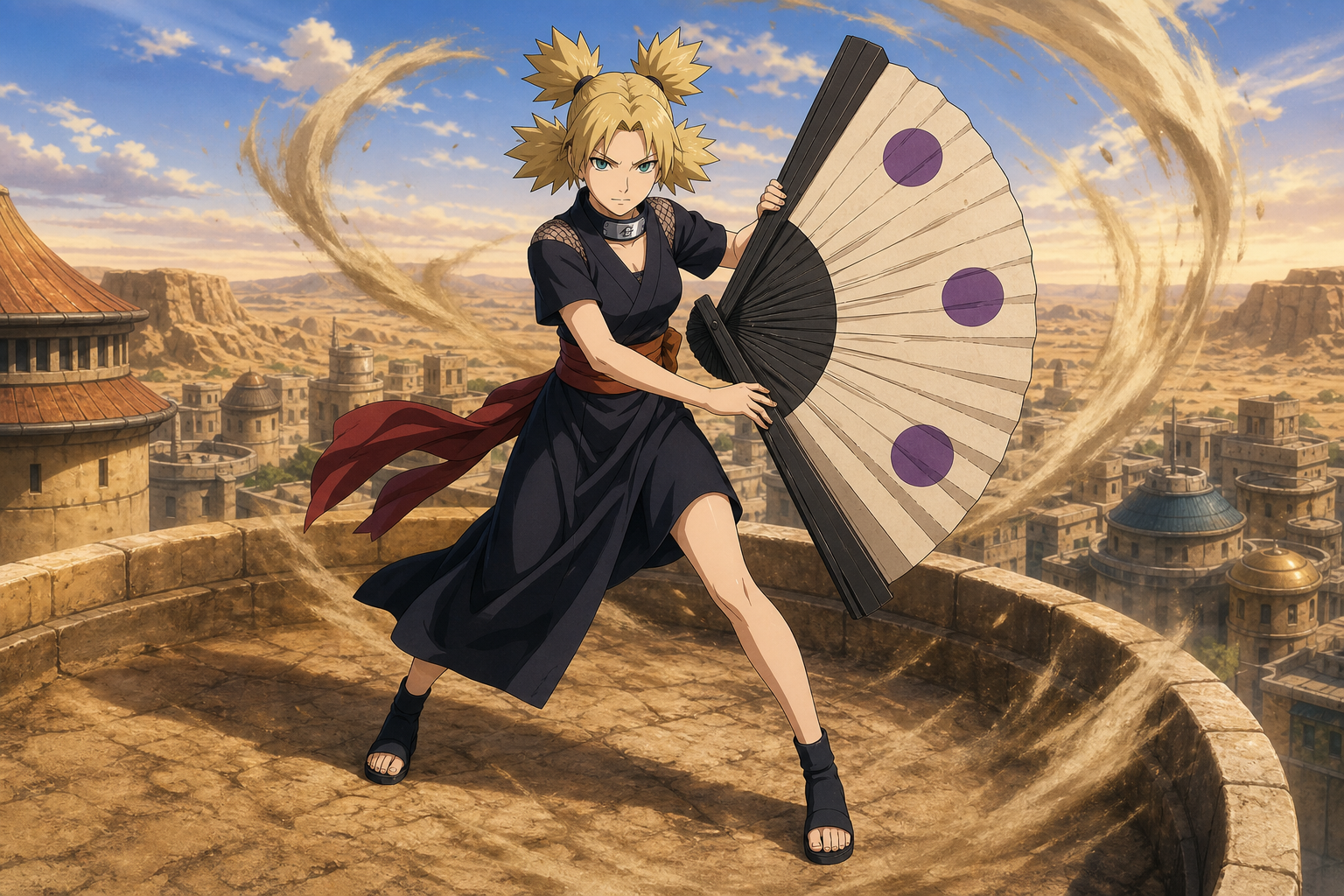
Naruto Character Encyclopedia · Complete Canon Profile
Temari
The eldest Kazekage daughter turns distance into control, diplomacy into labor, and a giant fan into the clearest boundary in the room.
01
Bottom line
Temari learns to control distance because closeness in Rasa‘s family is dangerous. Her fan can keep an army away, erase a forest, and turn open ground into territory nobody else controls. Her sharper achievement arrives later: she stops treating every relationship as a threat calculation and becomes a bridge between villages her father helped turn into enemies.
That does not make Temari a love-interest delivery service. Before Shikamaru, she is Gaara and Kankurō’s elder sister, a Suna genin operating inside an invasion, the fighter who crushes Tenten‘s plan, and the strategist who forces Shikamaru to spend almost every resource he has. After marriage, she remains a jōnin, diplomat, Sand sibling, mother, and political link whose relocation creates real succession consequences.
The fan tells the whole story. Temari begins by controlling who can approach. She grows into somebody who can cross the distance herself.
02
Temari at a glance
- Japanese name: テマリ, Temari
- Married name: Temari Nara in the New Era
- Birthday: August 23
- Blood type: O
- Age: 15 to 16 in Part I; 19 to 20 in Part II
- Height: 157.3 to 159.3 cm in Part I; 165 cm in Part II; 170 cm in the Blank Period record
- Weight: 44.5 to 44.9 kg in Part I; 47.9 kg in Part II
- Registration number: 53-004
- Village: Sunagakure; later resides and works in Konohagakure after marriage
- Rank: Genin in Part I; jōnin in Part II
- Academy graduation: Age 12
- Chūnin promotion: Age 17
- Recorded missions: 42 total: 0 D-rank, 9 C-rank, 12 B-rank, 20 A-rank, and 1 S-rank
- Family: Rasa, Karura, Kankurō, Gaara, Yashamaru, husband Shikamaru Nara, son Shikadai Nara, and adopted nephew Shinki
- Manga debut: Chapter 35
- Anime debut: Episode 20
- Japanese performer: Romi Park
- Specialty: Wind Release, giant folding fan, long-range area control, Kamatari summoning, and tactical judgment
The databook progression gives Temari 19 total ability points in the first record, 23 in the second, and 24.5 in the third. Ninjutsu rises from 3 to 4 and stays there. Intelligence climbs from 2.5 to 3.5 and then 4. Strength rises from 3 to 3.5, while speed, stamina, and hand seals improve more gradually. Taijutsu remains 2.5 and genjutsu remains 1.5 across the three records.
That shape matches what the story actually puts on the page. Temari is not a close-range brawler wearing a fan as decoration. Her best work comes from reading distance, terrain, timing, and the amount of force required to end a problem before it reaches her body. The intelligence increase matters because her adult value is not limited to producing a larger gust. She becomes better at deciding where power belongs.
Her 42 recorded missions include no D-rank work, 9 C-rank, 12 B-rank, 20 A-rank, and 1 S-rank assignment. The record is unusually top-heavy compared with many Konoha classmates. It fits a Sand kunoichi introduced during an invasion plan and later trusted as a bodyguard, battlefield commander, liaison, and diplomat. It does not prove that every off-page mission was glamorous. It proves that Suna repeatedly used her where failure carried political or bodily cost.
03
Her name does not begin with Nara
Temari has no confirmed childhood surname. She becomes Temari Nara after marrying Shikamaru. Back-applying Nara to the Chūnin Exams rewrites her identity around a husband she has not met yet.
The word temari also names traditional Japanese handballs, decorative objects associated with craft, play, pattern, and gifts. The name reference may be intentional within Kishimoto’s naming habits, but a profile should distinguish linguistic association from a direct creator statement.
Her giant fan and wind attacks do not arise from the name. Please do not build a secret handball bloodline because the internet enjoys a theme.
04
Four ponytails and three moons
Temari’s blonde hair forms four spiked ponytails, creating one of the series’ clearest silhouettes. Part I pairs the hair with a dark dress, mesh, sash, sandals, Suna forehead protector, and a giant folding fan marked with three purple circles or moons.
Opening the fan reveals those marks progressively during early battles. Greater opening permits broader or stronger wind attacks, though a profile should verify the exact formal mechanics before declaring the moons a universal numbered level system.
Part II matures the outfit and keeps the fan central. War and diplomatic clothing adapt her presentation without discarding the visual identity. New Era Temari incorporates Nara household life while remaining visibly the same Sand kunoichi.
The fan is larger than ordinary portability should allow and nobody asks where she stores the giant thing at dinner. Some questions keep an anime ecosystem healthy.
05
Eldest daughter in a house run by fear
Temari is the eldest child of Rasa and Karura. Karura dies giving birth to Gaara after Shukaku is sealed into him under Rasa’s order. Kankurō and Temari grow around a younger brother who is isolated, sleep-deprived, weaponized, and capable of lethal sand attacks.
Part I Temari monitors Gaara constantly. She reads changes in his mood, warns Kankurō, follows instructions, and understands that one wrong interaction can produce death. That vigilance resembles maturity because somebody in the room has to notice danger. The labor belongs to a child.
Rasa fails the reciprocal duties of father and Kazekage. He creates the jinchūriki project, orders assassination attempts, and leaves the siblings to manage consequences they cannot fix.
Temari’s sharpness grows in that environment. Direct speech, rapid assessment, and emotional restraint keep her functional. Calling her naturally bossy misses the survival training inside the attitude.
06
Fear of Gaara is not proof she never loved him
Temari obeys Gaara during the Chūnin Exams and invasion because she fears what he can do. Fear creates distance between siblings. The distance is rational.
Fandom sometimes treats her caution as betrayal. That reading asks a teenage girl to provide unconditional emotional care to a brother who threatens and harms people while adults provide no safe support. Love does not require standing inside an uncontrolled attack.
After Naruto defeats Gaara and Gaara changes his conduct, Temari supports his repair and political rise. Their later warmth becomes possible because Gaara stops making closeness lethal.
The relationship demonstrates a basic consequence rule: victims and family members need evidence, not speeches. Gaara supplies different behavior. Temari responds with chosen loyalty.
07
Wind lets her decide who gets close
Temari’s giant fan produces Wind Release currents capable of deflecting projectiles, cutting targets, controlling broad areas, disrupting footing, and destroying terrain. The fan turns distance into a resource.
She reads range well and forces opponents to move through exposed space. A large attack can affect many enemies at once, making her valuable in open battle and long-range divisions.
The style has limits. Opening and positioning the fan take movement. Tight indoor space reduces the comfortable arc. Close pressure can interfere before she creates distance. Large wind attacks risk allies and terrain. Chakra and concentration still govern scale.
Wind is not merely personality symbolism. Temari trains a concrete elemental system. The symbolism works because the mechanics remain specific.
08
What Temari can actually do
Sickle Weasel techniques
Temari uses fan-driven wind to create cutting currents, often localized as Sickle Weasel or Great Sickle Weasel techniques. Names vary across translations and adaptations, so each technique needs its licensed label.
The attack can deflect ordinary projectiles and cut across an area. The Tenten match demonstrates how completely wind can dismantle a thrown-weapon plan.
Wind Cutter and broad-area attacks
Later manga, anime, and game material expands blade-like wind, cast-net patterns, defensive walls, and large rotating currents. Not every named game attack belongs to manga continuity.
Kamatari
Temari summons Kamatari, a small weasel carrying a sickle. Through Summoning: Quick Beheading Dance, Kamatari moves through the wind field and cuts a wide area, famously destroying the forest cover around Tayuya.
The summon is comic in scale and horrifying in result. Tiny weasel, enormous deforestation invoice.
09
Kamatari turns wind into coordinated labor
Kamatari is not simply a decorative animal riding Temari’s attack. The summon moves through the wind field with a sickle, converting airflow into widespread cutting action. Temari supplies chakra, direction, and battlefield conditions. Kamatari supplies independent motion and a specialized blade.
The Tayuya rescue demonstrates why summoning is more than calling a larger body. The forest gives the opponent concealment and positional advantage. Temari and Kamatari remove the environmental system protecting her.
The technique also creates risk. Broad cutting force does not politely stop at mission-relevant branches. Trees, shelter, pathways, and anything else inside the area become collateral. A spectacular rescue can leave ecological and civilian costs outside the frame.
Kamatari’s exact contract history and personal biography receive limited manga explanation. A profile should not invent a sacred weasel clan because the design is delightful. The demonstrated partnership is enough.
Tactical judgment
Temari observes opponents, maintains distance, and understands when a battlefield favors her. Her Chūnin fights and later diplomacy both rely on reading what other people are preparing before committing.
10
Tenten runs into a wall of wind
Temari faces Tenten in the Chūnin preliminary. Tenten releases a large weapon barrage. Temari uses her fan and wind to reject the attack and wins decisively.
The manga gives the encounter little space. The anime expands the choreography, including more of Tenten’s arsenal and a humiliating final display where Temari catches or carries her on the fan. That staging difference matters when discussing cruelty and tone.
Temari wins because the matchup favors area wind against airborne metal. The result proves tactical dominance in that fight. The result does not prove Tenten has no career or that every weapon specialist loses to every Wind Release user.
The fandom meme lasts because Tenten receives no later solo manga match of equal prominence. Temari’s strength should not require using another underwritten woman as a permanent footstool.
11
Shikamaru traps her and then resigns
Temari faces Shikamaru in the Chūnin Exam finals. She controls range and keeps him under pressure. Shikamaru uses the arena’s geometry, previous battle damage, sunlight, timing, and a tunnel created earlier by Naruto to extend his shadow strategy.
He catches her with Shadow Possession and appears to have reached tactical checkmate. Then he resigns because his chakra and plan do not leave a reliable finish and because he has already demonstrated the judgment examiners need.
Temari wins officially. Shikamaru outmaneuvers her tactically. Both statements are true.
Reducing the match to “she lost to a lazy genius” erases the labor required to force his elaborate solution. Reducing the result to “she won fair and square” ignores the position at resignation. The interesting answer is messier, which is why powerscaling hates doing paperwork.
12
Their first relationship is mutual irritation and respect
The Shikamaru match establishes more than shipping chemistry. Each recognizes a capable opponent with an irritating personality. Temari sees that apparent laziness can conceal preparation. Shikamaru sees that dismissing women as troublesome does not stop one from controlling the entire field.
Their later interactions retain argument, dry humor, and strategic collaboration. Attraction grows from repeated contact rather than a single romantic revelation.
That pattern matters because Temari does not become gentler to earn love, and Shikamaru does not defeat her into femininity. They remain themselves while learning each other’s rhythm.
The relationship also grows inside politics. Suna and Konoha move from invasion to alliance. Personal intimacy becomes one consequence of institutional repair.
13
Temari participates in the invasion
The Sand siblings enter Konoha under a plan to attack the village with Orochimaru’s Sound forces. Temari knows the exam is cover for military action and helps move Gaara when the plan begins.
Rasa and Orochimaru carry senior responsibility, and Orochimaru has already murdered Rasa by the time the invasion unfolds. Temari is still a participating Suna operative.
Later alliance should not erase that fact. Suna’s repair requires changed policy and changed conduct. Temari contributes by returning as an ally during the Sasuke Recovery mission and by building durable diplomatic ties afterward.
The transition works because the story shows former enemies cooperating before asking viewers to call the relationship normal.
14
Official promotion does not tell the whole exam story
Shikamaru receives chūnin promotion from the Konoha finalists because examiners value tactical judgment and willingness to stop before wasting lives. Temari wins their match and does not receive the same immediate promotion in the recorded cycle.
That outcome can feel unfair if the exam is treated as a tournament. The event supposedly evaluates command suitability rather than victory alone. Temari’s official record later gives chūnin promotion at seventeen and jōnin rank by Part II.
The exam also occurs inside an invasion conspiracy. Suna participants are not ordinary visiting applicants. Temari’s performance is tied to a military plan that collapses when Orochimaru’s deception and Rasa’s death become clear.
Her later promotion therefore belongs to a different political environment. Alliance work, mission competence, and post-invasion responsibility provide a stronger basis than one arena result.
15
Tayuya receives the full fan
During the Sasuke Recovery mission, Temari arrives to rescue Shikamaru from Tayuya. Tayuya has pushed him through genjutsu, summons, and close danger. Temari evaluates the situation and uses overwhelming wind.
She summons Kamatari and deploys Quick Beheading Dance, cutting down the surrounding forest and defeating Tayuya. The environmental scale makes her earlier Chūnin attacks look restrained.
The rescue reverses their exam dynamic. Shikamaru once traps Temari and resigns. Temari now enters a field where his options are exhausted and solves the problem with force he does not possess.
She saves him because Suna is honoring alliance obligations. The scene can carry romantic charge without replacing the diplomatic receipt.
16
Gaara’s rise needs his sister’s political labor
Gaara becomes Fifth Kazekage before Part II. Temari and Kankurō support him against distrust within Suna. Their public backing matters because they remember his violence and can testify to his changed conduct.
Temari also understands elite expectations as Rasa’s eldest child. She can read village politics, family succession, and the difference between Gaara’s private intent and what elders will accept.
The series gives Gaara the title and emotional center. His siblings help make leadership operational. Security, communication, travel, representation, and council navigation do not happen through sand alone.
Temari’s later diplomatic work with Konoha grows naturally from that role. She knows both the cost of Suna isolation and the benefits of alliance.
17
Part II makes her a jōnin and liaison
Temari returns in Part II as a jōnin. She participates in Chūnin Exam administration and village coordination, often working alongside Shikamaru. Naruto notices the pair together and reads romance before either offers him a press release.
The liaison role fits her direct communication and strategic awareness. Diplomacy in the shinobi world is not polite tea alone. Villages exchange mission access, intelligence, exam logistics, military support, and political risk.
Temari represents Suna inside the village her nation invaded. That presence requires institutional trust built after Konoha Crush.
Her career is sometimes swallowed by the romance because Shikamaru stands beside her in many liaison scenes. The work explains why they keep meeting. The relationship does not explain why Suna trusts her with the work.
18
Diplomacy has an operations department
Village diplomacy requires more than leaders signing a paper. Somebody schedules joint exams, verifies delegations, protects visiting shinobi, interprets policy, carries messages, handles incidents, and decides which misunderstanding needs escalation.
Temari’s directness helps because ambiguous military language can get people killed. Her familiarity with Konoha gives Suna a representative who understands local personalities without forgetting Sand priorities.
Repeated liaison work also creates information power. Temari knows how Konoha trains, how its decision-makers argue, and which alliances are personal as well as formal. Konoha learns Suna through her conduct rather than invasion intelligence.
This labor rarely receives the spectacle of a fan attack. The work changes the conditions under which fan attacks become necessary. Preventing the next war will never trend like cutting down a forest, but the trees probably prefer diplomacy.
19
Kazekage Rescue makes the sibling stakes public
When Akatsuki captures Gaara, Temari is away on work connected to the Chūnin Exams and alliance. She returns into a crisis involving her brother, village leader, and former jinchūriki status.
Kankurō pursues and is poisoned. Konoha sends rescue teams. Chiyo eventually exchanges her life to revive Gaara.
Temari’s position underscores the cost of diplomacy. Serving the alliance places her away from Suna when her family is attacked. Public labor and private presence cannot always coexist.
Gaara’s return is also evidence that the village now values him as a person and leader. Temari no longer stands beside a feared weapon. She stands beside a brother citizens gather to welcome.
20
War puts wind inside coalition strategy
During the Fourth Shinobi World War, Temari serves in the long-range battle force under Gaara’s larger command structure. Wind Release provides area control and support against reanimated enemies.
Her presence reflects the alliance she helped normalize. A Suna jōnin fights beside former rivals under a command system led by her younger brother.
The war also scales beyond what her earlier fan battles prepared viewers to see. Long-range specialists need to coordinate fields of fire, avoid allies, respond to regeneration, and work against enemies with historical techniques.
Anime episodes expand her battlefield actions. Those additions should be credited as adaptation, not quietly folded into manga feat lists.
21
Shikamaru Hiden adds political and emotional context
Blank Period novels develop Shikamaru and Temari beyond the original manga’s sparse transition. Shikamaru Hiden places their connection amid his mission, emotional withdrawal, and responsibilities. Konoha Hiden shows them around Naruto and Hinata’s wedding. Gaara Hiden treats their impending marriage as a Suna political issue.
Novel continuity belongs on a named shelf. The original manga epilogue confirms the marriage and Shikadai, but does not dramatize every step.
The relationship works best when read as mutual recognition between professionals. Temari can challenge Shikamaru’s avoidance. Shikamaru can read the pressure behind her directness. Neither should become the other’s unpaid therapist.
22
Marriage is personal and geopolitical
Temari marries Shikamaru and becomes part of the Nara clan, relocating to Konoha while retaining ties to Suna. Their son Shikadai belongs to both family histories.
Gaara Hiden makes the succession problem explicit. Because Temari is the Kazekage’s sister and her child will be a Konoha shinobi, Suna elders worry about future claims if Gaara and Kankurō leave no heirs. The council pressures Gaara toward marriage.
That politics turns Temari’s body and children into state math even after the villages declare friendship. Cross-village love exposes how incomplete peace remains when institutions still count bloodlines as strategic property.
Her marriage can strengthen alliance without being reduced to an arranged diplomatic transaction. Personal choice and political consequence coexist.
23
The Kazekage succession follows her across the border
Temari is Rasa’s eldest child and Gaara’s sister. Gaara Hiden presents Suna elders treating Kazekage succession as bound to the ruling family. Once Temari plans to marry into Konoha’s Nara clan, any child she has may carry Sand blood while belonging politically to Leaf.
The council’s concern reveals how peace remains structured by suspicion. Shikadai can be beloved nephew and theoretical succession risk at the same time. Temari’s marriage becomes evidence in a state contingency plan.
The pressure falls back onto Gaara, whom elders push to marry and produce an acceptable heir. Kankurō attempts to redirect the expectation. Nobody asks whether family members want their bodies used as office insurance.
Temari’s choice is personal, but institutions extract meaning from personal life. Women crossing borders through marriage often become symbols of alliance while carrying the daily cost of belonging to two places.
The novel’s politics should not be generalized as a complete constitutional code for every Kazekage era. The depicted council concern is enough to show that Suna has not separated leadership from bloodline imagination.
24
Moving to Konoha does not erase Suna
Temari becomes a Nara household member and Konoha resident. She remains Gaara and Kankurō’s sister, Shinki’s aunt, a former Suna jōnin, and somebody whose political identity crosses village lines.
Migration through marriage often asks women to absorb the husband’s home while their earlier community becomes background flavor. A serious profile refuses that disappearance.
Temari carries Suna knowledge into Konoha and Konoha family stakes back into Suna politics. She is not culturally blank space between two men.
Her position can create divided obligations. A conflict between villages would not offer a simple answer. Peace gives the family room to remain whole across borders.
Temari also loses the convenience of being surrounded by people who understand Suna without explanation. Climate, food, customs, professional networks, and family access change after relocation. The manga does not narrate every adjustment, so a profile should not invent homesickness scenes. Migration still carries material consequences even when love is chosen.
Her frequent contact with Gaara and Kankurō keeps the move from becoming narrative erasure. She is not exchanged between villages like a treaty object. She becomes a living relationship both governments have reasons to protect.
25
Shikadai inherits more than shadow
Shikadai is Temari and Shikamaru’s son. He inherits Nara shadow techniques and develops wind-related skill in adaptation and franchise material. Exact technique/development boundaries need medium labels.
Temari trains and disciplines him, expects respectful behavior toward Gaara, and connects him to his Sand family. She does not exist only to enforce homework while Shikamaru supplies intellect.
The New Era often repeats a comedy pattern where Temari is the frightening wife or mother and Shikamaru is the exhausted man avoiding conflict. The joke borrows from Shikaku and Yoshino’s household dynamic.
Repetition can flatten her into domestic violence with a laugh track. Temari’s authority, frustration, and care deserve more options than blasting husband and son out of the room.
26
The “scary wife” joke gets lazy fast
Temari is direct, powerful, impatient with avoidance, and capable of physically enforcing a boundary. Those traits make a useful comic contrast with Shikamaru’s sighing passivity.
The joke becomes misogynistic when every disagreement proves a husband has been “whipped” or a woman becomes lovable because men fear her. Shikamaru is a military strategist and senior political advisor. He is not a hostage to marriage.
Temari also should not need violence to make domestic labor visible. If Shikamaru and Shikadai ignore responsibilities while she manages the home, the problem concerns unequal attention. Turning the response into a blast gag can hide the labor behind spectacle.
Their better chemistry comes from matched intelligence, trust, dry teasing, and willingness to confront what the other avoids.
27
Wind, distance, and chosen intimacy
Temari’s combat style creates space. Her childhood role also depends on space. She needs enough distance from Gaara to survive, enough distance from Rasa’s policy to think, and enough awareness to move before danger reaches her brothers.
Adult diplomacy asks the opposite skill. She must enter rooms, negotiate, stay present through disagreement, and trust people from a village Suna attacked.
Marriage intensifies the movement. Temari crosses the national distance permanently while keeping Suna family ties.
The symbolism works because the mechanics and chronology support the reading. Wind does not prove she fears intimacy. Her behavior, family history, and later choices create the interpretation.
28
Confucian duty and the eldest daughter’s unpaid job
Rasa’s authority should include reciprocal protection. Instead, Temari receives family duty without a safe household. She helps manage Gaara’s danger because the father-Kazekage refuses to build care around the child he weaponized.
Eldest daughters across cultures are often praised for maturity that adults required too early. Praise can hide unpaid emotional management. Temari’s competence makes the arrangement look functional.
Later she chooses reciprocal duty toward Gaara, Kankurō, Shikamaru, Shikadai, and both villages. Chosen responsibility differs from coerced childhood vigilance.
Her strongest relationships allow authority to move both directions. She challenges Shikamaru. He rescues or supports her in novel material. Gaara respects her counsel. Shikadai receives expectations and family connection.
29
Buddhist nonattachment and changing allegiance
Temari releases the belief that Suna’s old rivalry must define every Leaf relationship. She does not abandon Suna to do so. She allows identity to expand.
Her fan offers a simple impermanence image. Air cannot be held, yet disciplined movement shapes consequence. Political conditions also change. An invasion becomes alliance. An opponent becomes husband. A feared brother becomes Kazekage.
Nonattachment does not mean passive acceptance. Temari acts, argues, and protects. She releases fixed hostility while keeping judgment.
30
Romi Park in Japanese
Romi Park performs Temari in the original Japanese anime and relevant franchise animation. Her credit is verified. The role moves across teenage threat assessment, battlefield command, dry comedy, sibling concern, diplomacy, romance, and motherhood.
I am not inventing vocal pitch, timing, dialect, or emotional-texture analysis without the heard Japanese scenes. Naming the contexts describes the role. It does not turn a cast list into criticism.
31
Manga, anime, novels, films, OVAs, and games
Kishimoto’s manga controls Temari’s core biography. The anime expands Chūnin choreography, Wind Release techniques, missions, family comedy, Shikadai training, and adult diplomacy. Every expansion needs a label.
The Blank Period novels provide important relationship and political context through Shikamaru Hiden, Konoha Hiden, and Gaara Hiden. Those books should be named rather than vaguely called canon background.
Temari appears across franchise films, OVAs, and games. Games expand fan attacks and team combinations for playable systems. Alternate-world Road to Ninja behavior does not define main continuity.
32
Eight fandom shortcuts that blow away context
“Temari destroyed Tenten because Tenten is useless”
Temari has the decisive matchup. One loss does not summarize Tenten’s career.
“Shikamaru beat Temari”
He achieves tactical control and resigns. Temari wins the official match. Both facts matter.
“Temari won only because he got bored”
Her pressure forces his resource calculation. Resignation is strategy, not proof the opponent contributed nothing.
“She was always Gaara’s loving caretaker”
She was a frightened sibling inside an unsafe system. Later closeness follows Gaara’s changed conduct.
“She becomes important because she marries Shikamaru”
Temari is already a jōnin, diplomat, Sand sibling, war fighter, and strategist.
“Shikamaru tamed her”
No. Their relationship works through mutual recognition. Temari does not become smaller for marriage.
“Shikamaru is whipped”
That sexist joke replaces two capable adults with a frightened-husband cliché.
“Moving to Konoha makes her Leaf identity complete”
Temari joins the Nara clan and remains connected to Suna, its leadership, and its politics.
33
The final verdict
Temari begins as a teenage girl reading danger before danger reads her. She turns distance into defense, defeats opponents by controlling space, and survives a family where closeness can kill.
Her adulthood does not replace the fan with romance. She brings the same judgment into diplomacy, alliance, marriage, and motherhood. The battlefield becomes larger and less visible.
Temari’s strongest wind is not the forest-cutting summon. Her strongest movement is the distance between Suna and Konoha becoming a road her family can travel in both directions.
She does not stop being sharp. She gives the sharpness a larger job. The girl who once measured distance to survive becomes the woman whose work makes distance survivable for everybody else, across households, borders, examinations, councils, wars, and the quiet days peace finally makes possible for the family she chooses to keep whole.
Sources and canon boundary
Editorial record: Manga chronology controls. Anime expansions, novels, films, OVAs and games are labeled instead of blended into canon.
Primary franchise references: Naruto Official and VIZ Media Naruto. CVM Sekai’s conclusions about Wind Release, military strategy, Gaara, Kankurō, Shikamaru, diplomacy, family, war, and New Era political labor are editorial analysis, not invented creator quotations.