
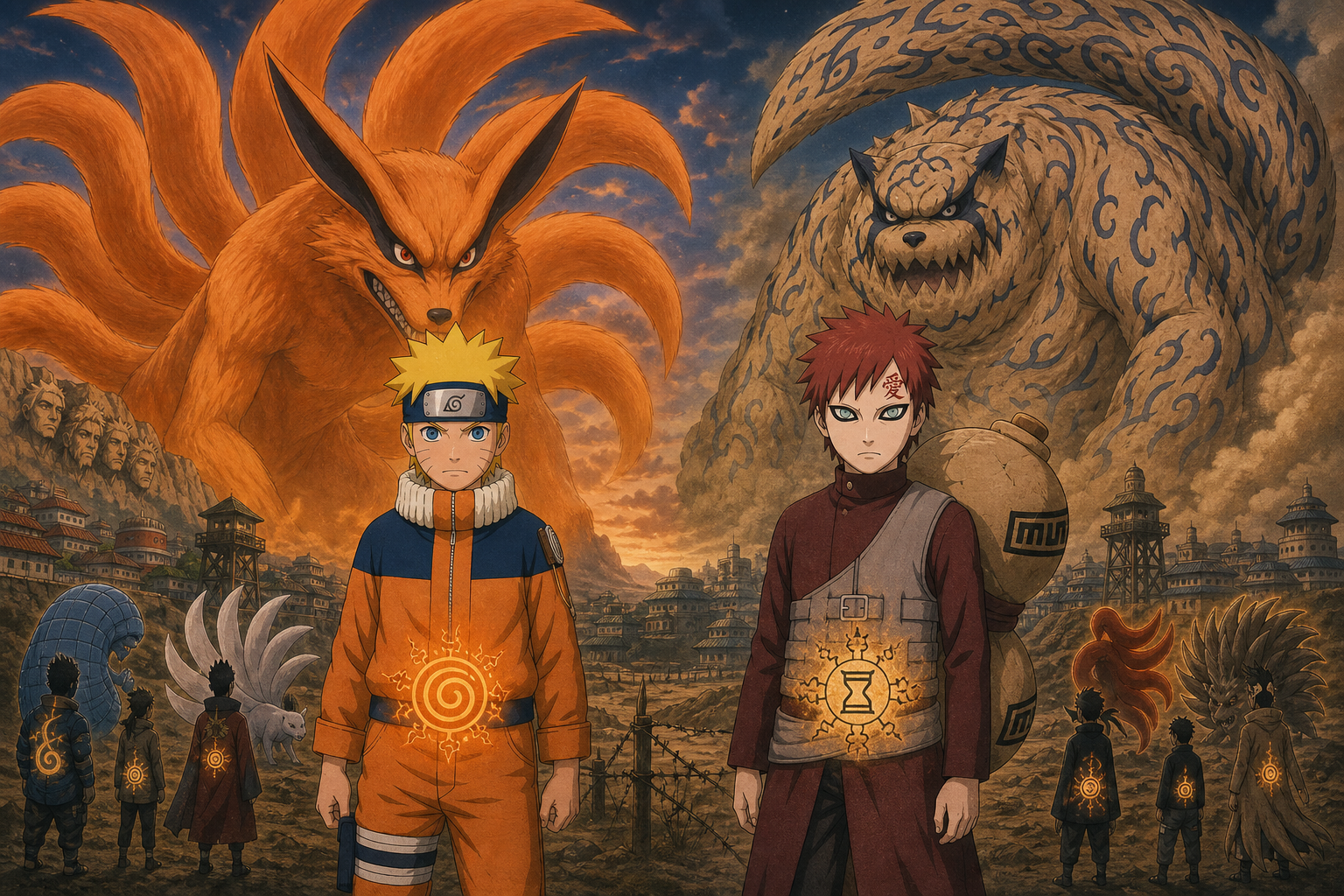
Jinchūriki & Tailed Beasts
The ninja world calls them containers, hosts and weapons before it calls them children. This file separates the tailed beasts from the people forced to carry them,and follows the political machinery that turns living beings into deterrence.
The one-sentence truth
A jinchūriki is not a tailed beast wearing a human face; it is a person whose body has been made into a border, prison, weapons vault and potential relationship without meaningful consent.
Jinchūriki
A human being with a tailed beast sealed inside their body. The term 人柱力 evokes “power of a human sacrifice,” preserving the system’s cost inside the vocabulary.
Tailed beast
One of nine immense chakra beings created when Hagoromo Ōtsutsuki divided the Ten-Tails’ chakra. They have names, memories, personalities and relationships independent of their hosts.
The nine beasts are people before they are numbers
| Tails | Name | Form | Major jinchūriki |
|---|---|---|---|
| One | Shukaku | Tanuki-like sand beast | Bunpuku; Gaara |
| Two | Matatabi | Blue-flamed cat | Yugito Nii |
| Three | Isobu | Armored turtle | Rin Nohara; Yagura |
| Four | Son Gokū | Great ape | Rōshi |
| Five | Kokuō | Horse-dolphin | Han |
| Six | Saiken | Giant slug | Utakata |
| Seven | Chōmei | Armored beetle | Fū |
| Eight | Gyūki | Ox-octopus | Blue B; Killer B |
| Nine | Kurama | Nine-tailed fox | Mito Uzumaki; Kushina Uzumaki; Naruto Uzumaki |
Villages often refer to beasts by tail count because numbering makes allocation and threat comparison easier. Hagoromo gives them names because a name recognizes a subject rather than an inventory unit. Naruto’s decision to learn and use those names is therefore political as well as personal.
How one monster becomes nine
The Ten-Tails is bound to the God Tree and Kaguya Ōtsutsuki’s seizure of chakra. Hagoromo becomes its jinchūriki, then uses Creation of All Things to divide its chakra into nine distinct beings. He does not manufacture nine batteries. He gives emerging lives bodies, names, and a shared childhood before predicting that they will eventually find another kind of unity.
After Hagoromo’s death, human societies meet enormous autonomous chakra beings and interpret them through fear and utility. Hashirama later captures several and distributes them among great villages in an attempted balance of power. The First Five Kage summit treats living beings as strategic allocations even while Hashirama hopes equal distribution will reduce war.
The policy resembles arms deterrence: no village should possess overwhelming beast power. The difference is not decorative. The arsenal thinks, remembers captivity, resents handlers, and is frequently sealed into a child. A balance-of-power plan becomes two layers of imprisonment, beast inside host and host inside village expectation.
Madara’s control of Kurama and later Obito’s attack on Konoha deepen human suspicion, but they also prove the beasts are vulnerable to human coercion. Villagers remember destruction and forget the eye controlling the destroyer. Fear travels toward the visible monster while political responsibility disappears behind it.
The war-era reunion with Hagoromo restores the family dimension. The beasts remember being young, named, and addressed as individuals. Their numbers help readers track them; their names tell us the count was never the whole person.
Why villages create jinchūriki
Deterrence
A village possessing a tailed beast signals catastrophic retaliatory capacity. The host’s body becomes military messaging aimed at rival states.
Deployable force
Leaders hope to control beast chakra in war. Most hosts cannot safely access full power, making the program dangerous and unreliable.
Containment
Sealing prevents a free beast from attacking or being captured. The solution transfers risk into one human life and the surrounding community.
Political legitimacy
Control can demonstrate Kage authority, clan sealing knowledge, and strategic status. Failure becomes publicly embodied in the host.
The system encourages contradictory treatment. Villages need hosts powerful enough to defend everyone, then fear them too much to offer ordinary integration. Isolation destabilizes the control the state claims to prioritize. Naruto and Gaara are punished for emotional volatility produced partly by the punishment.
Hosts may also be tied to leadership families because a Kage wants the weapon close, the seal compatible, or the succession politically manageable. Mito and Kushina connect Kurama to Uzumaki sealing strength and Konoha’s leadership circle. Gaara is the Kazekage’s son. Killer B becomes the Raikage’s adopted brother. Family intimacy can offer protection, but it can also turn kinship into weapons custody.
Confucian duty exposes the state’s failure. If leaders demand that one person bear danger for the whole community, reciprocal responsibility should require exceptional care, honesty, education, and belonging. Instead, many villages request sacrifice and return stigma. That is not duty. That is abandonment with a uniform.
Sealing: containment is not consent
Fūinjutsu binds a beast’s chakra and consciousness inside a host through a specific design. Seals differ in strength and permeability. Some allow chakra leakage, access, and eventual conversation; others emphasize suppression. A seal is a relationship architecture built before one participant can negotiate.
Naruto’s Eight Trigrams Seal combines two Four Symbols Seals and is designed to let Kurama’s chakra mix gradually with Naruto’s. Minato leaves a key and a structure capable of change. That foresight helps Naruto survive and grow. It does not make using a newborn body consensual.
Gaara’s unstable relationship with Shukaku produces chronic sleeplessness, fear of takeover, and partial manifestation. Killer B and Gyūki demonstrate that cooperation can make control more reliable than suppression. The mechanical lesson and ethical lesson point in the same direction: a captive partner who chooses to help is safer than a prisoner constantly searching for the weak point.
Seal quality is not the only variable. Host vitality, compatibility, training, emotional state, external tampering, and the beast’s own decisions all matter. Orochimaru’s Five Elements Seal disrupts Naruto’s existing balance, proving that a third party can weaponize the containment system without opening it fully.
A technically elegant seal remains a political act. Naruto, Gaara, Rin, and many others do not choose the procedure. Their bodies become state infrastructure before they can speak. Calling the seal protective without naming who required protection from whom is how violence gets filed as engineering.
What happens to the host
- Stigma: communities blame the child for the beast’s destruction, collapsing container, captive, and attacker into one feared identity.
- Surveillance: movement, training, and relationships may be controlled because the host is classified as a strategic asset.
- Power: beast chakra can increase reserves, healing, durability, and destruction, but access may injure the body or weaken the seal.
- Psychological pressure: isolation, internal voices, nightmares, and fear of losing control shape development.
- Political targeting: enemy villages and Akatsuki hunt hosts for the being inside them.
- Extraction: removing a beast ordinarily kills the jinchūriki, showing how completely policy and physiology have been joined.
No single host story represents all nine. Yugito is a capable Kumo jōnin but still becomes Akatsuki prey. Yagura is a Mizukage and jinchūriki whose rule is entangled with manipulation. Fū’s hunger for friendship and Utakata’s anime-expanded life show isolation taking different forms. Rōshi and Son Gokū spend decades together without achieving Naruto and Kurama’s intimacy.
The host’s identity can also be swallowed by the public label. Naruto is called the fox. Gaara is treated as Shukaku’s violence. Rin becomes a plan to unleash Isobu on Konoha. The person disappears behind what their body can be made to do. That linguistic collapse is part of the weaponization.
Extraction makes the ownership fantasy impossible to ignore. Akatsuki removes the being, the host dies, and the village learns too late that its “asset” was two lives bound together. Chiyo resurrects Gaara through a separate sacrificial technique. Kushina survives briefly through Uzumaki vitality. Naruto survives extraction through extraordinary intervention. Exceptions prove how lethal the normal rule is.
Naruto and Kurama: from jailer logic to relationship
Kurama attacks Konoha under Obito’s control, and Minato seals half inside newborn Naruto. Villagers remember the fox and project that terror onto the baby. Iruka becomes the first adult shown clearly separating the child from the beast.
Early interactions are transactional and hostile. Naruto reaches for chakra under pressure. Kurama exploits anger, desperation, and weak control. The internal cage makes their relationship materially unequal even when Kurama appears more powerful. Naruto holds the seal; Kurama holds power capable of destroying him.
Jiraiya teaches Naruto to access more chakra, and Yamato later helps suppress dangerous transformations. Those lessons improve survival without solving personhood. Naruto’s struggle at the Falls of Truth matters because no technique can permanently manage hatred he refuses to recognize as his own.
During the war, Naruto learns Kurama’s name, confronts the hatred produced by centuries of use, and offers partnership. Kurama does not become morally valuable only after helping humans. Cooperation becomes possible when Naruto recognizes that the being called a weapon has also been imprisoned.
The relationship remains complicated by origin. Naruto cannot give back the childhood Kurama lost, and Kurama cannot undo the harm he caused while enraged or controlled. Their bond works because recognition does not require fake innocence. They choose what to do next with the truth still in the room.
When Naruto shares Kurama’s chakra across the Allied Shinobi Forces, private containment becomes collective protection. The imagery reverses the village’s original policy. Instead of one child being isolated to hold danger for everyone, the power moves outward through consent and connection.
Gaara and Shukaku: the same system, different conditions
Gaara is made a host before birth by order of his father, the Kazekage. The village then subjects him to emotional and assassination tests. Shukaku’s threat during sleep helps produce the dark rings and chronic vigilance associated with Gaara’s design.
Unlike Naruto’s gradual network of bonds, Gaara receives almost total social confirmation that he is only danger. His violence is his responsibility, but its conditions are political manufacture.
Their later relationship receives less sustained intimacy than Naruto and Kurama’s, yet Shukaku develops respect and cooperation. Extraction separates Gaara’s identity from host status: he remains formidable, becomes Kazekage and continues using sand after Shukaku is removed.
Killer B and Gyūki: proof that control can mean cooperation
Killer B and Gyūki operate as partners, conversing internally and coordinating transformations. B still experiences village fear and restrictions, but their bond demonstrates a route beyond domination.
“Perfect jinchūriki” can be a misleading label if read as perfect control over a beast. The functional advantage comes from agreement. Gyūki lends knowledge, cautions B and retains personality.
B becomes Naruto’s practical teacher because he understands that confronting inner darkness and learning a beast’s power require more than stronger restraints.
Akatsuki and extraction
Akatsuki hunts jinchūriki to extract all nine beasts into the Demonic Statue of the Outer Path and reconstruct the Ten-Tails. Hosts are restrained while members perform a prolonged sealing ritual; death normally follows extraction.
The hunt exposes village failure. States isolate hosts as dangerous assets, then discover that isolation makes them easier to target and less politically mourned. Gaara’s rescue marks a shift because Sunagakure mobilizes around him as Kazekage and person. Naruto insists on the human bond that the strategic vocabulary erased.
Akatsuki’s plan repeats the village system at greater scale. It condemns endless war while gathering living beings into a superweapon intended to impose peace through terror. Pain understands what great powers do to small nations, then adopts the same deterrence logic with a larger bomb.
The extraction ritual is also labor. Members contribute chakra and time while captured bodies are reduced to inputs. Zetsu gathers intelligence. Deidara and Sasori invade the Sand. Hidan and Kakuzu pursue Yugito. Kisame targets B. The organization industrializes hunting across specialized teams.
Obito and Madara ultimately treat beasts, hosts, Akatsuki members, and the entire war as components in a plan that denies ordinary consent. Infinite Tsukuyomi promises peace by replacing relationship with imposed experience. The jinchūriki system’s logic reaches its cosmic endpoint: nobody can hurt you if nobody is allowed to remain an independent subject.
Transformation and chakra use
Chakra cloak
Beast chakra surrounds the host, enhancing physical ability. Early forms may burn skin, erode judgment or allow the beast greater influence.
Partial transformation
Limbs, tails or features manifest without full release. The host borrows specialized power while retaining a human center.
Full transformation
The beast’s complete form appears through or around the host. Cooperation greatly improves control and distinguishes transformation from catastrophic seal failure.
Tailed Beast Ball
A compressed balance of positive black and negative white chakra produces immense destructive force. The Rasengan’s conceptual lineage draws from this concentrated rotation.
Are the beasts demons?
Early Naruto language and translation often frame the Nine-Tails as a demon fox. The broader story identifies the tailed beasts as chakra beings with individual histories, not embodiments of metaphysical evil.
Kurama can hate, deceive and destroy. Those actions remain real. So do captivity, mind control and generations of being treated as transferable property. Personhood does not require innocence; it requires that morality be discussed at the level of a subject rather than an object.
Japanese fox folklore informs Kurama’s imagery, while Shukaku draws on tanuki traditions. Naruto transforms cultural motifs into its own cosmology rather than reproducing a single folktale.
The politics hiding under the friendship story
Naruto’s friendship with Kurama is emotionally satisfying, but personal reconciliation does not automatically reform the jinchūriki system. A just settlement would recognize beasts as autonomous beings, end involuntary sealing, and refuse to classify children as military containers.
The series moves toward recognition through names, shared memory, and voluntary cooperation. It remains uneven about what states formally change after war. That gap matters. Characters can reach moral understanding faster than institutions rewrite doctrine.
Gaara’s rise to Kazekage shows one route: the feared host becomes the village’s chosen leader. That is genuine social change, but it can still leave acceptance tied to extraordinary service. A child should not have to save the entire population before neighbors decide he counts as human.
Killer B’s position is warmer yet restricted. The Raikage loves him as a brother and still limits his movement because strategic protection outranks B’s preference. Care and control can exist in the same relationship. Calling it love does not make the power imbalance evaporate.
Buddhist ideas about attachment and personhood sharpen the final movement. The beasts suffer when humans cling to ownership, fear, and fixed labels. Freedom does not require erasing memory. It requires ending the claim that one being exists as the instrument of another.
The central lesson is larger than “be nice to the lonely host.” Ask who benefits when society fears the person carrying the weapon more than the authorities who placed it there. Then ask whether postwar peace changed the procedure or merely produced nicer handlers.
Common questions
Can a host survive extraction?
Ordinarily no. Exceptional survival involves unusual life force, immediate intervention or resurrection. Kushina remains briefly alive after extraction due partly to Uzumaki vitality; Gaara is resurrected through Chiyo’s technique.
Does the host own the beast’s chakra?
Seals allow access, but ownership language reproduces the political problem. Chakra may be taken, leaked, lent or shared depending on the relationship.
Can a beast live without a host?
Yes. Tailed beasts are autonomous chakra beings. If killed, their chakra can eventually re-form; sealing is not required for existence.
Is every host hated?
No. Treatment differs by village, era and individual usefulness. Respect may still be conditional on military performance, which is not the same as freedom.
What jinchūriki are really about
The jinchūriki system makes policy intimate. Deterrence is not a diagram between states; it sleeps inside a child. Borders, war memory, and leader anxiety appear as a seal on skin.
Naruto and Gaara demonstrate that isolation is not an inherent symptom of hosting a beast. Communities produce it. Their different Part I outcomes measure the timing and availability of recognition, not good monster versus bad monster.
The hosts also expose gender, class, and family power. Kushina is selected for compatibility and brought into Konoha’s custody. Rin is turned into an involuntary delivery mechanism. Gaara is ordered into the role by his father. B receives family attachment and state restriction together. “Chosen vessel” sounds mystical until we ask who did the choosing.
Both host and beast confront identities imposed from outside: monster, weapon, container, failure. Freedom begins not by pretending those histories never shaped them, but by choosing relationships and names that refuse the imposed definition as complete.
Naruto’s greatest victory with Kurama is not the cloak, the giant avatar, or the Tailed Beast Ball. It is the moment two prisoners stop accepting the prison’s description of each other.
A host is a person before the village calls them a weapon
Jinchūriki policy begins with a government decision made about somebody else’s body. The village wants deterrence, emergency power, or control over a tailed beast. The host inherits surveillance, fear, physical danger, political value, and a seal they usually did not choose. Calling that arrangement necessary does not turn it into consent.
Naruto and Gaara make the harm visible through different childhoods. Both are isolated because adults fear what was placed inside them. Naruto reaches for attention. Gaara is taught that love itself is unreliable. Their later bond matters because neither boy needs the other to explain the loneliness. Recognition arrives before agreement.
The series becomes strongest when a tailed beast stops functioning as stored ammunition and becomes a speaking participant. Naruto and Kurama do not repair their relationship through domination dressed up as friendship. Naruto listens, Kurama chooses, and shared power changes meaning because consent enters the exchange. That does not erase decades of coercion. It proves coercion was never the only possible relationship.
Survival does not retroactively justify the seal
Naruto saves lives with Kurama’s chakra. Killer B builds a working partnership with Gyūki. Those outcomes are real, but they cannot be used as receipts proving the original policy was humane. A person can create meaning inside an imposed condition without blessing the adults who imposed it.
That distinction belongs at the center of every jinchūriki discussion. Celebrate the bonds they build. Name the systems that treated them as containers. Do both, because the franchise does both.
Source shelf and continuity boundary
Creation history, jinchūriki policy, Kurama’s relationship with Naruto, and the Fourth Shinobi World War use the core manga/anime record and official Naruto retrospectives. The official war retrospective supports the tailed-beast reunion and Allied Forces context. The official Naruto birthday retrospective supports Naruto’s host history and major turning points. Analysis and judgment are original to CVM Sekai.
Anime-only host stories, games, novels, and sequel developments can add scenes without changing every core rule. This guide labels broad continuity boundaries and does not promote game transformations or unsourced host lists into manga canon. Japanese names and tail counts identify the beasts; they do not replace their personhood.