
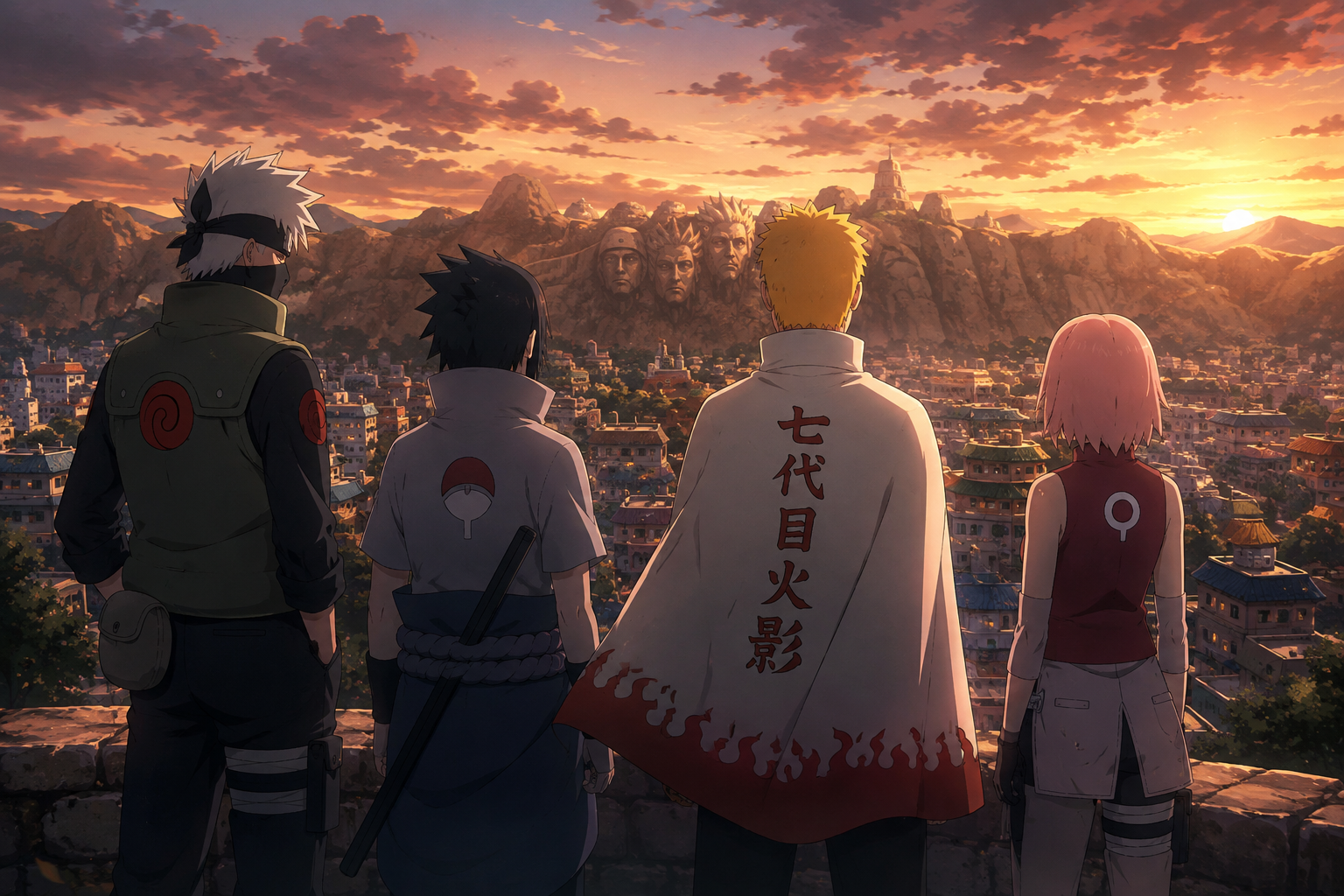
Hidden Villages: home, army, employer, symbol, and unfinished peace project
Konohagakure is inside the Land of Fire; it is not another name for the whole country. That distinction unlocks Naruto’s map: Kage and daimyō, shinobi contracts, clan alliances, borders, smaller nations, and children raised inside military communities.
The distinction readers need first
A Hidden Village is a concentrated shinobi community and military institution located inside a larger country. The village trains ninja, assigns missions, stores intelligence, coordinates defense, and governs internal affairs. The country around it includes territory, civilians, agriculture, trade, borders, towns, aristocratic authority, and a daimyō.
Konohagakure
The Village Hidden in the Leaves: Naruto’s hometown and the shinobi center allied with the Land of Fire.
Land of Fire
The broader country with a Fire Daimyō, civilian settlements, territory, wealth, roads, and political life beyond Konoha’s walls.
Hokage
Konoha’s village leader and military-political authority, not monarch of every civilian living in the Land of Fire.
Daimyō
The country’s feudal lord. Funding, appointment legitimacy, negotiation, and mutual dependency tie the office to the village.
English-speaking fandom often says “Konoha” when it means the Land of Fire, then wonders why a daimyō appears during a Hokage appointment. The confusion is understandable because the plot spends most of its time inside ninja institutions. It still matters. A military village serving a country is not the same political creature as a sovereign nation containing only soldiers.
The village accepts missions from clients, protects national interests, trains armed labor, and negotiates with civilian authority. The daimyō supplies recognition and resources but does not personally command every squad. The Kage wields extraordinary force but does not own every farm and town. Their partnership is messy by design. Naruto’s world is feudal language, modern bureaucracy, clan politics, and military capitalism sharing one apartment and pretending the rent is fine.
The Five Great Shinobi Villages
| Konohagakure | Village Hidden in the Leaves · Land of Fire · led by the Hokage. Built from the Senju-Uchiha alliance and later home to many clans whose cooperation and conflict shape the series. |
|---|---|
| Sunagakure | Village Hidden in the Sand · Land of Wind · led by the Kazekage. Desert pressure, puppet traditions, unstable funding, and the weaponization of Gaara define its early political story. |
| Kirigakure | Village Hidden in the Mist · Land of Water · led by the Mizukage. Bloody Mist history, graduation violence, missing-nin, and later reform expose how village culture can institutionalize cruelty. |
| Kumogakure | Village Hidden in the Clouds · Land of Lightning · led by the Raikage. Military confidence, jinchūriki policy, attempted acquisitions of bloodline power, and strong command culture make it a major rival. |
| Iwagakure | Village Hidden in the Stones · Land of Earth · led by the Tsuchikage. War memory, strategic endurance, mercenary choices, and long institutional experience shape its position. |
The Kage titles are element-linked village offices, not rulers of elemental magic. The five-village order reflects history, military force, economic recognition, and international balance. It does not prove that other communities are unimportant. It proves that the great powers wrote the seating chart.
Konoha’s green streets can make it look like the default moral center because the story begins there. The other villages correct that comfort. Sunagakure turns a child into a deterrent while leaders worry about weakening contracts. Kirigakure lets violence become institutional identity. Kumogakure protects Killer B better than Konoha protects Naruto, yet its history includes attempts to seize the Byakugan and Kushina. Iwagakure carries war grudges and hires Akatsuki. No village gets one permanent moral personality.
The Five Kage Summit exposes the problem beautifully. Leaders enter with legitimate injuries, selective memories, and states to protect. Cooperation becomes possible only after accusation makes the shared system visible. The alliance does not erase history. It creates a temporary structure capable of acting despite it.
How authority is distributed
The Kage commands a village, but never alone
The Kage is commander, administrator, diplomatic representative, public symbol, mission authority, and crisis decision-maker. Advisors, elders, department heads, clan leaders, jōnin, intelligence units, medical systems, and civilian workers make government possible. The face on the monument compresses a network into one visible body.
That compression creates accountability and myth at once. The Hokage signs orders and becomes the person citizens praise or blame, while thousands of less visible workers keep barriers running, records moving, patients alive, streets rebuilt, and teams assigned. Tsunade’s leadership during Pain’s assault works because her chakra enters a care network. A title without infrastructure would be a cape standing in an empty office.
The daimyō relationship makes sovereignty messy
The official Hashirama retrospective describes Konoha forging a relationship with the Land of Fire and seeking equality between daimyō and shinobi. The village is neither a fully independent country nor a simple military department. Funding and appointment processes keep civilian aristocratic authority intertwined with armed power.
Danzō’s post-Pain rise shows the distinction. He becomes the village’s political choice and receives the Fire Daimyō’s support while Tsunade is incapacitated, but the sequence is interrupted before a normal public inauguration settles his status. Exact wording matters because Naruto’s politics are already complicated enough without promoting a candidate by fandom paperwork.
Clans remain states inside the state
The founding bargain does not erase the Senju, Uchiha, Hyūga, Nara, Yamanaka, Akimichi, Aburame, Inuzuka, or other family systems. Clans retain knowledge, property, internal hierarchies, marriage politics, reputations, and specialized labor. The village centralizes violence without dissolving older loyalties.
The Uchiha police force demonstrates the danger. A clan can receive official responsibility while remaining socially isolated and politically suspected. Integration on paper is not belonging in practice. When surveillance replaces reciprocal trust, the institution can describe exclusion as security right up until the catastrophe it helped create.
Departments turn ideals into administration
The academy, hospital, ANBU, intelligence, barrier teams, interrogation, police, mission desk, records, and communications matter because a village is not sustained by speeches. Institutions decide which children are trained, which threats are recorded, which bodies receive care, and which secrets survive.
Why the Hidden Village system was invented
The official Hashirama column locates the dream in the Warring States era, when clans hire themselves into recurring conflict and children die on battlefields. Hashirama and Madara imagine a settlement where former enemies can protect children from that cycle. Their alliance produces Konoha; other nations imitate the model until five major villages dominate the shinobi world.
The achievement is real. Concentrating clans under public institutions creates schooling, shared defense, rules, infrastructure, and longer horizons than contract warfare allowed. Hashirama’s brothers do not all survive long enough to enjoy that horizon. Madara’s trust does not survive the politics required to maintain it. The founding is not a clean myth. It is traumatized adults trying to build what their dead siblings never received.
What the village solves
Endless clan vendetta, fragmented training, unstable contracts, lack of shared protection, and children deployed solely through family warfare.
What the village preserves
Military competition, secrecy, inherited inequality, child training, externalized violence, political sacrifice, and the temptation to value the institution above the people it was built to protect.
Hashirama’s later willingness to protect the village even against friend, brother, or child reveals the founding paradox. An institution created to protect children becomes the value for which children are sacrificed. Will of Fire rhetoric can inspire reciprocal care, but it can also ask the young to burn while elders call the smoke tradition.
Confucian political language helps explain the ideal without excusing the result. Authority is supposed to carry responsibility downward as well as obedience upward. A Hokage who asks sacrifice but refuses care has broken reciprocity. Hiruzen’s affection for the village is sincere; his failures toward Naruto, the Uchiha, and Orochimaru still count. Filial language does not cancel adult accountability.
Buddhist ideas about attachment add another pressure point. Loving a home is not the problem. Treating the institution as a permanent self that must survive at any moral price turns attachment into suffering. Naruto’s best leaders protect relationships inside the village. Its worst decisions protect the name of the village from the people living under it.
Smaller nations make the great-village map honest
Land of Waves
The Land of Waves has no major hidden village capable of countering Gatō’s private violence. Tazuna must purchase protection from Konoha, and poverty makes the true mission unaffordable. His lie is dangerous. It is also produced by a market where safety is priced above what an occupied community can pay.
Team 7 does not arrive as international aid. They arrive as contracted labor under false risk data. Kakashi’s decision to continue keeps Tazuna alive, but it also places genin in a conflict their bureaucracy did not authorize. The bridge becomes infrastructure, resistance, and a reminder that a weak country’s survival can depend on whether foreign soldiers choose mercy outside the form.
Land of Rain and the cost of being a crossroads
Amegakure sits where great-nation wars keep passing through. Yahiko, Konan, and Nagato do not invent grievance for dramatic lighting. They grow up among casualties produced by other powers’ strategies. Pain’s later violence is his responsibility, but the great villages do not get to erase the world that taught him suffering was their most reliable export.
Rain also shows how a smaller village can become authoritarian while claiming protection. Hanzo’s fear and Nagato’s surveillance answer vulnerability with control. Victimhood does not guarantee humane government. It only explains why certain promises find an audience.
Hidden village is not the only model
Samurai authority in the Land of Iron, temples, wandering shinobi, missing-nin networks, criminal organizations, merchants, towns, and unaffiliated specialists complicate the assumption that every capable person belongs naturally to a Kage. The map is full of lives the mission desk does not organize.
Mission markets reproduce hierarchy
Great villages sell coordinated shinobi labor. Wealthy clients purchase capability. Weak states may remain weak because domination stripped the revenue required to buy protection. Sunagakure’s willingness to join Orochimaru’s Konoha invasion grows partly from economic pressure after the Wind Daimyō shifts missions toward Konoha. That does not excuse invasion. It shows how budgets become bodies.
Read the separate Mission Classifications guide for the assignment system built on top of this geography.
What a village means to the people inside it
Home is emotionally true
Ramen shops, classrooms, training grounds, hospitals, clan homes, memorials, festivals, friendships, and ordinary streets make Konoha more than a command structure. Naruto does not dream of abstract bureaucracy acknowledging him. He wants the people whose faces formed his world to call him one of their own.
That desire is not foolish because the institution failed him. Ichiraku, Iruka, Team 7, Konohamaru, and later the wider village give the place human content. Naruto’s attachment becomes healthier as it moves from begging an audience for recognition to participating in reciprocal relationships. Home stops being the crowd that judges him and becomes people whose lives he knows.
Military institution is also true
The headband signifies belonging and deployability. Academy graduation is recognition and conscription. The mission desk turns ability into contracted labor. The monument turns leadership into civic mythology. Love of home does not require pretending these functions disappear.
This double truth is why “Konoha good” and “Konoha evil” are both lazy. A village can shelter a child and exploit another. It can produce healers, teachers, torturers, dissidents, bureaucrats, heroes, and people selling vegetables. Institutions are relationships stabilized into rules. Change the relationships without changing the rules and the old harm waits for a new manager.
Defection becomes existential
A missing-nin does not merely quit a job. They carry techniques, intelligence, clan history, and symbolic betrayal beyond the institution that claims them. Scratching a village symbol attacks the link between identity and allegiance.
Zabuza leaves the Mist but carries its killing culture. Sasuke leaves Konoha because the village failed to make belonging stronger than revenge and Orochimaru’s offer. Itachi is branded criminal while serving a secret village order. The category “traitor” can describe a real threat and hide the authority that produced it.
Peace requires more than alliance
The Five Kage cooperate against a common enemy, and the Allied Shinobi Forces coordinate across former borders. Durable peace also requires memory, institutional reform, economic change, and willingness to see people in smaller nations as more than terrain between great powers.
Boruto’s modern Konoha proves that peace changes infrastructure, technology, work, and childhood. It also preserves rank, secrecy, clan inheritance, and enormous military power. The sequel does not show a finished utopia. It shows the next bill arriving in a cleaner envelope.
A hidden village is not the whole country
Konohagakure belongs to the Land of Fire, Sunagakure to the Land of Wind, Kirigakure to the Land of Water, Kumogakure to the Land of Lightning, and Iwagakure to the Land of Earth. The village manages shinobi power. The surrounding country includes civilian communities, economic networks, borders, and a daimyō whose political authority does not vanish because the Kage can level a mountain.
This separation explains several story tensions that disappear when fans use village and country as synonyms. A Kage leads a military settlement, not every civilian institution across the nation. Daimyō participate in recognition, funding, diplomacy, and succession politics. Clients can come from inside or outside the country. A village may protect national interests while also competing for contracts that keep its own system alive.
The village system turned clans into state infrastructure
Before the hidden villages, armed clans sold their service through unstable alliances and cycles of revenge. Hashirama and Madara’s project promised children a life beyond clan battlefields. Konoha genuinely changed the political map. It also gathered clan power under a new military institution that could train, rank, deploy, surveil, and discipline the next generation more efficiently.
That is the central contradiction. The village can be home, school, employer, army, intelligence service, and family myth at once. Citizens love it because real relationships live there. Leaders invoke that love when demanding sacrifice. The Will of Fire can inspire mutual care, but it can also make institutional loyalty sound like a parent’s embrace while actual children remain unprotected.
Military labor keeps peace tied to competition
Hidden villages need missions, clients, resources, and reputation. If one village appears weak, work and political influence can move elsewhere. The Chūnin Exams package that competition as international cooperation while young fighters advertise their villages before spectators and officials. The event builds diplomatic contact, yet it also stages military capacity for public consumption.
Economic insecurity helps explain why peace agreements alone do not fix the system. Villages trained for conflict still need a role when wars recede. Weapons, classified knowledge, elite units, and national rivalries do not disappear because leaders shake hands. Sustainable peace requires changing incentives, accountability, education, and the idea that every valuable relationship must eventually serve state power.
Small countries absorb the cost of great-power rivalry
The Five Great Shinobi Countries dominate the political imagination, but places such as the Land of Waves and the Land of Rain reveal who pays for that dominance. Great villages fight, maneuver, and project power while smaller territories become routes, buffers, proxy fields, or neglected clients. Nagato’s anger begins in a country repeatedly used as somebody else’s battlefield.
Naruto’s promise of peace means very little if it only improves relations among the strongest villages. The test is whether people without a Kage, a tailed beast, or a seat at the summit stop becoming disposable geography. Peace that protects the center while abandoning the margins is a quieter form of the same hierarchy.
Defection turns citizenship into a question of ownership
A missing-nin carries training, secrets, techniques, and possibly a bloodline the village considers strategic property. Pursuit may protect civilians from a dangerous criminal. It may also enforce the belief that the institution owns what it taught and can punish departure regardless of why the person fled.
Sasuke makes that conflict personal. Konoha is his home, the site of his clan’s destruction, the government that concealed the truth, and the community Naruto refuses to surrender. Any honest reading has to hold all four realities. Loyalty is emotionally real. So is the state’s violence.
RaeRae’s bottom line
Do not reduce a hidden village to a charming neighborhood with a leader’s face on the mountain. It is a home built inside a military economy, full of people capable of love and institutions capable of harm. Naruto’s hope matters because he believes community can become better than the machinery it inherited. The series is strongest when it makes that change difficult instead of pretending one heroic Hokage automatically completes it. Leadership can open the door, but reform needs records, laws, resources, dissent, and people willing to name what the village did wrong. Otherwise the faces on the monument change while the machinery underneath keeps asking children to pay the same bill, under a cleaner banner and a kinder speech, while everyone applauds the new face above it.
Source shelf and continuity boundary
Founding, daimyō relations, system diffusion, and the first Five Kage summit use the official Hashirama birthday column. Later governance and diplomacy use the official Five Kage Assemble retrospective. The system’s historical critique uses the official Team 7 Returns and Obito retrospective. Analysis and explanatory language are original to CVM Sekai.
The manga and anime reveal political history gradually, and adaptation can add village texture or change emphasis. This guide separates established institutions from interpretation. It does not treat one leader’s speech as a neutral constitution, and it does not convert every fandom map label into canon geography.
Now read the village through the people it trained.
Character files show how Konoha, the Mist, the Land of Waves, clans, teachers, and mission systems become intimate history.
Open the Naruto character directory → · Open Mission Classifications → · Return to Naruto 101 →