
Chakra: the energy that turns a body, a memory, and a will into power
Chakra is not “anime mana.” It is produced, shaped, controlled, inherited, sealed, exhausted, shared, stolen, and judged,and Naruto builds an entire political world around who gets to use whose energy.
What chakra actually is
Chakra is the workable energy a shinobi produces by combining physical energy from the body with spiritual energy built through experience, discipline, knowledge, and will. The result still has to be molded, controlled, and released correctly. Having chakra does not mean knowing what to do with it.
That distinction saves us from calling chakra “anime mana” and moving on. Mana usually acts like fuel sitting in a tank. Chakra is closer to labor performed by the whole person. Muscles, cells, stamina, breath, memory, concentration, emotion, and training all participate. When a shinobi is injured, frightened, exhausted, distracted, poisoned, or fighting a seal placed on their body, the problem is not a blinking fuel gauge. The instrument producing the power is under stress.
The story sometimes uses “stamina” and “chakra” loosely in dialogue, especially in early explanations and translation. The useful rule is simple: bodily and spiritual energies are the ingredients; chakra is the usable energy molded from them. A technique then gives that energy a method, nature, shape, target, and cost.
This is why chakra can be sensed as a personal signature. It belongs to a body and history before it becomes a fireball. Sensors recognize people, hostile intent can disturb a room, and borrowed chakra can feel different from the user’s ordinary supply. Naruto does not give us one laboratory measurement for every variation, so do not pretend the system is cleaner than the text. It gives us consistent working principles and then shows what war, lineage, monsters, gods, and human experimentation do to them.
Control is not the same thing as quantity
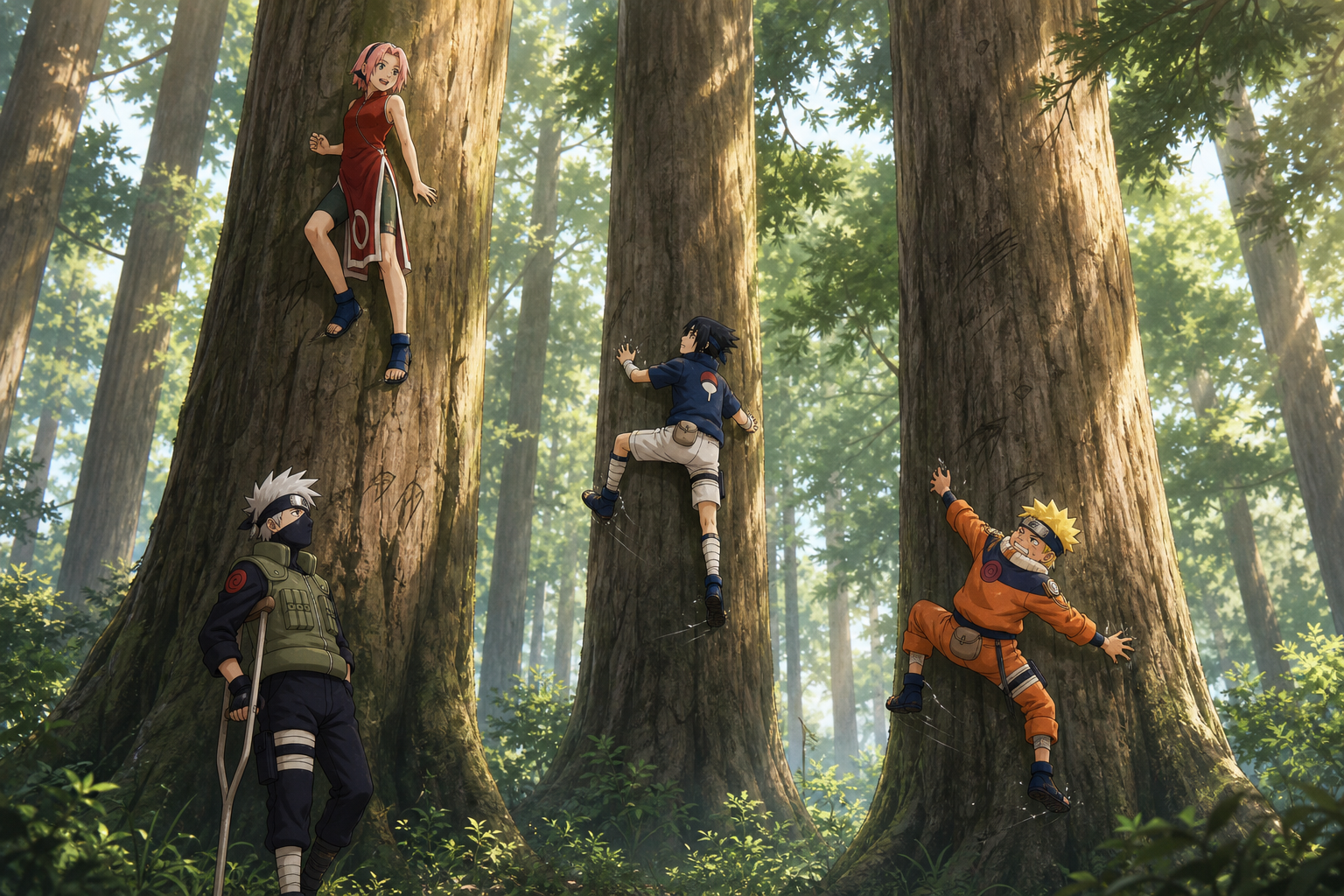
Sakura completes the tree-climbing exercise first because she can send the right amount of chakra to one precise point with little waste. Naruto has enormous reserves and terrible early control. Sasuke has strong aptitude, discipline, and competitive drive, yet he still has to fall off trees until his body learns the lesson. The bark is a better teacher than a power ranking: too little chakra and the foot slips; too much and the surface breaks.
Molding
Producing and combining the energy a technique needs. Inefficiency means spending more chakra than the result requires, which matters in a long fight.
Channeling
Moving chakra to the correct place, such as the feet during tree climbing or water walking, without losing stability elsewhere.
Shaping
Controlling form, rotation, density, range, and behavior. The Rasengan is the loudest early proof that shape can be brutally difficult even without hand seals.
Timing
Releasing the correct amount at the correct moment. Precision delivered late is still failure when another person is bleeding.
Episode 10, “The Forest of Chakra,” turns Team 7’s rivalry into peer education. Naruto asks Sakura how she does it. Sasuke later needs the same information but cannot bear to ask her directly, so he asks Naruto what she said. Naruto keeps that vulnerability private. The training is not only a mechanics lesson. It shows three children building a learning network their formal institution did not finish building for them.
Water walking raises the difficulty because the surface moves and the user must keep adjusting output. When Naruto struggles, Jiraiya discovers that Orochimaru’s Five Elements Seal is disrupting the even circulation created by the Eight Trigrams Seal. That moment matters. A student can practice honestly and still fail because someone altered his body without consent. Good teaching checks the system before blaming the child.
Medical ninjutsu, chakra-enhanced strength, puppetry, genjutsu disruption, and sensory work all demand different kinds of control. Sakura and Tsunade do not become formidable by secretly receiving Naruto-sized reserves. They make precision frightening. That is not a consolation prize. It is a different architecture of mastery.
Reserves, exhaustion, and the body’s bill
| Large reserves | Support more techniques, longer battles, clones, summons, healing networks, or unusually expensive attacks. They do not automatically grant precision, judgment, speed, or an answer to every matchup. |
|---|---|
| Low chakra | Can make techniques fail, weaken movement, blur concentration, and leave a shinobi unable to defend themselves. Repeated warnings about chakra exhaustion are not decorative dialogue. |
| Overuse | The body pays through collapse, injury, damaged pathways, shortened endurance, or death. Chakra is tied to life rather than stored in a detachable battery. |
| Recovery | Rest, food, medical treatment, and time matter. Elite shinobi still require bodies capable of surviving what their techniques demand. |
Naruto complicates the ordinary model because Kurama is sealed inside him. Naruto has his own exceptional vitality, the Nine-Tails has a separate ocean of chakra, and the seal regulates contact between them. Early leaks can save Naruto while also overwhelming judgment, injuring his body, and threatening everyone nearby. Power arriving from inside a body is not automatically power the conscious self owns.
Shadow clones make the arithmetic even messier. The user divides chakra among active bodies, then receives their experience when they disperse. Naruto turns huge reserves into accelerated training by having many clones perform parallel work. The trick is brilliant and dangerous. A person with ordinary capacity could not copy the schedule without copying the collapse.
Kakashi’s early battles show the other side. The Sharingan and copied high-level techniques consume him heavily, especially before later-war scaling stretches everyone’s limits. He can win a tactical exchange and still require recovery afterward. The bill does not cancel the victory. It tells us that expertise includes knowing when one more technique will leave the team without a functioning leader.
Chakra transfer also proves that reserves are not always sealed private property. Healers send chakra into patients. Katsuyu distributes Tsunade and Sakura’s healing through divided bodies. Naruto shares Kurama’s chakra across the Allied Shinobi Forces. Those scenes are not identical, but each turns capacity into infrastructure. A large reserve matters most when it keeps other people alive, not when a fandom chart crowns its owner.
Chakra nature and shape are different problems
Nature transformation gives chakra an elemental quality. Shape transformation controls form, movement, density, range, and behavior. A technique may emphasize one, the other, or both. The Rasengan is primarily a shape achievement. Naruto’s later Rasenshuriken works because he forces wind nature into that already difficult rotating structure.
Fire
Common in the Uchiha repertoire, but never exclusive to one clan. Fire techniques convert chakra into flame with range, heat, fuel conditions, and counterplay that vary by jutsu.
Wind
Naruto’s affinity. Its cutting quality makes the Rasenshuriken devastating at a microscopic level, which is exactly why Tsunade initially forbids him from using the hand-thrown version.
Lightning
Central to Chidori. Penetration and speed create lethal force, while the tunnel vision of a straight rush makes enhanced perception a practical safety requirement.
Earth and water
These can reshape terrain, build defense, restrain bodies, create mobility, or weaponize the environment. Kakashi and Zabuza’s water battle proves that an element is a tactical language, not a personality quiz.
Chakra paper gives a simplified affinity check: it burns for fire, splits for wind, crumples for lightning, turns to dirt for earth, and becomes wet for water. Affinity makes one transformation easier to learn. It does not ban every other nature. Experienced shinobi can develop several, while the highest-level combinations may require rare bodies, inherited traits, transplanted power, or techniques the ordinary classroom does not offer.
Kekkei genkai such as Haku’s Ice Release combine natures through inherited ability. Kekkei tōta extends the idea further. Yin Release works with spiritual energy and form; Yang Release works with physical vitality; Yin-Yang Release sits behind some of the franchise’s most reality-bending creation and nullification effects. The series grows the system far beyond five colored arrows, but the basic question remains useful: what quality is being changed, what shape is being built, and what body can sustain it?
The common elemental advantage diagram is a starting relationship, not a guaranteed win button. Scale, density, timing, terrain, experience, and the specific techniques involved can reverse a neat classroom answer. If combat were solved by checking a wheel, Kakashi could have laminated one and sent everyone home.
Special sources and altered chakra
| Tailed beasts | Vast chakra beings sealed inside jinchūriki as military deterrence. The arrangement can involve coercion, stigma, bodily occupation, negotiated cooperation, and eventually friendship, but friendship does not retroactively make the original policy ethical. |
|---|---|
| Senjutsu | Balances natural energy with the user’s physical and spiritual energies. Too little natural energy fails; too much can petrify or transform the practitioner. Stillness, bodily capacity, and instruction matter. |
| Medical use | Requires precise diagnosis and control to heal tissue, stop damage, perform surgery, or store and release chakra. Care is treated as technical mastery, not magical kindness. |
| Eight Gates | Removes limits that protect the body from its own output. Each opened gate offers greater performance at escalating physical cost. The final gate makes sacrifice mechanically explicit. |
| Seals and cursed marks | Can store, restrict, regulate, transfer, or contaminate chakra. A seal may protect a village while forcing one host to live with the danger; a cursed mark turns another person’s body into Orochimaru’s access point. |
Transplanted eyes, Hashirama cells, scientific tools, resurrection techniques, and Ōtsutsuki power all complicate the claim that chakra belongs neatly to one person. The franchise keeps asking whether a body can borrow power without becoming property. Sometimes the answer is collaborative. Sometimes it is surgery performed by a nightmare with excellent research funding.
Senjutsu gives the cleanest limit. Natural energy exists outside the user, but it cannot simply be gulped down. The practitioner must balance three ingredients precisely. Naruto succeeds by training stillness and using shadow clones as remote reservoirs. Jiraiya achieves an imperfect Sage Mode with help from Fukasaku and Shima. Kabuto alters his body to gather and manage more. Same category, different bodies, different methods, different moral histories.
Medical chakra also exposes the lie that combat is the only serious use of power. Tsunade builds rules, training expectations, and battlefield systems around keeping teams alive. Sakura stores chakra for years before releasing the Strength of a Hundred Seal. Katsuyu turns individual reserves into a village-scale care network. The spectacle is quieter than a crater, but the consequence is thousands of people who remain alive to have a next scene.
What chakra lets Naruto say about people
Talent is never only individual
Clans transmit secret methods. Bodies inherit traits. Teachers reveal shortcuts. Villages guard techniques as military assets. Wealth, family position, political suspicion, disability, and access to safe training all change what effort can become. Naruto loves persistence, but its own power system refuses the fantasy that every child begins on the same starting line.
Neji is wrong to treat destiny as absolute, yet he is not hallucinating the Hyūga institution tattooed onto branch-family foreheads. Rock Lee’s labor is real, but so is Guy’s rare decision to recognize and train him. Naruto works brutally hard, but he also has Uzumaki vitality, Kurama, elite teachers, inherited techniques, and political attention. The honest reading can celebrate effort without stealing the receipts from everyone who made that effort possible.
The body remembers institutions
Jinchūriki carry village policy inside their bodies. Cursed seals turn grooming and experimentation into anatomy. Clan techniques convert family history into combat capability. Medical ninjutsu makes care a technical discipline. The Eight Gates reveal how military achievement can require self-destruction. Chakra ensures that politics never stays abstract. Leaders make a policy; years later a teenager bleeds it.
This is where the series becomes more than a clever power manual. Hidden villages train children to turn life energy into national labor. Mission clients purchase risk. Bloodlines become security concerns. Healers are asked to return damaged bodies to the same system that damaged them. Naruto’s final answer is not to abolish chakra. It is to change relationships around power, though the sequel era keeps proving that reform is unfinished.
Sharing power changes its meaning
Stolen chakra and forced containment treat energy as property detached from personhood. Voluntary transfer, healing, summons, and Naruto sharing Kurama’s chakra with allies make power relational. Consent does not erase every hierarchy, but it changes the moral structure. The giver remains a person with agency instead of becoming raw material.
That is also why Naruto and Kurama’s partnership matters. Naruto does not become pure by expelling the monster, and Kurama does not become valuable only after serving the village. They learn names, negotiate access, remember harm, and choose cooperation. The power increase is enormous. The deeper victory is that two beings formerly treated as containers stop treating each other that way.
Control is a cultural value, not just a combat stat
The series repeatedly praises endurance, discipline, obligation, and mastery of emotion. Those values can support Confucian ideas about cultivated conduct and reciprocal duty, but Naruto also shows the danger of demanding composure from the injured while institutions avoid responsibility. Sakura’s control earns praise because it creates capacity and care. Haku’s control serves a coercive dependency. Technique alone cannot tell us whether the relationship around it is just.
Chakra makes interior life visible, but it does not reduce people to vibes. Grief may destabilize power. Love may motivate impossible endurance. Hatred may be weaponized. None of that means every emotion is secretly a spell. The writing works best when feeling has a body, a history, a choice, and a consequence.
Chakra control is not the same thing as having more chakra
Naruto spends years proving why this distinction matters. He begins with enormous reserves, poor precision, a damaged relationship with the power sealed inside him, and a habit of solving control problems by forcing more energy through them. Sakura starts with far less spectacle but can regulate output with exceptional accuracy. Kakashi’s tree-climbing exercise makes the difference visible before the story starts handing out transformations that can distract from fundamentals.
Control decides how much chakra reaches the technique, how much gets wasted, and whether the user can sustain the result. Reserves decide how long the body can keep producing and circulating that energy. A shinobi can excel at one and struggle with the other. That is why “strong chakra” is not a complete diagnosis, and why a large pool does not magically create mastery.
The body always pays the bill
Chakra is supernatural, but the series refuses to make it consequence-free. Exhaustion, damaged pathways, physical collapse, shortened life, disrupted consciousness, and death remain part of the system. Medical ninjutsu demands precision because the margin for error is a living body. The Eight Gates produce impossible output by removing the body’s safeguards. Tailed-beast chakra can heal and empower while also burning, distorting, or overwhelming its host.
This matters editorially because Naruto repeatedly turns political choices into bodily conditions. A seal placed by adults becomes a child’s daily anatomy. Clan techniques travel through families as both inheritance and obligation. War strategy lives in soldiers’ muscles and nerves long after leaders finish giving speeches. The body remembers what institutions prefer to call necessity.
Nature transformation is a vocabulary, not a personality test
The five basic transformations describe how chakra changes, not five sealed character classes. Affinity makes one nature easier to learn, but training, lineage, tools, copied knowledge, and specialized conditions widen a shinobi’s range. Combined natures and kekkei genkai complicate the chart further. The familiar advantage cycle helps explain certain clashes, yet tactics, scale, timing, and execution still decide fights.
That is the fun of the system when the writing is disciplined. Chakra supplies rules without reducing combat to arithmetic. A weaker fighter can read the field better. A supposedly inferior nature can win through placement. A technique can fail because the user misunderstands the opponent, not because the fandom forgot to update a power ranking.
RaeRae’s bottom line
Chakra works because it is never only fuel. It is breath, labor, inherited knowledge, weapon policy, spiritual language, and the physical record of what a person has survived. Learn the mechanics, absolutely. Then keep asking who taught the technique, who controls access, whose body carries the risk, and who gets praised when that body survives.
One more boundary: chakra is not moral alignment
The same system powers healing, surveillance, transportation, coercion, art, assassination, and rescue. Chakra does not certify the user as good because the technique glows beautifully, and dark presentation does not make a method inherently evil. Judgment belongs to purpose, consent, cost, and consequence. That is why the franchise can let identical mechanics reveal completely different people. Power tells us what a character can do. Their choices tell us who they are. Context keeps that judgment honest. Every single time.
Source shelf and continuity boundary
Early control and training checks use the official Episode 10 page. Later development checks use the official Naruto birthday retrospective and the official Fourth Great Ninja War retrospective. Technique wording can vary across official English manga, subtitles, dubs, guidebooks, and games. This guide uses the core manga and anime mechanics, labels major extensions, and does not import a flashy game move simply because a wiki placed it on the same shelf.
The system also expands over hundreds of chapters. An early teacher explains what a genin needs today; a late-war revelation explains ancient chakra history. Those statements can add layers without making the first lesson “wrong.” When the franchise contradicts its own scale or leaves a mechanism vague, the honest answer is a boundary, not a homemade law wearing glasses.
Chakra is the power. Jutsu is what people teach it to do.
This file explains the energy system. The separate Jutsu file covers technique families, hand seals, classification, rank, transformation, and why a shinobi’s repertoire tells a social story.