
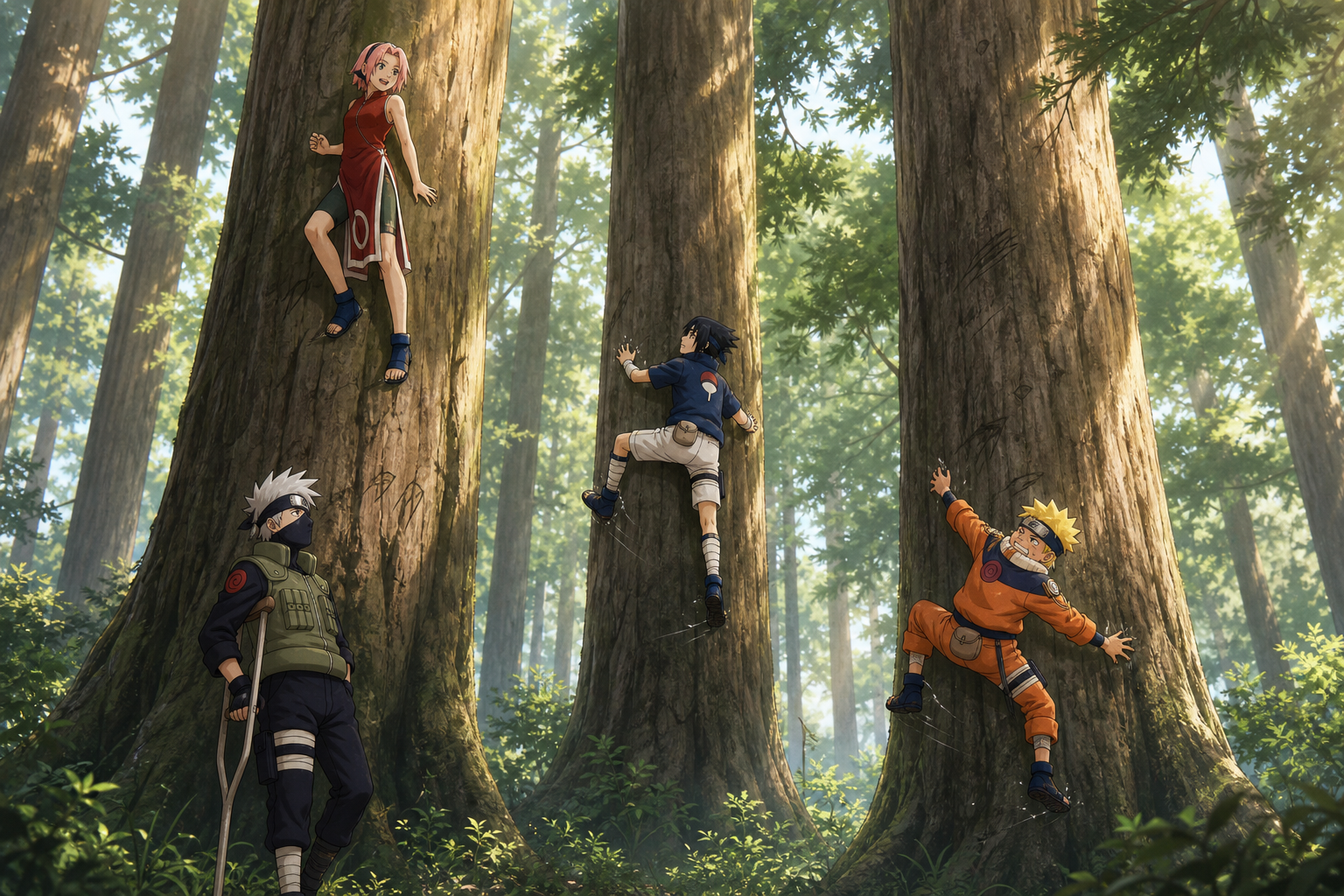
Episode 10 turns a forest into a diagnostic instrument. The tree does not care who has the largest dream, bloodline, or chakra reserve. The exercise reveals who can make power obey.
A Victory That Does Not Feel Finished
Kakashi wakes inside Tazuna’s home after exhausting himself with the Sharingan. The team survived. Zabuza was carried away as a corpse. By ordinary mission logic, the immediate threat appears resolved.
Kakashi is unsatisfied because the details do not cohere. Hunter-nin exist to destroy a missing shinobi’s body and protect village secrets. The masked child removed Zabuza intact. The senbon struck precise points in the neck, weapons capable of interrupting vital signs without necessarily causing irreversible death.
What looked like official procedure now resembles rescue performed through the costume of official procedure.
Kakashi’s strength in this scene is not ocular. The real strength is intellectual humility. He revises the conclusion he accepted on the riverbank. Competence does not mean never being deceived. Competence requires a willingness to reopen the evidence after confidence becomes inconvenient.
The Masked Child as an Accomplice
The hunter-nin’s youth shocked Naruto, but Kakashi’s reconstruction changes the comparison. The masked child may not have effortlessly killed Zabuza. The child may have deceived an elite jonin, extracted an ally, and hidden the relationship beneath a recognized institutional role.
That possibility is more impressive and more disturbing. Strength is no longer measured only by lethal output. Medical precision, disguise, timing, and social knowledge can overturn a battlefield.
The mask functioned because Kakashi already knew what a hunter-nin should look and sound like. Deception entered through expertise rather than ignorance. The more fluently a person recognizes a system, the easier it can be to present the correct symbol and move through the gap between symbol and truth.
Zabuza is alive because the child understood both anatomy and authority.
Why Training Cannot Wait
Kakashi is still physically depleted, yet he knows Zabuza’s recovery creates a countdown. Team 7 cannot depend on the same battle resolving the same way. Surprise has been spent. Zabuza now knows the students can disrupt his technique and Kakashi can dominate his confidence with the Sharingan.
The genin must become more capable before the rematch. Kakashi does not begin with a new attack. He begins with control.
This choice is pedagogically important. Naruto and Sasuke have enough dramatic techniques to mistake repertoire for growth. Sakura possesses less visible combat power and may mistake that absence for inferiority. The tree-climbing exercise separates the amount of chakra a person has from the precision with which it is used.
What Chakra Is Doing
Kakashi explains chakra as energy produced through the body and spirit, then shaped and directed through training. Techniques require more than possession. The user must gather an appropriate amount, mold it, and release it through a controlled pathway.
Too little chakra and the technique fails. Too much and the energy becomes wasteful or destabilizing. Power can sabotage itself through excess.
This is one of Naruto’s central ideas disguised as mechanics. Potential is not action. Desire is not execution. Inner resources become meaningful only through a relationship between intention, discipline, and form.
The lesson also refuses a simple hierarchy. Someone with smaller reserves may perform a task more effectively because less is lost between intention and result. Efficiency is a kind of strength.
Walking Up a Tree Without Hands
Kakashi channels chakra into the soles of his feet and stands horizontally on a vertical trunk. The demonstration turns an ordinary tree into a violation of gravity.
The students must run upward, maintain contact through a precise flow, and mark the highest point reached with a kunai. The mark converts each failure into information. They are not asked to leap blindly until success arrives. They are asked to measure the edge of current control and move it.
The exercise is elegant because the tree answers instantly. Too little chakra and the foot slips. Too much and the bark breaks, throwing the student away. Correct control produces adhesion without destruction.
The goal is not to dominate the tree. The lesson asks each student to create a stable relationship with the surface.
Naruto’s Problem: Abundance Without Governance
Naruto attacks the task with force. He gathers chakra, charges, and expects commitment to carry him upward. The tree throws him back.
His difficulty reflects everything we know about him. Naruto possesses extraordinary reserves, intense desire, and a habit of solving invisibility through scale. More clones. More noise. More effort. Tree climbing punishes the assumption that more is automatically better.
He must learn to feel what is enough. That may be emotionally difficult for a child shaped by deprivation. Naruto has rarely experienced “enough” recognition, belonging, family, or trust. His survival language is excess because scarcity has taught him that small signals disappear.
Chakra control requires a new interior belief: precision can make a quiet amount sufficient.
Sasuke’s Problem: Control Disturbed by Urgency
Sasuke advances farther than Naruto, but he also fails. His technical foundation is stronger, and his body responds with greater discipline. Yet comparison begins working against him.
He wants to master the exercise quickly, especially once Sakura succeeds. The need to remain ahead tightens attention around outcome instead of sensation. Control becomes harder when the task is carrying the weight of identity.
Sasuke has built worth around competence because competence feels safer than attachment. A training failure is never only a training failure. Each mistake threatens the structure through which he distinguishes himself and approaches revenge.
The tree asks him to learn without using superiority as proof that learning is occurring.
Sakura Reaches the Top
Sakura channels the correct amount of chakra and walks to the top with startling ease. The moment matters because the series has so far placed her beside boys whose dramatic narratives dominate attention.
She does not need the Nine-Tails, a bloodline eye, a crowd of clones, or a spectacular attack. She listens, calculates, feels, and executes.
Kakashi identifies her natural control as the best in the group. The praise is not consolation. Sakura’s success proves that the hierarchy Naruto and Sasuke assume is incomplete.
Sakura’s success also reveals a cruel social pattern. Skills associated with restraint, accuracy, and support are often treated as less impressive until the story creates a task where they become decisive. The ability existed before recognition. The exercise makes it visible.
Pride, Gender, and the Boys’ Surprise
Naruto and Sasuke are shocked that Sakura succeeds first. Their surprise carries more than friendly competition. Both boys have organized the team around their rivalry. Sakura has been positioned emotionally as admirer, annoyance, or audience.
The tree refuses that arrangement. The exercise measures control without caring whose ambition occupies the loudest space.
Kakashi’s praise gives Sakura authority inside the lesson. Naruto and Sasuke now need what she understands. The shift does not automatically repair the series’ treatment of her, but it establishes a foundation the story can either honor or neglect.
Competence becomes a demand to be seen differently.
Marks in the Bark
Each student cuts a mark at the highest point reached. The forest begins collecting a visible record of failure and progress.
The marks externalize learning. A fall can feel total inside the body, but the cut proves distance was gained. The next attempt does not begin from nothing. The student begins again from evidence.
This is especially important for Naruto, whose shame tends to transform a single failure into a verdict on identity. The bark offers a narrower statement: this is where control ended today.
A measurable limit can be challenged without turning the entire self into the enemy.
Training While the Enemy Heals
The calm forest exists beside an unseen recovery. Somewhere else, Zabuza is alive because the masked child protected him. Team 7 trains while the antagonist regains strength.
This parallel creates urgency without rushing the lesson. Both sides are using time. Recovery is not inactivity. Training is not a pause from the plot. The next battle is already being shaped by what bodies do between fights.
Naruto often treats growth as a dramatic breakthrough inside crisis. Episode 10 shows growth as repetition performed before crisis returns.
Chakra Control as an Existential Practice
The exercise can be read beyond combat mechanics. Chakra combines physical and spiritual energy, then asks the person to direct the mixture without waste or collapse. Chakra control becomes a model of agency.
Human beings contain drives, memories, bodies, fears, and desires. Possession of those forces does not guarantee authorship over their expression. Too little engagement and action slips. Too much unregulated force and the surface breaks.
Control is not emotional suppression. The student does not eliminate chakra. The student learns the amount and direction through which it can sustain contact.
The tree becomes a quiet existential teacher. Freedom is not infinite force. Freedom becomes the practiced ability to place force where choice intends.
The Hidden Village and Productive Bodies
Konoha trains chakra control because the village needs bodies that can convert inner energy into reliable mission outcomes. The lesson is personal growth and institutional production at once.
Sakura’s efficiency makes her valuable. Naruto’s reserves make him potentially valuable. Sasuke’s technical responsiveness makes him valuable. The system sees capacities that can be assigned.
Kakashi’s teaching creates a more humane layer by addressing students as distinct learners rather than interchangeable tools. He names their different strengths and limitations. Yet the urgency still comes from an approaching hired assassin.
Education inside the hidden village always carries this double meaning: empowerment and preparation for use.
Character Pulse Check
Naruto
His enormous reserves become a control problem. The lesson asks him to trust that precision, not only excess, can make his effort visible.
Sasuke
He progresses quickly but discovers that urgency and comparison disrupt technique. Sakura’s success unsettles the hierarchy he assumed.
Sakura
She masters the exercise first and receives direct recognition for superior chakra control. The episode finally lets an existing strength reorganize Team 7’s attention.
Kakashi
He revises the hunter-nin conclusion, identifies the rematch, and chooses foundational control training while his own body recovers.
Zabuza
His absence remains active. Knowing he lives turns every training attempt into preparation rather than leisure.
The masked child
Medical precision and institutional disguise reveal a protector capable of defeating Kakashi’s first interpretation without fighting him directly.
Easter Eggs and Rewatch Echoes
Hunter-nin should destroy bodies
Kakashi solves the deception by noticing that the performance was too incomplete. The body’s removal looked official, but the expected destruction never occurred.
Sakura’s control foreshadows specialization
Her precision is not a one-episode novelty. Sakura’s control becomes the foundation for later medical ninjutsu and the exact chakra release required for extraordinary strength.
Tree walking before water walking
The exercise establishes a progression from sustained contact with a solid surface toward control on an unstable one. Naruto 101 will treat these as foundational chakra applications rather than tricks.
The tree does not reward pedigree
Uchiha lineage and the Nine-Tails do not provide the first victory. The task rewards a skill Sakura has cultivated through attention and discipline.
Reaction: Sakura Finally Changes the Ranking
What I love most here is the simplicity of Sakura reaching the top. No enemy needs to underestimate her. No sudden transformation announces importance. Kakashi sets a task, and she is the best at it.
The moment feels almost radical after the first episodes because Naruto and Sasuke have occupied so much narrative gravity. Sakura’s crush and frustration have made her seem reactive. Tree climbing gives her a relationship to ability that does not depend on either boy.
The episode also makes Naruto’s struggle emotionally coherent. He has never been asked to believe a precise, quiet amount can be enough. His whole life has trained him to escalate until someone looks.
Watching him learn control is watching a lonely child begin to discover that power does not need to scream in order to hold him against the world.
Sakura reaches the top because she can hear the lesson beneath the competition. Naruto and Sasuke must first learn that the tree is not asking which of them matters more.
Episode Verdict
Emotional core: Sakura’s precise control forces Team 7 to recognize a hierarchy their rivalry had ignored.
Best character beat: Kakashi reopening the evidence and admitting the apparent death was a rescue.
Big idea: Inner power becomes freedom only when deliberate practice can govern its expression.
Rewatch value: High. Chakra mechanics, Sakura’s future path, Naruto’s control problem, and Haku’s deception all deepen later.
CVM Sekai rating: 9.1/10. A foundational training episode that makes mechanics inseparable from psychology.
Continue the Naruto Journey
Tree climbing exposes the difference between talent and control
Kakashi’s lesson looks almost insultingly small after a battle that threw dragons made of water across a clearing. Walk up a tree. Do not use your hands. Yet the exercise reaches underneath the spectacle and asks whether Team 7 can control the power they already possess. Huge reserves mean very little if the shinobi cannot release the precise amount needed at the precise point of contact. Too little chakra and the foot slips. Too much and the bark breaks.
Sakura gets it first, and the episode lets that victory matter. She has spent the mission watching Naruto and Sasuke occupy the loudest emotional space. Here, her concentration and control are not consolation prizes. They are the skills the exercise is actually measuring. Kakashi points out that she may be the closest of the three to becoming Hokage, and for one brief stretch the boys have to live in a world where the teammate they underestimate is ahead of them.
Naruto and Sasuke turn insecurity into a race
Neither boy knows how to say that the other’s progress scares him. They convert the fear into competition because competition is the language they share. Sasuke cannot comfortably admit that Naruto’s refusal to quit has become useful. Naruto cannot admit how badly he wants Sasuke’s recognition. So they attack the trees, tear themselves up, and keep checking how high the other one climbed.
The rivalry is funny until you notice the cost. Both boys are willing to grind their bodies down rather than ask plainly for help. Naruto eventually asks Sakura for advice, which is a small act of maturity hidden inside a comic exchange. Sasuke wants the same information but approaches the question sideways. Their pride is not decorative. It controls how quickly they can learn.
Chakra control is also emotional control
The lesson requires steady output while the body expects to fall. That makes the tree a clean metaphor without turning it into a lecture. Naruto surges. Sasuke clenches. Sakura regulates. Their chakra habits resemble their emotional habits because the same children are doing both.
Kakashi understands that the next fight cannot be won by unveiling another miraculous trick. Zabuza survived, and the masked hunter-nin was almost certainly involved. Team 7 needs fundamentals that hold under pressure. The training therefore answers the last episode’s warning. Kakashi was carried home because his own body reached its limit. Now he teaches the children how not to waste what their bodies can produce.
Inari’s anger is grief defending itself
Inari does not receive Team 7 as saviors. He sees strangers making promises in a country where promises have already failed. His hostility toward Naruto sounds cruel, but it grows from a lesson the adults around him have been forced to accept: powerful people win, ordinary people suffer, and hope gives the loss somewhere tender to land.
Naruto reacts because Inari’s despair resembles a version of his own loneliness that chose surrender. He hears contempt where there is also terror. Inari hears empty confidence where Naruto is trying to name the survival practice that kept him moving. Neither boy yet has the language to recognize the other’s wound.
The Land of Waves keeps the training honest
This is not a retreat at a comfortable village facility. Tazuna still has to finish a bridge under threat from a wealthy man who controls shipping through fear. While Naruto and Sasuke chase balance on tree trunks, workers decide whether showing up to the bridge is worth dying for. The training sits inside that political reality.
Gatō’s power does not come from bloodline eyes or a legendary jutsu. It comes from owning routes, buying muscle, and making a population believe resistance is irrational. That contrast remains one of the arc’s smartest choices. Ninja power can dominate a battlefield, but economic power created the battlefield and will still be there when the water settles.
Sakura’s early finish should have changed more
RaeRae has to say it: the story recognizes Sakura’s superior control and then quickly sends its attention back toward the boys’ race. Her success is real, but the narrative treats it as information more than momentum. This is an early example of Naruto understanding that Sakura is capable while remaining reluctant to build the plot around what her capability could become.
Still, she is not incidental here. She explains the method, keeps watch, and proves the exercise can be solved without the largest reserve or the loudest determination. The lesson belongs to her before it becomes their montage.
RaeRae’s final take
Episode 10 slows the action without lowering the stakes. Team 7 needs better chakra control because Kakashi cannot always stand between them and the consequences. Sakura demonstrates the answer. Naruto and Sasuke make the answer painful because rivalry is easier for them than vulnerability. Inari arrives to remind everyone that training montages do not automatically restore a community’s faith.
The forest is where power becomes discipline. The house is where confidence meets grief. Both lessons will matter when Zabuza and Haku return, because the next battle will test far more than who can climb the highest tree.
Official Viewing and Episode Guide
Streaming availability varies by region. Watch through an official licensed service carrying the original Naruto series, including Crunchyroll or Netflix where available. Episode continuity was checked against the official Naruto Episode 10 guide.
Editorial note: CVM Sekai’s Naruto coverage centers the original Japanese series and original Japanese performances. English dub casting is outside this project’s scope.