
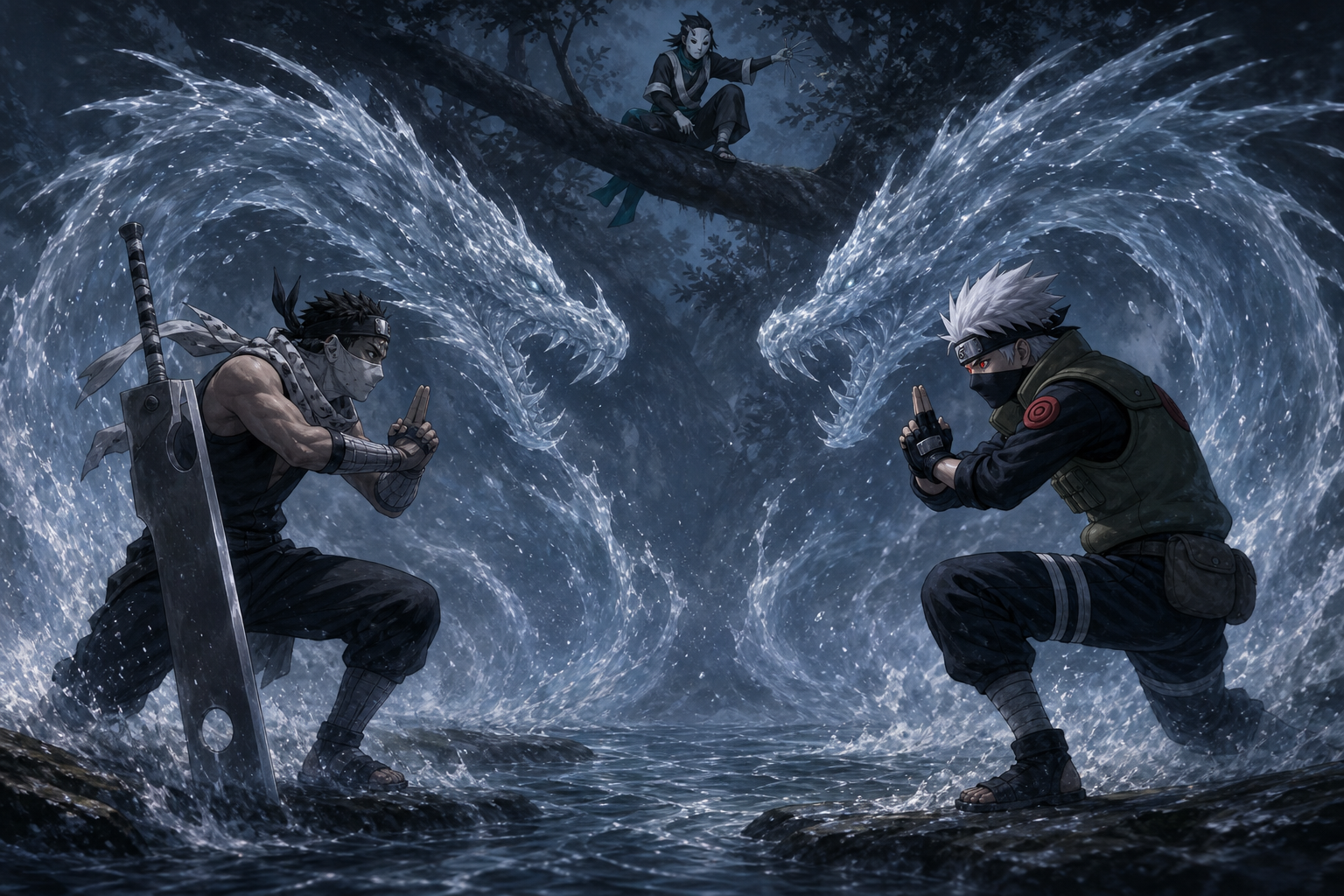
Episode 9 asks whether copying another person makes the self less original, then introduces a child whose entire identity has been hidden behind a professional mask.
Kakashi Returns Because the Team Reached Him
The Water Prison collapses, and Kakashi lands back in the river. The visual restoration of the adult protector is satisfying, but the episode does not allow us to forget how he became available. Naruto imagined the concealed attack. Sasuke gave it precision. Sakura maintained the client line. Kakashi’s freedom is a team achievement.
This changes the emotional meaning of his next display of power. Kakashi is not a solitary legend rescuing helpless students. He is the strongest member of a unit that has already rescued him.
The reversal validates the bell test more deeply than any speech. Interdependence is not a lesson powerful adults impose on weaker children. The condition eventually reaches everyone.
Zabuza’s Clone Cannot Survive the Original Fight
Once the Water Prison ends, the division supporting Zabuza’s strategy becomes unstable. His clone cannot continue as an independent threat while the original must confront Kakashi directly.
The children’s narrow objective has reshaped the battlefield. They did not defeat Zabuza, but they removed the condition that allowed him to isolate strength and attack vulnerability separately.
Kakashi tells the genin to return to Tazuna. This time, the defensive order does not feel like exclusion. Naruto and Sasuke have already contributed what the moment required. Discipline means knowing when a successful intervention is complete.
The Sharingan as More Than Copying
Zabuza knows Kakashi can reproduce techniques, so simple imitation should no longer surprise him. Kakashi’s deeper advantage is timing. He mirrors hand signs while reading breath, gaze, chakra, and expectation. Then he appears to move ahead.
The Sharingan’s psychological force lies in collapsing the distance between intention and exposure. Zabuza thinks of a technique and sees Kakashi already shaping it. He prepares words and hears them spoken from another mouth. The assassin begins to wonder whether Kakashi is predicting him or controlling him.
Kakashi intensifies that doubt deliberately. He does not merely copy Water Release. He performs the experience of being copied so precisely that Zabuza loses confidence in the privacy of his own mind.
Combat becomes interpretive warfare. The victor is not only the person with greater force. Victory belongs to the person who determines what the opponent believes is happening.
Mirrored Water Dragons
Zabuza begins the long sequence of hand signs for the Water Dragon technique. Kakashi matches him. Two fighters shape the same element through synchronized movement until enormous dragons rise from the river and crash across the clearing.
The spectacle makes copying feel mythic. Water reflects by nature. Kakashi’s jutsu turns the whole battlefield into the logic of his eye. Zabuza faces his own technique as though the river has refused to recognize him as its sole author.
Yet the copy is not empty repetition. Kakashi’s body, chakra, intention, and purpose differ. The form may be borrowed, but the use belongs to the person performing it now.
This distinction matters throughout Naruto. Techniques are inherited, taught, stolen, sealed, copied, and rediscovered. Originality rarely means creating without influence. Originality means taking received form and choosing what the inheritance will serve.
The Great Waterfall and the Collapse of Certainty
Kakashi moves from matching Zabuza to overwhelming him. A massive surge of water crashes through the battlefield and leaves the assassin critically injured. Zabuza, who entered balanced above the river like its master, is battered by the element he made central to his identity.
The reversal is not only physical. Zabuza’s confidence has been dismantled. The man who weaponized mist and absence can no longer trust his own anticipation.
Kakashi approaches with the apparent authority to end the fight. Team 7 has survived. Tazuna remains protected. The hired assassin appears defeated.
Then needles strike Zabuza’s neck.
The Hunter-Nin Mask
A masked figure watches from above and identifies themself as a hunter-nin from the Hidden Mist. Hunter-nin pursue missing shinobi, kill them, and remove their bodies so village secrets cannot be extracted by enemies.
The explanation introduces another profession built around the politics of the body. A missing-nin does not only carry personal guilt or criminal history. Muscles, scars, organs, chakra pathways, and remains can contain classified information. Death does not end institutional ownership.
The hunter mask erases individual expression and replaces it with function. The newcomer is not presented as a child with a name. They are the office of retrieval, speaking politely while claiming a corpse.
Zabuza’s body becomes contested property. Kakashi defeated him. Kirigakure claims him. Gatō purchased his labor. The hunter-nin carries him away. The assassin who treated others as targets is reduced to an object of procedure.
Senbon and the Appearance of Death
The masked hunter uses fine senbon needles rather than a dramatic blade. Their precision contrasts with Zabuza’s enormous sword and Kakashi’s overwhelming water. A tiny intervention settles what huge techniques could not.
Kakashi checks the body and accepts that Zabuza is dead. The hunter-nin requests custody, citing the obligation to destroy the missing-nin’s secrets. The explanation is plausible enough to pass because it fits a known system.
For a returning viewer, the scene becomes an education in how deception uses institutional fluency. The best lie is not fantastical. The strongest lie arrives wearing a recognized uniform and supplies the correct vocabulary.
The mask does not merely hide a face. The uniform lends authority.
A Child Stronger Than the Story Naruto Told Himself
After the hunter departs with Zabuza, the team realizes the masked figure is young, perhaps not much older than Naruto. Naruto is stunned. He has organized early ambition around the belief that age and status explain why stronger people stand above him. Here is a child who appears to have eliminated the Demon of the Hidden Mist in an instant.
The comparison wounds his heroic timeline. Naruto wants to become Hokage eventually. The hunter-nin seems to have already entered a level of lethal competence Naruto cannot imagine reaching.
Kakashi tells him that younger shinobi can be stronger than adults. The world does not distribute power according to emotional fairness.
This is not simply a motivational challenge. The encounter becomes an unsettling reminder that the shinobi system accelerates children into specialized violence. Precocious strength may inspire Naruto, but it also reveals what some children have already been required to become.
Kakashi’s Body Collects the Cost
After the immediate danger passes, Kakashi collapses. The Sharingan is not his natural bloodline ability, and using it drains him severely. The legendary eye that made him appear almost omniscient has a bodily price.
This detail prevents power from becoming detached spectacle. Kakashi can reproduce techniques, but his body does not forget that the eye was received rather than inherited. Every use is both capability and strain.
The collapse also restores vulnerability after victory. Team 7 must continue the mission while its jonin recovers. Zabuza appears dead, but the country remains under Gato. Winning one fight has not repaired the system that purchased it.
Identity Made From Borrowed Things
Kakashi’s reputation is constructed from a borrowed eye and copied techniques. By a narrow definition, nothing about the legend seems original. Yet no one else has assembled those elements into this particular person.
The Sharingan belongs to Uchiha history. The techniques belong to people Kakashi observed. His choices, discipline, grief, timing, and purpose create the arrangement through which those inheritances act.
Identity in Naruto is rarely private property. Names, clans, villages, teachers, enemies, and sealed beings enter the self. The ethical question is not whether influence exists. Responsibility begins with what inherited power does through the person carrying it.
Haku’s First Appearance as a Question
The audience does not yet receive the hunter-nin’s name. We receive a mask, a young voice, precise hands, and a professional explanation. The character enters as a question about the distance between role and self.
Why does a child speak so calmly beside death? Why does the child claim Zabuza’s body? What kind of relationship could exist beneath that mask?
Episode 9 withholds the answers because Naruto must first experience the figure as an impossible comparison. The person behind the mask will matter later. For now, the mask changes what Naruto believes children can be.
Character Pulse Check
Naruto
His plan frees Kakashi, but victory immediately introduces a younger figure whose apparent ability dwarfs his own. Pride becomes curiosity and insecurity.
Sasuke
He shares credit in an operation that depended on his precision, then watches Kakashi use the Uchiha eye at elite scale. His clan inheritance exists before him as both promise and mystery.
Sakura
She maintains the defensive obligation around Tazuna while the battlefield transforms. Her steadiness keeps tactical success connected to mission success.
Kakashi
Freed by his students, he turns copying into psychological domination. His collapse reveals that the legend is sustained through real physical cost.
Zabuza
His identity as master of water and mist is turned against him. Apparent death transforms the feared assassin into a body claimed by another system.
The masked hunter-nin
The newcomer’s youth, precision, and institutional performance disturb Naruto’s assumptions while concealing a relationship the story has not yet revealed.
Easter Eggs and Rewatch Echoes
The mask makes a lie credible
The hunter-nin explanation works because clothing, vocabulary, and procedure align. Naruto repeatedly studies how institutions teach people to trust symbols before persons.
Kakashi’s copied thoughts
His apparent mind reading is psychological theater built from extraordinary perception. The distinction foreshadows how often intelligence in Naruto will resemble magic because observation has become weaponized.
The body as intelligence
Hunter-nin destroy corpses to protect village secrets. The concept anticipates bloodline research, stolen eyes, forbidden techniques, and the political value assigned to anatomy throughout the series.
Power that exhausts its user
Kakashi’s collapse is an early reminder that spectacular ability has metabolism. Chakra is not abstract permission. Bodies pay.
The Hidden Village Owns More Than Loyalty
The hunter-nin system claims that a village retains an interest in a shinobi’s body after desertion and death. Knowledge has been embedded in flesh, so flesh becomes classified material.
This reveals the depth of institutional ownership. A shinobi may leave a village geographically and still carry information the village believes it possesses. Missing-nin status turns the former member into both traitor and stolen archive.
The logic is strategically understandable and existentially horrifying. If the body is a container for communal secrets, where does personal ownership begin?
Naruto himself is already living inside the same problem. Konoha treats the Nine-Tails sealed within him as village security while the child experiences the consequences as private loneliness.
Reaction: Victory Interrupted by a Mask
The mirrored jutsu remains gorgeous, but the masked arrival is what gives the episode its aftertaste. Kakashi and Zabuza have spent the battle making power enormous. Water dragons rise. The river becomes a weapon. Then a few needles and a quiet explanation end the scene.
The change in scale is unnerving. The shift suggests that the most dangerous person may not be the loudest or largest. Precision and institutional knowledge can move through gaps spectacle leaves open.
Naruto’s reaction grounds the mystery. He does not first ask whether the hunter-nin’s paperwork is correct. He sees someone young. The age comparison collapses the distance he had placed between himself and elite violence.
The masked child does not merely carry Zabuza away. The child carries away Naruto’s belief that youth protects anyone from becoming terrifyingly useful.
Episode Verdict
Emotional core: Naruto’s tactical triumph collides with the sight of a child who appears far more lethal.
Best character beat: Kakashi accepting rescue from his students, then revealing the bodily cost of the eye that defines his legend.
Big idea: Identity is built from inherited and borrowed forms, but responsibility belongs to the person choosing how those forms act.
Rewatch value: Exceptional. Haku’s mask, Zabuza’s apparent death, and Kakashi’s exhaustion transform completely with later knowledge.
CVM Sekai rating: 9.5/10. A powerful victory episode that refuses to let victory settle the moral or narrative field.
Continue the Naruto Journey
Kakashi wins control before he wins the fight
The Sharingan battle works because Zabuza cannot decide whether Kakashi is copying him, predicting him, or reaching inside his intentions. The mirrored hand seals turn technique into psychological pressure. Zabuza built his identity around being the professional nobody can unsettle. Kakashi makes him doubt the privacy of his own next move.
That doubt matters more than a simple power comparison. Kakashi uses observation, timing, reputation, and theatrical confidence together. He does not merely reproduce Water Dragon Jutsu. He creates the experience of being surpassed before the clash finishes.
Borrowed power still requires a body to carry it
The Sharingan gives Kakashi extraordinary visual access, but his covered eye and later exhaustion keep the cost visible. He is not an Uchiha using an inherited ability through the body it developed within. The eye is a gift, a wound, a memorial, and a combat tool at once. Episode 9 lets the mystery remain while showing that mastery never makes the history disappear.
Sasuke watches somebody outside his clan use the Sharingan at a level he cannot yet approach. The reveal therefore lands as more than spectacle. It touches the family inheritance Sasuke believes belongs to his revenge and introduces an adult whose body complicates ownership.
Zabuza’s defeat is interrupted by another performance
Senbon strike Zabuza’s neck, and a masked hunter-nin claims the body. Kakashi accepts the role because the explanation fits known village practice: hunter-nin recover missing shinobi and protect secrets. The uniform supplies credibility. Haku weaponizes the institution’s expected procedure without needing to overpower Team 7.
That deception is sharp because it uses professional trust. Kakashi reads techniques and intentions during battle, yet a correct costume, correct vocabulary, and plausible duty create enough certainty for Haku to leave with Zabuza. Systems make coordination possible. They also give convincing liars a script.
Haku enters as gentleness wrapped around lethal competence
The masked figure moves precisely, speaks calmly, and appears younger than the threat should allow. The contrast prepares the arc’s central wound. Haku has been trained to make extraordinary violence look clean and purposeful. Zabuza calls that usefulness devotion. The story will keep asking whether either boy was ever allowed to imagine a life outside being needed.
At this stage, Team 7 sees only the rescue disguised as an execution. The audience receives enough unease to know the file is not closed.
Naruto and Sasuke’s plan changes their standing
Operation Windmill freed Kakashi, but the emotional consequence continues here. Kakashi can finish the duel because his students created an opening. Sasuke and Naruto have evidence that their combined thinking can affect a jōnin-level battlefield. That confidence will feed the tree-climbing rivalry next.
The danger is obvious too. Children who succeed once may believe success proves the risk was appropriate. Adults may praise courage and forget that courage was required because the mission was misclassified. Team 7 deserves credit. The system still owes an answer.
The copied Water Dragon is gorgeous and politically ugly
Two elite shinobi command the landscape while Tazuna’s country waits to see whether a bridge will survive. The animation sells the power, but the reason for the fight remains economic control. Gatō can hire violence because he has money. The Land of Waves has children, workers, and hope tied to construction.
That contrast is why the battle matters. Jutsu does not float outside material conditions. Somebody pays, somebody profits, and somebody’s home becomes the arena.
RaeRae’s final take
Episode 9 makes Kakashi look terrifying without pretending power is simple. The Sharingan carries borrowed history. Zabuza’s confidence collapses under psychological pressure. Haku rescues him by performing institutional legitimacy better than the real institution can verify it.
The fight ends, but nothing is settled. Kakashi is exhausted, Zabuza is alive, the bridge remains threatened, and Team 7 has just learned that a convincing death can be another ninja technique.
The silence after the spectacle is the real warning
Kakashi’s collapse changes the temperature of the victory. Team 7 has just watched him dominate a feared assassin, but the body under all that skill still reaches its limit. That quiet aftermath refuses the easy fantasy that mastery makes a shinobi untouchable. It also leaves Sakura, Sasuke, and Naruto responsible for guarding the man who was supposed to guard them. The mission has not returned to normal. Its danger has simply changed shape, and the children now understand that even their strongest adult can become the person who needs carrying.
That is the episode’s final truth: surviving the first battle does not mean the threat is over. Sometimes it only gives everyone enough time to realize how badly the mission was understood.
For Naruto, the moment also revises what being acknowledged can mean. Kakashi does not praise him with a grand speech. He trusts the result of Naruto and Sasuke thinking together, then lets the consequences stand in the room with them. Recognition arrives beside responsibility. That is much harder, and much more useful, than applause.
Official Viewing and Episode Guide
Streaming availability varies by region. Watch through an official licensed service carrying the original Naruto series, including Crunchyroll or Netflix where available. Episode continuity was checked against the official Naruto Episode 9 guide.
Editorial note: CVM Sekai’s Naruto coverage centers the original Japanese series and original Japanese performances. English dub casting is outside this project’s scope.