
Gatō
He cannot summon a dragon, copy a technique, or swing the swords he pays for. He conquers a country anyway by owning the route food travels, renting people willing to kill, and making every frightened citizen believe resistance will happen alone.
Profile and bottom line
Bottom line: Gatō is the weakest fighter in the Land of Waves and the man who makes every strong fighter work for him. Money lets him buy missing-nin, bodyguards, thugs, shipping routes, food access, public fear, and the story a poor country tells itself about resistance. The tiny man with the cane is not comic relief. He is the arc’s clearest lesson that power does not need chakra when power owns the contract.
- Name: Gatō (ガトー)
- Born: April 30
- Age: 48 at death
- Height / weight: 162.5 cm / 69 kg
- Blood type: A
- Occupation: businessman, shipping magnate, criminal operator
- Organization: Gatō Company
- Affiliation: Land of Waves occupation
- Debut: Manga Chapter 10; anime Episode 6
- Japanese voice: Naoki Bandō
- Status: Deceased
- Other formats: novel, game, and Ultimate Ninja Storm Generations cutscene material
Identity, appearance, and a villain designed to look physically unimpressive
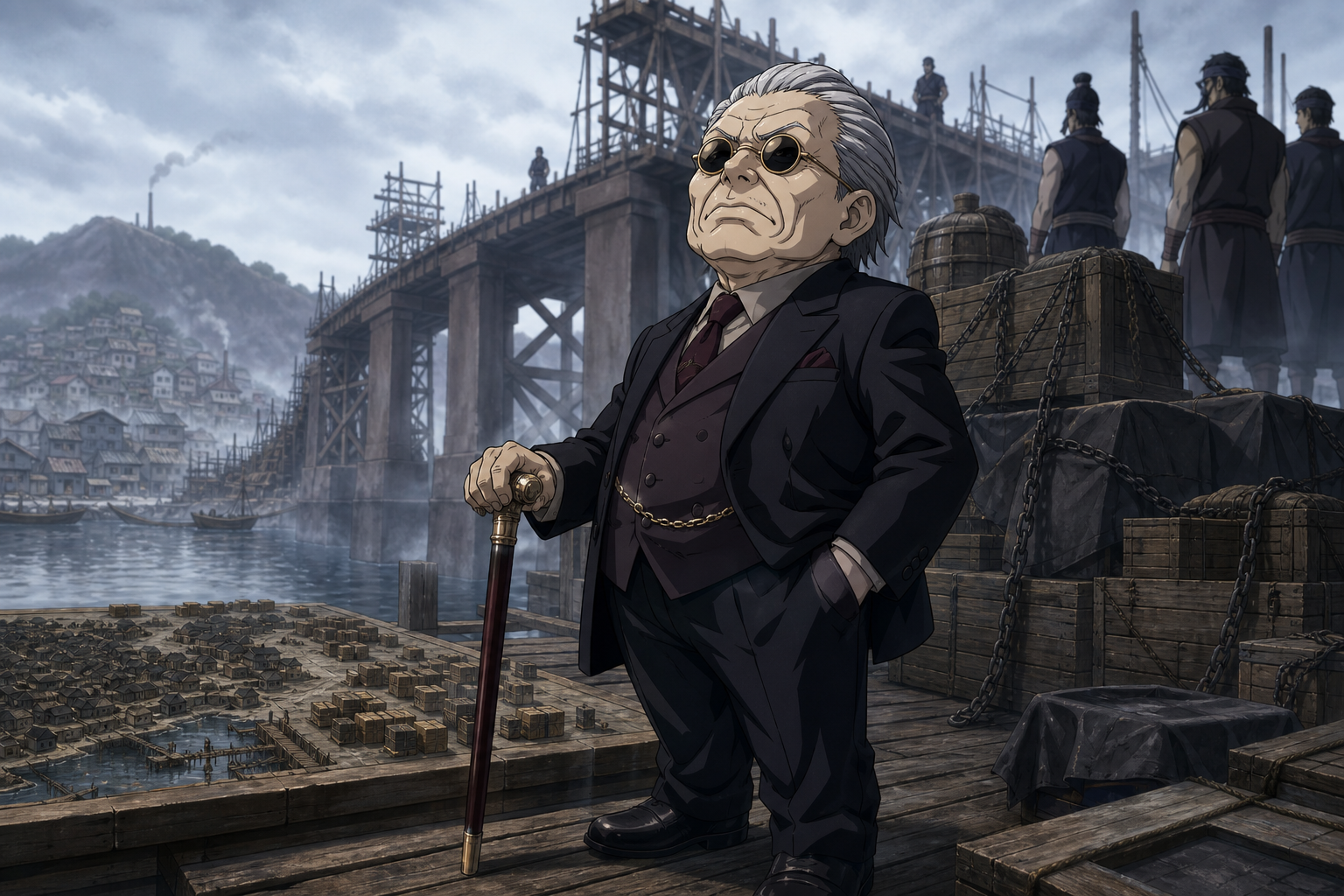
Gatō is a short, heavyset forty-eight-year-old man with gray hair, small round dark glasses, formal business clothes, and a walking cane. His eyes remain hidden behind the lenses, which makes his face harder to read while his mouth does all the sneering. The cane and expensive suit separate him from shinobi, workers, and the mercenaries he hires. He looks like management because management is the weapon.
Kishimoto makes the body physically unimpressive beside Zabuza, Haku, Kakashi, and Team 7. Gatō stands 162.5 centimeters tall and weighs 69 kilograms according to first-databook reference material. Nothing about that build suggests a man who can personally defeat the Demon of the Hidden Mist. The contrast forces viewers to notice why Zabuza still accepts his orders and why an entire island country still fears him.
The new CVM Sekai hero places him beside chained cargo, bridge construction, and distant hired muscle because a generic portrait missed the character. Gatō only becomes recognizable as a Naruto-world villain when the environment shows what his suit controls. The bridge, crates, shipping water, and armed employees are part of his silhouette.
His name appears as Gatō, Gatoh, or Gato in different English materials. Revised Hepburn styling supports Gatō. The Japanese katakana ガトー also resembles the French word gâteau, meaning cake. The naming joke gives a greedy man a rich dessert name, although the manga does not stop to confirm a grand symbolic thesis. Sometimes a nasty little man gets named cake. I can work with that.
The Gatō Company sells transport in public and organized crime underneath
Gatō owns a shipping and maritime transport company. Reference profiles describe the legitimate business as a front for drug trafficking, smuggling, and the takeover of other companies and countries through violence. The company gives him invoices, routes, warehouses, employees, and a respectable title while criminal operations handle competitors who do not cooperate.
The structure matters because he does not arrive in the Land of Waves as a wandering bandit. Gatō enters through commerce. An island country needs shipping, so the company can present control as service before control becomes dependence. Once his network owns the routes, residents cannot easily separate survival from the man exploiting them.
Shipping power touches food, tools, medicine, labor, prices, and movement. Gatō does not have to rob every family at swordpoint. He can make the country poor by controlling what enters, what leaves, who gets paid, and which alternatives survive long enough to compete. Armed men protect the monopoly after economic pressure narrows the choices.
The company also creates distance between Gatō and violence. Zōri, Waraji, missing-nin, and hired thugs do the physical work. Gatō can call murder a contract, retaliation a business decision, and occupation a market condition. Corporate language does not clean the blood. Corporate language only gives the blood a filing system.
How Gatō teaches a country to police its own hope
Gatō’s rule combines scarcity with spectacle. Shipping control makes resistance expensive. Mercenaries make resistance dangerous. Public punishment makes residents imagine the danger before anybody raises a hand. The smartest part of the system, and I hate giving him credit for anything, is that fear eventually travels without payroll.
Inari demonstrates the result. The child repeats Gatō’s argument at Tazuna’s table: powerful men win, heroes die, and trying only hurts the people left behind. Gatō never needs to recruit him. The execution of Kaiza recruits the boy’s trauma.
Adults in the country also withdraw into private survival. That response is not proof that everyone lacks courage. Organized terror makes cooperation hard to see. Each person assumes neighbors will remain home, so remaining home feels rational. Gatō converts isolation into evidence that collective action cannot happen.
The final arrival of the villagers breaks that loop. Nobody in the crowd has Kakashi’s skill, but public presence destroys the appearance of universal submission. Gatō dies before witnessing the full reversal. His employees still learn that a wage does not guarantee enough fear to face an entire population.
Kaiza’s execution is a company training video written on a body
Kaiza becomes dangerous because the country trusts him. The traveling fisherman saves Inari, joins Tsunami’s family, handles the floodgate crisis, and proves ordinary residents can organize around useful courage. Gatō needs that example destroyed before residents treat the example as a plan.
His men overpower Kaiza through numbers. The manga has them cut off the arms connected to his promise about protecting precious people, then execute him in public. Gatō mocks the lesson while Inari watches. The anime changes the explicit mutilation, but the punishment still targets the relationship between Kaiza’s body, his reputation, and the country’s memory.
Gatō does not kill Kaiza only because Kaiza opposes the company. He curates the death for an audience. The widow, child, workers, and neighbors receive the same message: the company can enter civic life, rename resistance as criminal behavior, and leave families responsible for the aftermath.
The strategy works until Naruto gives Inari new evidence. Kaiza’s death initially functions as Gatō’s warning. Inari later recovers the earlier meaning of Kaiza’s life and carries that meaning back to the villagers. The body Gatō used as propaganda becomes a reason the country finally rejects him.
Tazuna’s bridge threatens the monopoly at the level that matters
Tazuna builds a permanent bridge to the mainland. The project threatens Gatō’s maritime monopoly because residents would gain another route for goods, travel, work, and political contact. The bridge is hope with engineering specifications, which makes the project far more dangerous than a speech.
Gatō hires assassins to kill Tazuna before construction finishes. The decision confirms that his business cannot survive fair competition. A better service provider might lower prices, improve routes, or negotiate. Gatō selects murder because coercion is the real product.
Tazuna’s poverty forces him to misclassify the Konoha mission. That lie endangers Team 7, but the economic circle is the point. Gatō impoverishes the country. Poverty prevents the country from purchasing the correct protection. The resulting weakness makes Gatō’s violence cheaper. Capitalism has left the group chat and started hiring missing-nin.
The bridge also challenges his control of the future. Infrastructure lasts beyond one confrontation. A completed connection can outlive hired thugs, frightened officials, and Gatō himself. He understands the threat correctly and responds like a man whose wealth depends on everybody having fewer choices.
Why Gatō hires Zabuza and Haku instead of a hidden village
Gatō hires Zabuza Momochi, a missing-nin from Kirigakure, to eliminate Tazuna. Zabuza brings Haku, whose Ice Release and loyalty make him part weapon, part partner, and part exploited child. Gatō purchases both fighters as a package without caring about the relationship between them.
A missing-nin offers deniability and a lower cost than hiring a hidden village for an openly political assassination. Zabuza also has reasons to accept money outside legal village channels. Gatō sees those vulnerabilities and assumes payment gives him control over a man whose entire identity has been built around refusing control.
The arrangement mirrors the wider shinobi economy in an uglier register. Villages sell trained violence through missions. Gatō buys unregulated violence through a criminal contract. Team 7 and Zabuza stand on opposite sides of the job, but civilians remain the people whose lives appear as objectives.
Gatō personally confronts Zabuza after the first failure and roughly handles Haku during the dispute. Haku nearly injures his arm in response. That moment should have warned him that money had not erased the danger inside the room. Gatō reads restraint as ownership because arrogance keeps translating survival into proof of superiority.
The contract betrayal reveals what Gatō thinks labor is worth
Gatō never intends to honor the agreement once Zabuza becomes expensive and injured. He arrives at the unfinished bridge with a larger force of cheaper thugs, dismisses the missing-nin, and announces that the men will kill the weakened fighters as well as finish the job. He wants the result without paying the specialist.
The betrayal is not a clever twist in isolation. Gatō treats every worker as disposable once the worker loses immediate usefulness. Kaiza’s labor, Tazuna’s construction, Zabuza’s violence, Haku’s body, and the thugs’ loyalty all enter the same profit calculation. Relationships become contracts, and contracts become temporary excuses for control.
Zabuza has spent the arc treating Haku as a tool. Gatō enters and behaves like a cruder version of the same logic. The comparison matters because Naruto’s speech forces Zabuza to confront the human bond he has hidden beneath utility. Gatō has no buried loyalty waiting for permission to speak.
The hired army also exposes the weakness of transactional power. His men arrive for money, not belief. Once Naruto’s clones and the villagers change the risk, the force dissolves. Nobody chooses death for Gatō’s shipping margins.
Kicking Haku’s body is the moment Gatō misunderstands the room
After Haku dies protecting Zabuza, Gatō approaches the corpse with contempt. In the manga, he kicks Haku’s face in revenge for the earlier confrontation. The anime softens the visible action. Either version communicates the same moral vacancy: a dead child has value only as an object he can insult without consequence.
Naruto reacts because he has spent the battle learning what Haku felt. Zabuza initially performs indifference, continuing the tool language that has protected him from acknowledging attachment. Gatō assumes the performance is real and pushes harder.
The insult becomes the final proof Naruto uses to reach Zabuza. Gatō believes wealth has purchased the right to define every person on the bridge. Naruto names Haku’s devotion, grief, and humanity instead. Zabuza’s tears reveal a relationship the employer never understood because no amount of money taught him how people can matter beyond use.
That failure kills him. Gatō does not lose to a superior financial plan or a hidden jutsu. He loses because he mistakes suppressed love for absence and humiliates the dead person most capable of turning Zabuza’s remaining life into one final act.
Zabuza’s final charge and Gatō’s two deaths
Zabuza has lost the use of his arms and carries severe injuries from Kakashi’s attack. Naruto gives him a kunai, and Zabuza holds the weapon in his mouth while charging through Gatō’s men. The sequence converts the feared Demon of the Hidden Mist into a dying man choosing the target of his own violence for once.
In the manga, Zabuza stabs Gatō and decapitates him. The anime replaces the decapitation with repeated slashes and a fall from the bridge into the water below. Both versions end the shipping magnate through the worker he planned to cheat, but the visual meaning shifts.
The manga gives Gatō an abrupt, bodily answer to a career built on distance. The anime lets the bridge and water participate. A man who controls shipping routes falls from the structure designed to break his monopoly. The cleaner broadcast version loses gore and gains a brutally tidy environmental irony.
Zabuza dies from the wounds inflicted during the charge and asks to be placed beside Haku. Gatō’s death cannot redeem Zabuza’s earlier choices, and the story does not require a neat acquittal. The final action proves love existed and that Gatō’s reading of the relationship was fatally shallow.
Employees, bodyguards, missing-nin, and the army that never becomes a community
Gatō uses layers of force. Zōri and Waraji serve as personal bodyguards and take part in intimidation around the Land of Waves household. Zabuza and Haku provide elite assassination work. A large crowd of hired thugs supplies cheap numbers for the final betrayal.
The company also reaches beyond named fighters through smugglers, transport workers, and criminal networks referenced in profile material. Not every employee receives a face or biography. That anonymity supports the system. Violence can continue when one contractor falls because Gatō treats labor as replaceable inventory.
The Demon Brothers sometimes get listed among forces connected to the broader conflict, but Team 7 encounters them as missing-nin attacking Tazuna during the approach. A responsible profile should avoid turning every hostile body in the arc into a direct salaried employee without scene-level confirmation. Association, contractor status, and personal bodyguard work are different relationships.
His army disappears after his death because no shared cause holds the group together. Some flee Zabuza. Others retreat when Naruto’s clones and the villagers arrive. The company has payroll, not solidarity. Gatō understands fear as a tool but never understands loyalty as anything except delayed payment.
Power profile: no jutsu, no fighting record, enormous structural damage
Gatō has no known chakra nature, jutsu, shinobi rank, combat school, or credible personal fighting feat. The cane is part of his presentation rather than an established named weapon. His profile still belongs in a power system because Naruto repeatedly asks what trained violence serves.
Money gives him reach. Corporate ownership gives him legitimacy. Shipping control gives him economic leverage. Contractors give him violence. Public punishment gives him psychological reach. Each layer lets a physically weak person direct stronger bodies.
His limitations are equally clear. Purchased loyalty lasts only while payment and fear outweigh risk. He cannot defend himself when Zabuza reaches him. He cannot inspire workers to stay once the population appears. He cannot imagine a bond strong enough to override a contract.
Gatō therefore becomes a better villain than a random strong thug would have been. Team 7 cannot solve the full problem by winning one fight against one technique. The country needs the bridge, local courage, economic alternatives, public memory, and the collapse of his hired network.
Class, hierarchy, industry, and the villain hiding inside respectable work
A class lens is unavoidable. Gatō converts private wealth into public authority while residents who perform essential labor lose choices. Tazuna builds infrastructure, Kaiza fishes and organizes, Tsunami maintains the home, and workers complete the bridge. Gatō owns routes and claims the largest share of the future.
A Confucian lens exposes failed reciprocity. Authority gains moral weight when leaders fulfill obligations to the people beneath them. Gatō demands obedience, uses reputation, and punishes disorder while providing no protection, fairness, or social duty in return. He weaponizes hierarchy after removing the reciprocal half.
A Buddhist lens finds attachment without compassion. Gatō clings to profit, control, humiliation, and the belief that ownership can protect him from consequence. The bridge embodies impermanence inside his monopoly. Routes change. Fear changes. Contractors change sides. A man who believes wealth fixed the world dies because every condition holding his power together moves at once.
The industry reading lands beyond fiction. Companies can hide exploitation behind necessary services, fragment labor through contracting, and describe structural coercion as consumer dependence. Naruto does not offer a policy paper, but the Land of Waves understands that a monopoly with mercenaries is still a monopoly when the owner wears a tie.
Naoki Bandō and the voice of a man certain nobody can touch him
Naoki Bandō performs Gatō in the original Japanese cast. The voice needs contempt, impatience, smugness, and the brittle confidence of somebody accustomed to stronger men stepping aside. Bandō gives the character enough theatrical nastiness to register quickly without turning the threat into harmless camp.
His scenes with Zabuza depend on status inversion. The smaller, weaker man speaks as employer because money temporarily controls the exchange. Bandō’s delivery pushes that confidence until the audience can hear the mistake forming. Gatō believes surviving one confrontation confirms permanent superiority.
The final bridge scene lets the voice collapse from mockery into fear when Zabuza keeps moving. No new information arrives about Zabuza’s strength. Gatō finally understands information that was visible from the beginning: the contract never made him physically safe.
CVM Sekai documents the original Japanese performance only. Bandō’s name should link after a dedicated Japanese performer profile exists. English dub credits remain outside the normal Naruto character-file scope.
Manga, anime, localization, and censorship differences
The manga presents harsher violence around Gatō. Kaiza’s arms are cut off before execution. Gatō kicks Haku’s corpse. Zabuza kills him by stabbing and decapitation. The anime reduces or changes each moment for broadcast presentation.
The anime’s death sends him over the unfinished bridge after repeated slashes. That change removes the severed head and lets the setting finish the metaphor. The shipping magnate falls into the water beneath the structure that will destroy his monopoly.
Localization can also change spelling between Gato, Gatoh, and Gatō. CVM Sekai uses Gatō while preserving searchable variants in context. A spelling variation should not become a fake second character or separate taxonomy identity.
Game and OVA-style cutscene appearances can restage his role for franchise adaptation. Those appearances do not resurrect him or extend his life past the bridge. They document how later media repackage the Land of Waves story.
Databook facts and complete appearance boundary
First-databook reference material records Gatō as forty-eight years old, born April 30, 162.5 centimeters tall, 69 kilograms, and blood type A. He owns the Gatō Company and works as a businessman while criminal operations sit behind the public enterprise.
He debuts in Manga Chapter 10 and Anime Episode 6, early enough that his economic control frames Team 7’s mission before the final bridge reveal. Reference databases record the novel adaptation Naruto: Innocent Heart, Demonic Blood, the game Naruto: Konoha Ninpōchō, and cutscene material associated with Naruto Shippūden: Ultimate Ninja Storm Generations.
Those additional formats retell, adapt, or register his existing role. They do not establish a hidden career in Shippuden, Boruto, theatrical films, or later novels. The company status after his death is not developed enough to support a confident corporate epilogue.
A complete file records both presence and absence. Gatō matters across the franchise because the Land of Waves arc keeps mattering, not because he secretly returns for every era.
Common misreadings
“Gatō is a weak filler villain.”
He belongs to the core manga arc and creates more structural damage than many stronger fighters. Combat weakness is the design.
“Zabuza worked for him because Gatō was stronger.”
Zabuza accepted a paid assassination contract. Economic leverage and temporary employment do not equal physical superiority.
“Killing Gatō automatically fixes the country.”
His death removes the owner, but recovery still requires the bridge, workers, trade alternatives, and residents willing to act together.
“The hired army proves loyalty.”
The force disperses when risk changes. Gatō buys bodies by the job and never builds a community willing to protect him.
“The manga and anime deaths are the same.”
The manga uses decapitation. The anime uses repeated slashes and a fall from the bridge. The outcome matches while the imagery changes.
Profit needs distance from the body count
Gatō’s power depends on keeping respectable business language between himself and the violence that protects his monopoly. He owns a company. He signs contracts. He hires specialists. Each layer makes coercion look like somebody else’s job even when every order serves his profit. That distance is why his betrayal of Zabuza is not a sudden break in character. Gatō treats mercenaries the same way he treats Wave Country: useful while controlled, disposable when payment becomes inconvenient.
The bridge threatens more than shipping revenue. It makes the connection between commerce and violence visible. Tazuna’s crew can point to a structure and say exactly why armed men want it unfinished. Once exploitation has a location, a deadline, and a public work standing against it, fear becomes harder to pass off as private bad luck.
Gatō finally loses control because he misunderstands every form of loyalty he cannot purchase. Haku protects Zabuza. Naruto defends people he met on a mission. Inari brings neighbors who have been terrorized into isolation. Zabuza turns on the man holding the money. Gatō understands transactions, but the bridge battle is won by bonds that continue after the contract stops making sense.
Essential viewing and source boundary
Episode 6: Gatō’s control frames the Land of Waves mission. Episode 10: his relationship with Zabuza and bodyguards becomes clearer. Episode 11: Kaiza’s execution explains how fear became government. Episodes 18 and 19: contract betrayal, Haku’s body, Naruto’s appeal, Zabuza’s final charge, and Gatō’s death complete the arc.
This profile uses the Land of Waves manga chapters, official episode listings and franchise retrospective material, the first official character databook, adaptation records, and the credited original Japanese performance by Naoki Bandō. Criminal-business descriptions and cross-format appearances remain tied to established reference records. Cultural and symbolic readings are labeled as CVM Sekai interpretation rather than creator-confirmed intent.