
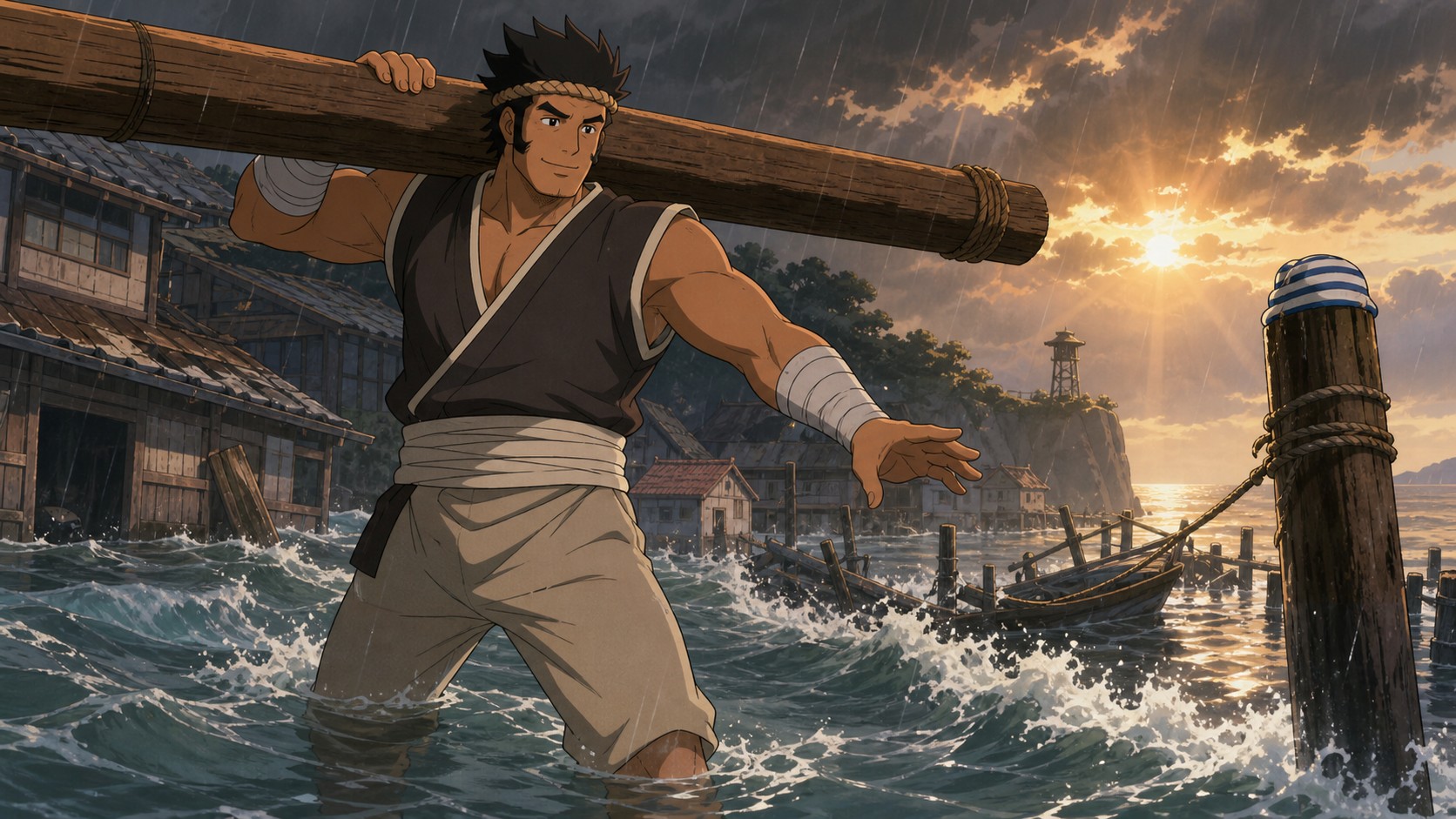
Kaiza
A migrant laborer enters an occupied country, chooses a family, and teaches a frightened child that precious things require protection. Gatō kills him to make courage look ridiculous. The entire arc is a struggle over whether that execution gets to define what Kaiza’s life meant.
Profile and bottom line
Bottom line: Kaiza is the Land of Waves hero Gatō has to break in public because killing one fisherman quietly would not teach a country to surrender. His death shapes Inari, Tsunami, Tazuna, Naruto, and the bridge long after his body leaves the story.
- Home: Land of Waves by choice
- Family: Tsunami and Inari
- Occupation: traveling fisherman
- Role: chosen father and civilian resistance figure
- Japanese voice: Akimitsu Takase
- Status: Executed before Team 7 arrives
- Born: August 21
- Age: 30 in Part I reference data
- Height / weight: 183 cm / 75 kg
- Blood type: A
- Debut: Manga Chapter 20; anime Episode 11
- Other formats: Naruto: Innocent Heart, Demonic Blood and Naruto: Konoha Ninpōchō
An outsider who stays long enough to become family
Kaiza arrives in the Land of Waves as a traveling fisherman looking for opportunity. He has no clan name, hidden technique, village rank, or government appointment. The country remembers him because he acts when action costs something and stays after the dramatic moment ends.
Saving Inari from drowning begins the relationship, but rescue alone does not make a father. Kaiza remains in the household, forms a partnership with Tsunami, and helps raise the boy. Chosen family in Naruto often gets treated as a warm side theme. Kaiza’s family shows the harder version. Love creates duties, public risk, and grief with no bloodline required.
His outsider status also matters politically. The Land of Waves has been trained to accept shrinking possibilities. Kaiza arrives without the same learned boundaries. He sees a community and behaves as though community members can still solve problems together. Sometimes the person least accustomed to a prison notices the bars first.
Saving Inari gives the child more than a life debt
Kaiza pulls Inari from the water and then teaches him to protect precious people with his own arms. The phrase becomes the moral center of Inari’s childhood. Kaiza connects strength with care rather than dominance. A man’s body matters because somebody else can rely on those hands.
The lesson lands because Kaiza demonstrates the behavior. He does not lecture from a porch and send everybody else into danger. Inari sees work, protection, affection, and public courage occupying the same adult. Kaiza becomes the model against which the boy measures heroism.
That intimacy explains why the execution damages Inari beyond ordinary bereavement. Gatō does not only remove a parent. Gatō appears to disprove the father’s entire worldview. If protecting precious people ends with mutilation, death, and a terrified family, the child can mistake fear for the mature lesson.
The floodgate incident turns private courage into public trust
When heavy rain threatens part of the settlement, Kaiza organizes a response and helps close the gate before the area floods. The event makes him a community hero because the danger is shared and the solution requires collective effort. He does the dangerous work while asking others to participate.
The scene gives the Land of Waves a memory of functioning solidarity before Gatō’s occupation reaches full control. People can act together. A civilian can lead without owning an army. Public trust can grow from demonstrated usefulness rather than inherited office.
Gatō later has to attack that memory. A tyrant who relies on helplessness cannot leave behind a popular example proving that ordinary residents can organize around somebody they trust. Kaiza becomes dangerous before he ever confronts Gatō directly because the community has already watched him make cooperation work.
Why Gatō needs humiliation, not a quiet murder
Gatō controls the country through shipping, money, mercenaries, and fear. Kaiza challenges the part of that system no ledger can measure: public belief. Gatō’s men overpower him, damage or remove the arms associated with his promise, and execute him before the population.
The spectacle converts a person into propaganda. Gatō wants witnesses to remember that courage produces pain, that families inherit punishment, and that nobody will arrive in time. Inari takes that lesson home. Adults lower their heads. Kaiza’s body becomes an advertisement for surrender.
The violence against his arms is especially deliberate in the manga. Kaiza taught Inari to defend precious people with those arms. Gatō targets the symbol as well as the man. The anime softens or changes the visible mutilation, which alters the brutality of the symbolic attack even though the execution remains devastating.
Gatō’s mistake is assuming terror controls memory forever. The population initially remembers Kaiza the way Gatō intended. Naruto’s refusal helps Inari recover the earlier meaning. Once the boy carries that memory back to the villagers, the execution stops functioning as a warning and starts functioning as evidence against the regime.
The arms lesson contains courage and a dangerous burden
Kaiza’s language about protecting precious people “with these two arms” offers Inari a caring model of masculinity. Strength serves relationships. Manhood grows through responsibility rather than emotional distance. For a boy seeking a father, the lesson provides shape and security.
The message also carries a burden. Kaiza connects masculine worth to protection even at the cost of life. Inari can hear love, duty, and self-sacrifice in one sentence. After the execution, the ideal becomes almost impossible. A child cannot protect adults from a shipping magnate’s armed network, so failure can feel like proof that he is small, weak, or unworthy.
I do not need to cancel Kaiza for using the language his story gives him. The useful reading keeps both sides visible. His ethic challenges cowardly power and centers care. His ethic also risks teaching boys that love must be proven through bodily destruction. Inari’s later courage works because he acts without successfully becoming another dead hero.
A Buddhist lens makes the distinction clearer. Compassion does not require attachment to martyrdom as the only honorable outcome. Kaiza’s love survives when Inari releases Gatō’s interpretation of the death. The boy can keep the duty to care without clinging to the exact form of Kaiza’s sacrifice.
Tsunami, Inari, and the family left behind
Tsunami
Partner and co-parent. Her grief gets less narrative space than Inari’s, but she carries the household after Gatō removes him.
Inari
Chosen son, student, and witness. Inari inherits both Kaiza’s ethic and the terror designed to bury that ethic.
Tazuna
Family through Tsunami and another builder whose work threatens Gatō. Tazuna turns resistance into infrastructure after Kaiza’s execution.
Gatō
The occupier who recognizes Kaiza’s social value and targets the body, reputation, and family attached to that value.
Chosen family makes Kaiza’s fate harder, not softer. No blood relation protects Tsunami and Inari from grief, and no official status forces him to defend them. Obligation grows from love and repeated behavior. A Confucian reading can recognize the family role while also noticing that Kaiza earns the role through reciprocity rather than hierarchy alone.
Kaiza and Naruto share an inheritance without meeting
Naruto never speaks with Kaiza. The connection moves through Inari. Kaiza gives the child a language for protecting precious people. Gatō turns the language into a threat. Naruto demonstrates that acting under fear can still change the conditions around a person.
Naruto does not replace Kaiza as father, hero, or moral authority. He helps Inari remember Kaiza before the execution. That difference protects the emotional logic of the family. The outside protagonist becomes a catalyst, while the local dead still owns the first lesson.
The Great Naruto Bridge name can make Kaiza’s contribution feel swallowed by protagonist gravity. Naruto deserves the honor, but the bridge carries Kaiza’s earlier stand, Tazuna’s labor, Inari’s organizing, Team 7’s protection, and the villagers’ return. One name cannot contain every worker who made the structure possible.
The narrative echo reaches farther into the franchise. Naruto repeatedly inherits unfinished convictions from dead people and refuses the meaning their killers tried to impose. Haku, Zabuza, Jiraiya, Minato, Kushina, Nagato, and Neji all become part of that pattern. Kaiza establishes the pattern before Naruto knows enough to name what he is doing.
A fisherman becomes dangerous because occupation is also a story
Kaiza has no supernatural power. Gatō still treats him as a serious threat because political control depends on accepted stories. Gatō’s version says money decides movement, mercenaries decide safety, and resistance ends alone. Kaiza gives the country a competing story based on shared work and public courage.
The class contrast is blunt. Gatō owns routes and hires violence. Kaiza sells labor and uses his body. One man converts wealth into fear. The other converts trust into cooperation. The conflict explains why a capitalist villain and a civilian fisherman belong in a ninja manga without feeling like a detour.
Kaiza’s death also shows the limits of personal heroism. One brave person can inspire a country, but inspiration without organization leaves the hero exposed. Gatō’s gang needs many men to defeat him, yet the crowd watches rather than intervenes. The tragedy does not prove ordinary people are hopeless. The tragedy shows how terror isolates people who might have been powerful together.
Appearance, design, and the body Gatō turns into a message
Kaiza has short, spiky black hair, black eyes, and a small X-shaped scar on his chin. A white rope wraps around his forehead and ties on the right side. He wears a dark short-sleeved shirt with light trim and loose white trousers suited to physical work near water. Scars already mark his arms before Gatō’s attack, which supports the image of a fisherman and laborer whose body records work rather than clan prestige.
The design separates him from the shinobi cast without making him look fragile. Kaiza has no forehead protector, flak jacket, clan crest, weapon pouch, or costume announcing a hidden technique. His size and posture communicate adult strength in a civilian register. Kishimoto needs the audience to believe he can fight a current, move heavy equipment, and confront hired men while also understanding that training and courage cannot make one fisherman equal to an organized gang.
The head rope gives him an older working-man silhouette and keeps the face readable during flashback panels. The chin scar makes the design memorable within limited page time. Neither feature receives a long official origin story. A profile should record what the art shows without inventing a secret battle that explains every mark.
Gatō’s violence then rewrites the design. Kaiza’s arms carried scars from work and the language of protection. The manga removes those arms from the execution image, so the body becomes a cruel visual rebuttal to his own promise. The anime changes the detail, but the staging still turns a recognizable protector into a public warning.
Physical ability, practical skill, and very human limits
Kaiza has no chakra-based ability on record. Narutopedia and first-databook material describe exceptional stamina, and the floodgate sequence supplies the evidence. He swims through a current strong enough to make the attempt seem impossible for an ordinary person, reaches the gate, and closes the mechanism before the threatened area floods. The feat requires strength, breath control, judgment, and a willingness to enter danger while other residents coordinate around him.
Calling the feat “superhuman” can confuse Naruto’s power scale. The story presents Kaiza as an extraordinary civilian, not a secret shinobi. He does not use Water Release, walk across the surface, summon help, or reveal a seal. His ability grows from a body trained by fishing and hard labor, plus a refusal to watch the village drown while somebody else makes the first move.
Fishing also implies knowledge the battle-focused summaries skip. A traveling fisherman reads water, weather, currents, equipment, and risk for a living. Those skills help explain why he understands the floodgate danger and can attempt a solution. The manga does not provide a full occupational manual, so that connection remains a reasonable inference from the stated profession and visible scene rather than a named canon skill list.
His limits matter as much as his strength. Gatō’s men overwhelm him through numbers and organized violence. Kaiza can save Inari, protect a district from flooding, and inspire a town, but courage does not grant institutional protection. The loss is not evidence that his values were childish. The loss proves one body cannot replace collective organization when wealth can keep hiring more bodies.
The complete execution sequence and why every step matters
Gatō expands control over the Land of Waves through his company, shipping monopoly, and armed employees. Kaiza resists the takeover as a citizen who already holds public trust. The gang needs many men to subdue him. That detail survives in the family account because the number confirms his strength while also showing the scale of force Gatō can purchase.
Gatō accuses Kaiza of opposing the company and presents the punishment as a lesson to the country. Zōri and Waraji, the bodyguards later seen with Gatō, participate in the violence described around his execution. The manga has the henchmen cut off Kaiza’s arms before killing him. Gatō mocks the exact body part Kaiza used in his promise to Inari, then leaves the child to watch the man die.
The public staging destroys privacy on purpose. Tsunami cannot mourn only as a wife. Inari cannot remember only as a son. Their loss belongs to a crowd that has been ordered to interpret the death as proof that resistance fails. Gatō converts family grief into civic discipline.
Inari’s presence makes the punishment especially vicious. An adult witness can understand a political warning and still separate the regime’s message from the victim’s values. A child sees the strongest, kindest adult in his world broken exactly where that adult promised strength. Gatō reaches into the boy’s future and tries to make every later act of hope feel like betrayal of common sense.
The plan works for years. Residents keep their heads down. Inari attacks Naruto’s confidence. Tazuna has to lie for outside help because the country cannot openly organize protection. Gatō wins the first battle over memory. The bridge confrontation reverses that victory when Inari calls the villagers together and the crowd stops repeating the lesson Kaiza’s execution was supposed to teach.
Databook facts, appearances, and what the record actually supports
The first character databook lists Kaiza as thirty years old, born August 21, 183 centimeters tall, 75 kilograms, and blood type A. Those measurements add useful reference detail, but none should replace the actual biography. Knowing his height without explaining why Gatō destroys him in public is how a profile becomes an infobox wearing pants.
Kaiza debuts in Manga Chapter 20 and Anime Episode 11 through the story Tazuna tells about the country where a hero once lived. The placement means the audience meets his legacy before receiving an independent present-day scene. Every appearance is shaped by memory, narration, flashback, or adaptation. The structure asks readers to judge what a dead man still causes rather than wait for him to join the active cast.
Reference databases also record appearances in the novel adaptation Naruto: Innocent Heart, Demonic Blood and the game Naruto: Konoha Ninpōchō. Those records expand adaptation history, not his core life story. A novelization can retell or shade scenes, and a game can register the character for story or mechanical use. Neither format proves new manga-canon adventures.
Narutopedia describes a personality similar to Naruto’s and sometimes to the Fourth Hokage’s heroic ideal. The Naruto comparison has textual support through courage, stubborn hope, and the effect on Inari. The Fourth Hokage comparison is a reference interpretation rather than a developed relationship or creator-confirmed parallel. CVM Sekai records the comparison without pretending Kaiza secretly belongs in Minato’s biography.
Kaiza’s stated profession, family, status, and physical data come from story and databook sources. Claims about hidden ancestry, secret shinobi training, survival, or a larger world journey do not. The gaps can remain gaps. Complete coverage means documenting the boundaries too.
Manga violence, anime presentation, and continuity limits
Kaiza appears through Land of Waves flashback material in the manga and anime. The manga depicts harsher damage to his arms before execution. The anime changes the presentation, using severe beating rather than the same explicit mutilation. That adaptation choice reduces graphic violence and weakens some of the direct visual connection to his “two arms” lesson.
The core facts remain stable: Kaiza arrives as a fisherman, saves Inari, joins the family, helps the community, resists Gatō, and dies as a public warning. Later references work through memory rather than a secret survival or supernatural return.
Movies, OVAs, games, and promotional material may reuse the character or family context. None gives Kaiza a separate canonical life after death. A complete profile should map the adaptation history without padding a dead civilian into a franchise-wide adventurer.
The name “Kaiza” is commonly linked to “Kaiser,” the German term associated with emperor. The source does not confirm a grand symbolic program. The irony still lands: a traveling fisherman carries an imperial-sounding name while the wealthy man behaving like a ruler is Gatō.
Akimitsu Takase and the warmth required before tragedy
Akimitsu Takase performs Kaiza in the original Japanese cast. The performance has to create a father, worker, and local hero within limited flashback time. Warmth comes first. Without ordinary affection and confidence, the execution would function as plot information rather than a family wound.
Takase also gives Kaiza’s lesson enough conviction to survive repetition. Inari remembers the words under two different emotional meanings. Before the death, the lesson offers security. After the death, the same lesson hurts. Naruto’s actions later let the memory change again.
CVM Sekai documents the original Japanese performer only. Takase’s name should link once a dedicated performer profile exists. No English dub material belongs in the normal Naruto character file.
Common misreadings
“Kaiza is only backstory fuel for Inari.”
Inari receives the largest consequence, but Kaiza also explains the country’s lost public confidence, Tsunami’s widowhood, Tazuna’s resistance, and Gatō’s governing method.
“His lesson proves dying for family is always noble.”
The lesson centers care, but Gatō weaponizes the sacrifice. Inari’s arc learns action without requiring another martyr.
“Naruto replaces Kaiza as the real hero.”
Naruto helps Inari recover Kaiza’s meaning. The relationship works through inheritance, not replacement.
“A civilian cannot matter in a power-system profile.”
Kaiza proves social trust can threaten a regime before any chakra appears. Power in the Land of Waves includes money, labor, transport, fear, memory, and the willingness to organize.
Why Gatō needs a public example
Kaiza’s murder is not only revenge against one man who resisted. Gatō turns the body into a message for everybody watching. The point is to make courage look selfish. If one person’s defiance brings torture, grief, and economic punishment onto a family, neighbors may begin policing one another before Gatō has to send another hired thug.
That is why the mutilation matters beyond shock. Kaiza teaches Inari that protecting someone requires arms strong enough to hold them. Gatō attacks the symbol as well as the man. He tries to rewrite Kaiza’s lesson so that strength means nothing against organized money and violence. The public execution converts a father’s language of care into a warning against resistance.
The strategy works for years because trauma does not stay at the execution site. Inari carries it into every argument about hope. Tsunami carries it through widowhood and the fear of losing another family member. Tazuna builds under the knowledge that his project could repeat the same punishment. Kaiza remains active in the arc because the people who loved him still make choices inside the wound.
Naruto does not replace Kaiza as Inari’s hero. He makes Kaiza’s example usable again. The boy sees someone accept danger without pretending pain is imaginary, then realizes Gatō’s lesson was never that resistance cannot matter. Gatō’s lesson was that resistance must remain isolated. Once Inari calls the village together, Kaiza’s private act becomes collective memory.
That does not make the death necessary, noble, or clean. A fandom profile should not turn a murdered civilian into motivation with no life beyond the effect on other characters. Kaiza chose a family, did skilled physical work, helped his community, and confronted the economic order squeezing it. His value existed before Gatō selected him as an example. The tragedy is not that his death failed to inspire enough people quickly. The tragedy is that a decent life was destroyed so fear could be administered more efficiently.
Essential viewing and source boundary
Episode 11 contains the central history of Kaiza, Inari, and Gatō’s occupation. Episodes 13 and 19 show Inari carrying the lesson into action and the villagers reclaiming public courage. The original manga material around the Land of Waves flashback supplies the harsher violence and clearest arm symbolism.
This profile uses the manga Land of Waves chapters, the official Episode 11 listing, official franchise retrospective material, databook facts where consistent, and the credited original Japanese performance by Akimitsu Takase. Adaptation differences and symbolic interpretation remain labeled.