
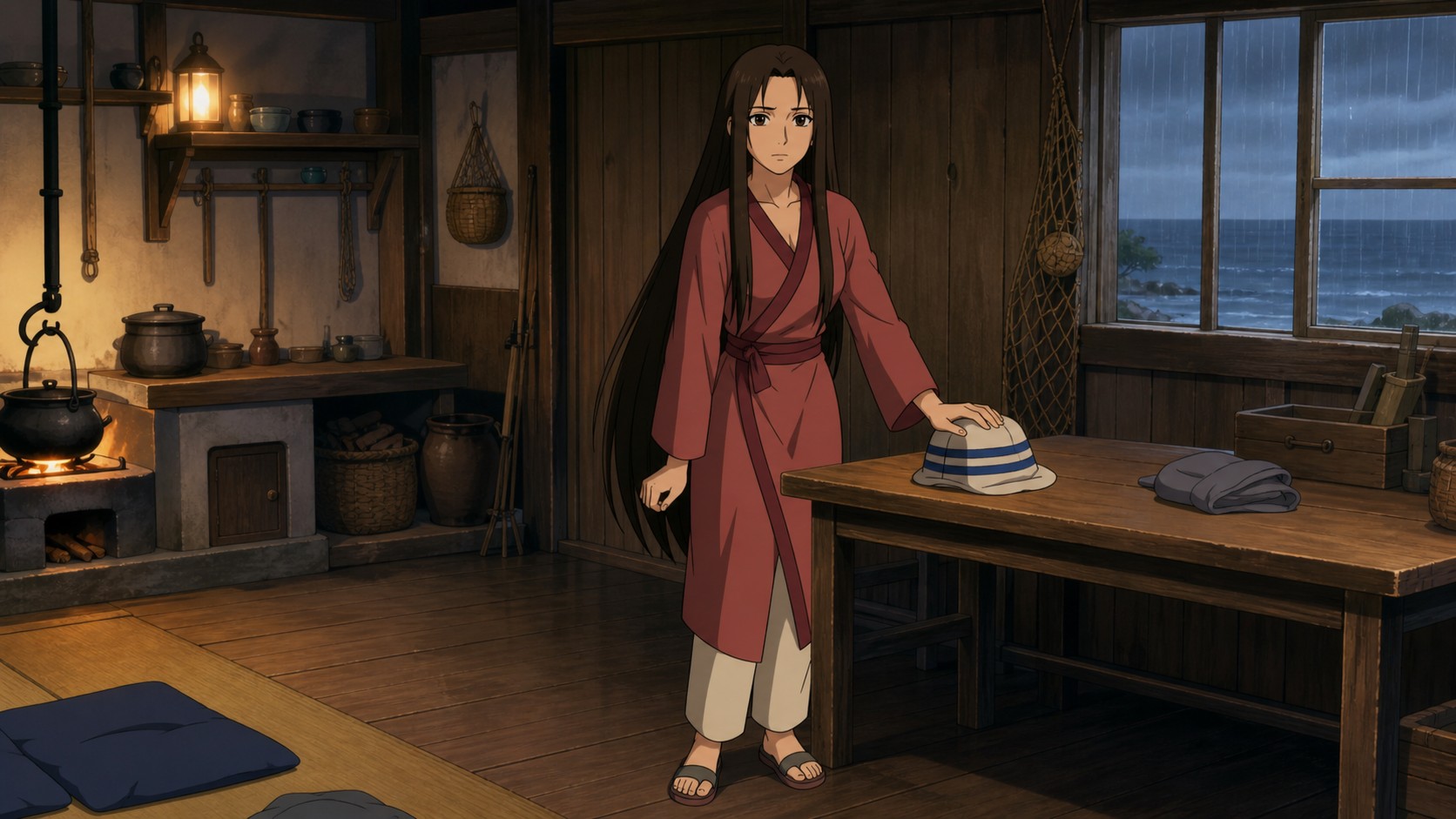
Tsunami
The Land of Waves arc gives its battles to shinobi, but its endurance to a widow who keeps a traumatized child alive, shelters the people protecting her father, and turns her own body into the last leverage available when armed men threaten her son.
Profile and bottom line
Bottom line: Tsunami is the adult woman holding the Land of Waves household together while every man with public power makes her kitchen somebody else’s battlefield. The arc gives shinobi the flashy violence. Tsunami handles bereavement, food, shelter, a traumatized child, an endangered father, and armed kidnappers with no jutsu and no clean choices.
Before Kaiza: a life the manga refuses to over-explain
Tsunami is Tazuna’s daughter and Inari’s mother. The story does not identify Inari’s biological father in useful canon detail. I am not filling that silence with fan-fiction just because biography templates hate an empty box. What the manga establishes is enough to understand the household: three generations live together in a poor island country whose economy has been captured by Gatō.
That home matters before Team 7 ever sleeps there. Tazuna works as a bridge builder. Tsunami raises Inari. Ordinary labor keeps the family alive while the country loses access to money, trade, and public confidence. Naruto arrives after the crisis has already lasted long enough to become routine.
Tsunami’s lack of a narrated childhood or career does not make her blank. The limited point of view tells us whose memories the arc centers. Inari remembers Kaiza as father and hero. Tazuna explains the political history. Team 7 sees the home during one emergency. Tsunami lives between those accounts and handles the parts nobody turns into a legend.
Kaiza, chosen family, and the future Gatō stole
Kaiza enters the family’s life after saving Inari from drowning. Tsunami does not merely thank a heroic stranger and disappear behind the boy’s story. She welcomes Kaiza into the household, forms a partnership with him, and helps build a new family. Kaiza becomes Inari’s chosen father because both adults keep choosing the relationship after the dramatic rescue ends.
Fans often describe Kaiza through his effect on Inari, which makes sense because the flashback belongs to the child. Tsunami loses a partner as well as her son’s hero. Gatō’s execution destroys a shared future, removes another adult from the household, and leaves her parenting the witness most damaged by the murder.
Kaiza teaches Inari to defend precious people with his own arms. Tsunami performs the less quotable version every day. She feeds the family, keeps the home open, manages grief, and refuses to discard a child whose pain comes out as hostility. Nobody engraves domestic continuity on a monument. Gatō still needs that continuity broken, because families capable of remembering love can remember why resistance once made sense.
Widowhood under occupation is work, not a sad character trait
Gatō executes Kaiza publicly because one dead opponent can become a warning to thousands. Tsunami has to mourn inside the same political order that staged the murder. She cannot take Inari somewhere safe. Gatō controls the routes, the jobs, and the violence. The family wakes up under the authority that created the trauma.
Inari responds by mocking hope before hope can embarrass him again. Tsunami does not punish the boy into emotional neatness. She lets grief remain ugly. That patience deserves more attention than the old “nice anime mom” label. Loving a traumatized child means surviving repetition, anger, withdrawal, and statements designed to make everyone else stop trying.
The household’s calm is labor. Meals appear. Kakashi gets a place to recover. Naruto and Sasuke can train because somebody handles the domestic world around their bodies. Tazuna can return to the bridge because somebody remains with Inari. The story rarely frames maintenance as action, but resistance collapses without food, rest, memory, and care.
Women in action stories often become emotional infrastructure for male heroism, then criticism stops after naming the trope. Tsunami does perform that function. The useful question is what the function exposes. Professional fighters depend on unpaid civilian care while the mission system barely records the caregiver’s risk. Team 7 earns a fee. Tsunami gets armed men in her house.
Tazuna’s mission sends danger through Tsunami’s front door
Tazuna lies about the mission because the Land of Waves cannot afford protection priced for the real threat. Kakashi has every right to be angry. The lie places three genin in lethal danger. The larger system still deserves a side-eye. Gatō creates the poverty, then poverty prevents the country from buying the protection required to challenge Gatō. Very convenient little circle for the man holding the shipping monopoly.
Tsunami never signed the Konoha contract, yet the contract changes her home. She shelters Team 7, feeds them, watches an injured jōnin recover, and accepts the possibility that Gatō will retaliate against the family. Tazuna becomes the public face of resistance because he builds the bridge. Tsunami maintains the base that lets him continue.
Recognizing that labor does not require turning her into a secret commander. Domestic work has political value without needing a sword taped underneath. Tsunami keeps people alive long enough for their decisions to matter.
The hostage scene: Tsunami turns coercion against itself
Gatō’s men enter the home to abduct Tsunami and use her against Tazuna. The invasion drags national politics into the most private room in the story. Gatō controls trade outside, then his employees claim a mother’s body inside. Economic power and gendered violence are working the same shift.
When the men threaten Inari, Tsunami says she will kill herself if they harm him. The statement is horrifying because the available choices are horrifying. She has no weapon, no shinobi training, and no institution arriving on schedule. The kidnappers need her alive for leverage against Tazuna. Tsunami threatens to destroy the value they assigned to her captivity.
I am not calling self-destruction empowering. The scene shows how little clean agency an unarmed woman receives under occupation. Tsunami finds leverage at the edge of that trap. Admiring her nerve should not turn the trap into a beautiful sacrifice lesson.
Inari then moves to protect her. Mother and son reject Gatō’s logic from opposite positions. Tsunami refuses to let the men use Inari to control her. Inari refuses to let fear make him abandon Tsunami. Naruto’s clone supplies the combat power, but the family’s moral decision happens before the rescue becomes safe.
Motherhood without sainthood or self-erasure
Tsunami loves Inari fiercely. The profile still should not reduce her to “mother” as if the word explains every decision and deletes the woman making them. She is also a daughter worried about Tazuna, Kaiza’s surviving partner, a citizen under occupation, and the person running a politically exposed household.
A Confucian family lens helps explain her obligations. Each role carries duties to other people, not blind submission to whoever claims authority. Tsunami protects her son, supports her father, honors her partner, and receives almost no reciprocal protection from public power. Gatō weaponizes family obligation while refusing every duty that could make authority legitimate.
The franchise often rewards women for absorbing pain quietly. Tsunami’s restraint can be read as dignity, but restraint also reflects the narrow range the narrative gives a civilian mother. Both facts can remain true. I do not need to invent a hidden battle career to respect her, and I do not need to pretend the gender pattern vanished because she made one fierce threat.
Relationship atlas
Inari
Her son, her daily responsibility, and the child carrying Kaiza’s death as a worldview. Tsunami protects his body without demanding tidy grief.
Tazuna
Her father builds the bridge while Tsunami keeps the household functioning. His resistance risks everyone under her roof.
Kaiza
Partner, co-parent, and public hero. Gatō turns his death into policy and leaves Tsunami to protect the meaning of his life from that propaganda.
Naruto
A guest whose behavior helps Inari recover Kaiza’s lesson. Tsunami’s home gives Naruto a civilian family whose suffering changes his idea of a mission.
Gatō
The ruler whose employees invade her kitchen and convert motherhood into leverage. For Tsunami, occupation has a front-door sound.
Team 7
Protectors whom she shelters in return. Care and defense move both ways even though the mission paperwork only prices one direction.
Class, hierarchy, and the civilian cost of the shinobi economy
The Land of Waves story arrives early enough that viewers can miss how sharply the arc criticizes class. Konoha ranks missions by danger and payment. Tazuna cannot afford the mission his country needs, partly because the enemy has destroyed the local economy. The system asks the poor to purchase safety at a price made impossible by the person threatening them.
Tsunami carries the micro consequence of that macro failure. National trade control becomes an empty pantry. Mission deception becomes strangers sleeping in her home. Political retaliation becomes kidnapping. “Civilian stakes” sounds abstract until armed men threaten her child.
A Buddhist lens adds another layer to her grief. Tsunami does not release Kaiza by forgetting him. She continues living, loving Inari, and supporting the bridge while the future changes without consent. Impermanence here is not a pastel quote. A partner is gone. A country is damaged. Compassion means continuing the work without pretending loss became fair.
Misa Watanabe and the sound of controlled fear
Misa Watanabe performs Tsunami in the original Japanese cast. The role depends on restraint. Watanabe has to establish hospitality, fatigue, grief, and alarm without receiving a giant monologue or combat transformation. Small changes in tone carry the distance between a mother calming a child and a hostage calculating what her captors need.
The performance also keeps Tsunami from becoming a saintly cardboard cutout. Fear remains present. Her threat works because the audience hears the cost. Courage does not erase terror or turn suffering into a reward.
CVM Sekai records the original Japanese performance only. English dub casting remains outside this Naruto profile system. Watanabe’s name should link after her dedicated performer profile goes live. A missing profile is not permission to create a fake link.
Manga canon, anime choices, and the limits of her file
Tsunami debuts in Manga Chapter 16 and the anime around Episode 10. Her central family role, the history with Kaiza, the hostage crisis, and the villagers’ stand belong to the core Land of Waves story. The anime adds performance timing, color design, music, and some presentation differences.
The anime changes details surrounding violence and localization can soften the suicide threat in some versions. Those differences matter because the original scene reveals the exact leverage Tsunami attempts to use. A profile should not blend every adaptation into one frictionless memory.
She receives minor later appearances and adaptation cameos, including material associated with supplemental animation, but no substantial Shippuden or Boruto character arc follows. The honest file stops where the evidence stops. Tsunami does not need invented adventures to justify a profile.
Her name means “harbor wave,” which fits the Land of Waves setting so neatly that nobody needs a graduate seminar to notice. The text does not confirm a complicated symbolic program beyond the naming pattern. Sometimes Kishimoto sees a water country and names the woman Tsunami. We can enjoy the efficiency.
Common misreadings
“Tsunami does nothing.”
She sustains the resistance household, shelters Team 7, protects a traumatized child, manages bereavement, and creates leverage during abduction. Combat is not the only action worth naming.
“The suicide threat proves weakness.”
The threat is an emergency tactic under extreme coercion. The horror belongs to the situation and the men who created the choice.
“She exists only as Inari’s mother.”
Motherhood is central. Tsunami is also Tazuna’s daughter, Kaiza’s partner, a citizen under occupation, and the adult managing the private consequences of public resistance.
“Quiet means passive.”
Tsunami’s quiet presentation reflects restraint, survival, limited page time, and a gendered supporting role. Those factors deserve analysis instead of a personality shortcut.
Domestic labor is part of the mission whether the report admits it or not
Team 7 can recover because Tsunami’s home becomes an unpaid field station. Kakashi sleeps under her roof after the Sharingan drains him. Three young shinobi eat there, train nearby, and return from danger to a place where somebody has kept food, water, bedding, and basic order available. The mission report can call that hospitality. The story makes it logistics.
This is the kind of work action stories love to use and forget. A battle needs a safe place before and after the blades come out. Injured people need watching. Children need feeding even when the adults are scared. News has to move through a household without panic swallowing every conversation. Tsunami handles that labor while grieving Kaiza and watching her father walk toward the same economic power that killed him.
None of this makes her infinitely patient or morally obligated to absorb everybody’s danger. Tazuna accepts a lethal mission under false terms, then brings the consequences home. Team 7 did not create the occupation, but their presence raises the stakes around the family. Tsunami’s care supports the resistance. It also reveals how often public courage quietly transfers work onto the woman expected to make survival look normal.
Calling her a background mother misses the economy of the arc. Gatō controls boats, contracts, and hired violence. Tazuna builds infrastructure. Shinobi sell protection. Tsunami maintains the domestic system that allows all of them to keep functioning. Her labor is not more innocent because no one issues a mission scroll for it. It is simply less likely to be counted.
Civilian courage has no substitution jutsu
Tsunami cannot solve the hostage scene by revealing a hidden bloodline or waiting for a power-up. Two armed men enter her home and threaten Inari. Her choices are brutally small. She can comply and let them use her against Tazuna, resist and risk immediate violence, or turn the threat onto herself. She chooses the last option because her own body is the only leverage she controls.
That decision should not be polished into a cheerful lesson about maternal instinct. A system has failed when a widow must threaten self-destruction to make kidnappers release her child. The scene is brave, but it is also evidence. Gatō’s violence has reached the kitchen. The shinobi mission outside cannot be separated from the coercion happening inside the civilian home.
Tsunami’s response also refuses the easy reading that civilians merely wait for ninjas to save them. She assesses the attackers, identifies what they need from her, and makes herself unusable on their terms. There is no guarantee the gamble will work. Courage here is not superior combat skill. It is a decision made with terrible information and no safe outcome.
Inari’s intervention matters because it changes the burden. The child she is trying to protect chooses to act, and the arc lets mother and son move out of the frozen roles Gatō imposed on them. Tsunami is not only the person who shields Inari. Inari becomes someone willing to help protect her. That exchange does not erase the age difference or romanticize child danger. It shows a family beginning to recover agency together.
Widowhood is not the end of her biography
Kaiza’s death defines the household, but Tsunami cannot be reduced to the woman a dead man left behind. She had a life before he entered it. She chose him as family. She parented with him. After Gatō murdered him, she continued raising Inari, sharing a home with Tazuna, and navigating an occupation that had turned grief into public discipline.
The series gives only fragments, so a responsible profile has to respect the blank space. There is no need to invent a romance after Kaiza, a secret shinobi past, or a neat career title to prove she matters. The confirmed material already contains adult decisions: whom she welcomes, how she protects her son, what danger she tolerates, and how she responds when armed men enter the house.
Her restraint is especially easy to misread. Tsunami does not deliver long speeches about rebellion. She lives with the cost of the last person who became a symbol. Caution in that context is not cowardice. It is memory doing risk assessment. The audience knows Team 7 will change the balance. Tsunami does not. She has to decide what to do while the most recent evidence says Gatō kills brave people and leaves their families to carry the lesson.
That is why her continued care for Tazuna can include love, anger, and fear at the same time. Family loyalty does not require pretending his lie was harmless. The bridge may save the country, but Tsunami knows exactly whose rooms become vulnerable while men discuss the public good. Her perspective keeps noble language attached to household consequence.
What the camera does not follow still counts
Land of Waves closes on a bridge, a grave, and a community beginning to move again. The camera leaves with Team 7. Tsunami stays. That difference matters. The heroes carry a formative lesson back to Konoha, while the civilians remain responsible for living in the place where the lesson cost actual bodies.
Reconstruction means more than celebrating Gatō’s defeat. Food routes have to reopen. Work has to return without another monopolist taking the same position. Inari has to grow around trauma rather than being congratulated once for overcoming it. Tazuna has to finish and maintain the bridge. Tsunami has to build ordinary days after years when fear organized the household.
Fandom often rewards the person who lands the final blow because a fight provides a clean timestamp. Domestic recovery refuses that convenience. There is no single moment when a widow finishes grieving or a child stops expecting public courage to end in execution. Tsunami’s importance lives in that longer scale. She makes continuity possible after the spectacle moves on.
Her profile therefore belongs beside the shinobi files, not beneath them as supplemental trivia. Naruto’s argument about recognition only works if the story recognizes the people whose labor is not measured in chakra. Tsunami cannot summon water, but she keeps a home functioning in a country strangled through its waterways. She cannot issue missions, but she feeds the children sent into one under false terms. She cannot defeat Gatō, but she refuses to let his men make her son’s life the price of her obedience.
That is not perfection. It is endurance with judgment. Tsunami protects, worries, accommodates, resists, and keeps living after the arc has taken almost everything it can use for drama. The bridge is the visible monument. The household she preserves is the reason crossing it matters.
Loving Tazuna does not cancel the argument
Tazuna’s bridge is necessary, and his deception puts Tsunami’s household in danger. Both statements belong in the same sentence. The family cannot afford the mission’s true rank, but Team 7 cannot consent to a threat nobody discloses. Once Zabuza appears, the lie stops being an abstract breach of procedure. Armed consequences begin following Tazuna back to the people who did not negotiate the contract.
Tsunami has every reason to understand why her father lies. Gatō has made honest resistance unaffordable. She also has every reason to resent the price. Her partner was publicly murdered for opposing the same regime. Her son has built a worldview around that loss. Now her father risks repeating the pattern while shinobi recover, plan, and train inside her home.
The profile should not manufacture a screaming confrontation the story never gives her. It should notice that silence does not equal uncomplicated agreement. Tsunami supports the household, shelters Team 7, and continues caring for Tazuna without receiving a magical guarantee that the bridge will succeed. That is loyalty under pressure, not proof that he made a harmless choice.
Their relationship also shows two forms of resistance that action stories often rank unfairly. Tazuna builds a public structure and becomes an obvious target. Tsunami preserves the private structure that keeps Inari, Tazuna, and their guests alive long enough for the public work to continue. One produces a monument. The other produces meals, recovery, memory, and the possibility of another morning.
Neither role should be romanticized into destiny. Tazuna is not naturally entitled to danger because he is a man with a bridge. Tsunami is not naturally responsible for absorbing danger because she is a daughter and mother. Their choices matter because Gatō has narrowed them, not because suffering proves each person belongs in a traditional place.
After the bridge opens, that tension should remain part of the family history. Victory proves Tazuna’s gamble worked. It does not retroactively make every risk fair. Tsunami’s perspective keeps the celebration honest: liberation can be necessary, collective, and worth fighting for while still leaving specific people with costs they never volunteered to carry.
Essential viewing and source boundary
Episode 10: Team 7 enters the family home and Tsunami joins the story. Episode 11: Kaiza’s history explains the wound governing Inari and the household. Episode 13: Gatō’s men invade and the hostage threat exposes Tsunami’s available leverage. Episode 19: the country emerges from the fear that has organized her family.
This profile uses the manga Land of Waves chapters, the official Episode 11 listing, the official franchise Land of Waves retrospective, databook facts where consistent, and the credited original Japanese performance by Misa Watanabe. Anime-only or localization-dependent details remain labeled rather than blended into manga canon.