
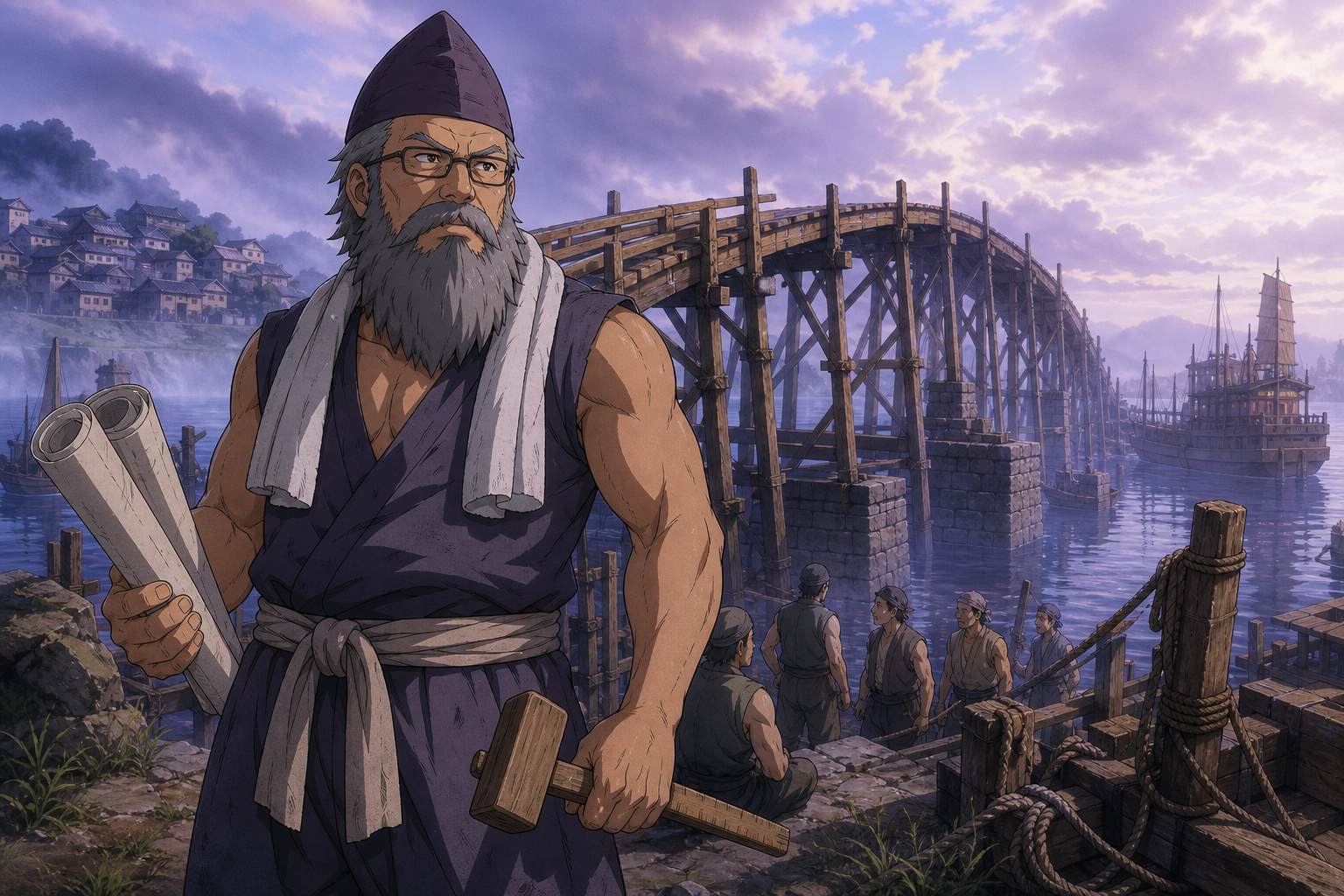
Tazuna
He lies about the mission, insults the children assigned to protect him, and builds the one piece of infrastructure Gatō cannot afford to let exist. Tazuna is compromised, brave, manipulative, necessary, and very human.
Tazuna weaponizes a bridge because a poor country cannot punch a monopoly.
Tazuna is not a noble old man who simply needs rescue. He deceives Konoha about the danger, purchases child labor at the wrong mission rank, guilt-trips Team 7 when exposed, drinks through stress, insults Naruto on arrival, and keeps building anyway. That mess is the point. The Land of Waves has been pushed so far below Gatō’s boot that clean choices have become luxury goods.
The bridge transforms civil engineering into resistance. Gatō controls shipping, trade, food access, and movement because the island depends on routes he owns. Tazuna cannot outfight Zabuza, outspend Gatō, or summon a national army. He can connect the country to markets beyond Gatō’s ships. Naruto makes courage visible, but Tazuna gives that courage concrete, timber, rope, stone, wages, and a destination. Inspiration without infrastructure would leave everybody cheering on the same trapped island.
Verified identity, family and appearance record
- Name: Tazuna (タズナ)
- Title: Tazuna the Master Bridge Builder
- Birthdate: April 5
- Age: 59 in Part I; 64 in Part II
- Height: 179 cm
- Weight: 79 kg
- Blood type: A
- Home: Land of Waves
- Occupation: Carpenter and master bridge builder
- Daughter: Tsunami
- Grandson: Inari
- Family bond: Kaiza as Tsunami’s partner and Inari’s chosen father
- Manga debut: Naruto Chapter 9
- Anime debut: Naruto Episode 6
- Novel record: Naruto: Innocent Heart, Demonic Blood
- OVA record: Hidden Leaf Village Grand Sports Festival!
- Game debut: Naruto: Konoha Ninpōchō
- Status: Alive in the last confirmed Naruto-era record
Tazuna is a civilian. He has no ninja registration, rank, chakra nature, bloodline limit, summoning contract, or secret combat technique in the confirmed record. His profile becomes weaker when fans “upgrade” him into a hidden fighter. The whole arc depends on a builder confronting shinobi violence through labor, planning, deception, and community organization.
His blunt personality, drinking, and willingness to manipulate Team 7 sit beside genuine diligence and public courage. Neither side cancels the other. Reference-grade biography needs both because turning him into Grandpa Infrastructure Jesus would erase the ethical cost that makes his decision interesting.
The towel, pointed hat, glasses and hands of a working man
Tazuna has gray hair, dark eyes behind simple glasses, and a large gray beard and mustache. His Part I clothing includes a sleeveless V-neck work shirt, broad obi, loose trousers, sandals, a white towel around his neck, and the distinctive pointed Land of Waves hat. The design reads civilian labor before dialogue explains his profession.
The towel matters because Tazuna’s body is always near work. Naruto outfits often announce clan, village, rank, or technique through symbols. Tazuna’s strongest symbols are practical: cloth for sweat, sleeves removed for movement, sturdy sandals, plans, tools, and the bridge growing behind him. He has no forehead protector because he protects people by changing the routes their lives depend on.
Part II keeps much of the same clothing and work identity. Inari adopts the towel habit, a small visual sign that the grandson no longer sees labor and public courage as pointless. The design inheritance is not a bloodline technique. The boy copies a builder because the builder’s work finally appears capable of changing history.
Gatō does not merely terrorize the Land of Waves. He owns the exits.
The Land of Waves is an island country whose economy depends on shipping. Gatō arrives through a legitimate company and turns maritime access into monopoly power. He controls transport, suppresses trade, impoverishes residents, and hires violence against resistance. Hunger and fear then become management tools. The poorest people lose the spare resources needed to organize against the system making them poor.
Tazuna understands that the monopoly has a physical weak point. A bridge can create overland access beyond Gatō’s shipping routes. Goods, workers, information, and outside relationships could move without passing through the company’s tollgate. That possibility explains why Gatō spends money on assassins. The bridge threatens revenue, but the deeper threat is proof that the country can coordinate around something Gatō does not own.
The arc therefore treats infrastructure as politics. Roads and bridges are never neutral when one corporation controls movement. Whoever decides which bodies and goods may cross decides whose work has value, whose family eats, and whose resistance can meet allies. Tazuna’s construction site becomes a battlefield before Zabuza ever raises a sword there.
Tazuna buys a C-rank mission while carrying A-rank danger
Tazuna requests a routine escort from Konoha and withholds the fact that assassins have been hired to kill him. The Demon Brothers expose the deception on the road. Kakashi identifies the assignment as far more dangerous than the purchased rank and confronts the client. Tazuna admits that the Land of Waves cannot afford the correct fee.
Then he manipulates. He describes the poverty awaiting his family and country if Team 7 abandons him, effectively making the shinobi responsible for consequences produced by his lie. The guilt trip is ugly because the team includes children who never consented to an assassination mission. Poverty explains the deception. Poverty does not transform deception into informed consent.
Kakashi chooses to continue after weighing the threat, his team, and the client’s circumstances. That distinction matters. Tazuna does not gain moral permission retroactively. Kakashi assumes responsibility for the altered mission. Team 7’s choice turns the escort from a fraudulent contract into a conscious intervention.
The mission-class system also deserves scrutiny. Konoha prices protection according to danger, which makes sense for allocating trained labor. The same system means poor communities facing elite violence may be least able to buy the protection that violence requires. Tazuna exposes a structural gap: transparent pricing can still reproduce injustice when purchasing power determines whose survival receives qualified force.
Tsunami, Inari and Kaiza carry the occupation home
Tazuna lives with his daughter Tsunami and grandson Inari. Kaiza became Tsunami’s partner and Inari’s chosen father after saving the boy from drowning and joining the family. His courage extended beyond the household. Kaiza organized local people, repaired community systems, and represented the possibility that ordinary residents could resist fear together.
Gatō captured Kaiza, publicly tortured and executed him, and used the body as a warning. The murder broke more than one family. Tazuna lost a son-in-law figure and political ally. Tsunami lost her partner. Inari lost the father who taught him courage and concluded that courage only helps tyrants choose whom to kill first. The country learned the same lesson on purpose.
Tazuna continues the bridge project after Kaiza’s death, but continuation does not mean emotional invulnerability. He drinks, speaks harshly, hides risk, and keeps danger close to his family. Tsunami later faces abduction because of his resistance. Inari watches assassins arrive at the house. Public action enters domestic space because occupation refuses to respect the boundary.
The family profiles interlock without becoming interchangeable. Kaiza’s chosen-family labor, Tsunami’s survival work, Inari’s grief, and Tazuna’s infrastructure each reveal a different response to coercion. Linking them only as “sad backstory” would miss the political system joining their lives.
The bridge is hope with maintenance costs
The unfinished bridge symbolizes connection, but symbolism cannot replace engineering. Tazuna needs designs, materials, skilled labor, safe access, food, time, and enough workers willing to appear despite intimidation. Each day of construction converts private hope into public risk. Gatō can identify the site, calculate the threat, and attack the people making change material.
That materiality strengthens the symbol. A speech disappears after the crowd leaves. A completed bridge changes tomorrow’s price of transport. The country can trade, travel, organize, and contact outside markets differently. Naruto inspires the name, while Tazuna and the workers create the function. Calling the structure the Great Naruto Bridge honors courage without pretending Naruto personally laid every support.
The naming also contains a tension worth keeping. Local workers build the bridge. Kaiza’s death helped create the resistance culture. Inari mobilizes villagers. Team 7 protects the site. Tazuna directs construction. Naruto becomes the public symbol because his visible defiance unlocks the final collective turn. Movements often choose one name to carry many people’s labor. The name can inspire and still compress authorship.
From drunken client to completed Great Naruto Bridge
Tazuna arrives in Konoha intoxicated, insults the inexperienced genin assigned to him, and begins the return journey under Kakashi. The Demon Brothers attack from a false puddle, revealing professional assassination pressure. Kakashi extracts the truth. Team 7 elects to continue.
At the shore, Zabuza Momochi attacks with Hidden Mist assassination tactics. Kakashi’s Sharingan and Team 7’s cooperation free him from Water Prison and drive Zabuza back after Haku stages a hunter-nin retrieval. Tazuna brings the injured team into his home, where Tsunami and Inari expose the family history and the country’s fear.
While Kakashi recovers and the genin train in tree climbing, Tazuna returns to the bridge. Worker attendance falls because Gatō’s intimidation is working. Zabuza and Haku launch the second assault. Kakashi fights Zabuza while Naruto and Sasuke confront Haku inside the Crystal Ice Mirrors. Sakura remains with Tazuna, holding the client-protection formation while the others fight.
Gatō arrives with hired thugs, betrays Zabuza, and expects exhausted killers and frightened workers to collapse. Naruto’s words force Zabuza to acknowledge Haku as a person rather than a tool. Zabuza kills Gatō at the cost of his life. Inari arrives with villagers prepared to resist, and the remaining thugs flee.
Tazuna completes the bridge and names the Great Naruto Bridge after the boy whose courage helped the country recover public action. Team 7 leaves with its first major mission transformed from deceptive escort into political intervention, grief education, and proof that ninja contracts sit inside larger economies.
Tazuna learns what each Team 7 member protects
His relationship with Naruto begins through mockery. Tazuna sees a small loud child and assumes incompetence. Naruto takes the insult personally, then repeatedly risks himself for the client and country. The bridge name marks Tazuna’s revised judgment, but the stronger evidence appears earlier: he allows Naruto’s influence to change how he reads Inari’s despair.
Kakashi receives the lie and chooses whether to continue. Tazuna depends on his command judgment, medical recovery, and ability to match Zabuza. Their relationship remains professional rather than sentimental. Kakashi protects the client without pretending the client behaved honorably.
Sakura stays nearest Tazuna during the bridge battle because guarding the client is the assigned objective. Her role receives less spectacle than the boys’ fights, yet Tazuna’s survival depends on someone maintaining formation. Sasuke’s growth and apparent sacrifice occur within the larger defense of the bridge project. Tazuna witnesses Team 7 become a functioning unit around a mission he misrepresented.
Naruto does not save passive villagers. Villagers decide to become dangerous together.
Inari’s arrival with armed residents completes the political arc. The villagers have not become elite shinobi. Their tools, numbers, and willingness create a cost Gatō’s remaining thugs no longer want to pay. Fear had isolated each household. Collective appearance changes the calculation.
Tazuna’s bridge works the same way over a longer period. One carpenter cannot finish a national crossing alone. Workers must coordinate specialized labor while sharing risk. The project teaches community through practice before the final crowd recognizes the lesson emotionally.
A fandom version that credits Naruto alone repeats hero worship the arc quietly complicates. Naruto’s courage is catalytic. Tazuna’s plan, Kaiza’s memory, Tsunami’s household labor, Inari’s organizing, worker skill, Kakashi’s command, Sakura’s protection, Sasuke’s sacrifice, and even Zabuza’s final choice all matter. Social change has a cast list, babes.
Tazuna returns as a builder, not a retired symbol
In Part II, Tazuna and an older Inari visit Konoha after Pain’s destruction and help with reconstruction. The return pays off the original exchange. Konoha once sent skilled protection to the Land of Waves. The Land of Waves later sends skilled builders when Konoha’s own infrastructure collapses. Reciprocity becomes material.
Tazuna’s age advances to sixty-four while his clothing and work identity remain recognizable. Inari now participates beside him, showing that courage has become apprenticeship and public service. The boy who believed struggle was pointless grows into a young worker helping another community rebuild.
Anime closing material also places Tazuna and Inari among people visible after the Infinite Tsukuyomi’s end. The appearance confirms survival and continuing connection without inventing a later political office, secret wealth, or retirement biography. The confirmed record remains focused: builder, father, grandfather, client, organizer, and friend of Konoha.
Master craftsmanship, endurance, planning and human vulnerability
Tazuna’s title identifies exceptional bridge-building skill. He can design, organize, and supervise complex construction across water under resource scarcity. The bridge’s scale implies knowledge of load distribution, materials, foundations, labor sequencing, and coastal conditions even though Naruto does not turn the arc into an engineering manual.
His physical build and continued work at fifty-nine show practical stamina. He carries tools, works long shifts, travels to Konoha, and continues after assassination attempts. Those feats belong to civilian labor, not chakra-enhanced combat. He cannot defend himself against missing-nin and relies on Team 7 when violence exceeds community capacity.
His strongest tactical skill is political risk assessment, and even that skill is compromised. Tazuna correctly identifies the bridge as Gatō’s vulnerability. He underprices the danger, endangers the assigned team, and exposes his household. Expertise in construction does not produce perfect ethics or perfect security planning.
Craft dignity, reciprocity and attachment to heroic symbols
A Confucian lens highlights responsibility across roles. Tazuna owes honesty to hired protectors, care to family, and stewardship to the community. He violates the first obligation because poverty makes the formal system inaccessible, then attempts to fulfill the latter two through the bridge. The conflict matters because duties collide under unjust conditions.
Reciprocity develops across the series. Team 7 protects Tazuna’s project. Tazuna later helps rebuild Konoha. Naruto changes Inari. Inari later works beside Tazuna. Ethical order emerges from returned care rather than one-directional loyalty to power.
A Buddhist reading can focus on fear, attachment, and collective suffering. Inari’s attachment to the belief that resistance always ends in loss protects him from hope while trapping him inside Gatō’s lesson. Tazuna’s attachment to finishing the bridge gives purpose but also makes him manipulate others. The arc does not demand desire disappear. Desire must be examined through consequence.
The worker’s body provides a creative counterweight to ninja spectacle. Tazuna changes the world with measurements, material knowledge, and repeated physical labor. Naruto’s power system loves exceptional bodies. The bridge arc remembers that societies also depend on trained hands whose achievements cannot be summoned in one panel.
Takeshi Aono and Shigeru Ushiyama
Takeshi Aono performs Tazuna in Japanese during Part I, giving him rough humor, alcohol-soaked defensiveness, worker’s bluntness, fear, and stubborn conviction. The performance keeps the client abrasive enough that Team 7’s decision cannot be reduced to instant affection.
Shigeru Ushiyama performs Tazuna in Part II, carrying the older builder into reconstruction material after Aono’s era. The later voice retains practical warmth without turning the character into a soft nostalgia cameo. Tazuna arrives to work.
CVM Sekai records the original Japanese performances. Takeshi Aono and Shigeru Ushiyama carry Tazuna across the two eras without asking a later localization to define him.
Manga, anime, novel, OVA and game boundaries
Tazuna debuts in Naruto Chapter 9 and Episode 6. The core Land of Waves material carries his main biography through the mission deception, family history, two Zabuza assaults, Gatō’s death, village mobilization, and completion of the bridge.
Naruto: Innocent Heart, Demonic Blood adapts the arc in prose and provides the principal novel record. Hidden Leaf Village Grand Sports Festival! supplies an OVA appearance. Game history begins with Naruto: Konoha Ninpōchō, with later adaptations using him as a client, support figure, story NPC, or Land of Waves marker rather than a conventional fighter.
Part II reconstruction and final-era anime appearances extend his record. No confirmed theatrical-film role of narrative substance, hidden novel career, Boruto office, shinobi promotion, or death belongs in the profile. Checking the shelf includes writing down what the shelf does not contain.
Tazuna is neither innocent saint nor selfish coward
“His lie was fine because the country was poor.”
Poverty explains the lie and indicts the mission economy. Children still faced professional assassins without informed consent. Compassion can justify Kakashi’s decision to continue without laundering Tazuna’s manipulation.
“Naruto saved the Land of Waves by himself.”
Naruto catalyzes courage. The bridge plan, worker labor, Inari’s organizing, Team 7’s protection, and local resistance convert courage into changed conditions. Hero worship is easier than infrastructure analysis. The arc contains both and asks us to notice the bridge.
“Tazuna is weak because he cannot fight ninja.”
Tazuna is a civilian master builder confronting a shipping monopoly. Combat inability is the premise, not a character flaw. His competence appears in design, labor organization, persistence, and identification of the economic pressure point.
My read: Tazuna earns respect without becoming pure. His country needs the bridge, his family pays for the danger, his contract is dishonest, and his plan works. Naruto’s first major client teaches the series that people under oppression rarely arrive with perfect paperwork and morally tidy options.
The bridge is the arc’s political argument
Tazuna does not hire Team 7 because he needs four armed escorts for an ordinary construction project. He hires them because Gatō has turned transportation into a choke point. Whoever controls the boats controls trade. Whoever controls trade can keep wages low, isolate resistance, and make hunger feel like weather instead of policy. The bridge threatens that arrangement before Kakashi draws a kunai.
That distinction matters. Naruto’s first major mission does not begin with an ancient demon or a prophecy. It begins with infrastructure. A civilian understands that one completed public work can redistribute power across an entire country. Tazuna cannot defeat Zabuza, but he can design the thing Gatō is willing to kill to prevent. Calling him powerless misses what the villain sees immediately.
His lie still carries a bill. Team 7 accepts a lower-ranked mission without the preparation or pay the danger requires. Sakura, Sasuke, and Naruto are children entering lethal combat because Tazuna hid the threat. Poverty explains the choice. It does not erase the people exposed by it. The story works because both facts remain true at once: Tazuna acts dishonestly, and the mission system prices desperate communities out of honest protection.
The family consequences sharpen that argument. Tsunami has already lost Kaiza to Gatō’s terror campaign. Inari has learned that public courage creates private funerals. Tazuna’s bridge project asks them to risk the same machinery again. He is not a lone heroic craftsman floating above domestic cost. His work draws courage from a household that has every reason to be afraid of another body coming home.
When the townspeople finally arrive, the bridge becomes collective rather than personal. Tazuna supplies expertise. Team 7 survives the shinobi violence around the site. Naruto breaks the emotional paralysis Gatō depends on. The community supplies the last necessary force: enough people willing to stand where they can be counted. That is why naming the bridge after Naruto feels earned without making Tazuna irrelevant. Naruto becomes the symbol, but Tazuna built the route that lets the country move after the symbol leaves.
A successful rescue still has to become ordinary life
The most important result is not that Team 7 wins one spectacular fight. It is that the bridge remains after the shinobi leave. Missions end. Infrastructure keeps changing what food, medicine, work, and information can reach a community. Tazuna’s victory becomes real only when people no longer need a famous ninja standing beside them to cross the water or challenge a merchant’s control.
That is also the quiet test of his leadership. He cannot treat Naruto’s courage as a souvenir and return to the habits that let Gatō isolate everybody. The bridge asks Wave Country to practice cooperation after fear stops being an emergency. Builders must maintain it. Traders must use it without rebuilding the old monopoly under a new name. Families must decide that Kaiza’s murder and Inari’s grief belong to public memory, not private shame.
Tazuna therefore sits at the hinge between rescue and reconstruction. He creates the physical condition for a different future, but the structure cannot guarantee justice by itself. Naruto supplies hope. Tazuna supplies craft. The community still has to decide what both are worth once the cheering ends.
Viewing and reference shelf
Read Naruto Chapters 9 through the Land of Waves conclusion and watch Episodes 6 onward for the complete Japanese-language performance, economic setup, family history, bridge battles, and naming scene. Return to Part II reconstruction material for the reciprocal Konoha visit.
Profile facts were cross-checked against official anime summaries, character-data records, manga, anime, novel, OVA, and game citations summarized by established Naruto references. Cultural, economic, labor, Confucian, Buddhist, symbolic, and fandom readings are CVM Sekai interpretation rather than invented creator intent.
No shinobi rank, chakra power, film career, secret wealth, death, or later political office is invented. Tazuna remains a civilian builder whose confirmed power is material, social, and economic.