
Sasuke Recovery Mission
Five genin chase a coffin through the forest because one teammate mistakes power for freedom. Every mile turns friendship into duty, every fight asks a child to spend his body for another child’s choice, and the Valley of the End proves that love can be sincere without being strong enough to stop someone from leaving.
The one-sentence truth
The Sasuke Recovery Mission is the tragedy that Naruto cannot talk his way out of: a rescue built on real loyalty, undermined by the rescuers’ incomplete understanding of the person they are trying to save.
- Anime episodes: 107–135
- Manga material: chapters 172–238
- Mission leader: Shikamaru Nara
- Original team: Naruto, Chōji, Neji and Kiba with Akamaru
- Reinforcements: Rock Lee and the Sand siblings
- Primary enemy unit: the Sound Four
- Final battlefield: Valley of the End
- Outcome: Sasuke reaches Orochimaru; retrieval mission fails
The rooftop tells Sasuke what he cannot bear to hear
Sasuke returns from Itachi’s Tsukuyomi physically awake and psychologically cornered. His life has been organized around revenge, yet Itachi defeated him as casually as before. Worse, Naruto, the class failure Sasuke once dismissed, is developing at a rate he can see.
The hospital rooftop fight is not a random explosion of rivalry. Sasuke initiates it because comparison has become panic. Naruto’s Rasengan collides with Sasuke’s Chidori until Kakashi redirects both boys into water tanks. Sasuke initially sees the clean hole Chidori punched through his tank and believes his technique won. Then he sees the back of Naruto’s tank peeled open by internal rotational force. The visual lands like a verdict: Naruto’s growth is no longer hypothetical.
Sakura watches two people she loves aim lethal techniques at each other and tries to put her body between them. Kakashi stops the collision, but the emotional problem remains. He warns Sasuke that revenge empties more than it restores. Sasuke asks, in effect, whether Kakashi could remain calm if everyone he loved were murdered. Kakashi quietly explains that everyone Sasuke named is already dead. It should create recognition. Instead, Sasuke hears another adult offering wisdom after the damage has become irreversible.
The Sound Four do not persuade Sasuke. They validate his worst conclusion
Orochimaru’s Sound Four arrive with an argument tailored to Sasuke’s shame: Konoha has made him comfortable, attachment has weakened him, and the curse mark contains the power he needs. They defeat him together, then invite him to imagine that defeat as evidence that his current life is a cage.
Sasuke already knows Orochimaru wants his body. Leaving is not an innocent mistake made because nobody explained the villain clearly enough. He chooses danger because remaining in Konoha now feels like accepting permanent inferiority. That distinction is crucial. A rescue party can fight kidnappers; it cannot easily rescue someone from a decision he experiences as self-authorship.
Sakura meets Sasuke at the village gate and offers every form of attachment she knows how to articulate. She confesses love, promises to help with revenge, begs him to stay and threatens to scream. Sasuke thanks her before knocking her unconscious. The gratitude makes the scene crueler. He is not unaware of her care. He has decided care is precisely what must be cut away.
Tsunade gives Shikamaru a command built to expose him
Konoha is depleted after invasion. Most experienced shinobi are on missions, and the retrieval window is closing. Newly promoted chūnin Shikamaru receives command of Naruto, Chōji, Neji and Kiba. His first leadership assignment is not a comfortable exercise. It is a pursuit against elite enemies carrying a teammate toward one of the village’s greatest traitors.
Shikamaru builds a formation around specialties: Kiba tracks, Neji observes with Byakugan, Naruto supplies unpredictable force, Chōji anchors the rear, and Shikamaru coordinates. The plan is intelligent. The arc then subjects it to the oldest battlefield law: contact with the enemy turns diagrams into sacrifice.
One by one, team members stay behind. Tactical necessity converts a five-person rescue into a chain of solitary battles. Each boy tells the others to continue because Sasuke’s retrieval matters. Beneath the mission language is a deeper exchange: they trust Shikamaru to carry their risk forward and trust each other not to waste the time purchased with blood.
Five battles, five definitions of strength
Chōji vs. Jirōbō: love without an audience
Jirōbō mocks Chōji’s body, appetite and apparent weakness, correctly identifying the insults most likely to hurt. Chōji remains because his friends have trusted him with the rear. The Akimichi clan’s Three Coloured Pills convert stored calories into explosive chakra at escalating physical cost. The final red pill forms butterfly wings and places his life at risk.
The emotional weapon is not anger alone. Chōji remembers Shikamaru choosing him when other children did not. Their bond was built through ordinary companionship through cloud watching, snacks and invitations, not grand declarations. Chōji wins because someone once treated him as a person before demanding that he become useful.
Neji vs. Kidōmaru: genius learns to fight the unknown
Kidōmaru analyzes the Byakugan’s nearly complete field of vision, discovers its blind spot and attacks from outside Gentle Fist range. Neji, once convinced destiny fixed every outcome, fights an opponent who turns his hereditary advantage into a solvable system.
Neji takes an arrow through his body, threads chakra through Kidōmaru’s web and strikes back along the connection. His victory reverses the logic he preached during the Chūnin Exams. Fate may establish conditions; choice still decides what a person does inside them.
Kiba and Akamaru vs. Sakon and Ukon: the body as home
Sakon and Ukon can invade and merge with another person’s body. Their technique makes bodily boundaries unstable, a grotesque inversion of Kiba and Akamaru’s partnership. Kiba and Akamaru coordinate through affection and practiced trust; Sakon and Ukon weaponize fusion as violation.
Kiba stabs himself to injure the brother sharing his flesh, choosing pain rather than surrendering ownership. When survival narrows further, Kankurō arrives and traps the brothers inside Black Ant before crushing them with Iron Maiden. The rescue also signals that the former invading Sand village now honors its alliance.
Shikamaru vs. Tayuya: command runs out of pieces
Tayuya controls three Doki through flute melodies and genjutsu. Shikamaru reads patterns, manipulates shadows and repeatedly builds answers with dwindling chakra. His intelligence lets him survive, but intelligence cannot create resources that do not exist.
Temari’s arrival changes the board with overwhelming wind and a forest-clearing summon. Shikamaru’s relief contains humiliation: his first command has scattered, he cannot confirm who lives, and another village has to finish the opponent he could not. Leadership will teach him that needing reinforcement is not the same as being unworthy.
Rock Lee and Gaara vs. Kimimaro: bodies with expiration dates
Lee leaves the hospital before recovery is complete and accidentally drinks sake instead of medicine, producing the series’ famous Drunken Fist sequence. Comedy gives way to threat when Kimimaro’s bone-manipulation kekkei genkai overwhelms him.
Gaara arrives not as Naruto’s enemy but as Suna’s ally. His sand meets Kimimaro’s skeletal armor and forest of bone. Kimimaro is dying from illness and moves through devotion to Orochimaru, who gave him purpose as a vessel. He nearly kills Gaara and Lee before his body stops. The death is unsettling because loyalty sustains him even after Orochimaru has replaced him.
The cursed seal coffin stages a false rebirth
The Sound Four place Sasuke inside a sealed container to accelerate the curse mark to its second state. The image resembles burial: a boy closes himself inside a coffin so a stronger self can emerge. Orochimaru’s promise of transformation requires Sasuke to rehearse his own death.
The curse mark externalizes a temptation already present. It offers immediate power linked to surrender: allow Orochimaru’s chakra and will deeper access, and receive strength without waiting for the slower work of community, training and uncertainty. Naruto’s shadow clones and Rasengan are also borrowed inheritances, but they become his through relationship and adaptation. Sasuke’s new power is designed to make ownership ambiguous.
Valley of the End: two boys argue with their entire bodies
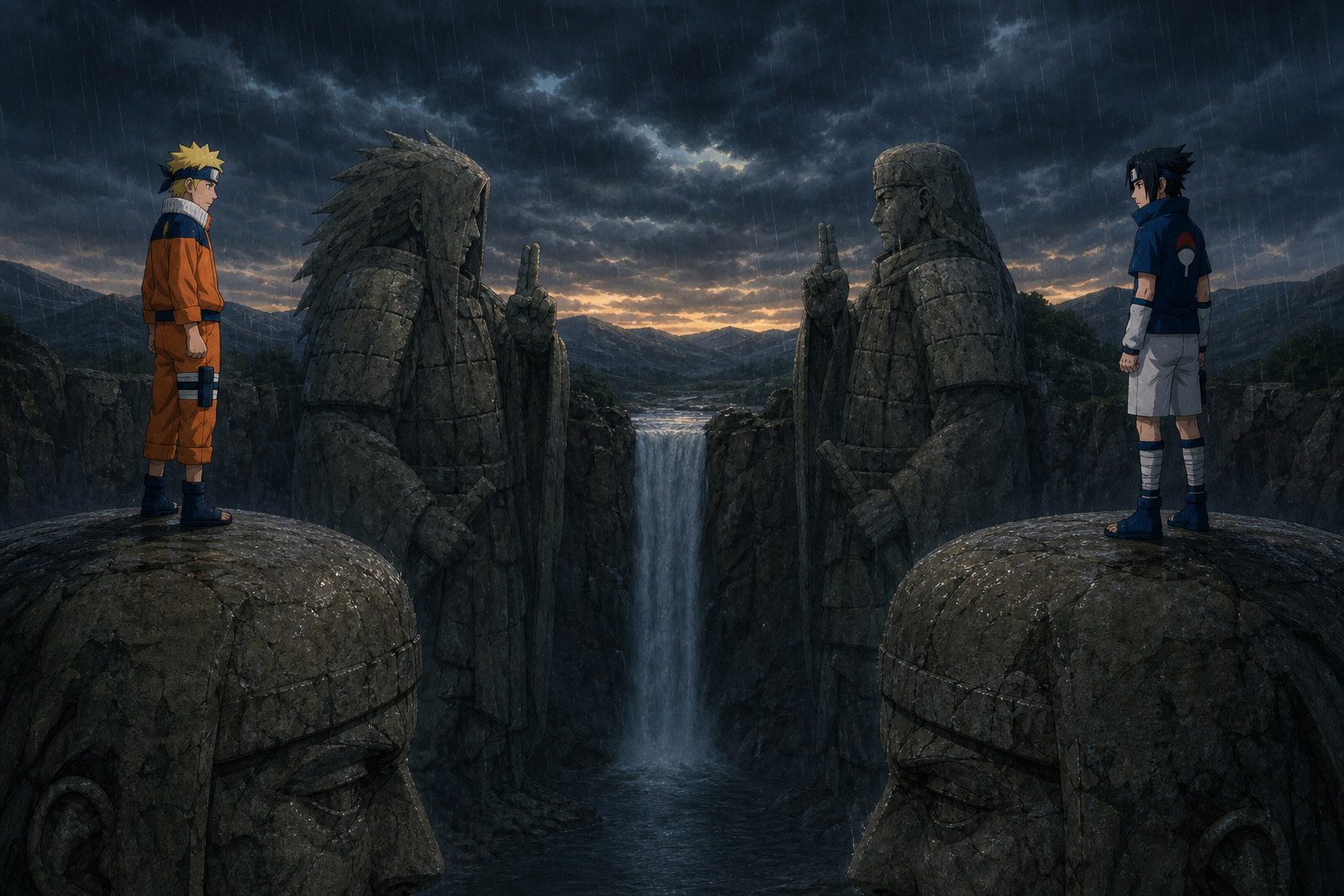
The founder statues of Hashirama Senju and Madara Uchiha frame Naruto and Sasuke before the audience knows the full history they represent. The landscape turns a private rupture into inherited mythology: two bonds, two visions of power, one river carrying the consequences forward.
Naruto insists Sasuke is like a brother. Sasuke says Naruto cannot understand because he never had a family to lose. Naruto answers through memory: loneliness made their antagonism meaningful because Sasuke was one of the first people whose attention made him feel visible. They recognized each other long before either had the emotional vocabulary to call recognition affection.
Sasuke explains that killing his closest friend will awaken the Mangekyō Sharingan, following Itachi’s instructions. Naruto hears this as proof that Sasuke must be stopped. Sasuke experiences resisting or accepting that instruction as part of a larger problem: even his path to power has been scripted by the brother he hates.
The fight escalates through clones, fire, Chidori, Rasengan, curse-mark transformation and Nine-Tails chakra. Each power system reveals a relationship. Naruto’s red chakra comes from a being sealed into him without consent. Sasuke’s wings and markings come from a predator he approached willingly under coercive circumstances. Both boys borrow from monsters because ordinary childhood strength has proved insufficient.
Why Sasuke does not kill Naruto
At the final collision, Sasuke’s Chidori drives toward Naruto while Naruto’s Rasengan turns toward Sasuke. Naruto scratches Sasuke’s forehead protector, answering Sasuke’s earlier claim that Naruto could not land even one mark. Sasuke leaves Naruto alive.
He tells himself he refuses to gain power by following Itachi’s method. That decision preserves a fragment of autonomy: he will go to Orochimaru, but he will not let Itachi dictate every step. It also reveals that the bond was not successfully severed. Sasuke can defeat Naruto and still cannot complete the murder that would convert their relationship into fuel.
Naruto loses the fight and fails the mission. The series allows both facts to remain. Love does not guarantee control over another person. Refusing to abandon Sasuke may be morally meaningful, but it does not grant Naruto the right language, power or timing to change Sasuke’s choice.
Shikamaru’s tears are the beginning of leadership
Back in Konoha, Shikamaru expects punishment and considers resigning. He believes a commander whose team returns critically injured has forfeited the role. His father Shikaku refuses the easy escape. If Shikamaru quits, the next mission goes to someone less experienced, and the suffering of this team teaches nobody.
Tsunade reports that every member survives, but survival does not transform the mission into success. Chōji required extraordinary intervention after the red pill. Neji nearly died. Kiba and Akamaru were badly injured. Lee fought against medical orders. Naruto returns without Sasuke.
Shikamaru cries in front of Temari and his father, finally letting responsibility reach him emotionally. The moment rejects the idea that leadership requires invulnerability. His grief is evidence that the people under his command are not pieces. The task is to feel their cost without becoming too frightened to command again.
Relationship atlas
Naruto ↔ Sasuke
Rivalry became recognition, recognition became attachment, and attachment becomes a battlefield because neither boy knows how to ask the other to remain without turning the request into a challenge.
Sakura ↔ Sasuke
Sakura understands that Sasuke intends to leave and reaches him before the mission begins. Her confession cannot overcome the identity he has built around revenge, but his thanks proves her care reached him.
Shikamaru ↔ Chōji
The mission reveals the childhood friendship beneath their tactical partnership. Chōji’s confidence is rooted in being chosen by Shikamaru before anyone knew whether he would become formidable.
Orochimaru ↔ Sasuke
Orochimaru offers power while planning bodily theft. Sasuke knows the danger and treats it as a cost he can outmaneuver, beginning a relationship in which each believes the other is ultimately a tool.
Gaara ↔ Rock Lee
The former opponents become allies. Gaara protects the person he once nearly killed, evidence that Naruto’s intervention changed not merely Gaara’s mood but his political and moral behavior.
Tsunade ↔ Shikamaru
Tsunade entrusts an ugly mission to a new chūnin because rank creates responsibility before confidence arrives. Afterward, she does not pretend the cost was small.
The linked character files below follow the people whose loyalties, losses, and choices determine how this recovery mission ends.
Easter eggs and details that change the reading
- The scratched forehead protector: Naruto does not bring Sasuke home, but he disproves Sasuke’s claim that he could not mark the symbol between them.
- The Valley statues: Hashirama and Madara foreshadow a generational conflict the boys do not yet understand, visually placing them inside history before the exposition arrives.
- Sasuke’s headband: he initially refuses to wear it for the rooftop fight, then puts it on at the Valley. The Leaf symbol remains present at the moment he insists he has cut the Leaf away.
- Chōji’s butterfly: the insult “fat” is transformed into the Akimichi clan’s most beautiful and dangerous release of stored energy.
- Neji’s forehead bird: his apparent death imagery recalls the caged-bird seal, but surviving allows his post-exam rejection of fatalism to continue.
- Kimimaro and Sasuke: both are selected as vessels. Kimimaro’s illness makes Sasuke’s availability strategically urgent, linking the retrieval pursuit to Orochimaru’s deteriorating body.
- The Sand siblings: their rescue role is the practical consequence of the post-invasion alliance, not merely a crowd-pleasing cameo.
- The hospital tanks: Chidori’s visible puncture and Rasengan’s hidden rear destruction mirror the boys: Sasuke performs focused damage; Naruto’s impact is larger than it first appears.
The recovery mission exposes the cost of sending children to repair adult failures
Tsunade has barely taken office when she has to build a retrieval team from whoever is available. Konoha is still recovering from invasion. Experienced ninja are stretched across missions, patrols and medical work. Sasuke leaves during that shortage, so Shikamaru receives a chūnin command with genin under him and almost no margin for error. The arc does not hide the promotion certificate behind his head and pretend he has become an adult. It makes the gap between rank and readiness hurt.
That matters because every duel is shaped by scarcity. Shikamaru cannot keep the team together and still stop the Sound Four. He has to divide people, trust individual judgment and move toward a target he may not be able to persuade. Chōji spends a life-threatening resource because nobody stronger is there to replace him. Neji takes a nearly fatal wound because his eyes and precision make him the best answer to Kidōmaru. Kiba and Akamaru share damage because their combat style and affection are physically linked. Naruto reaches Sasuke only after friends have bought him that distance with their bodies.
The Sand siblings arriving as allies does not erase what happened during Konoha Crush. It shows a political relationship changing under new leadership and new incentives. Gaara, Temari and Kankurō once entered Konoha as weapons inside an invasion. Now they answer a request for aid and save the same generation they fought. Reciprocity becomes policy. Their intervention also embarrasses Konoha’s heroic self-image a little, which is healthy. The village survives because former enemies help, not because the Leaf secretly had everything under control.
This is one of Naruto’s clearest arguments against the lone-genius fantasy. Sasuke thinks power requires severing bonds. The rescue mission demonstrates that bonds create capability no individual owns. It still fails to bring him home. Cooperation is not magic, and care does not cancel another person’s choice. What it does is keep more people alive, reveal who will answer a call, and create the relationships that later wars will depend on.
How the anime makes attrition feel personal instead of repetitive
A long pursuit built from consecutive one-on-one fights could become a tournament wearing hiking boots. The anime avoids that by giving each separation a different emotional question. Chōji’s battle asks whether kindness and appetite make him weak. Neji’s asks what he does with the freedom Naruto helped him claim. Kiba’s asks what partnership costs when Akamaru cannot be treated like equipment. Shikamaru’s asks whether strategy can survive grief and incomplete information. Naruto’s asks whether love can become control when he refuses to accept Sasuke’s answer.
The original Japanese performances keep those questions attached to recognizable children. Shōtarō Morikubo lets Shikamaru’s intelligence coexist with panic and shame. Kentarō Itō gives Chōji dignity when the jokes stop and the stakes become bodily. Kōichi Tōchika keeps Neji’s precision without returning him to the emotional ice of his introduction. Kōsuke Toriumi and Akira Ishida make Kiba and Gaara carry very different histories of violence. Junko Takeuchi and Noriaki Sugiyama turn the Valley of the End into an argument between boys who understand each other’s loneliness and still cannot agree on what that knowledge requires.
Music, pacing and repeated flashback fragments can tempt viewers to call the finale melodramatic. I disagree with the lazy version of that complaint. The repetition is the point when it shows memory being used as evidence. Naruto remembers intimacy as proof Sasuke belongs with him. Sasuke remembers the same intimacy as the bond he believes he must cut. The images repeat because the meaning has split. Where the adaptation lingers too long, say so. But do not confuse emotional duration with emptiness when the same memory is being prosecuted by both sides.
The fights also protect limits. Pills injure Chōji. Gentle Fist cannot make Neji immune to range and deception. Akamaru’s condition changes Kiba’s choices. Shikamaru needs Temari. Naruto’s one-tailed power does not guarantee the outcome. Sasuke’s cursed-seal transformation carries Orochimaru’s ownership inside the visual design. Power arrives with a bill, and the arc makes the children pay it on screen.
What the arc is really saying
The retrieval mission is often framed as a simple friendship test: Naruto cares, therefore he chases. The harder reading is that care does not automatically produce understanding. Naruto recognizes Sasuke’s loneliness but underestimates how humiliation, trauma and the demand for revenge have narrowed Sasuke’s idea of freedom. Sasuke recognizes Naruto as his closest bond but interprets that bond as a threat to the self he believes he must become.
The hidden village complicates the rescue further. Konoha calls Sasuke a comrade, but he is also a military asset carrying the Sharingan. Orochimaru calls him a student, but wants his body. Itachi calls him a brother, but organizes his life through torture. Everyone offers Sasuke an identity with conditions attached. His departure feels like agency because he chooses the condition that promises immediate power, even though it leads directly into another form of ownership.
Existentially, the Valley of the End rejects the fantasy that sincerity guarantees success. Naruto means every promise. The retrieval team spends real blood. Sakura’s confession is honest. Kakashi’s warning is earned. Sasuke still leaves. Meaning survives the failure because actions reveal who these people are and shape what they become next, but meaning is not a vending machine that dispenses the desired outcome.
Consequences that define the rest of Naruto
- Sasuke reaches Orochimaru and begins training outside Konoha.
- Team 7 fractures; its absence becomes the emotional architecture of the time skip and much of Shippuden.
- Naruto deepens his promise to Sakura and his personal commitment to bring Sasuke back.
- Shikamaru begins growing into the strategist and leader the village will repeatedly need.
- Chōji, Neji, Kiba and Lee prove that secondary characters carry complete moral worlds, not merely support functions.
- Gaara, Temari and Kankurō demonstrate a repaired Suna–Konoha alliance through action.
- Kakashi arrives too late, reinforcing his recurring experience of bonds breaking despite his desire to protect them.
- Naruto leaves to train with Jiraiya after the anime-original mission period, seeking strength for threats and promises larger than his current self.
Sources and adaptation boundary
This guide follows the anime arc while separating adaptation choices from the shared story spine. Analysis and editorial judgment are original to CVM Sekai.