
Kiba Inuzuka & Akamaru
The loud boy with one spinning move is actually a sensory specialist whose best intelligence work happens through smell, terrain, and a lifetime partnership.
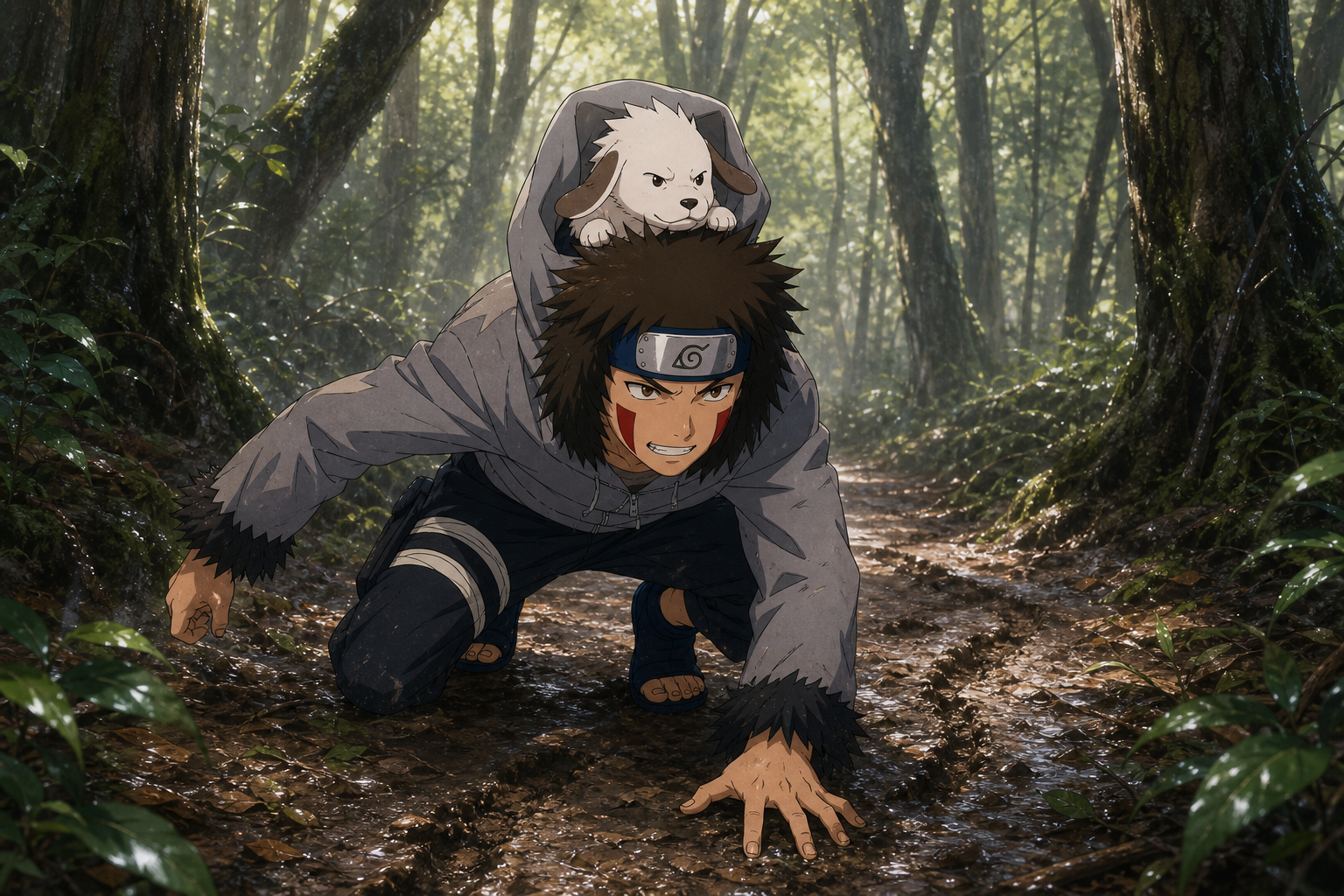
Kiba Inuzuka spends years announcing that he will become Hokage while Naruto keeps collecting the actual qualifications. That running joke has convinced some fans that Kiba is a failed rival with one spinning move and a dog. Wrong file, babes.
Kiba is a sensory and pursuit specialist whose intelligence enters through smell, movement, terrain, and partnership with Akamaru. He can identify people by scent, follow trails other shinobi cannot perceive, fight through coordinated transformation, and turn two bodies into one attack system. His loud confidence is useful when hesitation would kill the mission. The same confidence also makes him easy to bait, quick to underestimate people, and desperate to move before the whole situation has finished introducing itself.
He never becomes Naruto. Good. Konoha does not need eleven smaller Narutos circling the same office chair. Kiba grows into work that the Hokage depends on: finding people, reading physical evidence, breeding and training dogs, and moving through spaces where eyes alone are not enough.
His databook growth is the opposite of standing still
Kiba completes 21 D-rank missions, 19 C-rank, eight B-rank, two A-rank, and no recorded S-rank assignments in the databook period, for a total of 50. The record belongs to a young chūnin whose work centers tracking and pursuit rather than village-level spectacle.
The stat progression matters. His first-databook profile begins at ninjutsu 1.5, taijutsu 2.5, genjutsu 0.5, intelligence 1, strength 2.5, speed 3.5, stamina 1.5, and hand seals 1.5. By the third databook, he reaches ninjutsu 3.5, taijutsu 3, genjutsu 2, intelligence 2, strength 3, speed 4.5, stamina 2.5, and hand seals 1.5.
Speed remains the standout, but ninjutsu doubles, genjutsu rises sharply, stamina improves, and the total profile expands from 14.5 to 22. Kiba’s hand-seal rating stays low because his fighting system depends more on clan transformations, coordinated movement, and direct physical execution than long conventional seal chains.
Guidebook numbers are not a court ruling on his brain. Intelligence 2 does not mean Kiba cannot reason. His strongest cognition is embodied and environmental. He smells direction, stress, identity, contamination, and movement. The shinobi academy rewards written abstraction. A tracking mission rewards the kid who knows somebody crossed the creek three hours ago while everybody else is debating footprints.
The design grows with both partners
Part I Kiba has spiky brown hair, vertical red fang marks on both cheeks, a Konoha forehead protector, and a loose gray coat trimmed with dark fur. His clothes make the silhouette broad and animal-coded even while he is still a small twelve-year-old. Akamaru is tiny enough to ride on his head or tuck into his coat.
Part II sharpens the look. Kiba grows taller, his clothing becomes darker and more fitted, and Akamaru becomes large enough to carry him. Their changed scale reverses the early visual relationship without changing the partnership. The puppy who once watched from Kiba’s hood becomes a full combat body beside him.
Adult Kiba adds facial hair and a more settled working-shinobi look in New Era material. Akamaru visibly ages. The older dog is not a cheap button labeled cry now. Aging completes the visual promise the series began when a puppy sat on a child’s head. Partners grow at different speeds, and the human has to recognize that shared time is finite.
The Inuzuka household treats dogs as coworkers and kin
Kiba’s mother is Tsume Inuzuka, a fierce shinobi partnered with Kuromaru. His older sister Hana works with the Haimaru Brothers. Those dogs are not interchangeable clan mascots. Each human-ninken pair has its own relationship, skill rhythm, and history.
The Inuzuka system depends on training across species. Humans learn smell-based movement, clawed taijutsu, and canine coordination. Ninken learn commands, field judgment, scent exchange, transformation timing, and risk. The word pet cannot carry all that labor.
Calling Akamaru a weapon is worse. Weapons do not become afraid, injured, tired, protective, playful, or old. Akamaru makes decisions and communicates with Kiba. The human receives more institutional status and dialogue, so the partnership is not socially equal in every way. The narrative still treats Akamaru as a subject rather than a replaceable object.
Confucian reciprocity helps explain the bond if we avoid forcing human family hierarchy onto an animal. Kiba owes Akamaru food, care, protection, trust, and attention. Akamaru returns labor and loyalty without becoming property in the moral sense. Their techniques work because responsibility travels both directions.
Tsume and Hana make the Inuzuka household feel matrilineal without a canon manifesto
The two named senior figures in Kiba’s immediate household are his mother and older sister. Tsume is forceful, experienced, and partnered with Kuromaru. Hana is a medical ninja and dog specialist associated with the Haimaru Brothers. Kiba grows up around women whose authority is practical rather than ceremonial.
That family picture supports a reading of Inuzuka gender culture, but the manga does not hand us a clan constitution announcing matrilineal succession. Kiba’s father is absent from the published family record, and jokes sometimes orbit Tsume’s temperament. Absence is not permission to invent abandonment, death, or a terrified husband hiding beyond the panel.
What the record does show is enough to challenge ordinary shōnen household grammar. Kiba does not learn strength from a famous father whose name opens doors. He learns inside a working household led by women and dogs. His loud masculinity develops under female authority rather than in opposition to female competence.
Hana’s medical work widens the clan economy. Ninken partnerships require treatment, breeding knowledge, anatomy, rehabilitation, and long-term care. The spectacular spinning attack depends on somebody knowing how to clean a wound, assess a paw, manage diet, and decide when a working animal should rest. Care is not backstage decoration. Care keeps the pack operational.
Team 8 is a reconnaissance network, not three solo acts waiting for screen time
Kurenai leads Kiba, Hinata, Shino, and Akamaru. Hinata’s Byakugan reads chakra and long-distance movement. Shino’s insects gather information and pursue targets through tiny spaces. Kiba and Akamaru build a scent map. Kurenai specializes in perception itself through genjutsu.
The team can find, verify, surround, and deceive. That architecture is excellent. The manga uses the members in separate showcases more often than letting the whole system sing.
Kiba supplies momentum and confidence. Hinata often supplies caution and visual precision. Shino supplies quiet analysis. Kurenai has to prevent Kiba from treating volume as leadership while also recognizing that his willingness to move can pull a hesitant group out of paralysis.
His relationship with Hinata is protective without turning him into her owner. He notices her feelings for Naruto and sometimes reacts with teasing or blunt observation. Shino receives less casual warmth on the page, but their field styles complement each other. Kiba’s nose and Shino’s insects can cross-check a trail that eyes miss.
The Chūnin Exam fight is more than a fart, although yes, the fart happened
Kiba enters the preliminary match against Naruto convinced the class failure cannot beat him. That confidence has evidence behind the belief. Four Legs Technique increases Kiba’s speed and animal movement. Akamaru can become a Beast Human Clone. Their rotating attacks make two visually identical opponents difficult to track.
Naruto disrupts the system by transforming into Kiba and Akamaru, exploiting confusion, enduring repeated hits, and refusing to stay down. Kiba’s enhanced nose should remain an advantage. Naruto’s accidental flatulence overloads that same sense at close range and creates the opening for the counterattack.
The gag is juvenile. The mechanism is still consistent. A sense powerful enough to distinguish tiny scent differences is also vulnerable to overwhelming odor. Adaptive traits create specific disabilities when the environment turns hostile.
Kiba loses because he underestimates Naruto, commits to a familiar rhythm, and cannot recover after the sensory disruption. Naruto wins through stamina, deception, improvisation, and shameless biology. The result does not prove smell is useless. The result proves any specialized system needs contingency planning.
Kiba’s rivalry with Naruto begins as ego and ends as community
At the Academy, Kiba treats Naruto as someone safely below him. Naruto’s exam victory breaks that assumption in public. Kiba keeps announcing a Hokage ambition and measuring himself against Naruto even as the gap becomes ridiculous.
The boast functions as masculine cover. Saying I will be Hokage too is easier than admitting admiration, insecurity, or fear of becoming irrelevant. Competition gives Kiba a language for staying connected to a peer whose path has outrun his own.
By the war and New Era, the claim reads as self-aware comedy more than a serious political program. That change is growth. Ambition does not become worthless when the original destination changes. Kiba can stop needing Naruto’s exact title and still build a useful adult identity.
Fandom calls that losing. Real adulthood calls that updating the plan after receiving new information.
The Sasuke Retrieval fight makes partnership physically expensive
Kiba and Akamaru confront Sakon and Ukon during the mission to retrieve Sasuke. Their enemies can merge bodies, attack from within another person, and use a cursed-seal transformation that increases their power. Kiba and Akamaru respond by escalating clan coordination.
Dynamic Marking lets Akamaru tag the enemy through scent. Human Beast Combination Transformation turns the pair into a giant two-headed wolf. Fang Wolf Fang converts that body into a high-speed rotating attack with immense destructive power.
The transformation creates a major limit. Rotation destroys ordinary vision. Kiba must navigate by the scent marker. When the enemy disrupts the mark and survives the attack, power no longer guarantees contact.
Sakon and Ukon injure Akamaru badly. Kiba carries his partner and uses desperate measures to keep Ukon from taking over his body. Their escape is not a triumphant clean win. Kankurō arrives and defeats the Sound brothers, preserving Kiba and Akamaru’s lives.
That rescue should remain in the biography. A profile does not become more respectful by pretending Kiba soloed a fight he survived through grit, partner loyalty, and allied intervention. Shinobi work is collective. Being saved is not a moral failure.
Smell is intelligence stored in the body
Kiba can identify and follow scents beyond ordinary human capacity. That allows pursuit across terrain, recognition through disguise, detection after visual contact ends, and comparison of traces other people cannot perceive.
Smell also carries time. A trail fades, mixes with weather, crosses water, absorbs smoke, and picks up other bodies. Tracking therefore requires interpretation rather than simply turning on a magic nose. Kiba must judge freshness, direction, contamination, and whether an enemy knows enough to plant false evidence.
MRT asks whose knowledge counts as intelligence. Western-style fandom discussions often privilege verbal strategy, diagrams, and internal monologues. Shikamaru explains reasoning, so everybody calls him smart. Kiba moves toward a scent before other characters know a clue exists, so people call him instinctive. Instinct can contain trained expertise.
The body pays for that expertise. Strong odors can overwhelm him. Smoke, chemicals, animal marking, weather, and deliberate scent masking can reduce accuracy or cause pain. Sensory advantage and sensory vulnerability are the same doorway.
A complete technique shelf needs both bodies
Four Legs Technique shifts Kiba toward a canine posture and fighting pattern. Chakra supports sharper claws, increased speed, reflexive movement, and a lower stance. The technique does not literally turn him into a dog.
Beast Human Clone transforms Akamaru into Kiba’s appearance. Two matching attackers can coordinate Fang Passing Fang, a high-speed rotating assault that makes the source and angle harder to read. Translation labels vary across editions, so Passing Fang and Fang Passing Fang need exact licensed names beside their distinct uses.
Dynamic Marking is Akamaru’s scent-tagging method. Yes, the marker is urine. The technique is practical, undignified, and extremely dog. Naruto’s world contains eye transplants, corpse puppets, and frogs who demand respect. We can survive one honest biological tool.
Double-Headed Wolf combines Kiba and Akamaru into a huge two-headed form. Fang Wolf Fang multiplies rotational power and destructive reach. The form relies on scent because the speed removes useful vision.
During the war, Kiba adds Shadow Clone to the partnership and creates a three-headed form in manga chapter 633. Some localizations invoke Cerberus language. The Greek label helps English readers picture three heads but does not prove the Inuzuka clan studies Greek underworld mythology.
Earth and Yang Release appear in guidebook classification. They do not provide a secret shelf of manga elemental attacks. Games and anime may animate extra moves. Those belong to their own continuities.
Part II proves he can find what stronger fighters cannot catch
Kiba returns after the time skip as a chūnin with a larger Akamaru and stronger senses. During the search for Sasuke and Itachi, Team 8 joins Naruto, Sakura, Kakashi, and Yamato in the Eight Man Squad. Kiba’s nose becomes part of a larger detection network with the Byakugan, insects, ninja hounds, and field command.
Against Tobi, detection and capture become separate problems. Kiba can locate or surprise a target whose space-time technique prevents ordinary contact. Finding the enemy is real work even when the next fighter cannot hold him.
That distinction matters across the series. Damage receives applause because damage is visible. Reconnaissance prevents ambush, narrows terrain, and gives somebody else a target. The person who supplies the answer may never receive the finishing panel.
Kiba’s limitation is not that tracking fails. His narrative problem is that the series increasingly values world-ending attack scale. A great nose cannot compete with a moon explosion for panel size. The village still needs the nose after the crater cools.
Tracking creates power because being found changes what an enemy can do
A tracker does more than point toward a destination. Reliable pursuit removes hiding places, shortens preparation time, forces movement, and makes disguise more expensive. An enemy who knows Kiba is following may avoid familiar routes, abandon supplies, separate from allies, or burn energy masking scent. Detection reshapes behavior before contact.
That is structural power. Kiba rarely receives the final strike because his labor often happens earlier in the chain. Intelligence becomes coordinates, coordinates become interception, and interception becomes somebody else’s battle panel. Readers remember the explosion and forget the person who made sure the explosion happened in the correct forest.
Tracking also carries ethical risk. The same skill can find a missing child, pursue a criminal, monitor a political dissident, or help an institution cross a person’s privacy boundary. Naruto usually treats village orders as sufficient authorization. A mature New Era profile should keep asking who issued the search, who can challenge the search, and whether a powerful nose serves protection or surveillance.
Kiba’s later association with investigation or police work makes that question sharper. Specialized senses do not arrive with automatic moral judgment. Training must include evidence handling, restraint, false-positive awareness, and the humility to distinguish I smell this person from this person committed the offense.
Pain and war expand the scale without changing his job
During Pain’s attack, Kiba participates in village defense and moves through a disaster where information, rescue, and survival matter as much as direct victory. The anime adds material around many Konoha peers; exact scenes need adaptation labels.
In the Fourth Shinobi World War, Kiba serves in the Fifth Division and faces infiltration by White Zetsu. Scent and familiarity matter when enemies can copy allied appearances. The war turns identity verification into a survival task.
Kiba continues comparing himself to Naruto, but his major manga escalation remains partnership-based. Shadow Clone allows the Three-Headed Wolf transformation, and the combined attack destroys Ten-Tails spawn. He has not abandoned the clan system to chase a fashionable new power source. He increases the number of coordinated Kiba/Akamaru bodies.
The upgrade has limits. Huge rotation attacks require space, setup, scent control, and a target that can be reached through physical force. Kiba does not suddenly rival Naruto’s chakra reserves or become a Six Paths combatant. Contribution does not require fraudulent equality.
War turns the pack into an identification system
White Zetsu infiltration makes resemblance dangerous. A copied face, voice, or uniform can turn allies against one another. In that environment, smell becomes a second identity channel outside ordinary vision.
No sensory method is magically perfect. Blood, battlefield smoke, transformed bodies, mass movement, and prior contact can contaminate a trail. Kiba’s value comes from combining information with other specialists rather than declaring his nose a one-boy court system. Hinata’s vision, Shino’s insects, command records, behavior, and known chakra signatures can strengthen or challenge a scent conclusion.
The war therefore fulfills Team 8’s original design at a larger scale even when the manga does not assemble a long showcase around them. A reconnaissance unit becomes most valuable when the enemy attacks the reliability of perception itself. Kurenai’s genjutsu specialty, Hinata’s sight, Shino’s distributed insects, and Kiba/Akamaru’s scent map all answer different forms of uncertainty.
Tamaki and the New Era let dog boy meet cat girl without forcing a wedding
Later franchise material connects Kiba with Tamaki, the granddaughter associated with Granny Cat’s household. Dog breeder meets cat lover is a joke the series can explain in one visual. Their relationship develops across fanbook, novel, manga-adaptation, and anime material, so each version needs a clear label.
They are shown as romantic partners in later continuity. Sources also associate adult Kiba with dog breeding and investigative or police work. Exact employment language varies by record and should remain tied to the source rather than becoming one universal job title.
Breeding deserves more than cute puppies. Ethical animal work includes health, temperament, socialization, retirement, training conditions, and what happens when a working dog cannot perform. The Inuzuka clan’s military use of ninken raises questions the franchise rarely asks directly.
Kiba and Tamaki’s dogs-and-cats household offers a comic answer to clan purity. Partnership crosses habits, species preferences, and family traditions. No marriage certificate or invented children are required to make the relationship real.
Akamaru grows old, and Kiba has to love a partner on a different clock
Akamaru is a puppy when Kiba is twelve, a large adult dog in Part II, and visibly elderly in the New Era. Kiba remains a working-age man while the companion who shaped his whole fighting system slows down.
Buddhist impermanence fits this relationship without turning age into doom music. Everything formed through conditions changes. Refusing change would not preserve Akamaru; refusing change would make Kiba stop seeing the dog in front of him.
Care must therefore change form. A partner who once carried Kiba may later need rest, medical support, slower movement, or retirement. Loyalty is easy to advertise during a finishing move. Loyalty becomes morally interesting when productivity declines.
The story has not completed every final consequence of that aging. The profile should not invent Akamaru’s death for tears. A living old dog is not a pre-obituary.
Kōsuke Toriumi and the original Japanese performance
Kōsuke Toriumi performs Kiba in the original Japanese anime. His verified credit spans the Chūnin Exam preliminary, the Sasuke Retrieval mission, Part II tracking work, the war, and New Era comedy. Those scenes place bravado, fear, pain, partnership, and adult self-awareness inside one long-running role. A cast list can establish who performs Kiba. It cannot substitute for scene-specific criticism, so this profile does not fake vocal analysis it cannot support.
No English-dub material belongs here.
Anime, films, OVAs, novels, fanbooks, and games
The anime adapts Kiba’s major manga record and supplies many Team 8 missions that expand tracking, rivalry, and partnership. Anime-only techniques and feats remain labeled. Adaptation abundance cannot be imported into manga canon by osmosis.
Kiba also appears in licensed Naruto films and OVA material, usually as part of the wider Konoha ensemble. Those appearances belong on the media record, but a crowd cameo is not a new character arc and an animated game move is not manga evidence.
Later fanbook and novel material develops Tamaki, adult work, and the animals around their household. Manga and anime adaptations may rearrange those details. Each version deserves its own receipt.
Games use Kiba and Akamaru as a combined combat unit across Ultimate Ninja, Clash of Ninja, and Ultimate Ninja Storm lines. Their spinning attacks translate naturally into readable game mechanics. A game-exclusive move still does not become a manga technique because the animation looks expensive.
Seven fandom misreadings that need a better scent trail
Kiba is the guy Naruto beat with a fart
That happened. The full fight also includes sensory tracking, transformation, coordinated attacks, deception, stamina, and Kiba’s fatal underestimation of Naruto. One gag is not a complete biography.
He only knows Fang Over Fang
Kiba uses Four Legs, Beast Human Clone, scent tracking, Dynamic Marking, multiple fang rotations, two-headed transformation, Shadow Clone, and three-headed transformation. The kit is thematically narrow, not mechanically singular.
Kiba is stupid
He is impulsive and academically unremarkable. He also interprets scent evidence and coordinates high-speed interspecies combat. Intelligence comes in more than one interface.
Akamaru is Kiba's weapon
Akamaru is a ninken partner with agency, injury, communication, labor, and age. The techniques require both participants. Object language fails.
Kiba seriously thinks he can beat Naruto forever
The Hokage rivalry becomes comic self-performance as the gap grows. Continuing to joke does not prove he has no situational awareness.
Kankurō saving him makes the Retrieval fight worthless
Kiba and Akamaru survive a brutal matchup, expose abilities, and remain alive because an ally arrives. Collective rescue is how a military alliance should work.
Adult Kiba did nothing
Later sources associate him with investigation/police work, dog breeding, Tamaki, and continued village life. The sequel underuses him, but underuse should be named rather than converted into nonexistence.
Final verdict
Kiba Inuzuka is loud, impatient, loyal, physically brave, sensory-smart, and inseparable from a partnership that requires more coordination than most solo prodigies ever learn. He loses to Naruto, nearly dies beside Akamaru, grows into a chūnin tracker, contributes in war, and eventually stops needing the Hokage joke to become true.
His story works best when strength is not measured only by explosion radius. Kiba finds people. Akamaru confirms the trail. Together they turn smell into evidence and movement into a shared language. Naruto becomes Hokage. Kiba becomes somebody the Hokage’s village still needs. That is not second place. That is a different job.
Sources and canon boundary
Manga chronology controls this profile. Anime staging, databook material, novels, films, games, and New Era appearances are labeled instead of being blended into one false continuity.
Primary franchise references: Naruto Official and VIZ Media Naruto. CVM Sekai’s conclusions about partnership, tracking labor, Team 8, clan practice, and Kiba’s adult role are editorial analysis, not invented creator quotations.