
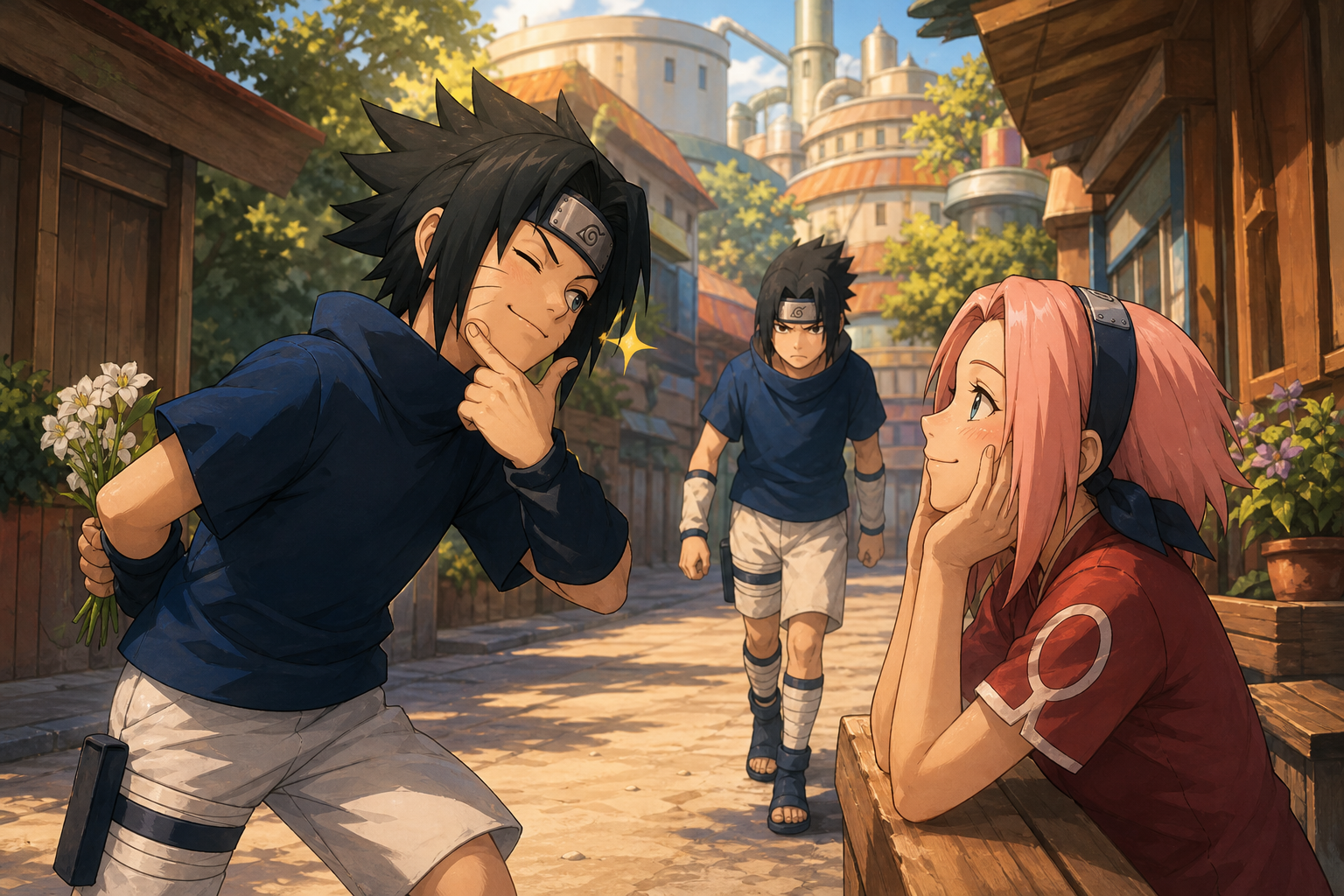
Sasuke and Sakura: Friends or Foes?
Team 7 is assembled by a classroom seating chart, but the episode immediately exposes how little its members know about one another and how quickly desire turns a person into a fantasy.
The Feeling You Remember
This is the accidental-kiss episode, the one with the classroom girls swarming Sasuke, Naruto glaring from the desk behind him, and a badly timed shove pressing two rivals’ mouths together. The image became a franchise joke because it punctures every romantic expectation in the room at once.
But Episode 3 is more uncomfortable than its meme. Naruto kidnaps and impersonates a classmate in order to manipulate Sakura’s affection. Sakura speaks cruelly about Naruto’s orphanhood because she wants to bond with the boy she imagines understands loneliness. Sasuke, the episode’s desired object, is almost never asked what he desires. Everyone is looking intensely. Almost no one is seeing accurately.
That ugliness is useful if we refuse to sand it down. Team 7 does not begin as a charming found family waiting for a mission. Team 7 begins as a collision of children whose coping strategies injure one another. The future bond matters because this is the starting distance.
Scene-by-Scene Recap
The forehead protector changes Naruto’s walk
Naruto wakes after graduation with the forehead protector Iruka gave him and moves through Konoha as an acknowledged shinobi. The symbol is new enough to feel almost magical. One day earlier, he was excluded from the class photograph of belonging. Now he expects the village, his classmates, and especially Sakura to recognize the upgraded version of him.
The expectation reveals how quickly earned recognition can become a demand. Iruka’s acknowledgment gives Naruto real dignity, but it does not entitle him to Sakura’s attention. Episode 3 begins testing whether Naruto can distinguish being worthy of love from being owed a particular person’s love.
The classroom chooses Sasuke
Sakura and Ino race toward the Academy, competing to sit near Sasuke. Their friendship has become organized around rivalry for a boy who offers neither of them meaningful encouragement. Other girls crowd him as well. Sasuke’s popularity is depicted as privilege, yet his expression reads as irritation and withdrawal.
Naruto climbs onto the desk and stares directly at Sasuke, demanding to understand why everyone chooses him. A classmate bumps Naruto. The famous kiss happens. The room erupts. Sasuke is furious; Naruto is horrified; the girls redirect romantic frustration into violence against Naruto.
The joke is built from violated scripts. Naruto wants Sakura. Sakura wants Sasuke. Sasuke wants to be left alone. Physical comedy gives no one what they want and makes the hidden triangle public.
Team assignments turn desire into obligation
Iruka announces three-person squads. Naruto first hopes for Sakura, then despairs when Sasuke is added. Sakura celebrates Sasuke and laments Naruto. Sasuke receives the assignment with the least visible investment. The team exists administratively before it exists emotionally.
The composition is intentional. Naruto performed poorly in formal school work, Sasuke ranked at the top, and Sakura possesses academic discipline and precise control. Their strengths and weaknesses can balance. Yet children do not experience one another as instructional design. They experience jealousy, comparison, fear, and status.
Naruto removes Sasuke from the triangle
Determined to learn what Sakura sees in Sasuke, Naruto confronts his rival, binds him, and uses transformation to take his appearance. The plan is comic in presentation and unethical in substance. Naruto removes Sasuke’s agency, appropriates his face, and seeks romantic access through deception.
The series does not provide a mature vocabulary for consent here, but a contemporary recap should. Naruto’s loneliness explains the desperation but does not excuse the method. His central strength is transformation, and Episode 3 shows its moral danger: the ability to become another person’s image can turn empathy into impersonation if used to obtain what the person would not freely give.
Sakura meets the Sasuke she invented
Naruto-as-Sasuke approaches Sakura. She is immediately open in a way she would never be with Naruto. Naruto asks what she thinks of him and hears the answer he feared. Sakura calls Naruto annoying and attributes his behavior to having no parents to discipline him.
Her comment is not framed as calculated cruelty. Her remark carries the casual cruelty of a child whose home life feels normal enough to be invisible. She interprets freedom from parental correction as an advantage because she has never experienced the absence. Worse, she uses Naruto’s private wound as romantic conversation with someone she assumes will agree.
Naruto is hurt, but he also learns something. Sakura’s imagined Sasuke is a compliant listener who confirms her judgment. Naruto had imagined Sakura as a reward for his new status. Both fantasies shrink the real person.
The almost-kiss and the stomach’s intervention
Sakura leans toward the disguised Naruto. For a moment, his deception appears likely to deliver the intimacy he wanted. Then spoiled milk and digestive panic interrupt him. The gag is bodily justice. Naruto can control appearance, but not the consequences of what his actual body consumed.
His retreat prevents a deeper violation, though not because he independently chooses honesty. The scene remains deliberately messy. Early Naruto often reaches better outcomes through failure before he develops the judgment to choose them.
Sasuke returns and speaks from the wound
The real Sasuke escapes and encounters Sakura. She continues criticizing Naruto and repeats the claim that parental absence makes him fortunate. Sasuke calls her annoying and tells her she does not understand what loneliness means.
The rebuke carries weight because Sasuke’s entire clan has been killed. Sakura does not yet know the full history, and Sasuke does not explain it. He refuses the intimacy she imagines while defending Naruto indirectly. This is not friendship yet. Sasuke offers recognition across parallel isolation.
Sakura is left to reconsider herself. The episode gives her shame as a beginning rather than immediate absolution. She resolves to behave more kindly toward Naruto, though later growth will be uneven.
Character Reaction
Naruto
He is newly validated and still profoundly insecure. He can read Sakura’s expression but not respect her autonomy. His hurt creates insight only after his scheme forces him to hear the truth.
Sasuke
He is desired as an image and isolated as a person. His defense of orphaned loneliness is the first crack in Naruto’s assumption that popularity means belonging.
Sakura
She is intelligent, socially competitive, romantically inexperienced, and capable of cruel ignorance. The episode does not define her forever, but it establishes the self-awareness her growth will require.
Iruka
His team assignment translates educational assessment into forced interdependence. He knows balance on paper cannot guarantee trust.
What Episode 3 Is Really Saying
Desire invents people
Naruto wants “Sakura,” but much of what he wants is proof that the admired girl now recognizes him. Sakura wants “Sasuke,” but her Sasuke is a projection who listens warmly and validates her contempt for Naruto. The real Sasuke wants neither assigned role.
Attraction is not condemned. Fantasy becomes dangerous when it substitutes for curiosity. Each child uses another person’s face as a screen for a private need. Team 7 can become a family only when the screens begin to tear.
Loneliness has different disguises
Naruto’s loneliness is noisy and socially obvious. Sasuke’s is quiet and hidden behind popularity. Sakura’s insecurity is relational rather than orphaned: she measures herself through Ino, her forehead, and Sasuke’s imagined approval. The episode refuses a single visual language for isolation.
Sasuke’s popularity and Naruto’s notoriety are both forms of being watched. Neither guarantees the experience of being known.
The village assigns cooperation before earning trust
Konoha forms squads as military units. Children with incompatible desires are placed together because their skills balance. The arrangement may be strategically sound, but emotional integration is left to a future teacher and dangerous missions. The hidden village depends on bonds while creating them through bureaucracy.
This tension will shape the series. Team loyalty becomes sacred, yet the institution initially treats teammates as components. Kakashi‘s coming bell test will make the contradiction explicit: rules assemble the team, but shared food and chosen sacrifice make it real.
Orphanhood is not freedom
Sakura’s remark captures a protected child’s misunderstanding. Without parents, Naruto appears free from discipline. The premiere has already shown the cost: no one waits at home, explains the village’s hostility, celebrates graduation, or protects him from a predatory teacher. Sasuke’s rebuke prevents the misconception from passing unchallenged.
The scene also connects Naruto and Sasuke before either can admit connection. One craves family because he never knew it. The other grieves family because he knew it and lost it violently. Their rivalry will repeatedly circle this difference.
Consent, Comedy, and the Rewatch Problem
Early shonen comedy often treats disguise, unwanted contact, voyeurism, and romantic persistence as harmless embarrassment. Episode 3 participates in that tradition. The accidental kiss itself is not chosen by either boy. Naruto’s later impersonation is chosen, and it is a serious violation even if the scene avoids lasting physical intimacy.
A thoughtful fandom does not need to ban laughter or pretend the episode intended a modern ethics seminar. A thoughtful response can hold two truths. The sequence is structurally funny, and Naruto’s method is wrong. Explanation is not exoneration. His childhood neglect makes his behavior legible; Sakura’s rejection remains hers to give.
This honesty improves the character arc. A flawless child would have nowhere to grow. Naruto’s eventual ethic depends on seeing other people as more than labels. Here, he has not yet applied that principle to romantic desire. Sakura’s growth similarly requires more than declaring that she was secretly kind all along. Episode 3 gives us children capable of harm and change.
The Existential Reading
Who are you when another person wears your face?
Transformation makes a philosophical problem literal. Naruto can reproduce Sasuke’s appearance while lacking Sasuke’s history, consent, desire, and interior life. The disguise fools Sakura because she was already relating to an appearance. She supplies the personality she hopes is behind it.
The episode’s answer is that identity exceeds visible form. This will become central in a world of clones, possession, masks, reincarnation, stolen eyes, sealed beings, and inherited names. A body can be copied. A person remains a history of relationships and choices.
Recognition requires the risk of disappointment
Naruto disguises himself because the real Sakura might reject him. Sakura projects onto Sasuke because the real Sasuke might not return her feeling. Fantasy removes the risk and therefore removes reciprocity. To know someone, each must be allowed to answer unexpectedly.
Sasuke’s blunt “annoying” is painful but real. His response breaks Sakura’s script and creates the first opportunity for self-examination. Authentic recognition is not always comforting. Sometimes it begins when another person refuses the role we wrote for them.
Production and Adaptation Notes
The episode draws from the manga’s early Team 7 assembly material and uses expanded classroom timing to establish social hierarchy. Repeated reaction shots make Sasuke’s popularity feel claustrophobic. Naruto’s exaggerated jealousy and digestive crisis keep the tone broad even as the dialogue touches genuine loss.
Performance does crucial work. Naruto must sound predatory enough in his scheme that the mistake registers, then young and wounded when Sakura speaks. Sakura’s voice must convey ordinary thoughtlessness rather than villainous calculation. Sasuke’s quiet rebuke lands because his emotional volume drops rather than rises.
The artwork and staging favor faces, disguises, and blocked sightlines. Characters hide behind desks, transformations, romantic assumptions, and social reputation. The episode visually rehearses its argument that seeing a face is not the same as knowing who occupies it.
Easter Eggs and Payoff Seeds
- The accidental kiss previews the rivalry’s intimacy. Naruto and Sasuke will spend the story defining themselves through opposition while denying how deeply they understand each other.
- Sasuke defends Naruto before friendship exists. Shared orphanhood produces recognition without warmth.
- Sakura’s inner conflict has begun. Her socially performed self and private thoughts will remain a comic device and a marker of self-division.
- Transformation is morally ambiguous. The same flexible technique can save a mission or violate identity depending on purpose.
- Team 7 begins with three incompatible versions of strength. Naruto brings improvisation, Sasuke formal excellence, and Sakura knowledge and control.
- Food continues to tell the truth. Ramen signaled ordinary belonging; spoiled milk exposes the neglected domestic reality behind Naruto’s bravado.
RaeRae Reaction
I remembered the kiss and forgot how sharp Sasuke’s rebuke is. The boy surrounded by admirers is the one who understands that an empty home is not freedom. He does not comfort Naruto directly. He simply refuses to let Sakura romanticize a wound he knows too well.
I also appreciate this episode more when I stop asking it to make Team 7 immediately likable. They are not ready. Naruto is violating boundaries. Sakura is cruel from ignorance. Sasuke is contemptuous and unreachable. The team has been assembled, but relationship has not happened. That gap is the story.
The episode is not emotionally clean, and its comedy has aged unevenly. Yet its central insight is excellent: every member of Team 7 is being mistaken for an image. The loud failure. The perfect survivor. The pretty girl with the crush. Their long arc will be the slow, painful replacement of those images with knowledge.
Mission scorecard
Emotional impact: 8.2/10
Character depth: 9.1/10
Comedy: 7.8/10
Worldbuilding: 8/10
Existential aftertaste: 9.2/10
Overall: 8.6/10
Where to Watch Officially
Streaming availability varies by region. Use VIZ’s official Naruto viewing options or the official Naruto page on Crunchyroll.
Team 7 begins with three private stories colliding
Naruto wants Sakura because she represents the ordinary peer affection he has never known how to earn. Sakura wants Sasuke because he is admired, distant, and therefore safe to idealize. Sasuke wants enough isolation to pursue revenge without anybody asking what the pursuit is doing to him. Kakashi has not entered the room yet, but the team is already a collection of needs disguised as attitudes.
The episode is funny because none of them understands the others nearly as well as they think. Naruto reads Sakura’s crush as a competition he can win by impersonating Sasuke. Sakura reads Naruto’s behavior as proof that he lacks discipline while missing the loneliness underneath it. Sasuke sees both classmates as interruptions. The viewer gets the uncomfortable advantage of watching every misunderstanding at once.
Naruto’s disguise crosses a real consent line
Transformation makes the impersonation mechanically possible. It does not make the choice harmless. Naruto uses Sasuke’s appearance to create romantic access Sakura did not agree to give him. The scene stops short because his stomach rebels, but intent still matters. Wanting affection does not grant permission to obtain it through somebody else’s face.
The series plays the sequence broadly, and the physical comedy keeps it moving. A RaeRae React still has to name the boundary. Naruto is a neglected child learning social rules through failure, not a monster. Sakura is still entitled to know who she is talking to. Understanding why he makes the choice explains it. It does not erase her consent.
Sakura’s orphan comment finally breaks through the crush
When Sakura complains that Naruto behaves badly because he has no parents to correct him, she treats orphanhood as freedom from discipline. Sasuke hears the cruelty immediately because he knows the condition from the inside. His response forces Sakura to confront the distance between admiring him and understanding him.
The correction matters because Sasuke does not deliver a speech about his massacre. He simply refuses the fantasy. Loneliness is not getting to do whatever you want. It is returning to a home without anyone waiting, carrying pain that classmates can turn into careless conversation because they have never had to learn its weight.
Sakura’s shame is an early sign that she can grow. The episode does not pretend one rebuke repairs her thinking. It gives her the first crack in the version of Sasuke she built for herself and the first reason to reconsider Naruto as more than a nuisance.
Sasuke’s hunger becomes comedy and evidence
Naruto tying Sasuke up and then suffering digestive consequences is slapstick. Sasuke’s return to the room, suspicion, and impatience remind us that he is not merely the cool object in two classmates’ triangle. He has his own appetite, schedule, boundaries, and anger. Episode 3 keeps restoring personhood to characters immediately after somebody else reduces them to a role.
That pattern is the episode’s quiet structure. Sakura is not a prize. Sasuke is not a romantic silhouette. Naruto is not only the class clown. Team 7 cannot work until all three learn to see beyond those reductions.
The classroom assignment is administrative; the family comes later
The village places them on a team because of graduation results and training design, not because destiny announces a perfect emotional unit. Their first interactions are petty, intrusive, jealous, and lonely. That rough beginning is exactly why later loyalty matters. Team 7 becomes family through choices made after the assignment, not through the assignment itself.
Episode 3 lets the audience see the raw materials before Kakashi begins testing them. Naruto brings relentless need and surprising empathy. Sakura brings social awareness limited by insecurity and fantasy. Sasuke brings discipline hollowed out by grief. None is ready. All three are capable of becoming more than the role the others assigned.
RaeRae’s final take
This is not a cute love-triangle episode with a little team setup tucked inside. It is a study in projection. Everybody wants another person to complete a story they wrote alone. Naruto wants Sakura’s approval, Sakura wants Sasuke’s affection, and Sasuke wants silence. The episode starts their education by making each fantasy fail.
The jokes have aged unevenly, especially where deception and gender sit underneath them. The emotional correction still lands. Before Team 7 can fight together, they have to learn that teammates are people with histories, boundaries, and needs that do not exist for somebody else’s convenience.